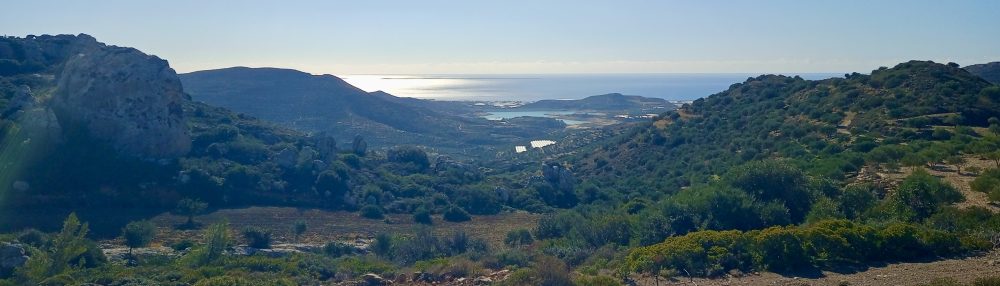
You may remember that I’ve talked about this before, but something that one gets used to, in fact truly enjoys, when one has lived over here as long as we have, is the fact that every month there are new fruits, new vegetables that come into season and, just for a few weeks, harvesting, drying and preserving – it’s all the villagers are occupied with. I was reminded of this just last weekend, when we dropped by to visit our friend in Meseleri who’d lost her husband at this time last year.
Marika has three sons, and a couple of them, along with their wives and assorted children, were visiting for a couple of weeks. This is something else that you become familiar with in these islands. Greeks very often don’t take package holidays (after all, where would they want to go?), but their annual holidays, if they even take them, usually consist of a trek from one end of Greece to the other to visit the aged parents and stay a while. It matters not how small the house in the village may be, if nine or ten relatives of both genders (or ought that nowadays to be ‘all three genders?’) want to come to stay, then the hosts, usually the parents/grandparents, will welcome them gracefully and there will be bodies sleeping everywhere, on sofas, balconies, in the bath (if they have one), on the floor, because whatever beds are present in the house will very soon not be adequate in number once all of the relatives have come in through the door.
As we entered Marika’s gate, there she was, sitting beside an old table in her courtyard, fiddling with a huge bowl of grapes. Beside her, spread out on a huge tray in the sun, were hundreds of almonds, still in their shells, but minus the husks that they’re ‘wearing’ when they’re shaken from the tree. There was another tray too, this one laden with figs drying in the sun, as were the almonds. In fact, we found to our costs that you fail to dry out your freshly picked almonds at your peril. We’d shelled a couple of kilos of almonds after I’d gathered them all up while Giannis next door was harvesting a tree near to our fence [see this post], then poured the naked nuts into a preserve jar for storing. It didn’t take long for a whitish hue to begin to appear on the nuts as they began the process of going mouldy. Quick as a flash, we had to tip them all out again, spread them on a large tapsi and get it out into the sun PDQ. Almonds store a huge amount of water, even if it doesn’t look like it, and they must be dried thoroughly before thy can be stored.
Grapes come in a bewildering variety too, as we were soon to find out when we remarked on how delicious the green ones in the bowl on the table in front of her looked. “Oh, those are far too sharp, you won’t want to eat those. I’ll be using those instead of lemon when I make some Horta later on today.”
Now, that was a new one on us. Horta, as you may well know, is basically weeds boiled up and then served in olive oil and squirted with lemon juice. Well, apparently this type of grape will do just as well as lemon juice to flavour the Horta in these parts. You learn something new every day, eh? There are grapes specifically for wine-making, and they, of course, vary hugely in size, colour and flavour, as do the wines from which they’re made, and there are the ones for making preserves, that petrified stuff you get served up in a little glass dish with a spoon, and there are the grapes simply for eating, some with pits and some without. Marika heaved herself up out of her chair and told us to sit while she went to find some ‘eating’ grapes for us.
Something that I really like about ‘dropping in’ on people in a Greek village, is that they’ll often simply bring out a couple of bottles of chilled water and some glasses, then they’ll place a huge pile of whatever fruit is in season (and the occasional vegetable too, see this post from May of this year) on the table, along with a knife if it’s necessary, some paper serviettes and a plate for the guests to use. Marika went inside and re-emerged some minutes later with the water (as mentioned), a couple of plates, some serviettes and a huge glass bowl of a mixture of red and green grapes.
“Now those you will like to eat! They’re soo sweet, see if you don’t agree!” she said, and sat back down to carry on fiddling with the bitter grapes for the Horta. Of course, she then decided that we would be offended if she didn’t place yet more on the table, so we were soon confronted with a huge pile of chopped water melon, some peaches and a few late figs. If you don’t attack the edible evidence of Greek hospitality with gusto it’s considered bad manners.
When we were finally ready to begin the long and protracted process of taking our leave, she was quick (well, as quick as an 85 year-old can be) to produce a couple of polythene bags, into which she insisted on stuffing a good helping of figs and also some sweet ‘eating grapes’ to take home with us. Greeks eat their figs fresh, of course – and a fig freshly picked from the tree is, to me, one of life’s most superlative pleasures – but they also lay a goodly portion of their harvest out in the sun to dry. Sun-dried figs can be eaten as they are (and are used as part of the picnic when the olive harvest is going on in November/December, for example), but they are also used in all kinds of delicious baked cakes, tarts and biscuits.
It’s truly a great blessing of life in these parts that every month brings its own specific fruit and vegetables to be enjoyed, thus ensuring a fulfilling subtle varied cycle of diet as one goes through the year. You get the strawberries in springtime, followed by fresh cherries, apricots, water melons and honeydew melons, figs, nectarines, peaches, grapes, walnuts, almonds, all kinds of summer fruits too, pomegranates and – come winter time – the citrus fruits like oranges, mandarins and grapefruit, limes and lemons, the list is impressive and everything is eaten in season. I well remember that in the UK one could go to the supermarket and buy any of the above listed fruits and nuts at virtually any time of the year. In order for the people in such countries to enjoy such a privilege involves a huge amount of transportation of foods across oceans and continents, and cannot be good for the planet’s environment. How much better it is to simply be content with what’s fruiting that particular month, and then let the ever-changing variety bring a fresh delight every few weeks. That’s how it is here, and I love it.
And so to this post’s clutch of photos…
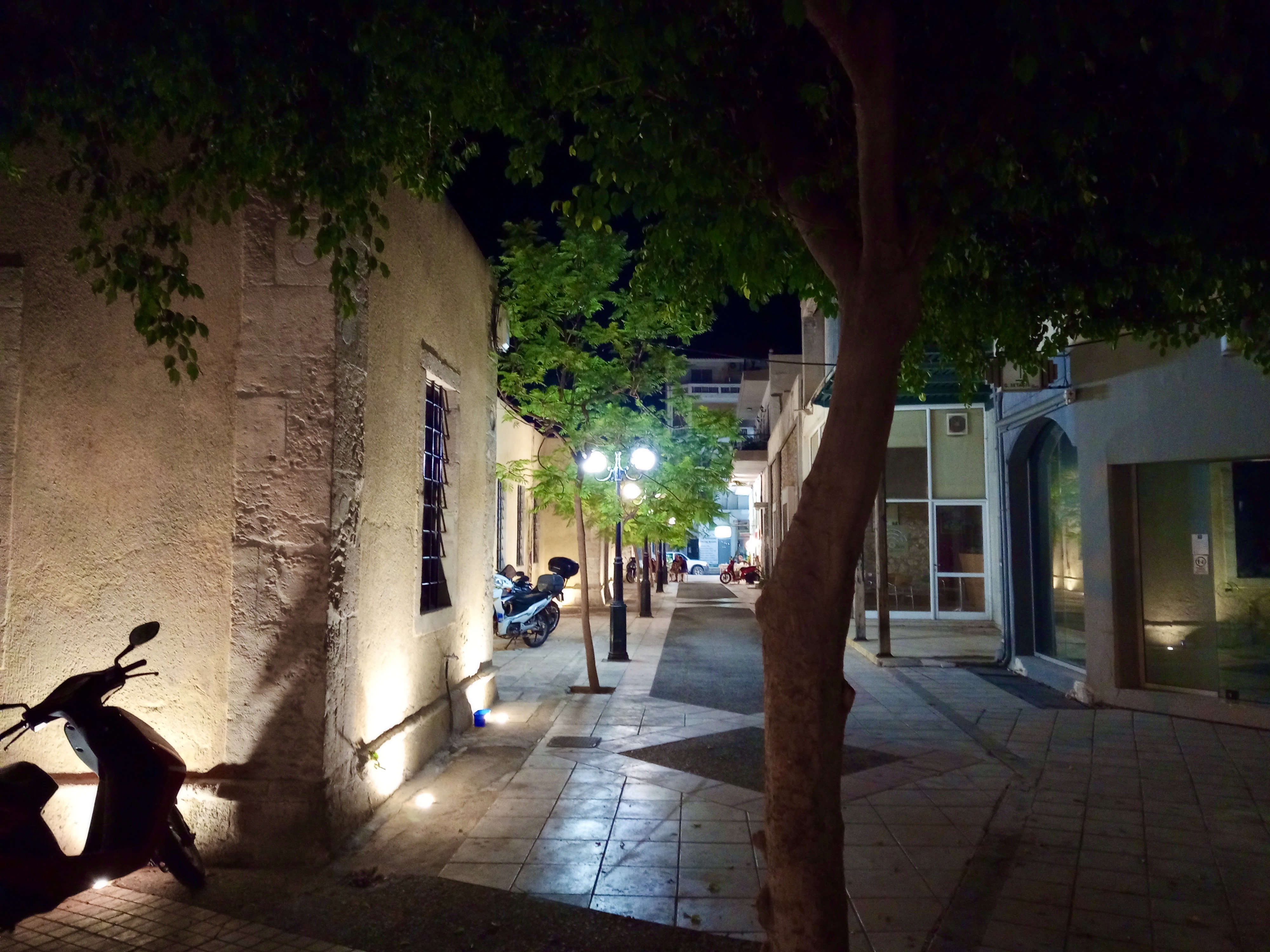
Above: ‘Behind’ the newly renovated and reopened Archeological Museum in Ierapetra late at night. I’ve added a satellite image below so you can see the Museum’s location in the town…


Above: I found this little chap on the path in the upper garden the other day. I trawled through hundreds of images on-line but couldn’t find one that matched this little fella. I even found one of a very well-known German car in smart metallic green, but not this bug. I’m hoping he’s not a pest, because I didn’t have the heart to harm him and so left him where he was. Note the red ‘neck’ area just below the head (I don’t know the technical phrases!).
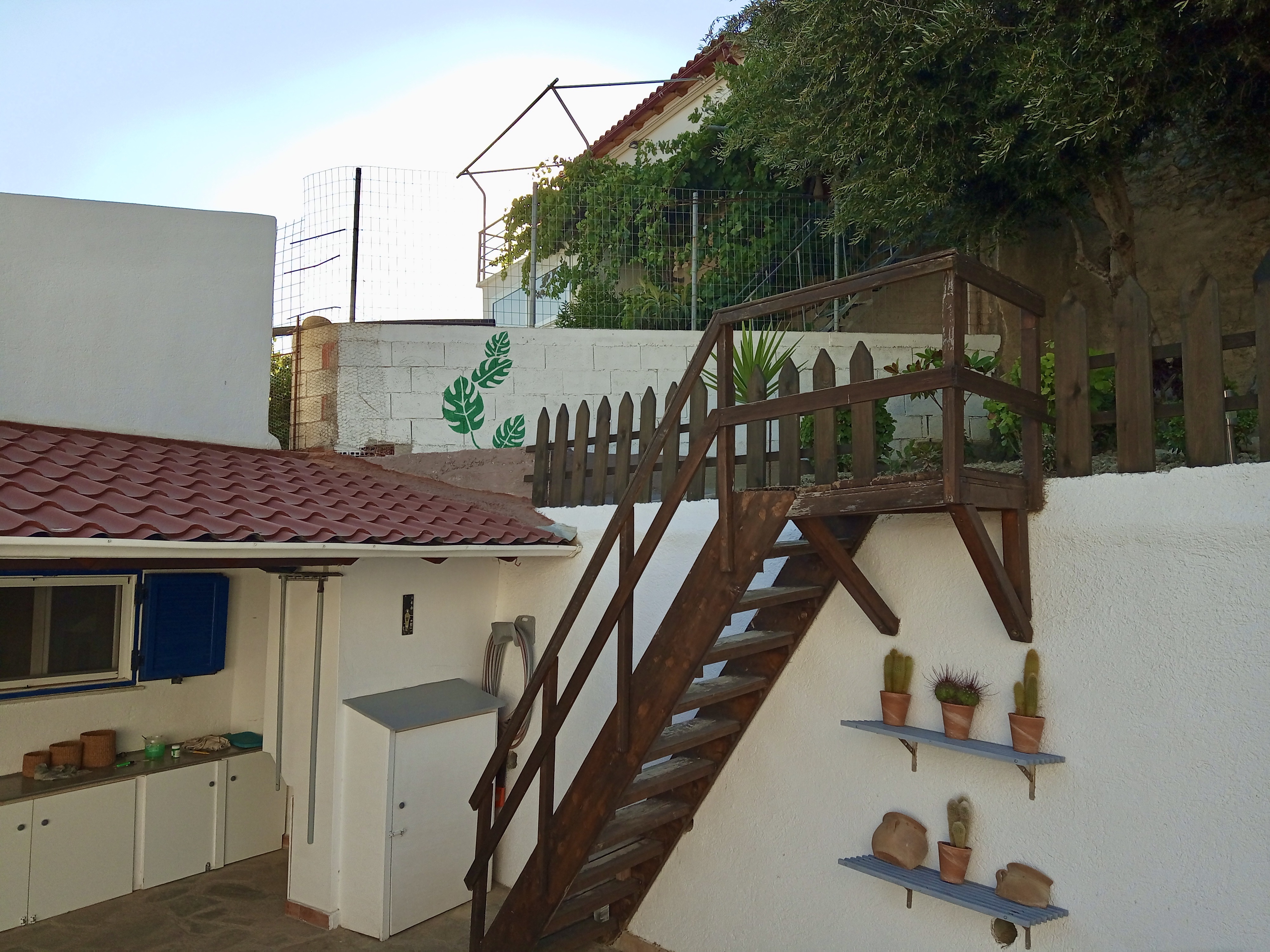


Above: What do you think of my leaves? Yvonne decided that the wall was too plain and suggested that I add something just to make it slightly more interesting. It’s the wall that boundaries the small yard of Giorgo, who lives in the house above that vine, partially obscured by our olive tree.
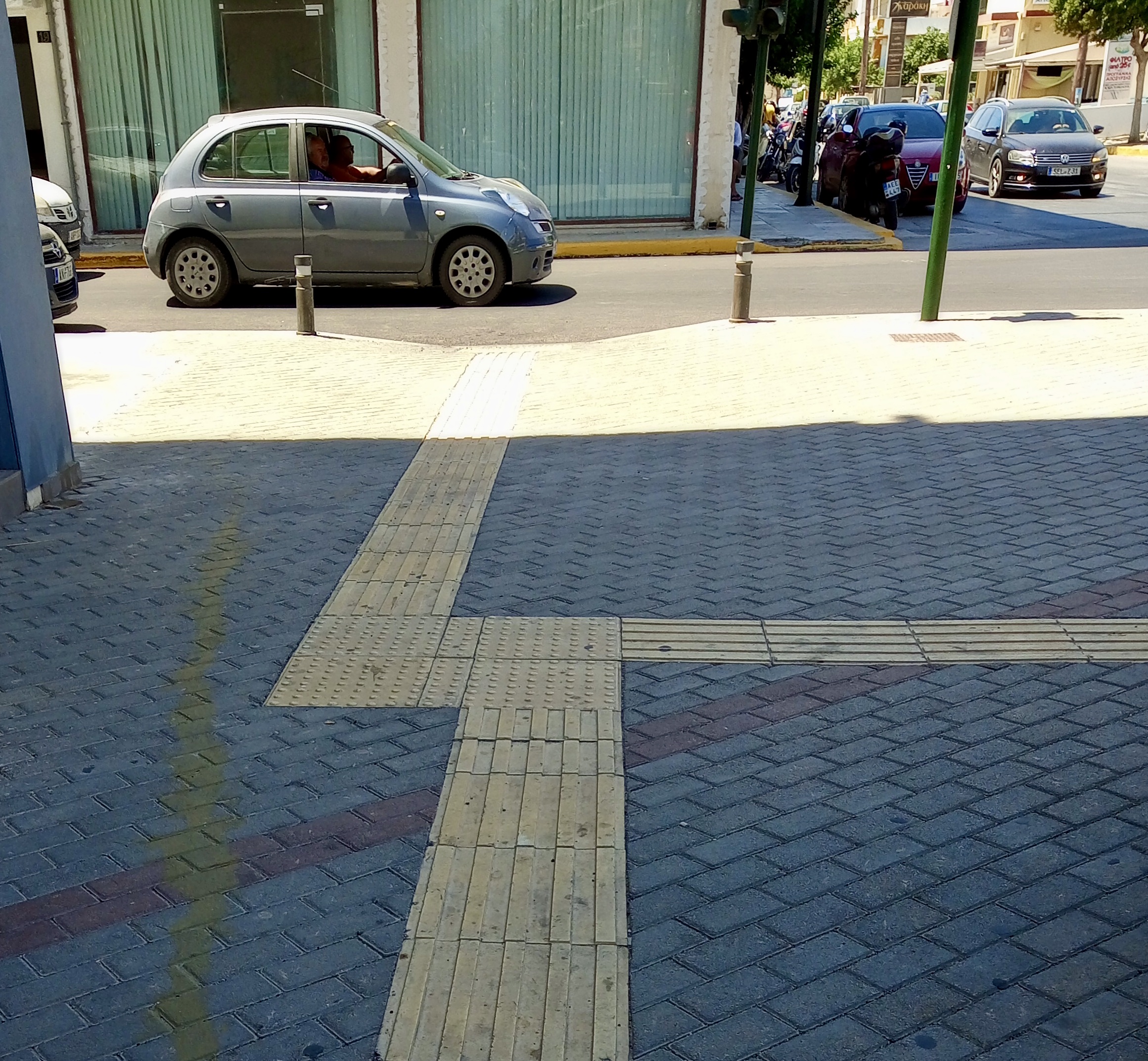
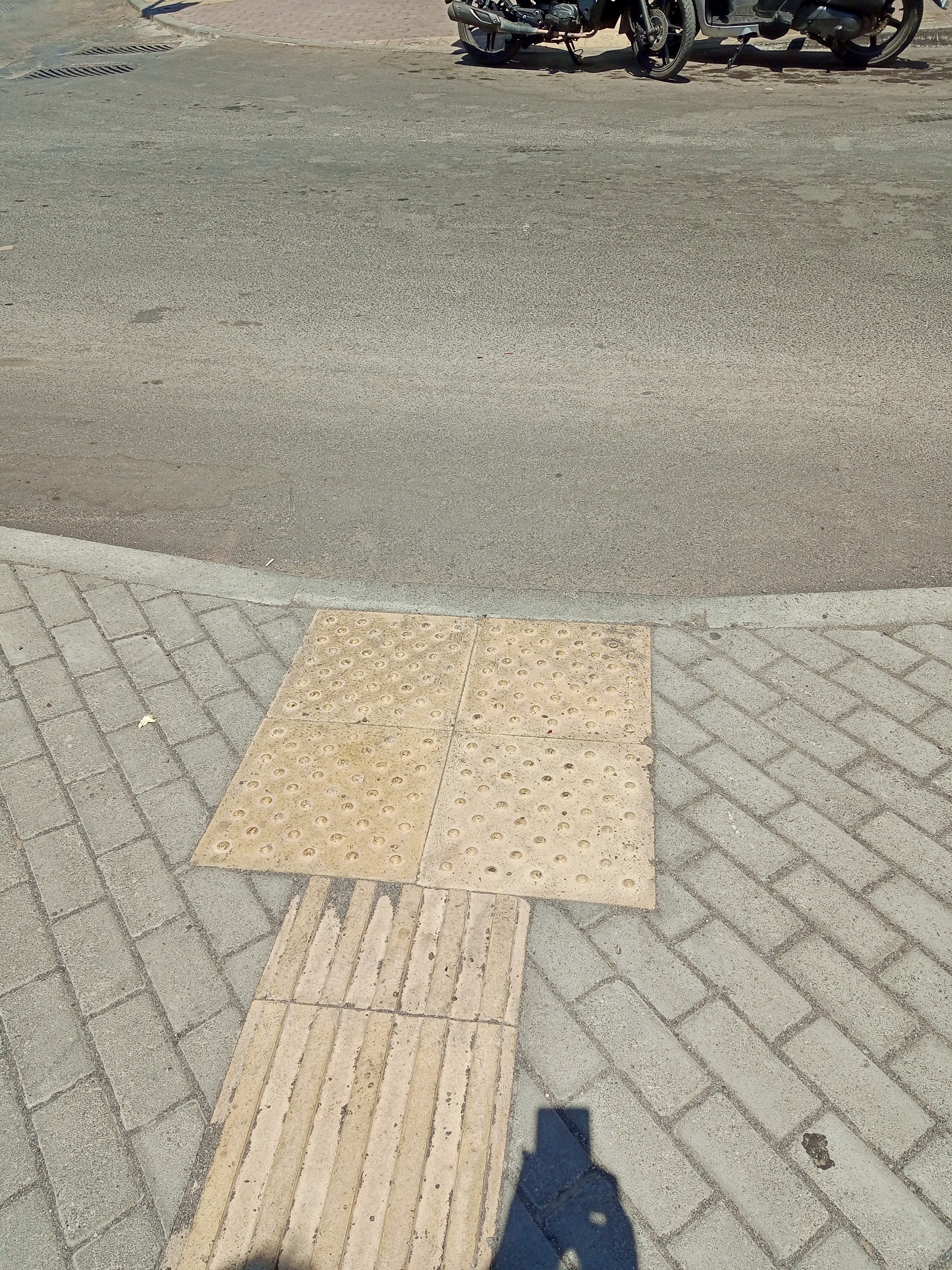
Above: Now here’s something that I’ll bet you didn’t know. If you walked any streets in a Greek town or city lately, you’ll have seen these grooved or dimpled paving slabs around the place, I’m sure. I always thought that they were a rather daft attempt at making the pavements (sidewalks, guys) more interesting and nothing more. I now know different. A Greek friend of ours who walked us around when we were looking for somewhere recently was able to enlighten us. Those slabs serve a specific purpose for those who are visually impaired. The grooved ones tell the walker that they can proceed without worry (I’d qualify that here in Greece though!), and the dimpled ones tell the blind person that they’ve reached a junction, often a roadside kerb, so that they will know to stop and check before proceeding.
See? Don’t say Accretions isn’t a mine of information, eh?

Above: My wife freaks out when she sees these. I’m pretty sure it’s a locust and it’s about as long as a man’s thumb. I don’t think they’re too much of a nuisance, but she’s paranoid about them eating the foliage of our precious plants, so if she gets the chance, seeing one of these brings it instant oblivion. Actually, the cat’s been known to catch and eat them too. Not a pleasant sight though!
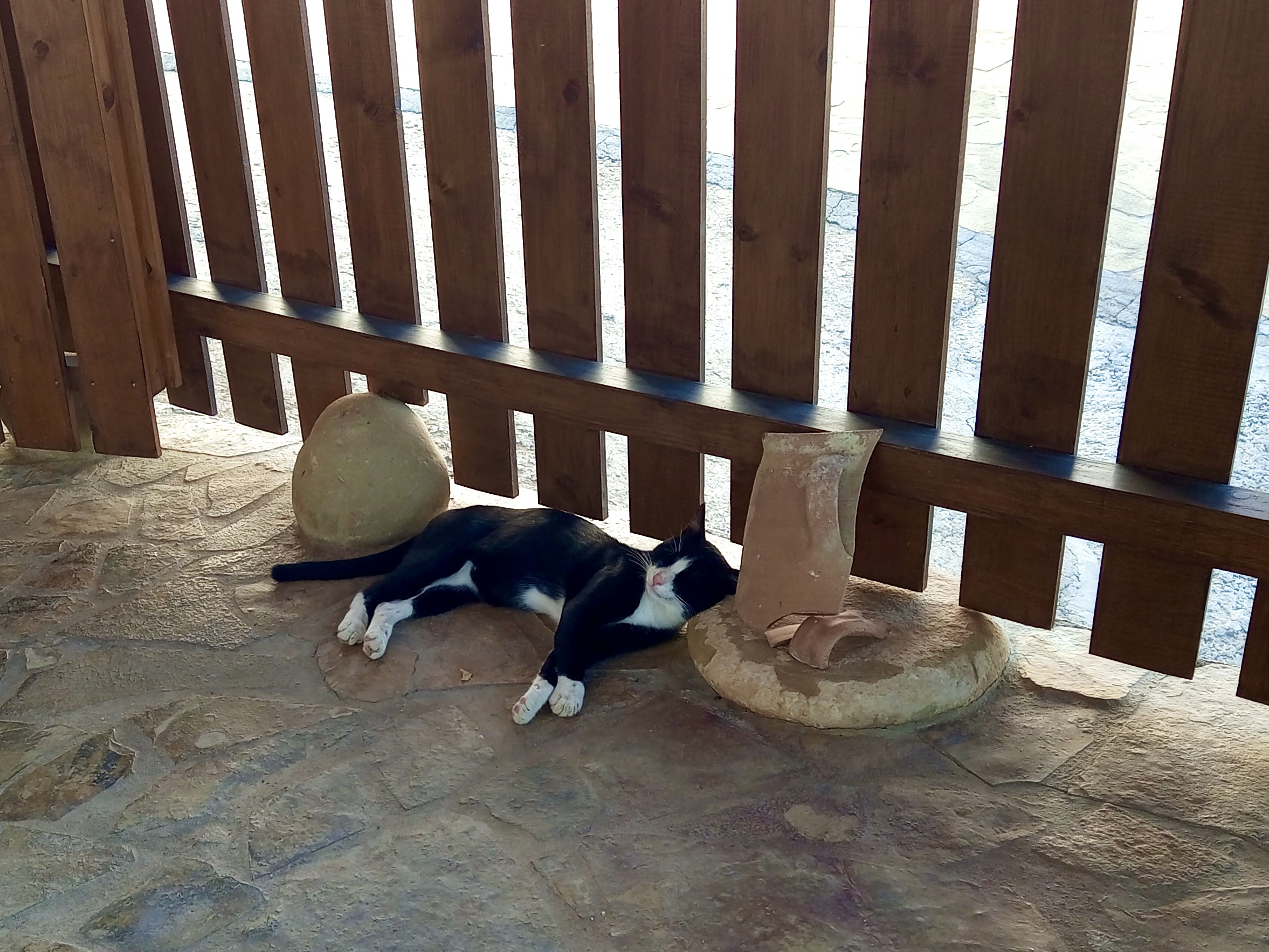
Above: Mavkos doing what he does most of the time in this weather. Tough life for a pussy cat, indeed.
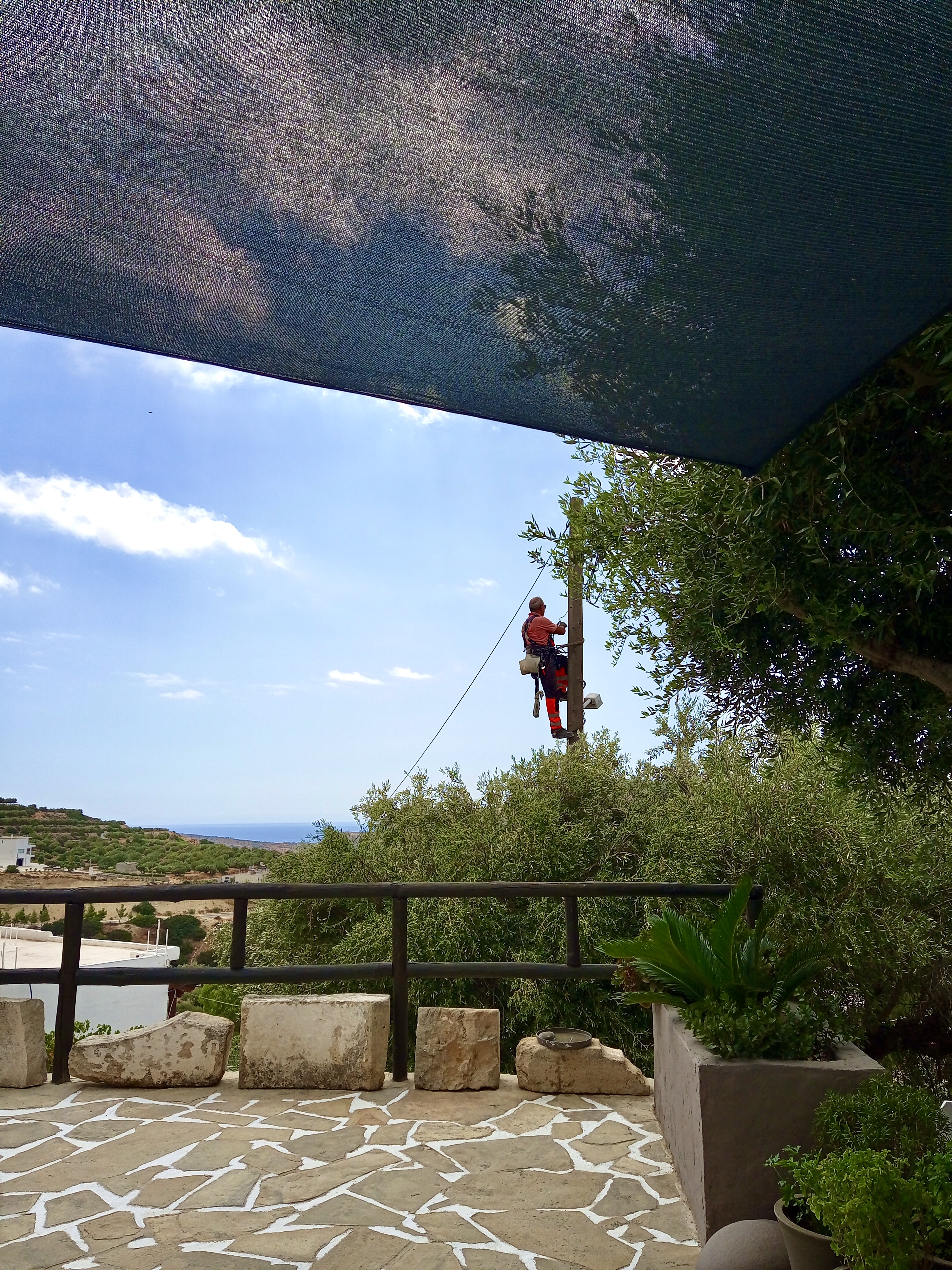
Above: Going up the pole, eh? There we were sitting under our ‘sail’ (that’s the large grey thing in the top of the photo) enjoying our iced coffees on our terrace the day before yesterday, admiring the progress we’re making in “Naxos-izing” the floor area, when this truck pulled up beneath us, and a couple of council workers got out. I asked them if they needed any help, to which they replied, “No, we’re just fixing streetlamps, thanks.” Next thing, this chap’s shinning up that pole with what looked like a couple of shark’s jaws attached to his feet. They’re very nifty gadgets and quite fascinating watch. Anyway, no sooner had he gone up there, than he was on his way back down, job done, and they were off.
OK, I’m about done for this one. See you soon!
My official website about my writing: https://johnphilipmanuel.wixsite.com/works
My Amazon Author page too. Thanks for your interest, it’s much appreciated, truly.
 Accretions
As always, I found this blog so worth reading & as usual, it made me laugh, so thanks! You’ve shown a photo of the newly re-opened museum in Ierapetra, is it worth a visit & whereabouts is it? We’re planning on visiting the town again while there again next month, so it would be a place of interest for us.
Julie, the Museum is situated at the town end of Dimokratias, the long tree-lined street that heads westward from the tiny roundabout just behind the sea front at the south end of the main square. I’m going to add a screenshot of the Google Earth satellite view any moment now, so if you re-read the post, you’ll see the map above. Best wishes John. PS. haven’t been inside the refurbished Museum myself yet, but saw a lovely video on the local news. Looks like they’ve done an excellent job.
Ah memories of visiting Kos and Patmos. The wonderful range of items like home made cherry brandy, home made jams in little jars and enough food to feed an army!