Something you get used to when living in a fairly rural location in Greece is the usual way in which members of the family, or even the community, communicate with each other. Back in the UK when I was first going out with the beautiful young woman who would eventually become my wife (Look, lads, I’ve told you before, if you want any tips on how to score valuable points…), I used to wonder why my mother-in-law would be standing in the kitchen at home, and when she’d prepared a meal for her family, she’d simply stay where she was and shout, “Elate paidia, einai etoimos!!” at the top of her voice. Her children may have been out in the garden, or a little way down the street playing with a football, maybe simply up in their bedrooms, but she’d not feel the need to move from the spot, she simply shouted, in the full expectation that they’d hear and come running.
Having lived in Greece for seventeen years, and the last three of those in a hillside village here in Crete, I fully understand why my lovely and sadly no longer with us mother-in-law would shout rather than go looking for the person or persons with whom she was intending to communicate. It’s the way they do things here, simple as that. In chapter 29 of my first book, “Feta Compli!” I mentioned how the mother in the family that used to run the psistaria opposite our accommodation on Leros, when we holidayed there back in 1996, used to perpetually call her young daughter Serafina using the same method. I also made mention of the custom in my novel “Eve of Deconstruction,” chapter 5, when Sofia, mother of the then small child Chrisanthi, would stand at the door of her humble village house and shout for all the village to hear when she wanted her daughter to come home.
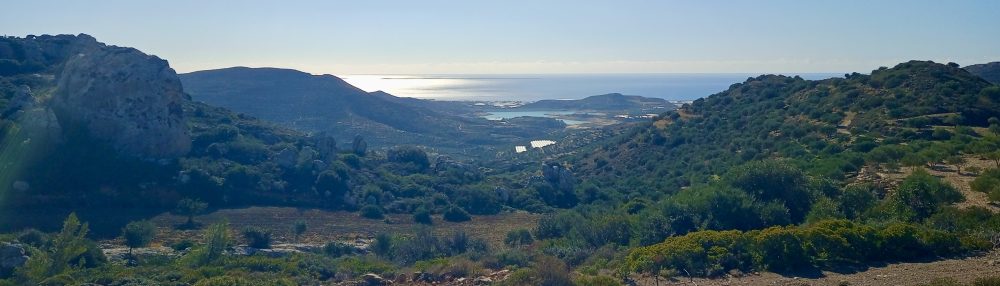
Here in our small village of Makrylia, there is a steep narrow street below our garden and veranda, and in that street there is a corner, one lane from which leads along to the house of the redoubtable Angla’i’a, mayor of the village and spiritual mother to all its residents. If she wants to see us, maybe because she has some eggs or produce from their horafia to give us, even to let us know that the postman has left something in our mailbox that particular week, she’ll make the effort to walk the few metres from her kitchen door to that corner, from where she’ll shout out “Gianni!! Maria!!” She’ll keep doing this until we eventually hear her and emerge to stand at our fence and peer down in her direction.
What’s somewhat confusing is that there are three Marias all living within about thirty metres of each other, so that will be why Angla’i’a, if she wants to talk to my wife Yvonne (also called Maria – it’s complicated), she’ll usually add the ‘Gianni’ to the call in order to differentiate. The lower Maria is Dimitri’s (the hobbit) mum, who lives in the house directly below ours, and the third Maria is Evangelia’s daughter, who lives across the lane from us. Some may say that to quite frequently hear voices shouting each other’s names is annoying, but we don’t find it so. When Dimitri comes home on his quad bike, he’ll stop outside the house and shout “mama!” When one of his cousins turns up in their pickup truck, they’ll stop it in the lane, roll down the window and shout “Paidia, you in there!!?” I’ll tell you why it doesn’t annoy us though, and it’s because it compares very favourably with the sound of planes, trains, busses and busy roads, none of which we hear here at all. Most of the time our lives here are lived to the backdrop of goats, chickens, wild birds, the occasional barking dog, sheep and a chainsaw, rotavator or two now and again. Oh, and the wind in the trees. We never hear the ugly sound of expletives from drunken passers-by, something which we did used to suffer in the penultimate house we’d lived in back in South Wales, UK. So, yes, you could say we count our blessings.
What does make me smile, though, is that every time someone in the village employs the tried and tested communication method that I’ve been discussing, it puts me in mind of an old Monty Python sketch that cracks me up even today. I swear that someone on the writing team must have had Greek blood. Check this sketch out (although sadly, it’s only a short snippet).
And now, it’s photo time…

Above: What about this little beauty then? I was watering and deadheading in the upper garden the other evening, with the last shafts of sunlight hitting the fence just nearby, when I glanced up and there was this exquisite creature sitting on the top of a re-bar, one of those that supports the fence. I had no idea whether it was a dragonfly or a damselfly, and I’d not seen one that purply-red colour before. So I went Googling (as you do) and discovered that in all likelihood it was a Male Violet Dropwing dragonfly. I had to once again check on the difference between dragonflies and damselflies, and this one, as you can see, has its eyes very close together, which is a sure sign that it’s a dragonfly. The damselfly has its eyes further apart, and that’s the only major difference between the two species, apparently. There are some slight differences in the body shape too, but the eyes – as is so often said – have it.
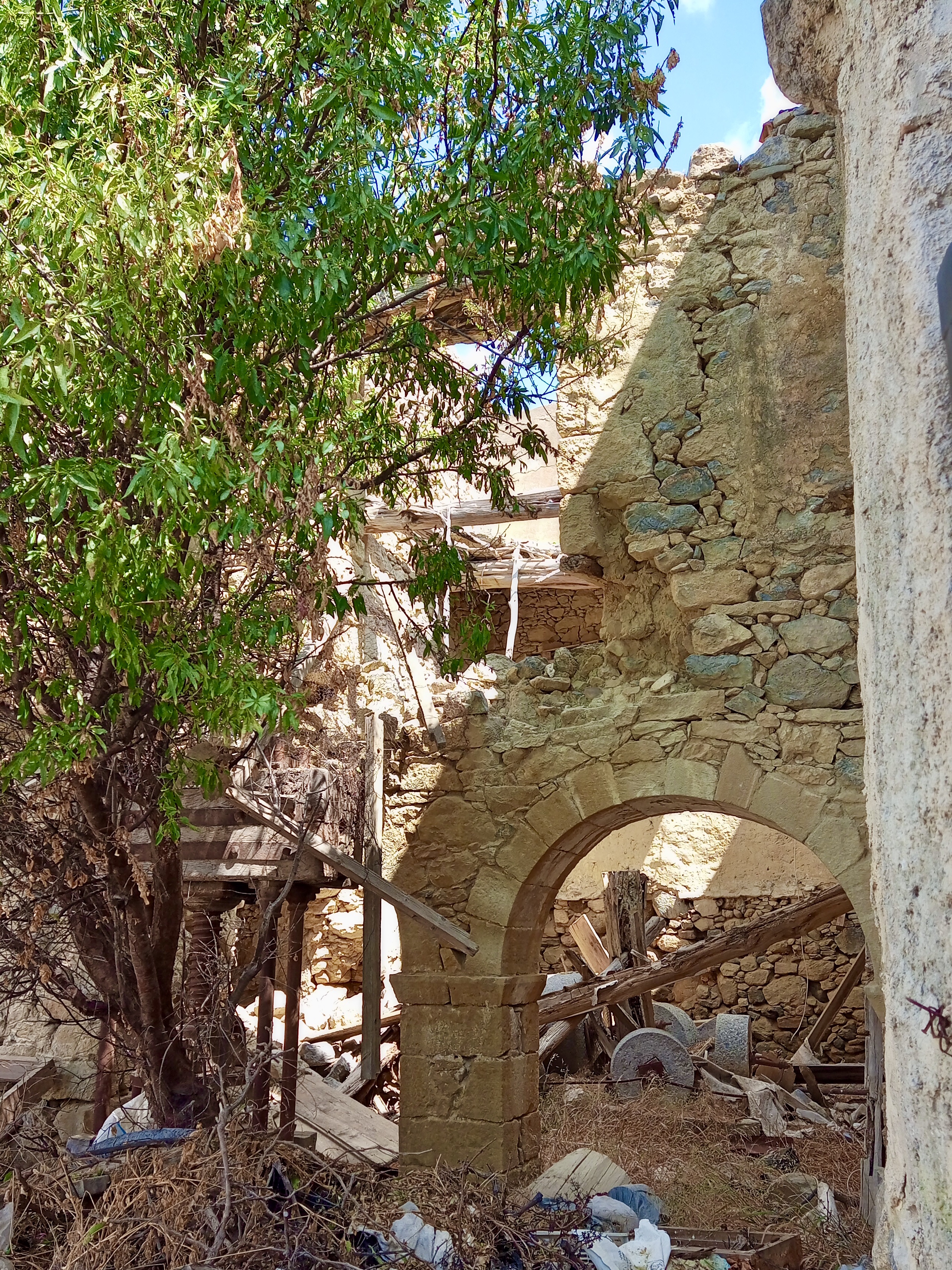
Above: Here’s another shot of the abandoned mill and press in the centre of the village. I’ve photographed it before, but it endlessly entrances me. I’d so love to know more of its history. One of these days I must shout to Angla’i’a to come tell me!

Above: A shot of a small corner of our terrace just above the lower garden. We had to wait a long time this year for that Canna to flower, but boy was it worth the wait.
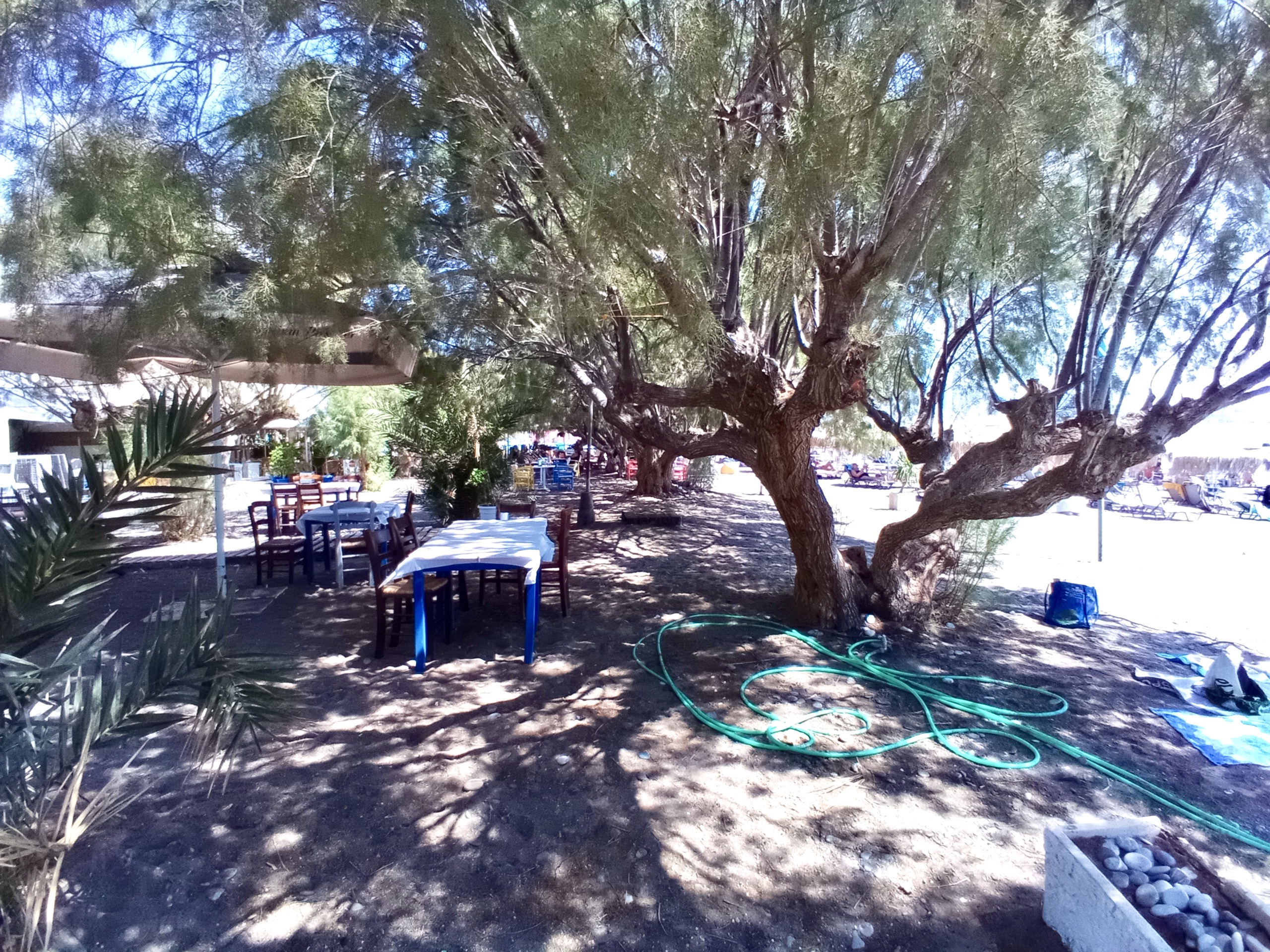
Above: A shady spot on the town beach in Ierapetra. Not a bad place to eat a light lunch, eh?

And finally, above is a well-developed courtyard on the edge of the town. Colourful, or what?
Anyway, don’t forget, if you want to communicate with me, you can always give me a shout.
My official website about my writing: https://johnphilipmanuel.wixsite.com/works
My Amazon Author page too. Thanks for your interest, it’s much appreciated, truly.
 Accretions
Lovely article–thankyou. Many a time, when trying to find out exactly where someone lives. I’ve been told “just go to the corner (or the square, or the shop) and shout!” And how on earth mobile phones ever caught on in Greece–except as a fashionable accessory to a scooter!)–everyone uses them but STILL shouts on them!
Our romance with Greece began in Lindos, Rhodes, way back in 1982, where we stayed in an apartment behind solid double doors at the entrance to the Lindian cobbled courtyard. Once those doors were closed, we were in our own little world, & could look up at the Acropolis towering above the village. The traditionally built self-catering accommodation was very basic, with minimum kitchen equipment, a huge butane gas bottle to fire up the 2-ring enamel hob, rock hard pillows & very squeeky mattresses! But I used to be fascinated by the constant sounds of women shouting loud & clear “Ella!!!”. Not speaking any Greek at all back then, I wondered how many women were called Ella living in the village??? I know better now, of course! Every afternoon, a group of women would sit on rickety rush seated chairs in the lane leading to our place, where they’d sit gossiping while crocheting various items to sell to tourists visiting the village every day. I knew they watched me & my family pass by every day, probably having a good chatter about us, & one day, I paused to look at what they were making. They couldn’t speak English, but made it clear that I should sit down & join them. The eldest lady there, Flora, then started to show me how to make one of the doilies that she was creating, giving me the little “pad” that was used to weave the thread, creating a little kind of cobweb, which would later be joined by other cobwebs to make a completed size of choice. Flora was my inspiration to try to learn the language & I kept in touch with her for a couple of more years, luckily, with the help of my mother-in-law’s Greek friend that she worked with in the U.K. Flora was 84 & lived in such a simple “cube” of a house, with very few creature comforts, but she seemed content, apart from the usual aches & pains of old age. She showed me around her single room house, with the outside, lean-to basic kitchen, & proudly pointed out all of her family photographs. I’ve often thought of her & wondered how she was, but knew that she might not have lived much longer after the time that we’d met. Years later, we returned to Lindos on a day trip, & although her little house was still there, it was difficult to recognize as it had been somehow altered &, I think, added to a neighbouring house to enlarge it? But, thank you, Flora, wherever you are, for showing me the generosity & love that Greeks can offer so freely, & for trapping our hearts forever, scattered around Greece & her beautiful islands!
Lovely experience Julie. As you know we lived on Rhodes, only a stone’s throw from Lindos, for 14 years. Lindos is truly beautiful, but sadly, IMHO, ‘over-touristed’ nowadays. In fact while we lived there we’d usually avoid going into Lindos during the summer season. In winter time it returns to being the simple village community that it used to be, and we loved to wander its tiny streets and alleys. So many people, like Flora, once they die, their houses are turned into Air BnB or let through agencies, sometimes to tour operators, and thus they’re remodelled accordingly. Everything and everywhere changes, I’m realistic enough to know that, but it doesn’t mean we always have to like it, eh?