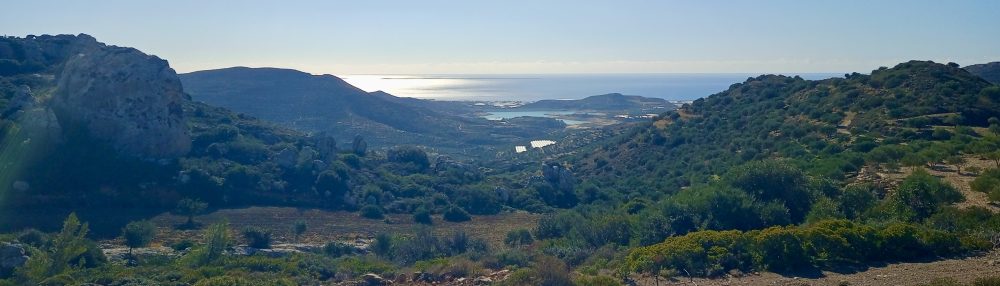
You’d have to be pretty lacking in the intellect department to deny that climate change is happening. You only have to look at industrialisation in the past 150 years, coupled with deforestation, and it’s a no-brainer really. But, and I almost hesitate to write what I’m going to say next, but I shall anyway, there is always a danger, IMHO, when we get an unusually warm spell, an exceptionally wet season, or an unseasonably cold snap, to immediately assign it to climate change or global warming, when actually it has much more to do with simple oscillation above or below the average. I’m able to cast my mind back to the fifties, and some people reading this even further I’m sure, and I can remember stand-out years when the winter was exceptionally warm, or conversely much more snowbound than the average, and I can think of summers that were either too wet and cold, or, as in the case of that glorious summer of 1976, on a par with the summers we get here in Greece, especially in the Southern Aegean.
What am I trying to say? I’ll have a go at explaining if I can: Every time we see the weather forecast we hear about averages, right? The rainfall for a particular month was above average, or the sunshine hours way below average. These days comments about such occurrences usually go hand-in-glove with that ‘Well, there you go, climate change, right?‘ ensuing comment. Yet think about it, where do averages come from? They’re the ‘mean’ between the highs and lows. If everything about the weather was exactly average every day, week, month, etc, wouldn’t that be weird, not to mention impossible? Plus, if the temperatures for one month or indeed a year hovered around what was established as ‘the average’ for most of that period, but then dipped way below for about a week/month, then the newly established average would be a lot lower, but artificially so, in fact, right?
OK, so, having established that fact, one can easily see that for averages to exist, there must by necessity be periods when the wind is stronger/weaker, the rainfall heavier/lighter and the temperatures higher/lower, it’s an inevitability. Thus I come to the weather so far this winter. I can well remember some winters when I was a boy being much warmer than the average, but equally, some that were a great deal more bitter. The winter of 1962-3 is a good example. We lived, my family and I (me, my sister and my parents) in a small village about six miles outside of the city of Bath. The village was situated on a ridge along some gentle hills, one side of which dipped down to the area around Dunkerton and Carlingcott, and the other dropped away across rolling fields to the village of Priston. That winter our village was cut off for weeks by snow-drifts that were higher than the hedgerows, and I remember walking with my dad along to the village sign on the B3115 and standing on packed snow at hedge height, worrying about when supplies might reach us, or when dad would be able to go into Bath to go to work again. That winter was the coldest in 200 years.
On the other hand, lots of you in the UK will remember the summer of 1976, and whenever I think back to that cloudless heatwave that lasted for months, I hear the Bellamy Brothers song “Let Your Love Flow,” or The Eagles’ “Take it to the Limit'” and Gary Wright’s “Dream Weaver,” ah such a great summer for music that was. That summer was the hottest of the entire 20th century, although only the second driest. The UK still hasn’t had a summer like it, despite the advent of ‘climate change.’ I remember waking up to cloudless skies day after day, much as we do here every year, but for the UK it’s unheard of. The temperatures were regularly over 30ºC during the daylight hours. Now, if that happened this past couple of decades, for sure it would be hailed as evidence of global warming, agreed?
Just to reiterate, of course I accept that climate change is a reality, but the fact that this winter here on Crete, at least up until last week, has been almost continually sunny and warm, isn’t in itself proof of it. It’s simply another of those ‘above average’ periods, which, when coupled with the ‘below average’ periods, gives us the averages that the meteorologists regularly quote at us.
Anyway, if it gives you readers from Northern Europe any comfort, last Sunday it rained here. We also had a colder air-mass over us and thus our friends Giannis and Maria, who’d invited us to their Myrtos home for Sunday lunch, lit their ‘Tzaki‘ in our honour. It’s when the weather’s cold and the humidity is up that Greek houses are no fun to be in during the winter months. Nearly all houses in the villages over here are either stone-built (the older ones), or built to withstand earthquakes according to that all-too-familiar concrete/re-bar skeleton, which is filled in with holed terracotta bricks and then rendered and plastered, before being painted, usually in white inside and out. They have no cavity, there’s just the one layer of plaster/cement/brick or concrete between the inside and the outside of the walls. That’s why most Greek houses of the most common construction method end up with black mould on their interior walls by the time the spring arrives.
I mean, can you imagine a house in the UK without cavity walls? Even the older stone-built cottages usually end up being dry-lined when they get renovated these days, and inside that dry lining is a layer of insulation, right? Here, it seems to me that because the winters are so short, the Greeks simply put up with the walls running with condensation when the interior of the buIlding is heated and the outside temperatures are down to around 10ºC, or even lower if you’re up on the Lasithi Plateau, for example. It’s no accident that many of the regular TV ads over here during winter are still either for air-con units (because air-con dehydrates the atmosphere in a room) or for dehumidifiers, various models of which are to be seen on display even in some supermarkets in the months December thru March. They’re certainly exhibited very prominently in all the electrical appliance stores at this time of the year.
It was actually a happy accident that the house we bought here in our small village near Ierapetra was constructed using the same method as the one we’d lived in on Rhodes for 14 years. The only difference was that the one on Rhodes had steel frame and this one’s timber. But this house is actually warmer than the one on Rhodes because the cavities between the inner and outer walls of our snug little home on Crete are thickly insulated, resulting in a home that never feels bitter inside, even when the outdoor temperature is maybe 9 or 10ºC and the humidity is at 80%. You can step into our home from a chilly wind outside and you’d be forgiven for thinking we had the heating on. We also never see any mould or condensation on our interior walls. When we stepped inside our friends’ home in Myrtos, at around 1.00pm last Sunday, from a heavy rain-shower and a cold wind outside, the house felt chilly to us. Our hosts Maria and Giannis soon got the fire going in the hearth though, and Giannis suggested I may want to warm my tootsies. I didn’t need a second invitation…

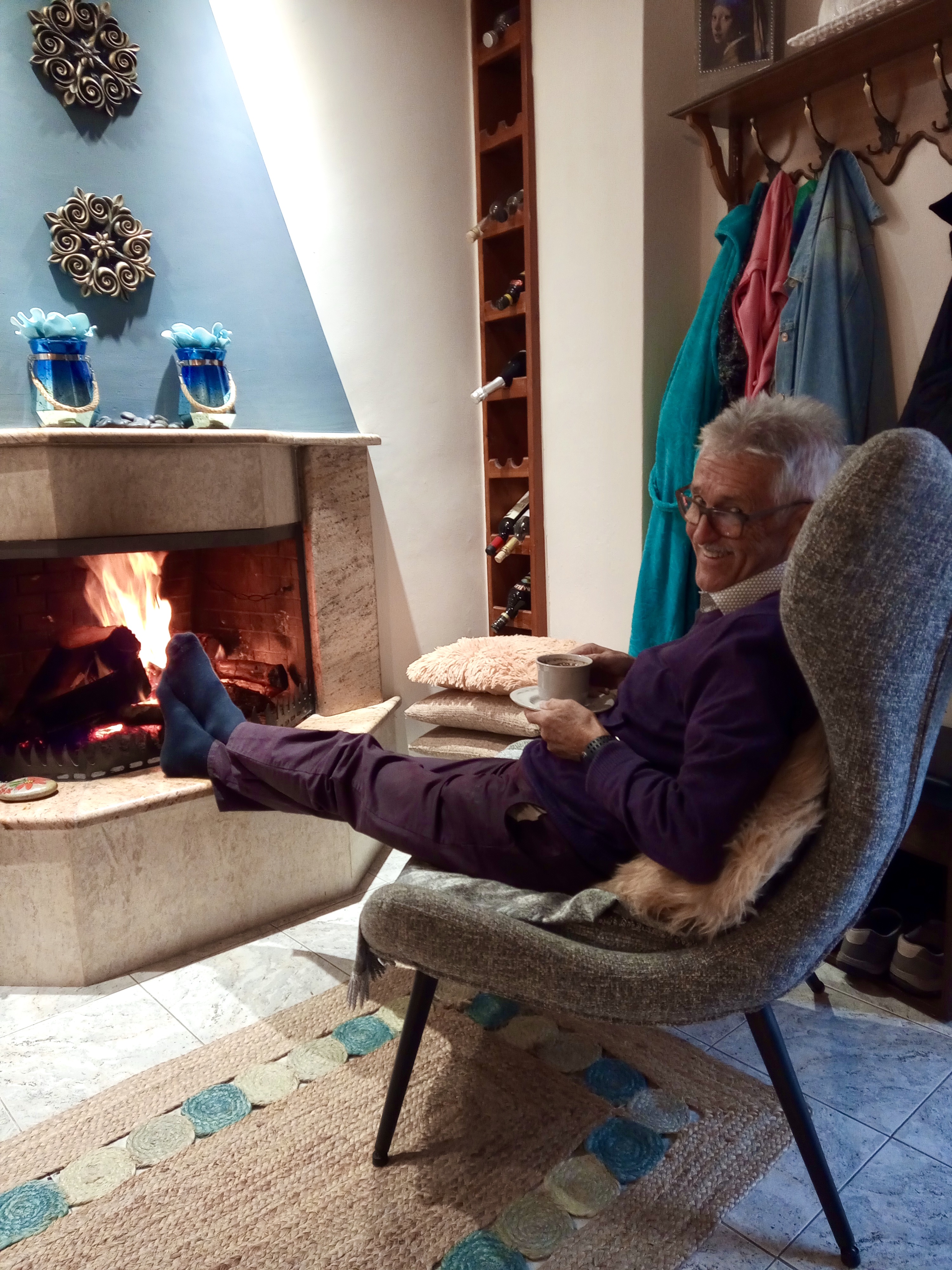
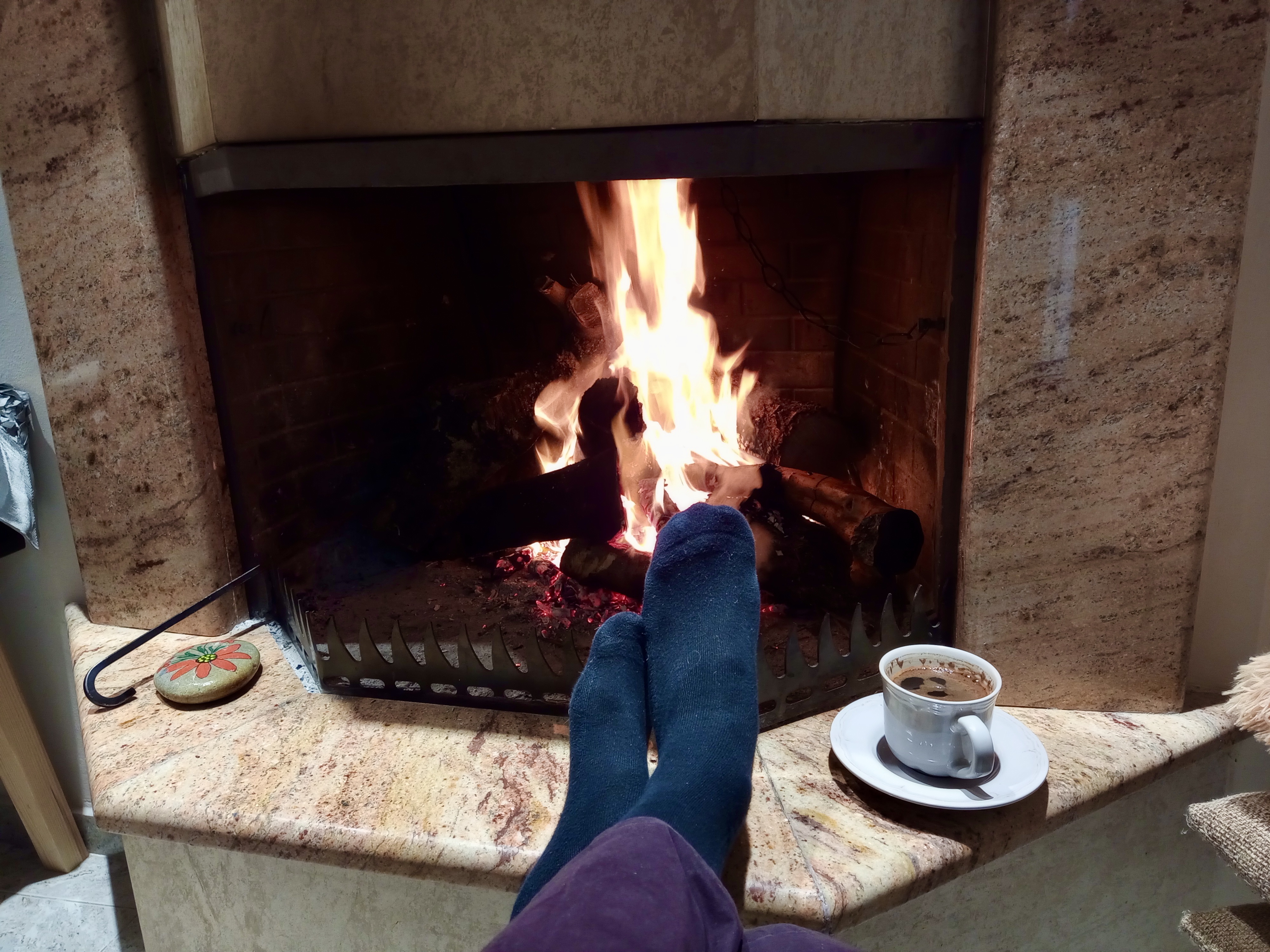
They may look nice and inviting, but these open fires consume heaps more wood than a cast-iron log burner with a glass panelled door in the front. Plus most of the heat goes up the chimney, whereas a log-burner (soba) acts like a radiator and does a better job of warming the whole room and not just the feet of whoever’s nearest. Nevertheless, Giannis and Maria insisted that I stay there and warm my tootsies, so, ever willing to please (it’s just the way I am, folks), I obliged for a while until Maria called us to the table to eat.
One thing you can be sure of if you’re invited to eat at a Greek home, you never leave that table still hungry. In Britain we’d serve up a roast dinner (or the like) on individual plates, whereas here they not only start with what’s on your plate (in this case each of us was presented with a grilled fish the size of a modest shark, accompanied with a warm risotto garnish) but there is also a selection of common dishes in the middle of the table that in this case were loaded with lettuce and red cabbage salad, a huge pile of ‘sectioned’ spanakopita, a dish of roasted sliced green and red ‘arrow’ peppers bathed in oil and lemon juice, enough paximadia to feed an army, some seeded bread sticks and a few other things besides. Plus there was a jug of water (a given), a bottle of very acceptable white wine and still more.
By the time we rose from the table to repair to the very welcoming corner sofa, we’d eaten full to bursting, and Maria was complaining that she thought that we hadn’t eaten much and couldn’t we manage just a little more. She made me a huge Elliniko, which I was persuaded to take with me back to the hearth (photo no. 3 above) to make sure my feet weren’t cold, which, with the solid floors here and lacking our slippers, was the case, to be honest. Giannis, as we sat and talked over how to solve the world’s problems along with how the girls disdained the current fashion trends, got up every quarter of an hour or so to open the front door (resulting in a flurry of raindrops and a few leaves being blown in) in order to go fetch another log large enough to fill a wheelbarrow on its own, such is the size needed to feed the Tzaki. When we had our soba back in Rhodes (and indeed we’d had one too back in South Wales where we’d lived before moving to Greece) we could heat the house for an entire evening on a few logs in a basket beside the fire, such is the difference between how much wood you need to get through a winter if you have an open fire, compared to how much is needed for a log-burning stove.
Nevertheless, we enjoyed a thoroughly lovely few hours in the company of our hospitable friends, who rent rooms for a living during the summer season, and have had a tough time of it during the past couple of years, and took our leave in the driving rain as the light was beginning to fade. As is always the case, they tried to get us to stay longer, which Greeks will always do even if they have a list of pressing chores or other responsibilities to accomplish, because it’s just the way they are. You have to learn to read the situation. In the past we’ve allowed their warm insistence to persuade us to stay, and then, as the time has gone on, come to realise that we’d actually overstayed our welcome, not that the hosts would ever let on, of course. I’ve mentioned before too that when you want to leave by a certain hour, it’s always best to start the process of departure a good 15 minutes earlier, because that’s at least how long it’ll take you to finally walk off along the road waving your goodbyes.
We got home around twenty minutes later, turned on the Masters Snooker from the UK on TV and promptly fell asleep, the pair of us, on the sofa. It had been a thoroughly enjoyable few hours. Oh, and before you go asking why I didn’t let my beloved sit in that armchair in front of the fire. I did, OK? She declined, several times. I did try, honest.
•

The latest work of fiction, “The Lone Refugee” (Click on cover image)

The latest work of non-fiction, “Greek Oddities” (Click on cover image)
 Accretions
Can you imagine a house in the UK without cavity walls? Yes–I live in one! Built 1908 as are most of the ones in this area of our city–it’s flipping freezing! Single glazed as well
Indeed Dilys, I think it proves my point! My sister too lives in a 200 year old cottage in Wiltshire, and her place takes some heating, but at least they do have a log-burner.