I thought I’d just post some recent photos this time. Summer has definitely arrived, as I mentioned in the previous post. We’ve actually now been able to take coffee on the beach this past couple of weeks and the temperatures have rocketed over what they were just a couple of weeks ago. Overnight, especially, it’s now staying around 20ºC+ and we can sleep with just a quilt cover over us, minus the quilt. It had seemed, just days ago, like this was never going to happen this year. And so to some recent photos from around the area…

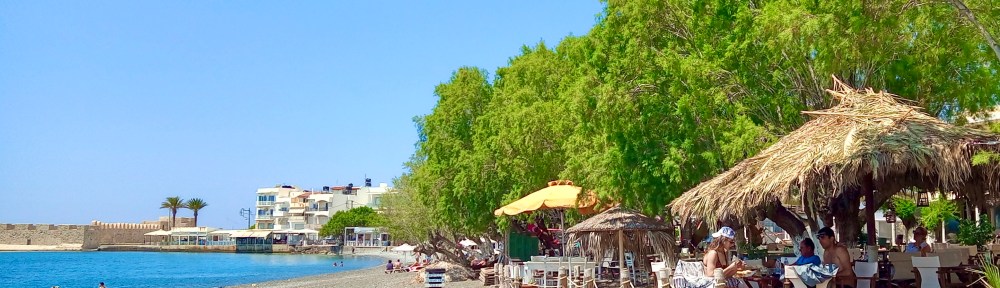
Above: Gra Ligia, 28th May 12,20pm.
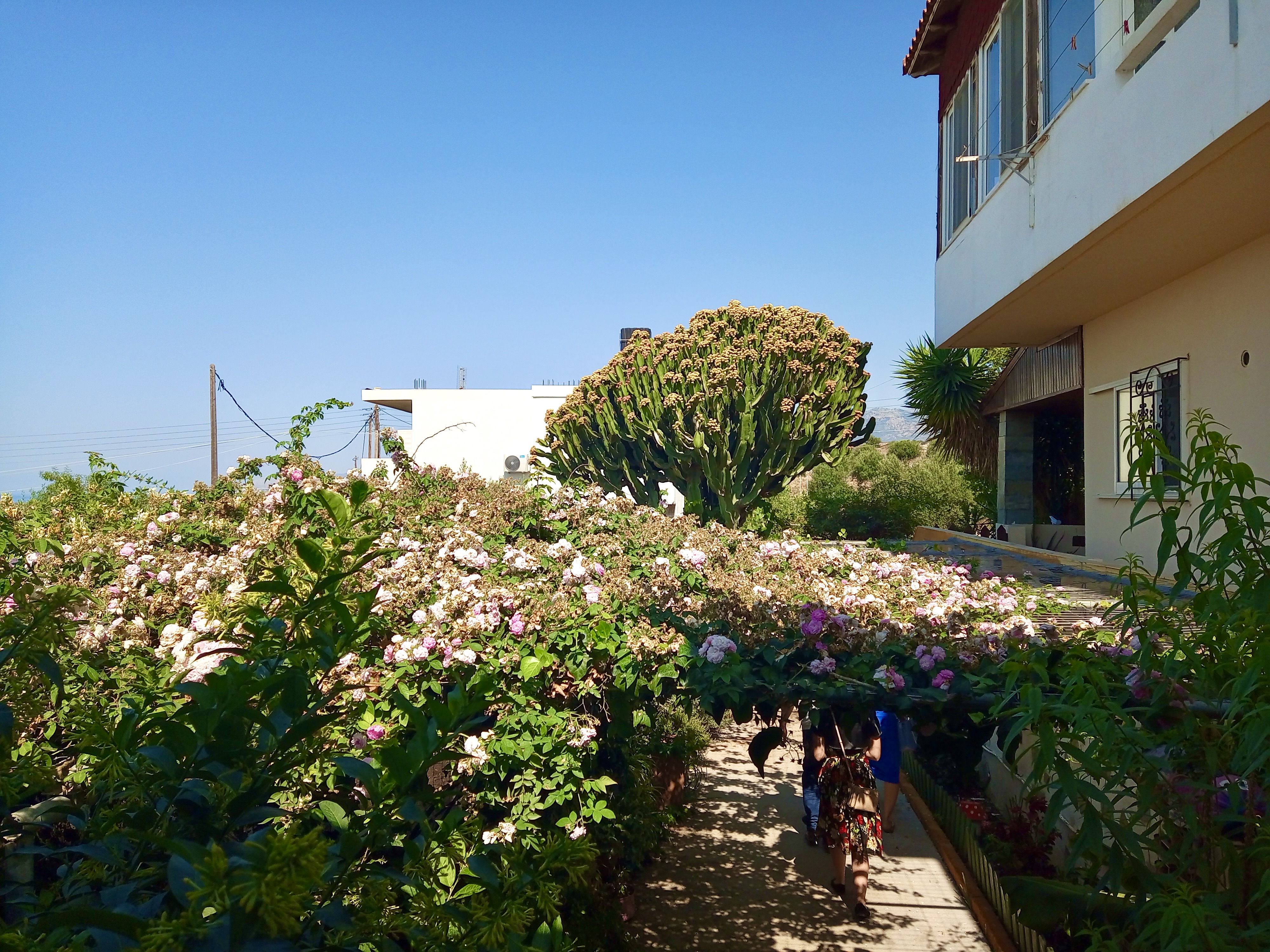
Above: That’s what you call a cactus, isn’t it? The entrance to a friend’s house is along this path, which runs under a wired rose bush that just smells divine at the moment. The cactus towers probably 20 feet above our heads as we pass beneath it.

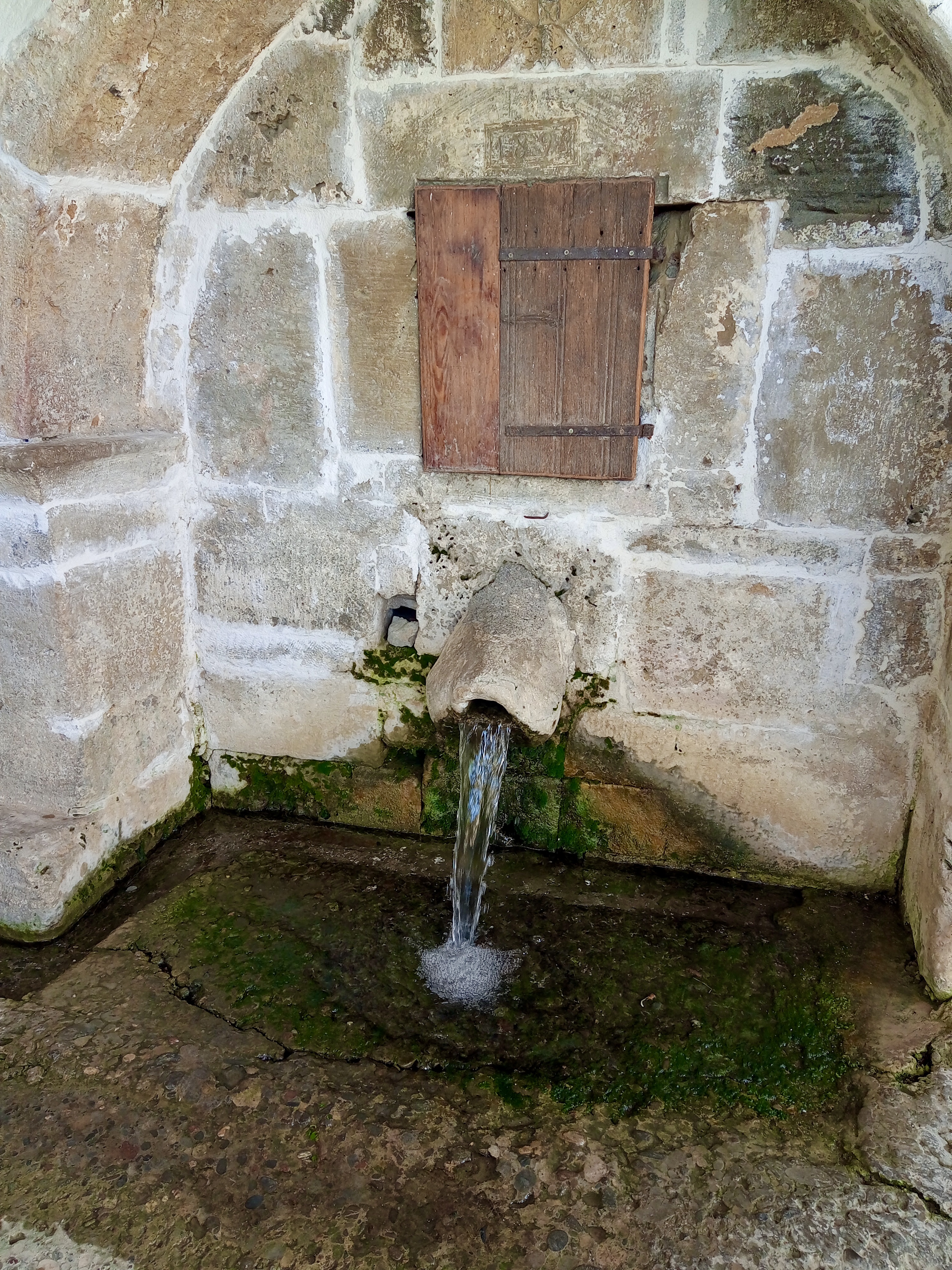

Above: In the village of Prina, next-but-one village up from us, passing Meseleri. This is the well-preserved village communal washing house and water source. You can see from the close-up of the stone lintel above the fountain that it dates from 1893.

Above: This little sign, almost too insignificant to notice as you walk past the doorway, translates as “Christoforos’ kettle [or cauldron].” What does it mean? It means that this is where they make the village ‘raki!’ The link takes you to a Wikipedia page where raki is called ‘tsikoudia‘ (pronounced tsikoudYAH), which is what some Cretans also call Raki (which, incidentally, is properly pronounced with the accent on the last syllable and not on the ‘a.’ It’s the same with the village of Kritsa, which English speakers usually pronounce KRITsa, when it is actually kritSAH. In fact, if you’re serious about pronouncing Greek words correctly, you can always take a safe bet that the syllable you should be stressing isn’t the one you want to stress!).
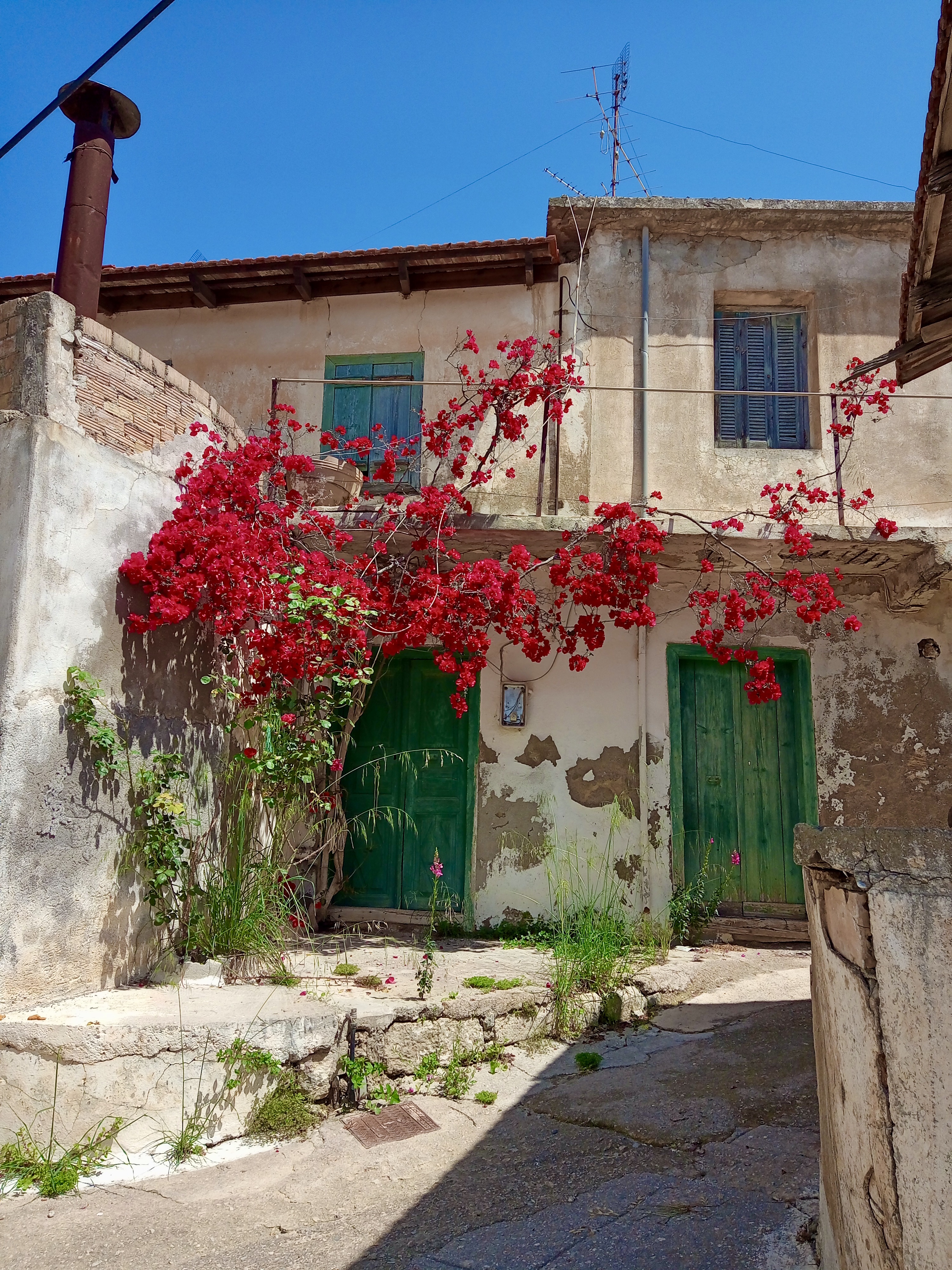


Above: Three more shots from the village of Prina, all taken late morning June 4th.
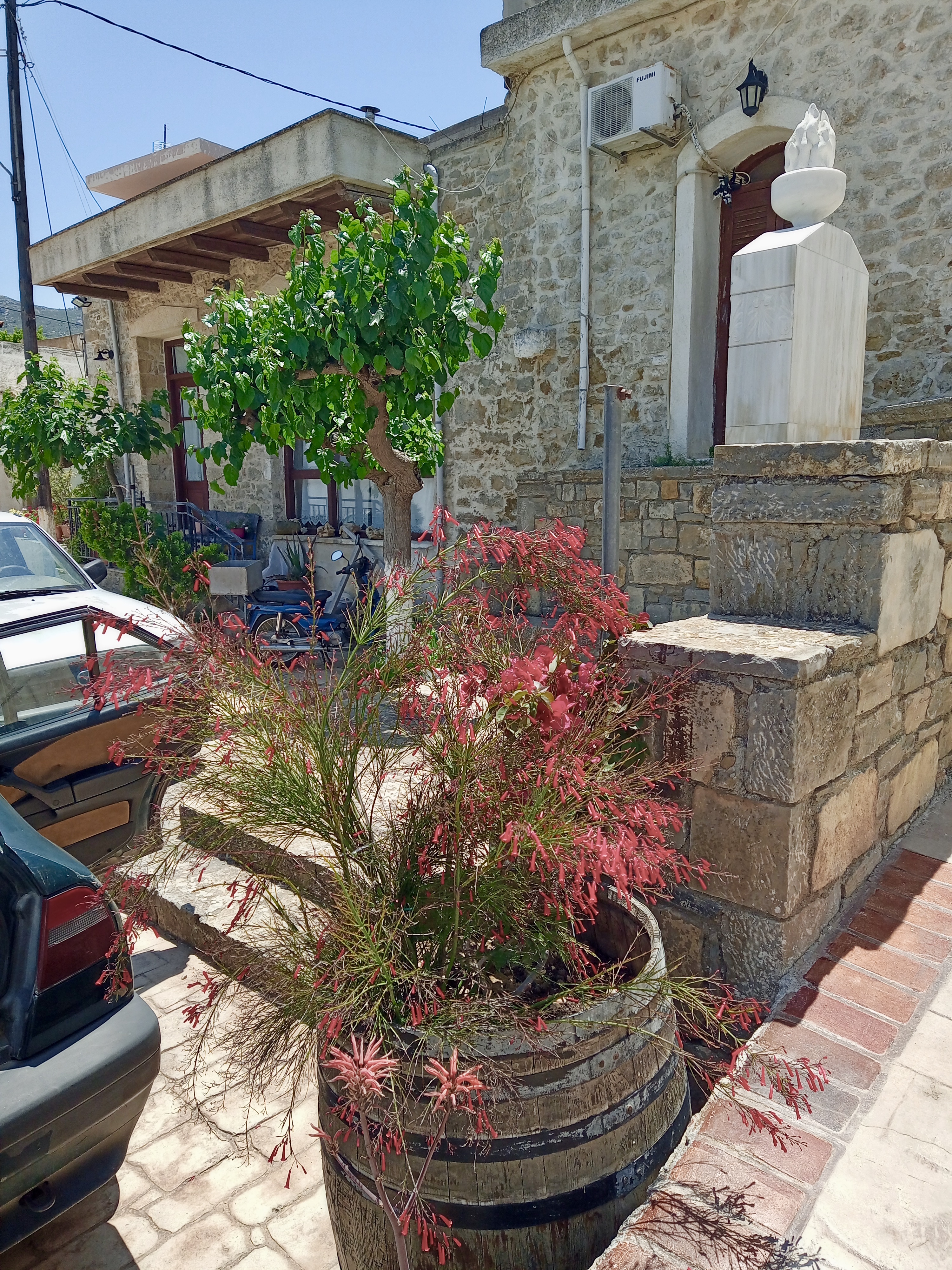
Above: A corner of the central square in the village of Meseleri. Here’s a link to a site that’s in English too.

Above: in an earlier post “One Firework” I mentioned our wedding anniversary (April 20th, if you’re interested), and the fact that my lovely sister and her hubby in the UK sent us a bouquet, which was delivered by one of the local flower shops in Ierapetra. I also said that the bouquet contained a spray of Sea Lavender, and remarked that it’s one plant that you should never throw away once all the other blossoms in the bouquet have withered. Why? Here’s the proof. The bouquet arrived on April 20th, yet look at the Sea Lavender now in the middle of June, still exhibiting its gorgeous purply-blue colour, and it’ll go on doing that for probably a couple of years yet. Good eh?


Above: Not a lot of people know this, right, but artichokes, which the Greeks like to eat (although quite why eludes me, since the rigmarole involved in getting to the actual bit that they eat seems hardly worth the effort, see this post) are actually a thistle. If you leave the artichoke on the plant instead of picking it when it’s at the right stage for eating, it’ll go on to burst into flower. This plant, which is on the ktima belonging to the bloke who sold us our house, and is situated just below the veranda of our nextdoor neighbours, is around seven feet tall, as you can see from those photos. Don’t encourage me to eat artichokes, will you, but I’ll tell you what, the plant, when it flowers, is truly a wonder to behold and I love to gaze at it. I even find myself wondering if John Wyndham had been thinking of one of these when the inspiration for a science fiction novel came to him…

Above: Taken at 11.50am this morning on Ierapetra beach as we took our iced coffees and had a gorgeous dip in a sea that’s now already up to 22ºC. Go on, tell me that the Caribbean is the place to go, eh? They get hurricanes, and it gets dark at tea time all year round!!! No, I know it’s wrong to make comparisons, but a few years ago back in Rhodes I once had a British bloke on one of my sea excursions whom I caught at the stern of the boat gazing at the endless blue sky and looking very pensive. As I approached him, he looked at me and asked me, “Is it always like this then?”
“Sorry?” I replied, “but like what exactly?”
“You know,” he replied, “so blue.” I kid you not good blogreading folk out there. He actually didn’t realise that with a three or four hour flight from good old Blighty, he could enjoy a holiday in the summer where he’d be lucky to see a cloud in two weeks. He told me that he always went to the Caribbean, 10 hour flight, jetlag and all, because he’d believed that it was the place to go to get the right weather, even though, by his own admission, it would cloud up in the afternoons most days and rain for an hour from around 4.00pm. By the time he’d boarded the boat on my excursion, he’d already had a few days to settle into his first ever summer visit to Greece. He actually told me, and I tell no lie, “If I’d known how great the weather was here in Greece, I’d not have spent all that cash and flown all that way for the past ten years, when for a lot less cash and a lot shorter flight I could have had this!”
•
Click HERE to go to my Amazon Author Page.
 Accretions
Loving the photos John. Such a shame that our 10 days exploring eastern Crete in May saw very different weather! Having though done 1500kms in our hire car whilst it was raining and blowing a hooley, it was still wonderful!
I adore the sea lavender pic, never knew how long it could last- simply glorious!