
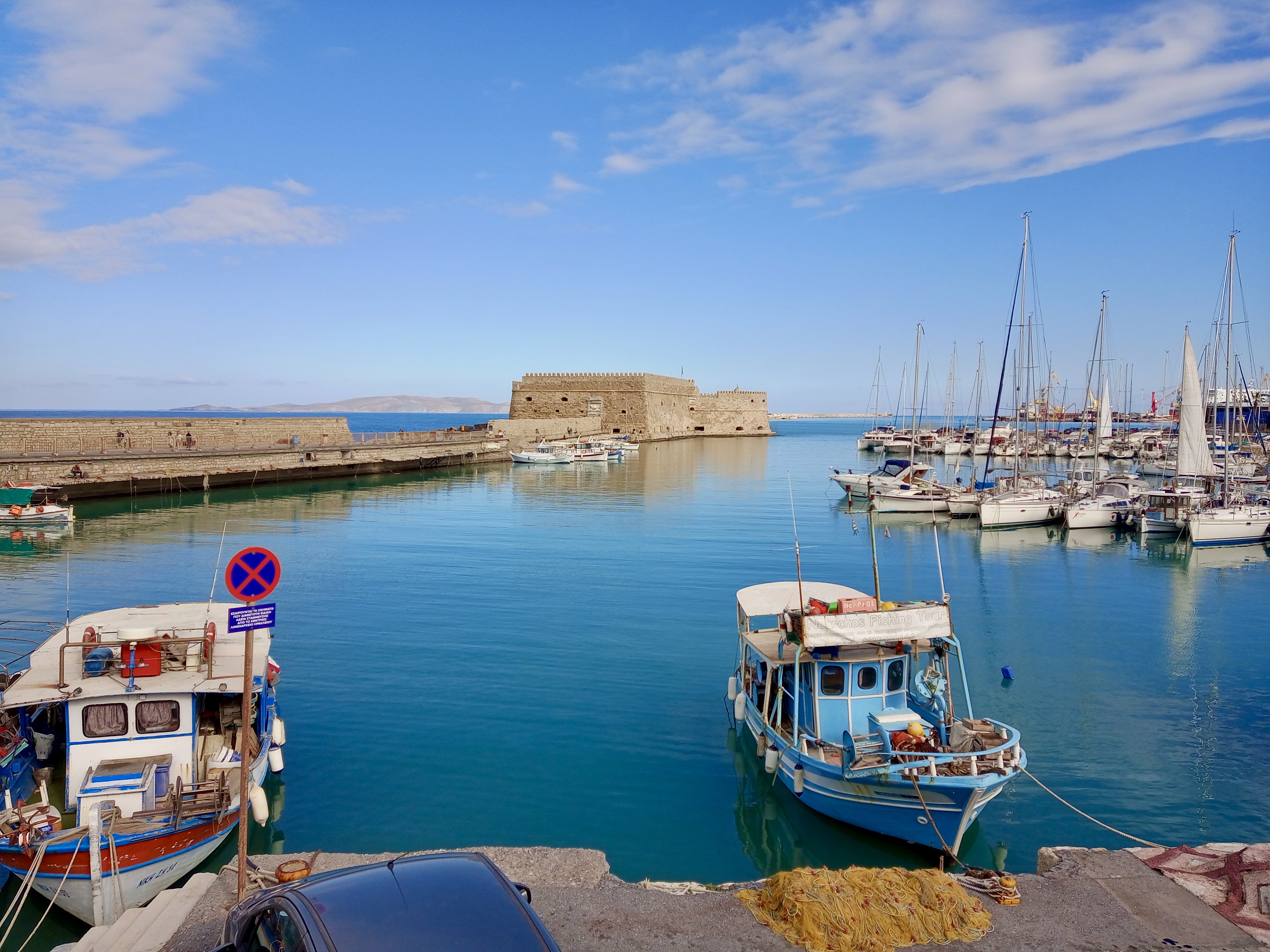
We’re well into our summer routine now. Twice a week we head off downtown to do some shopping, and preceding the visit to the supermarket take a couple of hours on the beach with a Freddo and a swim. I always sit in full shade, while the beloved does a spot of ‘helio-therapy’ too. When I watch the tourists and see how so many of them stretch out in full sun at this time of the year it makes me marvel, it really does. Yvonne’s got that Greek olive-skin hue that means she seldom burns and always tans to a certain level and stops there. She’s not daft enough to spend too long in direct sunlight anyway, and even then has her head in the shade. I, on the other hand, am very Anglo-Saxon and would quickly burn if I were to lay in full sun, so I usually apply factor 50 if I have to be out in it but, like I said, apart from when I’m walking somewhere, I stay in the shade anyway.
When I look at some of those holidaymakers that don’t seem to realise the dangers that direct Greek sunlight can pose, I shudder, I really do. I lost a good friend to skin cancer back in Barry, South Wales, some years ago and he got it from being a window cleaner right there in Barry, not even here in the Med, where the sun is so much fiercer still. David (that was his name) used to work in shorts during the summer months and would simply get on with the job without thinking of putting on a high-factor layer of protection. The cancer began on his leg, of all places, but eventually it killed him, leaving behind a wife and two beautiful daughters. We’ve had a few friends out here in Greece too who’ve contracted skin cancer and had to have minor surgery to remove it, one person right on her face too, near her nose, so we’ve kind of got the message, as it were, the hard way.
It’s not just the dangerous nature of exposing so much flesh to the merciless Greek sun that keeps me in the shade either, it’s the fact that, even if I spend a couple of minutes out in it, apart from when taking a dip (and if I go snorkelling, I always apply cream liberally to the back of my neck, my shoulders and upper back), I feel distinctly like the Greek Pasca lamb would feel, were it still alive that is, while rotating on that spit every Greek Easter. Why would I want to deliberately make myself feel like I was being roasted? I’ve learned something about tanning too, and I’ll share it with you, even though you probably already know this. If you lay under an umbrella, or a tree, any shade at all, when the sun’s shining on a cloudless Greek summer’s day, you’ll tan anyway, because the ultraviolet that causes your body to produce melanin as a defence against the assault you’re inflicting upon it bounces off the surface of the ground around you. A lot of people who look at me think I must be a sun worshipper, because during the course of a long Greek summer I turn a very dark brown. I seldom burn, because I don’t sit or lay in the sun, but the secondary assault on my skin from reflected (‘bounced’) UV tans me whether I like it or not. There have even been occasions when I have gone red and sore from laying under an umbrella when the beach around me has been composed of particularly light, reflective sand, for example.
I’m banging on about this because I get quite upset when I watch these two-week tourists and wish I could get them to understand what risks they’re taking. You can always tell the new arrivals when you live over here, of course. They’ll be the ones who turn up on the beach, strip down to their cozzies and their skin is a similar hue to an uncooked pork sausage. Those whom you also know must be about ready to go home are the ones who are either by then bright red or maybe a shade of mid-brown, depending on whether they’re ginger, blond or mousy haired. You can spot the ‘must get to Tesco the day after I get home‘ types. We’ve all seen them in the UK. You go to Tesco (other supermarket brands are also available) in August and there they are, the blokes in shorts and the women in spaghetti tops, making sure that as much flesh is exposed as possible, even though it’s 17ºC outside, pushing their trollies and silently saying to those around them, “See! WE’VE just come back from somewhere hot, so there!”
Something else that makes my blood boil is these quad bikes. Check out this link for a story that’s all too familiar over here all through the summer season. What’s chilling in that story is the fact that the bloke who was killed wasn’t even going too fast, he simply didn’t have a clue as to how dangerous those things can be. We had a good friend back on Rhodes who rented scooters for a living. After we’d known him for a few years he added a couple of quad bikes to his fleet. Before we could even broach the subject, he told us up front, “I don’t want to rent these death-traps, but the tourists keep asking for them. They’re far too dangerous, but I don’t really have a choice.”
Manolis (that was his name) had no sooner started renting out those quad-bikes when one of his customers turned one over on the road and ended up in hospital. During our 14 years of living on Rhodes I’d say that at least once every summer someone died on one of those things, and always a tourist, never a local. Remember the talented, if ever-so-slightly outrageous, comedian Rik Mayall in the UK? Well, click this link and scroll down to the subheading “Quad Bike Accident,” then read that section. Although he died many years later, many people believe that he was never the same following the accident, and even he himself said, “I rose from the dead” when he’d recovered from it initially.
When I worked for ten years as an excursion escort, I must have accompanied forty different coach drivers, and every single one of them cursed those quad bikes for causing tailbacks on the roads. They’re simply not designed for road use and that’s the fact. Even off-road they ought to be driven by people who know how they behave in a variety of situations, not by some fun-loving tourist who thinks doing sixpenny turns on dusty Greek lanes is their idea of fun, truly. If you’re reading this and have perhaps wondered if renting a quad bike might be a blast, take my tip, please, don’t do it. Your holiday insurance almost certainly says in the small print too that they won’t cover you if you come a cropper, always assuming you survive, that is.
Eventually I come to the point of why I called this post ‘A Wonderful Life,’ and it’s this: We go to the same bar twice every week for our swim and iced coffee, and have of course got to know the staff who serve there very well. We’re also now on first name terms with the lifeguard and his girlfriend (also a lifeguard like him), since their ‘station’ is only metres from our favourite umbrella. We’re a bit pedantic about recycling and have a couple of vacuum mugs, you know the type…
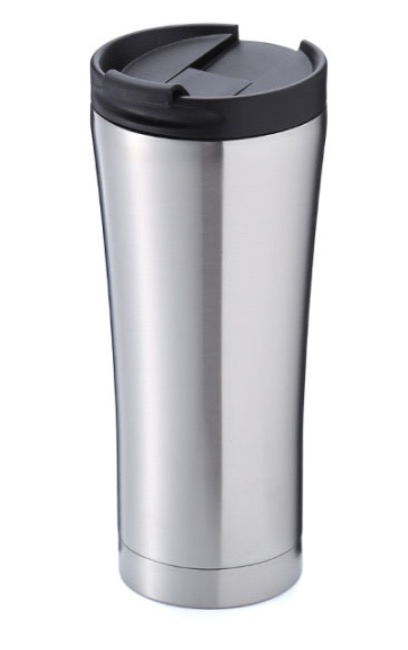
..and when we get to the bar we hand them over to Gianni (who serves the guests on the beach) and he sees to it that our coffees are prepared in our own mugs, into which we then slide our own stainless steel straws too. I don’t want to sound preachy, sorry, but recycling to us is vital in this day and age when so much plastic is still leaching by the ton into the environment on a daily basis. I truly believe that when it comes to caring for the environment, every individual needs to teach by example. When we go for iced coffees, no cardboard cups or plastic lids, no plastic straws or cellophane ‘sleeves’ from them are used at all. We take our own mugs and straws, and take them home with us afterwards. It’s no hardship whatsoever and means that at least a tiny number less of plastic dross gets into the environment. I mean, each time someone orders an iced coffee it gets served up with a straw in a cellophane sleeve. OK, so some forward-thinking cafés are now using biodegradable straws in paper sleeves, but they are still, sady, in the minority. If you look around most beaches you’ll see tons of those little cellophane sleeves blowing freely along the beach and into the sea, it’s horrifying. OK, so people might extract the straw, crush the sleeve and then deposit it into an ashtray, but the breeze in very short order whips it out and sends it on its journey to who-knows-where.
Giannis, our ‘waiter’ as it were, greets us with a cheery kalimera when we arrive, but often looks very hot, harassed and sweaty. He wears a t-shirt and shorts, and has a closely shaved head (these here young whippersnappers will have their No.1’s these days won’t they), and runs up and down the beach all day. I’m reminded so often when I see him of a cartoon I once saw in some travel magazine or other. It showed a holiday-making couple in deckchairs on a sunny beach being served cool drinks by a waiter, whose shirt was stuck to his body by sweat and who had perspiration raining down from his face like a shower. The tourists were taking their drinks from him and remarking, in obvious rose-coloured appreciation of the climate over here, “Boy, you must have a wonderful life, eh?”
What I’m getting at is – and I’m not particularly blaming tourists for thinking this way, because they don’t know any different, as indeed neither did I during all those years when we used to come here for holidays when we still lived in the UK – when you’re on holiday and you see wall-to-wall blue skies and you realise that it’s like that for months on end over here, you can be mistaken for thinking that for those who live here it must be wonderful to have such marvellous weather in summer. What they fail to appreciate is that most people, like that poor chap that served them their drinks, work their blooming socks off week in week out, often for seven days a week, in order to earn enough to survive and, in many cases, get them through the winter too. If you were to ask Gianni, our friend, for example, how often he goes swimming in the sea, the answer will often be, “I don’t.” It’s not for lack of desire, it’s simply due to lack of time. To many who work in the tourism industry in countries where the summers are long and hot, it’s a long, sweaty, tiring trial looking after people who can afford to spend a week or two stretched on their sun beds, and it’s all they can do not to despise those people. They don’t, of course, because the tourists are their bread and butter, but I do think it’s a good idea to remind people now and then to show a little appreciation to these waiters, waitresses, tour reps, chambermaids, barmen and women etc for the way in which they usually keep a cheery face for our benefit, while they go to bed every night after a very long day’s work (often on split shifts) totally exhausted.
Another sermon over! The photo at the top of this post, in case you didn’t recognise it, is Heraklion of course. And here are a few more recent photos…
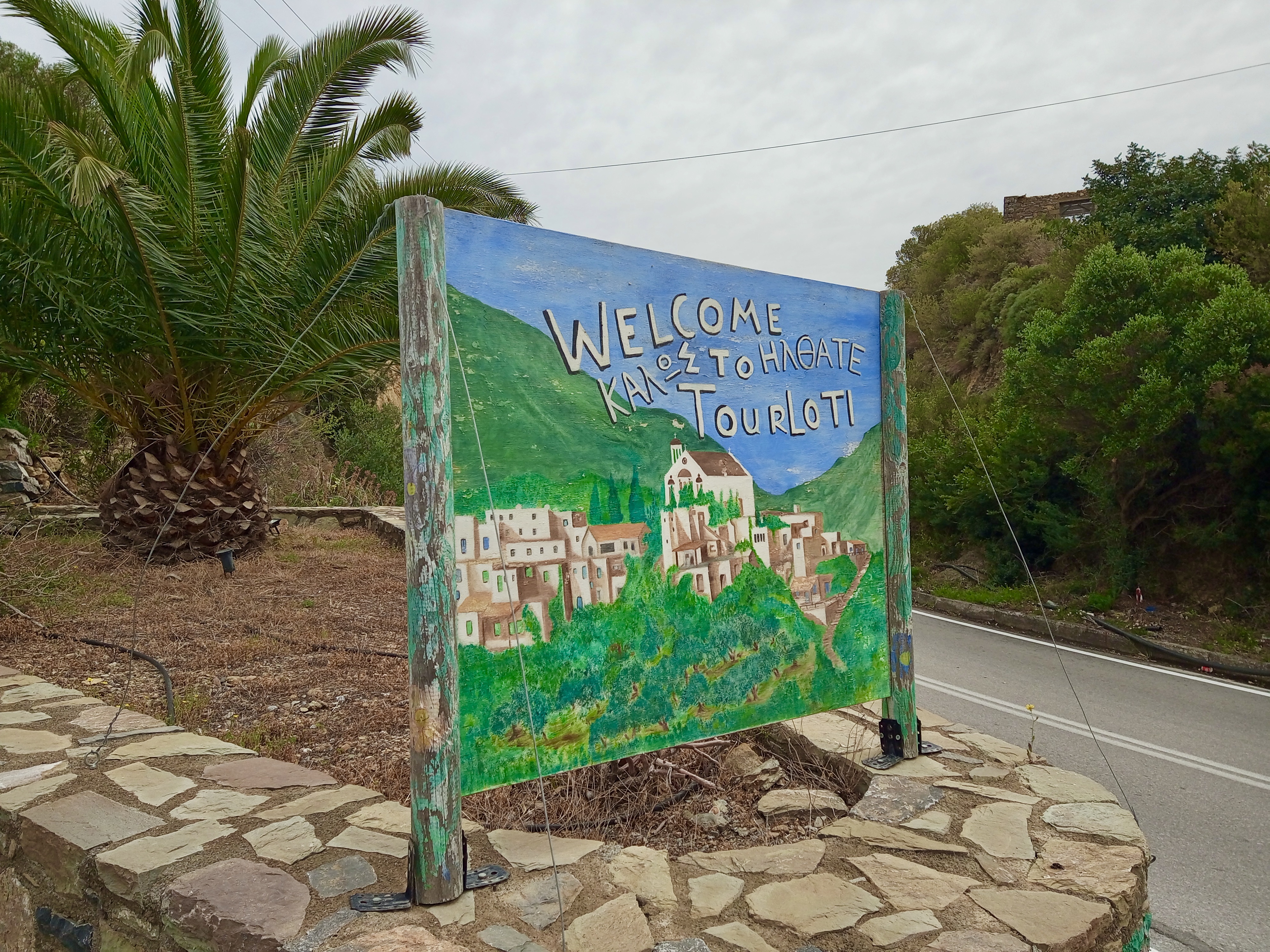
Above: The cheery sign indicating the entrance to the delightful village of Tourloti, on the road from Sitia to Pachi Ammos. That reminds me, we had a rather nice little experience there while travelling back from our week’s holiday in Sitia last May. Must write that up in a post soon.

Above: The town beach at Ierapetra at 8.00pm last Sunday evening. It’s a wonderful time to go for a swim, it really is.

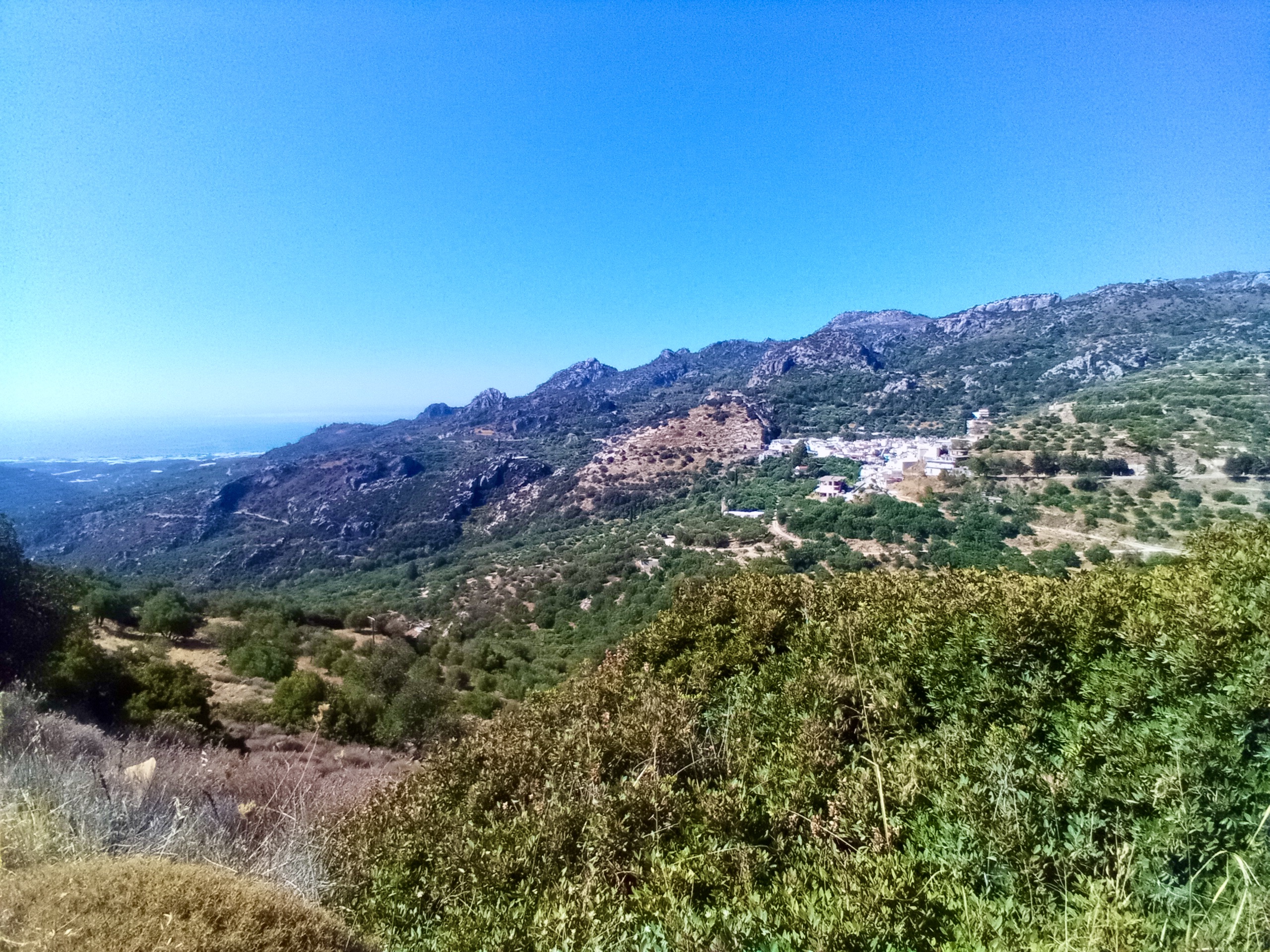
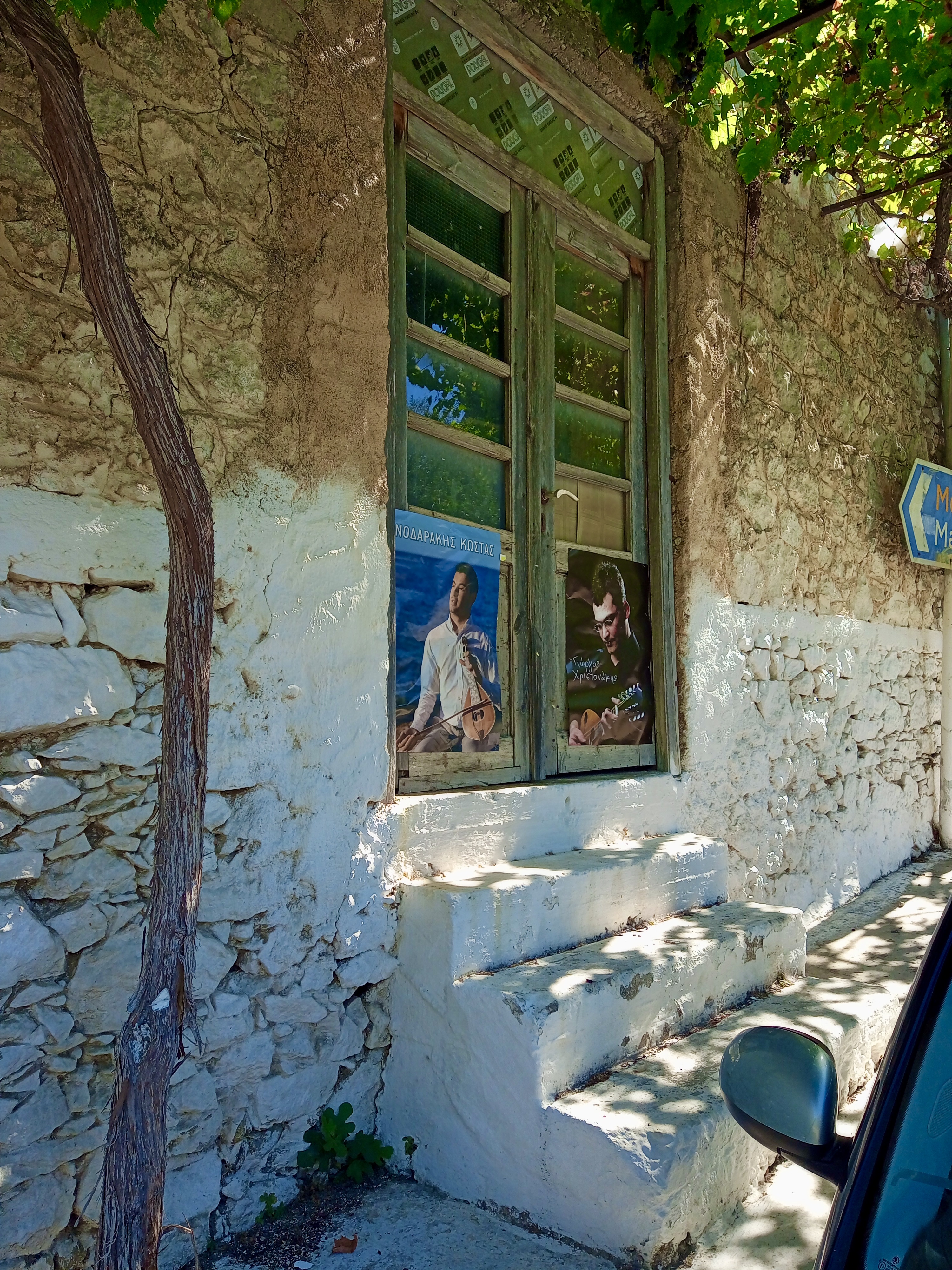
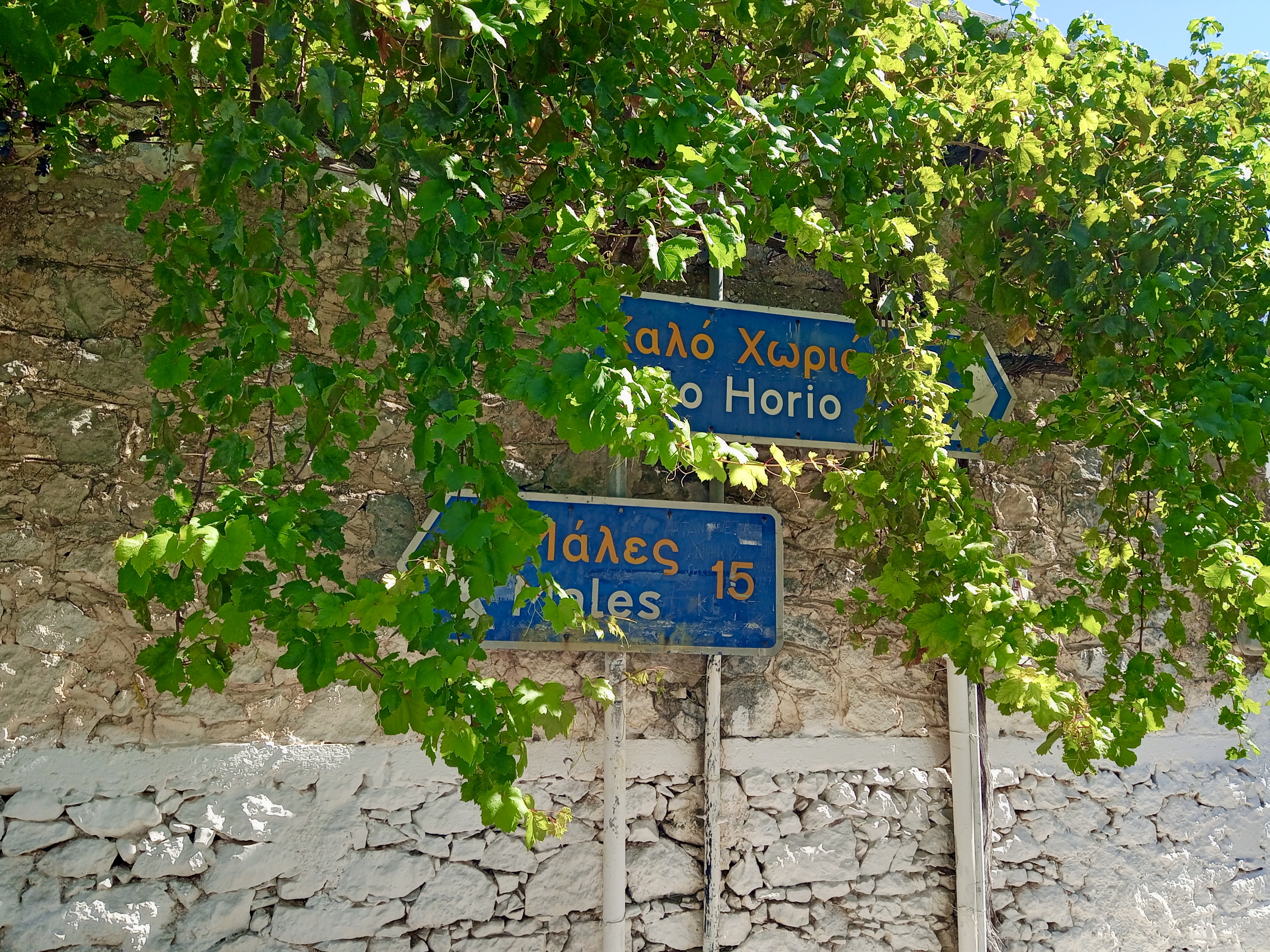
Above: The sleepy remote hillside village of Kalamafka, both from a distance and from up close.

Above: The reservoir just around the mountain from our village, still looking remarkably full following that wet spring we had this year.
•
Click HERE to go to my Amazon Author Page. There you can browse all of my written works.
 Accretions
Another interesting Blog, thanks John
The sign says “Good Village”? How appropriate! Great article John. Be talking to you on the phone before you know it!
Εννοείτε Bob! We’ve looked everywhere and we can’t find a village called ‘Kako Xorio’ either!! Though there are two other villages called Kato and Pano Xorio. I won’t insult you by telling you what those names mean either Bob!