How does your gardenia grow?

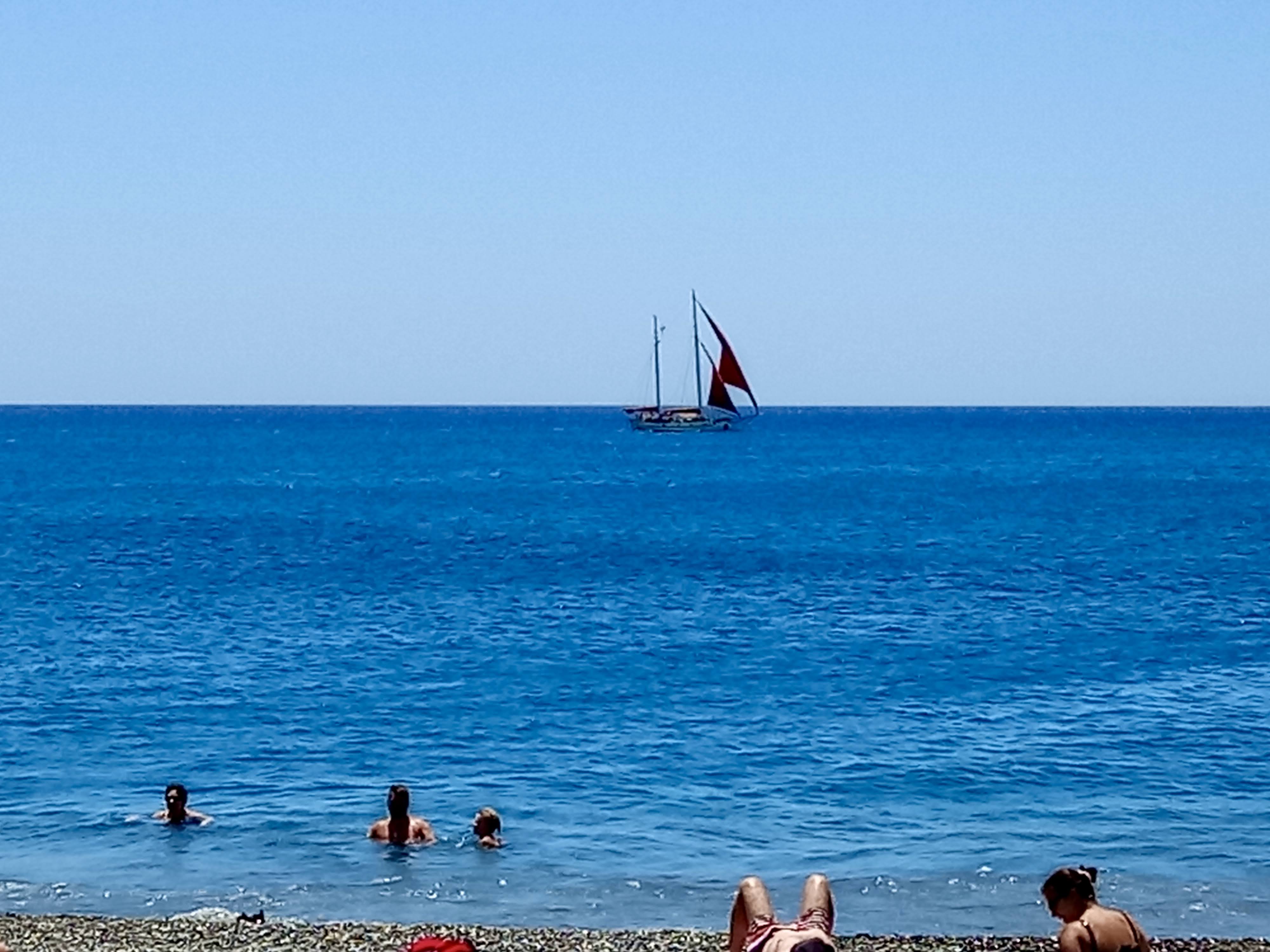
The above shot of a Ketch (watch as the aficionados shoot me down in flames here, since I know very little about such technical details!) passing our local beach was taken a few days ago. I don’t know what it is about such sailing vessels, especially those that look like they have some history behind them, but they evoke such romantic visions of past times when these vessels roamed the oceans all the time, but they do look so – well – just right, don’t they? I took another as well, so here it is…
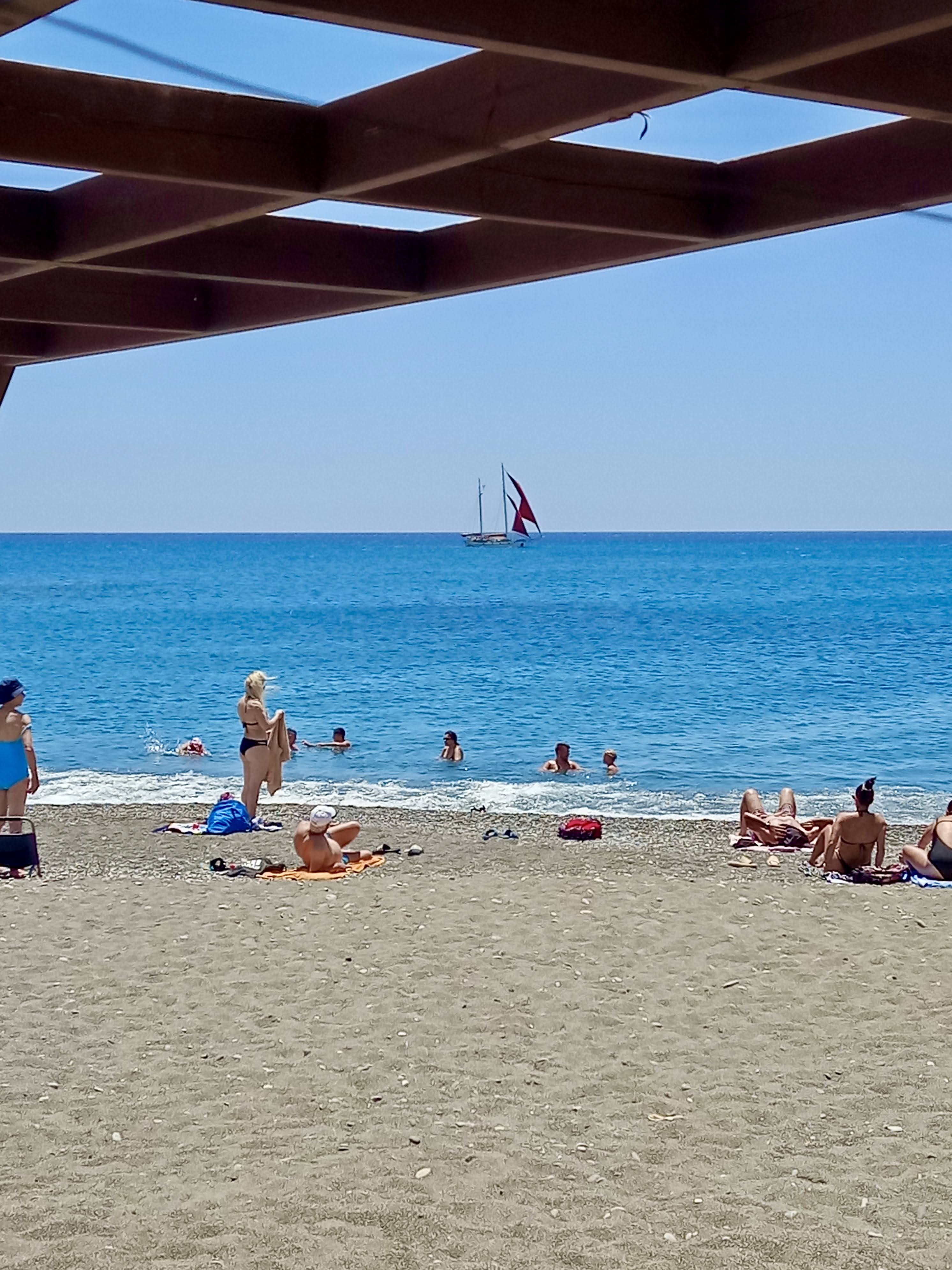
On the same day, I was rather amused by this bloke…
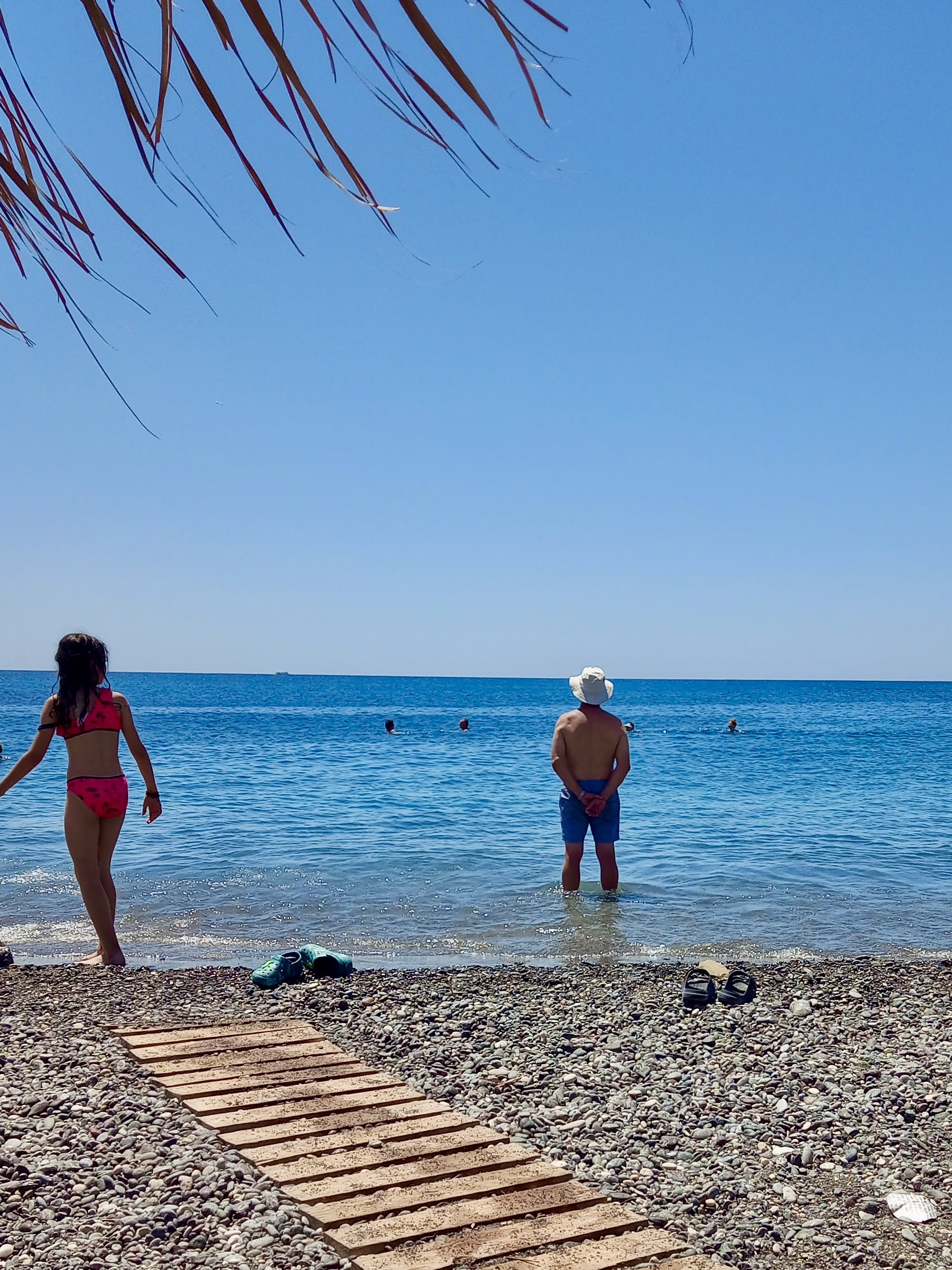
He stood there like that for at least half an hour or so, then he turned around and did the same thing again, but this time facing the beach. You won’t be surprised to learn that, when I heard him talking to his family a little later on, he was British! The hat is a good indicator (such sartorial elegance), as is the fact that he was evidently simply trying to brown himself off. Apart from when they go into the water to cool off, the locals simply never stay in the sun for more than a minute or two. Up until this year, and this is our fifth summer in our ‘new’ home, we’ve hardly ever heard an English voice in Ierapetra. This year, though, we’ve heard them more often, and so I did a little research, only to discover that this is the first season that TUI have contracted with a hotel a little way along the coast towards Makry Gialos, and thus I suppose we can expect to hear and see British tourists around the place a little more often now.

I called this post How does your gardenia grow? because we were talking with some locals recently about the gardenia plants in their garden. Gardenias evoke such vivid memories for me because, when I first visited Greece, which was in September of 1977, we stayed with Yvonne’s relatives in Athens for three weeks, during which we also passed a few days on my first ever Greek Island, which was Poros, in the Saronic Gulf. Incidentally, if you click on that Poros link, you’ll go to the official tourist info site for that delightful island. Just out of interest, if you look at the banner photo at the top of that page, the small village rooms where we stayed (and did so four more times over the succeeding five years) are smack in the middle of the photo, slightly right of centre. For me to try and explain exactly which rooms they are would be a bit of a struggle, but suffice it to say that once you’ve started your whole Greek experience in such circumstances, you begin to understand why I so hate big hotels, and especially the All-Inclusive variety. OK, so I had a Greek mother-in-law to make all the arrangements to begin with; but the only way, in my humble view, to truly enjoy Greece and to ‘feel’ the country, is to stay in modest accommodation in the thick of things, not out on some limb amongst a few hundred of either your own compatriots, or a mix of northern Europeans.

My wife’s Uncle Theodorakis grew gardenias for a living. Back then, when I first went to his house in Kato Patissia (which was a very different place in 1977 than it is these days, sad to say) the scent of these waxy, lush, creamy white flowers was heady indeed as you entered his nursery, which was situated along a fairly nondescript suburban street, oddly enough. The reason for its quite urban situation wasn’t hard to understand, because that nursery had been there since the days when Athens was more a collection of small villages that the urban conurbation that is has since become. Uncle Theodorakis made his living out of gardenias and nothing else. We’ve toyed with the idea of planting them in our garden here, but we’re a little worried about how you look after them, to be truthful. If you want to know what they look like, here’s a photo…
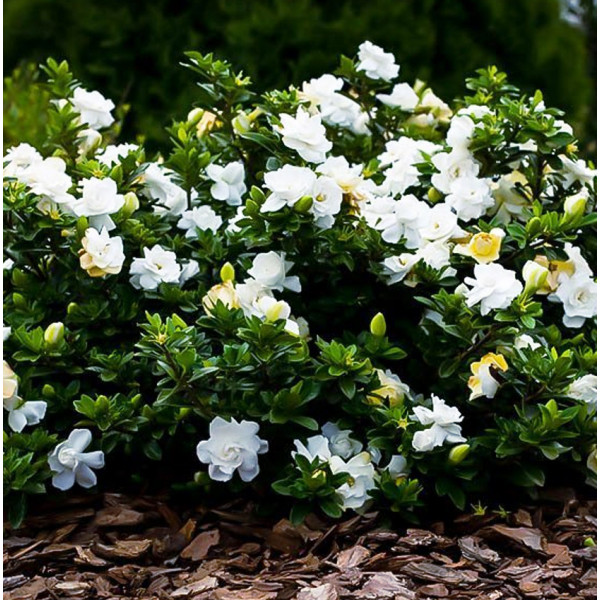
Gardenia bush photo courtesy of https://thessfyta.gr/

Theodorakis would sell the flowers to night clubs and restaurants, anywhere where there would be live music. Most people are aware that the most popular way of showing appreciation for musicians, singers and dancers during a Greek knees-up used to be by smashing plates. What perhaps you may not be aware of was that the plates that they would smash were more often than not specially made for the purpose and often not glazed in a kiln. Some years ago the Greek government of the time passed a new law (as long ago as 1969, in fact) prohibiting the smashing of plates, because the shards could injure people. It took a few decades for that law to actually bite, since during my early visits to the country throughout the seventies and eighties, plate smashing was alive and well, since I saw it many times. I used to marvel at how the staff in the club would brush all the fragments into piles along the side of the dance floor with stiff brushes, before they got going on yet another session.

When you entered the wooden gate into Uncle Theodoraki’s nursery, you passed through a few metres of rich, shiny foliage until you reached the few steps up to the veranda along the front of the house. Once you’d penetrated the gardenia ‘forest’ by but a few metres, you could have been forgiven for thinking that you were somewhere out in the wilds, the city street from which you’d just gained access seeming a whole world away. The plants were either growing out of huge terracotta pots, or were planted up in smaller pots on wooden benches, thus making the foliage and the luscious blooms around shoulder/head height. You’d have to gently nudge some delicate branches aside to avoid them brushing against you as you walked. Next time you’re near a gardenia plant, make sure you smell the flowers. Mind you, if it’s in bloom you won’t have much difficulty in doing that, because their smell is quite strong, especially if you’re near them in the early morning or early evening hours. It’s also one of the loveliest natural aromas you’re ever likely to enjoy.

Small wonder, then, that my first ever experience of gardenias, which was a mere 47 years ago, is still with me today, especially when I’m fortunate enough to be near to a gardenia plant nowadays.

Going back to the whole plate smashing thing, I only mentioned it because, owing to the new law, plates began to be replaced by flowers, and occasionally paper serviettes. If you go to a popular bouzoukia these days, by the time you reach about 3.00am, the dance floor (and often the singers sing from there, in amongst the revellers) is almost knee deep in paper serviettes, red carnation flowers and white gardenias, although these days the gardenias have lost a lot of ground to the carnations, which are cheaper. Where do the patrons get these flowers from? If you sit at a table in a bouzoukia (different link to the previous one), you’ll see members of staff regularly circulating amongst the customers carrying little wicker baskets of them, sometimes piled ten high on their arm. If you approve of either the bouzouki player or the singer, you show that approval by purchasing a basket of blossoms, getting up and then moving as close to the musician as you can before throwing the contents of the basket all over them. There is also another way of showing your appreciation, if you happen to be well-heeled enough (or want to give the impression that you are), and that’s to order a bottle of champagne from a waiter, who’ll then take it right up to the singer or bouzouki player, pop the cork while standing beside them, and then making a great show of pouring the effervescent liquid into a flute and handing it to the recipient, while pointing at you with the other hand to show them who’d shelled out for it. Aah, those were the days, when I had the stamina and the appetite to be out until dawn.

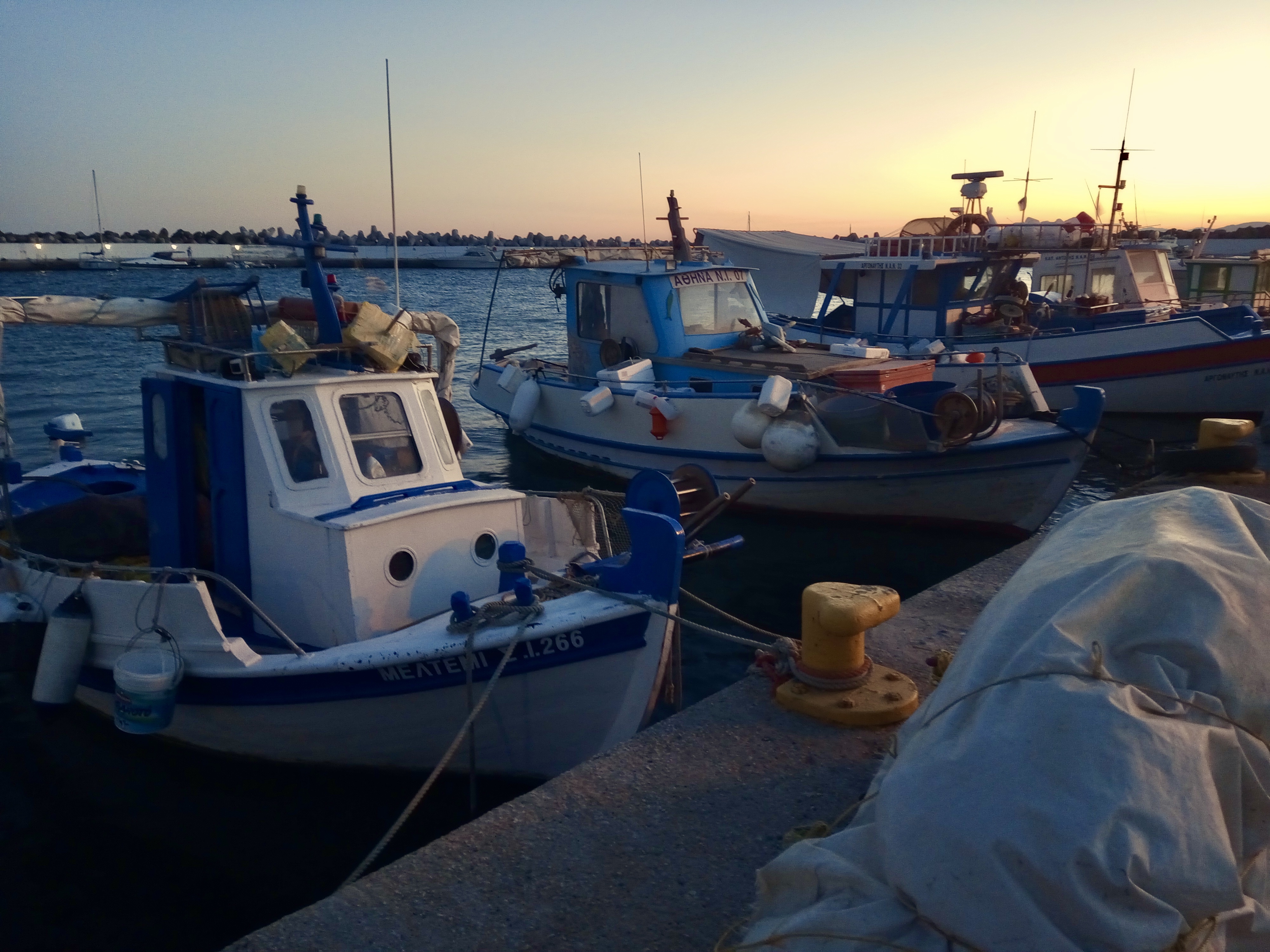
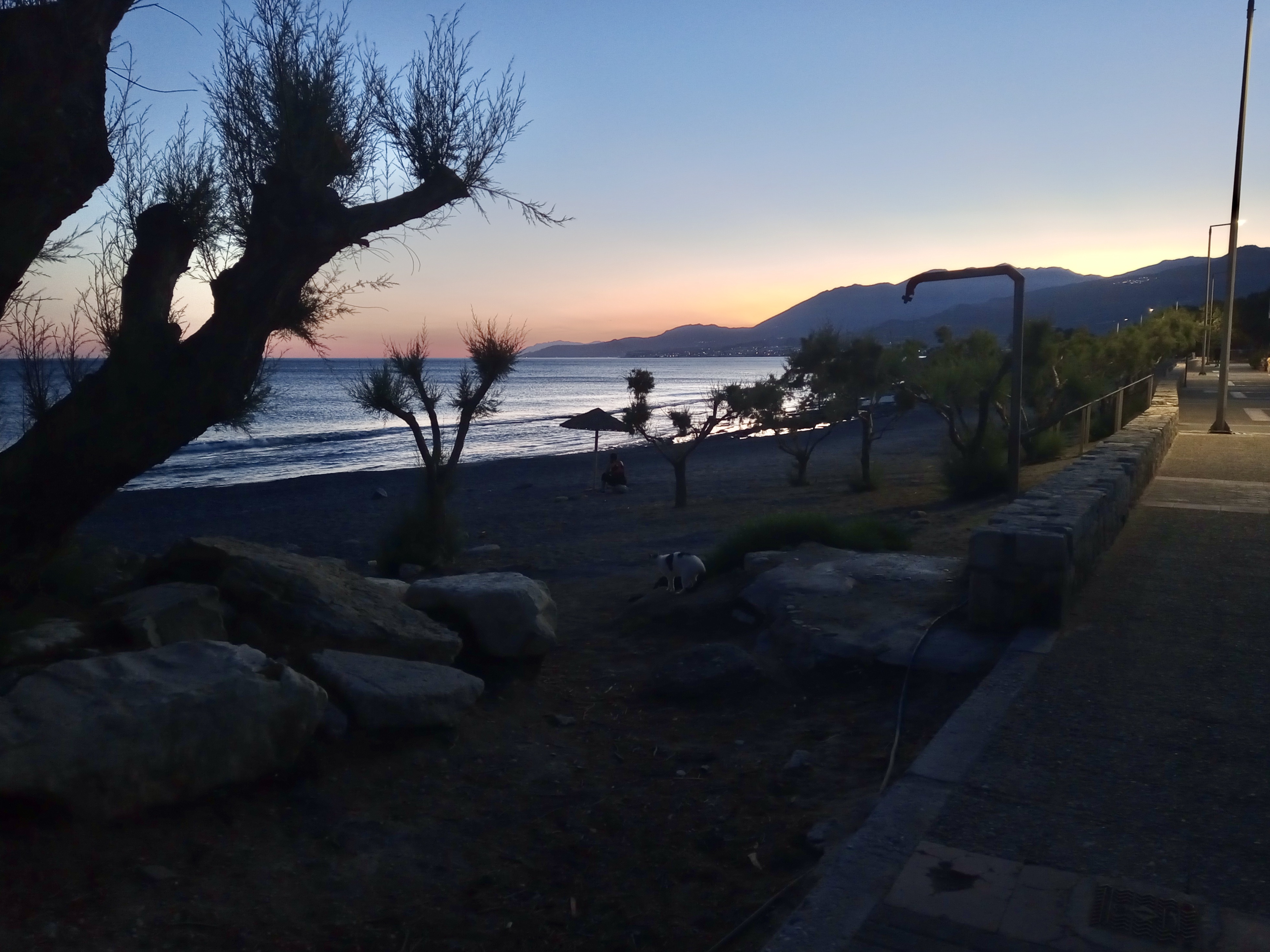
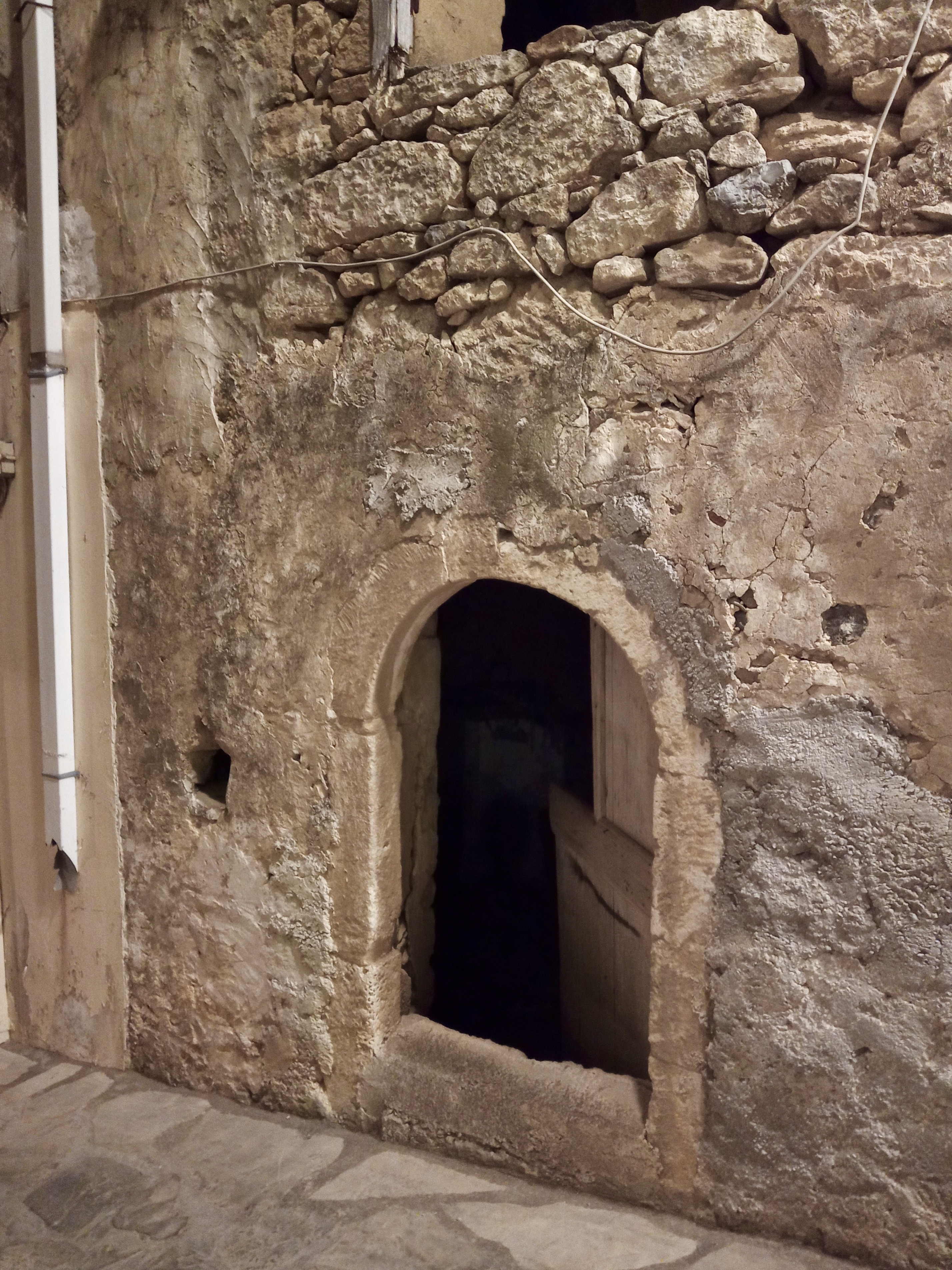
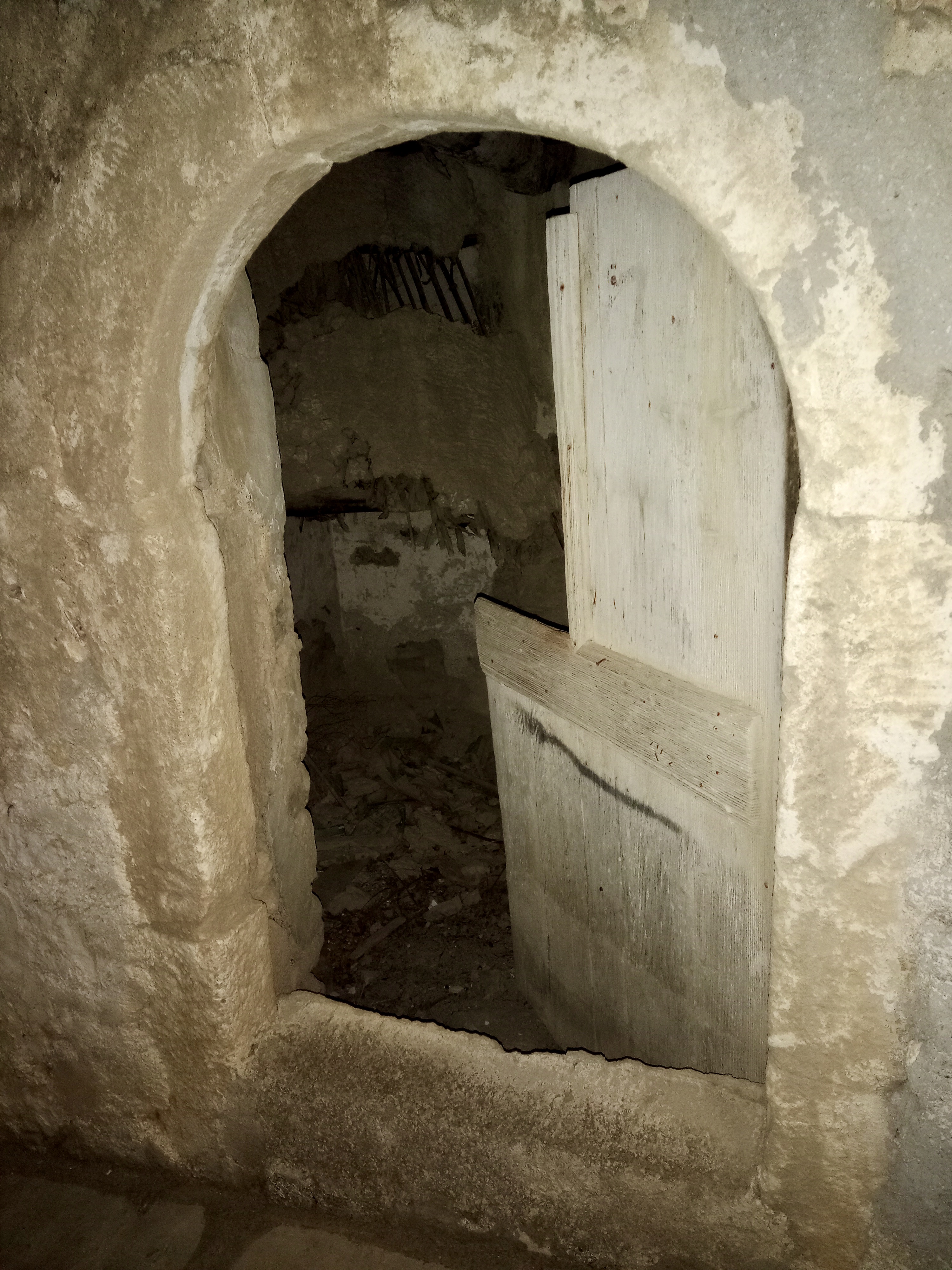
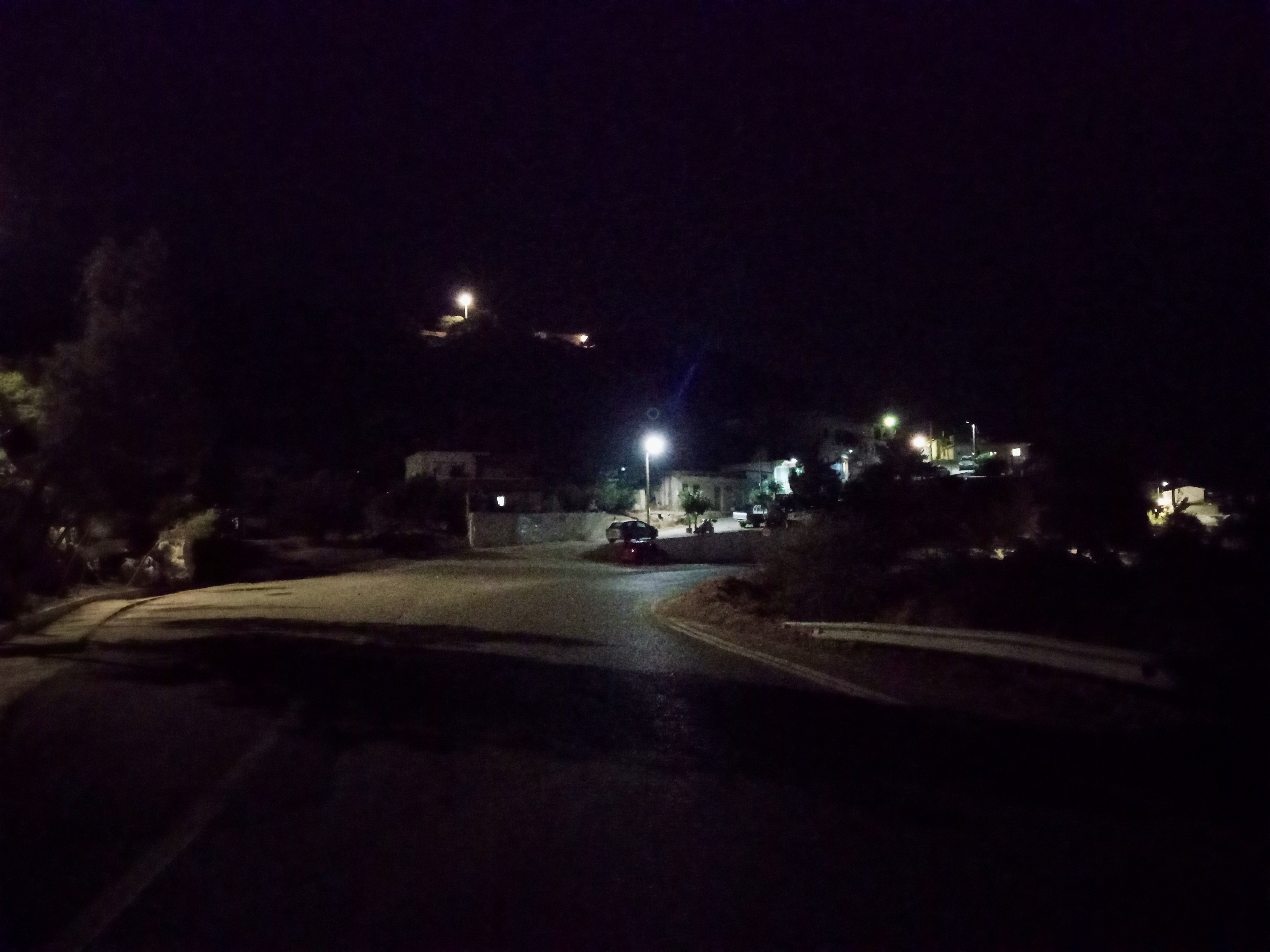
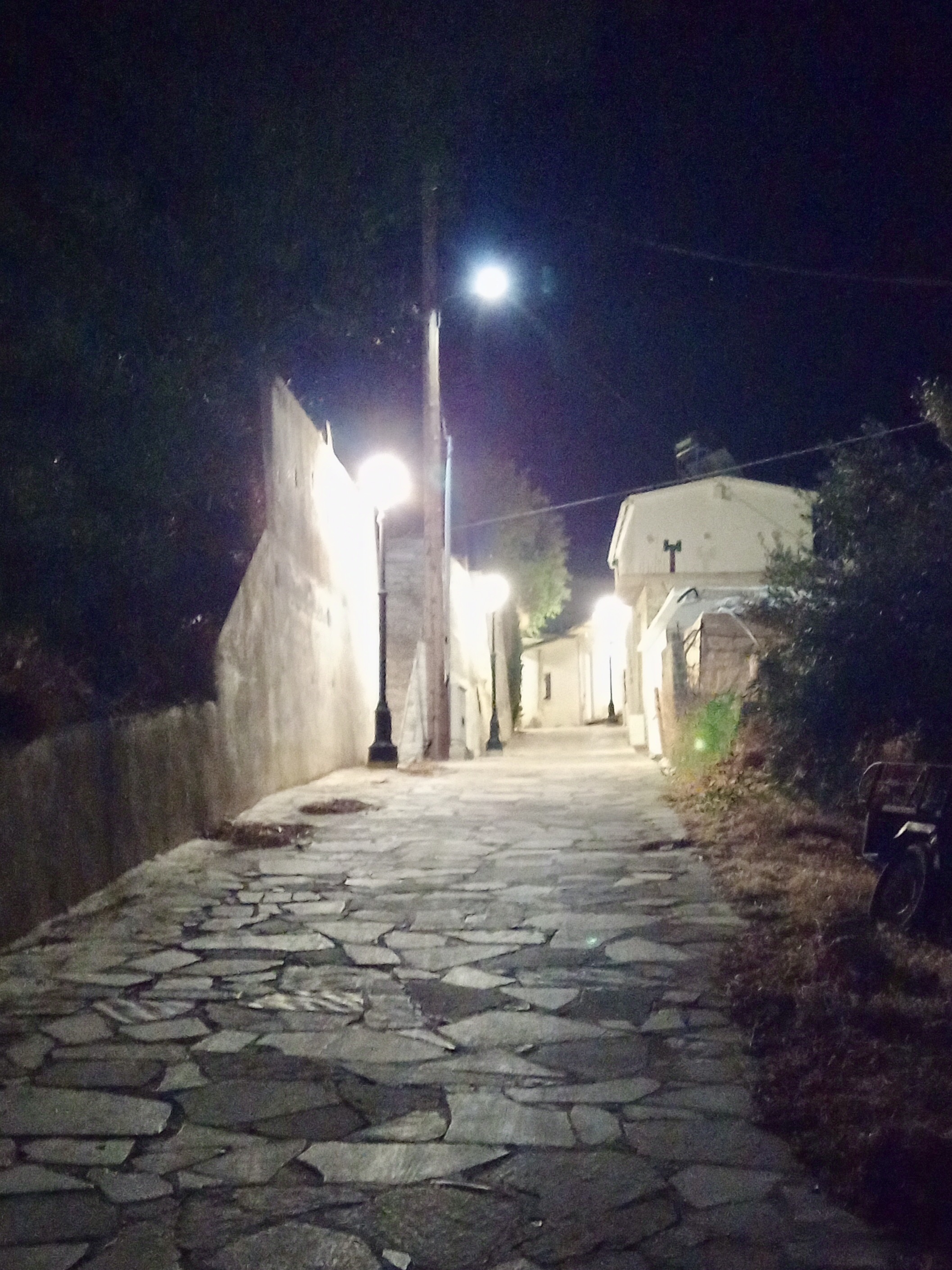
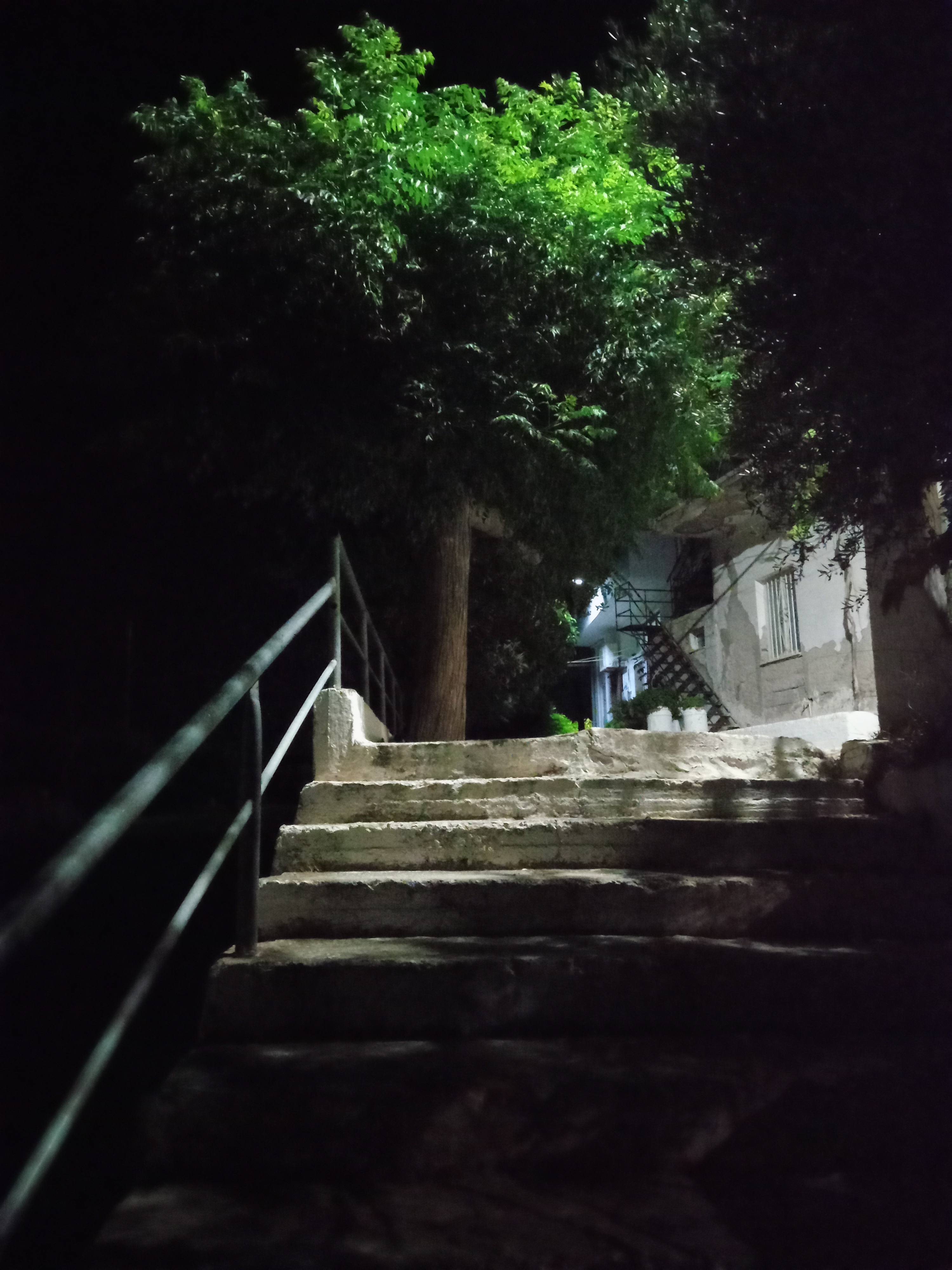
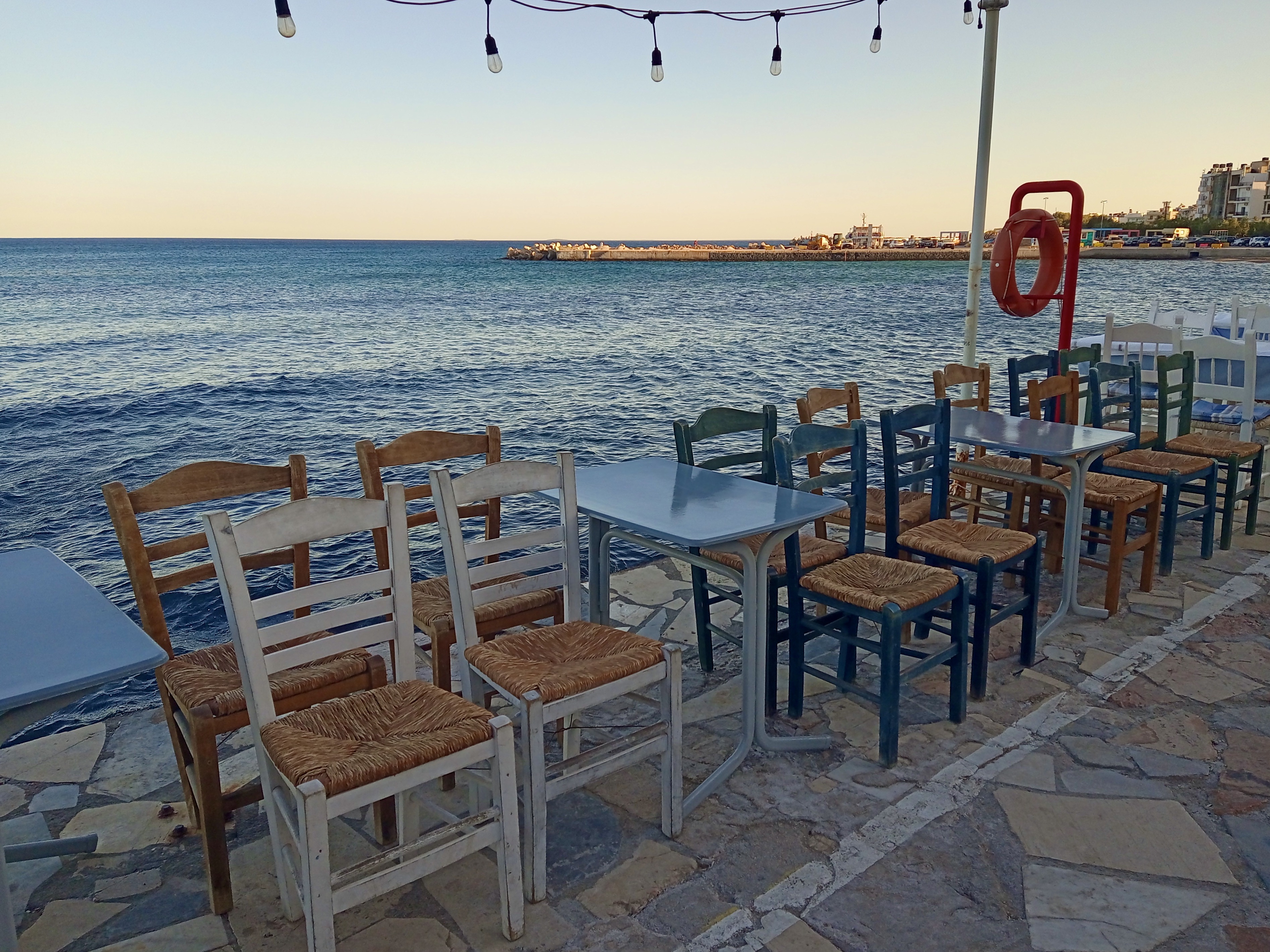
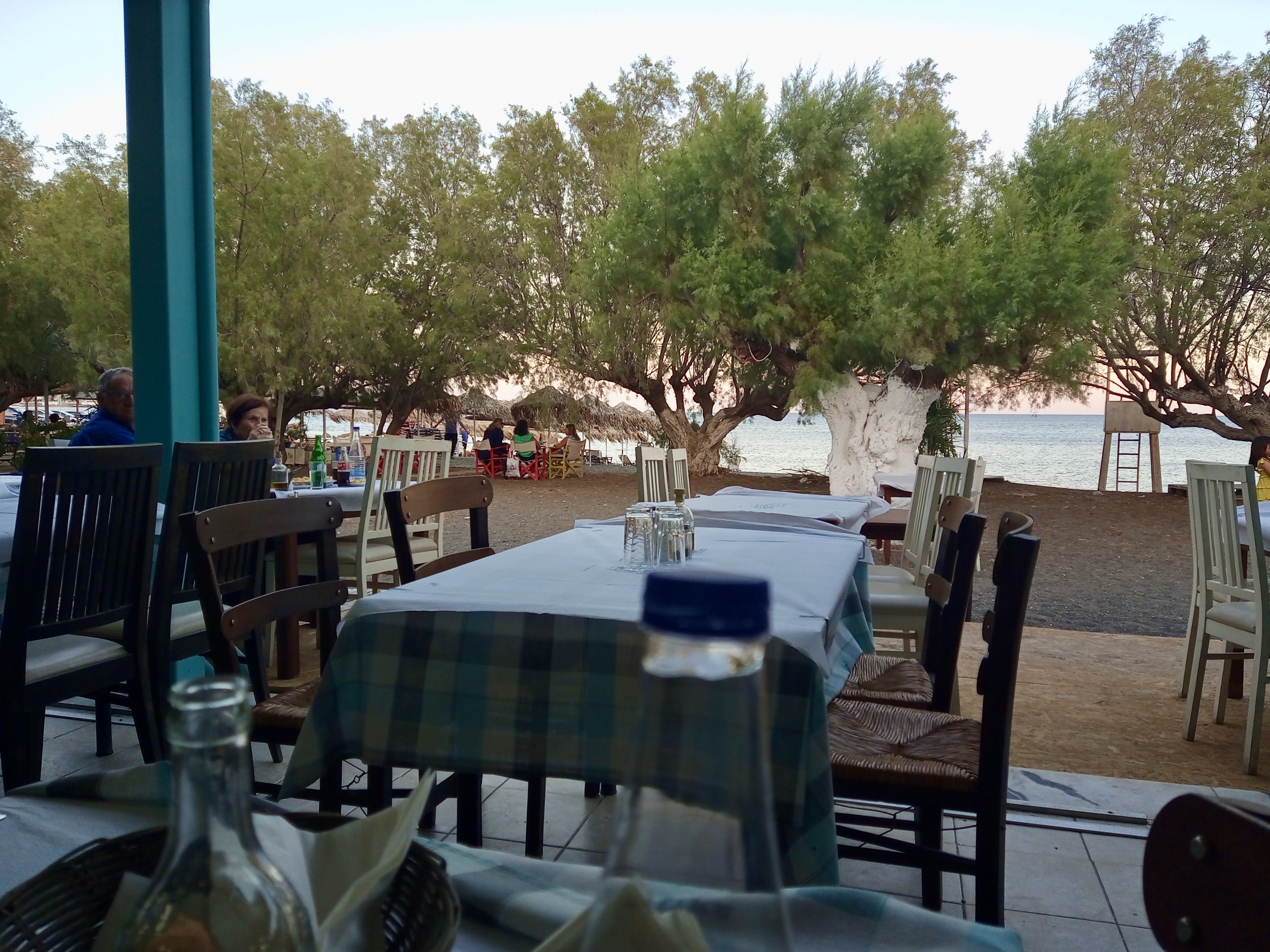
These photos below were all taken either at night, or at dusk either in the village or down in the town recently. Hope you like them…
Click HERE to go to my Amazon Author Page. There you can browse all of my written works.

That [those] darned cat [cats]

Cats, of course, are famously more independent than dogs, don’t require taking for walks and don’t wake up the neighbourhood in the dead of the night by barking for an hour without seeming to have any logical reason for doing so, apart – that is – from the desire to make sure that if they can’t sleep, then they’re going to make flippin’ sure that no one else does either. OK, yes, now and then a couple of local male cats will have a slanging match and go at each other hammer and tongs with their claws, but it doesn’t usually last long, although sadly it often results in the loser in the altercation coming off with a torn ear, or a nasty wound about its head or neck that would require a visit to the local A&E were it a human.

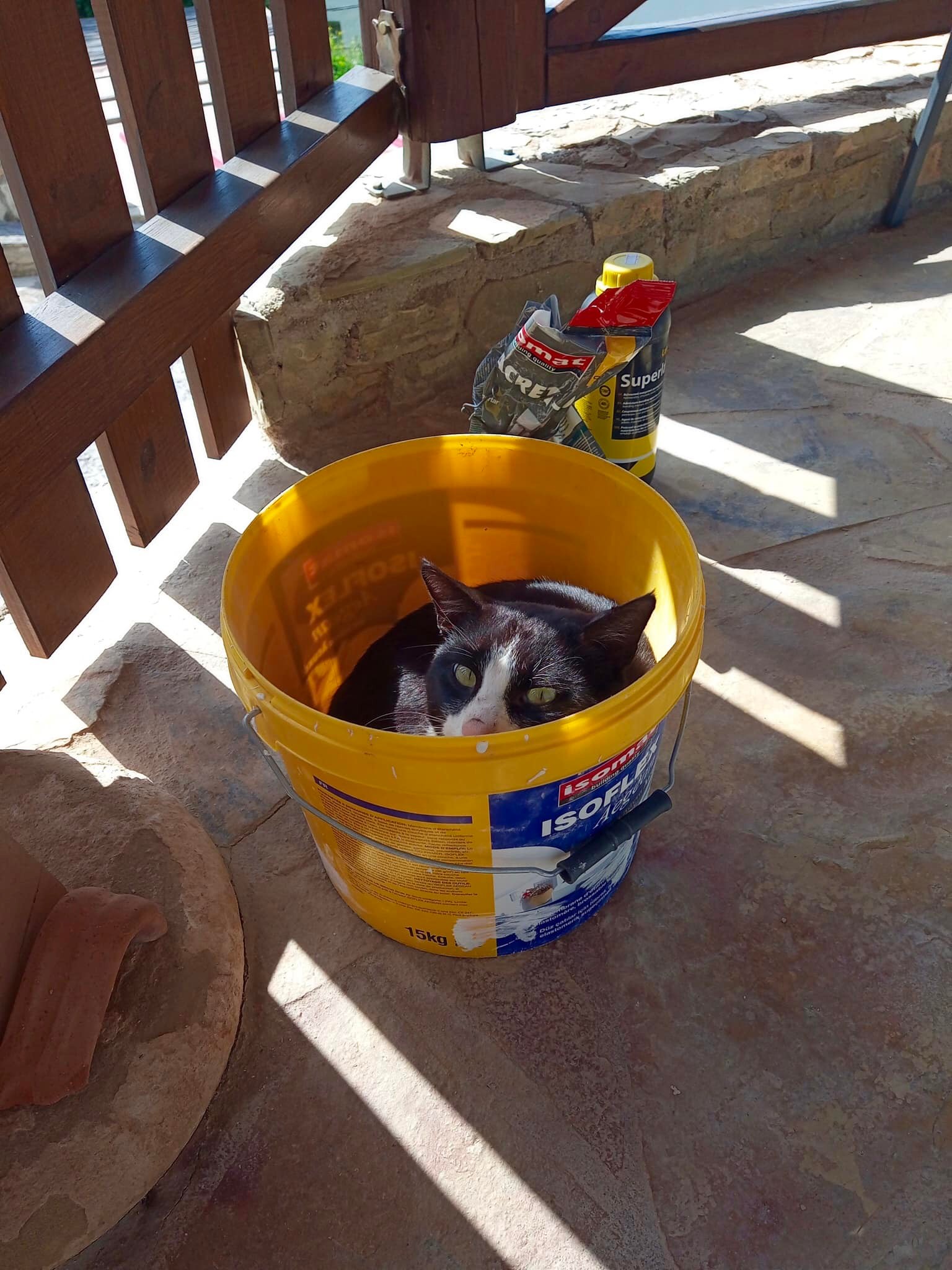
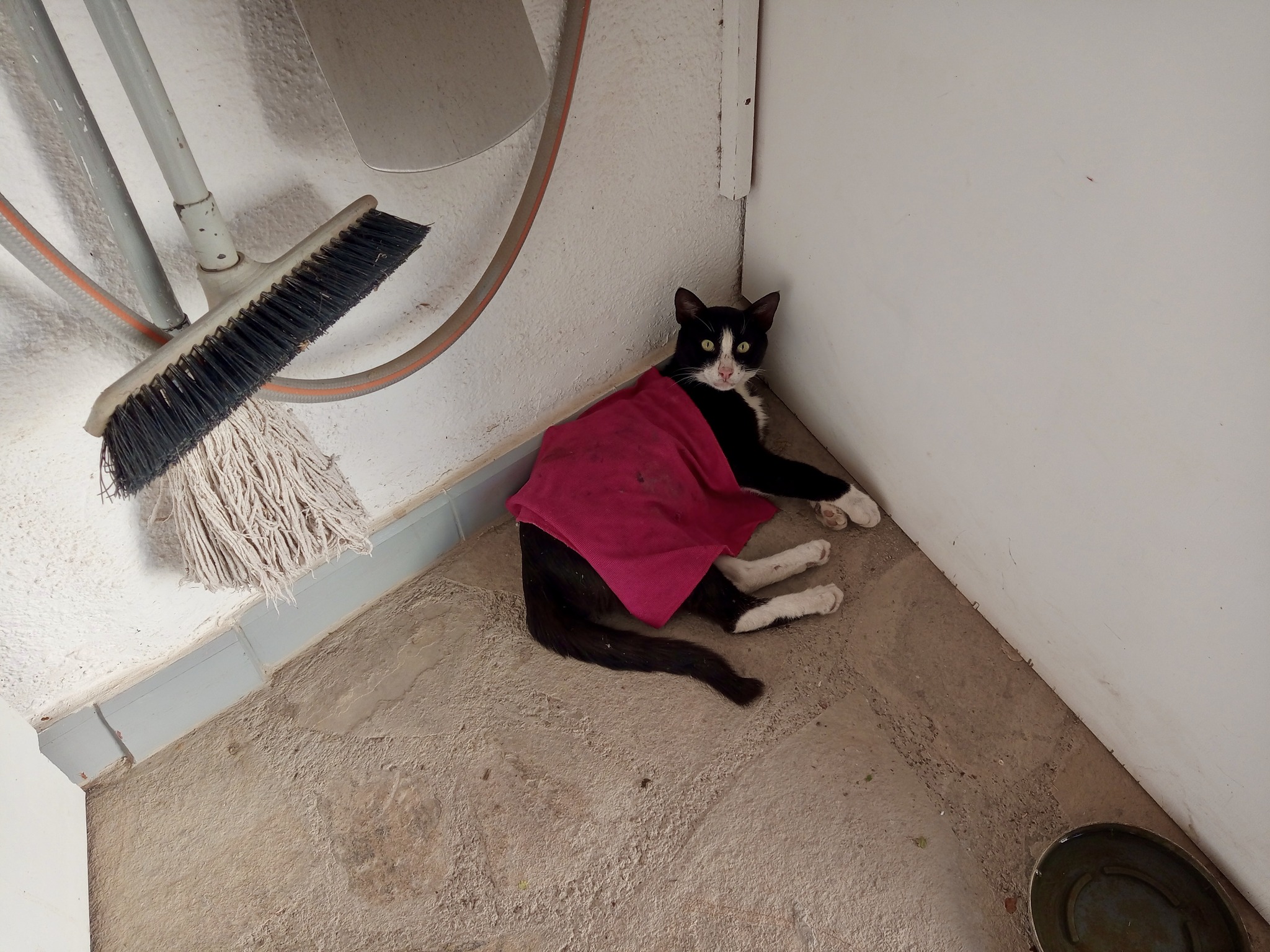
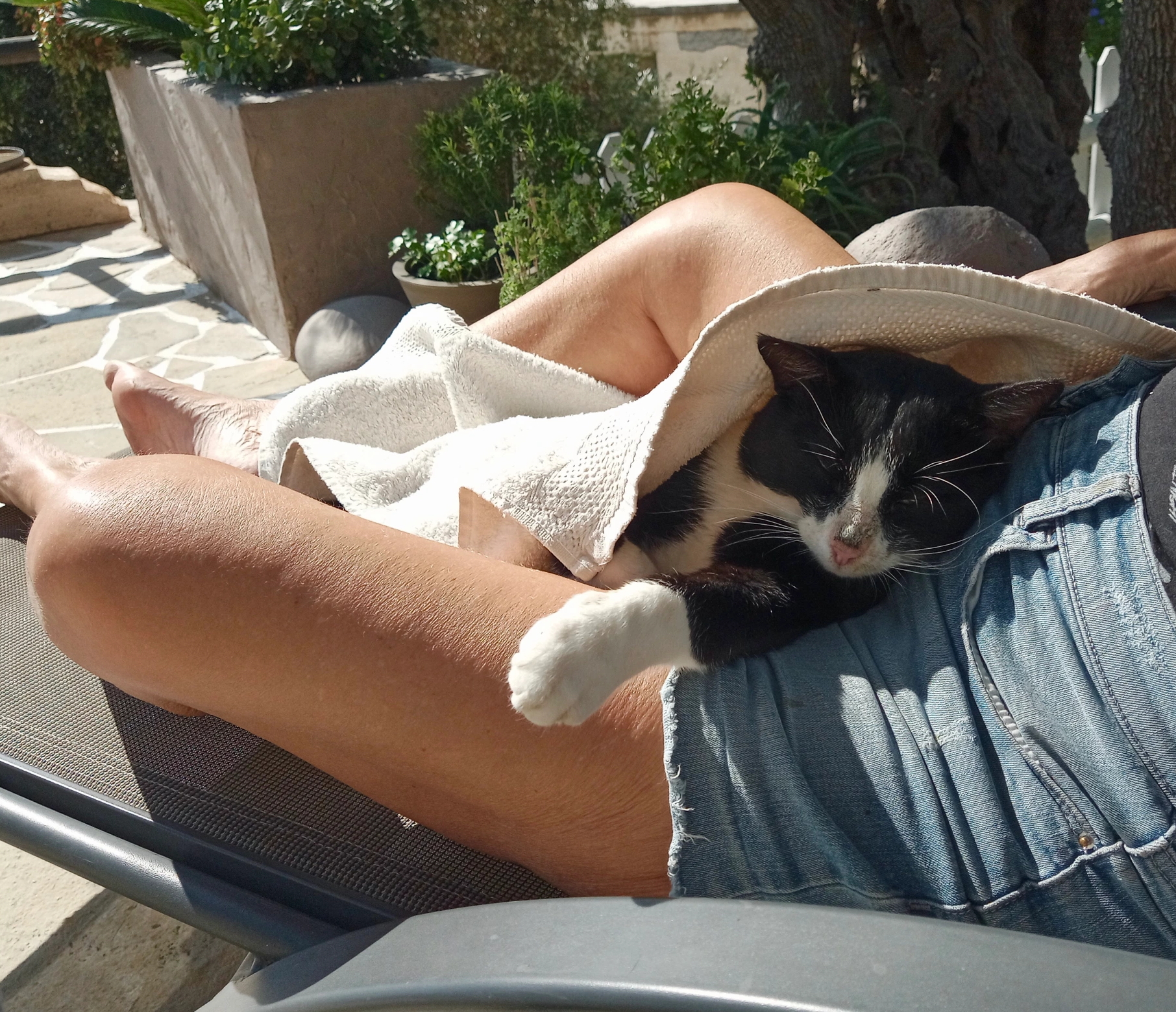
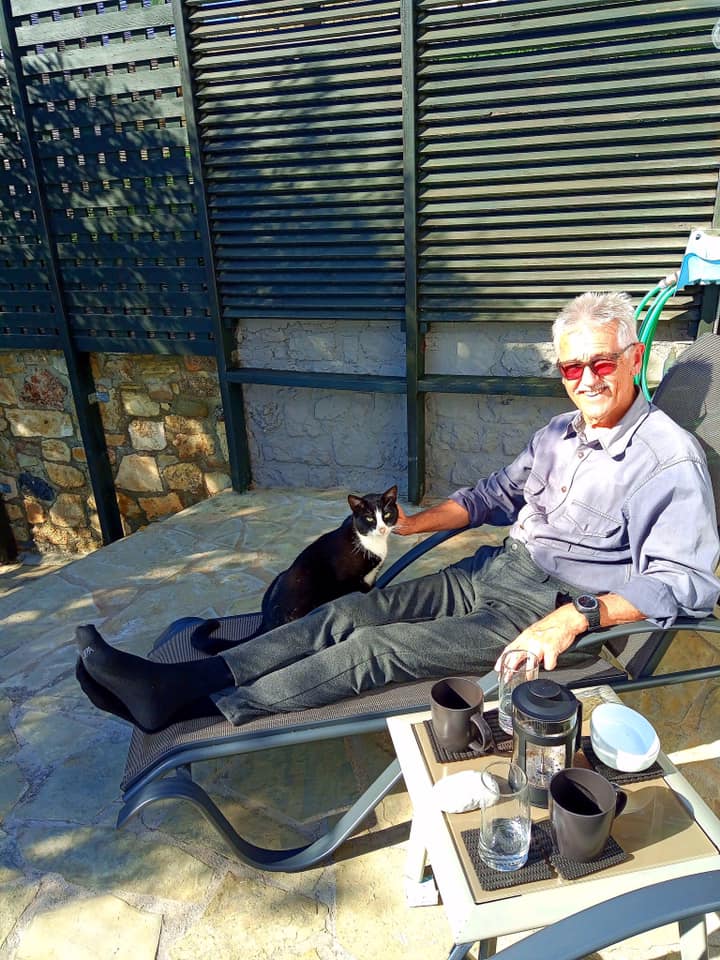
The beloved and I have always understood that to own a pet is a great responsibility, and it requires much sacrifice, which is precisely why we’ve spent most of our married life not owning one. In times past when my parents were alive we’d sometimes spend a few weeks back in the UK and to worry about what to do with a pet during that time was a principal reason why we decided against the whole venture. A couple of years ago however (and I know I’ve mentioned this before), a small black and white kitten (feral, of course) took to following me around the garden, to the extent that he quite stole my heart. The little perisher wheedled his way into our affections, so we started buying food for him and, before long, he’d well and truly got his paws under the table and was to all intents and purposes our cat. He lived with us for a couple of years while he grew into a formidable and handsome male, with a glossy coat and gentle disposition. We could do anything with our Mavkos, and he’d revel in the attention. Here are some photos of him, even though it still pains me to look at them (as I shall explain below) –

We became so soft on that cat that we’d also buy little packets of treats for him and he always knew exactly when it was time for coffee on the terrace. He might be nowhere to be found, but as soon as we opened that screen door with the tray in hand he’d come trotting around the corner of the house from the veranda and insist that he got his little dish of treats before ever we could settle down for our coffee. Once he’d finished his little dish of ‘nuggets’ as we used to call them, he’d sit there between our two sun loungers and look first one way, then the other, before deciding which of us would receive the privilege of having him curl up between our legs, his head on a human thigh, where he’d expect to be smoothed and tickled for half an hour or so.

Then, one day, about a year ago now I suppose, he started with his absences. At first he’d be gone for four or five days, then turn up like butter wouldn’t melt, usually around coffee time, and expect his treats and cuddles quite as usual. These absences gradually increased in length and we were sure that he’d found another house in the village where they’d taken to this amazingly affectionate cat that was obviously at home around humans and begun feeding him there too. Frankly, we were OK with this because the first time we’d been away while he was ‘our cat’, as it were, we’d enlisted the help of Angla’i’a to come and feed him while we were away. She’s no longer in a position to do that, because her legs won’t get her up the fifty metres or so of our drive any more, it’s simply too steep for her. So to be able to go away and not have to worry about Mavkos was a blessing.

The problem was, and anyone who knows cats will also know this, you never really own a cat, it’s more that he or she deigns to live with you. It seems to me that loads of cats the world over have more than one home, often without the original owner ever finding out. Back on Rhodes we’d hosted our neighbours’ cat each time they’d gone to the UK for a month or so each spring. The cat was called Simba and wasn’t even originally theirs to begin with. He’d moved in with the couple who’d bought the house that was built above and behind their place, and had belonged to Nicola, the new resident there. The trouble was, the more dogs that Nicola adopted, the more time Simba would spend on Ron and Janet’s terrace with them until, inevitably, he decided to throw his lot in with them to escape the hassle. When they went away he’d move effortlessly down the hill to our place and was effectively our cat for the duration of their absence. When Ron would come home he’d be very keen to collect Simba, since he’d missed that cat terribly. It’s not surprising really, because he and Simba were virtually inseparable all the time that Ron was at home. Simba would follow him all around the garden, sprawl on his lap while Ron read the papers on his Kindle device during the daytime and flop onto the sofa with Ron of an evening. When they got back to Rhodes from the UK, the simple act of Ron carrying Simba back up the hill to their terrace was the signal for the cat to return home, whenceforth it would be our turn to miss him for a while!

So, with all the above in mind, you’ll understand how we felt when Mavkos simply didn’t come back any more. Simba had disappeared a couple of years before we left Rhodes, and when he first went away Ron was beside himself. He’d wander the dirt tracks and forest trails around the house calling for the cat to come home, but he never did. There were no other houses within a sensible distance for a cat to relocate to when we lived in Kiotari, so we had to conclude that one of two things had happened to Simba. Either he’d been poisoned (a regular and barbaric habit of some of the locals in rural areas around the Greek islands), or, somewhat like an elephant, Simba had known that he was unwell and was going to die, and so went off to curl up in some concealed nook somewhere to go to sleep for good.

Once it had become apparent that we were to experience a similar loss with Mavkos, I ended up really identifying with Ron and how he’d felt at the loss of Simba. In fact on more than one occasion I scoured the village hoping to find where he’d decamped to with the idea of trying to coax him home, or at the very least making sure that he was happy and well cared for. No joy.

Mavkos came back just one more time, after a gap of about three months. At least we were relieved to see that he was OK physically and seemed to be well fed. He turned up right on cue as we were settling down to sip our iced coffees on the terrace one morning, only we didn’t have any packets of treats for him this time, so we fed him a few small chunks of Graviera (he loved cheese!). After that, he trotted off and we have never seen him since.

Our experience with Mavkos led us to decide that never again would we adopt a cat. To be honest, a lot of ex-pats take one look at a feral cat and decide, “Oh look! Isn’t he cute! Lets’ adopt him/her.” And they do. Unless you catch a feral cat at less than six months of age though, even though it can well acquire the habit of coming to you for food, it’ll never allow you to stroke it or pet it. After about 6 months it’s too late. After our own experience though, garnered over 19 years of living on a Greek island, we well understand how it is that lots of ex-pats end up caring for lots of cats, sometimes well into double figures. They simply look so cute. The fact is, though, that they are wild animals and their resemblance to the domestic cat is not really a good thing. As ferals they live off vermin and insects, and during the winter months they’ll eat vegetation too. When well-meaning foreigners turn up here and start feeding them cat food, they get lazy and no longer have to go hunting for rats, mice and lizards on which to survive. I once watched a feral cat on Symi chase down and devour a Symi spider, and it was not a pretty sight. That said, it was however somewhat reassuring, because if you’ve ever seen a Symi spider (and I talk about them quite a bit in my ‘Ramblings From Rhodes’ book series) then you’ll know that for the arachnophobe they’re a total nightmare. They’re easily as big as a tarantula and when one walks across the path that you’re following you hang back out of respect and let it go its way. We’ve stayed in various accommodations on Symi and once or twice had to deal with one of these monsters and it’s a daunting task, I can tell you. So, to be aware that the feral cats eat them is comfort indeed. But then, if those cats are used to being fed by well-meaning (although IMHO missguided) ex-pats, then they’ll have no need any more to hunt down their food. They thus become part-domesticated and the vermin population of the area prospers.

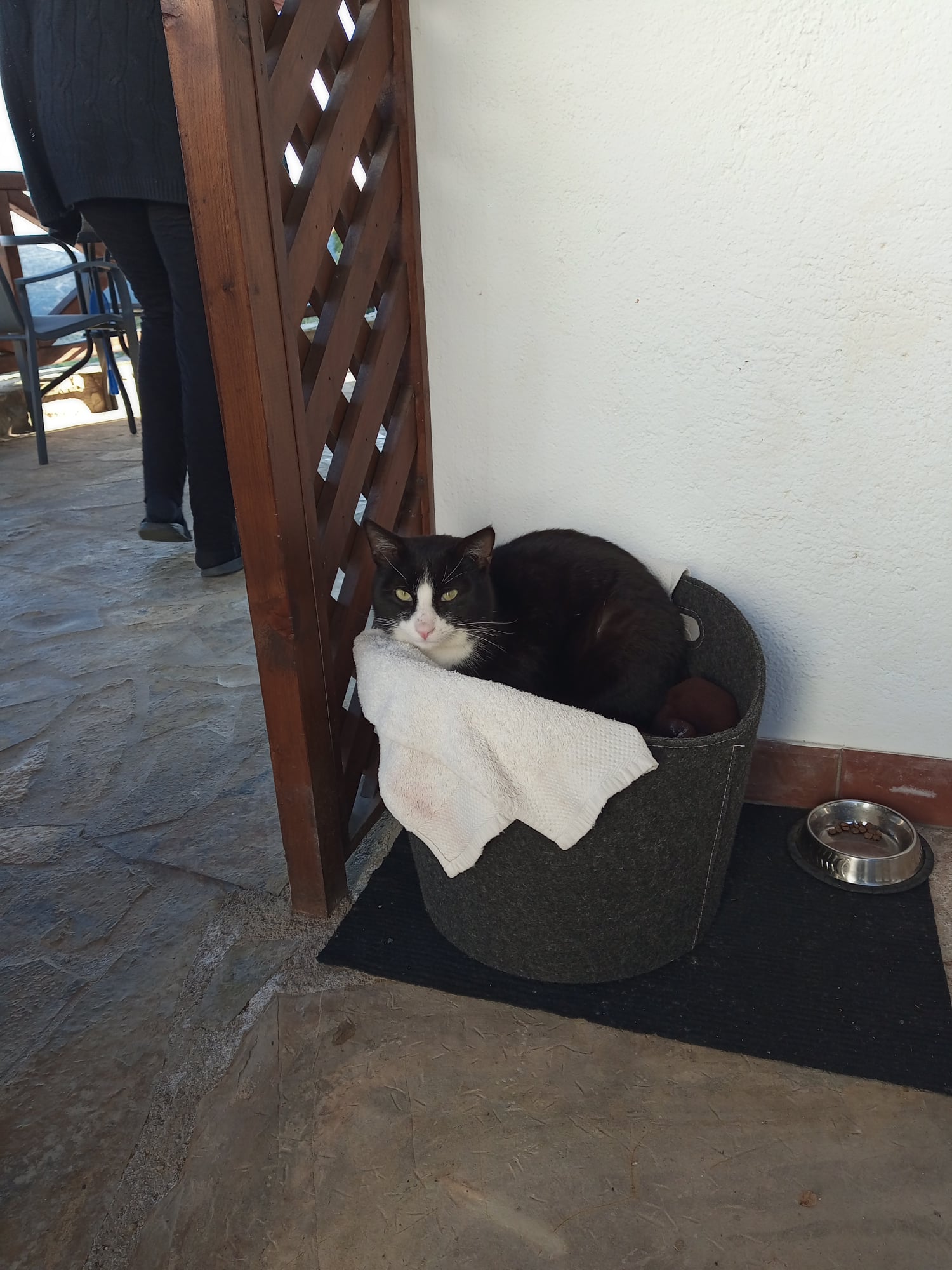
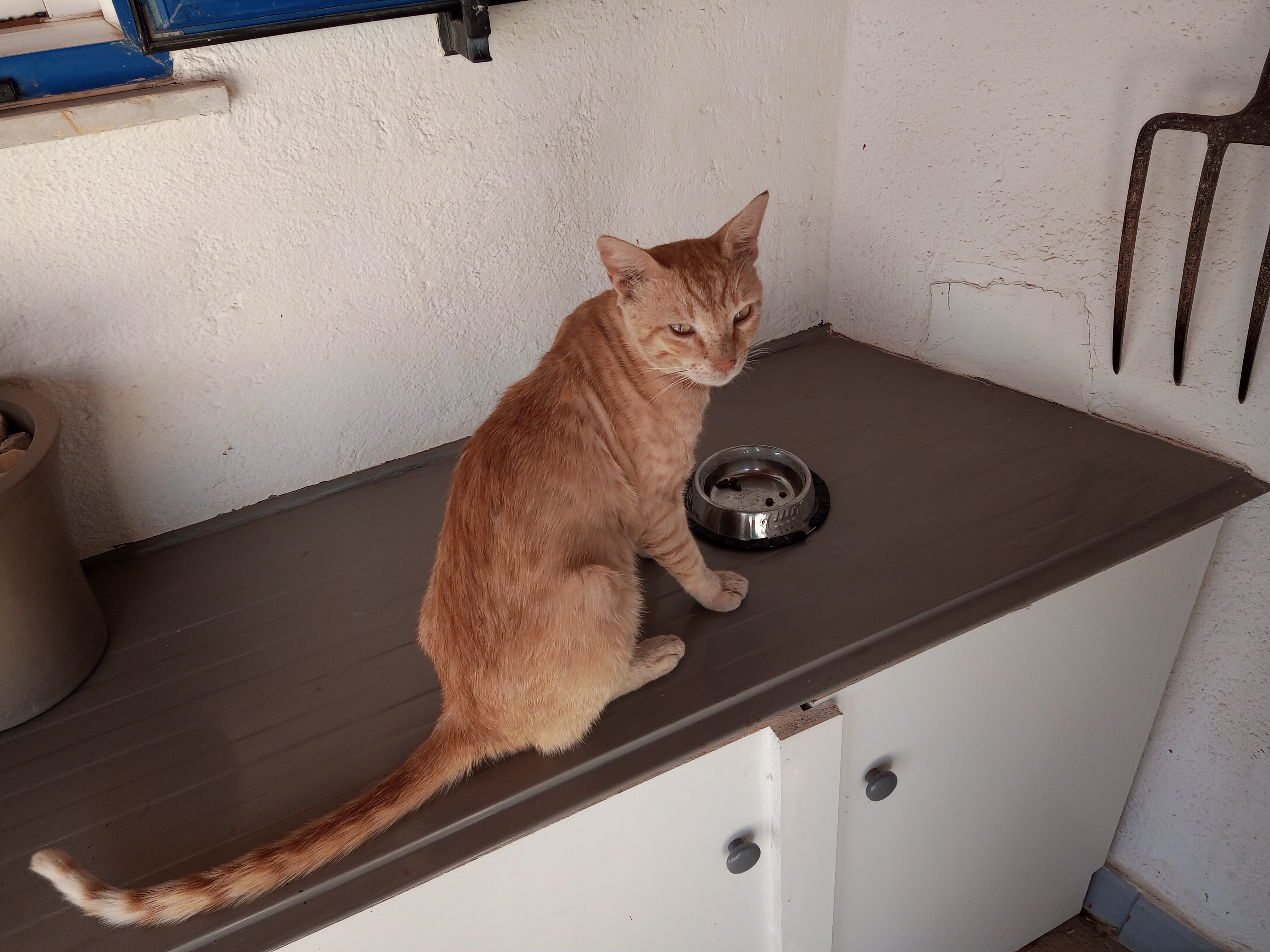
So, determined as we are not to become owners of another cat, you can understand how hard is our internal battle not to get too soft on White Sock, Groucho, Woebegone and Ginge, the ferals that regularly hang around our door when we’re pottering about at home. See, even to have given them names is to almost lose the battle, I know. It’s White Sock who’s dozing on the steps up to our upper garden in the photo at the top of this post. It’s also him staring in through the mozzie screen of my office while I write upstairs in the first shot below. There’s cunning old Ginge in the second shot below, scoffing a little food that we, in a moment of weakness, put out for him…

Here’s Groucho, the crafty little…

I don’t have a photo of Woebegone, so-named because he always looks like he has the cares of the world on his shoulders. Don’t let anyone tell you that cats can’t show feelings in their facial expression. Woebegone has a way of looking at you that says, “Poor me. No one loves me and the other male cats always pick on little old me.” It’s true, I tell you.

So, here’s the situation at present as I see it. Those puddytats mentioned above by name we do occasionally put food out for. What we are determined not to do though, is to feed them daily. That would be the beginning of enslavement, and we’re not prepared for that. Plus, we shall be going to the UK in September, and we don’t want them to suffer on account of our absence. It takes nerves of steel, I can tell you, not to rush to the cupboard and pour some cat food into a dish when Ginge is meowing at the front door, but it’s for his own good. Once you learn to be firm, you soon notice too that the cats don’t starve. None of them turns up looking emaciated, so they do OK. They’re first of all feral cats and must be allowed to remain so.

Dammit, Ginge even wants to be smoothed now. Courage, John, courage!!

Click HERE to go to my Amazon Author Page. There you can browse all of my written works.

For Michael

You know, I’ve read so many ill-informed comments from people on social media about the awfully sad death of Dr. Michael Mosley on Symi, that I decided to express my view in a simple blog post. These two questions have annoyed me somewhat:

“How could his wife have let him go off on a walk like that?” 

“How could someone get lost on such a small island?”

The sad fact is that, no matter how well-informed someone may be, they’re not always ready for the realities of walking in the midday sun when the temperatures are in the upper thirties, maybe forty C. 

The only reason I feel qualified to talk about this particular tragedy is the fact that, apart from anyone who actually lives on Symi, I probably know as much about the terrain where the good doctor went walking as does anyone. My wife and I not only spent a number of 3-week holidays on the island before ever we moved to Rhodes in 2005, but for ten years I was an excursion escort on Rhodes, taking guests to Symi sometimes twice a week for much of that time. We also spent a couple of short breaks there during November while living on Rhodes.

We’ve spent many happy hours on Ag. Nikolaos beach from where Doctor Mosley set out, and the coastal walk from Pedi to that beach is tricky, but well trodden and, as long as you watch where you’re putting your feet, you can manage it without incident. Setting out from Pedi along the coast Eastward, you simply follow a series of red paint dots which are to be found on various rocks along the way. The last fifty metres is a steep downward climb to the beach itself, and thus when you’re returning to Pedi, you start out climbing upward until it levels out somewhat. 

There are various theories about what Dr. Mosley did once he’d reached the North end of Pedi beach, and the roads at that end of the bay can confuse a walker. It’s very easy to be disoriented when it comes to which way is North for example. I’ve stood at that spot many times and, when we first went there, thought that a quick trek over the mountain at the far end of that side of the bay would in all probability bring us down in no time to Symi’s main town and harbour. In fact, the size of the peninsula at the far end of which sits the rather remote tiny resort of Agia Marina is very deceiving. Plus, the terrain there is like another planet, as it’s virtually totally devoid of vegetation, and thus affords no shade, and it’s very uneven and rocky underfoot. It’s what I’d call ankle-twisting, or even ankle-breaking territory. It’s not the kind of landscape that anyone should attempt to traverse alone, or at the very least without a mobile phone. 

Yvonne and I once actually made the very walk that brought about Dr. Mosley’s death, although there were two of us, and we didn’t attempt it at the hottest part of the day. We did, however, make it to Agia Marina, which, although pleasant enough, didn’t leave us wanting to make another visit. It’s surrounded by the most barren hillsides you can imagine, and the best way to get there is by sea. To make that walk you need at least a litre of water each, plus it would be a good idea to carry a few energy bars too. A high factor sun cream all over any exposed skin is a must, as is a hat. At least Michael had an umbrella with him, so that was a help.

Of course I’m in no position to draw definite conclusions, but on studying all the reports and seeing the videos on the TV news, my firm belief is that he thought he was making a shortcut back to his accommodation in Symi Harbour. He’d left the beach telling his wife that he didn’t feel so well, probably a touch of sunstroke I’d imagine anyway, since they’d already walked out to the beach earlier in the day. If he’d gone left instead of right at the North end of Pedi bay, he’d have made the climb on an asphalt road into Chorio, the village that sits in the shallow valley high above Symi Harbour and affords views both down to Pedi and to the harbour, if you know where to go and stand. From Chorio it would have been a simple, if slightly arduous descent down the Kali Strata, and he’d have got back to his accommodation safely.

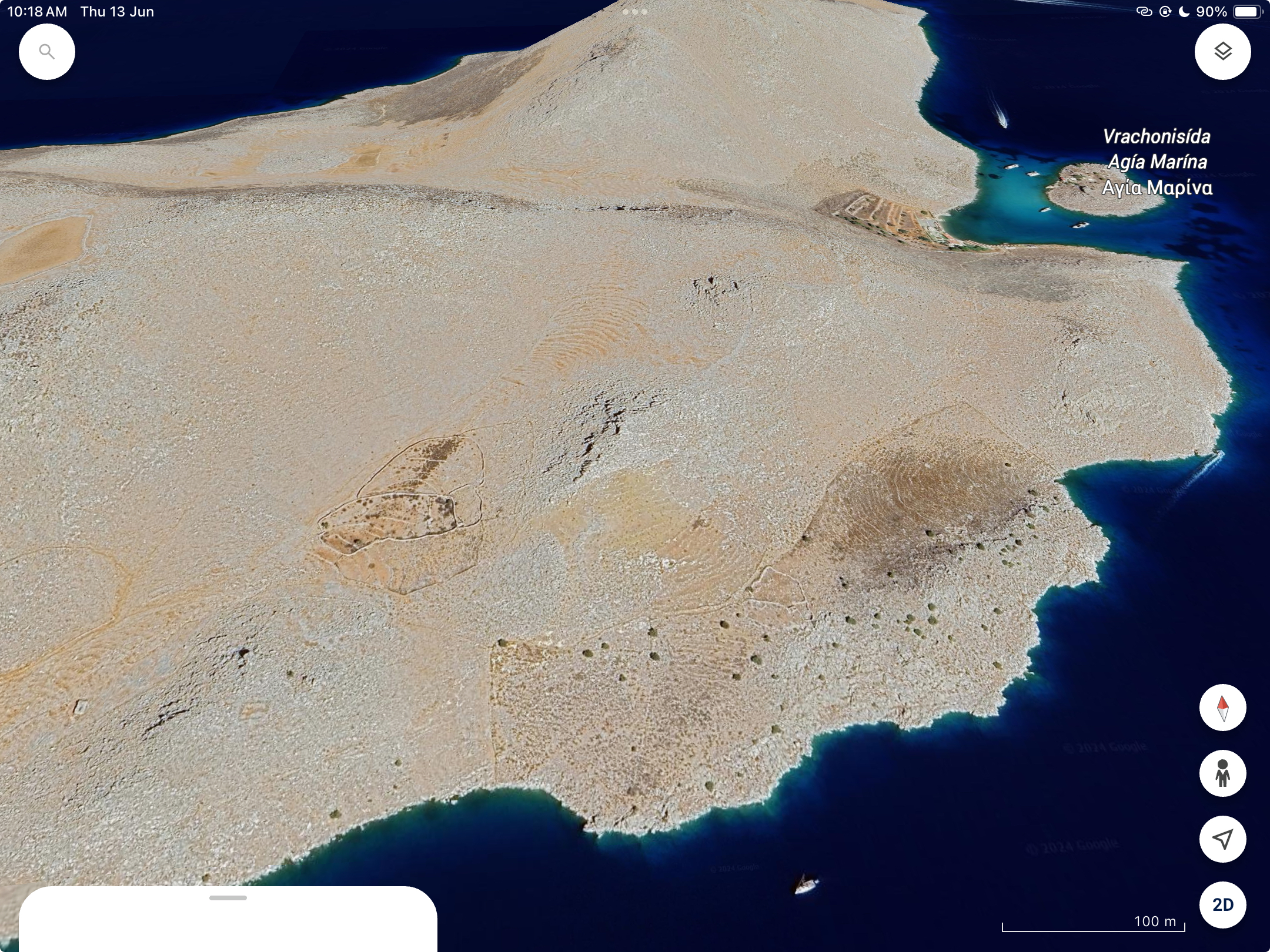
Once he’d committed himself to attempting to climb the mountain between Pedi and Agia Marina, he probably reached the point where he felt he had no choice but to press on, even though the landscape before him probably didn’t turn out to be what he’d expected to see. When we did the walk, we knew we were heading for Agia Marina, but I theorise that once he caught sight of the place, he thought that his best bet was to head there and ask for assistance, probably a boat, to get back to the harbour. If you take a look at some of these screenshots I’ve taken, courtesy of Google Earth Pro, you can see just how large the peninsula is that separates Pedi from the bay to the East of Symi Harbour. Also, it’s obvious that, once he’d set out to climb that hill, he was going in the opposite direction to the one he wanted, but without knowing it.

How people can ask questions like, “How could his wife have let him go off on a walk like that?” It’s beyond me. He was a grown man, a sensible and very fit man, by and large. He would have given his wife no reason to assume that he couldn’t have made it back to their accommodation, surely. There’s even a bus (used to be a 15 seater, not sure if it is these days) that goes between the two bays regularly.

As for the other question, “How could someone get lost on such a small island?” – Once again, to ask such a question is to misunderstand the meaning of the word ‘small.’ Looking at the screenshots I’ve posted here (see below), one can easily see that a walk on such a headland is going to be gruelling to say the least. Symi may be a ‘small’ island in comparison to other islands, but how long does a walk need to be in 38-41ºC when one probably doesn’t have enough water or food to embark upon it to begin with? The pathways on that peninsula are rough to say the least, and you do encounter a few stone walls that need to be either crossed, or negotiated around.

Below: The second photo shows the location of Chorio, with the Symi waterfront just visible to the far left. Agia Marina (where he was found) is that tiny bay at the far right end of the peninsula, where there is also a small island off shore. The last shot below gives an indication of the extreme barrenness of the terrain he would have been walking across.

There, that’s what I think. I believe that the good doctor was a victim of a mistaken sense of direction, that’s all. Sadly, he lost his strength just metres short of his goal and, had he not collapsed behind a wall, would have soon been spotted by people within the boundary of the Agia Marina resort and assistance would have surely been rendered. Circumstances conspired against him. It’s desperately sad, and one cannot but ache for his wife and family, not to mention all those who’ve enjoyed and benefited from his informative and entertaining TV presentations in recent years.

Below: Setting out from the far end of Pedi Bay (opposite side to the Ag. Nikolaos path) –

All screenshots courtesy of Google Earth Pro, except this one, which is a still from a beautiful video of Pedi on the Eagle Eyes From the Sky YouTube channel.

Don’t please, either, believe people who spout on social media about how this affects Symi’s reputation as a place to visit. Talk about irresponsible and ill-informed. I read some bloke’s comment on Facebook, something like, “Symi’s not so nice a place to go now then, is it?” That’s balderdash, pure and simple. Lots of people have met their deaths or been seriously injured in remote places in the UK, leave alone a beautiful Greek island. It’s nothing to do with Symi or its terrain, but everything to do with a few unfortunate circumstances catching up with the unwitting victim.

I doubt that she’ll ever read this, but I wish to extend my deepest sympathies to Dr. Claire Bailey Mosley, Dr. Michael’s loving wife, and indeed to their children. I, like many others, have enjoyed immensely her husband’s TV shows over the years, and the fact that he cared deeply about people and their health always shone through.

Click HERE to go to my Amazon Author Page. There you can browse all of my written works.

Burnt hands and a barn owl (or two)

June has come in with a bang. We’re being hit with a heatwave that is bringing us August temperature in the first week of June. As I type this the shutters are all closed and we’re only venturing outside when absolutely necessary. I hope it’s not a harbinger of the entire summer before us. The thermometer in the shade on the veranda reads 40ºC and, since there’s virtually no wind, it feels like you’re stepping into the oven when you go out the front door. I can only imagine with a large degree of horror what those people in India must be going through right now, where the reports are that temperatures are nearer to 50ºC than they are to 40.

Since we’re not even taking our iced coffees out on the terrace at the moment, any social intercourse with our neighbours is currently severely limited. Mind you, we always know that Evangelia, who’s (I’m sure I’ve mentioned this before) nearer to 90 than she is to 80 these days, is OK. See, she has a very distinctive sneeze. When we first heard it a few years ago we thought that it was either some species of bird that we weren’t familiar with, or maybe a small child being chastised in a corporal manner by its parent. Most days she sneezes at least once or twice and, if we don’t have any radio or music playing, we hear it over here. When it happens we look at each other with a knowing glance and without words communicate the fact that she’s OK, she’s ‘about’ as it were. Only a few days ago, when we actually had a slight breeze and the heatwave hadn’t yet hit us, she’d reminded us that we would always be welcome to go over to her house for a Greek coffee at around 5.00pm any day. Her daily programme never changes, and ours doesn’t a great deal either. The only problem is, we usually sleep from around 4.00pm until 5.30, or even later, and she goes for her siesta at 12 midday. She’s up and about again while we’re sipping our Earl Grey after lunch and thinking about going to bed.

Still, one day it’ll all come together. We’d like to sit with her again, since its been probably a couple of years since the last time, and whenever we’re in the lower garden, just across the steep lane from her tiny alleyway, she tends to have the knack of appearing in order to exchange a few neighbourly words.

I was trudging around Dingly Dell the other day, since I’d failed to drop off to sleep during the afternoon, and I came across one of the local goat herds. You don’t have to see them to know that they’re in the vicinity, because the clanging of their bells (I wonder if they ever get driven mad by those things hanging permanently around their necks) signals that they’re approaching, or that you’re approaching them. On this particular occasion, as they came into view, I also heard the telltale sound of the goatherd whistling and calling to them, usually to get them to go in a specific direction. I stopped in order to ascertain where the goatherd was, because, if he wanted the goats to pass anywhere near my position, I might well have proven to be a nuisance. Goats here will generally avoid any humans with whom they’re not familiar, and so, if I come into their field of vision, they’ll change direction so as not to allow me to get within about ten metres of them. I stood stock still as a couple of goats emerged from the undergrowth onto the lane a little way ahead of me, and scanning the hillside I could see the goatherd a couple of hundred metres across the valley.

I decided to retrace my steps a couple of hundred metres or so, so as to not impede the goatherd’s work. Within minutes the bells had receded to a distant tinkle and the sound of a moped could be heard approaching along the very uneven and occasionally steep path that I was following. Soon, rounding the corner in front of me came the Honda 90 in question, and riding it was none other than Manolis, our new village mayor. On seeing me he skidded to a halt in order to exchange a few neighbourly words, but I couldn’t help noticing that both of his hands were heavily bandaged up, with only the tips of his fingers showing. After both of us had discerned that the other was OK, I couldn’t help but point to his hands and ask what had happened to them.

“Oh, nothing,” he told me.

“Nothing?” I replied.

Well, I had a little accident with some revma.”

Now, in case you’re not familiar with the Greek word ‘revma‘ it literally means ‘flow,’ but is invariably a reference to mains electricity. The voltage here in Greece is similar to that in the UK, it’s about 220v, whereas in the UK it’s 240. It’s so similar that, as long as you have the correct adapter, any device bought in the UK will work just fine over here, and vice versa. If we have a power cut, or – to use the current in vogue expression – outage (See my dystopian short story of the same name, which I rather neatly chose to call ‘Outage.’ Oh yes, I know how to keep in with the trendy youth), people will simply say, “We’ve lost revma.” or “We don’t have any revma.”

So, for Manolis to dismiss the cause of his injuries as ‘nothing’ was to minimise the fact that he’d evidently been tinkering around with some mains electricity and gone and got his hands burnt in the process. Ouch. I asked him if it still hurt, and received a vigorous nod of the head to affirm that it did. The nod was accompanied by a knowing smile too, bless him. Now, my Dad (and here’s another pretext for using the term ‘bless him‘) had been an electrical engineer and knew all too well about the dangers of fiddling around with live cables and fuse boxes and the like. So, armed with the knowledge that my Dad had imparted to me when I was a lad, I knew what could well have happened in Manoli’s case. Judging by the bandages (which he still sports a week or so later) he had a close brush with death, to be honest.

Nevertheless, he restarted the machine, shrugged his shoulders as if to say, ‘I’ve experienced worse,’ gave me a wave and was off down the track in a cloud of yellow dust. They’re a tough breed these Greek villagers.

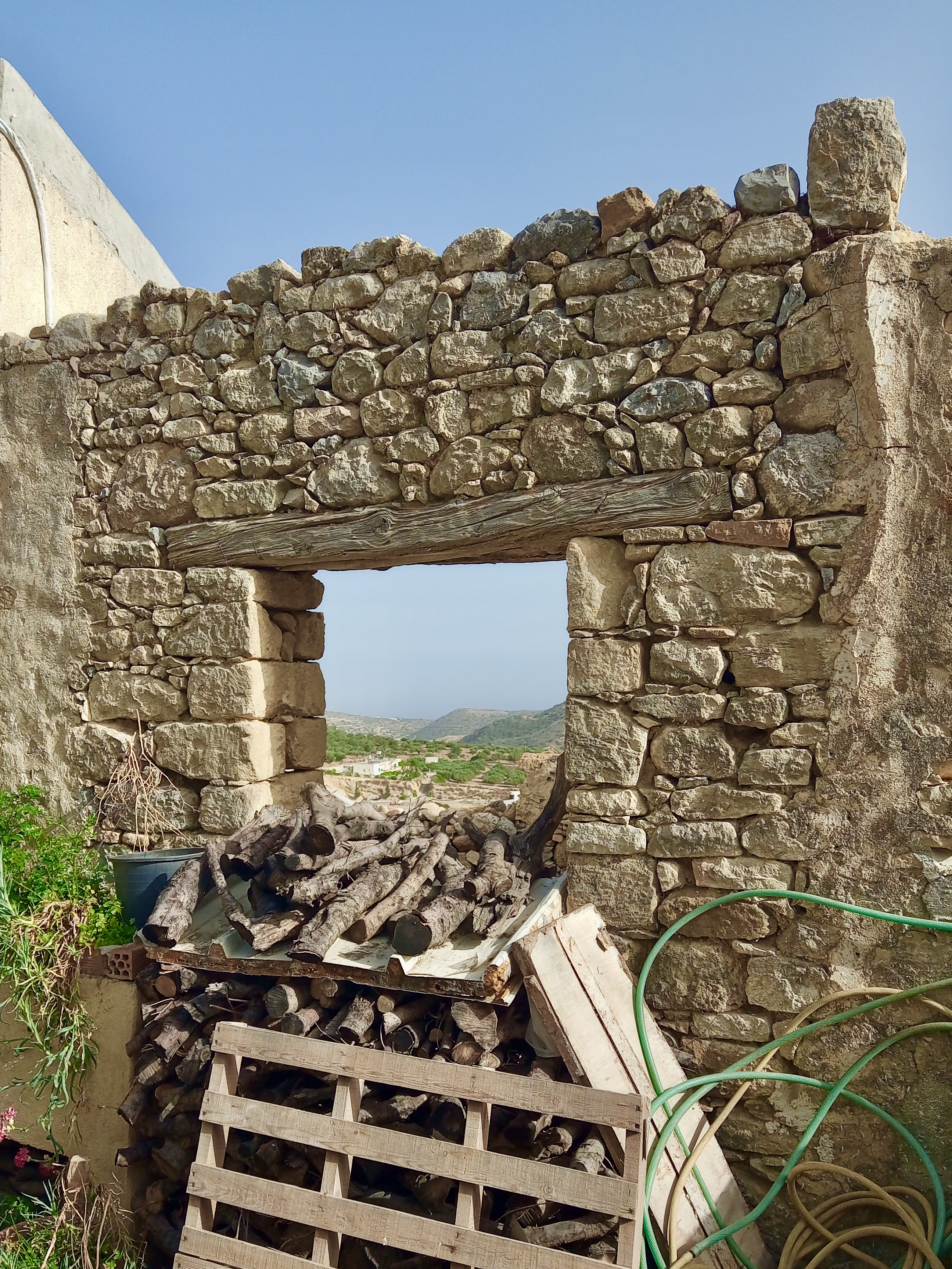
Just before I post some recent photos of the garden and village, I am so excited to report that we’ve now had two sightings of barn owls within fifty metres or so of the house this past week or so. Barn owls are unmistakable, as they look almost completely white and somewhat ghostly from underneath while flying and they also don’t make a sound. They fly ‘silent,’ which is one way in which they can catch their prey unprepared. One was perched on an electricity post and took off as we got near to it while doing one of our hikes around the village on a sleepless night during the small hours. The other was sitting on the veranda wall of our neighbour’s house, surveying the olive grove below, and took off as I came within a few metres of it, not actually aware of its presence until it took flight. We hear Scops Owls every night here these days, but they tend to nest in tree cavities, of which there’s an abundant supply on these olive tree clad slopes. Barn owls have the propensity to make use of derelict structures too, and will prefer an open window or roof space on a disused building more often than not. This was why we never saw them in the valley where we used to live on Rhodes, even though we’d often seen them in and around nearby villages.

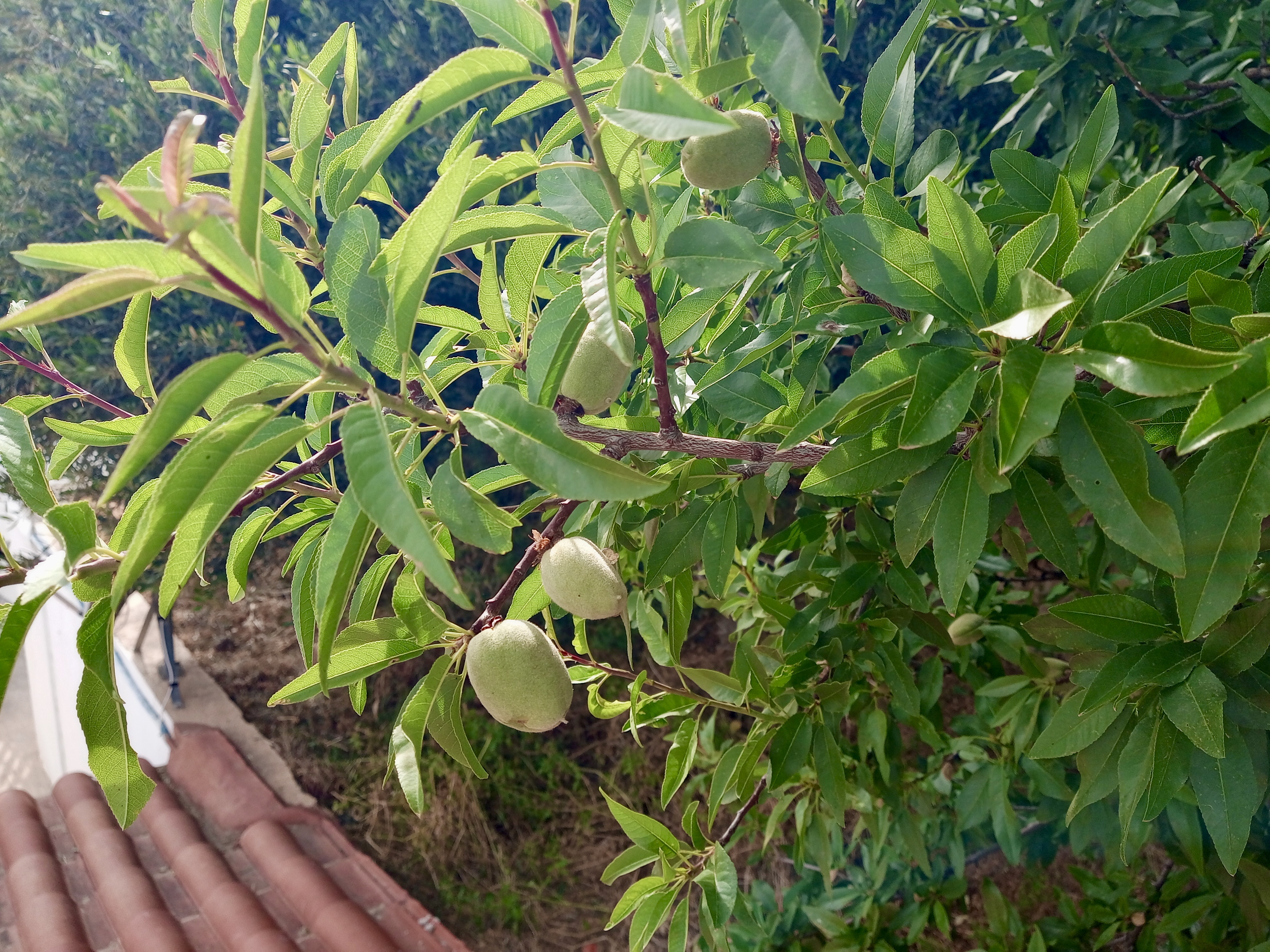
Here in the village there is an abundant supply of disused buildings, which is sad in one way, but rather fortuitous when it comes to barn owls. It’s not very likely that I’ll ever get the chance to photograph one, but if I do, it’ll sure as eggs is eggs get posted on the blog here. Here are some photos. Mainly the garden, but also in the village…

Click HERE to go to my Amazon Author Page. There you can browse all of my written works.