
I know I said in the previous post that we didn’t have the appetite any more for harvesting olives, and broadly speaking, that still holds, but…
There’s been a slight change of tack, because on close inspection we found that the olive tree in our upper garden was so heavily laden with fruit that it seemed to us a crime not to think about harvesting it. We have three trees in the garden in total, two in the lower garden and one up top. The two below are centuries old and were evidently in place long before our house was ever constructed. When the builder (and previous occupant of the house) from whom we bought it had the place designed and built, a lot of landscaping was required to excavate our steep driveway, and a huge retaining wall needed to be built, but those two stately aged trees were carefully preserved in their places. It may have something to do with government regulations about the importance of preserving olive trees, I don’t know. I have heard that such legislation exists, but I’ve never researched it.
Either way, it doesn’t matter. Those two older trees add such a wonderfully architectural and sculptural atmosphere to the garden, not to say giving it a thoroughly traditional Grecian feel, that we’ve loved them from the moment we first saw them. Last year I gave them a severe ‘haircut’ since they do have the habit of showering olives all over our terrace and lower beds during the winter months, so this year they only sport a thick canopy of smaller leaf-laden shoots that have provided shade during the summer months (as we’d hoped that they would) but have not put forth any fruit this season.
The tree in the upper garden, however, is much younger and looks like it was planted probably when the house was built, which was about 16-17 years ago now. I didn’t attack it all that much last year and this year, as a result, it’s decided to go into ‘turbo’ mode and produce a truly abundant harvest. We went up there a week or so ago to think about doing some routine maintenance to the paths and beds, and couldn’t help looking up and seeing the branches, and noting how heavily laden they were. There was nothing for it, we had to harvest those olives.


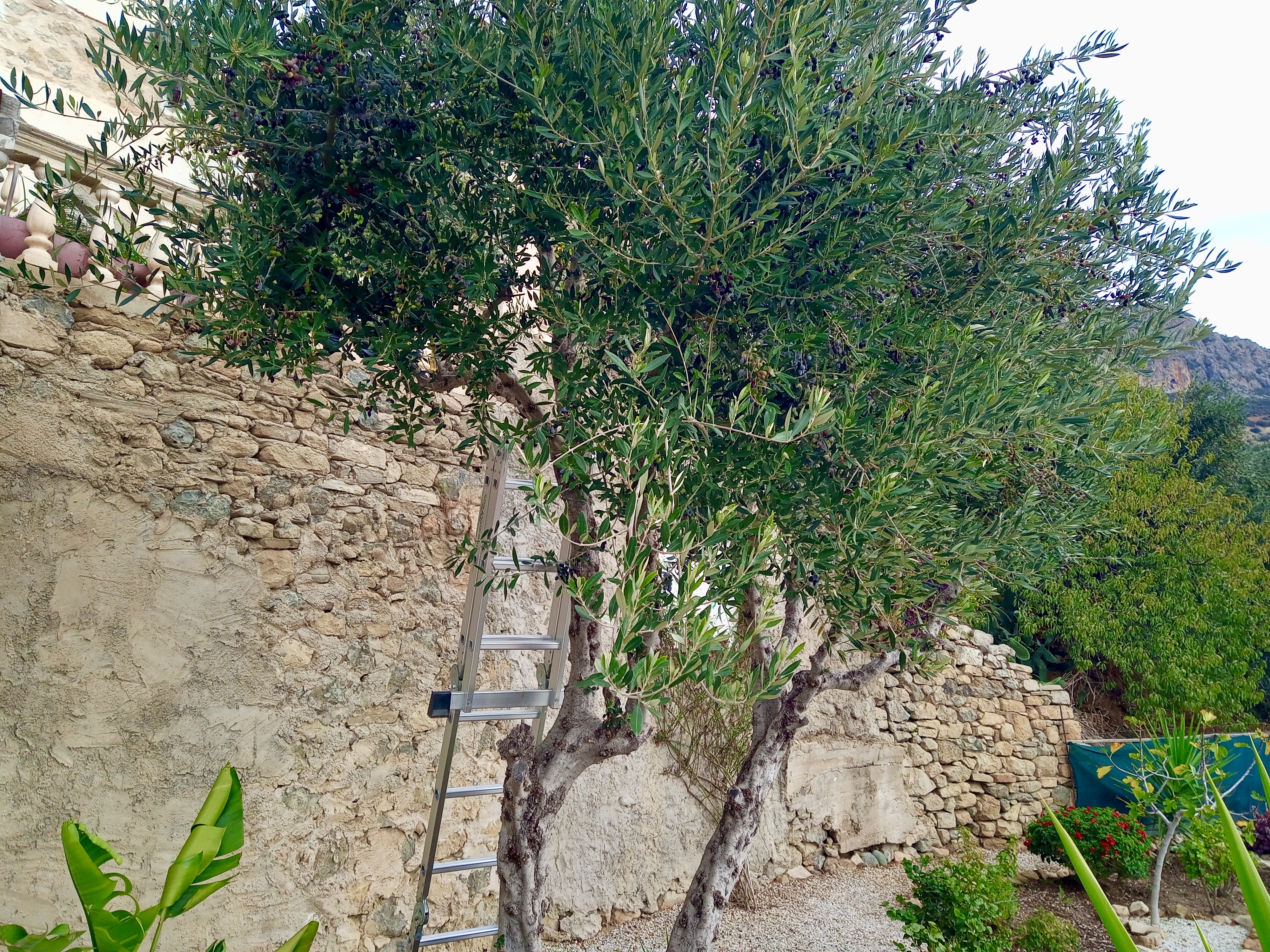
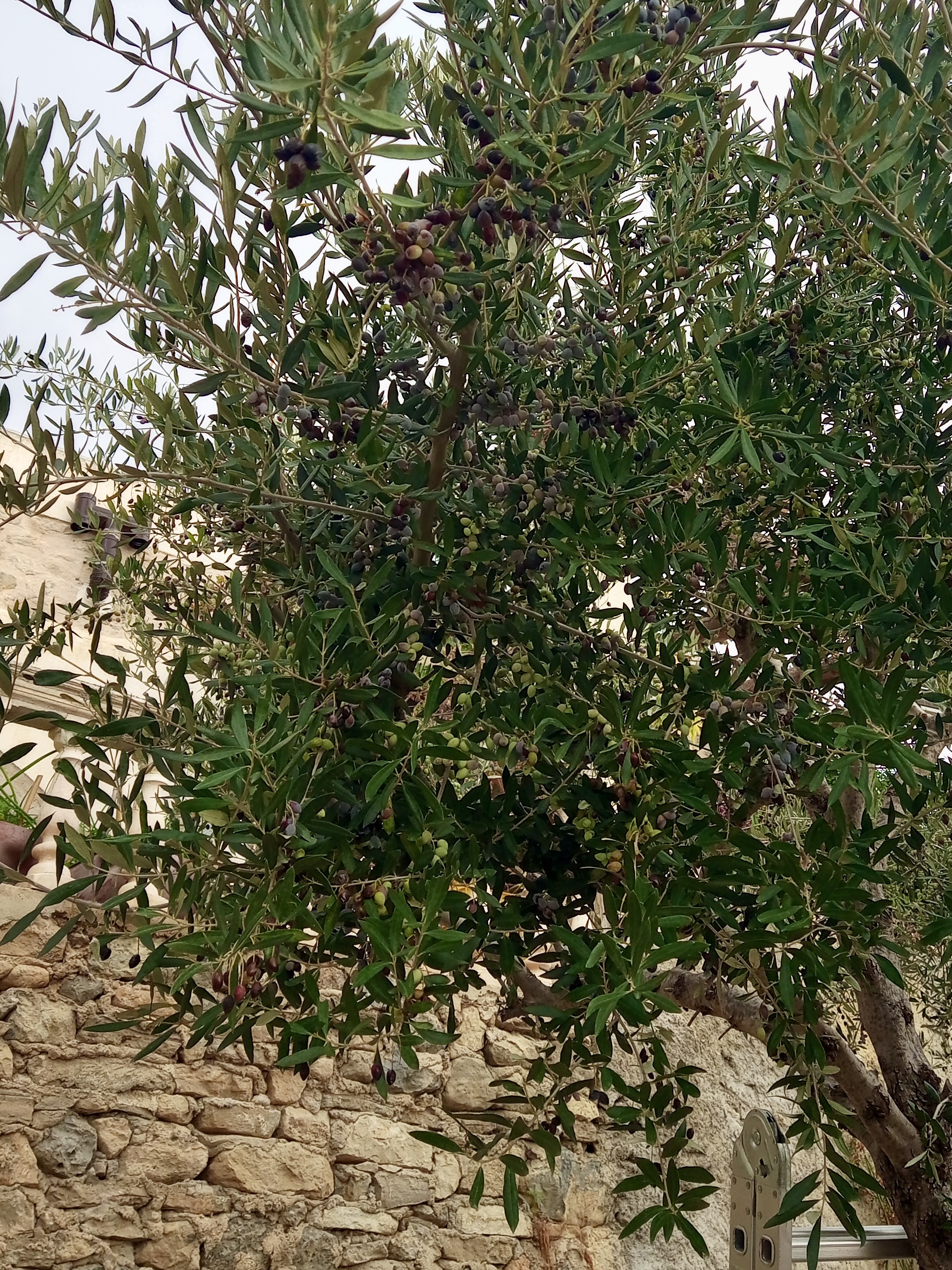

The thing is, if you know anything about olive harvesting then you’ll know that for every kilo of olives you take to the mill, you get about 20-30% of that weight back in oil, depending on the type of olive and how ripe they are etc. In order to harvest, say, 100 kilos of oil, you’d need to take around 4-500 kilos of olives to be processed. Small wonder that locals usually have hundreds of trees on their family’s land and they often take several weeks to harvest them all, not to mention the commercial growers who hire casual labourers to help with the harvest, usually every other year. On average, judging by our tree, one tree can yield anything from 25 to 50 kilos of olives, which means that each tree produces around anywhere from 6 to 12 kilos of oil. Here, they always do it by weight but, to be honest, a kilo of oil isn’t much different to a litre. The accepted conversion rate is 1.09 litres per kilogram.
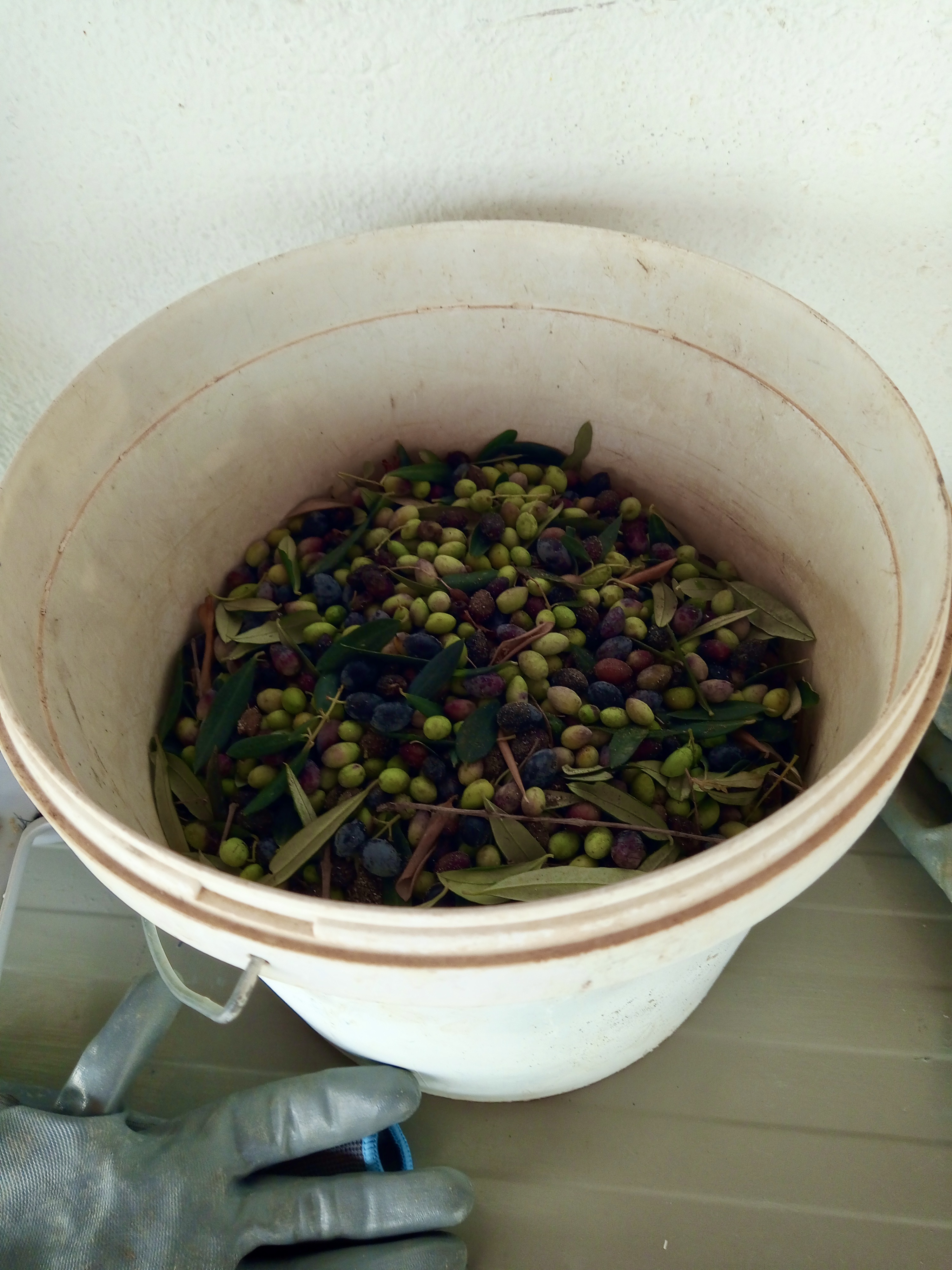
Round here they take their olives to the local mill in hessian sacks weighing in at about 60 kilos per sack. Thus each sack will yield around 12-15 kilos of oil. The last time we took any olives to a mill for processing was on Rhodes around 15 years ago. That was when our good friend Manolis, the “Six Million Drachma Man” as we used to call him ( see chapter 13 of “Moussaka to My Ears”) kindly gave us the olives we’d harvested with him on one occasion, which meant that we were able to take 5 sacks to the mill, and drove home satisfied with a haul of around 65 kilos of oil. That was enough to see us through the best part of two years.
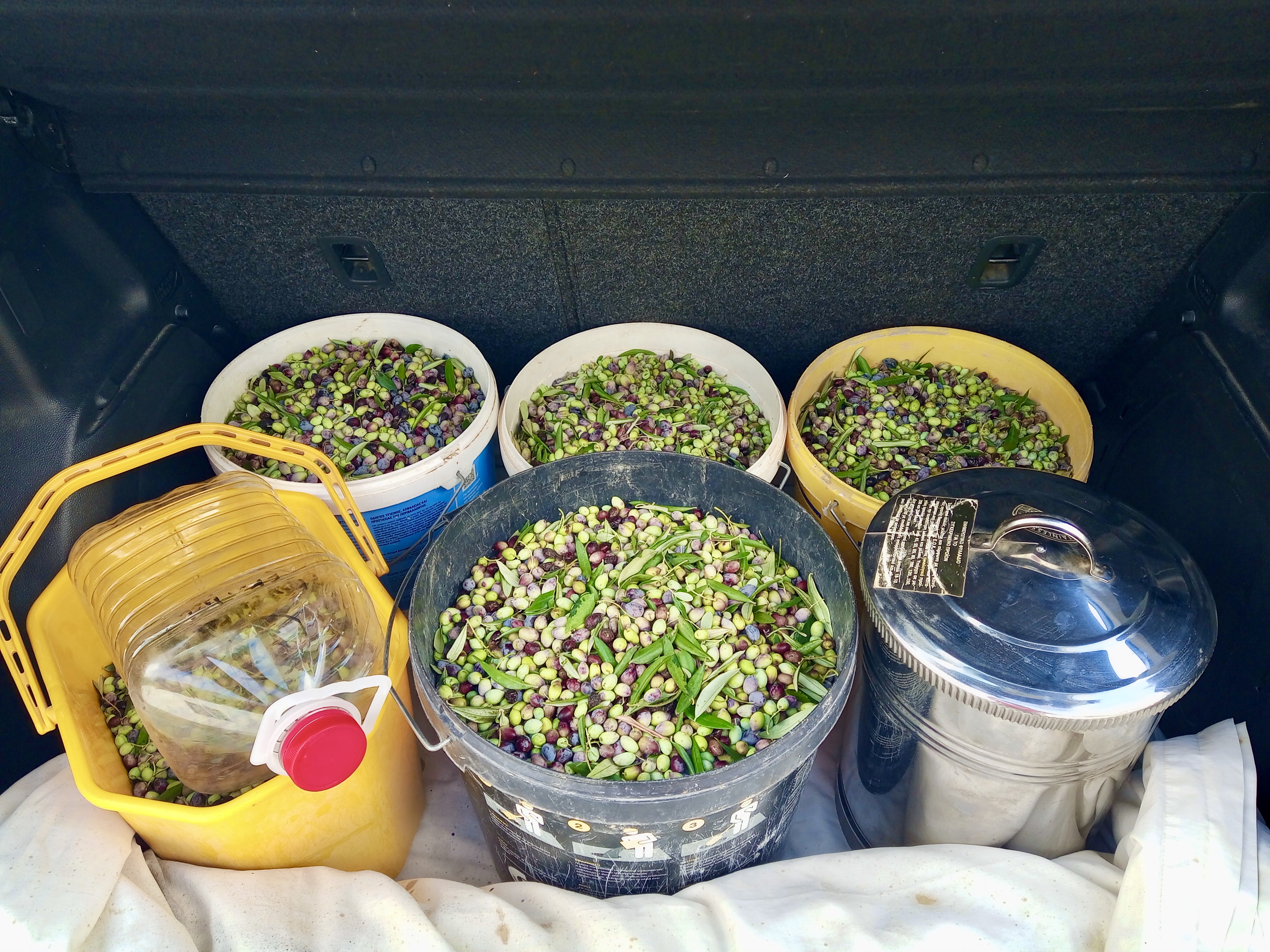
Anyway, we set to the work and began harvesting our tree. The work took us two days and by the time we’d finished we had around 30-35 kilos of olives, which we’d stashed into four plastic buckets and also half-filled the yellow mop-bucket we uses to clean the floors (we didn’t have any sacks). Time to head off to the mill.

Now, at this time of year the olive mills are working flat out seven days a week. Farmers and families are all totally immersed in their olive harvest and, even though it’s hard manual labour, families and village communities enjoy it, especially when they end up driving off to the mill in pickups loaded down to the buffers with sacks piled precariously high on the back.


We well remember when we harvested olives with ‘Dimitri the Horse’ back on Rhodes (see chapter 4 of ‘Moussaka’, ‘The Passers by’). There were sublime moments while we took short breaks and sat on the tailgate of Dimitri’s pickup, taking bites out of chunks of village bread, chewing on beef tomatoes and sipping hot coffee, while a few metres away, at least on one occasion we witnessed a baby goat being born right there before our eyes. Huge birds of prey mewed while they circled high above us and – at least at one of Dimitri’s many olive groves – his ducks and geese cackled as they foraged nearby. This time of the year the skies are usually blue, with broken clouds scudding around. Occasionally it’ll rain and you have to take shelter for half an hour or so, but the sun soon comes out again and, once you get cracking with the work, even in late November-early December, you’re taking off your fleece to work in just a t-shirt because the sun’s too hot on your back.
So, this year, as we made ready our modest haul of olives, I checked on the location of the nearest mill, which was fortunately only ten or fifteen minutes away, and we set off with the boot laden with our precious cargo. The mill here on the outskirts of Ierapetra is significantly larger than the one we used to go to in Arhangelos on Rhodes. There, they had one olive processing plant installed, which was about thirty metres long and all gleaming stainless steel. Olives are poured into a hopper at one end, where they’re also weighed, then they travel on a conveyor belt to a washing station, plus a section where leaves and small twigs are separated out, before the olives go into the mill-proper. At the other end of the ‘plant’ is the huge stainless steel receptacle into which your extracted oil is poured, gleaming green and still piping hot from the machinery. You can dip you finger in it at this stage and lick it. In this hopper the oil is weighed, the final tally glowing out at you from a red digital display screen, then the oil can be pumped into your receptacles using a tube and gun that suspiciously resembles the gun at a petrol pump in the local filling station (you chums across the pond, that would be a pump at your local gas station, of course). Here in the mill we went to at Ierapetra there must have been a dozen of these processing mechanisms, the place was that big.
As we drove into the huge parking area within the gates of the mill’s compound, we soon got the measure of how insignificant our little harvest was. All around us were wooden pallets piled with bulging hessian sacks, each with a paper label bearing the name of the owners of those olives. Pickup trucks were everywhere, unloading sacks, doing three-point turns, and narrowly avoiding the forklifts that were ferrying the pallets into the building through a huge roller door. Even from outside the building the sound of the machinery within was pretty loud. You had to shout to hear each other speaking once you got out of the vehicle.
I looked around for an entrance that might show me how to find the office. Rough looking farmers were trudging about everywhere, all of whom took no notice of me whatsoever. Old ladies wearing headscarves gazed at us in a bemused fashion from the open windows of pickup truck cabs. I eventually entered the building and found the office, which was just like the one back on Rhodes, in that it’s constructed of a few white aluminium window panels, primarily to reduce the noise within, the lower three feet of which were opaque white. Inside sat a few grizzly looking chaps, busy with paperwork, computer screens and cell-phones. Men were opening the door of this office and going in and out at will, so I decided that the only way to get some attention was to follow suit, even though the sign on the glass panel of the door read: ‘No entry to non-staff.’
Once inside I waited while a couple of chaps before me were served, and then a huge bloke with three or four days growth of white beard and a still good head of thick white hair turned to me from his seat at the desk and asked what I wanted.
“Well, um, we only have the one tree at home, but we couldn’t not harvest it, since it was so, so full this year. So we’ve brought our olives along in the car. I think we have maybe around 30 or 35 kilos, but that’s it.”
This chap stared at me for a moment, during which I thought he might be deciding whether to hit me or something. But then he burst out laughing and said, “You better show me where it is then.”
I led him outside to the car, where the boot was already open, and he stared in disbelief at our five buckets of olives. Right beside the car was a pallet stacked high with about twenty sacks, and here was this odd couple with five buckets of olives.
“Sack?” He asked, evidently meaning, “Do you not have one, then?”
“Well, no, sorry, is that a problem?” Again he chuckled, evidently finding this whole thing quite funny, and told me to hold on, while he strode back into the building. While he was gone, a forklift passed within millimetres of the car and the driver, glancing at our harvest cried out “Bravo sas! You did well!” He may have been being sarcastic, but we actually decided that he was truly commending us for not wasting even one tree’s worth of olives.
Our helper soon re emerged, carrying an empty sack, which he then held open while Yvonne and I emptied our buckets into it. By the time our receptacles were all empty, the sack was barely two thirds full. “All right,” our friend said (and, incidentally, I’m over six feet tall, and my head was about the height of his chin!), “Come back into the office and we’ll take your details. It’ll probably be a couple of days, is that OK?”
No doubt exuding a great expression of relief, I answered that yes, that was just fine. Back in the office he asked to me write down my name and number and told me that they’d call when the oil was ready. This was Thursday. Today has been Friday and they called this afternoon to tell me we could come and get our oil. Now, even if we net around 8 or 9 kilos of oil, that will save us, at today’s retail prices, anything from €50 to €90, so we’re not complaining.
So, in the morning we’re off to the mill to see what we’ve got to bring home with us. Whatever it amounts to, I’m glad I went back on my word.
•
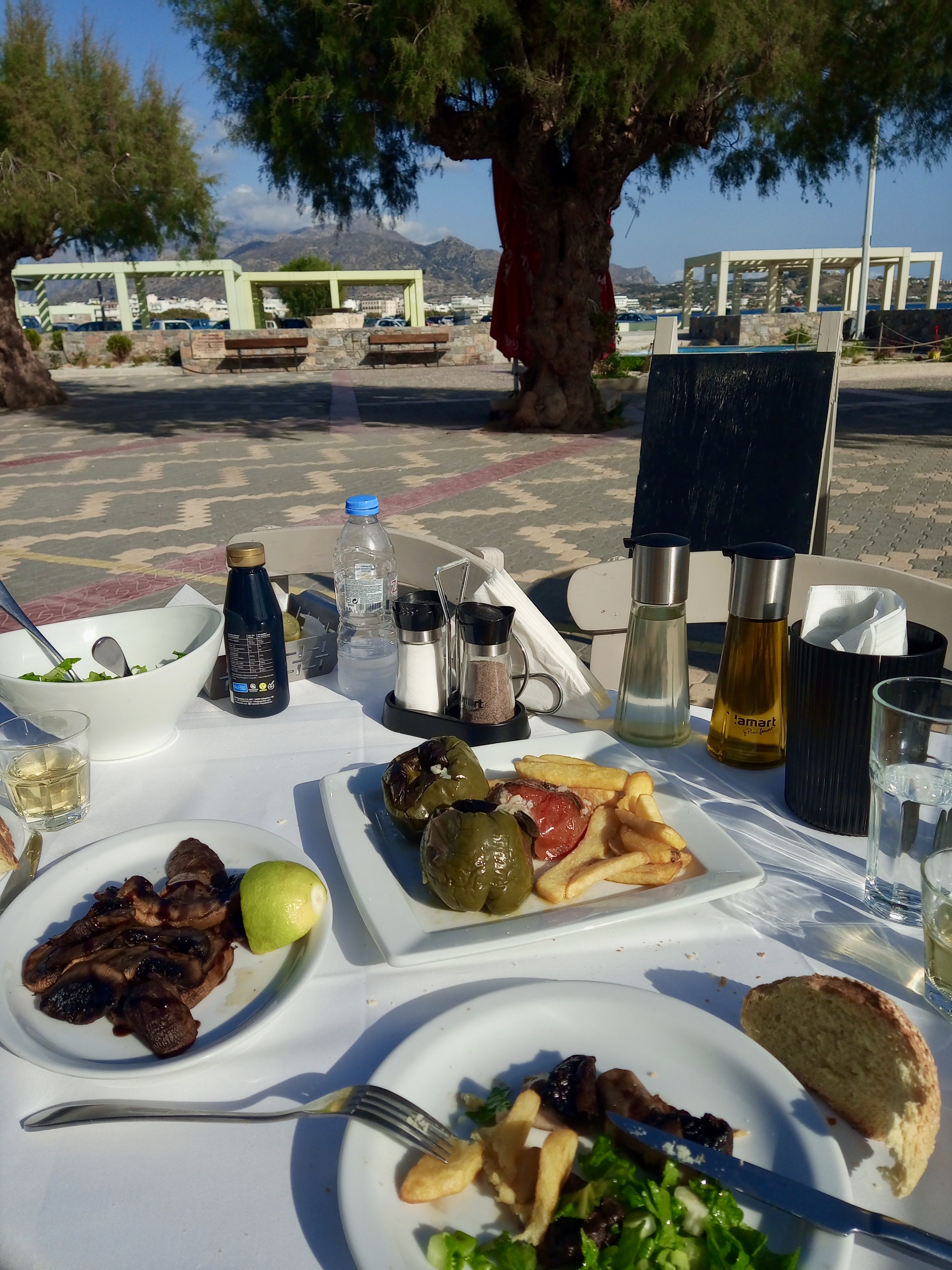
Here are some photos of an excellent lunch we had at the La Strada restaurant near the front in Ierapetra on November 29th. That dish that looks like meat is actually grilled mushrooms, and they were superb!


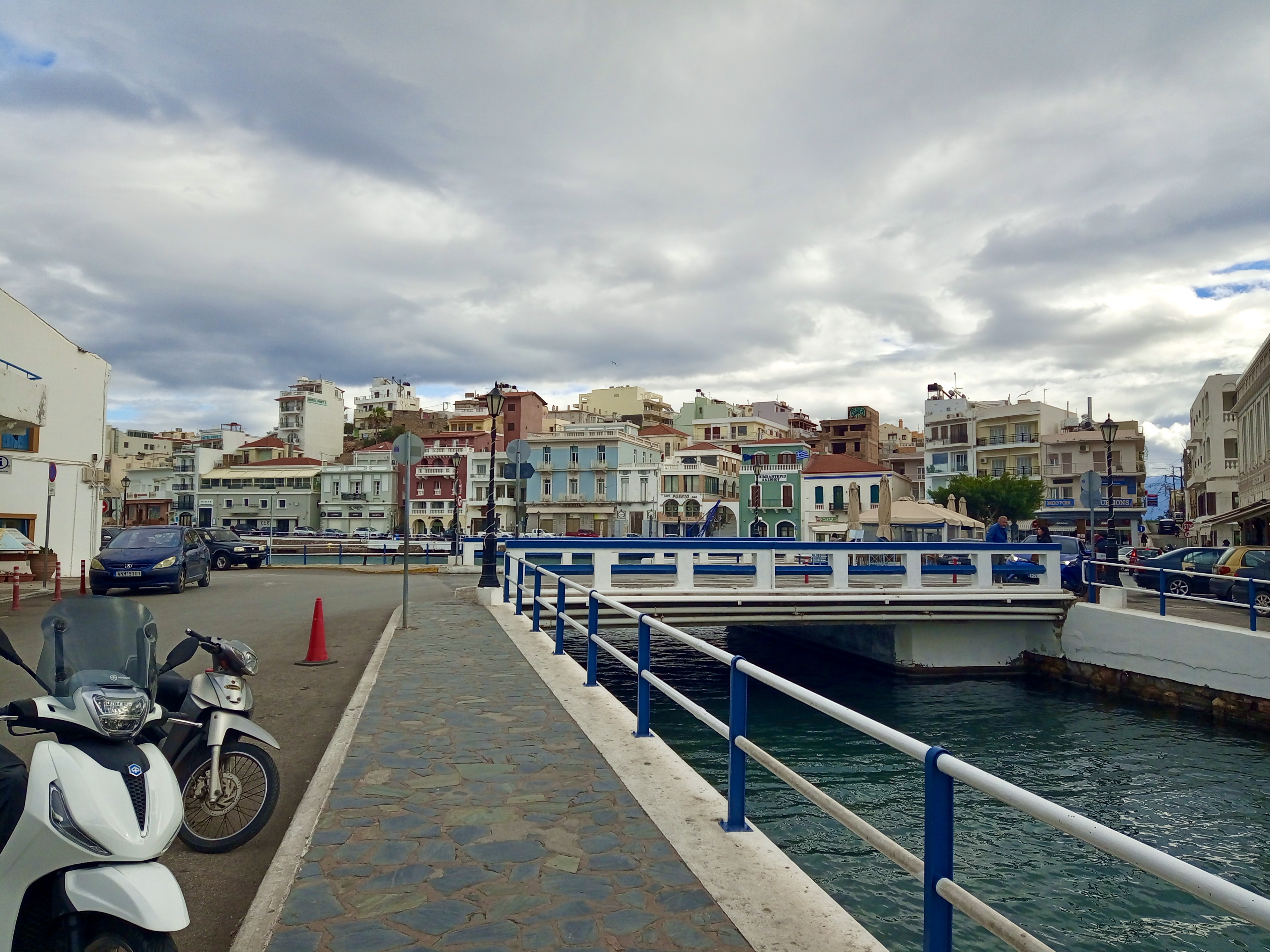
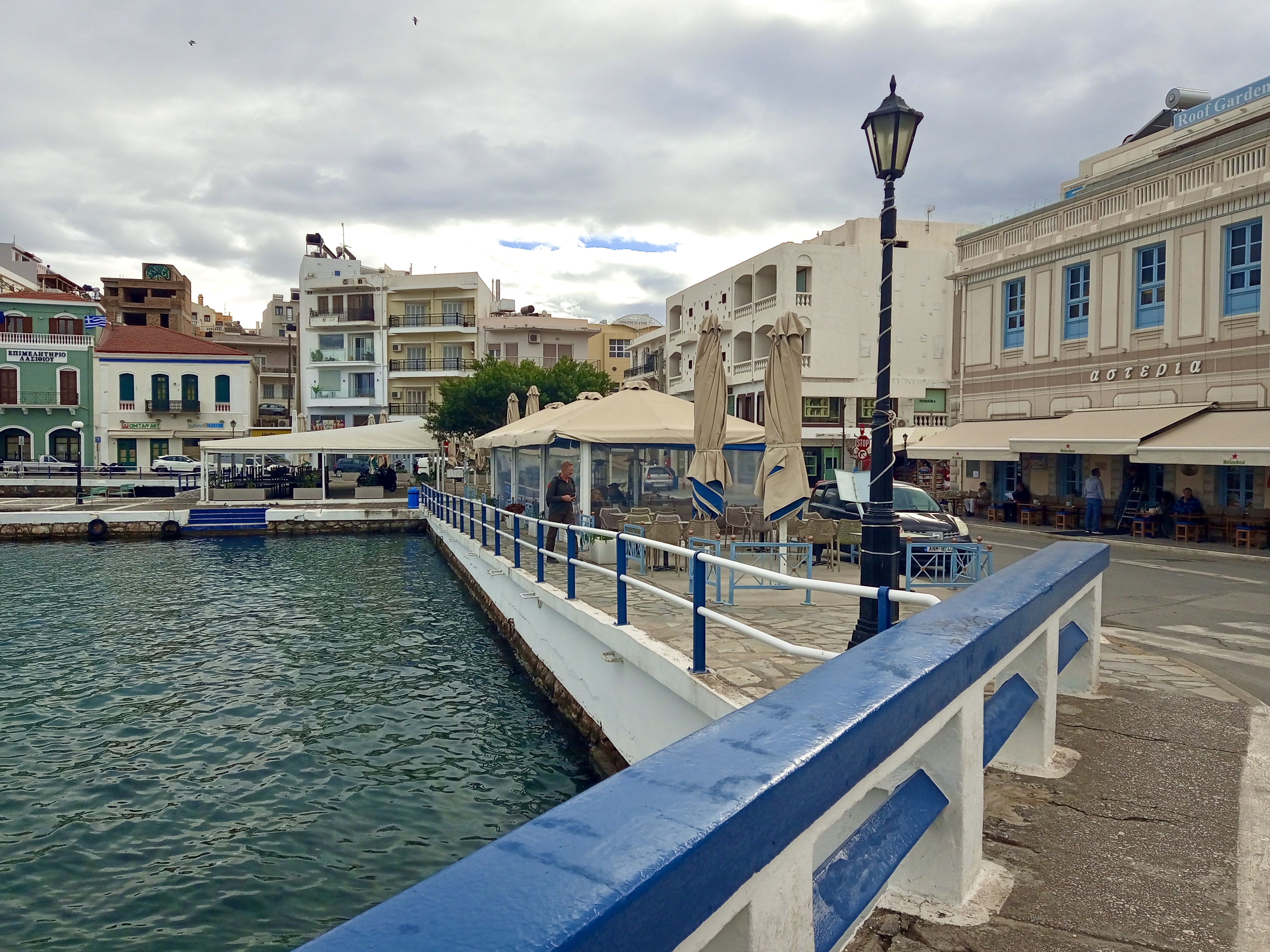
Finally, just a few from our visit to Agios Nikolaos last Tuesday, under mainly cloudy skies…

•
Click HERE to go to my Amazon Author Page, where you can browse and purchase all of my written works.
 Accretions
Should have read this entry first before commenting on your earlier post. Very interesting. Does the oil still count as cold-pressed extra virgin when it comes out hot? Or is extra virgin only a thing here in Western Europe and the Greeks don’t care? Also, and I’m saying this as a complete amateur, the olives in the boot of your car look quite pale, almost unripe?
As far as I understand it Marcus, all oil harvested from the same tree(s) in the same season is extra virgin. It’s a bit like Scotch whisky, in that you can get single malt or blended, single malt being one batch freshly distilled from malted barley in one single distillery, whereas blended can be a mix of whiskies from various distilleries. Regarding the ripeness, I asked Dimitri about this, the fella whose olives we harvested many years ago back on Rhodes. He told me that olives will all render oil, ripe or not. Maybe when they’re fully ripe they’ll render slightly more oil than when still green, but some seasons, and this year’s one such, the olives don’t ripen soon enough owing to a lack of rain at the right time of the year. It’s better to harvest them green that leave them too long on the trees, where they can rot. As for ‘cold pressed,’ it’s a bit of a misleading description. This may help: https://www.citizensofsoil.com/blogs/news/what-is-cold-pressed-extra-virgin-olive-oil?srsltid=AfmBOorqv4kEwwZ-tASng5w0sYnOwBBlorcRRfqHW0azkS7E5GhAXZhB
Very interesting, John, thanks a lot!
Pingback: Cracking oil | Accretions