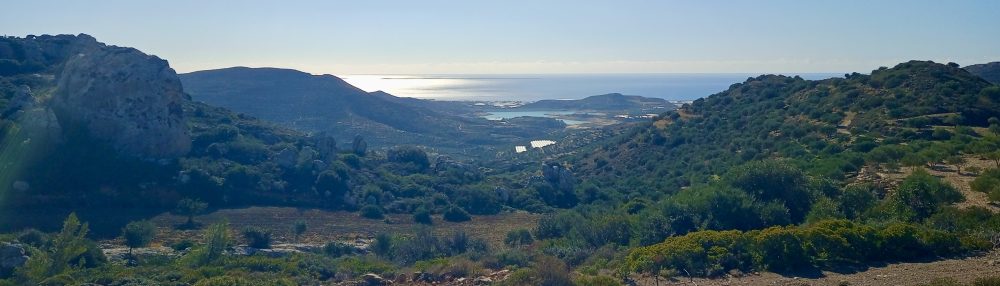
Did the earth move?

Twice, during our two-week stay in Sitia this year, we experienced an earthquake. Yes, twice. I’m always slightly irritated by the way in which much of the media talks these things up to such an extent that they have, firstly, tourists panicking about being drowned or swept away (which is worse anyway?) by a tsunami and, secondly, anyone in the UK who has friends or relatives either living over here or on holiday here is led to believe that we’re very liable to have been injured, lost our homes, or worse still, deceased.

I got to thinking of how many years ago it was when I first experienced an earthquake in Greece, and it was Kefallonia in 1987. We were staying at Marina Studios, on the edge of Argostoli town, right on the waterfront. It was September, and, even back then, we were in the habit of closing the shutters and taking a nap during the hottest hours of the afternoon. Out of curiosity I’ve just been checking it out on Google Earth Pro and it took me a while to find the place where we stayed, and I was pleased to see that Marina Rooms are still there, but the area bears no resemblance whatsoever to how it looked almost 40 years ago. Still, that’s ‘progress’ for you, I suppose.

Anyway, I recall being woken up at around 3.30pm by a shuddering, and the first thing I thought was that a large articulated truck (a semi, I believe, if you’re American) had just thundered past our ground-floor window. There was no damage, and it was only when we were out that evening for a meal, and someone we’d got to know in a local bar or taverna told us that it had been a quake, did we learn that that was indeed what we’d felt. Took me a while to realise that it couldn’t have been a huge lorry anyway, since there weren’t any that big on the island in 1987. Since moving out to Greece in 2005 we’ve lived through quite a few quakes and tremors, they’re just part of normal life here.

We lived for 24 years in South Wales UK before coming to Greece, and we even experienced a couple of quakes whilst there too. I worked in an office at Talbot Green, and I can still remember now the momentary quivering of the building we were in. When you consider that the whole area of the South Wales Valleys is riddled with mine shafts and tunnels from decades of coal mining, it’s no surprise, really, that things are going to ‘settle’ now and then. Of course the mines are long gone, and the slag heaps are landscaped green hills, but the shafts and tunnels are still a honeycomb way beneath the ground there.

I read somewhere that if you experience regular, modest quakes it’s much safer and less likely that you’re going to suffer a catastrophic one. The argument goes something like this: The tectonic plates are constantly moving against each other, and that means that the two surfaces ‘rub’ along in opposite directions, occasionally catching, like – say – when your toenail gets caught in your shorts when you’re trying to pull them up, but suddenly it frees itself, which would be the equivalent of that minor quake. If two sections of tectonic plate get caught in a big way and can’t slide against each other, then you’re in for trouble, because the pressure builds and one of these days it’s going to release itself when the ridge that’s catching on one side or the other snaps, which is apparently the problem in Southern California, and thus they’re always ‘waiting for the big one’ there. Here in the Southern Aegean there are several smaller plates that meet both north and south of Crete. When we get an earthquake here, it’s usually nothing to worry about, but the San Andreas fault in California is 1300 kilometres long, so, if that one blows you’ll know all about it. Let’s just hope that if and when it blows, Superman’s not taking the day off.

When we were on Rhodes we had earthquakes almost every year for 14 years. Most of the time you don’t even remark on them. Only once in that time did one merit making the news here, and that was in July of 2008. The epicentre was off the coast of Kattavia, way down south of the island, and there were no building collapses, or anything. There was one fatality though, and that was a woman in the village of Massari (or maybe Malona, they’re close to each other) who panicked, grabbed her grandchild and fled the building, tripped on the front step, fell and hit her head on a marble courtyard floor. Nine times out of ten the quakes in this area are in the region of 5 to 6 on the Richter scale. The 2008 one was a 6.4, on the upper end of the scale that we usually feel here.

The 2008 quake occurred at around 9.20am, and we were still in bed having a lie in. It lasted for around 20 seconds, which is a very long time when the ground beneath you is moving of its own accord. Count them, you’ll get the idea. In fact, we had time to get out of bed, slip on a gown, move from the bedroom to the front door, walk outside and across the courtyard on to the paved drive before it stopped. Later that day there were a couple of aftershocks too. The worst that happened that time was that a few buildings on the island suffered cracks in their walls, but that was about it.

Since we’ve been here on Crete, counting from our arrival in September of 2019, we’ve also had several notable quakes. In fact Ierapetra has felt quakes in May 2020, October 2021, five in 2024, and the most recent two, this past month, with epicentres south of Kasos Island and North of Heraklion, both under the sea. One quake hit while we were walking along the front in Ierapetra with my sister and her hubby in October 2021. It was around 12.30pm and a few ceramic souvenirs tumbled off the shelves in tourist shops as we walked past them. It was so terrifying that we had to go find a bar and quickly take a drink to steady our nerves (cue emoji with wry smile here).

So, you see from all of this that for the press to instantly talk about ‘authorities advising tourists to move away from coastal areas’ for fear of a tsunami, is scaremongering. Where on earth do they expect a few thousand holidaymakers to go then? Yes, our mobile phones squawk at us and flash a written caution, but that’s automatic, it’s not some government official being so quick as to get on-line within minutes of a quake having occurred and texting us all. 

Look, you can never say never, all right? No one would be daft enough to say that we’ll never get a quake that’s big enough to cause major damage and loss of life, but our experiencing frequent ‘normal fault’ or ‘crustal extension’ quakes is part of everyday life here, and to advise tourists either to stay away, or grab their things and run when we have one of our ‘normal quakes’ is the height of irresponsibility. 

Oh, and we have actually seen a tsunami while at the water’s edge in Ierapetra once. It was all of half a metre high. I must also close out this discussion by talking about the way buildings are constructed in this area. The concrete ‘frame’ containing reinforcing steel bars that has been required for decades now has proven its worth time and again, so even when buildings have been cracked and warped, people have been able to get out without suffering injury in most cases. There is one village here on Crete that has suffered houses collapsing this past couple of years, but they’re primarily old houses, built before the current regulations came into being.

Maybe it’s not the place for humour, but I can’t help echoing the words of Jerry Lee Lewis here (although he didn’t actually write the song): if you’re thinking of taking a holiday in Greece, why not ‘come on over baby, a whole lot of shaking’s going on…’ [Couldn’t resist it, sorry, if you’re easily upset, then accept my apology right here and now.]

And so to the photos…
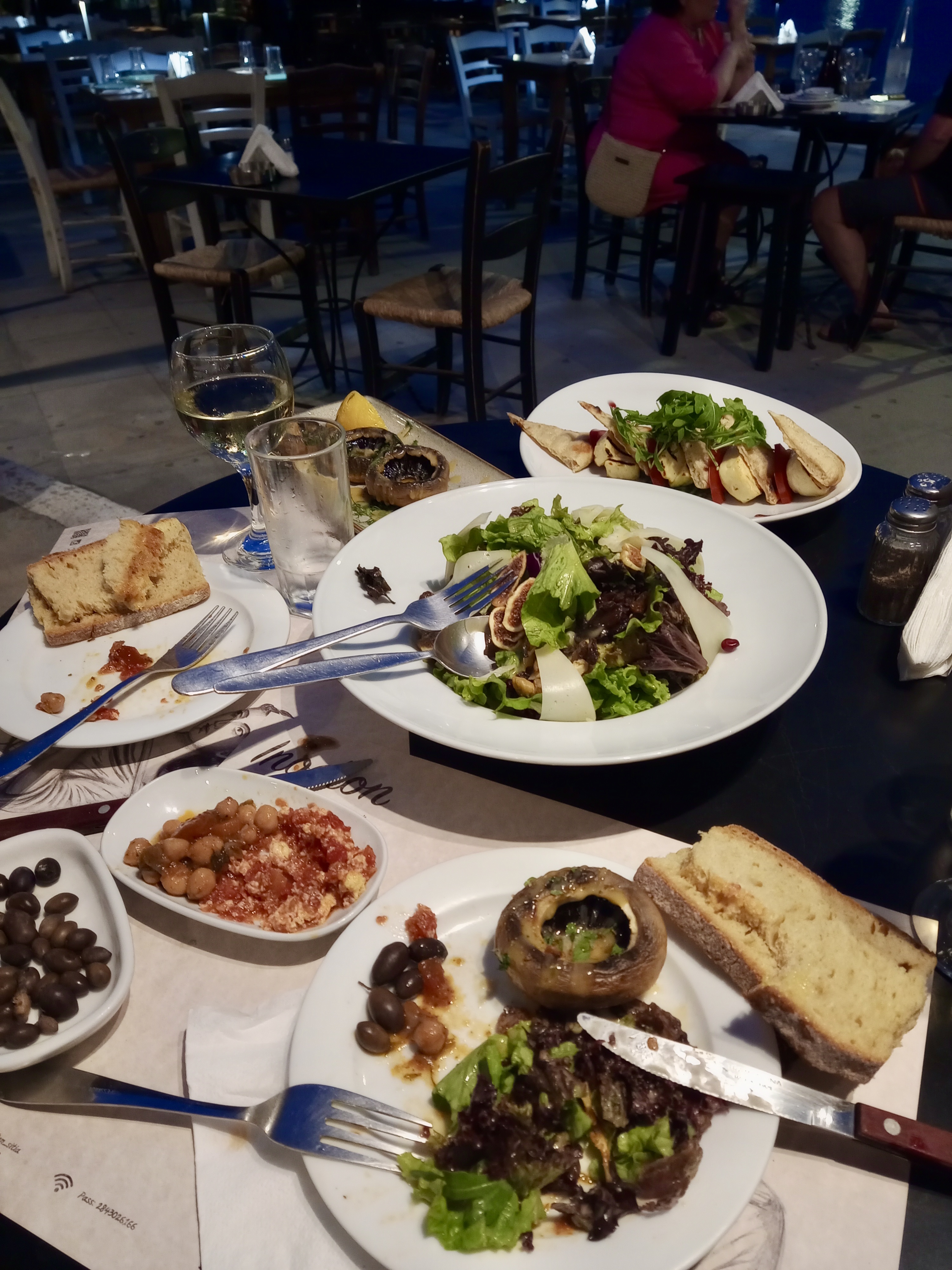
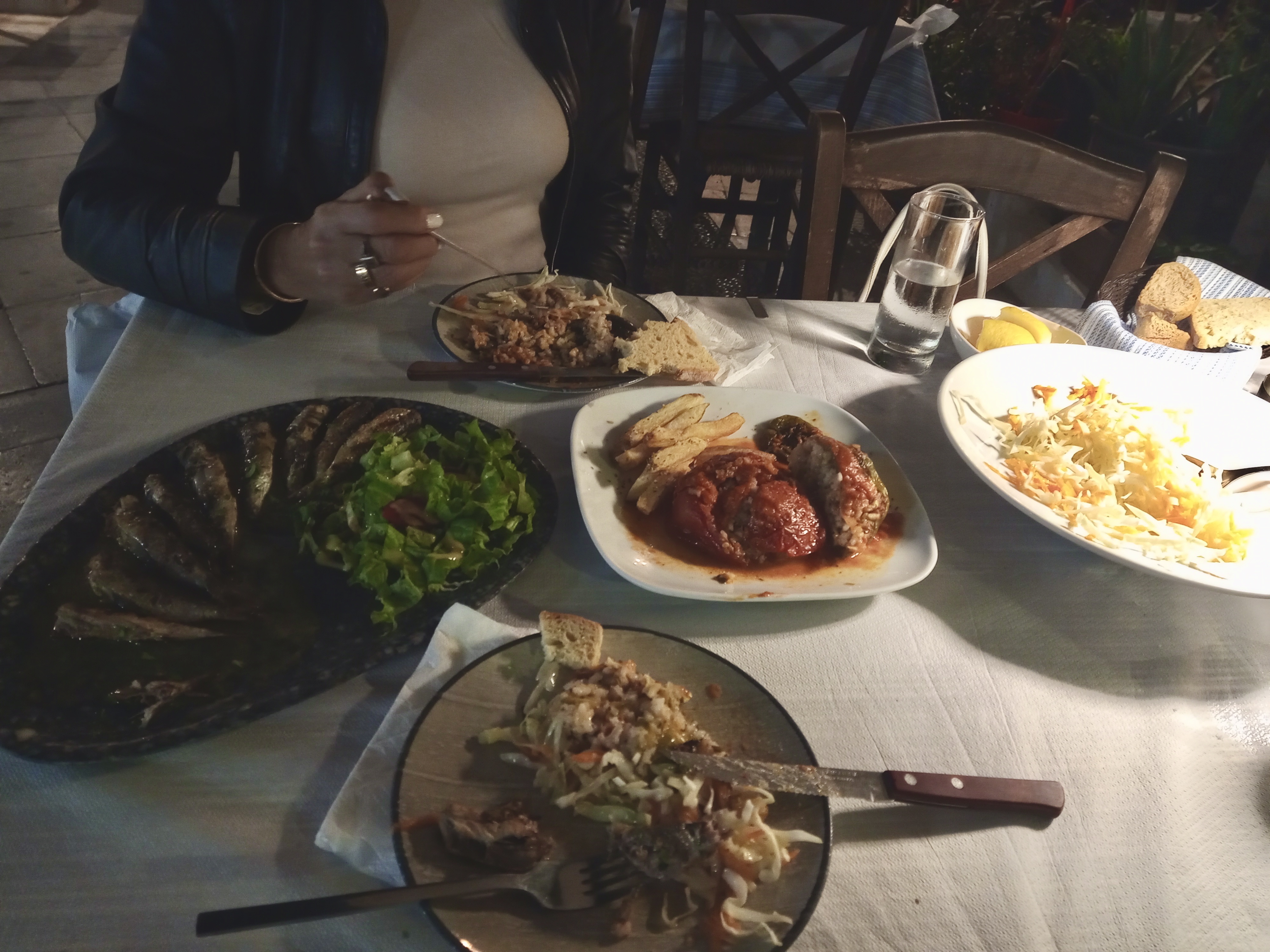
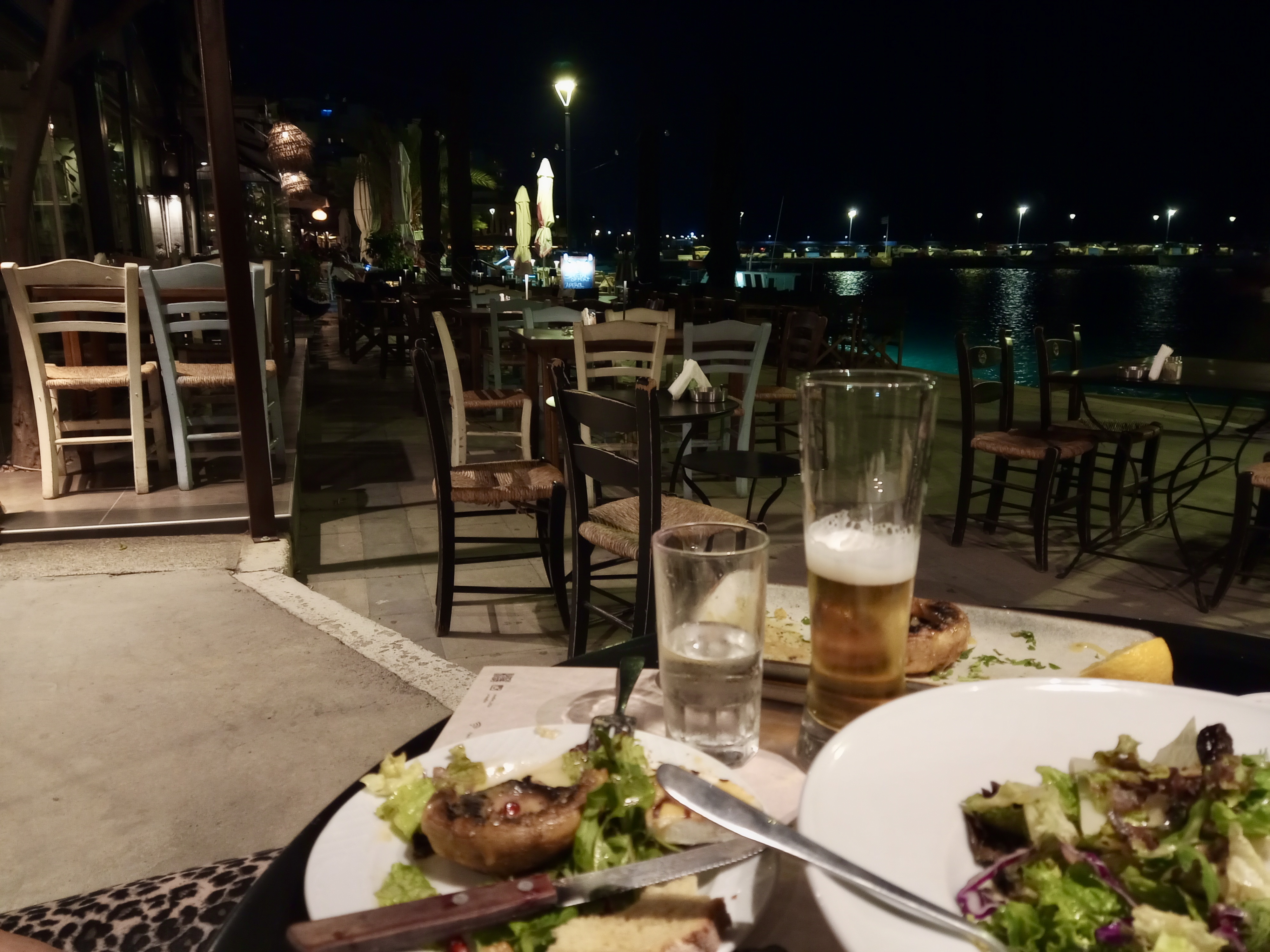
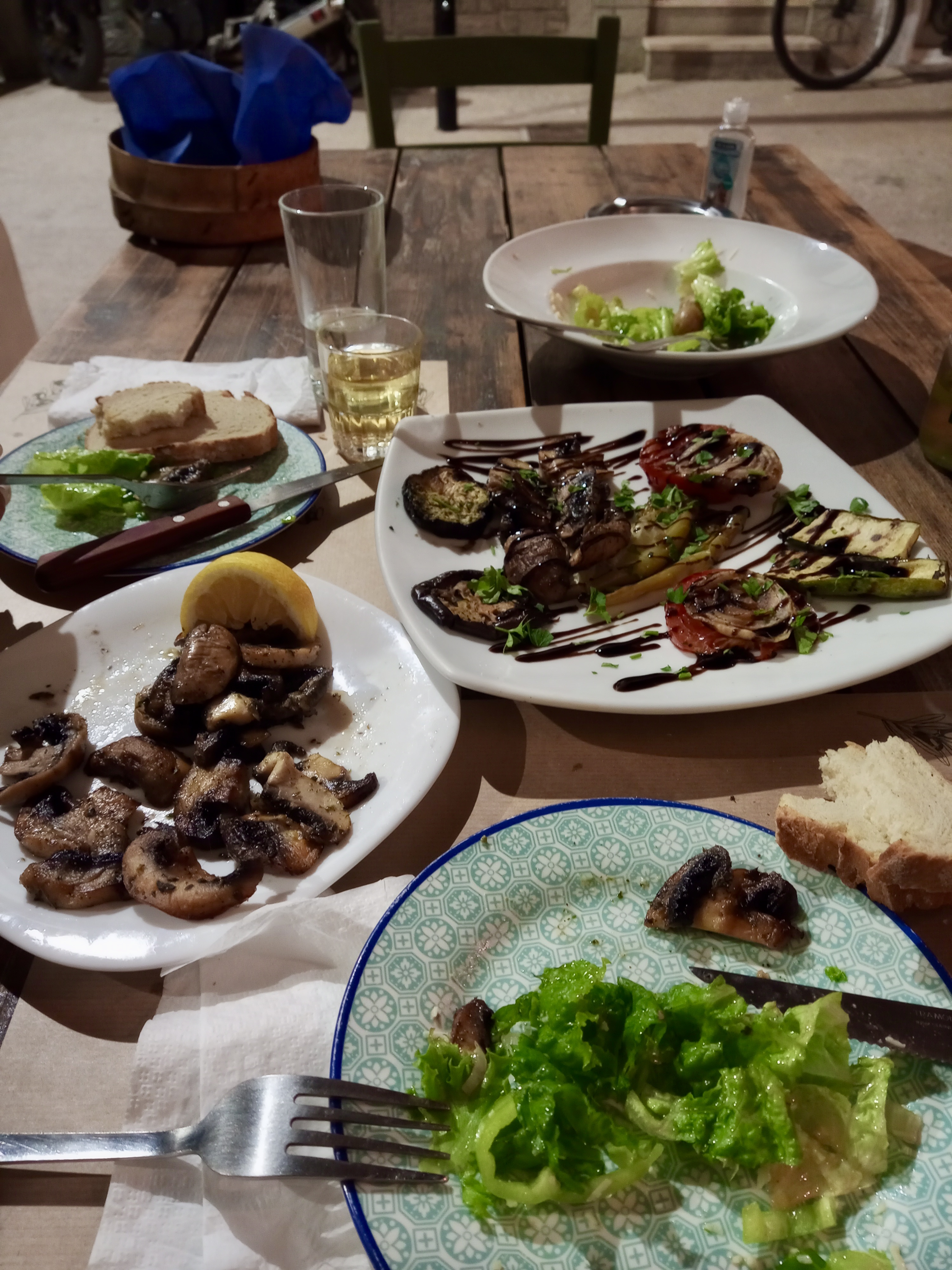
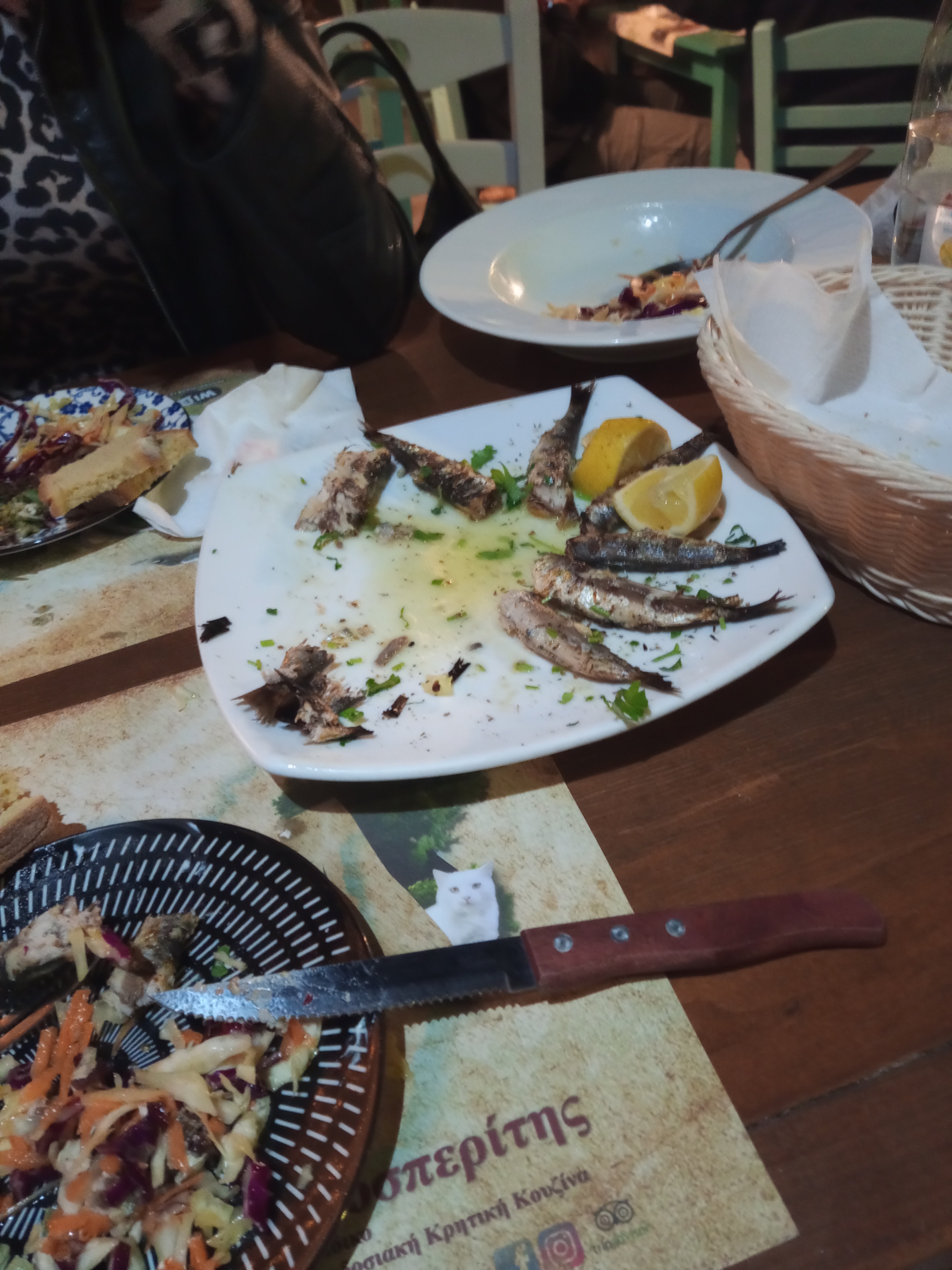
Above gallery (click on the photos for larger views): I don’t like to bang on about this, because I’m not an evangelical vegetarian. Each to his or her own I say, but that doesn’t mean I don’t believe that a lot of people shouldn’t educate themselves more on what they should and shouldn’t be eating. But there’s no denying that vegetarian (even vegan in some cases this time) food is so much more colourful than meat-based meals. We can well recommend two restaurants in particular if you’re lucky enough to be spending any time in Sitia (Shhh, OK? Keep it quiet) this year. Our absolute favourite is the Inodion, a family-run affair with impossibly friendly staff and the best presentation and portion sizes you’ll find anywhere. Their choice for veggies was outstanding and their salads TDF. In fact, on the subject of colourful meals, one night while we were eating there we had a young French couple on a nearby table gawking at our dishes in envy, as they ate their predominantly meat-based and decidedly colourless repas.

We were able to order a salad (not a basic ‘Greek’ salad, but one that contained lettuce, dried figs, walnuts, rocket, flaked Graviera cheese, onions, and a dressing that was so delicious you needed to wipe the dish clean with your bread once you’d consumed the contents), grilled mushrooms and one other dish, maybe grilled vegetables, or grilled halloumi, perhaps gigantes), add a drink (usually a half kilo of the house white, or maybe a bottle of retsina), and the food was so good and well balanced that you never needed to add condiments, and it completely filled us up. The bill rarely reached €30, so what was there to complain about?

The next restaurant that we really rate is the Limani. Here the portions are legendary and one of their best dishes is their fasolakia, which also contains cubed potato, carrots, and a few other things besides, in the delicious sauce. Their grilled mushrooms are equally as good as those of the Inodion, but theirs come sliced, whereas at the Inodion they’re whole, so it’s a different experience, and both are extremely tasty. The two restaurants are only metres from each other and we found ourselves going back to both again and again. Everywhere you go you get freebies, both at the start (mini eating olives, various ‘dips’) and at the end (slices of various cakes/tarts, halva, fresh chopped fruit, Raki or even a fruit or coffee liqueur) of the meal. Both restaurants are about the same price range and we ate ourselves full on a large salad and two ‘starter’ dishes every night. Greek salad is, of course, traditional, but since we tend to eat Greek salad at home virtually every day for lunch, a different lettuce-based salad when eating out adds variety to one’s life.

One other restaurant that deserves an honorary mention is the Aposperitis, which is next door to the Inodion. All three are right on the waterfront in the fishing harbour by the way. We ate there the first night and it was excellent too. In fact, the general standard of food at the restaurants in Sitia is very good, and the prices extremely reasonable. If you’re a bit confused by the word ‘Rakadiko’ which quite a few restaurants in this part of the world call themselves, here’s a brief explanation: The word ‘rakadiko’ in Crete means a small traditional eatery (usually a cafe or taverna) where they serve raki (or tsikoudia) and snacks. It is a place of social interaction, where people gather to drink, have a snack and chat. You could say that it is the Cretan equivalent of an ouzo bar, but with raki instead of ouzo. They usually serve traditional snacks: olives, dakos, rusk, greens, apaki, cheese pies, etc. and frequently play Cretan music (sometimes live too). That makes them sound more of a snack bar than a restaurant, but most rakadika have developed their menu into a full-blown restaurant menu these days.

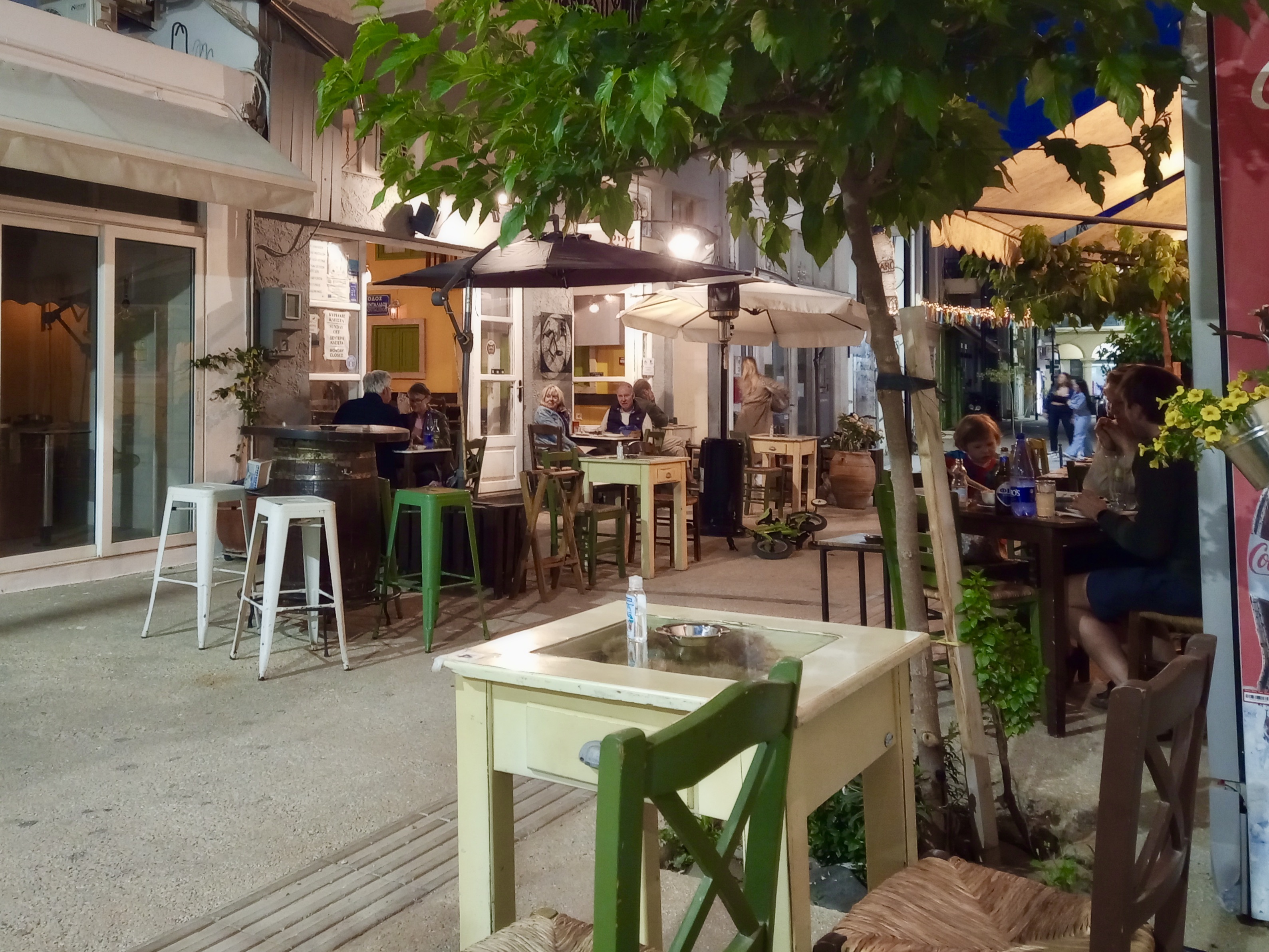
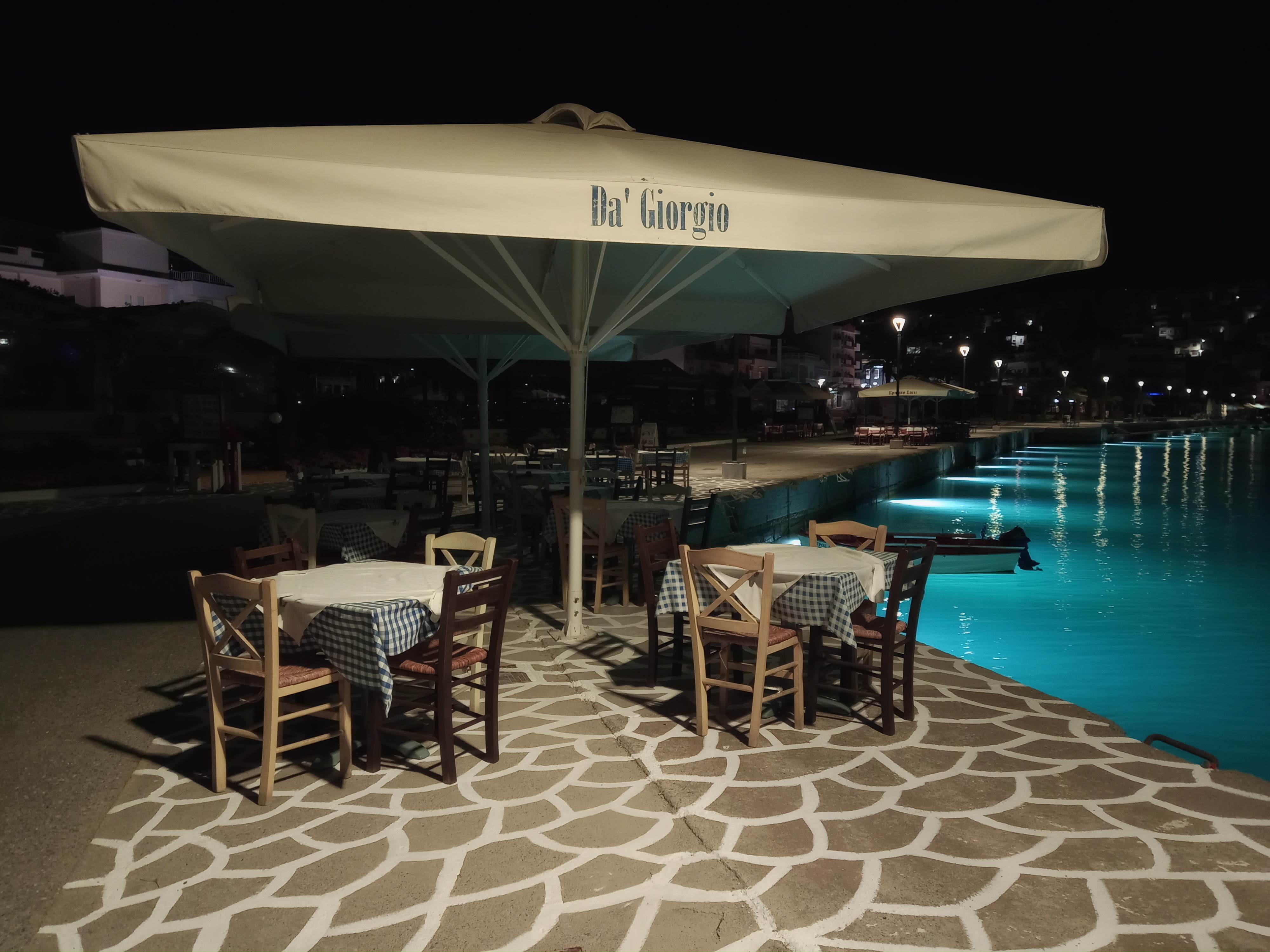
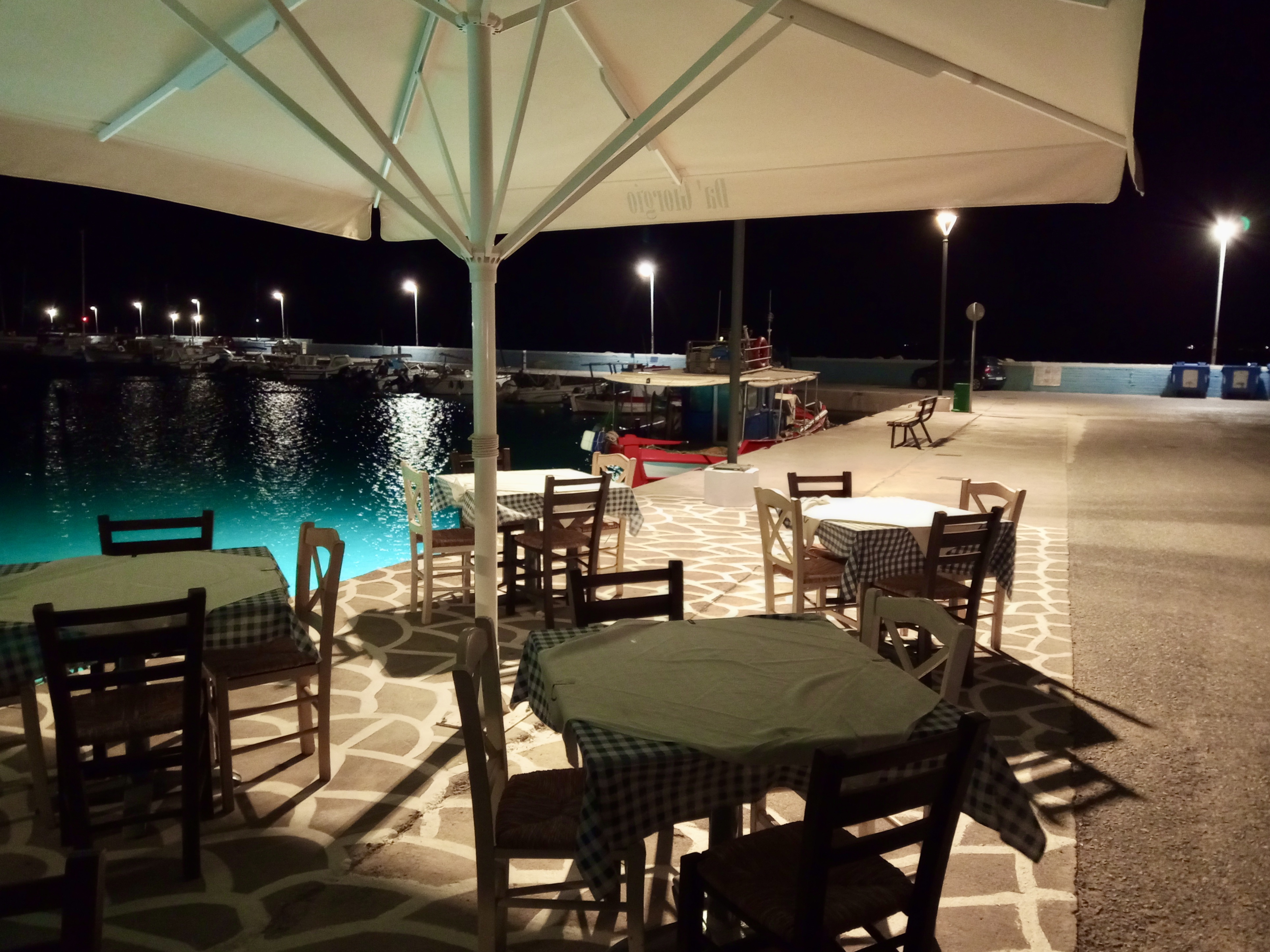
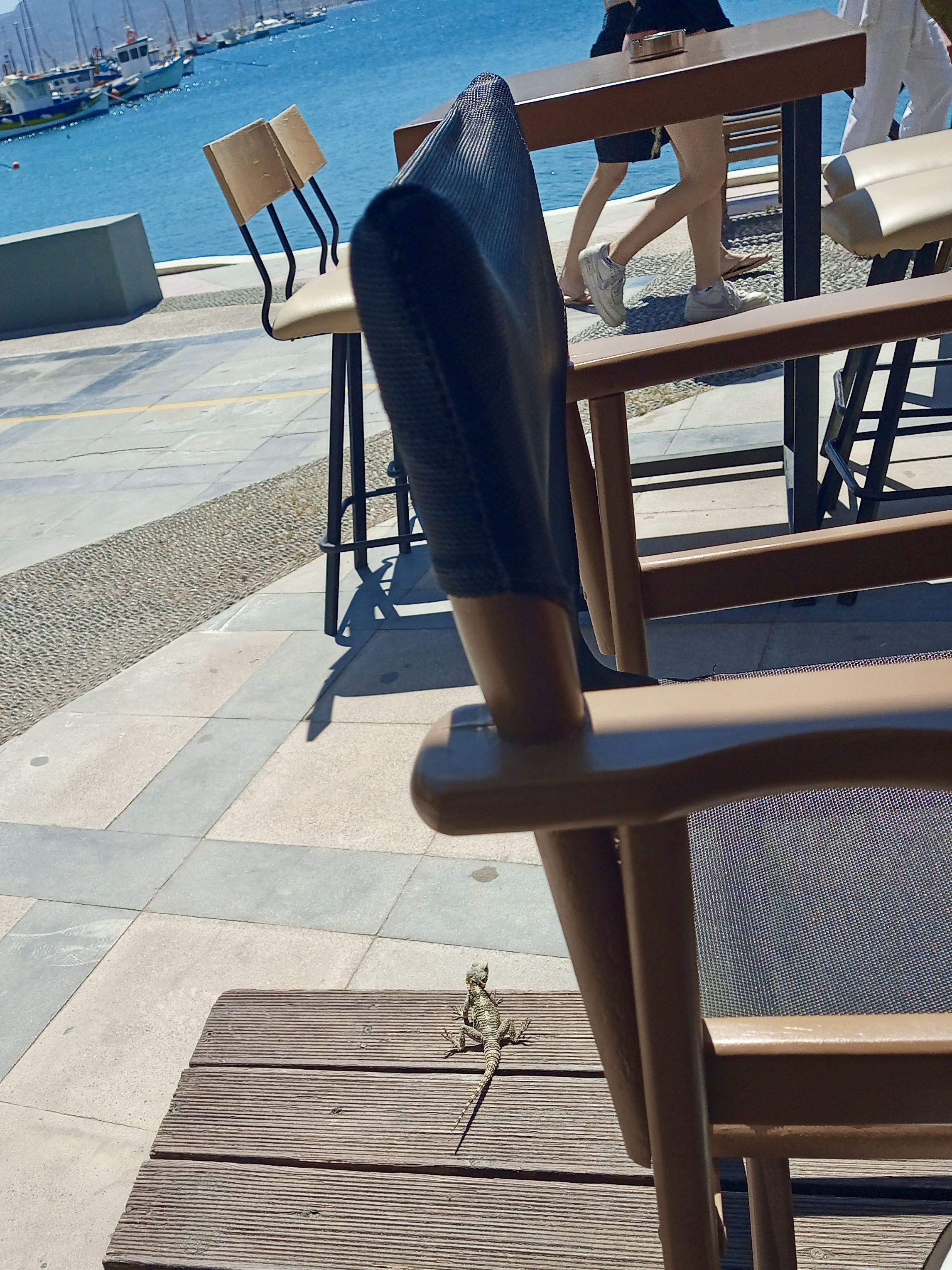
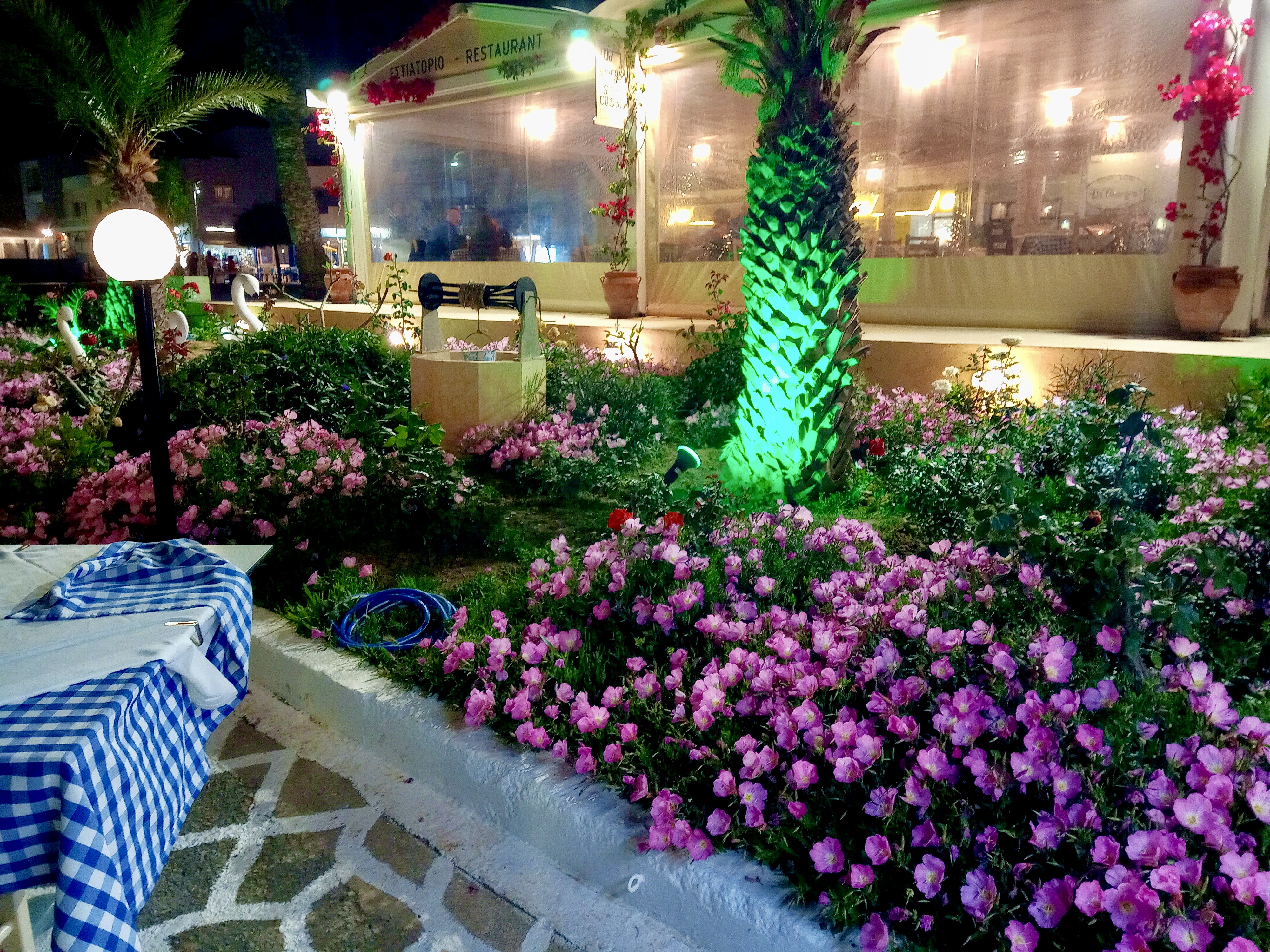
So, to finish off with, here are some restaurant and café themed photos from Sitia this year:

Click HERE to go to my Amazon Author Page, where you can browse and purchase all of my seventeen written works.

A change is as good as a rest

It’s funny really, because I guess that people reading this (and may I add here that I’m deeply grateful to those who do take the time out of their busy schedules to do me the honour of actually reading my random jottings) would quite justifiably say that someone who lives where we do doesn’t really need to be taking an annual holiday any more. 

And, of course, they’d have a point – to a degree. But when all is said and done, if you think about it, it doesn’t really matter where on this planet you reside, daily life is daily life isn’t it? I mean, when at home there are always jobs to be done, washing up* (Not wishing to sound holier than thou here, but we don’t believe in dishwashers, awfully bad for the environment, but you can ignore this part in the brackets if you like), DIY and maintenance tasks, cleaning, preparing meals, gardening, shopping, ironing, dealing with bureaucracy, the list goes on. 

[*See I’ve hit once again here on the difference between American English and British English. If I’m not mistaken, if you ‘wash up’ in America you probably wash your face and hands before dinner, or after a long journey or something, right? Whereas in the UK to ‘wash up’ means to do the dishes. There, that’s got that out of the way.]

Plus, me and the beloved are actively involved in a volunteer group down in the town whose aim is to bring solace to those seeking for it, and that occupies quite a lot of our time too, but that’s another subject for another time; though it does add to the list of ‘stuff’ that we do on a regular basis when at home.

So, when you get right down to it, a change from one’s routine is always good for recharging the spiritual batteries, right? Right. 

When we used to live in the UK, way back in the mists of time (since this coming August marks our 20th anniversary of living here in Greece), we went on holiday (vacation, folks, vacation, OK?) latterly twice, even three times in a calendar year, depending on how the finances were working out. Of course, we didn’t always come to Greece, and among the other places in the world that we gave a try were Ireland, the United States, Portugal, various Spanish locations, both on the mainland and the island groups, France, Belgium and a few others too. Not to be forgotten here, I ought to also include the far west of Wales in that list. If you get the weather, there are few places on this planet more beautiful. 

But, owing to my wife’s Greek heritage, we inevitably tended to gravitate back to Greece. Over the years while still living in the UK, we developed a list of ‘requirements’ that a Greek destination needed to have in order for us to pay it a visit. For starters, we wanted to be away from the ‘hordes,’ although we wanted enough waterfront cafés and restaurants to be able to take a pleasant stroll past them all before deciding where to sit for our morning coffee or evening meal. We wanted small accommodation, modest, but clean, and we hoped to see a few traditional fishing caiques parked up by the quay and to hear Greek voices around us most of the time, rather than those of our compatriots or any of half a dozen or so other European countries whose populace also liked to come to Greece for their summer break. Usually, to find the kind of destination that we were looking for, it would involve flying into an airport on one island, then taking a short transfer by boat to the one we were staying on, which, although adding to the time taken to get from A to B, it nevertheless also added to the pleasantness of the voyage, as it were.

I know, we were a bit fussy weren’t we? Still, we are what we are, after all. 

So, I finally come to the point (and thanks for having the forbearance to stick with me here), and it’s this: When we lived on Rhodes, to have a break in the manner heretofore described meant travelling to Naxos (which we did twice) and to Patmos (which we also did twice), since we didn’t know anywhere on Rhodes that fitted our criteria, sadly. Since moving here to Crete, however, we’ve discovered exactly what we want, and it’s only an hour’s drive from home. I hesitate to advertise it, because we don’t want it to change, but I’ll tell you anyway, it’s (and if you’ve read this blog for a few years, then you’ll already know that I’m going to mention…) Sitia.

The waterfront here in Sitia is beautiful. It probably has slightly more tourists staying in the area than does Ierapetra, but the majority here are French, Czech, and a small number of others. Freelance Brits who love to find the more out-of-the-way places do get here, and they stay AirBnB, or they find an apartment or studio for a few nights, and that’s OK. But all that said, tourism here is not mainstream, it’s not yet reached that awful ‘overtourism’ status of your Falirakis, your Malias, your Corfus and your Mykonoses of this world, thank goodness. All that could change, but it hasn’t yet.

Why could it change? There are two reasons: 1. The recently rebuilt and renovated, not to say enlarged, airport is now capable of receiving charter flights, and some of these have begun to come here this past couple of years, mainly from France and Czechia in fact. But owing to the fact that the road from Sitia to anywhere else on the island is extremely twisty-turny, it’s not a practical place to fly in the package crowd, because the coach transfer to anywhere else would be too tortuous. 2. [And this is connected in a way to reason no. 1] There is a hot debate running here at the moment about connecting Sitia to the BOAK, which is the ‘almost’ motorway that runs along part of the north of the island. From Agios Nikolaos to Heraklion the road is either dual carriageway, or well surfaced and wide, resulting in reduced journey times between the two towns. The Greek Government has only recent approved the extending of this road (BOAK stands for Βόρειος Οδικός Άξονας Κρήτης, or Northern Axis Road of Crete) on from Heraklion through Rethymnon to Chania, which will cost millions and take many years to complete. 

Here in Sitia there is a movement to campaign to have the BOAK extended eastwards too, All the way to Sitia. It’s hotly debated, and we’ve talked to several who don’t want it, because they say it would be the last nail in the coffin of Sitia’s delightfully acceptable level of tourism, and would result in massive hotels being built all around the bay and the Sitia that many know and have loved for decades being no more. Those in favour say that Sitia is the poor relation and they want some of the ‘action,’ as it were, and these appear to be those who think that the reduction of their journey time to other parts of the island is justification enough, but sadly, that won’t be the only upshot, if it’s ever actually built. You can’t walk anywhere in the town without seeing posters in windows declaring: ‘BOAK – it’s now or never!” But they don’t really know what they’re asking for. The new airport that’s being constructed on this island is, in my humble opinion, already another step towards Crete going the same way as Rhodes and Corfu, and at least I take comfort from the knowledge that, even were the Government to begin a feasibility study, it would take years to complete, as would the construction of all the tunnels and overpasses that would be required to create a half-decent highway from Pachi Ammos to Sitia through the kind of countryside through which they’ll have to cut their destructive swathe. Environmentally, it would be a disaster too.

Still, right now, here today in 2025, Sitia is still the ideal place for Yvonne and I, fulfilling as it does all our requirements for the perfect two-week holiday, and in that sense it gives us the same buzz that we used to get from arriving at our destination back in the days when we ‘lived’ for our two weeks in Greece every summer. 

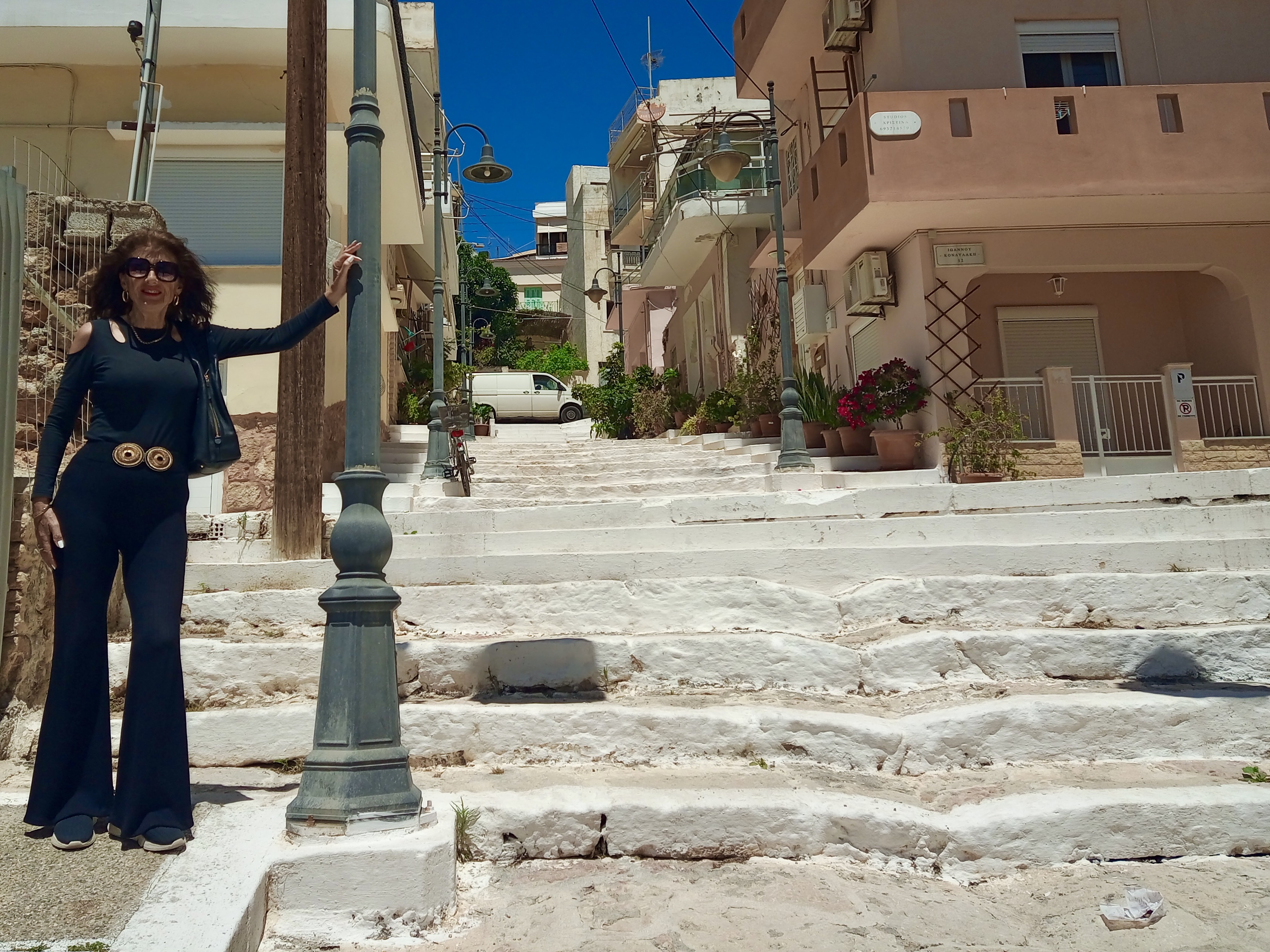
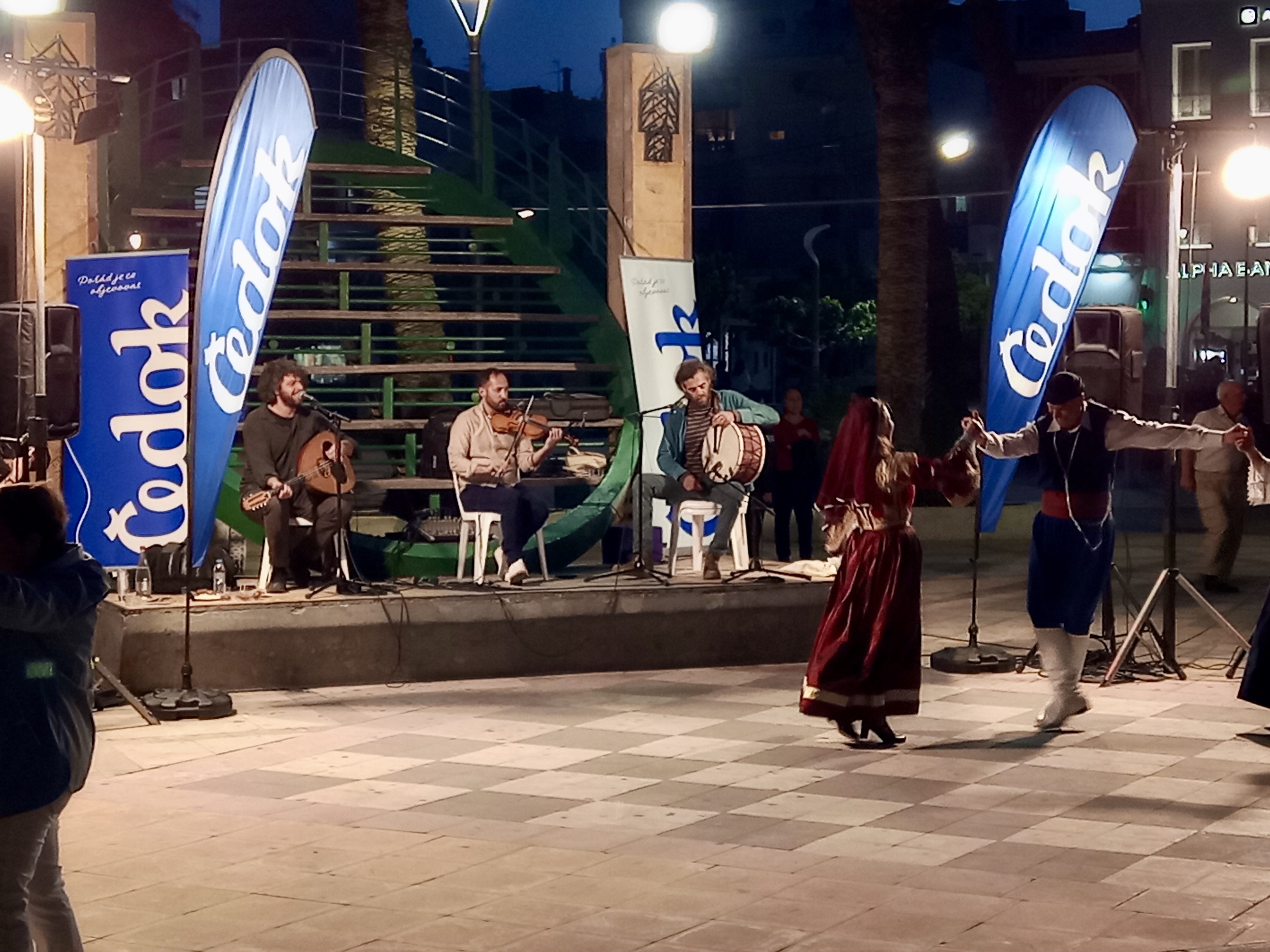
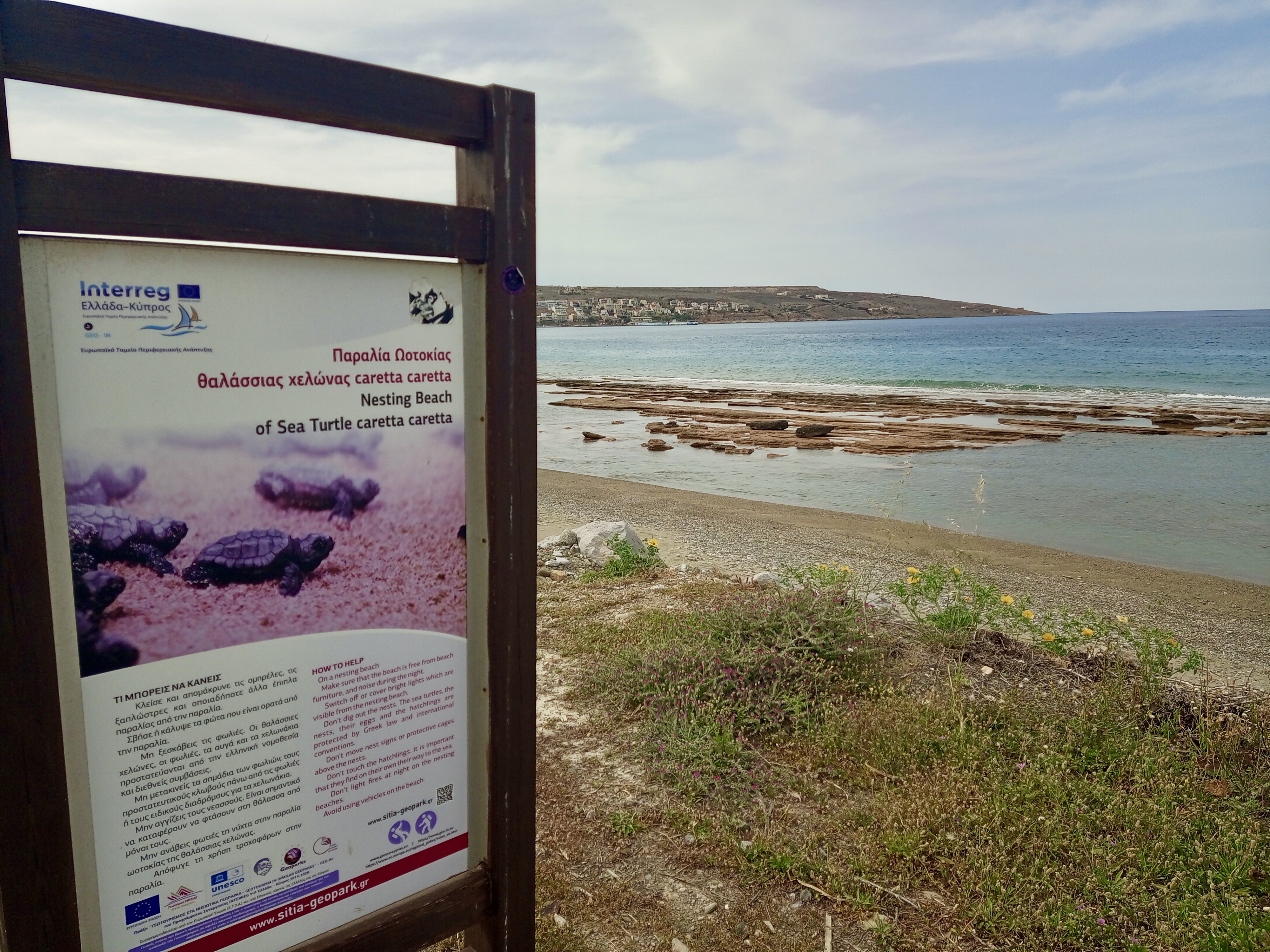
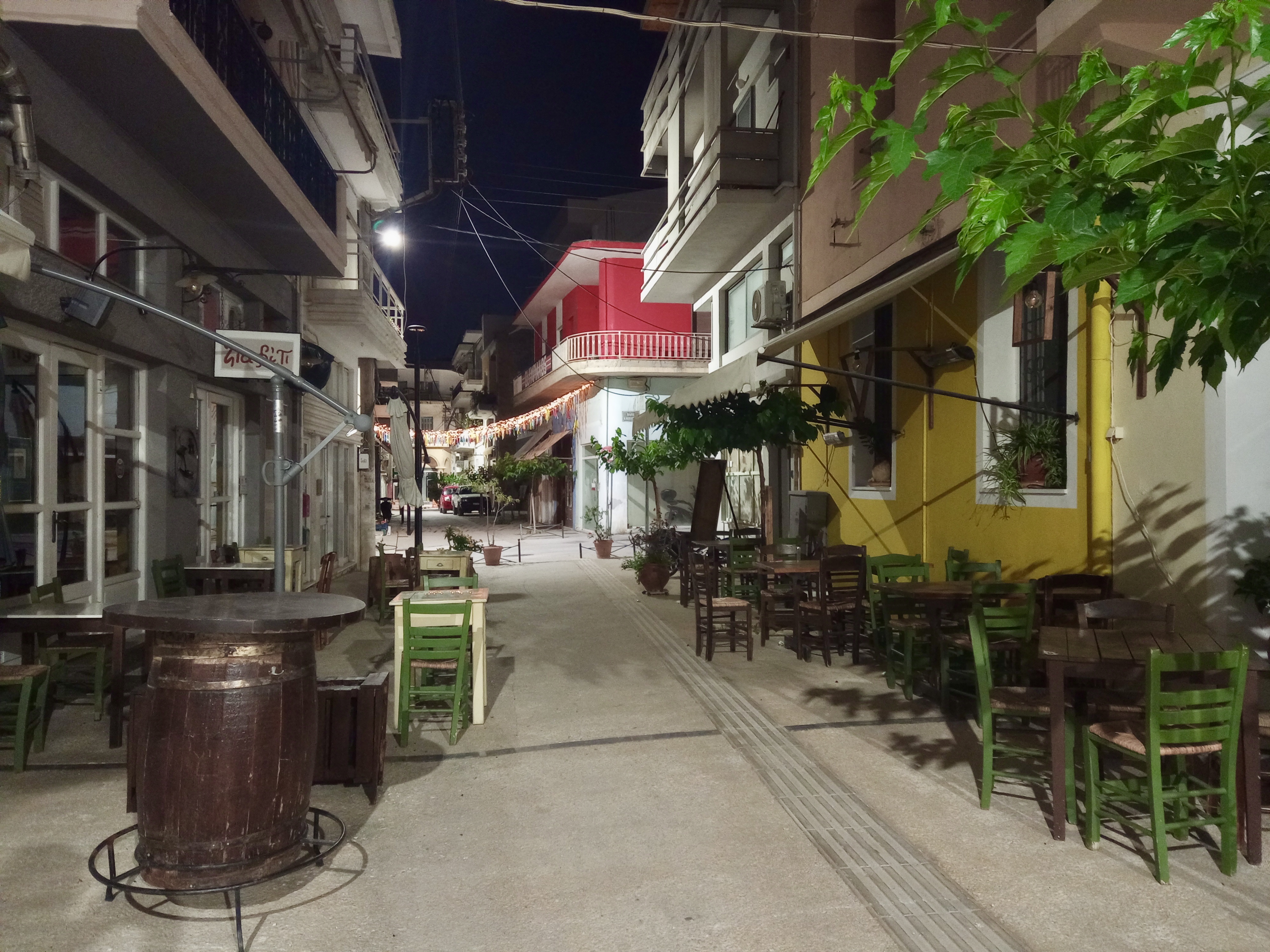
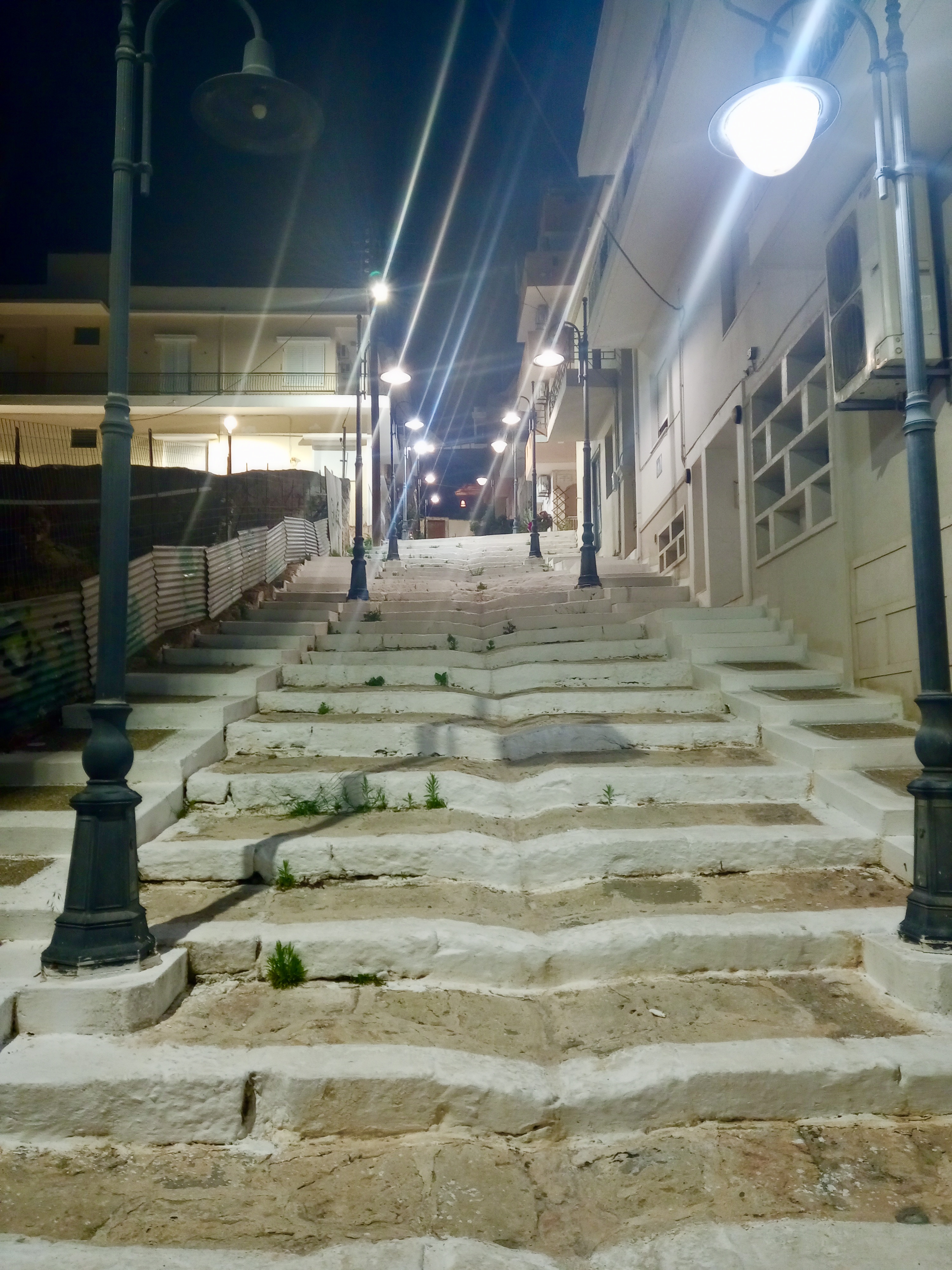
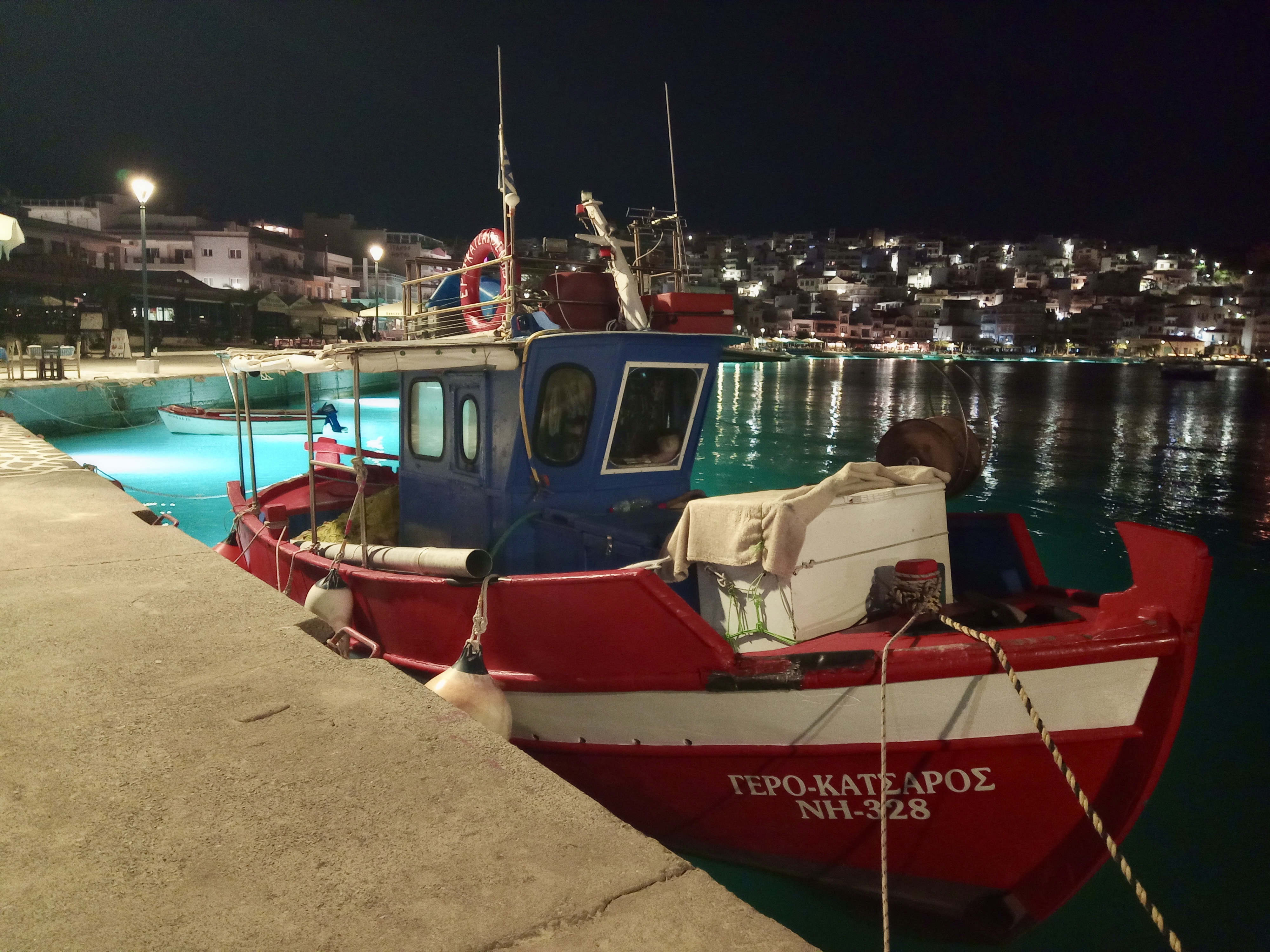
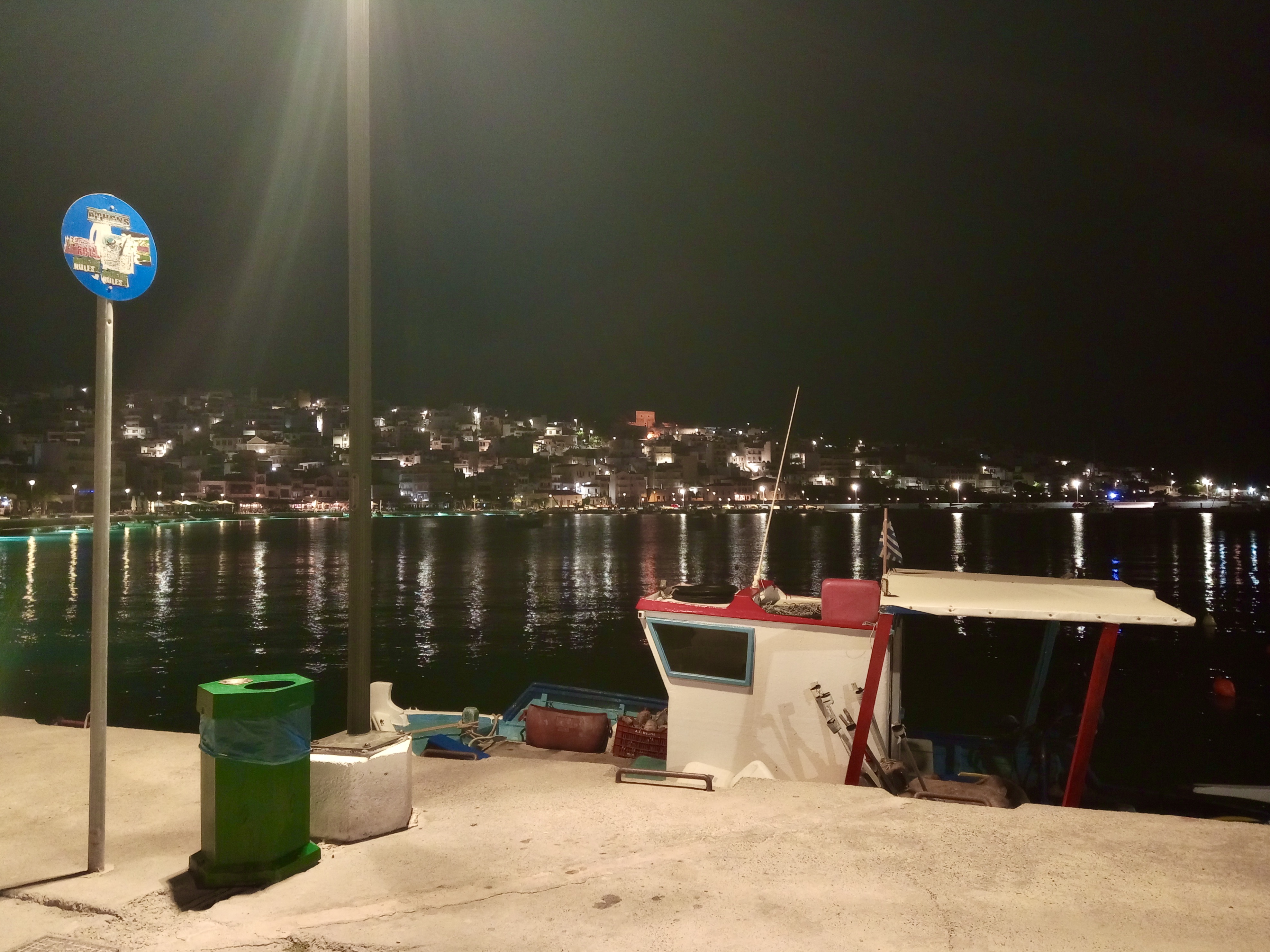
So, here are some of the zillions of photos I’ve already taken since we got here on Saturday May 10th. If you have any queries about any of these, by all means get in touch, and I’ll give a thorough explanation. The only general comment I will make is that, since I’m a poor sleeper, I do tend to wander the town and harbour area during the wee hours, and I’ve become quite addicted to taking nighttime shots, especially of the fishing caiques, which are still such an iconic representation of this lovely country. Here goes then…

Click HERE to go to my Amazon Author Page, where you can browse and purchase all of my seventeen written works.

On the verge

A lot of people, I’m sure, who’ve lived in Greece for some time will already know the following info, but there are those who come here for their holidays who may not be aware of what those small roadside ‘shrines’ are there for, so this is for them.

Roadside shrines, known as ‘proskinitaria’ or ‘votives,’ are to be found everywhere in Greece. They’re typically small structures or icons placed at the roadside, often at sites of accidents or in memory of deceased loved ones. They vary greatly in form, from simple stone ‘mini-churches’ on a plinth to elaborate marble structures with glass doors, flowers and photos of the deceased. They’ll sometimes have burning tapers or candles inside, often regularly tended by a relative of the person who’s being commemorated.

The most common types are accident memorials: These are erected at the site of fatal accidents to commemorate the deceased. They often include a cross, a picture of the deceased, and sometimes personal items like flowers or candles. Occasionally there’ll be a short inscription too. I’ve often mused on the way in which these are proliferating, as it seems that an inordinate number of fatal road accidents occur here in Greece. If things go on the way they are, I have visions of some road bends or junctions becoming so overrun with them that it’ll be a bit, well, like overkill (sorry about the bad taste pun).

The votive offering types are set up as offerings to saints or religious figures, often in gratitude for a safe journey or as a plea for protection. I hate to offend anyone, but to my logical mind such things are not of much use, except to salve the simple credulity of those who set them up. When someone reaches the end of their journey in safety, it’s more often down to good driving and a little luck than it is to anything else. What does the one who survives a journey say to those who died making a similar one? Are they perchance more ‘righteous’ then? My mind always goes back to the terrible events of the 11th September 2001, in New York City. 3,000 people died in those two towers, and yet reading a subsequent interview with the Duchess of York, who was in the city at the time, I was a bit incensed to be honest. She said, and I paraphrase (but the sentiment is right on the button), “I was held up in traffic, or else I’d have been at the top of one of those towers when the plane hit. Someone was looking after me.” Ahem, what does she say to the 3,000 who died then, and to their grieving relatives? Did that ‘someone’ who was looking after her not think much of all those others then? Logic is required in such circumstances, not age-old superstitions. It’s just my way of seeing things, folks, nothing more.

Some shrines also may commemorate historical events or figures and are placed along routes that hold cultural significance. As an example, in areas with historical importance, such as near ancient battlefields, shrines might be dedicated to fallen soldiers or significant figures from history. Many Greeks believe that these shrines (all types) offer spiritual protection to travellers, reinforcing the cultural practice of placing them along dangerous or frequently traveled roads. I believe, though, that this belief is waning as younger Greeks grow up less hidebound by old superstitions that have no grounding in fact or logic.

For families of accident victims, the act of creating and tending to a shrine seems to provide a sense of closure and ongoing connection with their loved ones, although the best that I can say about this is that there isn’t much basis, once again, for this actually helping, and it certainly won’t bring back the deceased, sadly.

On a positive note, though, I have to admit that these shrines can serve to some extent as visible reminders of the need for road safety, prompting drivers to exercise caution and respect the memories of those who have lost their lives on the roads. When I see one I do usually think, ‘OK, so this bit of road may be a bit dangerous,’ and hence exercise even more caution than usual.

Although the practice of erecting roadside shrines is deeply rooted in Greek culture, there are regulations in place to manage their placement and ensure they do not pose safety hazards. Local authorities may need to grant permission for their installation, especially on public land. In urban areas, too, the placement of shrines is more regulated due to space constraints and safety concerns.

So, there you go, a brief look at something that many who visit Greece may wonder about. Hope it’s informed those of you who were wondering, to some extent.

We’re in Sitia again folks, for our annual holiday (I know, don’t even say it), so here are some photos from this visit. There will in all likelihood be a lot more!!

Click HERE to go to my Amazon Author Page, where you can browse and purchase all of my seventeen written works.

Stopped by the ‘law’…

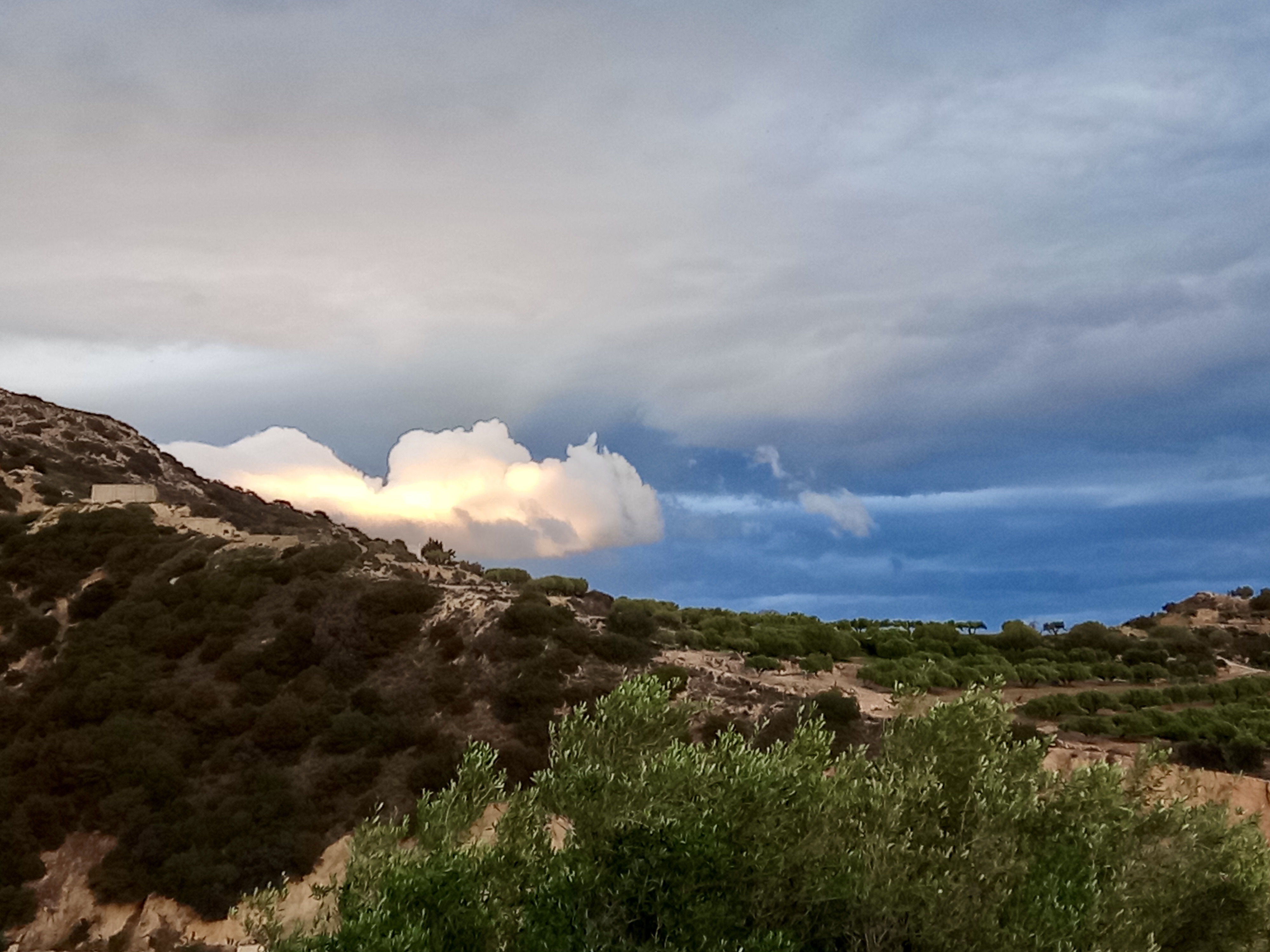
An unusual light phenomenon in the clouds during early evening last Thursday, the last time we had clouds and rain.

I was coming back from Gra Ligia the other day, in the car with Mihalis, our friend who used to work for the local Dimos and knows more people than just about anyone around here, which was just as well, as I’ll reveal in a mo. The road from Gra Ligia to Ierapetra is a few kilometres of almost dead straight asphalt, with farming supplies, agricultural tool and vehicle retailers, animal feed warehouses and the like strung out along its length. Add to that list a couple of café/bars, bakeries and filling stations, and you get the general idea. That’s to say, it’s hardly the most picturesque road you’re liable to find around these parts. Mind you, if you were piloting a light aircraft that got into difficulties, you’d probably be able to make an emergency landing on it, no trouble.

During the almost six years that we’ve now lived in the area, I hadn’t until this particular day even noticed that there are speed limit signs along the length of that road, together in many places with signs that forbid overtaking. The road is so straight and well wide enough that if anyone comes up behind a vehicle that’s moving irritably slowly, they just zoom on past, causing little if any bother to those coming in the opposite direction. I also hadn’t noticed (let’s face it, the Greeks don’t!) that for most of the length of that road the lines in the middle are double, unbroken and white. In Europe, that’s the universal indicator to motorists that overtaking isn’t allowed. Actually, in the UK it’s interpreted to mean that you could overtake, but not if it meant crossing those double lines. In most cases the width of the road would mean you inevitably would, and thus the basic understanding of the lines is, ‘no overtaking.’ 

If you drive along the piece of road in question, you’ll inevitably come up behind a slow-moving pickup truck or six. Lots of these are super deluxe with great fat alloy wheels and cost a small fortune, but a lot of them are forty-year old (and more) Japanese models that are still just about serviceable and being driven by ancient old papoudes who can barely see over the steering wheel, but they’ve been going along that road to get to and from their horafia, or to buy fertilizer or feed, for all of their working lives. These are the ones that everyone, and I mean everyone, just speeds on past, and it doesn’t really involve a great deal of risk.

Unfortunately, since the police don’t have an awful lot of gangland murders or jewellery heists to deal with around here, they do tend to lurk in a parking lot (and they’ve many to choose from) along that road and enjoy pulling folks over to check their papers and, if they’re really lucky, impose on-the-spot fines for overtaking or exceeding the rather frustrating 50kph speed limit. Keeps them out of trouble I suppose.

So, there was Mihalis, driving back towards town, with me in the passenger seat, our windows rolled down and he with his regulation forearm extending out of the window to catch the air, as it were, when a flashing blue light caught our eye and there was this young stocky policeman with his wayfarers glistening in the sunshine pointing at us and indicating very definitely that we were to pull in, where a smart white and blue police pickup was parked up, just far enough off the line of sight to be able to catch one unawares. Leaning against the bonnet (OK guys, the ‘hood’ if you like) was another young officer, also with his slick shades poised cooly beneath his peaked cap, apparently examining his fingernails so as to look disinterested, which he was, of course, anything but.

Now, we’d been the last in a line of maybe six or seven vehicles, all moving at the same pace, which was around 60kph. OK, that was a little over the limit, but everyone was guilty, not just us. I hadn’t even noticed, but Mihalis had apparently drifted out slightly, making it look as if he was contemplating an overtake, when all he was doing was taking a look along the road for some reason or other, or, more likely, adjusting his sunglasses on the bridge of his nose, thus losing concentration for a second or two.

Mihalis pulled into the parking lot, the police pickup just behind us when we came to a halt. The officer who’d flagged us down was at the driver’s window in seconds and asked Mihalis for his papers. 

I may not have mentioned this before, but his Toyota 4×4 SUV isn’t the neatest of vehicles inside. I wouldn’t say that it was total mayhem, but there were papers, small packs of tissues, spent coffee cups (the cardboard ones), rags for wiping the windows, CD cases all over the place. Every pocket was bulging with ‘stuff,’ as was the glove compartment when Mihalis opened it during his search for his insurance certificate. You have to be able to show your drivers license, your ID, your current insurance certificate and proof that you’ve paid your annual road tax when they stop you. The road tax having been paid (and here, everyone pays it in December for the following year) is no longer made evident by a screen sticker, no. When you pay it you print out a kind of certificate, which is about A6 size, and you keep it in your vehicle in case you get stopped. Once a car’s four years old you have to start taking it every two years for its roadworthiness test at the KTEO depot too, and in the intervening year it has to go anyway for an emissions test. If the vehicle is roadworthy, and hence passes its test, the engineer who examined it will place a small circular sticker on the rear number plate, and this is colour coded and indicates when the next test is due, so it’s a simple matter of looking at the rear plate to see if the car’s been tested and passed. 

Usually the officer who stops you will ask pretty early in the conversation for your license plate number anyway, because, let’s face it, if it’s your vehicle then you ought to remember your number, right? If you can’t tell the policeman your number while sitting in the driver’s seat, then it’s a good indicator that maybe you’ve just stolen it.

Mihalis, whilst flinging open glove compartments and poking around in door pockets, was mumbling “I could have sworn I had it in the car. Where the hell is it?” He was talking as much to himself as to either me or the young policeman. If you can’t produce the required papers, the next step is that the officer will ask you to step out of the car.

“Step out of the vehicle sir, and come with me please,” said the young man in uniform, and I’d have sworn he said this with a smirk beginning to spread from the corners of his mouth. ‘I’ve got one here,’ I reckon he was saying to himself, ‘Yesss!’

I remained where I was, sliding ever so slightly further down in my seat and thinking about calling Yvonne, because she and Soula, Mihalis’ wife, were waiting for us on a corner in the town. We were on our way to pick them up and we were already late. Mihalis is a Greek, after all. Why change the habit of a lifetime? 

As Mihalis and the first policeman reached the other officer, who now joined the conversation, I had visions of him being fined a couple of hundred Euros for crossing the double white lines, maybe breaking the speed limit, probably both. Did he have his cards on him? I’m sure he didn’t carry enough cash. At first, although I couldn’t actually hear what was being said, it sounded a bit sharp, that conversation. Oh dear. The three men were about five metres behind me, but the noise from passing vehicles was making it hard to make anything out.

After about five minutes, Mihalis got back into the car, a huge grin all over his face. I waited until he’d started the car up and we’d pulled out into the road again before asking him what I was desperate to learn – had they fined him? Did he have to go to the police station within 48 hours and show all his papers?

“Oh no, Gianni,” he replied, “Everything’s OK. No problem. Have you called the girls?”

‘Yes,” I replied, “they’re OK about it. But what happened back there?”

Now, Mihalis is a recent retiree, after spending a few decades working for the Dimos, and finally ending up as head of the Cleansing Department. In fact, the bloke who’d now been given his job regularly asks him back in an advisory capacity, which suits him fine as it makes him still feel useful. Like I’ve said before in previous posts, as well as in the book Moving Islands,” There isn’t a café owner in Ierapetra who doesn’t know him and whose café bar doesn’t regularly grant him a free coffee. Of course, I should have known, there aren’t many policemen who don’t know who he is either.

“So, go on then, tell me – what happened? Did they fine you?” I asked, with some degree of apprehension.

“Oh no, that second man was the son of my previous deputy’s daughter. I’ve known the family for years. Turns out he recently got married and his wife’s already expecting their first. Lovely people. He was only too pleased to see me and catch up a while.”

Needless to say, the reason for us getting pulled over was soon forgotten and we were sent on our way with very best wishes. It’s not what you know, eh?

This post’s batch of photos…

Above: We couldn’t believe our ears and eyes when, yesterday, as we were supping our coffees on the terrace, this vehicle crept up the lane, no doubt completely unaware that you can’t get through at the top in a regular-sized vehicle. Dimitri does it all the time on his quad bike, but this bloke soon realised that he’d need to back all the way down to the road again. I thought at first that it was Google Maps, but it was the other outfit, Apple, preparing images for their version of Street View, which I believe they call “Look Around.” As he was backing gingerly down the steep lane, I called out in Greek to ask if he needed any help. He replied in heavily accented English, “You speak English? I don’t speak Greek?” Would you Adam and Eve it, but he was a young Bulgarian bloke, sent into Greece just to do this work.

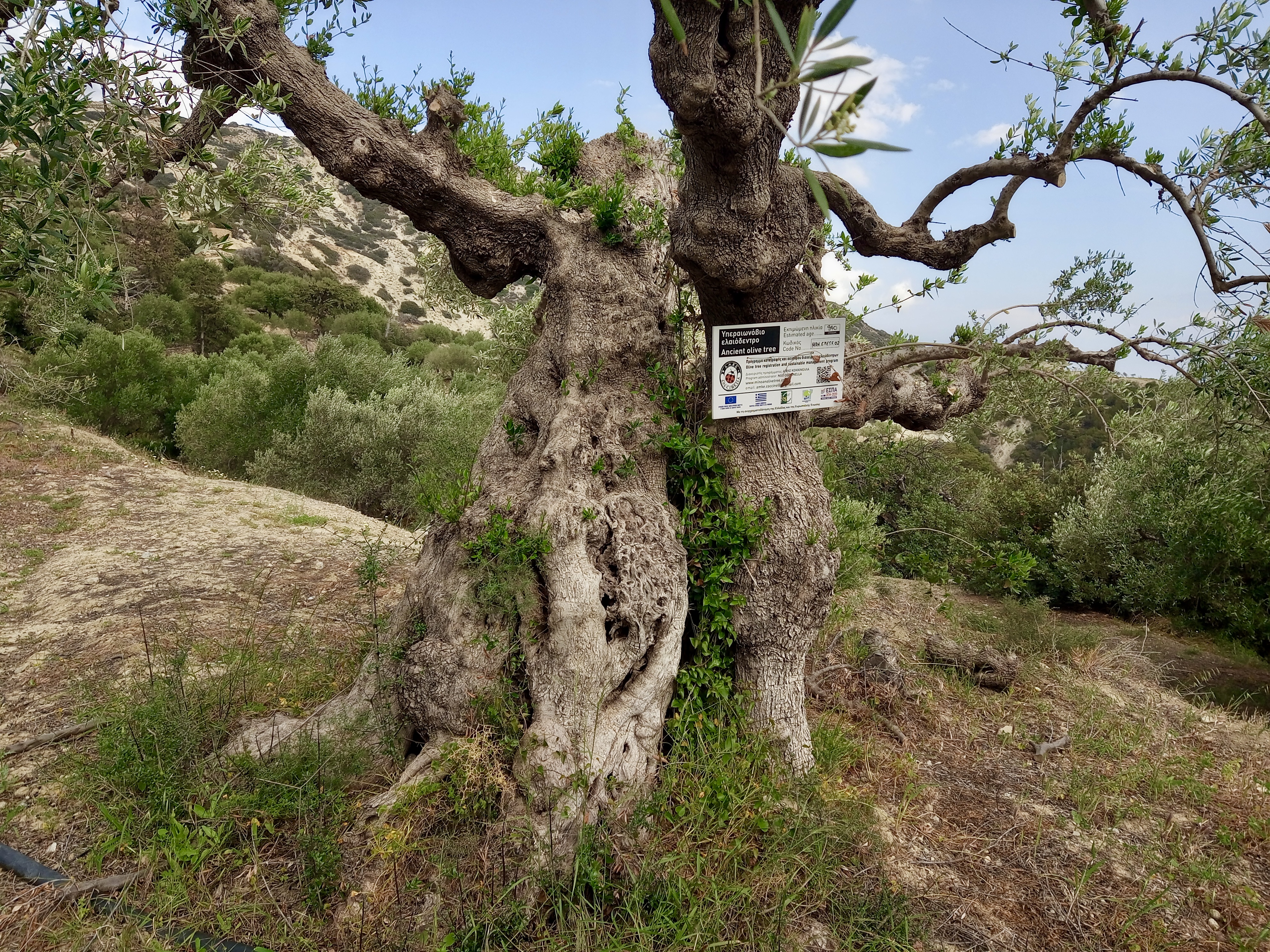
I went for a walk around ‘dingly dell’ the other afternoon. It was the first time I’d done that circuit for quite a while. These below are from that walk…

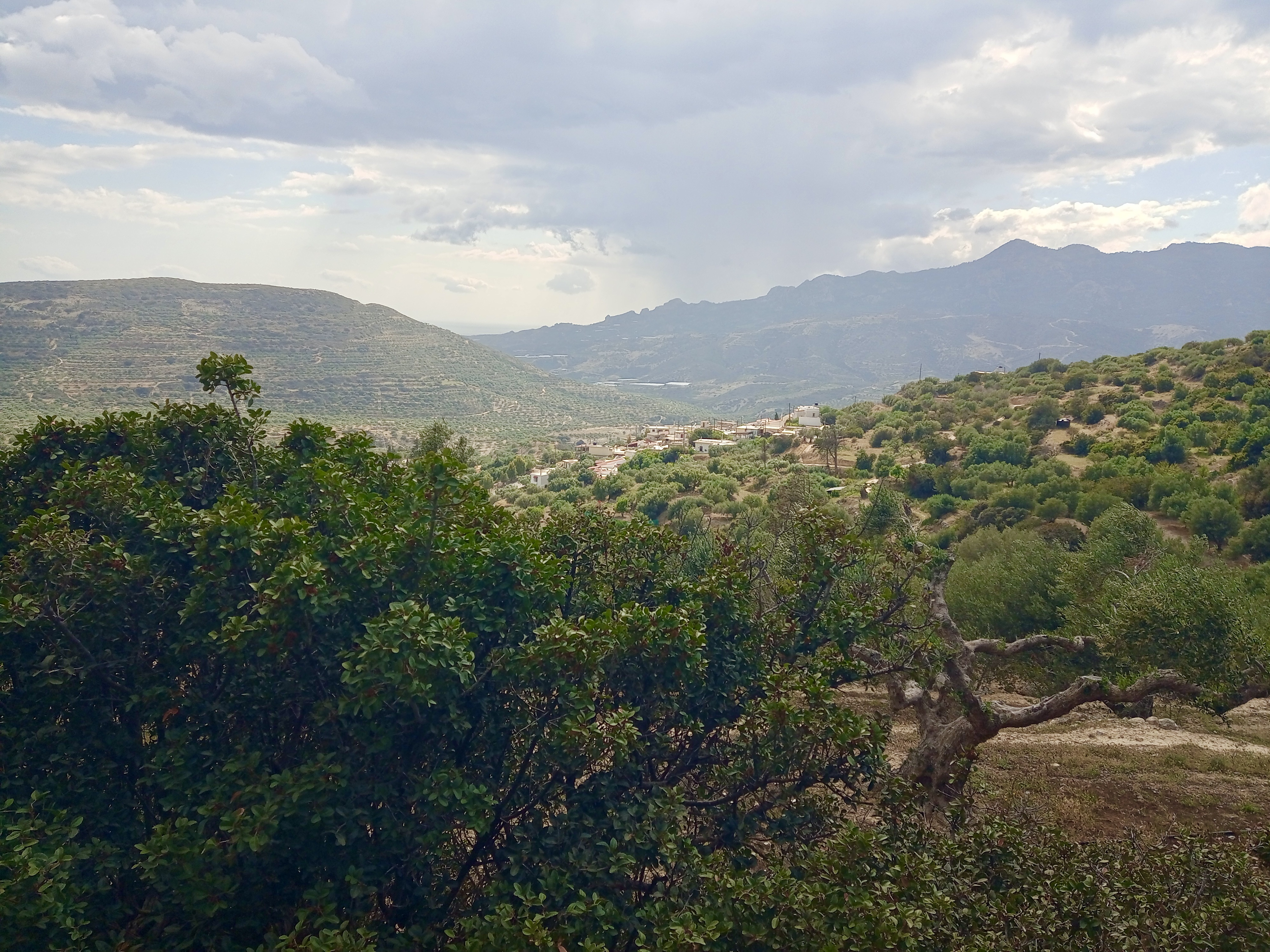
The sun’s out and the temperatures are climbing rapidly now, after a very changeable April that even got me slightly depressed. I know we need the rain, but it’s been unseasonably cold for April. It’s begun making up for that now though. The forecast is for the low to mid thirties this coming weekend, and we’re off to Sitia on Saturday for our annual two-week holiday in Greece! Below are some shots from the terrace, as we were having coffee on Monday morning…

Click HERE to go to my Amazon Author Page, where you can browse and purchase all of my seventeen written works.