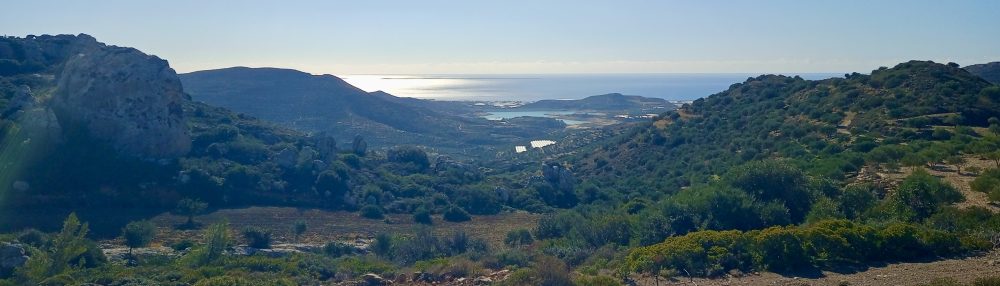
4.30am discovery

Above: Last Saturday evening, at around 10.00pm. The sea front at L’Angolo restaurant was buzzing. These heat-waves may be a bit difficult to deal with, but late in the evening, when the temperature’s hovering at around 30ºC, the best place to be is beside the sea. So that’s where we were, to enjoy our usual epic green salad with a large Pizza, not bad.

I’m a bit depressed though, to be honest. You know me, I’m sure. As a rule I like to keep positive, but occasionally I need to let off steam about something, and I’m feeling like doing so again now.

Let me explain. A couple of years ago we were on friendly terms with the lifeguards on the town beach, and they were a young couple, Mihalis and Spiridoula. They’re probably in Sydney now, because Mihalis told us that they couldn’t really make a living here in Greece, and that they’d worked out in Auz a few years before, and had come home because they wanted to be in their home country. However, the cost of accommodation here was becoming so out of proportion with their earnings, that they felt that the only way to get a half-decent living standard was to go back down under, so they said that they’d see that season out and then return to Australia.

Mihalis was the thinking type, and we had many a chat about world conditions and the state of the environment. Yeah, I know, nice light subjects for a hot day on a Greek beach, eh? I remember remarking that at least now there were recycling bins in evidence in Greece, a country that’s been very late coming to the ‘recycling & caring for the environment in general’ party, to put it charitably. When we’d first arrived in Greece on Rhodes back in 2005, there were no recycling facilities on that island at all, and the irony of it was that during the very summer of our arrival a big hotel in Rhodes Town was hosting an international conference on the importance of recycling. You couldn’t make it up, could you?

Nowadays, though, there are colour-coded dumpsters on most streets and – apart from a few wanton idiots who still chuck their general rubbish into whichever bin’s the nearest to their car window – people do seem to place their cardboard, glass, plastic and cans into the correct bin, which here on Crete is the blue one. I told Mihalis that I thought that this was an encouraging development, something to be positive about. His reply? “Sorry to disappoint you John, but they collect the contents of all bins, blue or green, makes no difference, in the same trash truck. Think about it, have you ever seen a recycling truck, painted in different livery, maybe with a recycling logo on the side, in Ierapetra? I happen to know that there are no recycling facilities here, it all goes into landfill, all of it.”

No doubt observing my reaction by my facial expression, he continued, “Look, I’m sorry to break it to you, but that’s the reason why most of the rubbish collections are done under cover of darkness. Whatever efforts you make to separate your recycling from household rubbish, it makes no difference. Ιt’s a bloody disgrace, but there it is.”

From that day to this, still fired with a basic need to live in hope, we continue to chuck everything that’s recyclable into the blue bins, and the normal rubbish in the green ones. I don’t want to blow our own trumpet here, but we actually have very little ‘normal rubbish’ to throw away anyway, because my wife always cooks with fresh vegetables, never packaged, and we steer well clear of packaged, processed foods as much as we can. Knowing, as I do, that there are European Union treaties and standards that have to be met by the member states, I’ve gone on believing that Mihalis may just have been wrong. Perhaps his opinion was coloured by a general disappointment in his home country, but either way, we’ve gone on trying to do the right thing. Yvonne and I find it impossible not to do whatever we can to help the environment, as should everyone with a brain IMHO.

So, to the reason why I’ve chosen to talk about this subject this time around. I’ve talked many times before about how, since I’m a bad sleeper, I often take a walk around the village during the night hours. All the local cats and dogs, probably even the local bat population, know me all too well by now, and they watch passively as I trudge by. Now and then I’ll pass a neighbour who’s also not sleeping, and they’ll be sitting quietly outside their front door, trying to keep slightly cooler when the temperature never drops below about 27-28ºC all night. We nod a quiet whispered greeting and I continue on my way.

Well, a few nights ago I took my walk at the crack of dawn. Well, it was actually around 4.30am, still before the blackness in the eastern sky had begun to develop its pre-dawn glow. As I walked back along the main road through the village, a loud noise reached my ears from a little way behind me. It was accompanied by nightmarish flashing lights that put me in mind of some hellish scene from a sci-fi movie or something, maybe the war of the worlds had actually begun. I soon realized that the sound was of machinery, including a diesel engined truck, and the clanking of dumpsters being heaved up by the rubbish truck’s lifting mechanism, which tips the dumpsters upside down and empties their contents into the truck’s gaping, hungry aperture at the rear end. I knew that a hundred metres in front of me were the two bins that serve our small lane, so I ducked behind a tree in the murkiness to see what happened when the truck reached our bins.

There are two bins beside the road at the bottom of our small, steep lane. One’s blue, placed there by the new village mayor Manoli after I’d suggested (when he’d asked us for suggestions) that there ought to be one, since our village, when he got elected, didn’t even have one blue (recycling) bin to its name, whereas Meseleri, five kilometres up the mountain, had about six. So now we do have one blue one and one green one (for regular waste) at several spots within the village, and, I’ve got to say, most villagers do put the right stuff in the right bin. The blue one’s often well full of cardboard packaging when someone’s had a new appliance delivered, for example. Good on them.

So, there I was, with a full and unimpeded view of our bins, watching from a dark recess behind a tree as the trash truck pulled up beside them. This was, of course, the regular dustbin-lorry (as we’d call them in the UK) and not one especially allocated to collect recycling, oh no. There are two men who stand on platforms either side at the back, and they cling on to metal grab-handles whilst the truck’s in motion. As the truck comes to a stop, the men leap off, grab the bins, wheel them to the truck, hook them up, then operate a control panel and the mechanism lifts the bins, then tips all the contents into the truck, where the hydraulic crushing mechanism takes over and compresses the waste before forcing it further back inside the truck’s ‘container.’

The men did exactly the same with both bins. In fact, when they emptied the recycling one, I heard the glass in it being smashed and shattered by the crushing mechanism too. To say I was crestfallen would be a huge understatement. Yes, I’d been warned a couple of years ago, but Greece is a member of the European Union, and as such has signed up to a whole raft of environmental measures. In fact, I’ve done some research and, at the risk of depressing you further, here are the facts as they stand, and it doesn’t make for pleasant reading:

There’s a European rule governing whether member countries need to recycle waste, and here are the facts. The main rule is part of the EU Waste Framework Directive (Directive 2008/98/EC, as amended by Directive 2018/851). This directive requires all EU member states to:

Take measures to promote recycling and reuse of waste and meet binding recycling targets:

By 2025: at least 55% of municipal waste must be recycled.

By 2030: at least 60%.

By 2035: at least 65%.

It also obliges countries to implement the following waste hierarchy: Prevention, reuse, recycling, recovery (e.g., energy recovery), disposal (landfill as a last resort).

Member states must report their recycling rates to the European Commission, which can take action (including infringement procedures) if targets aren’t met.

So, how is Greece doing on meeting these targets? The EU Waste Framework Directive (Directive 2008/98/EC, amended by Directive (EU) 2018/851) sets binding rules for recycling across member states, including:

Municipal waste recycling targets, to repeat the figures: 55 % by 2025, 60 % by 2030, 65 % by 2035. A landfill‑use limit: no more than 10 % of municipal waste may be landfilled by 2035

There is a  requirement that member states measure and report recycling rates, with the Commission empowered to take enforcement or infringement actions if targets or reporting obligations are missed.

The current performance of Greece (as of latest data)?

In 2021, Greece recycled just 17 % of its municipal waste, far below the EU average of 49–50 %. Landfilling is still dominant, at around 77–80 % of waste. Waste generation per person is about 509–524 kg/year, slightly above EU average of 502–527 kg. 

Is there a Risk involved when missing the EU targets? Oh yes… According to early‑warning assessments by the European Commission, Greece is at risk of failing to meet the 2025 recycling target and future landfill reduction objectives. Interestingly, In 2024, the Commission initiated an infringement procedure, issuing a letter of formal notice to Greece for failure to properly transpose the Directive and not reporting required data for 2020–2022. Plus, In December 2024, a reasoned opinion was sent concerning persistent non‑compliance with both the Waste Framework Directive and the Landfill Directive, focusing on deficiencies in waste facilities and untreated landfills.

OK, so Greece has implemented landfill taxes, increasing annually until 2027, with revenues redirected to fund recycling infrastructure and pay‑as‑you‑throw schemes. The Recovery and Resilience Plan (2021–2027) allocates €853 million to support recycling, separate collection, and waste treatment infrastructure. In early 2025, government reforms include redirecting 85 % of landfill tax revenue directly to municipalities, plus €70 million in bonuses to incentivise better performance*. Metrics reported for 2022 show recycling at just 17.3 %. Yes, seriously.

And, the consequences & penalties for non‑compliance?

Greece faces legal enforcement steps: formal notices and reasoned opinions, with risk of escalation to the Court of Justice of the EU if improvements aren’t made. Past examples of EU‑imposed fines: in 2000 Greece paid daily fines (over €17,000 per day) over failure to shut down an illegally operating toxic waste facility on – wait for it – Crete. 

(*Which begs the question, if local councils are actually receiving this cash, what the blazes are they doing with it?)

There you go, then. One can only hope that things will get better, because it has to be wholly unacceptable for local councils to be duping the conscientious among their populace with the placing of recycling bins in the community, whilst not actually recycling anything, right?

Moving swiftly on, to lighter matters, here are a few photos…

Above: Well, I say ‘lighter matters,’ but look at the temperature as we drove home with the shopping the other day)
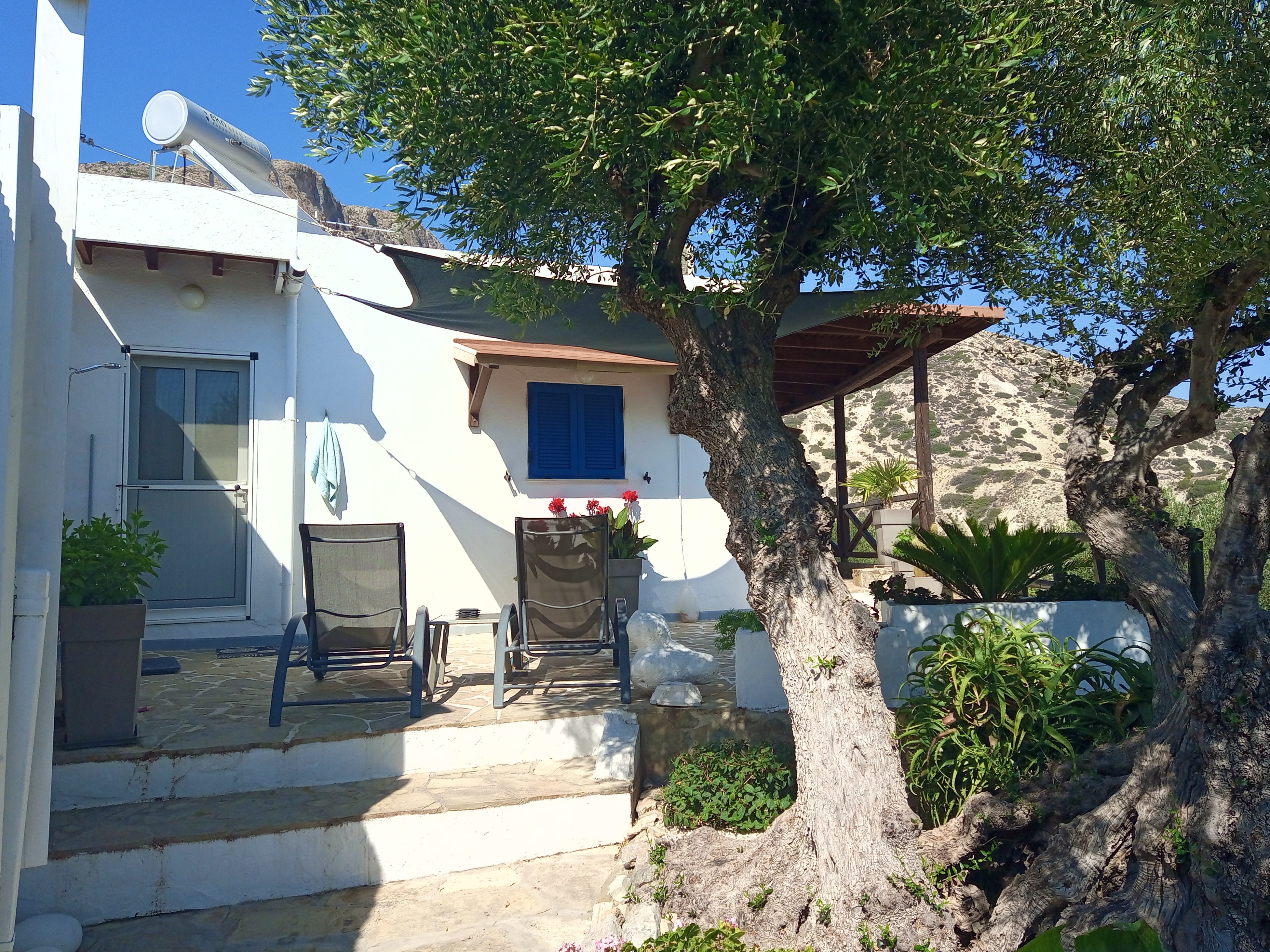
Above: Our ‘sun terrace’ yesterday. We rarely close the shutters on that bedroom window, but in these conditions it’s a must.

Above: The variety of different hibiscus flowers is amazing. We probably have about 6 different types in pots around the place and they’re all slightly different. This one’s truly ‘blousy’ when it’s in full bloom though, don’t you think?

Above: And, of course, the canas are a marvel to behold. Finally, the one below is of a dead wasp as the local ant population had just begun to arrive to do their ‘rubbish collection.’ Now, if you want to see a good example of natural recycling, look no further than the lowly ant.

Click HERE to go to my Amazon Author Page, where you can browse and purchase all of my seventeen written works.
Under the radar (and other diverse thoughts)

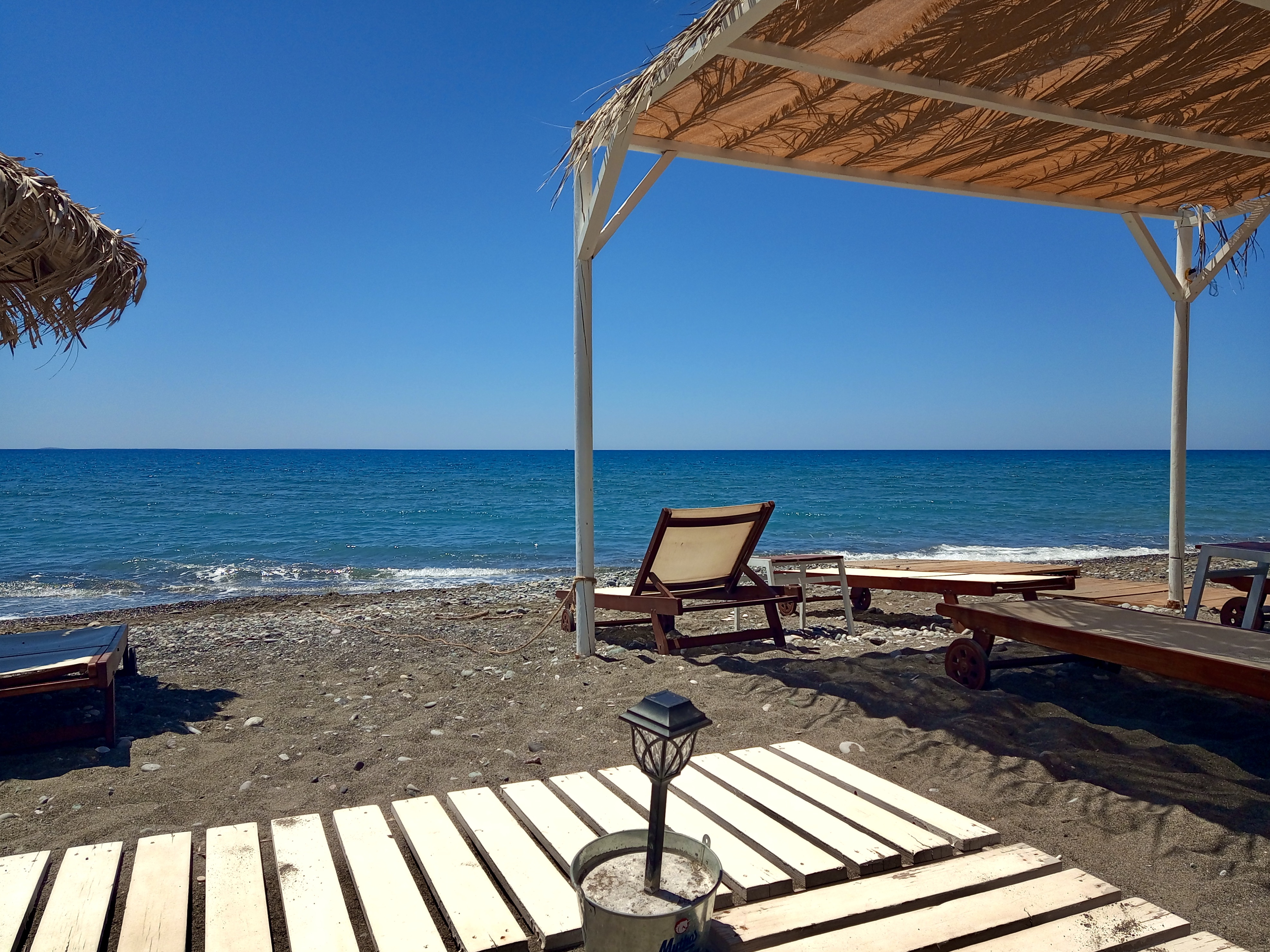
The photo above was taken at Gra Lygia beach, at the Cacao coffee bar, Sunday July 13th at around 12.30pm. Gra Lygia beach is gorgeous and mainly empty, even during the high season. It’s well over a kilometre long and backed by a concrete and tarmac road, which in turn is lined on the other side by a series of dwellings, some very smart, some scruffy, and a few derelict. The sea there, as is the case all along the south coast of Lasithi, is crystal clear and free of floating detritus, so common along the beaches of overcrowded ‘resorts’ these days.

Gra Lygia is nothing much to write home about when it comes to the village itself, although in the past few years determined efforts have been made to smarten the place up a bit, and the road surface through the village, which used to be so bad it would shake your fillings out, or put the tracking out on your car if you hit the lumps, bumps and potholes too quickly, is now ultra smooth after being resurfaced a couple of years ago. There a few new smart, modern cafeterias and tavernas, several pretty good supermarkets and even a school there.

There are, though, a great many immigrant workers in the area, many of whom live in very substandard accommodation, provided by their employers. Most of these are Pakistani and can often be seen when not working (but they usually are, for many long hours) walking around the area wearing traditional Pakistani clothing, which is called the shalwar kameez, which is a long, usually knee-length tunic top worn with loose-fitting trousers. When we first began to spot these men, it was a little odd, because in the UK we were very used to seeing traditional dress from all over Asia on the streets, not to mention from other parts of the world, but in Greece we’d only ever really seen Greeks, mainly white, with dark hair and the men at least with a swarthy complexion. Things are changing.

In general the locals don’t speak all that well of these people who are far, far away from their homes, yet without them the local economy would collapse. Gra Lygia, once you get away from the main road and head inland, is jam-packed with huge hothouses, the agricultural method first introduced by Paul Cooper [Paul Kuyper] back in the 1960’s. Coming from the Netherlands — a world leader in controlled-environment agriculture — Kuyper brought knowledge of plastic-covered cultivation and out-of-season production, which was revolutionary at the time for southern Greece. Before long the hothouses, clad in tough polythene sheeting rather than glass, began to proliferate and now they’re everywhere, enabling local farmers to cultivate a lot of vegetable crops out of season and the crops are now exported to multinationals all over Europe. It’s the reason why the area has prospered for the last 60 years or so, without the need for mass tourism.

The work inside these hothouses is arduous to say the least. We have a few friends who own them, and we’ve been inside for a mooch around. Imagine, when it’s in the mid 30’s C outside, what the temperature must be inside a hothouse half the size of a football pitch. Yup, you’re about right there. These foreign workers work their guts out for a minimum wage, much of which they send home to their families, and when they get a very short time off, they dream of home. Like I said, the locals don’t speak well of the Asians, yet they’re just people, like we all are. They’re in a country where they must agonise to pick up some of the language, and as far as I know, most of them have their ‘papers’ which enable them to work legally.

And that thought takes me back to the first few times I ever visited Greece. The first time I came across someone who was a kind of free spirit was on the island of Poros in 1977. Much of what happened and my first impressions of Poros, my first ever Greek island, is recounted in my ‘Ramblings From Rhodes’ series of books, but I don’t think I ever mentioned Claire.

My late mother-in-law, Lela, had become friendly with Giorgo Lukas, who ran a taverna along the seafront at Poros, back in the 1970s. She actually met him by chance, as she found herself sitting next to him on a plane going to Greece from the UK. She was going to visit family in Athens, and he was returning home after doing a series of Greek dancing shows, since he was at the time Greek National Sirtaki champion. He’d invited her to visit Poros and hence his taverna, and here we were the following year on our way there with her this time, since she’d raved about not only the island (which was a whole lot quieter then than it is now it seems), but also Giorgo’s taverna and the fact that he’d dance most evenings, when the mood took him.

Owing to this connection having been forged between my Greek mother-in-law and Giorgo, whose wife was an English girl named Susan (former holiday rep, usual story), we ate at the same taverna every night for three weeks. It was while we were sitting at Giorgo’s taverna that we also became friendly with this young Irish girl named Claire, who was only just out of her teens, had set off to bum around Europe a year or so earlier, ended up on Poros and was now working in the kitchen of Giorgo’s taverna. She’d been there all season when we got there, which was during the month of September, and she told us her story.

Claire was from the Irish Republic and had wanted an adventure before settling down to some kind of normal life, the life that her family had expected her to live. Only things hadn’t gone quite to plan. Once she’d been on Poros for a week or two, she’d been eating at Giorgo’s and he’d told her that he needed a kitchen hand for the duration of the season. She’d jumped at the idea and a deal was soon struck whereby Claire would live in a small studio over the taverna and receive all her meals from the kitchen below, plus she’d pay no rent, as her work in the kitchen would be her contribution to the arrangement. She’d work from around 10.00am until around 2.00pm, servicing holidaymakers who wanted a cooked breakfast, or simply a coffee or a beer, then she’d knock off and go to the beach for a swim. After a couple of hours on the beach, she’d head back to her room for a shower and a sleep, before starting work again at around 7.00pm and carrying on until the last diners had left, and the washing up had been done. She’d usually get into bed at around 2.30am. If and when she needed a small amount of cash, Giorgos was only too pleased to give her some, unofficially, of course.

Claire seemed to us to be enjoying her life tremendously, and she had no plans to change her situation for the foreseeable. She said she’d probably go to Ireland during the winter time, just to check in with the family, but would in all probability be back on Poros in the spring, ready for another season. What more could she want out of life, at least for the time being?

And thus were planted the seeds of desire within me to one day abandon the ‘nine-to five,’ and do something radical, like move to Greece and start a new life. It was to be three decades later when we eventually did it, but back then, in 1977, I’m sure a little envy at the lack of drudgery in Claire’s life had affected me and my way of looking at things. In the intervening years, of course, things changed radically regarding illegal foreign workers working casually like Claire did. The way that Claire and Giorgo had worked out their ‘arrangement’ was fairly typical all over Greece, and if you were to add to the equation the fact that most Greeks were getting away with declaring only a fraction of their real income for tax purposes, you get the idea as to why the country was on its knees by the year 2010, or thereabouts.

It’s a tough one, isn’t it. I mean, the idea of simply rocking up at a restaurant in a foreign country and getting a ‘gig’ working under the radar appeals to the bohemian in all of us. But, of course, it couldn’t really last. These days, the situation is vastly different, and legal workers are now experiencing major problems finding accommodation that they can afford, and this is in part due to the rise of the AirBnB phenomenon. For instance, there was a news story recently about a teacher living in his car. Unlike in the UK, where teachers in secondary schools probably have a job for life if they don’t step out of line, here in Greece a lot of qualified teachers have to apply each new school year for a position, and, having secured one, they then have to find digs for the duration. Up until a few years ago they’d soon be able to find an apartment in the area close to the school where they were going to teach. These days, much of the accommodation that genuine workers used to rent for a season, or a year, is given over to tourism, as the owners can make a lot more money that way.

I often sit and mull this problem over in my head, and I can’t come up with a ready solution. I mean, Yvonne and I have used AirBnB a few times ourselves when staying a few days away from home here on Crete. It’s a great and financially sensible way to do it without breaking the bank. Yet, to think that the places where we’ve stayed may have once been rented by people needing to work in the area, who nowadays can’t find anywhere that’s priced reasonably enough, is worrying. I saw a news report from Majorca in Spain, and people were demonstrating on the streets because qualified accountants, engineers, teachers, lifeguards (the list goes on) were living in tents because what accommodation was available was so expensive that they couldn’t afford it. One guy told the reporter that the rent that he was told he’d have to pay for one flat he’d applied for was actually more than his entire salary.

You know, this whole ‘holiday island’ thing bugs me, it really does. Places like Crete, Majorca, wherever, are first and foremost home to indigenous folk who have a basic right to be able to live in the area where they were born and raised, earn a decent living, raise their kids. Yet travel companies and tour operators talk about these places as being ‘resorts,’ or ‘holiday islands,’ like I said. So some tourists come here with the mindset that the whole place exists for their recreational pleasure. It’s like a lot of ‘holiday’ destinations are merely ‘theme parks’ for the hedonist. And I don’t profess to have any answers, but I do think it’s a topic that ought to be discussed, and that people who come here for their holidays ought to be educated, if that’s possible, to understand that they’re going to be guests in someone else’s country, and due respect for the locals should be shown.

As for the problem of the cost of accommodation though, and the ‘holiday let’ versus ‘real accommodation for locals’ issue, it’s a tough one. I’d be interested to hear your thoughts on the matter.

Photo time…

Here are a few shots taken this past couple of days. They well illustrate what current season we’re now in, don’t you think?

Click HERE to go to my Amazon Author Page, where you can browse and purchase all of my seventeen written works.

Could have been worse

First off, I want to repeat what I posted on the Facebook page the other day about precisely what was burnt during the recent fires in the Ierapetra area. I wrote, in part, the following:

“The news media kept headlining “Ierapetra fires,” and “Ierapetra burning.” This was totally inaccurate, since the fires broke out a few km to the east of the town and were carried further away by the winds. The rural coastal region that was hit the most hard is part of Ierapetra’s municipal council territory, and for that reason only the fires could be described as being in Ierapetra.

Ierapetra town is unscathed and the local businesses are worried about people not coming owing to the belief that the town is in some way damaged – it isn’t. All the restaurants, bars and accommodation are functioning normally.”

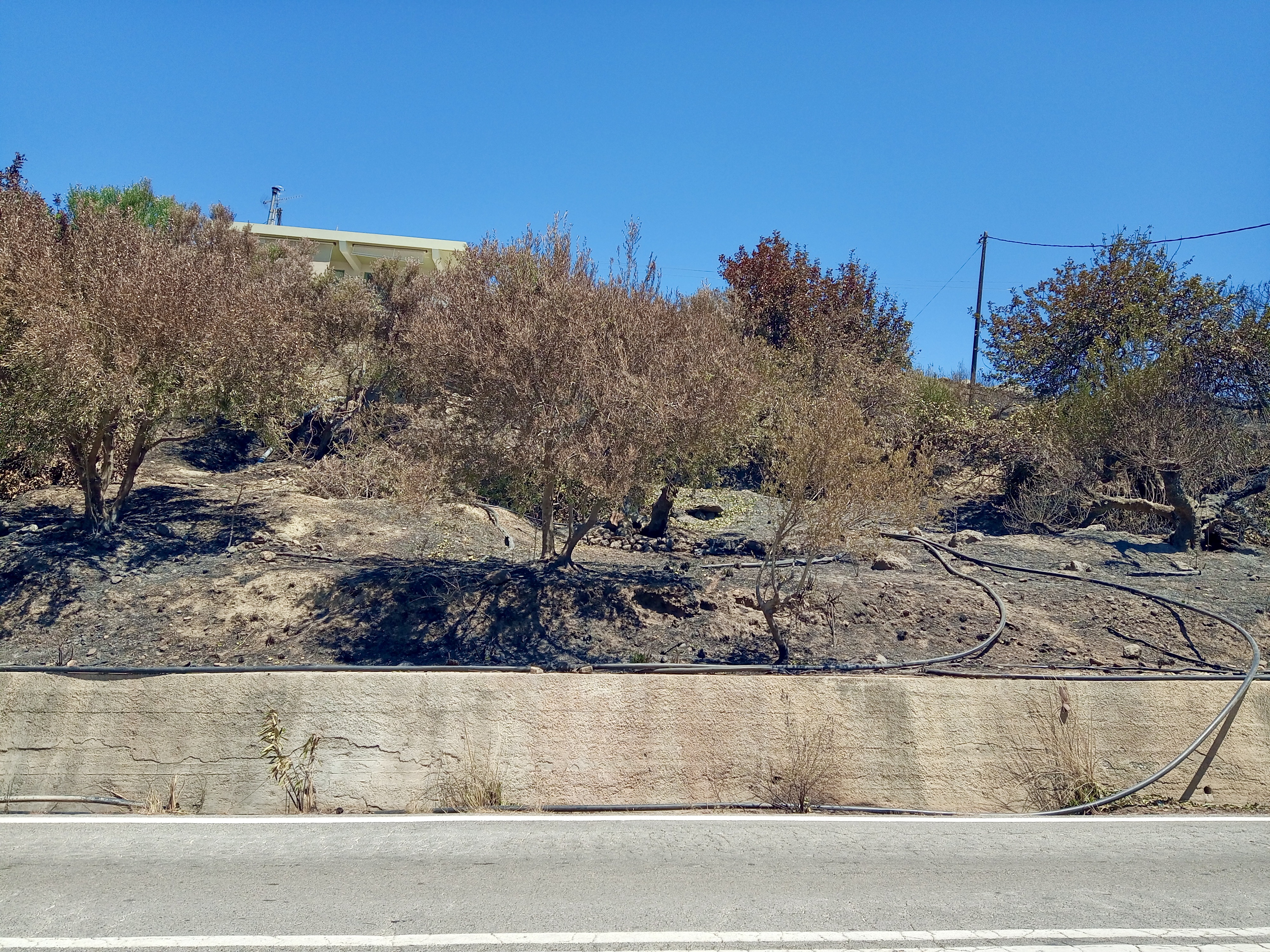
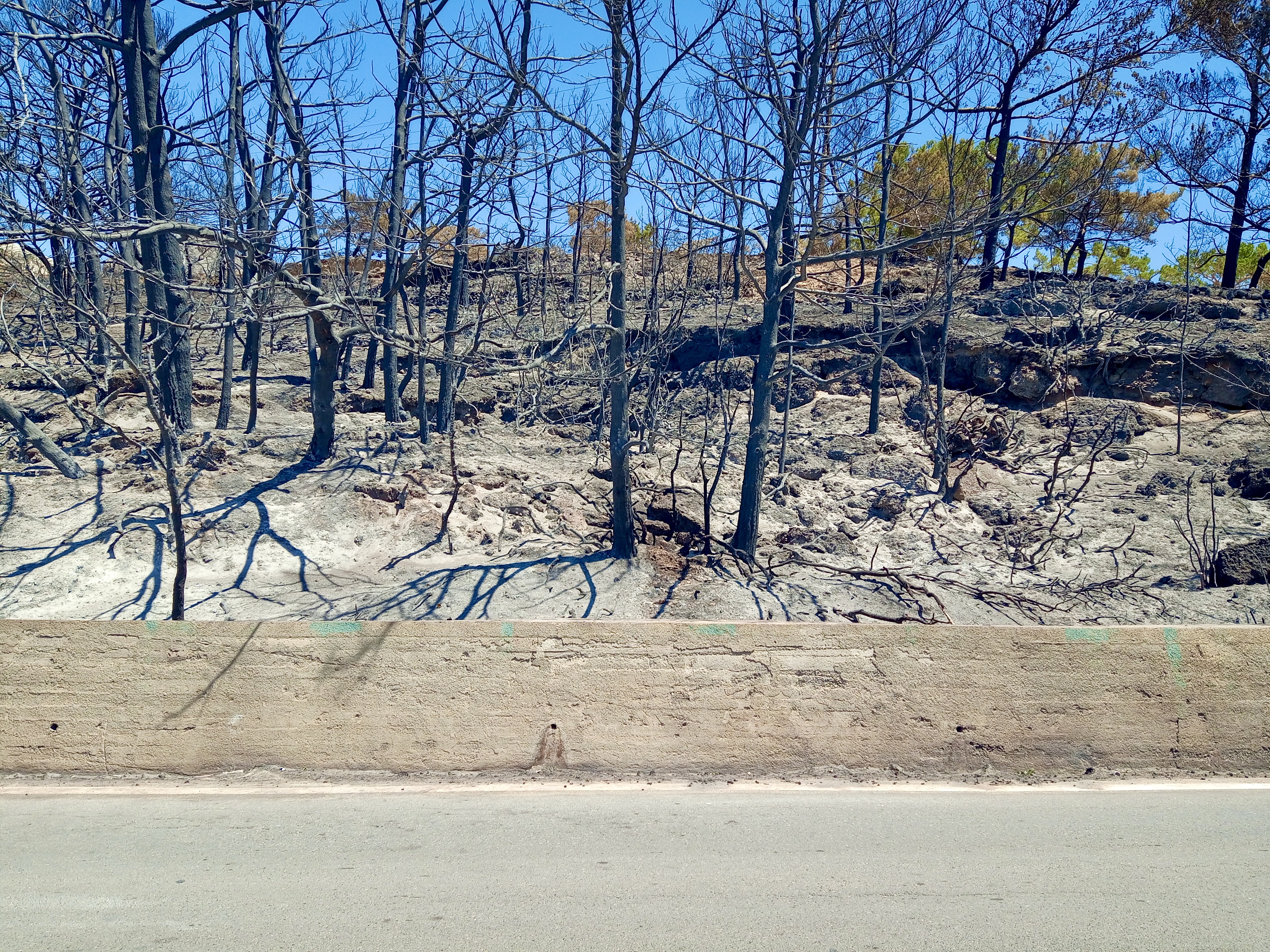
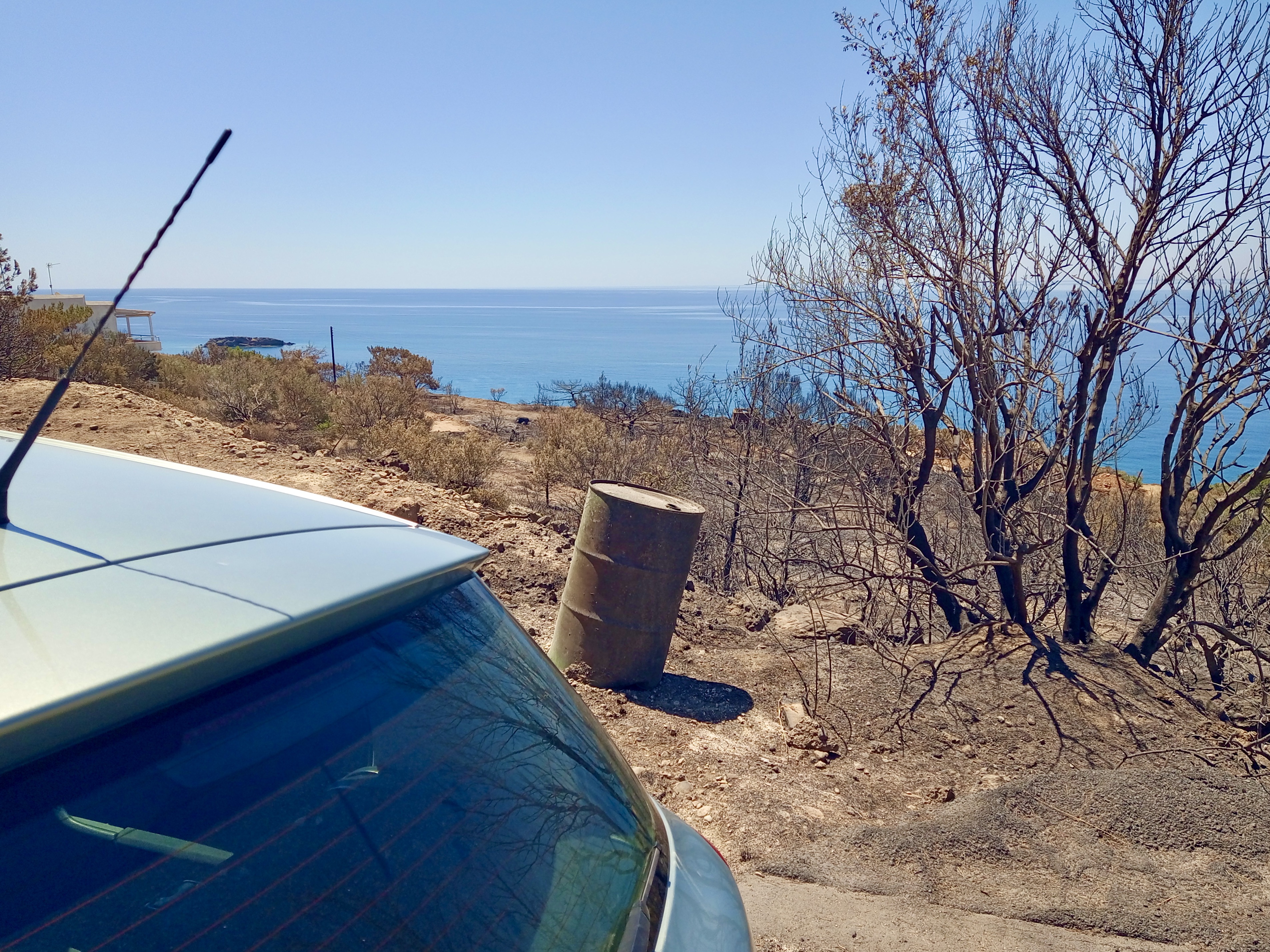
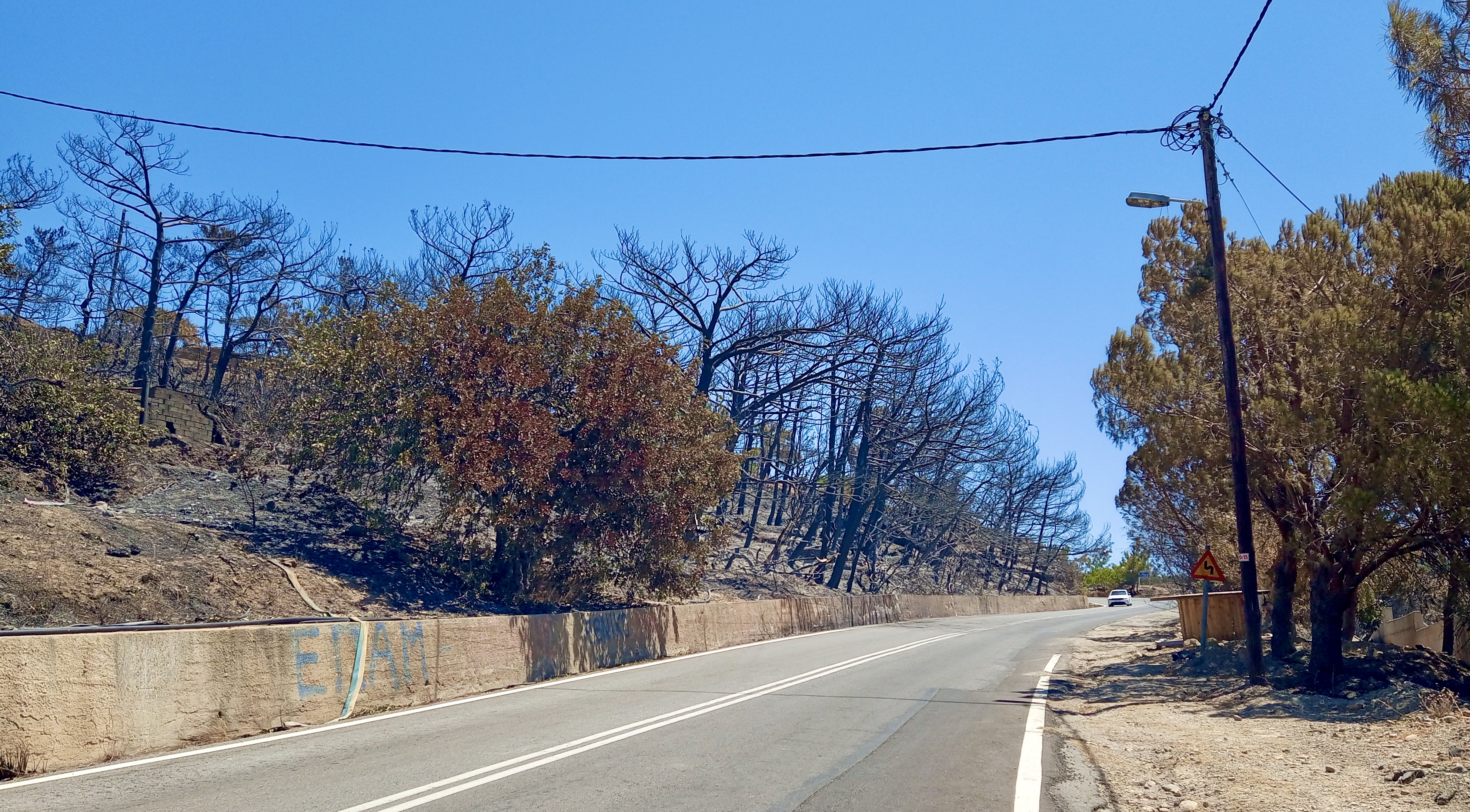
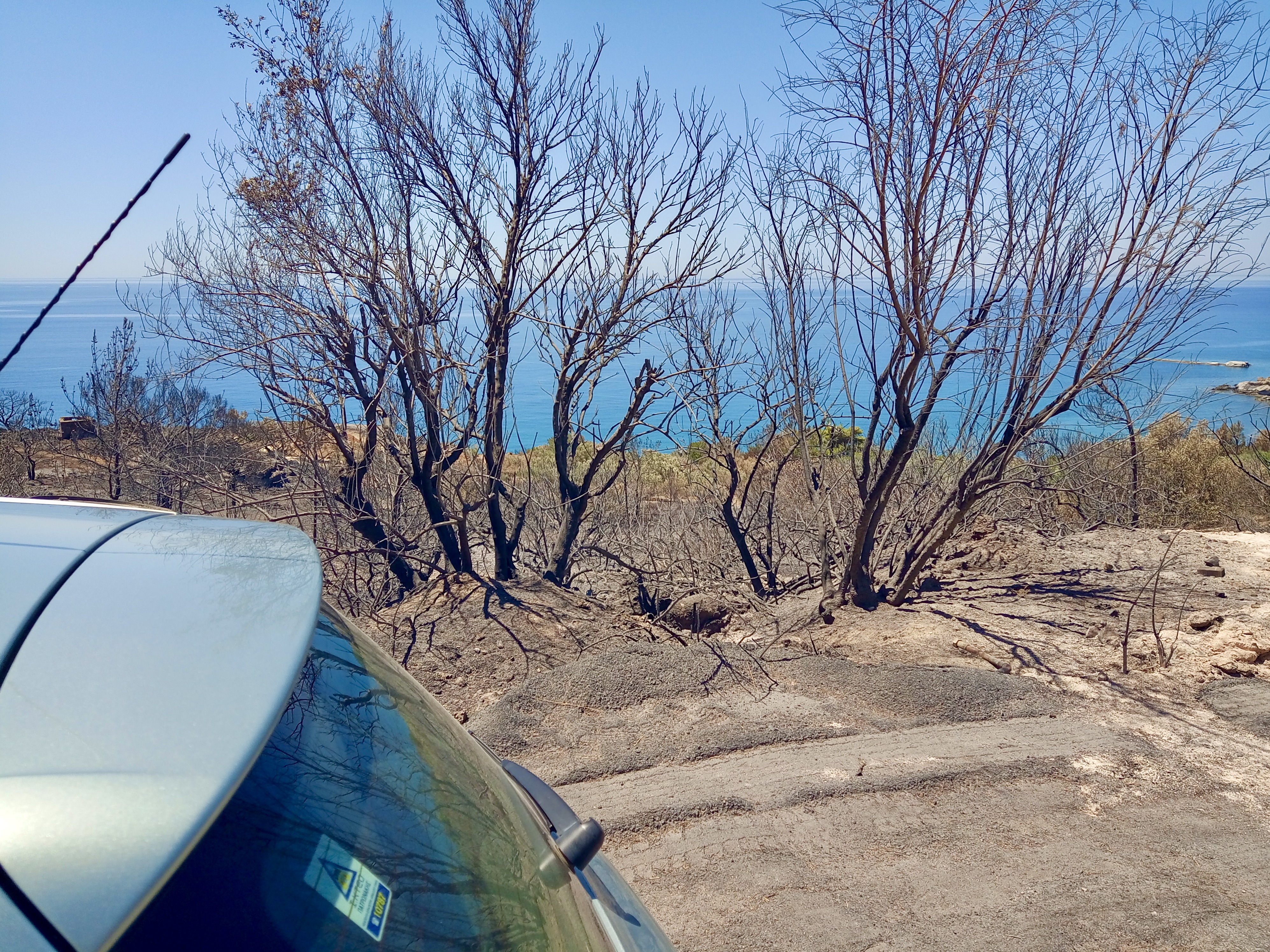
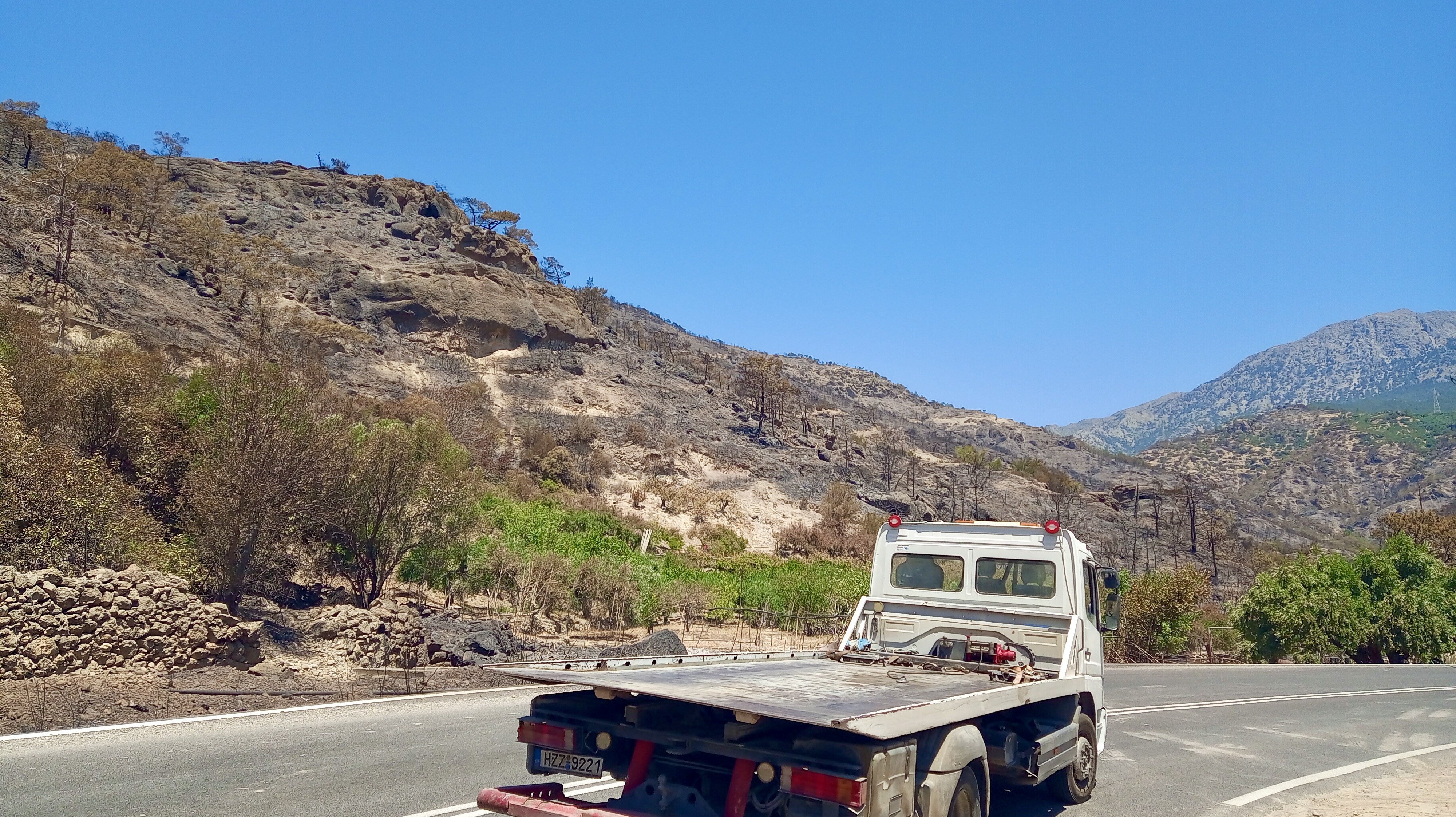
On Sunday morning we took a drive along the coast to see for ourselves what was the extent of the damage. It was bad, but mostly forest and wild vegetation were affected, and mercifully very few buildings, from what we saw. The fires swept very close to both Achlia and Agia Fotia bays, but the buildings looked as if they’d got away relatively unscathed, thank goodness. Here are the photos I took on Sunday. The white van belongs to the telephone engineers restoring phone lines where they’d been melted by the heat. We were relieved to see fire tenders and other Fire Dept vehicles still patrolling the area in case of re-ignition, which is a common occurrence in this climate.

Erosion is a problem that the affected area is likely to have once the rains come this winter. As you can see from some of the photos, large areas of steep hillside, many of which swoop down on to the main road, were stripped clean of vegetation/trees and now are simply bare earth and rocks. In order for the vegetation to make a recovery, rain is necessary, and none is likely to fall for several months yet. Once new vegetation begins to develop, then there’s a chance of it impeding soil erosion, but if we get heavy rains before that occurs, there will be a lot of soil and rocks washed down these hillsides, further adding to the environmental damage, sadly.

The news is still quiet about how the fires started, but arson is still the most likely cause, either that or absolute stupidity when it comes to cigarette ends or barbecues. Either way, humans are the likely cause, not simply an accident of nature. Incidentally, at the risk of ‘telling your grandmother to suck eggs,’ I would like to flag up something that we see all too often for my liking. It’s a very sad fact of our modern society that there is a virtual pandemic of plastic water bottles (and bottle tops) threatening the environment all over this planet of ours, isn’t it. What gets me every time is how many people simply sling their unwanted bottles out of their car windows when they want to get shot of them. As if that weren’t bad enough, once the water in a plastic bottle reaches a lukewarm temperature, people tend to discard the bottle with half its contents still in it, Grrr.

Now, anyone who actually paid attention during their Physics lessons at school ought to know that a lens can easily concentrate light into a virtual laser beam, and I for one certainly have vivid memories of setting pieces of paper alight in the school science lab doing just that. If you chuck away a plastic water bottle (rather than responsibly recycling it) then you’re a cretin anyway, but if you do it with water still in it, you’re placing a potential lense on the parched ground; a lens that, if the sun strikes it at the right angle, can easily set alight the straw-like vegetation on which it comes to rest, fact.

One other thought on plastic bottles, and those newly re-designed caps that don’t come off without a fight. The other day I watched with horror a short Facebook video as a flashy young woman, trying to be so clever, wrenched at the tough ‘straps’ that retain the bottle top when you try to remove it, and kept wrenching until the thing came away in her hands, at which point she cursed the new design as stupid, expecting her loyal viewers to agree with her. I have news for her: the environment is so full of those dratted plastic bottle tops, not to mention the bottles themselves, that this new design has been brought into circulation in order to make it less easy to remove and hence discard the bottle top, thus further polluting our already suffering environment. The new tops are specifically designed so that you can flip them back when you want to drink or pour, then reseal with relative ease afterwards, thus…

People with half a brain wanting to help preserve our environment will always dispose of plastic bottles (if we must use them at all, and it’s difficult not to sometimes, we have to admit) responsibly, right? At least if you employ the new tops correctly, they can be re-sealed on a crushed plastic bottle before it’s put into the appropriate recycling bin, this reducing (however slightly) the number of bottle tops that are cluttering up our world. OK, end of sermon.

Just a few photos now, to lighten the mood (I’m feeling quite a bit of righteous indignation ATM!) –

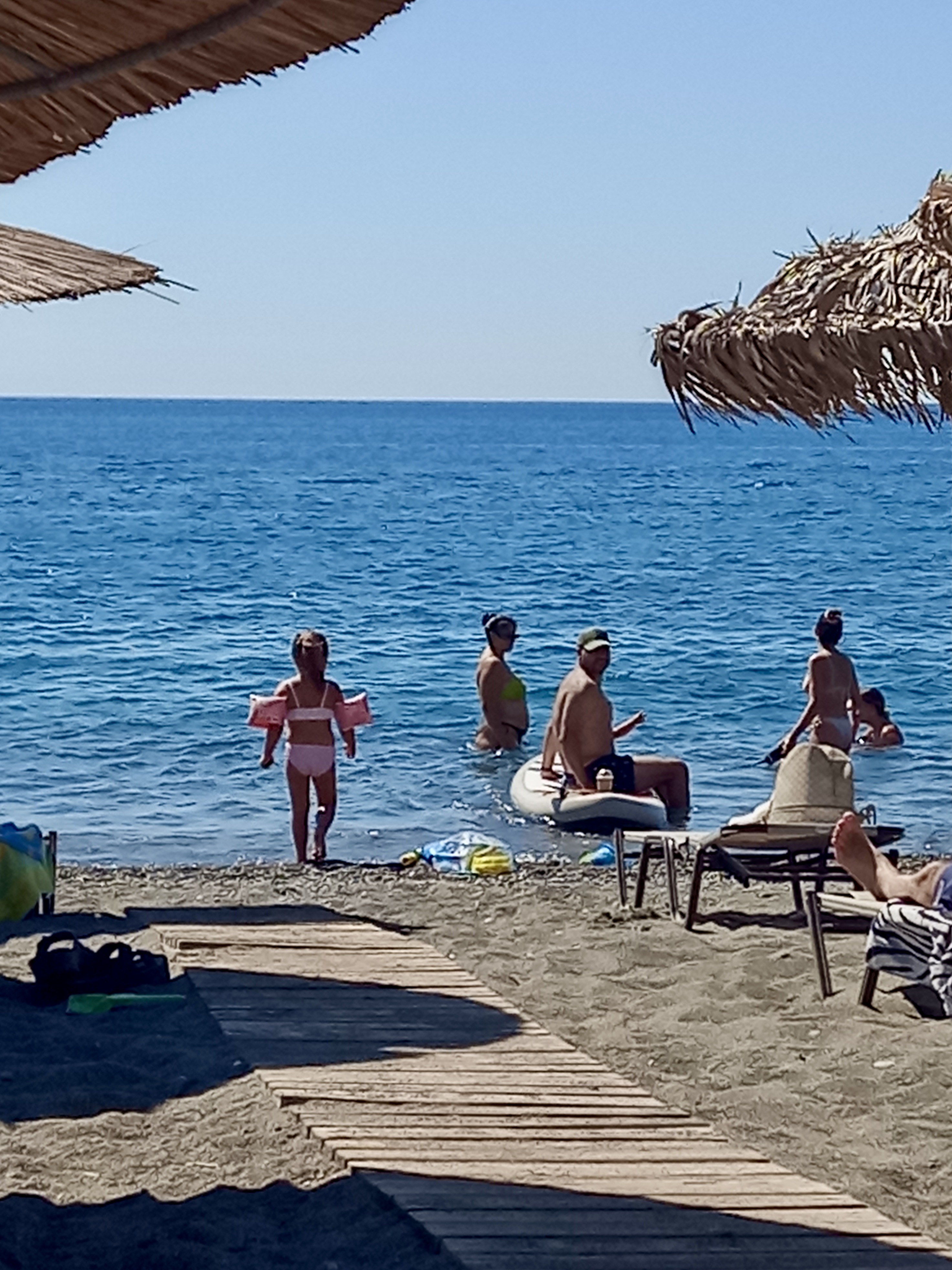
Above: Spotted on the town beach the other day, a Greek dad with his toddler on a paddle board, but evidently with his priorities right, spot the iced coffee resting on the board beside him.

Above: Just a little backstreet scene that I liked the look of.

Above: Nice, eh? And these last two below are of our sun terrace at home, showing how well our canas are doing…

Click HERE to go to my Amazon Author Page, where you can browse and purchase all of my seventeen written works.

On Edge

I went for one of my nocturnal walks around the village at around 6.00am the other day. If I do the circuit any time from around 1.00am until 6.00, I can guarantee that the only company I’ll come across will be the local cat population and the occasional farmer’s dog asleep in the back of a pickup. Maybe, if I’m really in luck, I’ll also spot one of the barn owls that live in the empty buildings in the heart of the village.

On this particular occasion, though, since it was 6.00am, people were stirring, and those were, as expected, all the ya-yas and papoudes, ie: the old folk. As I crested the top of the village, passing the tiny church that sits at the apex of the narrow street, and began to descend towards the north end of the village, there was Popi just sliding open her glass door on to her terrace. No chance there then of quietly striding by on my power walk. She spotted me instantly and so we had to have the expected polite exchange of greetings before I could carry on my way.

Rounding the tight bend at the bottom of the slope and heading back through the village, this time on the ‘main road,’ passing the kafeneio on my right, to the left, sitting at his rickety old plastic patio table, covered with the regulation oilcloth tablecloth, was Filia’s next-door neighbour (I forget his name), a chap with a shock of thick wavy grey hair, probably in his mid seventies, quietly preparing his first self-rolled ciggie of the day, an Elliniko steaming on the table in front of him.

As I passed the high wall, along the top of which is the lane where there is a series of dwellings, among them Angla’i’a and Giorgo’s, there, as I expected, was Angla’i’a herself sweeping up some leaves, apron on, already having started the daily routine. No, you can’t walk around the village at the crack of dawn without having to say hello to quite a few people, none of them under 75 years of age. It’s their generation, isn’t it? They’ve probably been rising at 6.00am or thereabouts for most of their lives.

As I type this there’s a fire raging about twenty kilometres to our east, along the coast in the Koutsounari, Ferma, Agia Fotia (uncomfortably close to the truth, that name, since it means ‘Holy Fire’) and Achlia areas.

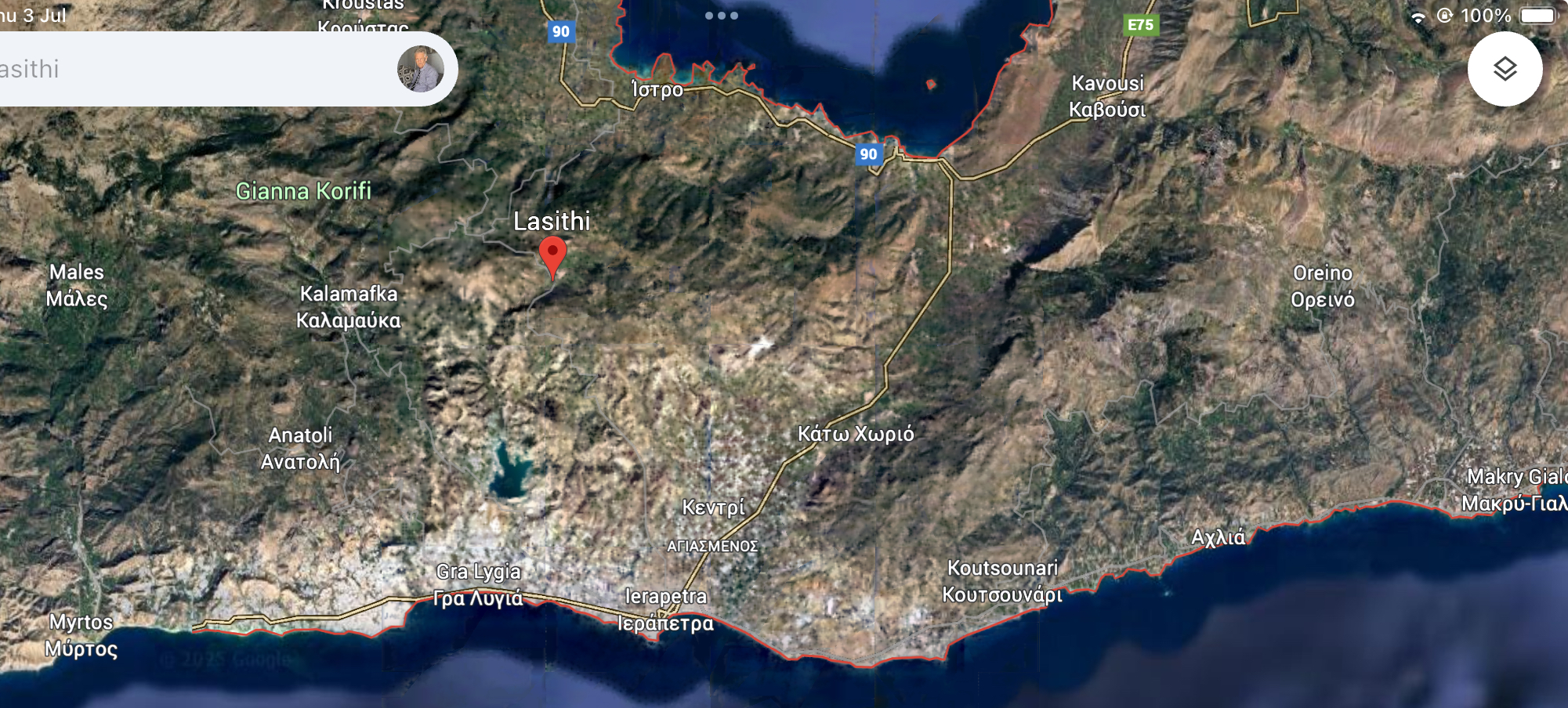
Image courtesy of Google Earth Pro. The pin on the above map shows the location of our house.

It’s a bad one, and last night I could smell burning as I stood on the veranda and saw a glow in the eastern sky at around 2.00am. This time of the year, every year, everyone’s on tenterhooks about fires, everyone’s on edge, and it’s easy to understand why. Every year there are ‘wildfires’ all across Greece and many of them are extinguished quite quickly, but, there are always the ones that get out of control, cause untold damage and destruction to property and the environment, and are usually avoidable. Fire fighters and equipment have arrived today from Athens to help with the work of trying to contain it and put it out, but with winds of 9 on the Beaufort Scale, they have their work cut out. The current word going around is that it may have been started by thoughtless tourists having a barbecue. I hope to goodness that’s not the case, but let’s face it, 90% of these fires are not started by natural causes, they’re usually human error or deliberate arson, almost unbelievable though that is.

In fact, I’ve been communicating with a few friends in the town about whether we ought to form a team and offer ourselves as volunteers, …watch this space. I’m pretty sure some of the lads from the village here have already gone to help, because, apart from the sound of the wind ruffling the olives trees, the village is very quiet right now, as I type this at 1.15pm.

Every summer, and we’re now in our 21st since moving here from the UK, people get nervy about fires. Before moving here, I thought that it was only earthquakes that we needed to worry about. It turns out that, in general, people here take most quakes in their stride, but fires? They’re always unexpected, always unpredictable, and usually destroy valuable countryside or farm land, not to mention houses, holiday accommodation and businesses. We can only hope that this current fire is contained and extinguished before it reaches Makry Gialos, because it’s headed that way.

Sorry to be the bearer of bad tidings, but we’re all on edge here, and it’s as yet uncertain as to how this one’s going to turn out.

Nevertheless, here are some photos, only one of which is new, the others are from my archive…

Above: The town beach on Friday at around midday. Bliss.

Above: A photo taken on Naxos back in 2016. And, finally, below, here’s yours truly back when I was an excursion escort doing regular trips to Halki from Rhodes. this one was taken (I think) around 2017 on the quay at Halki…

Click HERE to go to my Amazon Author Page, where you can browse and purchase all of my seventeen written works.