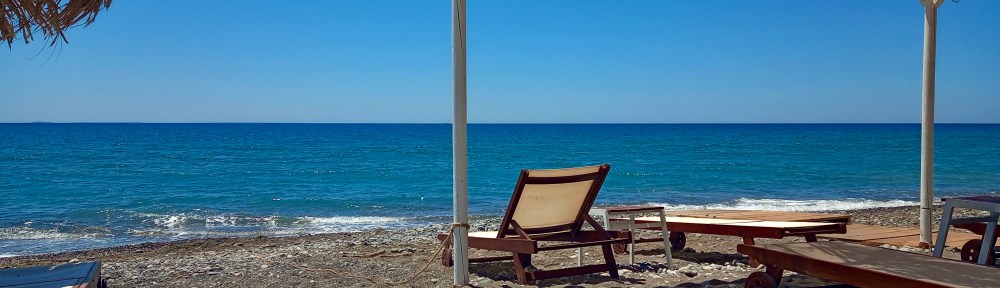
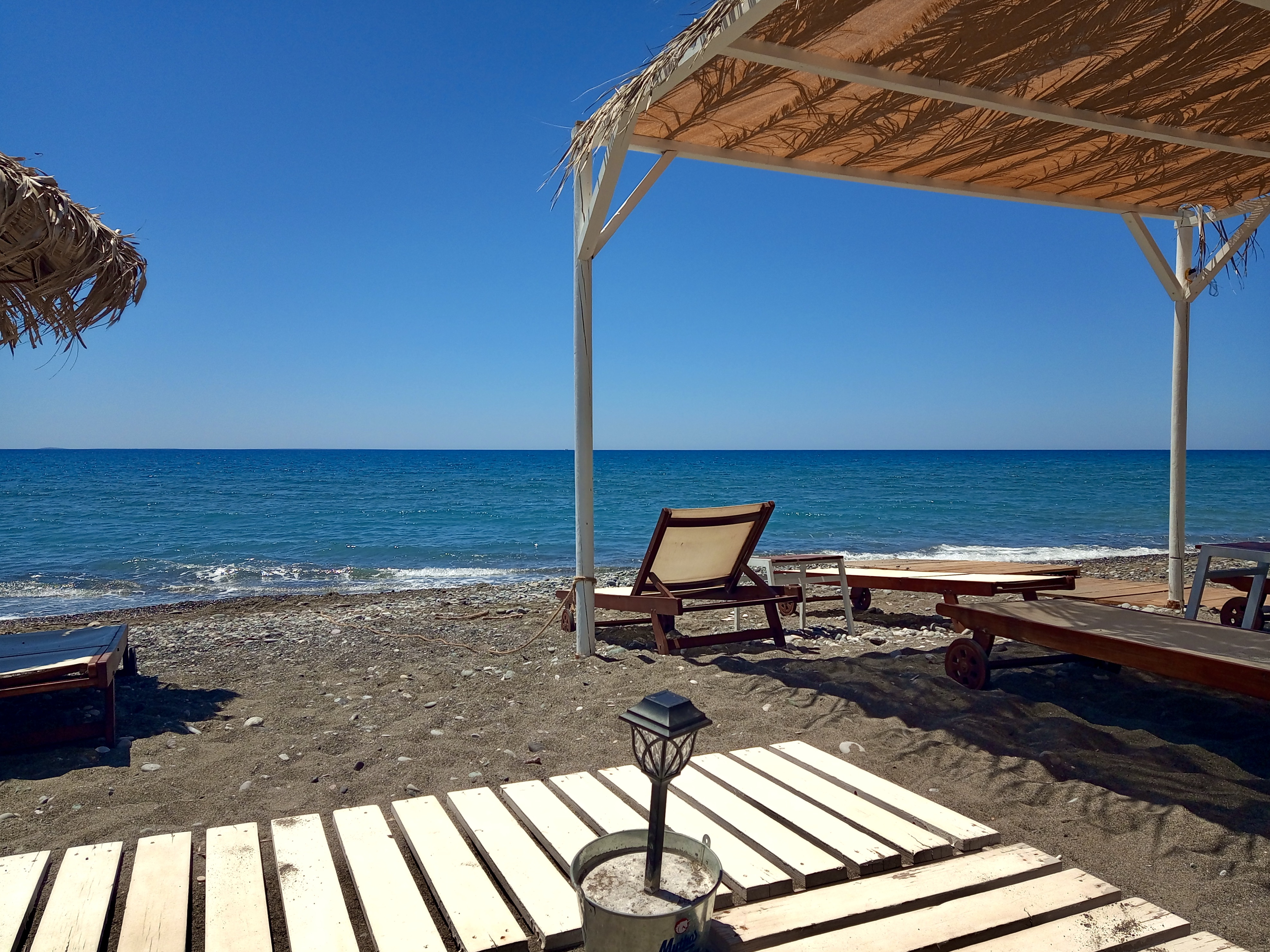
The photo above was taken at Gra Lygia beach, at the Cacao coffee bar, Sunday July 13th at around 12.30pm. Gra Lygia beach is gorgeous and mainly empty, even during the high season. It’s well over a kilometre long and backed by a concrete and tarmac road, which in turn is lined on the other side by a series of dwellings, some very smart, some scruffy, and a few derelict. The sea there, as is the case all along the south coast of Lasithi, is crystal clear and free of floating detritus, so common along the beaches of overcrowded ‘resorts’ these days.
Gra Lygia is nothing much to write home about when it comes to the village itself, although in the past few years determined efforts have been made to smarten the place up a bit, and the road surface through the village, which used to be so bad it would shake your fillings out, or put the tracking out on your car if you hit the lumps, bumps and potholes too quickly, is now ultra smooth after being resurfaced a couple of years ago. There a few new smart, modern cafeterias and tavernas, several pretty good supermarkets and even a school there.
There are, though, a great many immigrant workers in the area, many of whom live in very substandard accommodation, provided by their employers. Most of these are Pakistani and can often be seen when not working (but they usually are, for many long hours) walking around the area wearing traditional Pakistani clothing, which is called the shalwar kameez, which is a long, usually knee-length tunic top worn with loose-fitting trousers. When we first began to spot these men, it was a little odd, because in the UK we were very used to seeing traditional dress from all over Asia on the streets, not to mention from other parts of the world, but in Greece we’d only ever really seen Greeks, mainly white, with dark hair and the men at least with a swarthy complexion. Things are changing.
In general the locals don’t speak all that well of these people who are far, far away from their homes, yet without them the local economy would collapse. Gra Lygia, once you get away from the main road and head inland, is jam-packed with huge hothouses, the agricultural method first introduced by Paul Cooper [Paul Kuyper] back in the 1960’s. Coming from the Netherlands — a world leader in controlled-environment agriculture — Kuyper brought knowledge of plastic-covered cultivation and out-of-season production, which was revolutionary at the time for southern Greece. Before long the hothouses, clad in tough polythene sheeting rather than glass, began to proliferate and now they’re everywhere, enabling local farmers to cultivate a lot of vegetable crops out of season and the crops are now exported to multinationals all over Europe. It’s the reason why the area has prospered for the last 60 years or so, without the need for mass tourism.
The work inside these hothouses is arduous to say the least. We have a few friends who own them, and we’ve been inside for a mooch around. Imagine, when it’s in the mid 30’s C outside, what the temperature must be inside a hothouse half the size of a football pitch. Yup, you’re about right there. These foreign workers work their guts out for a minimum wage, much of which they send home to their families, and when they get a very short time off, they dream of home. Like I said, the locals don’t speak well of the Asians, yet they’re just people, like we all are. They’re in a country where they must agonise to pick up some of the language, and as far as I know, most of them have their ‘papers’ which enable them to work legally.
And that thought takes me back to the first few times I ever visited Greece. The first time I came across someone who was a kind of free spirit was on the island of Poros in 1977. Much of what happened and my first impressions of Poros, my first ever Greek island, is recounted in my ‘Ramblings From Rhodes’ series of books, but I don’t think I ever mentioned Claire.
My late mother-in-law, Lela, had become friendly with Giorgo Lukas, who ran a taverna along the seafront at Poros, back in the 1970s. She actually met him by chance, as she found herself sitting next to him on a plane going to Greece from the UK. She was going to visit family in Athens, and he was returning home after doing a series of Greek dancing shows, since he was at the time Greek National Sirtaki champion. He’d invited her to visit Poros and hence his taverna, and here we were the following year on our way there with her this time, since she’d raved about not only the island (which was a whole lot quieter then than it is now it seems), but also Giorgo’s taverna and the fact that he’d dance most evenings, when the mood took him.
Owing to this connection having been forged between my Greek mother-in-law and Giorgo, whose wife was an English girl named Susan (former holiday rep, usual story), we ate at the same taverna every night for three weeks. It was while we were sitting at Giorgo’s taverna that we also became friendly with this young Irish girl named Claire, who was only just out of her teens, had set off to bum around Europe a year or so earlier, ended up on Poros and was now working in the kitchen of Giorgo’s taverna. She’d been there all season when we got there, which was during the month of September, and she told us her story.
Claire was from the Irish Republic and had wanted an adventure before settling down to some kind of normal life, the life that her family had expected her to live. Only things hadn’t gone quite to plan. Once she’d been on Poros for a week or two, she’d been eating at Giorgo’s and he’d told her that he needed a kitchen hand for the duration of the season. She’d jumped at the idea and a deal was soon struck whereby Claire would live in a small studio over the taverna and receive all her meals from the kitchen below, plus she’d pay no rent, as her work in the kitchen would be her contribution to the arrangement. She’d work from around 10.00am until around 2.00pm, servicing holidaymakers who wanted a cooked breakfast, or simply a coffee or a beer, then she’d knock off and go to the beach for a swim. After a couple of hours on the beach, she’d head back to her room for a shower and a sleep, before starting work again at around 7.00pm and carrying on until the last diners had left, and the washing up had been done. She’d usually get into bed at around 2.30am. If and when she needed a small amount of cash, Giorgos was only too pleased to give her some, unofficially, of course.
Claire seemed to us to be enjoying her life tremendously, and she had no plans to change her situation for the foreseeable. She said she’d probably go to Ireland during the winter time, just to check in with the family, but would in all probability be back on Poros in the spring, ready for another season. What more could she want out of life, at least for the time being?
And thus were planted the seeds of desire within me to one day abandon the ‘nine-to five,’ and do something radical, like move to Greece and start a new life. It was to be three decades later when we eventually did it, but back then, in 1977, I’m sure a little envy at the lack of drudgery in Claire’s life had affected me and my way of looking at things. In the intervening years, of course, things changed radically regarding illegal foreign workers working casually like Claire did. The way that Claire and Giorgo had worked out their ‘arrangement’ was fairly typical all over Greece, and if you were to add to the equation the fact that most Greeks were getting away with declaring only a fraction of their real income for tax purposes, you get the idea as to why the country was on its knees by the year 2010, or thereabouts.
It’s a tough one, isn’t it. I mean, the idea of simply rocking up at a restaurant in a foreign country and getting a ‘gig’ working under the radar appeals to the bohemian in all of us. But, of course, it couldn’t really last. These days, the situation is vastly different, and legal workers are now experiencing major problems finding accommodation that they can afford, and this is in part due to the rise of the AirBnB phenomenon. For instance, there was a news story recently about a teacher living in his car. Unlike in the UK, where teachers in secondary schools probably have a job for life if they don’t step out of line, here in Greece a lot of qualified teachers have to apply each new school year for a position, and, having secured one, they then have to find digs for the duration. Up until a few years ago they’d soon be able to find an apartment in the area close to the school where they were going to teach. These days, much of the accommodation that genuine workers used to rent for a season, or a year, is given over to tourism, as the owners can make a lot more money that way.
I often sit and mull this problem over in my head, and I can’t come up with a ready solution. I mean, Yvonne and I have used AirBnB a few times ourselves when staying a few days away from home here on Crete. It’s a great and financially sensible way to do it without breaking the bank. Yet, to think that the places where we’ve stayed may have once been rented by people needing to work in the area, who nowadays can’t find anywhere that’s priced reasonably enough, is worrying. I saw a news report from Majorca in Spain, and people were demonstrating on the streets because qualified accountants, engineers, teachers, lifeguards (the list goes on) were living in tents because what accommodation was available was so expensive that they couldn’t afford it. One guy told the reporter that the rent that he was told he’d have to pay for one flat he’d applied for was actually more than his entire salary.
You know, this whole ‘holiday island’ thing bugs me, it really does. Places like Crete, Majorca, wherever, are first and foremost home to indigenous folk who have a basic right to be able to live in the area where they were born and raised, earn a decent living, raise their kids. Yet travel companies and tour operators talk about these places as being ‘resorts,’ or ‘holiday islands,’ like I said. So some tourists come here with the mindset that the whole place exists for their recreational pleasure. It’s like a lot of ‘holiday’ destinations are merely ‘theme parks’ for the hedonist. And I don’t profess to have any answers, but I do think it’s a topic that ought to be discussed, and that people who come here for their holidays ought to be educated, if that’s possible, to understand that they’re going to be guests in someone else’s country, and due respect for the locals should be shown.
As for the problem of the cost of accommodation though, and the ‘holiday let’ versus ‘real accommodation for locals’ issue, it’s a tough one. I’d be interested to hear your thoughts on the matter.
Photo time…
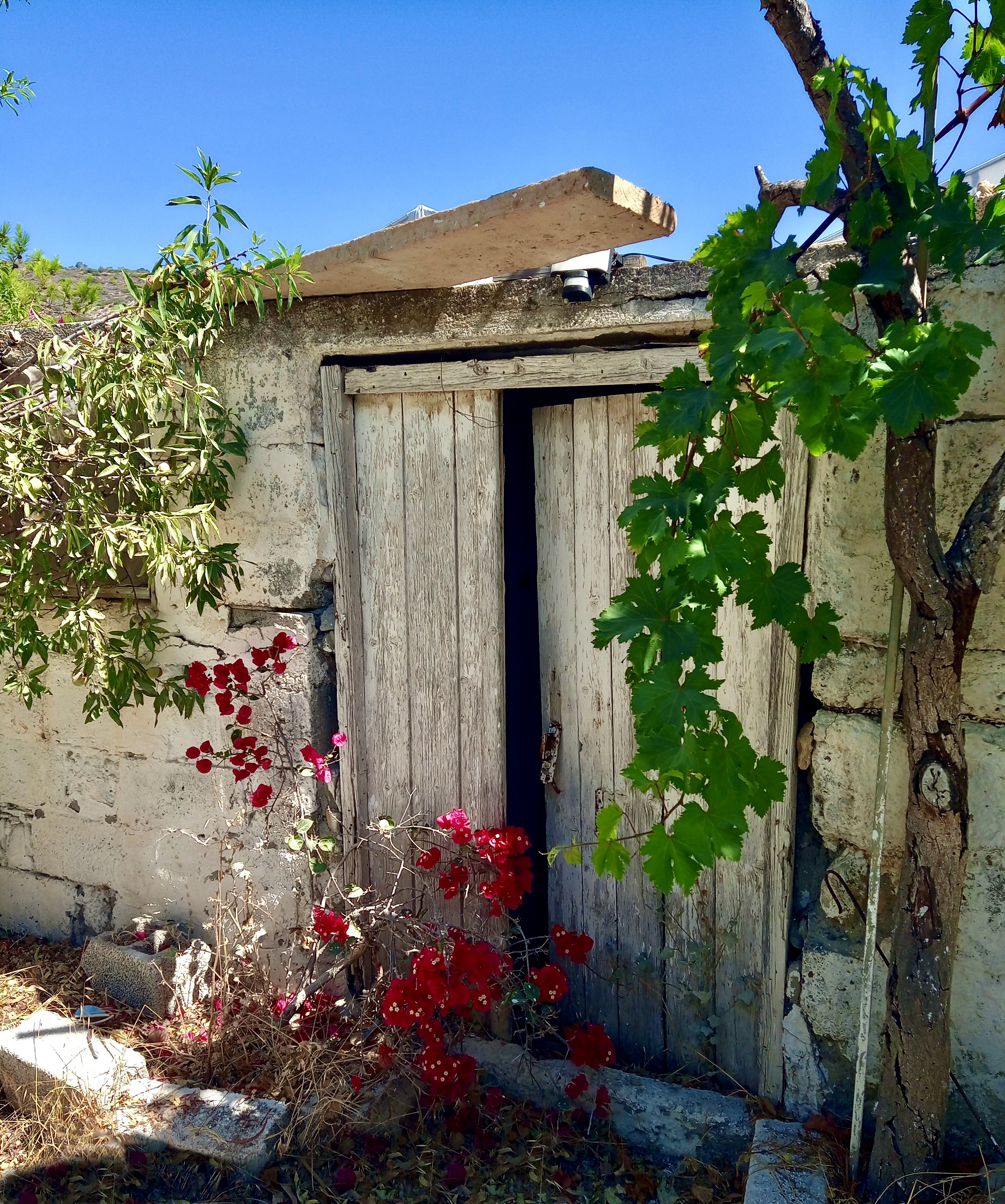
Here are a few shots taken this past couple of days. They well illustrate what current season we’re now in, don’t you think?


•
Click HERE to go to my Amazon Author Page, where you can browse and purchase all of my seventeen written works.
 Accretions