
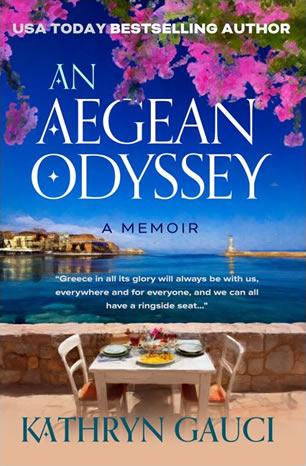
A good friend and fellow admin of mine on our Facebook reading Group ‘A Good Greek Read,’ Kathryn Gauci is also an accomplished author, whose books have never failed to delight and impress me. If you’ve never read any of her work, then best get started. She doesn’t always write about Greece, but when she does her passion for the country shines through every line. It may be good, if you’re not familiar with her work, to head over in the first instance to her website, which you can find by clicking HERE. Plus, I’d recommend starting your own Kathryn Gauci odyssey by reading the epic (and I use that word advisedly, because why it’s not already a major blockbuster movie is a mystery to me) ‘The Embroiderer.’
The main reason, however, for this post is twofold (OK, so maybe that should read, ‘the main reasons..?’); firstly she has a new book out, whose cover is shown at the top of this post. It’s called (as you’ll no doubt have keenly observed) An Aegean Odyssey, and it’s a must read, and I say that even though I’ve yet to read it myself. In my defence, I’m currently reading a book written by an old school friend of mine who lives in the USA, as I’d promised him that I would some time ago. But, as soon as I finish that one I’ll be starting on An Aegean Odyssey. As soon as I’ve read it I’ll be posting my review, both here and on its Amazon page, you can be sure of that. I always try to be objective, so my review will in no way be sycophantic, but I’d be very surprised if I weren’t blown away by this book, which I can’t wait to get stuck into. Anyway, watch this space.
Secondly, off the back of this new release by Kathryn, she graciously agreed to be interviewed about it, and I’m extremely proud to present that interview for you right here. So, let’s get started.

When you decided to become a writer, what made you return to Greece? What is your personal connection with the country?
I worked in Athens as a carpet designer from 1972-78 before moving to New Zealand, and finally Melbourne, Australia. Since then, I’ve been back several times. When I first worked in Athens, Greece was still under the military dictatorship and I witnessed it move from those dark days to democracy. It was a wonderful period of optimism. The carpet factory – Anatolia Carpets – was situated in Kalogreza/Nea Ionia, and I was also fortunate to work with the Asia Minor refugees who told me their family stories of life in Asia Minor and of The Great Catastrophe and the burning of Smyrna. I also learned about Greece in WWII too, as that period was still fresh in the minds of the Greek people. My apartment was in the suburb of Kypseli, where Lela Karagiannis lived. Lela was one of the most famous resistance leaders of WWII. There was also much evidence of the Civil War that took place after WWII, too. Many old walls were pot-marked with bullet holes. After the dictatorship fell, families of those who had been sent to Communist countries started to return. It was quite an emotional time. These were formative years for me and the Greek people welcomed me wholeheartedly. I can honestly say that those years helped shape my personality.
Did you know exactly what you were looking for when you returned to write the book?
No. All I knew was that I wanted to write and I wanted to find the old Greece that I’d experienced when I was there. Between the period when I left and when I returned to write, Greece, like everywhere, was changing, mainly through mass tourism and modernisation. Where we once used to bake our food at the bakery, people now had all the latest kitchen appliances. The suburbs that had once maintained a village atmosphere had moved on. The suburbs of Athens were also spreading out at an alarming rate, and places like leafy, aristocratic Kifissia were almost unrecognisable.
Which were the key locations you focused on?
Along with a few main areas in Athens, I wanted to explore islands I hadn’t previously visited. After much deliberation, I decided on Chios, Lesvos, Rhodes, Karpathos, and Crete, as I felt they would offer a greater diversity for me.
Were you planning to highlight specific cultural aspects such as art, literature and Greek culture, or did you focus on a certain period such as Ancient Greece, Byzantium, Ottoman Greece, or modern Greece?
I was open to exploring everything. As I have an art and design background, I am naturally drawn to all periods in history. I think it was a case of whatever that island had to offer as they are all different. With Chios, I was certainly immersed in the struggles with the Ottomans during the Greek War of Independence. The events that took place at the Byzantine Monastery of Nea Moni were a strong draw card for me. Lesvos was a mixture of the classical period, particularly with the writers of the time, and also the wonderful Roman mosaics, and its links with the Ottoman world, both during and after the Greek War of Independence and Asia Minor Catastrophe. In Rhodes, one cannot escape the Knights of Saint John although at the time I wanted to explore the smaller villages. Karpathos is unique because that not only has a different history, but wonderful beaches. And then there is Crete. I left Crete until the end because I wanted to explore everything from its Minoan past, its relationship with the Ottoman Empire, and WWII. In all of these places, I drew upon literature to help evoke the past and the Hellenic personality. I would also like to add that I have a love of Greek folk art, particularly Greek shop signs which are quite unique and unfortunately a dying art. I looked for these everywhere on my travels and quite a few led to some amusing episodes.
Did you explore Greece’s influence on the wider world, intellectually and artistically?
Yes, particularly when it came to the writers and artists who had influenced Western thinking, such as Eugene Delacroix, Lord Byron, Henry Miller, and of course, the classical writers. I also drew upon travellers’ tales when passing through Greece while it was under the Ottoman Empire.
How much emphasis did you place on the daily life of Greek people, past and present?
This is an important part of the book. While still being able to get off the beaten track, I interacted with the Greek people themselves who shared thoughts of their life and traditions. Some of these characters ended up in my earlier historical fiction books set in Greece.
Greek cuisine is a constant feature in your book. What are the regional dishes that you remember the most?
This is such a difficult question that I added a chapter specifically on recipes, including some of my favourites, and some that are unique to a certain place. It is not just the food that is important, but the importance attached to it: a sense that every meal will be a banquet no matter how big or small. Good food is very important to Greeks and they are extremely proud of their family and regional heritage. They place a great emphasis on food served in the time-honoured tradition, a special occasion, or simply for a friend. Spoon sweets are a great example of this hospitality.
Music also plays an important role in this journey. Can you explain why?
Music evokes a mood: a time and place that is special and will live in our memory. On this journey, I wanted to include some old favorites and a few new ones. The songs of Marinella, Vicky Moscholiou, and Haris Alexiou always remind me of my days in the carpet studio; Rebetika and the songs of Asia Minor too. In Lesbos I played Leonard Cohen as his songs recalled my days on Hydra, particularly So Long, Marianne. Then there was Rod Stewart’s Maggie May that reminded me of our carefree hippie parties. In Crete I played Glen Miller hoping that at times, the resistance and those soldiers left behind in WWII would have occasionally heard his music on clandestine BBC radio programmes. Elsewhere, I played classical music, particularly in spectacular or emotional settings when I was alone, surrounded by history or spectacular landscapes.
What can readers expect from your book?
I changed careers later in life. I loved my design years, but wanted a change and wasn’t afraid to take that leap of faith. If anything, I would like readers to realise that anything is possible if you truly set your mind to it. It may seem daunting to go out alone and explore pastures new, but at the same time it is liberating. You never know where it will lead and that is the exciting part. Finally, I would like to add that much of the time, I found myself alone in isolated places: by a beach, at the top of a mountain, overlooking vast areas of olive groves, and that sense of being alone with nature was like a rebirth. As I say in my book – “Greece in all its glory will always be with us, everywhere and for everyone, and we can all have a ringside seat.”
Amen to that, I say. Hope you found that enjoyable and enlightening. Here are a few photos from Kathryns’s own archive to inspire you…
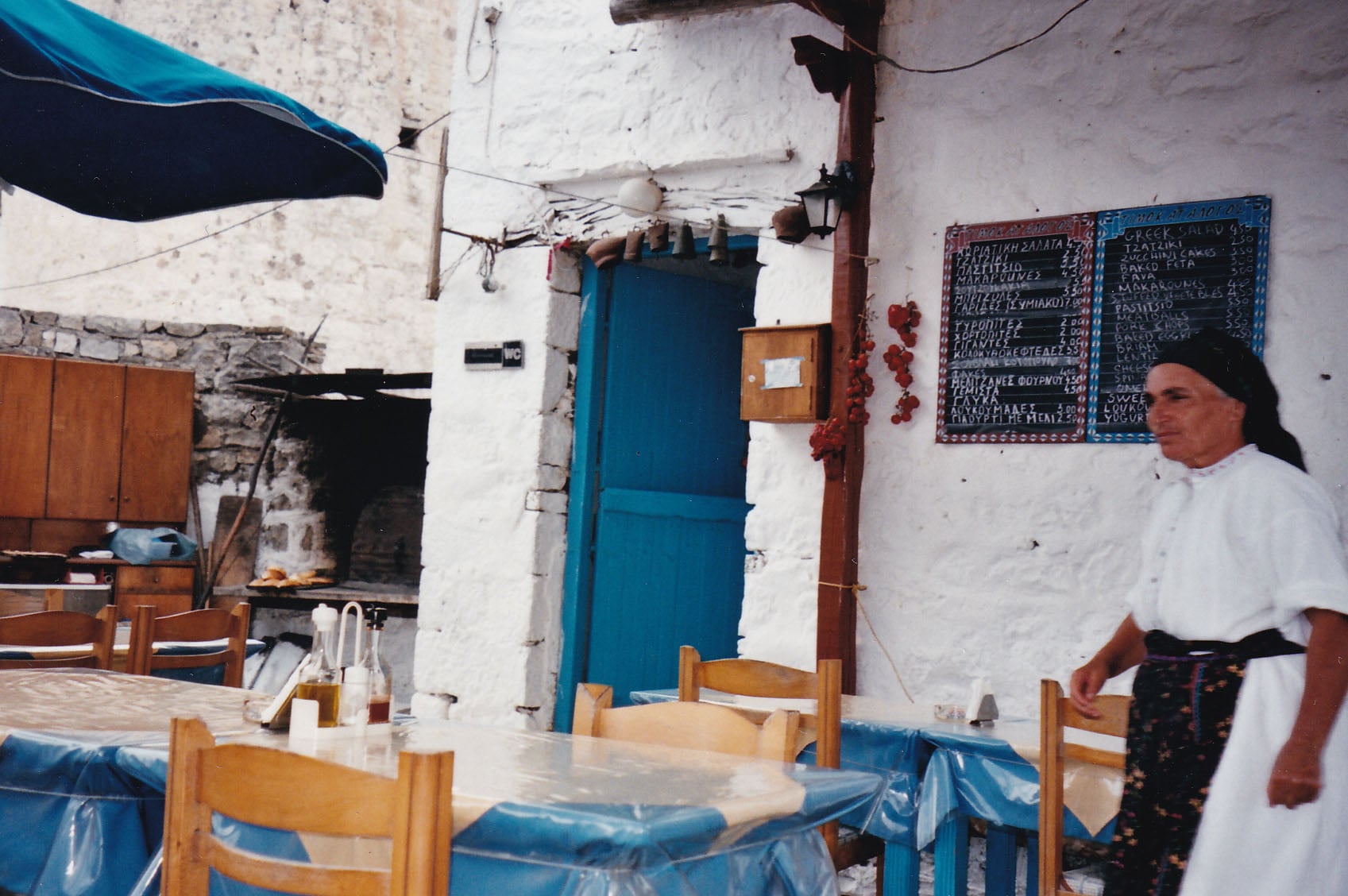

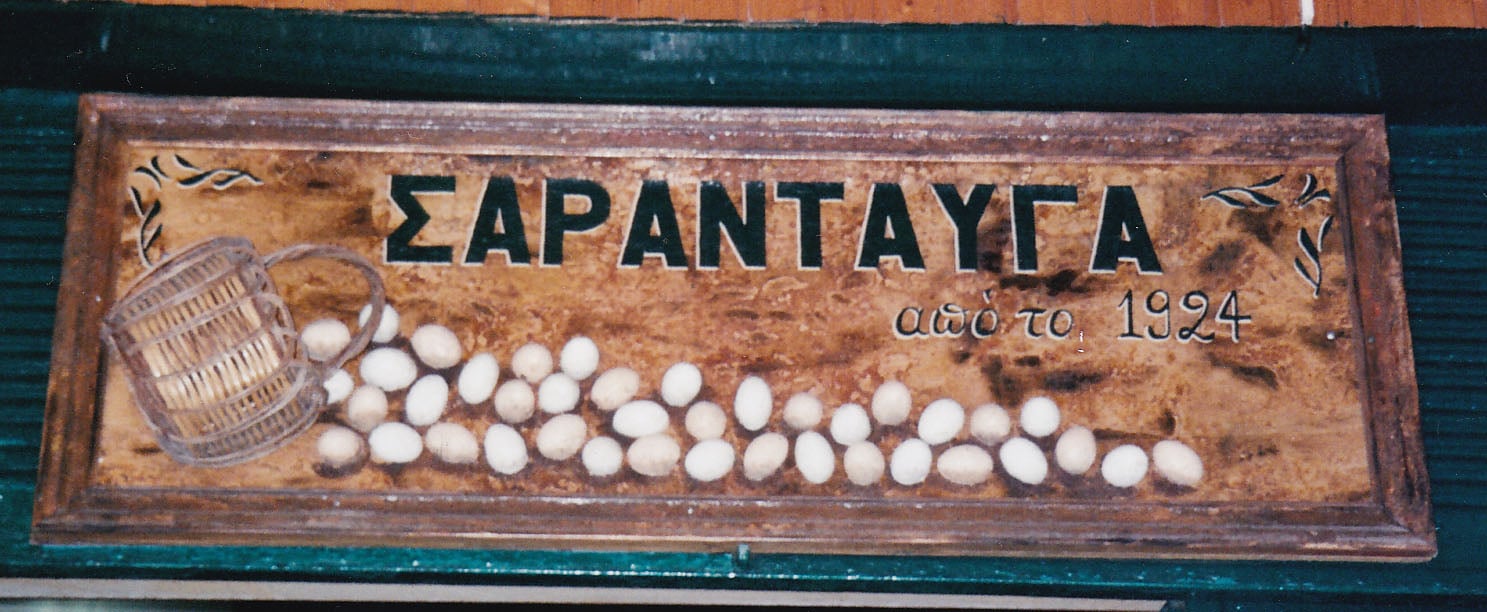


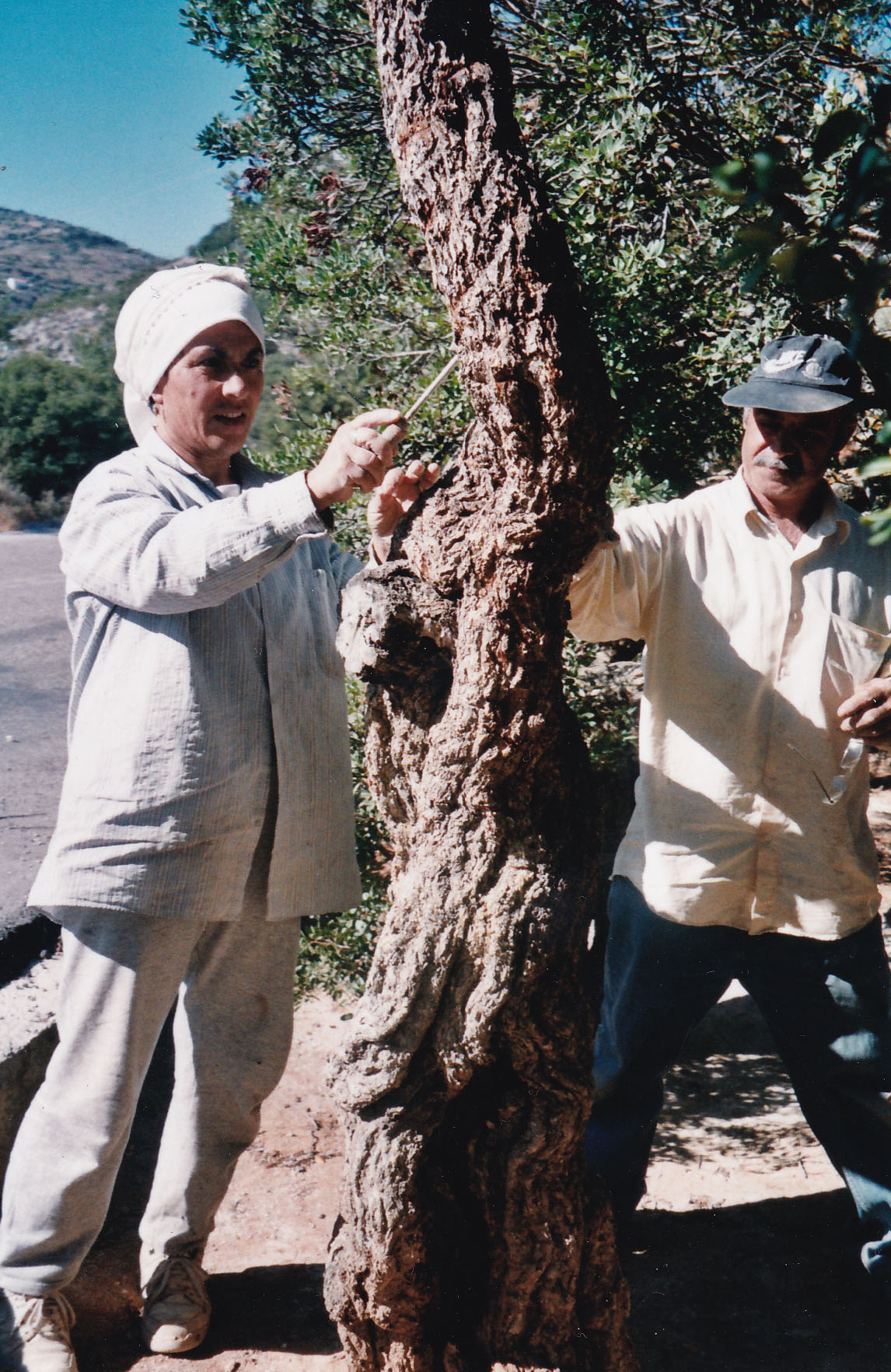
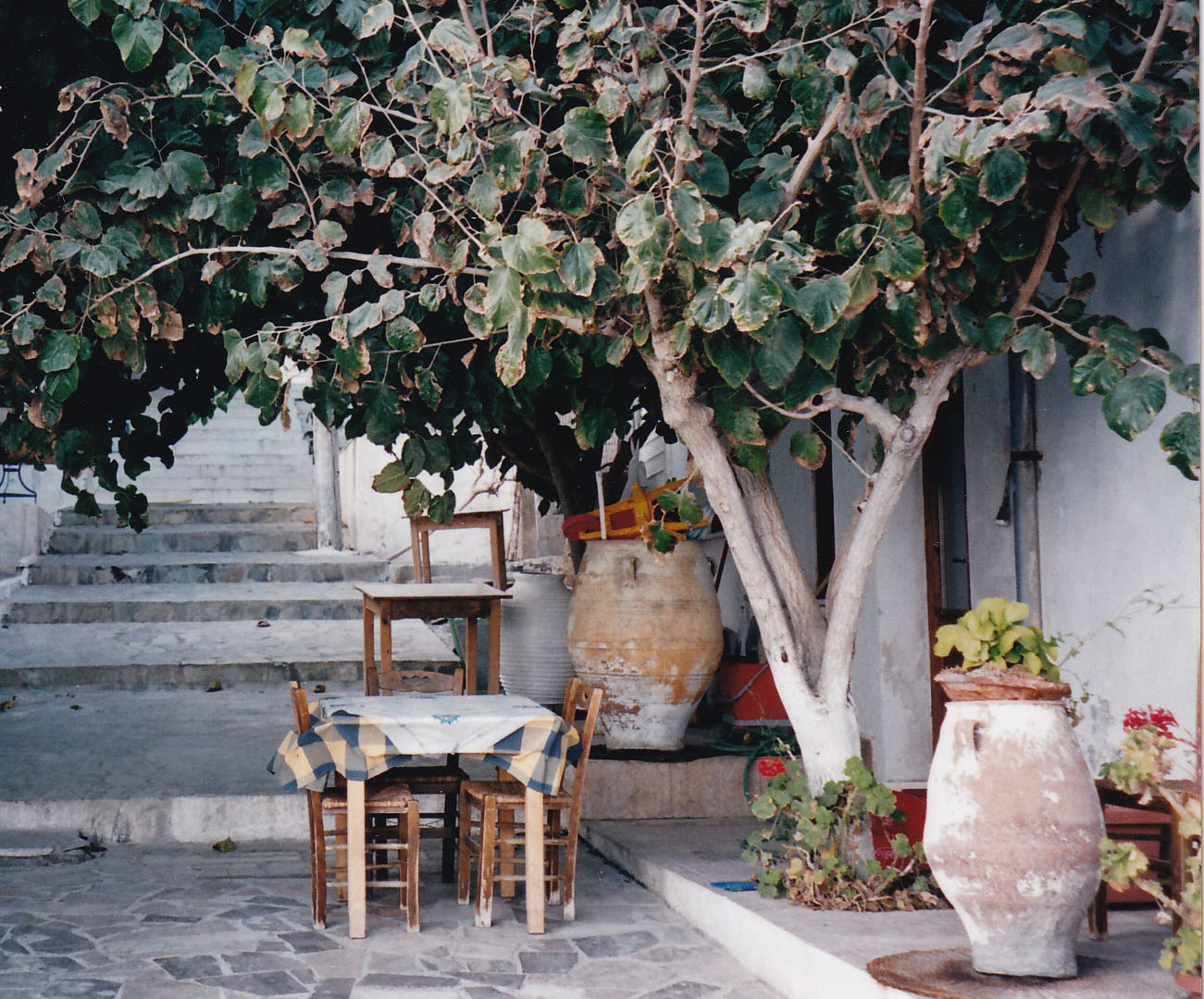
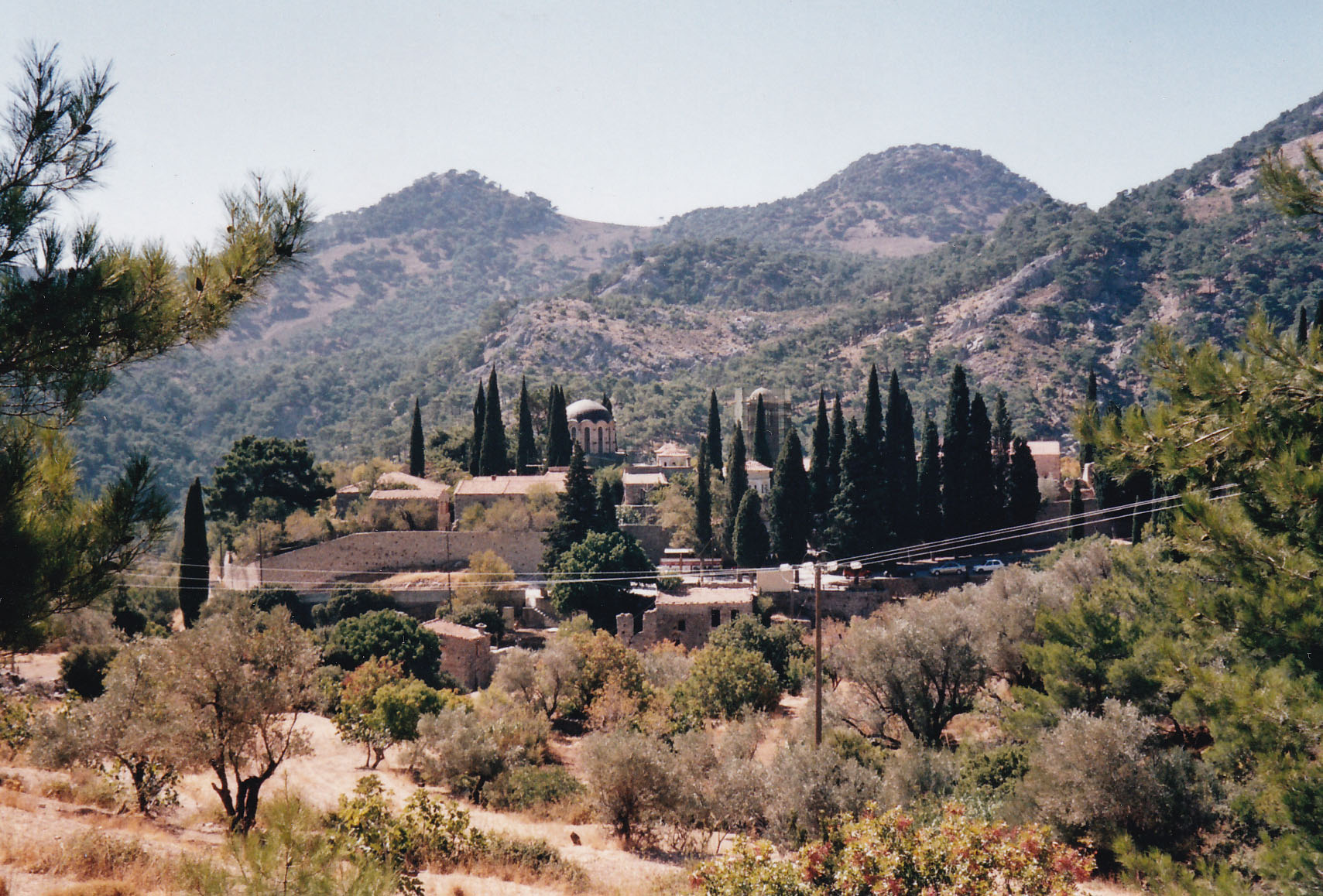
I particularly like that taverna sign, which translates as ‘Forty Eggs.’ There’s got to be quite a story behind that one! So, I do hope you’ll give Kathryn’s new memoir a try, and if you haven’t read any other books by her, I can only say that you’re missing out big time. On her website you can explore all of her works here.
•
Click HERE to go to my Amazon Author Page, where you can browse and purchase all of my seventeen written works.
 Accretions