

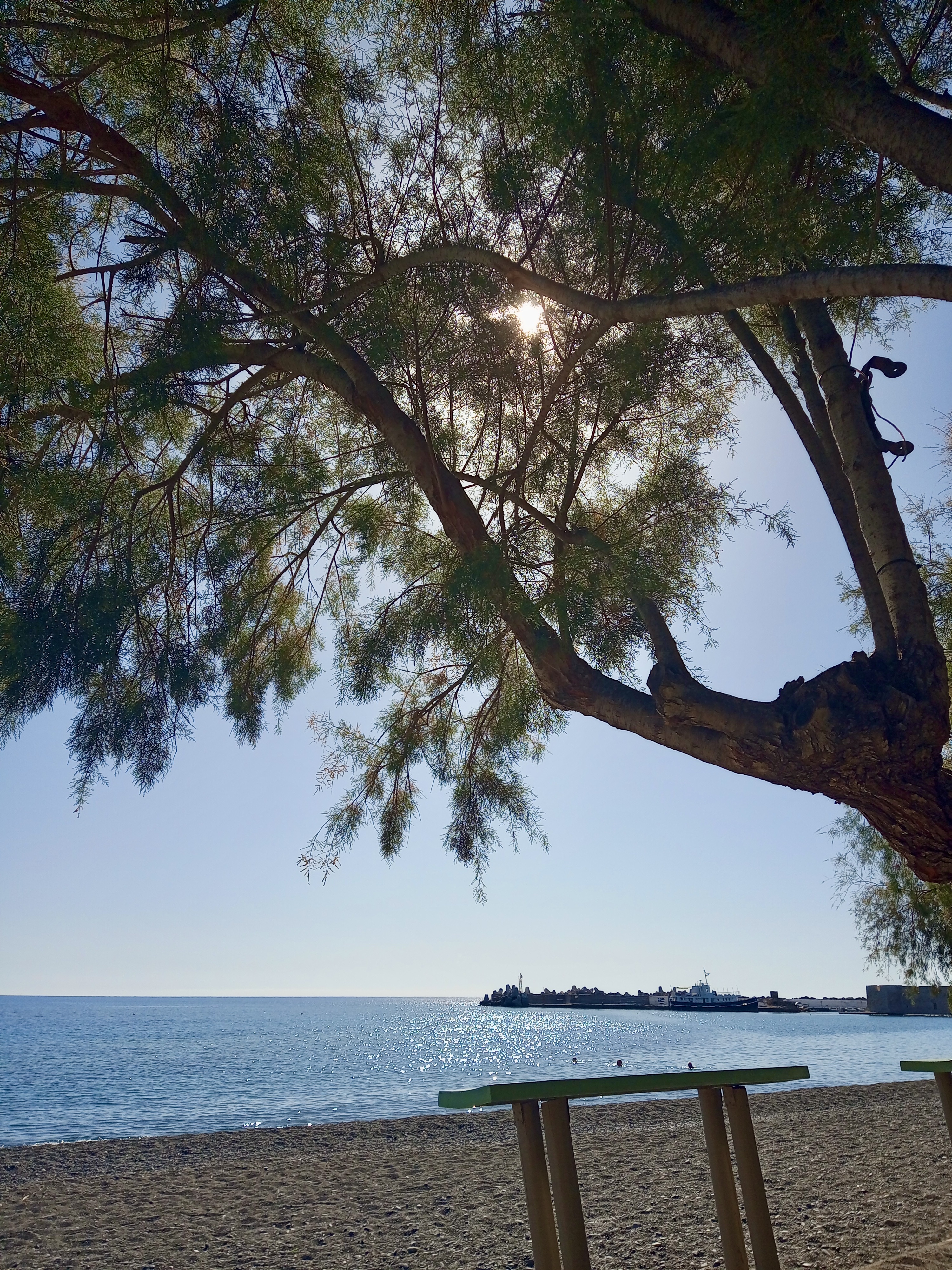
Above: The winter arrangement. All beach furniture now removed until next spring, but the sea’s still perfect for swimming.
Having finished reading Kathryn Gauci’s wonderfully evocative ‘Aegean Odyssey,” I’ve been immersed in some nostalgic thoughts of late about moments over the past 48 years of my Greek experience. Some brief instances in time are still so vivid in my memory that I can, not only see them in my mind’s eye, but smell the smells, feel the breeze, hear the sounds. Kathryn talks about various small accommodations that she stayed in during her journey of self re-discovery among a selection of Greek islands where the real Greece was still to be found back in 2005.
I’ve been to some of those places that she describes, although not all. Sadly, there have been changes since she re-visited those locations. After all, two decades have passed now and ‘development’ is no respecter of either place or memory. She mentions, for instance, the very pretty coastal village of Mochlos, on the north coast of Lasithi, just off the road from Agios Nikolaos to Sitia. Mochlos is still just as pretty as it was in 2005, but alas, now extremely busy with foreign tourists during the summer months. It’s not more than 30 minutes drive from our home, so a couple of years ago we decided to go and check it out, mainly because we’d had a chat with an English woman (a rare occurrence still on the local town beach here in Ierapetra) who’d raved about the place and said it was her favourite location for a waterside meal.
We set off full of anticipation and were soon winding our way down the snaky lane that drops down from the main Sitia road. Just behind the mountain from Mochlos is a massive quarry, where half a mountainside has been gouged out in order to provide sandstone for building works on the island and doubtless other locations as well. You can’t help but notice it as you negotiate the tight twists and turns of the steeply descending road on the way down to Mochlos. In fact, you drive right past the works entrance, where all the surrounding vegetation is coated with a thick layer of dust from the cutting of the stone. Although it’s now an eyesore, it does, oddly enough have a very ancient beginning and is thus an integral part of area’s history. It was extensively used during the Minoan New Palace period (around 1700-1450 B.C.) to produce large ashlar blocks for constructing important buildings, most notably the nearby Minoan palace at Gournia. Sandstone was valued at the time for its colour, texture, and the ease with which it could be cut.
Anyway, once you get well past it, the mountain cuts it off from view and you soon catch sight of the tiny island that’s only metres from the Mochlos quay, and this island too boasts a Minoan ruin dating back many thousands of years. The Mochlos sea front is quite compact, and consists mainly of a footpath which winds in and out of a couple of tiny bays and offers a varied choice of tavernas and bars. Picturesque it most certainly still is, but quiet? Afraid not. We walked the entire sea front and also the few back streets, and were quite dismayed at the fact that we hardly saw a Greek person eating at any of the tavernas. We had so expected to be charmed by the place, but found ourselves musing that, had we decided to sit down at one of the restaurants, our fluency in Greek aside, the staff would be certain to talk to us in English. Despite its visual appeal, we couldn’t wait to get out of there and back to Ierapetra. The whole place seemed to be packed with tall, blonde people. In fact, nearby Pachi Amos is nowhere near as pretty, but it’s much more authentic, and many locals can be seen in the few bars and restaurants there at any time of the year. We’ve eaten there a few times and always felt at home, and unhurried.
Meditating on Kathryn’s words, as she expressed her feelings when sitting in some tiny taverna, sampling the fish that’d been caught only hours earlier, one of my most vivid and cherished memories came flooding back over me. Four times in five years from 1977 through 1982, we’d stayed for three weeks at a time on the tiny island of Poros in the Saronic Gulf. Every time we’d gone there we’d stayed in village rooms run by Mrs Georgia Mellou, whose rooms were up a steeply stepped backstreet from the quayside where the boats plying the route from Piraeus to Hydra and Spetses tied up. We’d telephone Kyria Georgia a few days before flying (Dan Air, of course) and she’d be sure and keep us the same room each time. We had a tiny balcony, just large enough for a couple of chairs and one of those little round tables that we often think of as French to nestle on. After an afternoon sleep, we’d rise and make a cup of tea before Yvonne would begin her unhurried ritual of getting herself ready for our evening adventure, beginning with a stroll off down the narrow street called Mitropoleos to the sea front.
I’d say it would have been around the hours of 7.00pm to 8.30pm when I’d sit out on that balcony, book in hand, with other houses nestled right beneath where I sat, so close that I could see into their courtyards if I wanted to. There was a jumble of terracotta tiled roofs between me and the waterfront, just maybe fifty metres away, and I could catch through the gaps between the houses glimpses of some of the small shops on the steep Mitropoleos, which connected the street where we were staying with the harbour front below. Bougainvillea and jasmine scented the air and, as the evening slowly enveloped us and the stars began to emerge in the darkening sky, the smell of charcoal being prepared to cook was everywhere. The heartbeat of that small harbour town pulsed strong and true and I loved it. The smell of the charcoal would get my tastebuds excited as I sipped at my aperitif, usually ouzo, or maybe a vermouth, or perhaps Campari. I’d even imbibe a chilled beer that we kept in the shared fridge along the landing now and then too.
Those brief interludes were a life changing and enhancing experience for me, a young English kid, not long married and with a Greek mother-in-law. They made such an impact on me that here I am now, all those years later living the experience again when I close my eyes.
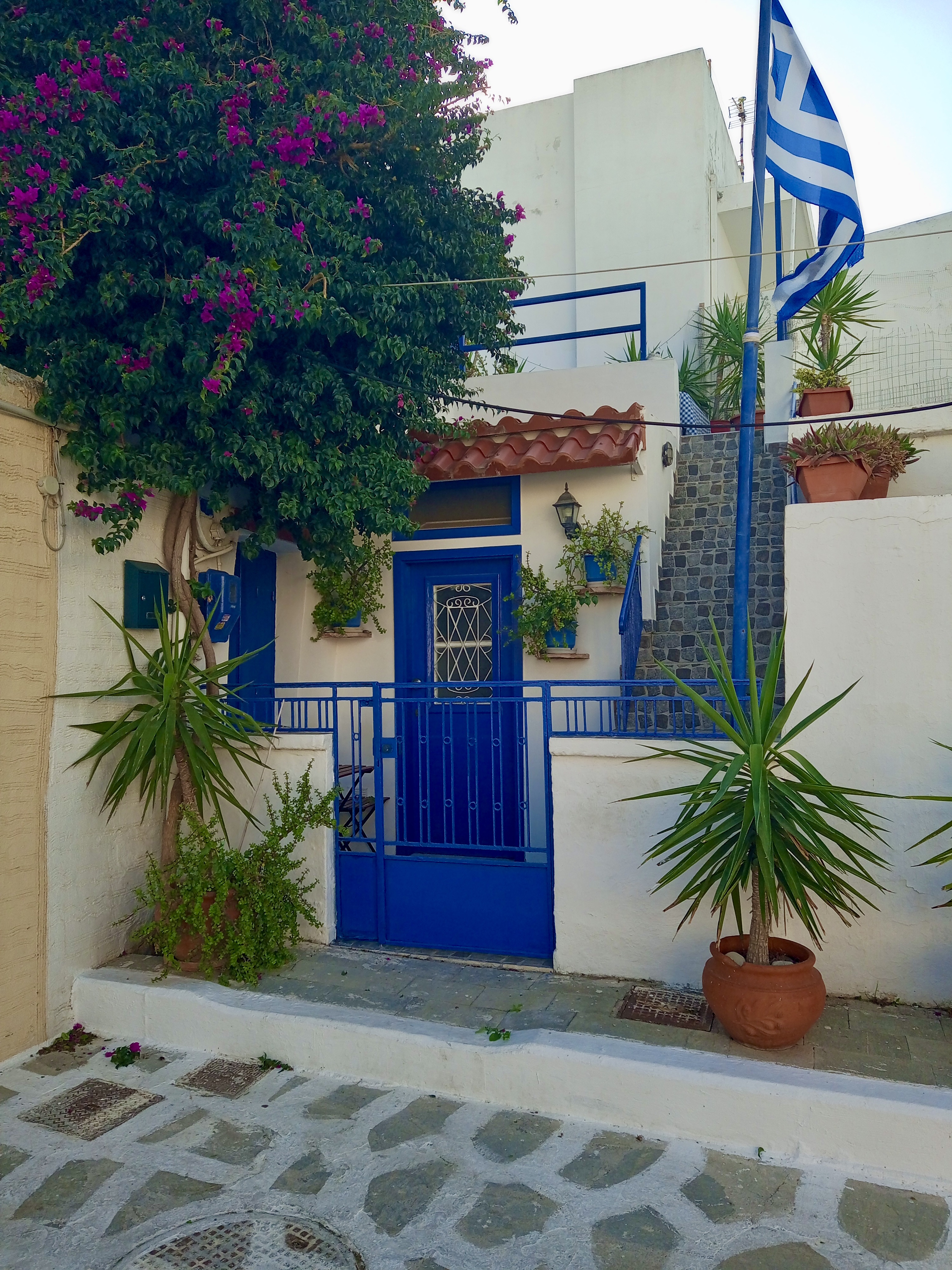
I could go on and on, but that’s enough for now. You want to see some photos, yeah? Here’s a gallery of recent shots taken in Ierapetra…





•
Click HERE to go to my Amazon Author Page, where you can browse and purchase all of my seventeen written works.
 Accretions
Oh God John ! 🤦♂️ just booked 11 nights in a recently renovated hotel 30 minutes walk from Mochlos. Our initial impressions of the village were “how quaint and traditionally Greek the place looked.” Fingers crossed it will still be the relaxing getaway we are looking for. Anyway we’ve hired a car and might get across to Ierapetra to buy you that beer I think I promised last you last year.
Regards
Liam
An avid reader of your blog.
Hey, don’t worry too much Liam. It’s still a gorgeous little place. What time of year will you be there? Plus, if you frequent the same bar or restaurant a few times, I’m sure you’ll experience some of that traditional Cretan hospitality. If you’re anywhere near us some time, by all means get in touch. Can’t promise we’ll be able to meet up, but always worth a stab.
first 10/11 days in June. We will definitely spend some time on the south coast during the day. Has a different vibe to the north but the whole island is beautiful. Matala is another spot we fancied but Yvonne my wife couldn’t find a hotel she fancied.
keep up the good work.
We found Mochlos probably 20 years ago–by accident. We had our beat up old UK car and were aiming for Sitia. Mochlos was delightful–probably around May 6th. Glad I’ve never been back. But I’d go back to Sitia in flash–thought it was a great place. But now found my nest in the Dodecanese (NOT Rhodes!)
I totally agree about Sitia, Dilys, although, if some businessmen there have their way, they’ll ruin it with even more charter flights. Some people are never satisfied. Still, when we’re usually there, which is late spring, it’s still primarily Greeks around us in the restaurants and coffee bars. As regards your favourite bolthole in the Dodecanese, I’ve a feeling I know where you mean, but I’ll not mention it here, because if you can keep the secret for a while longer, that would be a good thing!
You probably DO know where I mean, trying to keep it secret but unfortunately a lot of the British press is recommending it! Luckily the lack of airport and glorious jumble of the ferries saves it!