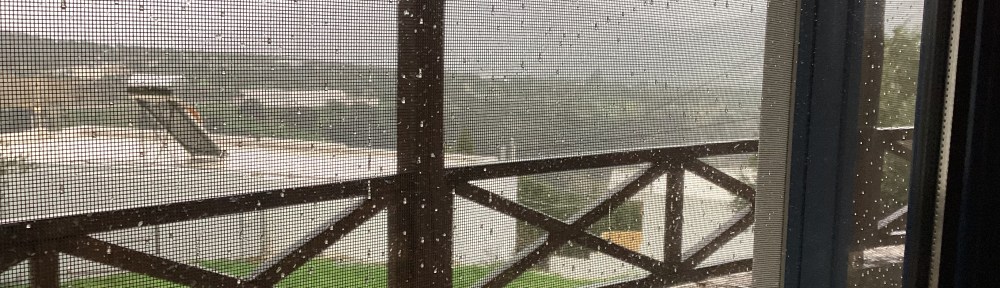
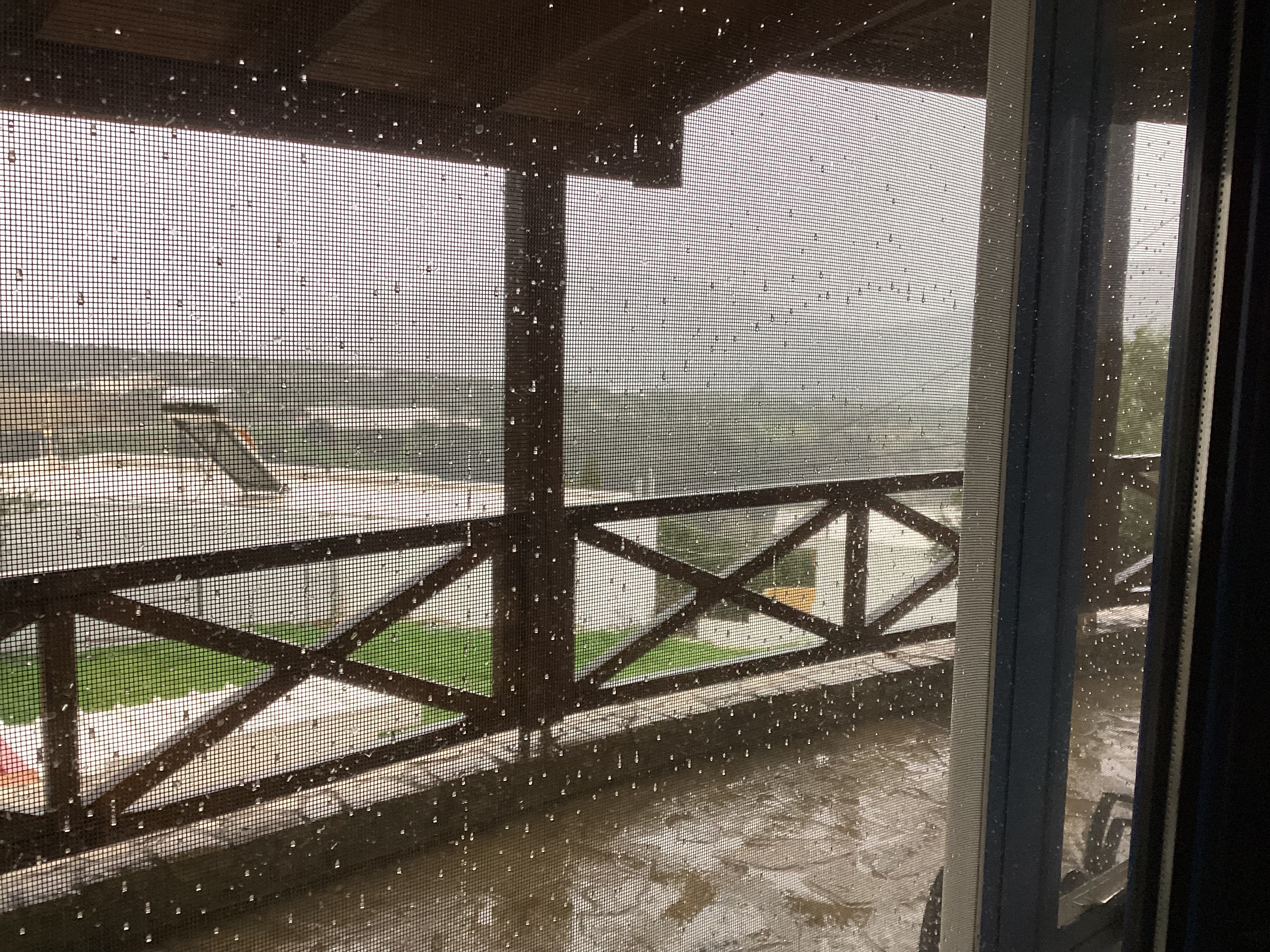
Well folks, if it makes you feel any better, the weather here’s diabolical at the moment. OK, so we don’t get this kind of weather too often, but when we do, it throws it all at us, and that’s what it’s doing today. The prevailing winds here are north to north west, which means that the western end of the island as well as the north coast in general tend to see more of the bad weather during the winter than we do, but today the wind’s blowing south, south east, so it’s coming straight up the valley and hitting our veranda full on. The sea down on Ierapetra seafront is definitely crashing over the promenade.
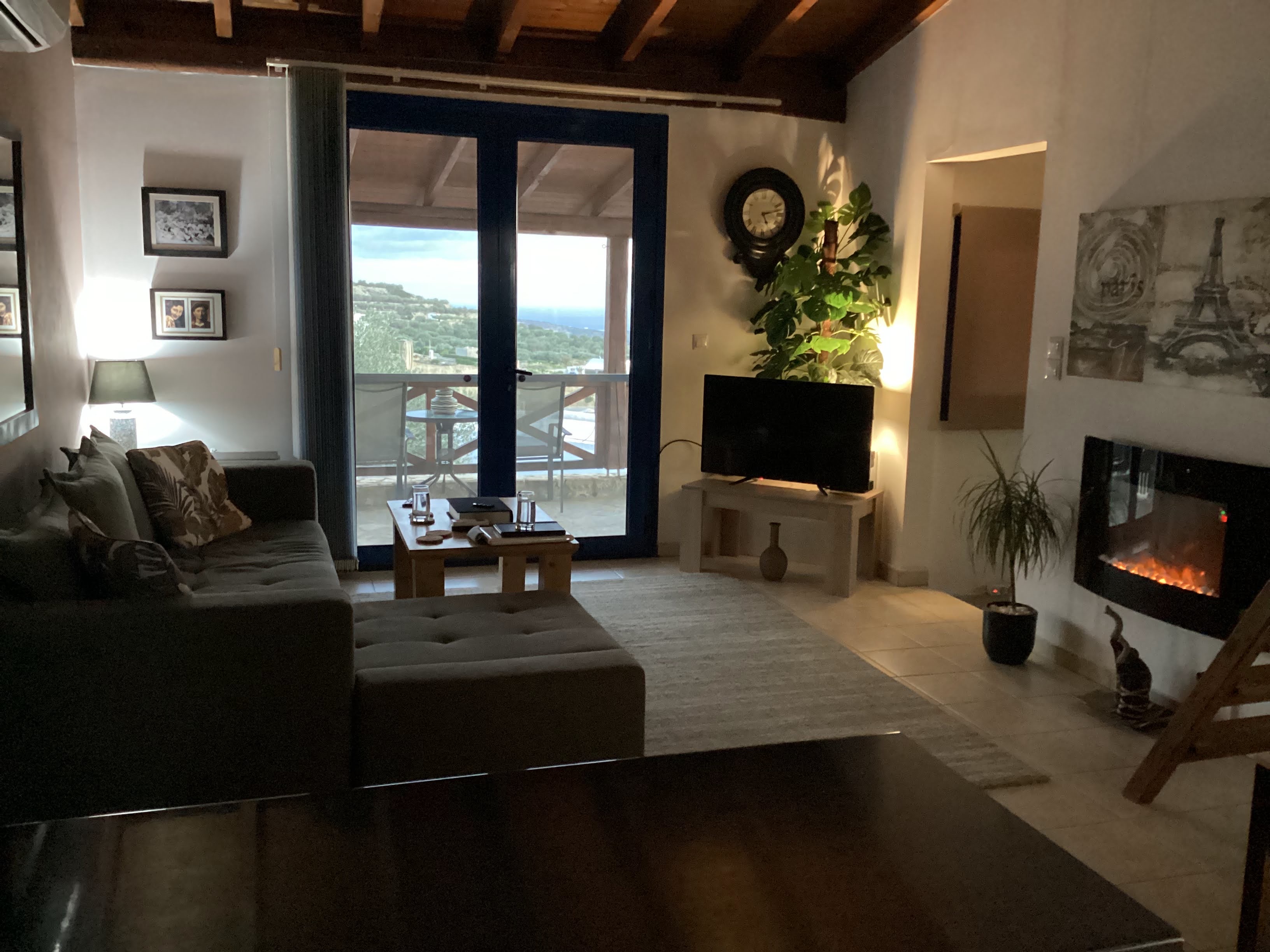
Usually, when it rains here in winter, we can still sit out on the veranda to drink our coffee in the mornings, because the rain seldom gets the place wet at all. When the wind’s in this direction though, the veranda gets soaked, and we even have droplets of water on the mosquito nets in front of our French windows…
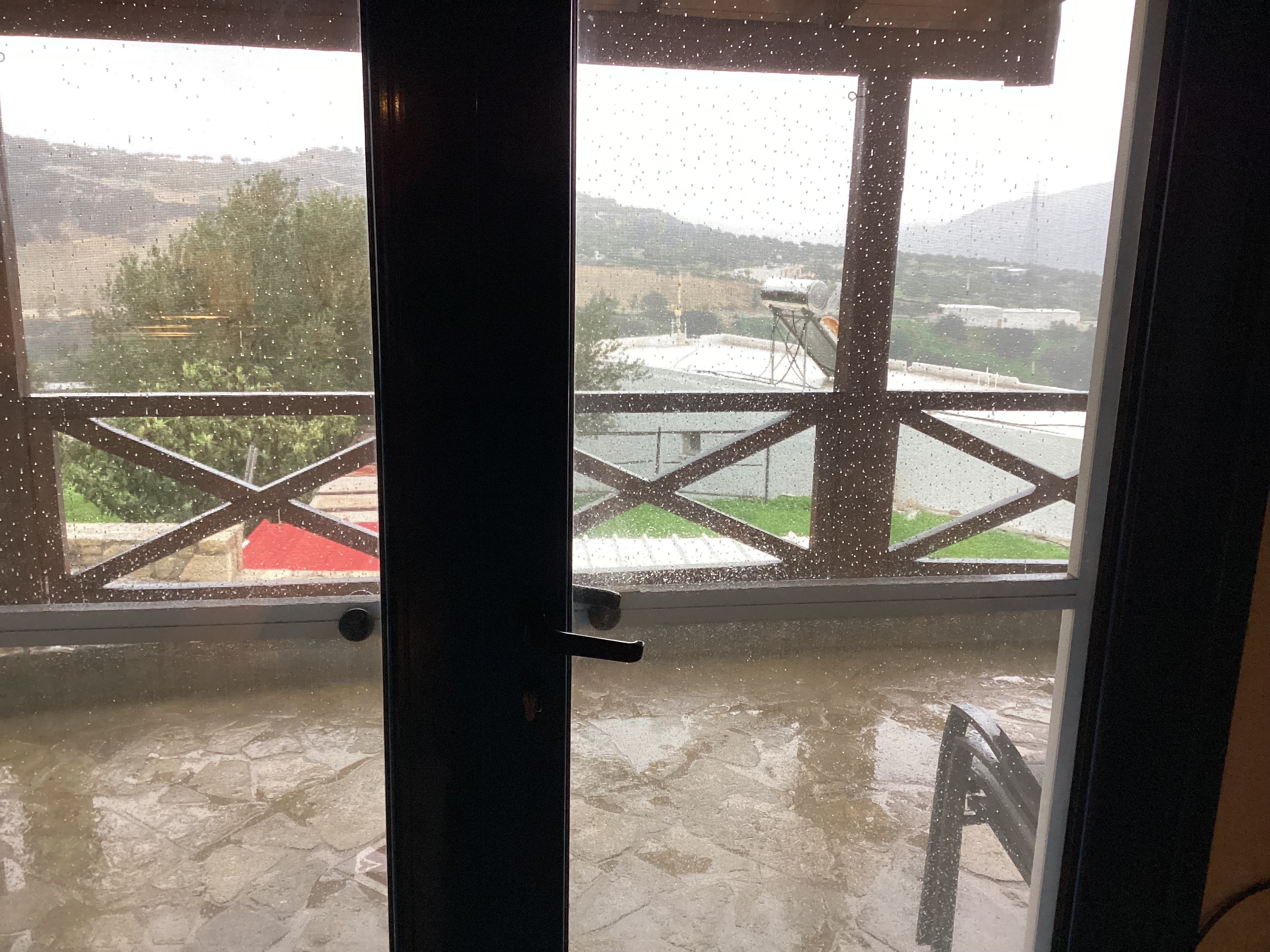
Nice, eh? It’s one of those days when you simply need to keep the house warm and be sure to have a good book in front of you. Either that or write a blog post. It’s a bit of a stark contrast with this time last year, when we had three weeks of unbroken sunshine in January and temperatures around the 20ºC mark for most of the time. Outside at the moment it’s around 11ºC, which for us is flippin’ freezing.
Still, in general, such weather doesn’t usually last long, and tomorrow the forecast is sunny and 17º, so I guess we can’t complain too much. We heat our hot water using our roof-mounted solar heating system, the kind you see on top of just about every house in Greece. You know the setup, there’s a glass panel (which the Greeks amusingly call the kathrefti, meaning ‘mirror’) and, above that, the horizontally mounted cylinder, which the locals call the ‘boiler,’ and that’s exactly how they pronounce it by the way, as it’s an anglicisation. A lot of people also have an electric immersion heater element fitted inside the cylinder, so that on days like this you can flip a switch in your fuse panel on the wall and heat the water electrically. We opted not to bother with that and, to be honest, most winters (and this is now our seventh in this house) we’ve never experienced more than a handful of days on which we didn’t have any hot water in the taps. I’ve a sneaking suspicion though that todays’ going to be one of those days.
I’ve got to say, too, that the local farmers (and that’s what most people are in this area) are loving it. For the reservoir to fill up to an acceptable level, and one that gives them the chance of having enough water to get them through the coming summer, they often tell us that however much rain we get during the winter months, it’s never enough. In the previous post you’ll have seen the photos I took showing the reservoir below us, and maybe you can’t tell, especially if you’re not from around these parts, but it’s still only a little more than half-full at the moment, having reached its lowest ever level by the time we got to the back end of last year. The current level, though, is at least evidence that this winter’s rains have been giving it a helping hand, and it’s hoped that if we continue to get a little rain every week then it’ll be full by the time the summer hits us with a vengeance. Judging by how much rain we’ve been getting this past few years though, it’s doubtful.
Mind you, as I sit here typing this and gazing up at the scene outside through the French windows, I could be forgiven for thinking that I ought to consider following Noah’s example when it comes to building projects.
Now, with all this talk about rain, you’re probably (if you’re not comatose by now) wondering why this post is called ‘furry, fluffy floors.’ That has to do with the locals’ quaint habit of covering every available surface with shaggy rugs and throws from December through March every year. We first came across this custom during our 14 years on Rhodes. Friends’ homes, whom we’d frequented often during the summer months, all of which have cool ceramic tiled floors, or maybe that polished crushed marble effect that seems to have gone out of fashion in recent times, seldom sported any floor coverings, since to walk barefoot on such floors during a Greek summer is a way of cooling oneself down a little. Come winter, though, it’s ‘all change.’
It seemed to us that just about everyone had a stash somewhere of really shaggy rugs and blankets and, once the evenings get a bit cooler and the winter months arrive, out of that ‘stash’ they’ll extract all these brightly coloured shaggy whatnots and throw them all over the floors and furniture. The first time we visited Mihali and Soula’s house back on Rhodes during the first winter we were there it came as a bit of a shock. Their normally sparse lounge and dining room was now knee deep in shaggy pile and fluff. Not only that, but the normally subdued colour palette was now visually smashed to smithereens because all their ‘throws’ and rugs were in garish colours, from bright orange, through chocolate brown, to red and pink stripes, aaaargh.
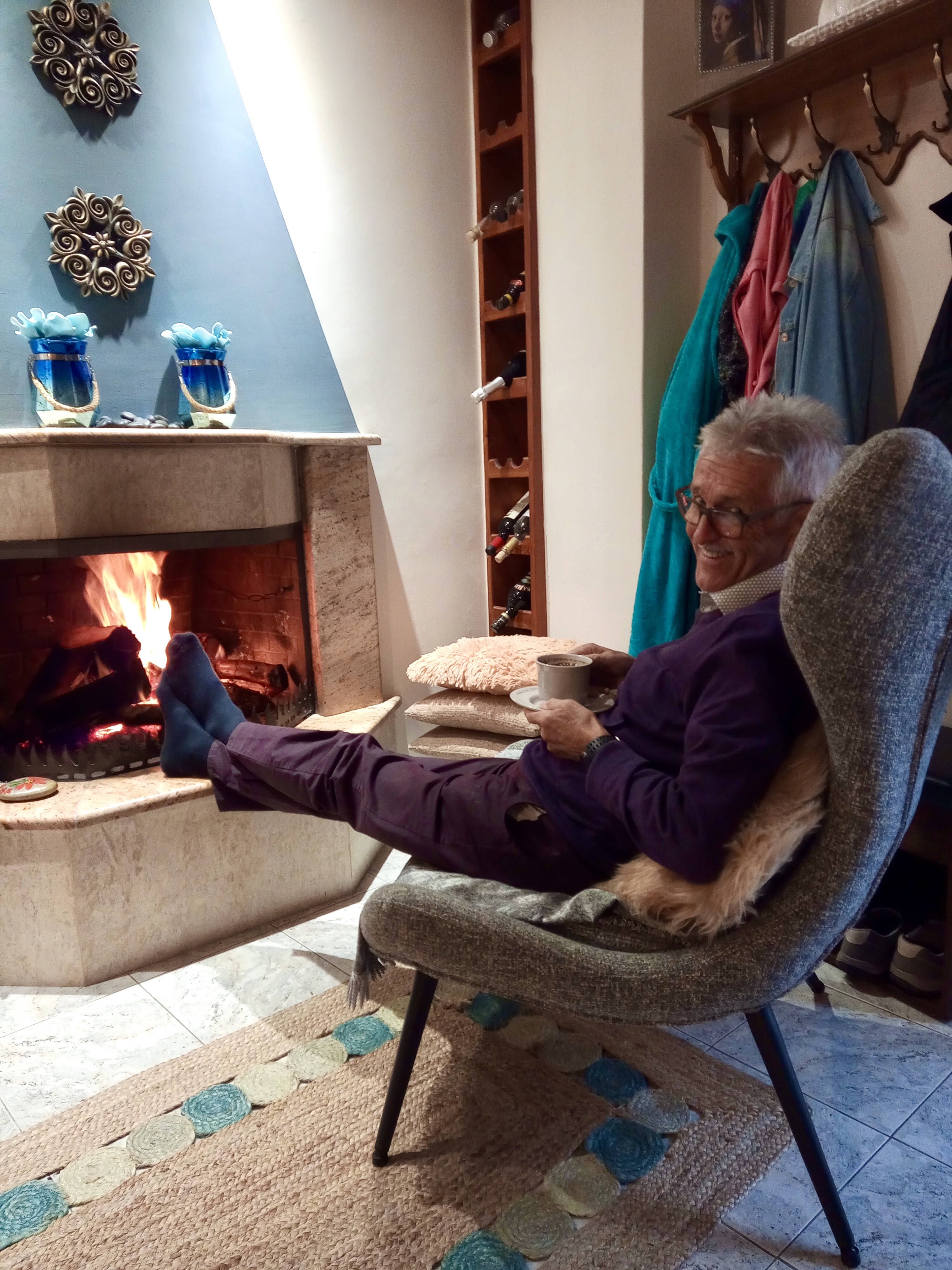
Not many Greek homes don’t have a ‘tzaki,’ or open hearth as we’d call it in the UK, on which they burn copious quantities of wood, the heat from which largely just goes straight up the chimney. In order to get any benefit at all from it you have to sit right on top of it, barely escaping third degree burns on your tootsies. So they’ll happily chuck a very, very shaggy rug on the floor right up to the edge of the hearth, in many cases. Why there aren’t more house fires from stray embers and sparks is beyond me.
A couple of years ago, as the summer was drawing to a close, one of our friends, whom I shall call Despoina, came up to lunch with her hubby Manoli. As they were leaving, she told us that she was going to give us something, because she couldn’t bear to see our house without its share of shagpile for the winter months. Despite our trying our level best to express our desire not to have such a ‘luxury,’ she still rocked up a couple of days later with a huge two metre square rug with pile that must have been at least three inches deep. Had it actually been sheepskin, it would have needed about six sheep, maybe more, to make one of that size. The thing weighed a ton and I’m not exaggerating, and she proceeded to march into our lounge and cast it upon the floor, all the time looking sideways at us with that ‘aren’t you grateful that I’ve saved you from getting frostbite in your toes this winter’ look in her eyes.
Once she’d gone, and we knew that she wouldn’t probably be dropping by again for at least a number of weeks, we immediately took it up again and tried to fold it up and put it away somewhere. That was when another conundrum struck us. Where on earth do you store such a thing? It would have totally consumed one section of our wardrobes, even if we’d had one to spare, which we didn’t. In the end, almost wrecking my hands and sustaining several blisters in the process, I attacked it with some robust dressmaker’s scissors and cut the thing in two. At least then we were able to stuff the two parts into huge heavy-duty polythene bags, the type you get from a dry cleaners. I don’t know where we got them from, but at least we had them. We learned that they all got these rugs and throws dry cleaned every spring before stowing them away for the summer, but exactly where they found to stow all of the dozen or so that most of them kept is still a mystery to us.
We eventually quietly disposed of the one that Despoina had given us by leaving the two parts beside a wheelie bin, the standard way of passing unwanted yet still serviceable household items and clothes on in these parts. We just had to hope that she wouldn’t remember it, or indeed pass by that particular bin before someone had spotted it and rescued it for their own place.
Here’s a nice shot from outside a garden centre in Ierapetra a week or so ago…
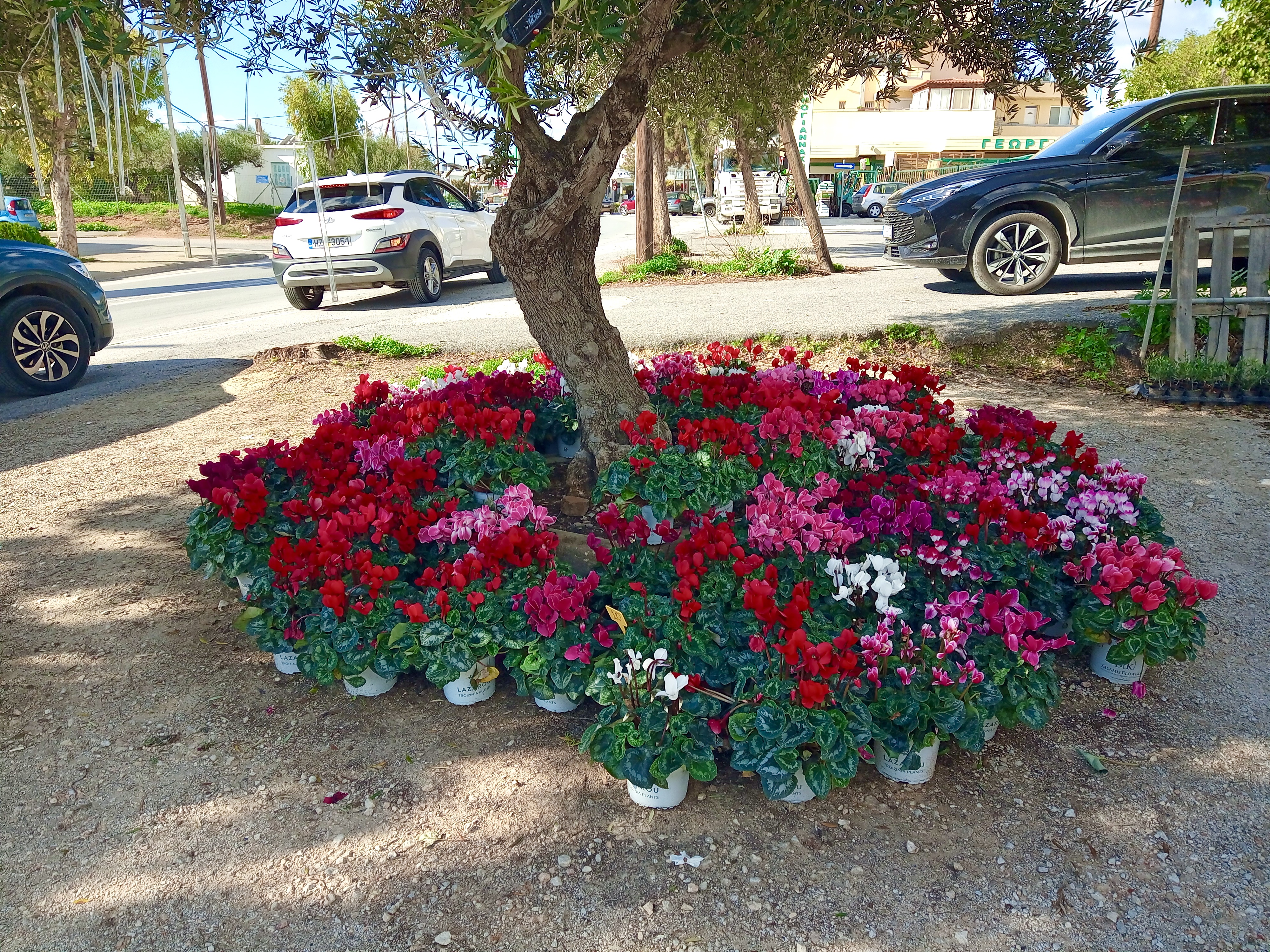
Yes, that’s right, they’re all cyclamen.
•
If you enjoy my blog posts, then maybe think about supporting me by purchasing one of my written works. Your support would be very much appreciated, rest assured. Click HERE to go to my Amazon Author Page.
Thank you.
 Accretions