Musings from South East Crete. Accretions: "Growth or increase by the gradual accumulation of additional layers or matter. A thing formed or added by gradual growth or increase." This is a spasmodic diary of life in south eastern Crete by writer John Manuel.
Here is another crop of photos taken during the past week or two. Hope you like them…
Above gallery: Just a few more from our Pachi Ammos walk in December.
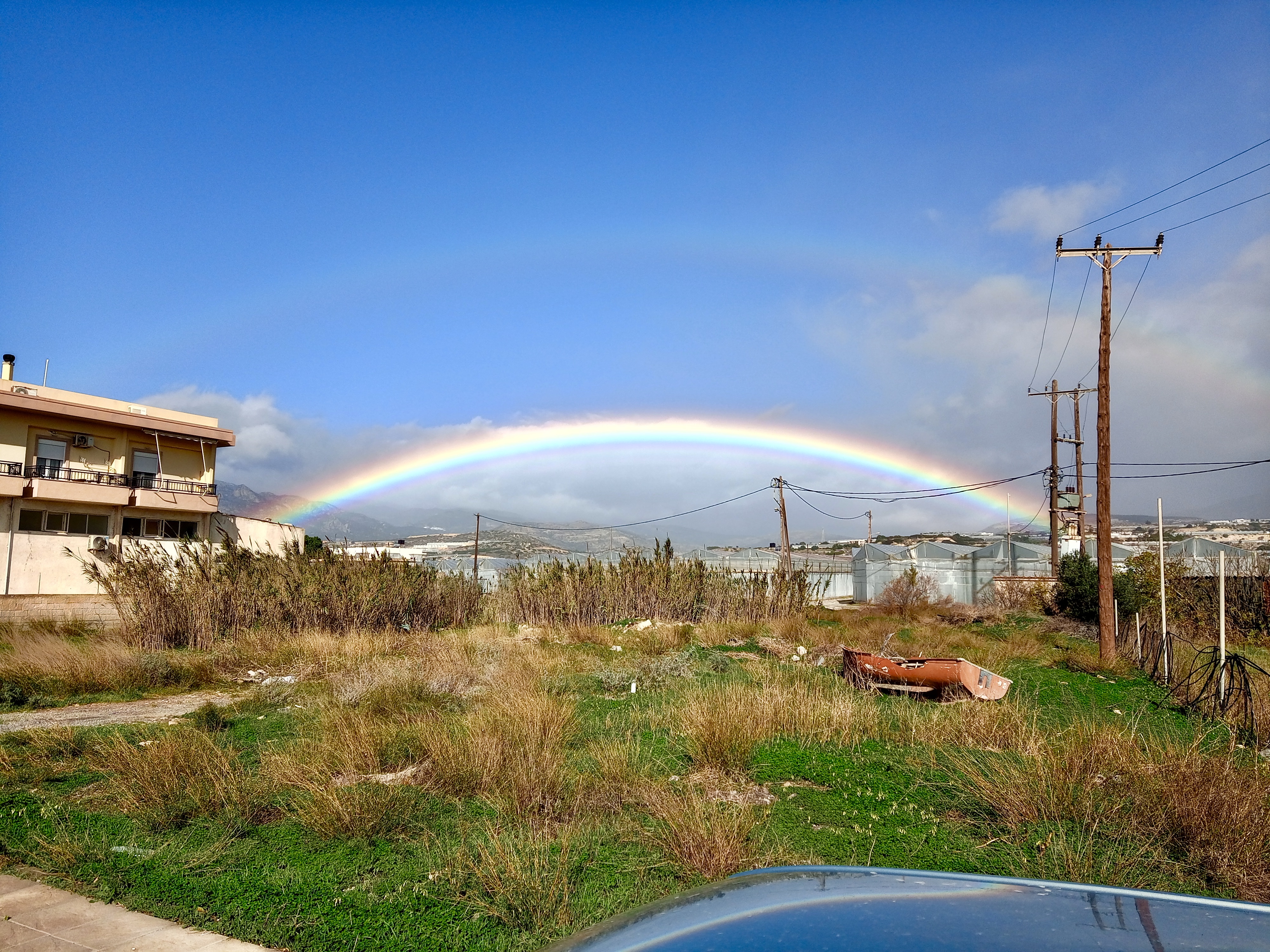
Above: I don’t think I’ve seen such a complete and vivid rainbow, and apparently at such close quarters, ever in my life. This was on the road out to Gra Ligia, and I just pulled over, stood on my door sill, and shot it. That’s why the roof of the car is in the below foreground!
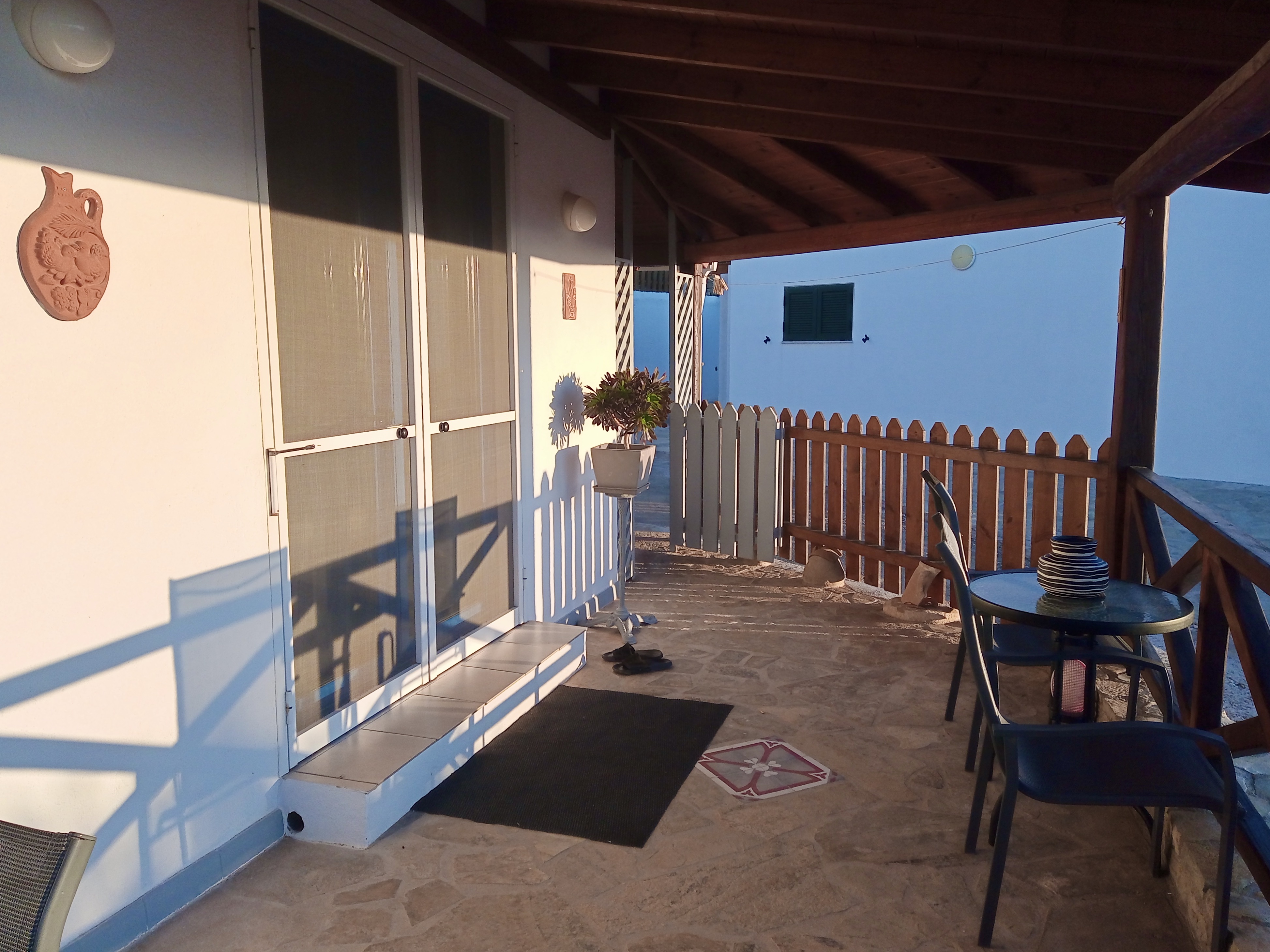
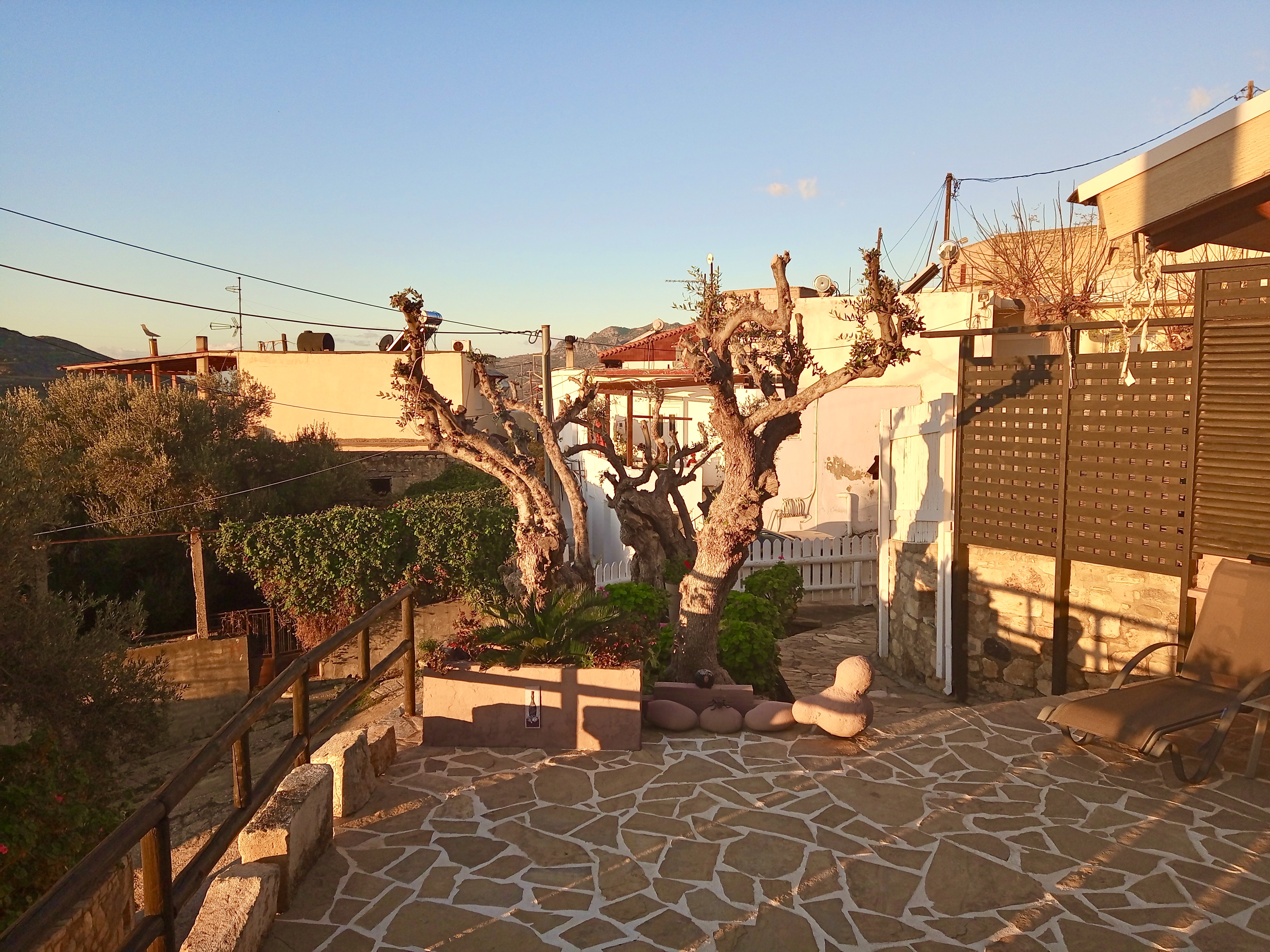
Above gallery: In and around the vicinity of the house, just a few days ago.
Above: Part of our lounge, seen from the top of the stairs up to the ‘patari.’
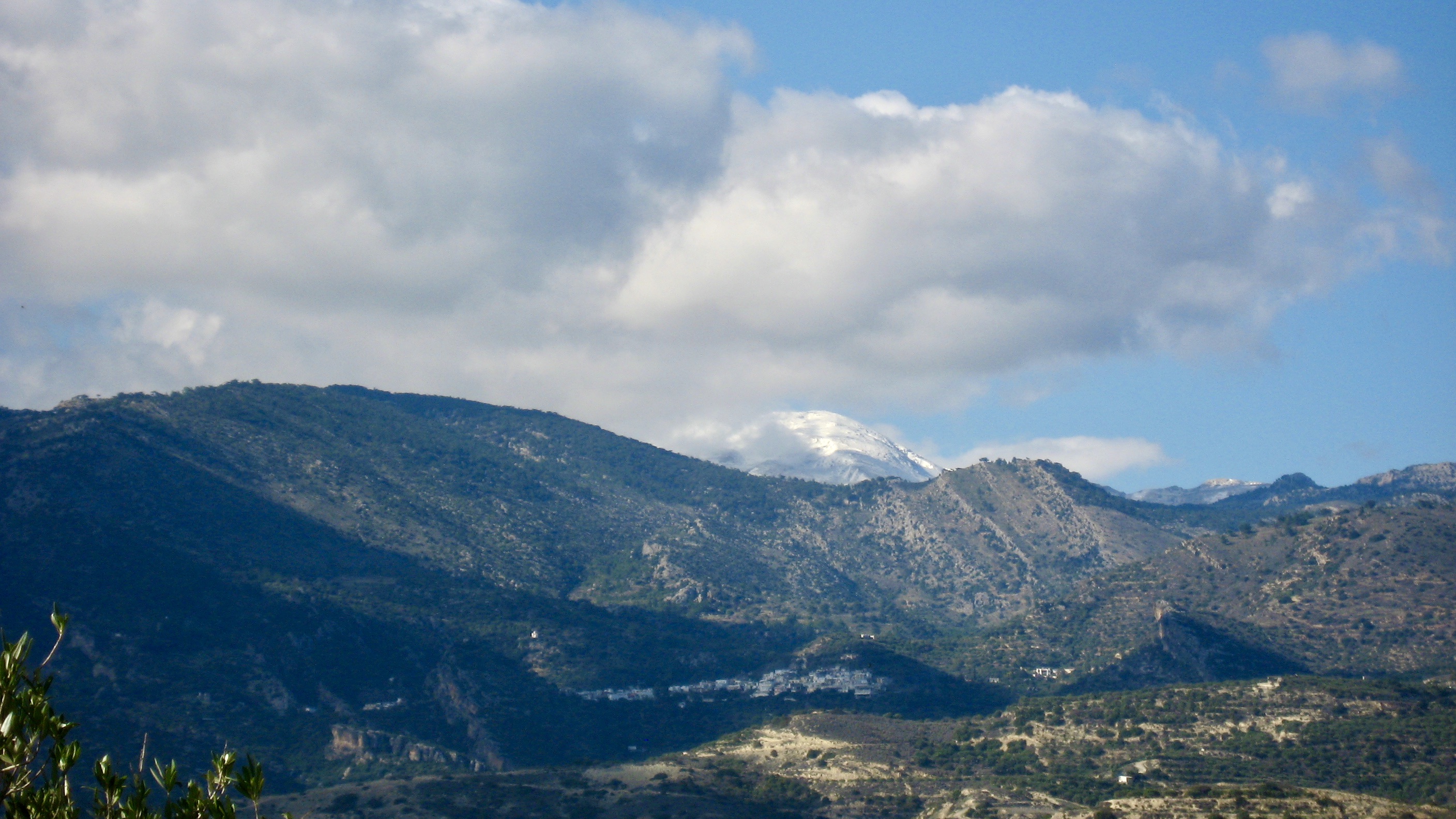
Above: I took these on Sunday morning (Jan 14th), as we were leaving the village to go into town. The ‘kourabietha‘ finally has snow on it.
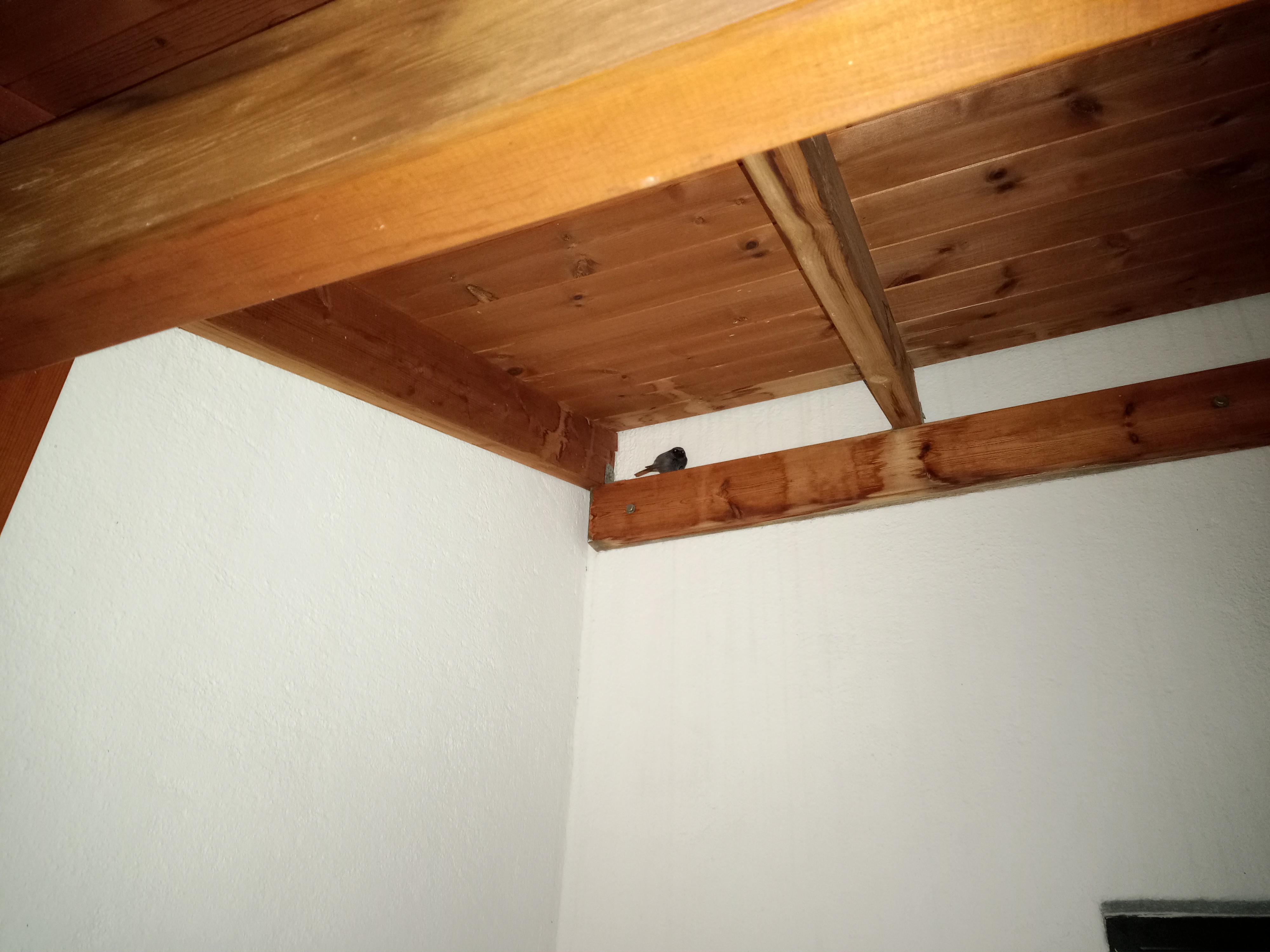
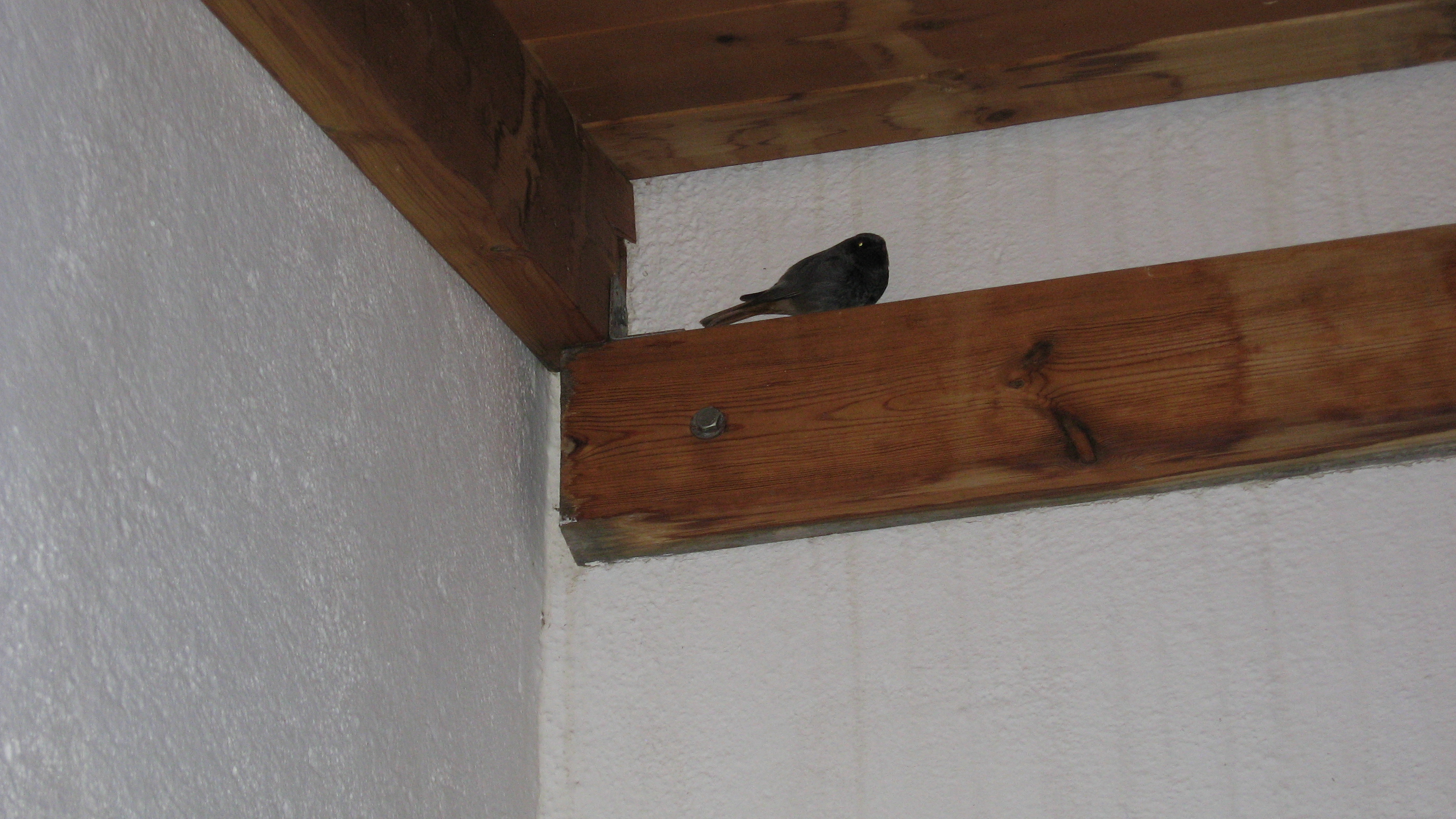
Above: Every night now, for the past week and more, a couple of Black Redstarts have been using the porch that wraps around the front of the house next door as their sleeping platform overnight. They’re there as soon as the sun goes down, and they take off at sunrise. While they’re sleeping I can take photos with the flash and they barely move, perhaps half-opening their eyes when the light flashes for a millisecond, that’s all.
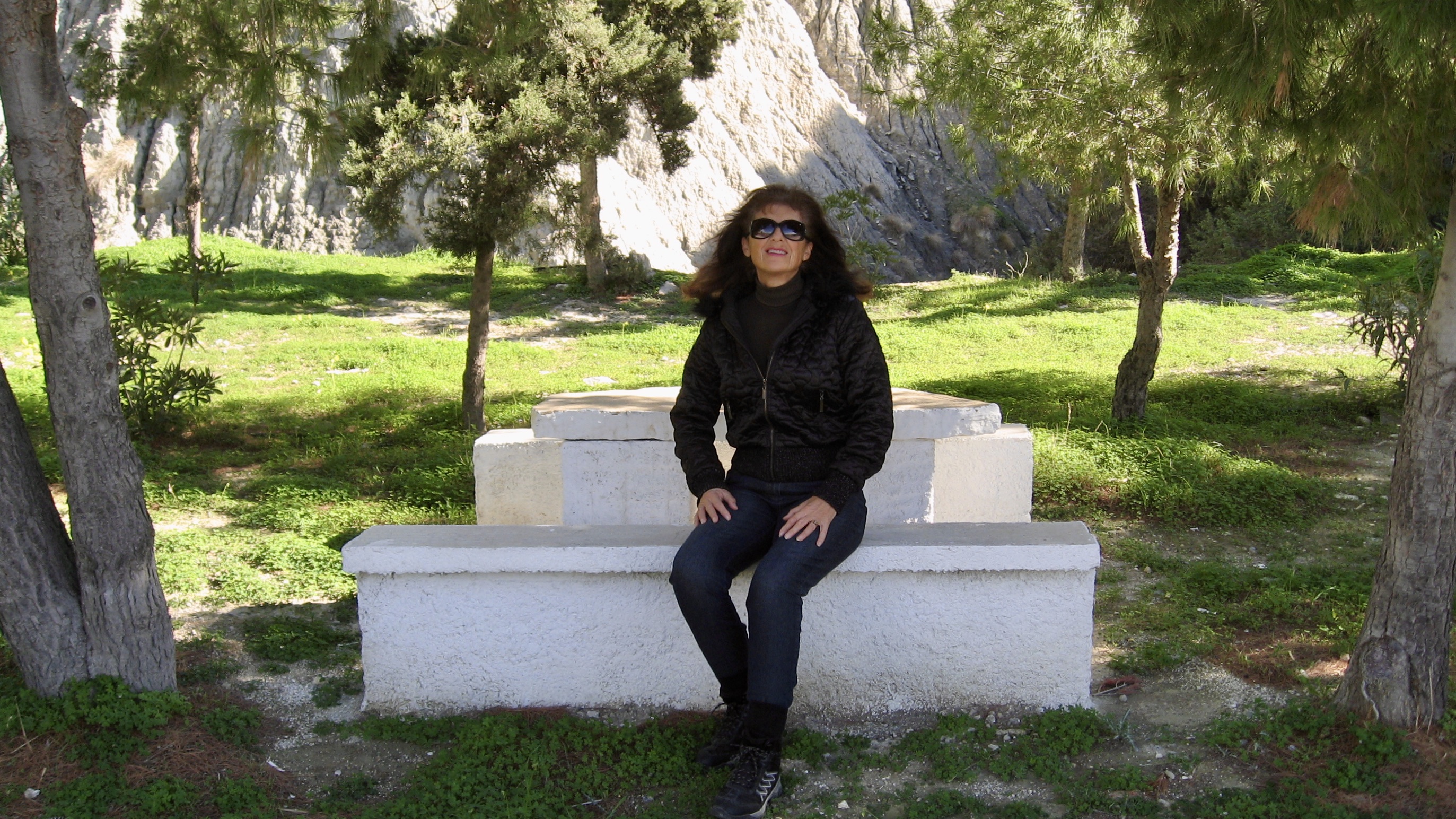
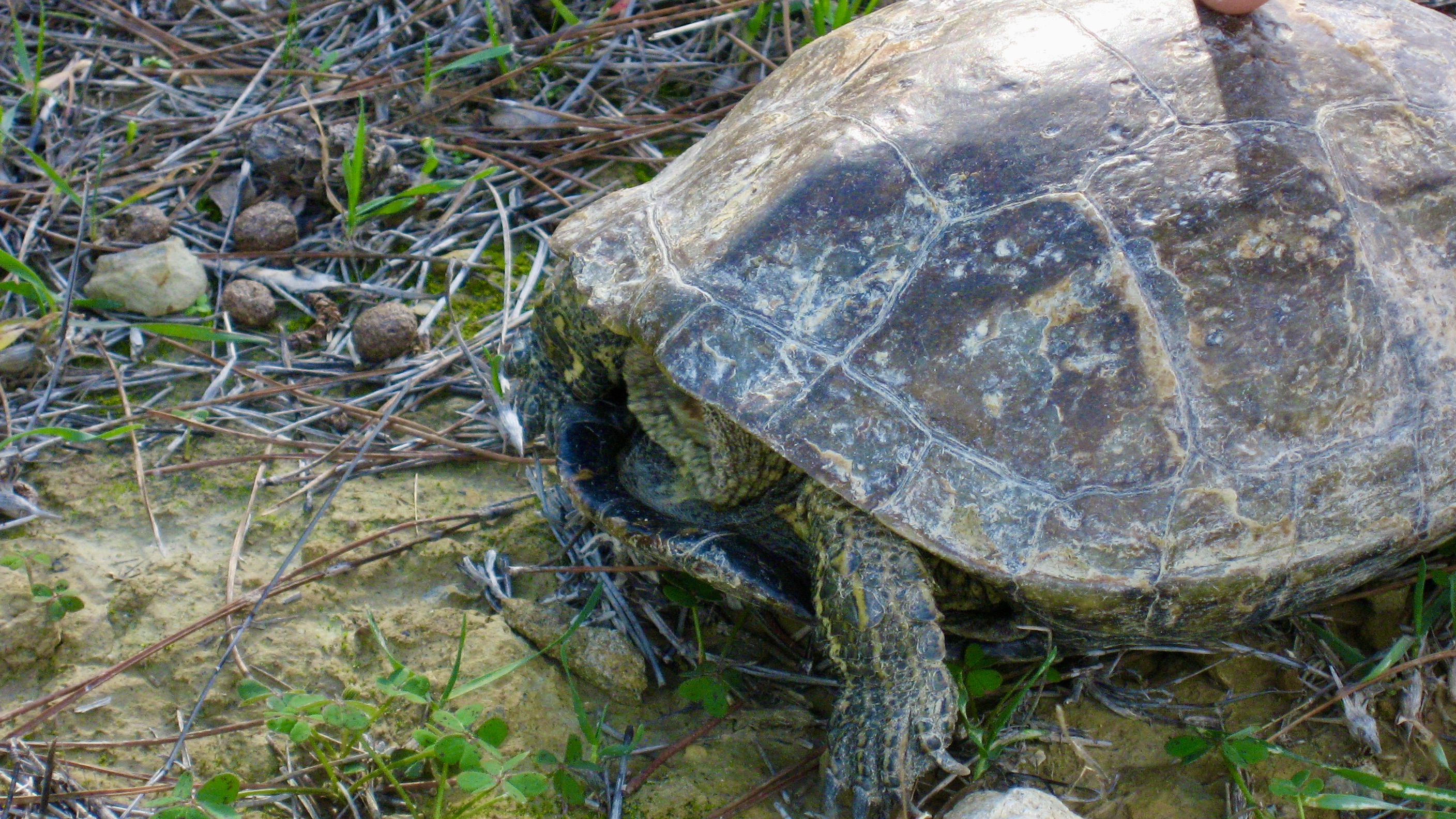
Above gallery: Finally, from a walk we did on Monday 15th, which took us about two hours. I almost stepped on the tortoise before Yvonne alerted me to its presence. Sadly it wouldn’t poke its head out for me to take its portrait, which is why it looks ‘headless’ in these shots. In the first photo, Yvonne’s sitting on one of the stone picnic tables that Angla’i’a organised, whilst still mayor, to be installed under the pine trees at the bend in the road a few yards south of the village. There are several, and they encourage passing tourists to stop a while when driving past in their hire cars during the summer. We think they certainly enhance the area.
I’m glad to be able to report that Yvonne’s shoulder injury is much improved. She has full movement back again in her arm, although the shoulder blade still hurts, especially if you happen to touch it, or if she raises the arm for too long. I also still have to help her put a pair of socks on. The really good news, though, is that she’s back to fully functioning ‘cooking’ mode in the kitchen!! Only joking sweetie (can’t be too careful, after all, she reads this stuff!).
•
Click HERE to go to my Amazon Author Page. There you can browse all of my written works.
The village is quite quiet right now, owing to the weather. It’s OK, it’s good, but this past couple of days its been ‘staying indoors’ weather, rather than the ‘tarrying outside’ kind. The local radio station and the local newspapers (we follow them on Facebook, as you do) are all saying the same, and with some degree of rejoicing, and it is that “winter is finally upon us, and it is welcome.”
Why, for a couple of nights it’s even dropped below 10ºC overnight, which is positively chilly. There has now been a period of several days when the weather has been, as the forecasters on TV call it, ‘astatos,’ meaning basically, ‘unsettled’ (literally, ‘fickle’). There has been cloud, rain and sunshine in equal measure. Those with crops, and the farmers in general, plus anyone who has olive trees as well, these are all much happier now that we’ve seen some rain, as December was virtually a drought in these parts. Fortunately, we haven’t seen any of that damaging torrential rain that we had a year ago last October, and which many parts of the world have experienced this past couple of months. No, our rain, thankfully, has so far been good solid ground-replenishing rain that the plants have enjoyed feeling on their foliage.
The local authority was only saying a week ago that if we didn’t get some decent rains soon, there would be a serious problem with the water supply in Ierapetra. I’m no expert, and I could probably be shot down in flames about this, but when I look at the ‘development’ that’s going on everywhere, not just here, but wherever you look in the so-called ‘developed’ countries, there never seems to me to be sufficient thought given to how all the new homes, factories, agricultural installations, hotels etc are going to be supplied with water. We hear that desalination plants are simply not efficient enough and too expensive, and this is why very few are being built. Yet, the forward-thinking people of the tiny island of Halki, accessible mainly from Rhodes, installed one a few years ago and have never looked back (see this post on my previous Rhodes blog).
Anyway, for now at least, it seems that the locals are happy and many have smiles on their faces, because the need for food production and drinking water far exceeds the enjoyment of perpetuel clear blue skies, which we always know are coming in the not too distant future to be with us for several months yet again.
And here’s the latest batch of photos…
•
Click HERE to go to my Amazon Author Page. There you can browse all of my written works.
Where to start with this one, that’s the dilemma. Badgers, broken arms or brazen pussy cats, that’s the problem. It’s been, by the way, the warmest December in Greece for 15 years, according to the meteorologists on Greek TV. As a rule we need a little heating in the house during the evenings from about the end of the first week in December each winter. We very seldom if ever need to have heating on during the daylight hours, since the sun warms the house sufficiently through the windows, but once the sun sets and darkness comes upon us, we usually resort to using a little heating every night, but this year, so far we’ve found ourselves going to bed at the end of an evening four or five times each week while remarking how we’d not needed to heat the house at all in order to be comfy on the sofa.
It’ll all change at the end of next week though, if the weather forecasters are to be believed. Finally a cold air mass is due to sweep down though the Balkans and way out into the Libyan Sea south of us on or around the 9th of the month. If it happens as they predict, then we’ll definitely be cranking up the heating during the evenings. On the local radio station (Radio Lasithi) this morning, the presenter was interviewing a fella who represented the farmers and veg growers of the district and I couldn’t quite believe what I was hearing. This is 2024, right? It’s not 1624 or anything like that? Thought so, well, this chap, nice bloke though he sounded to be, was asserting that the rainfall had been woefully inadequate this winter so far and, when the interviewer asked if he was worried about the crops this year and next season’s olive harvest, he replied, “No, well, I’m sure that God will make it rain, once we’ve thrown the crucifixes this weekend. He’ll respond and send us the rain.”
Honest, I’m not kidding you, and he was deadly serious, and I’ve abbreviated that part of their conversation to the pithy bits, to be honest. Most Hellenophiles will know that the 6th of January is when the Orthodox Church celebrates the so-called ‘Epiphany,’ and a priest throws a crucifix into the sea, leading a bunch of local men to jump into the water to retrieve it. The chap who grabs the cross on the sea bottom and brings it back to the priests gets a special blessing for his trouble. The whole thing has precious little to do with what the gospels say, to be honest, but then what religion in this world ever worried about that problem then? Now, I wouldn’t dream of interrupting them as they go about this annual ritual, but in this scientific age, is it really ‘normal’ for a grown man to believe that this will persuade the Creator to send some rain? Mightn’t the meteorological conditions, the movement of the air masses and the fact of global warming have something to do with the situation, just a tad? Maybe I’m just an old cynic. Answers on a postcard…
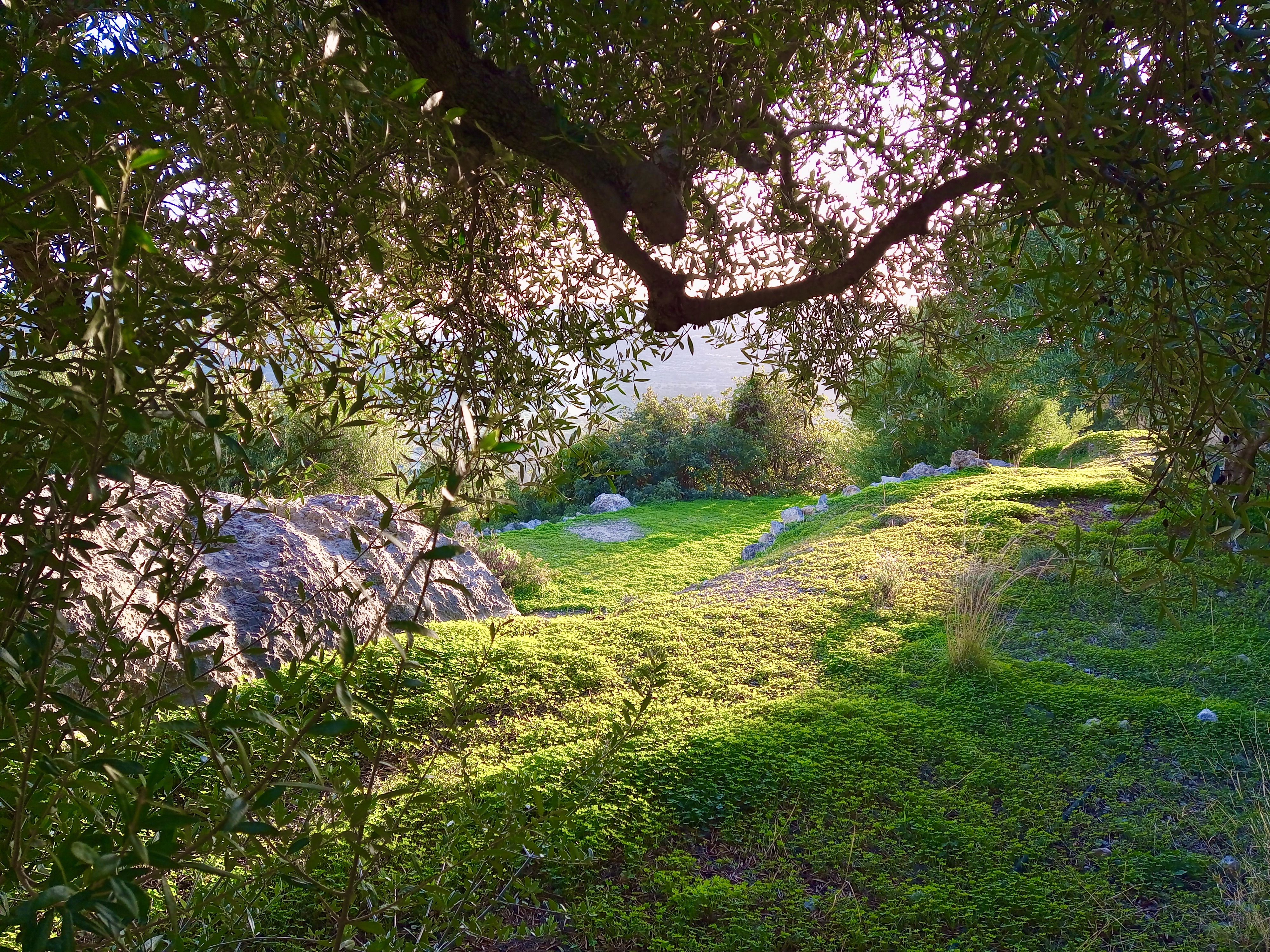
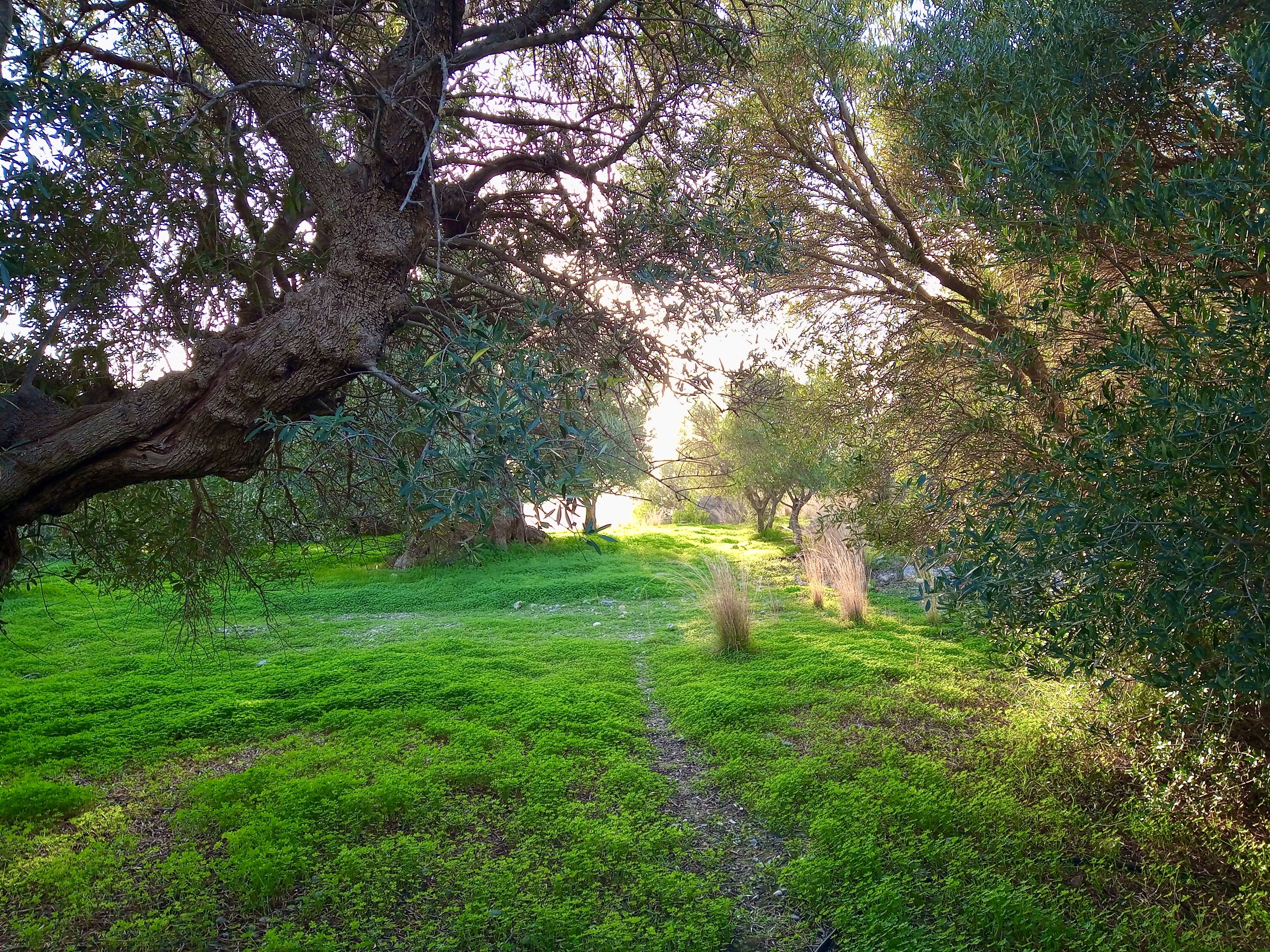
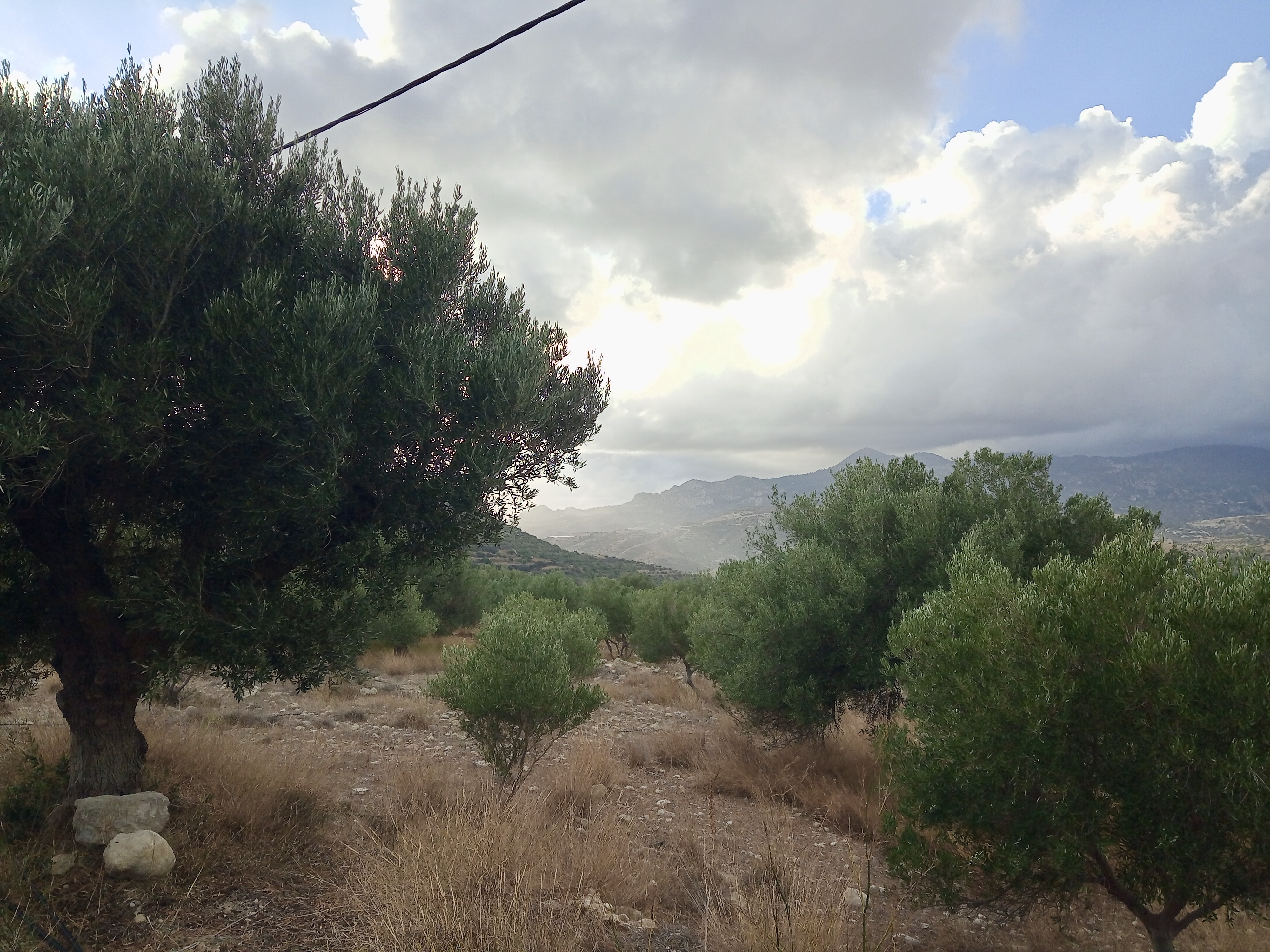
Above: The rains may not have been enough so far, but they’ve still produced this wonderful green carpet in the olive groves. Here I’ve photographed them just before sunset.
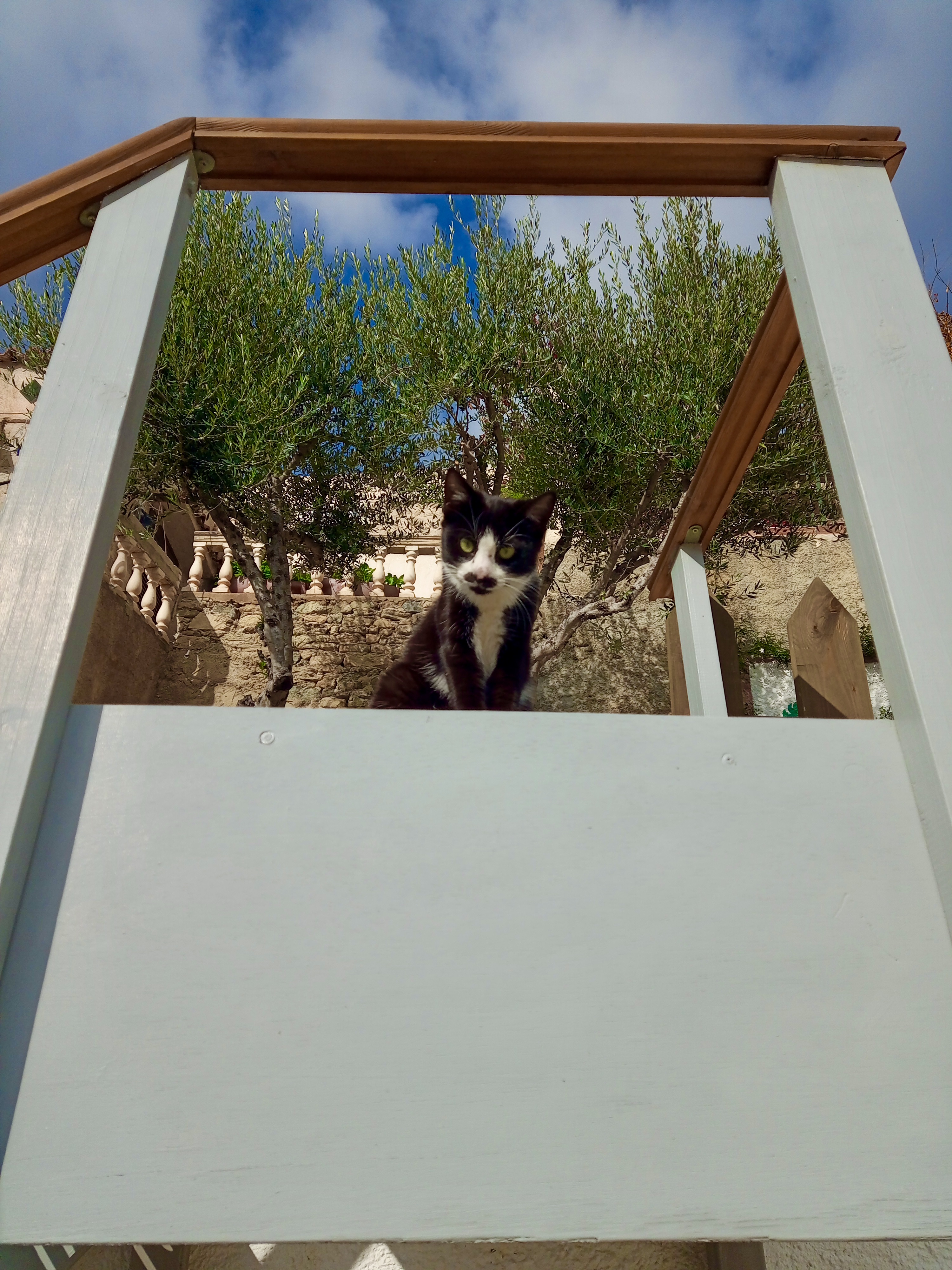
Now, the heading on this posts includes the expression, ‘On your Marx,’ and I’m sure you’re burning up with curiosity about what that might mean. Oh, go on, indulge me and pretend you are. There are a few small kittens in the neighbourhood at the moment that bear a striking resemblance to our very own Mavkos, who’s a black and white Tom. I say, ‘our very own,’ but he’s still essentially a part-domesticated feral cat really. He never comes into the house and often disappears for days on end. In fact, over the holiday period he’s been missing for a record two and a half weeks. We’re quite convinced that there’s another house in the village where the owners are only in residence now and again. The cat very often does a vanishing act on weekends, which tends to suggest that they’re usually in the village then and that they’ve tempted him away with some puddytat treats that he finds irresistible. To be honest, we don’t mind, as long as he’s happy. It makes us less inclined to worry about him when we go away, which we shall be doing come April/May time without a doubt, around the time of our wedding anniversary.
It makes sense to us that those other Mavkos-friendly people must have spent a couple of weeks in their house in the village over the Christmas and New year period, which is why he’s made himself scarce around our house. Maybe they give him things to eat that we’d consider bad for him. After all, cats are like kids, they’ll always eat stuff that’s not particularly good for them if it’s offered, whereas we never give him scraps, always good wholesome nutritious cat food. Anyway, one of these probable ‘sons of Mavkos’ had earned the name ‘Groucho’ from us. Look at the photo and see if you can see why…
The ‘get set’ part of this post’s heading refers to the fact that I’ve been very excited lately, because during one of my dead-of-night walks outside, when I haven’t been sleeping, a few nights ago I spotted a badger at very close quarters. During the more than fifty years that I lived in the UK before moving to Greece, I never once got to see a badger in the flesh. The house next door to ours here in the village, and the next one, are the last ones beside ours before the land drops below their terraces to an orchard, and then olive groves. The houses are both empty most of the time and so, during the night I can patrol their verandas while taking some exercise that’ll hopefully help me return to bed to get some sleep. I was standing on the veranda of the last house, just a few metres along from our own, at something like 3.00am, when I noticed in the moonlight some movement below. Not more than ten metres from where I stood. Shining my pocket torch in the direction of the movement, there, to my complete amazement, was an adult badger, slowly stalking its way among the olive trees without a care in the world. It didn’t seem at all fazed by the modest beam from my torch (flashlight, folks), and I watched it for a couple of minutes as it walked off around a tree and up the slope and into the nighttime gloom.
Needless, to say, every night since then I’ve gone out there when I’ve been awake in the small hours and tried to see another one, or even the same one, hoping that it’s a creature of habit, but no luck so far. I say, ‘no luck,’ but that’s not exactly wholly the case. At another time while I stood there sweeping the olive grove below with my torch beam, I heard a sound coming from probably 30 metres away and up a slight incline. It sounded to me like one of those squeaky rubber toys that people buy for their dog to play with. You, know, the type that squeak when the dog squeezes it between its teeth. I had no idea what it could be and, after some consideration, ruled out it being a bird, so I rushed back to the house to open YouTube, where I typed into the search box ‘sound of badger cubs,’ or something like that. Guess what, I turned up a brief video of a few badger cubs play-fighting and the sound was not just similar to what I’d heard, it was exactly what I‘d heard. That means, if I’m not mistaken, that somewhere in the olive grove not more than fifty metres from our house, there’s a badger set. I’ll carry on my patrols in the hope that I’ll get another sighting, but even if I don’t I’m still thrilled.
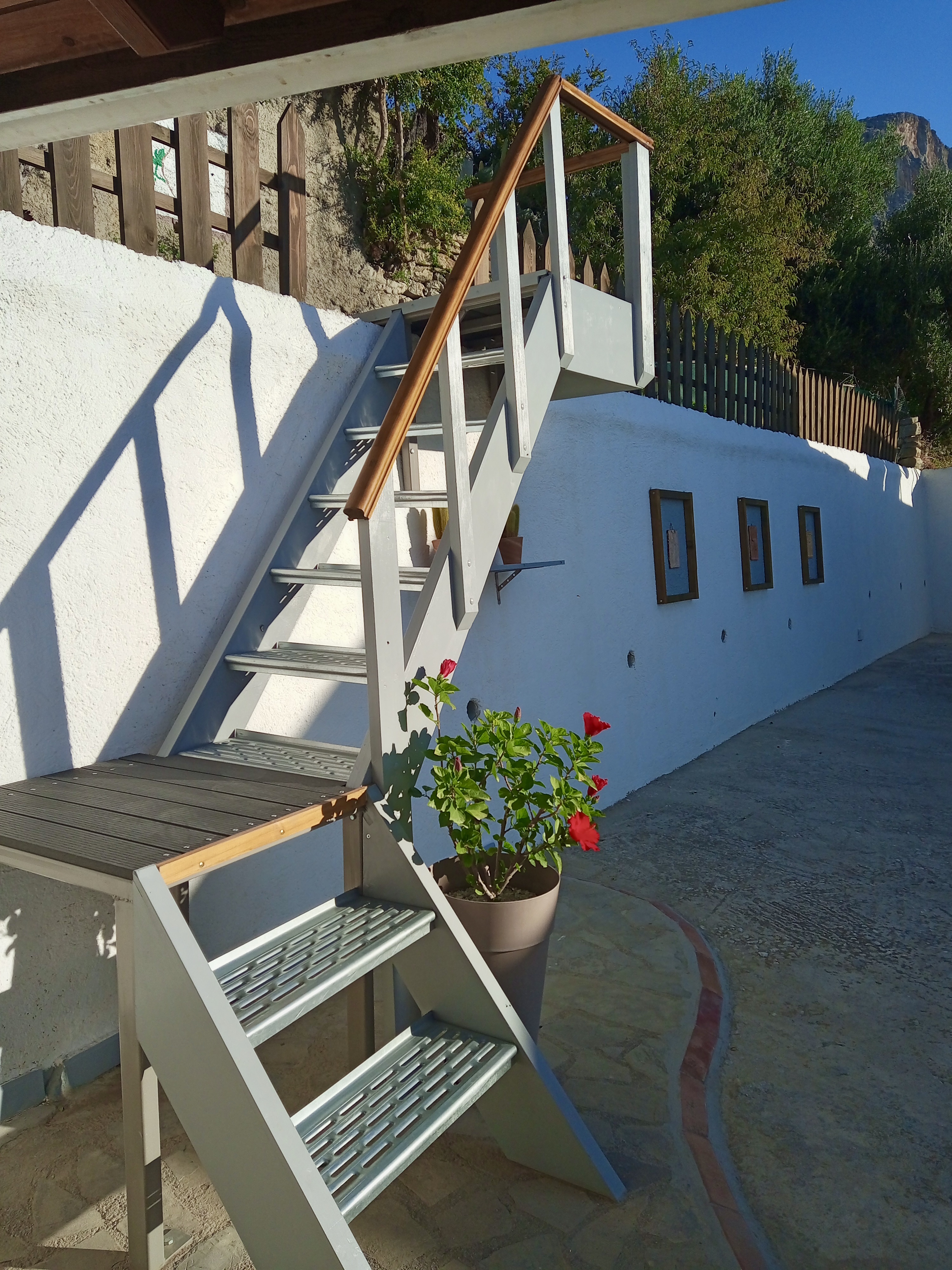
And so to the ‘sling it’ reference. A couple of weeks ago Yvonne slipped on the steps down from our upper garden and fell on her back against the lower platform and the bottom two steps. She let out such a howl that I knew that she’d done something bad to her back. I ran outside to see her trying to get up off the floor, her bucket of weeds and a couple of gardening tools strewn all over the place. If it had simply been a rough fall, she’d have recovered fairly quickly, but after a quarter of an hour or so she was still wailing in agony and so I said, ‘Get in the car, you’re going to the hospital.’
It’s a good job we did that, because (and what a blessing it is that Ierapetra’s hospital is only ten minutes away) once we got her in there and a couple of medics and a doctor examined her, they took a couple of x-rays and told her that she’d fractured her shoulder blade. She was also coming out in a couple of nasty bruises on the lower back and the doctor, when he’d finished with her, put her arm in a sling for a couple of weeks and told her to not use the right hand. When she asked him, “How am I going to do the cooking?” He replied, “Your husband will have to do it, won’t he.” As we were leaving the hospital, Yvonne said that she got the distinct impression that the doctor didn’t quite believe her explanation about how she got the injury that she did. He seemed to struggle to believe that she’d have fallen on her back, preferring to suggest that she’d have fallen on her front if she’d slipped, as she’d explained, on the outdoor steps. No wonder he stared sideways at me as I helped her on with her zip-up top before we left the accident and emergency department. I resolved to have a photo of the steps in question ready on my phone to show him when we return to see how the injury has healed.
Above: The offending steps.
Two days ago, as we walked on to the sea front to find a table for a morning coffee, none other than Mihalis and his wife Soula (Mihalis features heavily in the new book ‘Moving Islands’) were already there and bade us join them. Yvonne sat down next to Soula, who preceded to tell her that they’d just come from the hospital because she’d done something to her shoulder and had to go for an x-ray too. If it wasn’t for the fact that it was the other arm, the injury would have been near identical. Talk about coincidence. But there’s more.
Maria, she who lives across the lane from us and upstairs from her mother Evangelia, came out of her front door with her wrist bandaged up as we sat on our terrace the day before yesterday. I went over to ask what had happened and she told me that she’d gone to slam her car door and inadvertently slammed it against her outstretched fingers on the other hand. Needless to say we offered to help if she needed anything, knowing sadly that the likelihood was very slim. The next day, I saw her again and this time her left hand was completely bandaged up, so much so that the fingers and thumbs were completely encased and you couldn’t even see them. She also had her arm in a sling. Three women within the space of one week with their arms in slings. The Accident and Emergency section at the local hospital must be thinking that there’s a violent bloke on the loose.
I just hope they don’t put two and two together, make six and come after me!
And so to a few recent shots that I hope you’ll like…
•
Click HERE to go to my Amazon Author Page. There you can browse all of my written works.
The rhythm of the seasons is something I’ve talked about before, I know, but it’s so beautiful to be able to observe them from a small quiet hillside, far from the madding crowd. Gratitude, appreciation, thankfulness, these are all things that the ‘experts’ say are good for the human psyche. I agree. Not a day goes by without me expressing thanks for the simple little life we’re both leading since buying this beautiful little gem of a house in a tiny corner of the world that’s, thankfully (there I go again), sleepy, relatively undisturbed and surrounded by stunning scenery. When I think of what’s going on in other parts of this troubled planet, even in the cities of Europe, my heart aches for those who are enduring it all, but also bursts with gratitude.
You know, I sometimes read people’s posts on Facebook, asking where would be a good place to spend a winter in Greece. Many people could be forgiven for thinking that all of Greece is the same, as in: hot, sunny, and enjoying the outdoor life as the norm. That’s not the case, far from it. Greece, like every other country (well, possibly except Andorra, Liechtenstein or Monaco) enjoys a varied climate, depending on whether you’re up north in the mountains around Florina, somewhere in the mainland east of Ioannina, or maybe on an island somewhere either in the Ionian or the Aegean, where the further north or south you go, the more differences there are in the climate.
It’s interesting too to factor in how far east or west you are. In Cyprus, for example, today the sunset time is 4.44pm, a bit UK-ish I’d say. The reason is that Cyprus is on the same time zone as Greece, but is a long way east of us. Here where we are the sunset today will be at 5.10pm, half an hour later. In Rhodes, where we lived for 14 years, it’ll be 4.58pm, a full 12 minutes earlier than here, and that’s something we’ve noticed since moving here in September 2019. In Corfu, the sun sets on December 23rd at 5.20pm. Here in southern Greece, the sun rises so early, even in December, that you don’t endure any dark mornings really. Here today the sun rose at 7.23am, whereas back in the UK, in South Wales, where we lived for a quarter of a century before moving here to Greece, the sunrise was at 8.18am, almost an hour later. It’ll be getting dark around 4.08pm too, an hour earlier than here. That’s two hours difference in daylight hours between where we live here on Crete and where we used to live in Wales.
If you were to check the weather today in various parts of Greece, you’d see a wildly different picture from, for example, Florina in the north, to Ierapetra here in the furthest south point in all of Europe. In fact Florina has much harsher winters than most of England and Wales, owing to its being way up in the mountains and a long way from the sea. If you like the heat, Florina’s not the place for you, since their summers are short and their winters long, with snow covering the land for months on end. The scenery there is spectacular though, and much of Northern Greece has ski resorts, like the Alps of France, Italy and Switzerland.
The Sporades Islands, which include Skiathos, Skopelos and Alonissos, often get snowfall during the winter, owing to their proximity to the mainland. The best place in Greece for winter warmth is without a doubt the southern Dodecanese (Rhodes, Halki) or Crete. Even the two ends of this island have very different climates, as does the north coast from the south, where we are. The prevailing winds on Crete are from the north to north west. This results in the north coast getting a lot more cloud and rainfall than we do here. Over in the west, from Heraklion through Rethymnon and on to Chania, they have much stronger winds and more rainfall than we do, as a rule. Today, we sat out on our sun loungers at midday to drink our coffee in 21ºC and full sunshine. In fact, although I’d already stowed away our huge three metre wide ‘sail’ for the winter, I had to dig it out again and put it back up yesterday, because the sun was burning our faces.
So, there you are, if you wonder where would be the best place to over-winter in Greece, it depends a great deal on whether you want ski or sun, log fires or waterfront cafés. Me and my missus, we’re well happy where we are thank you very much. I haven’t possessed an overcoat now for 18 years, and we only have to resort to heating our home indoors during the daytime on as many days during the winter months as you could count on one hand. I have no need for thermal underwear, and the chance of returning home after being out and about in the winter with freezing cold toes is about zero. Suits me fine.
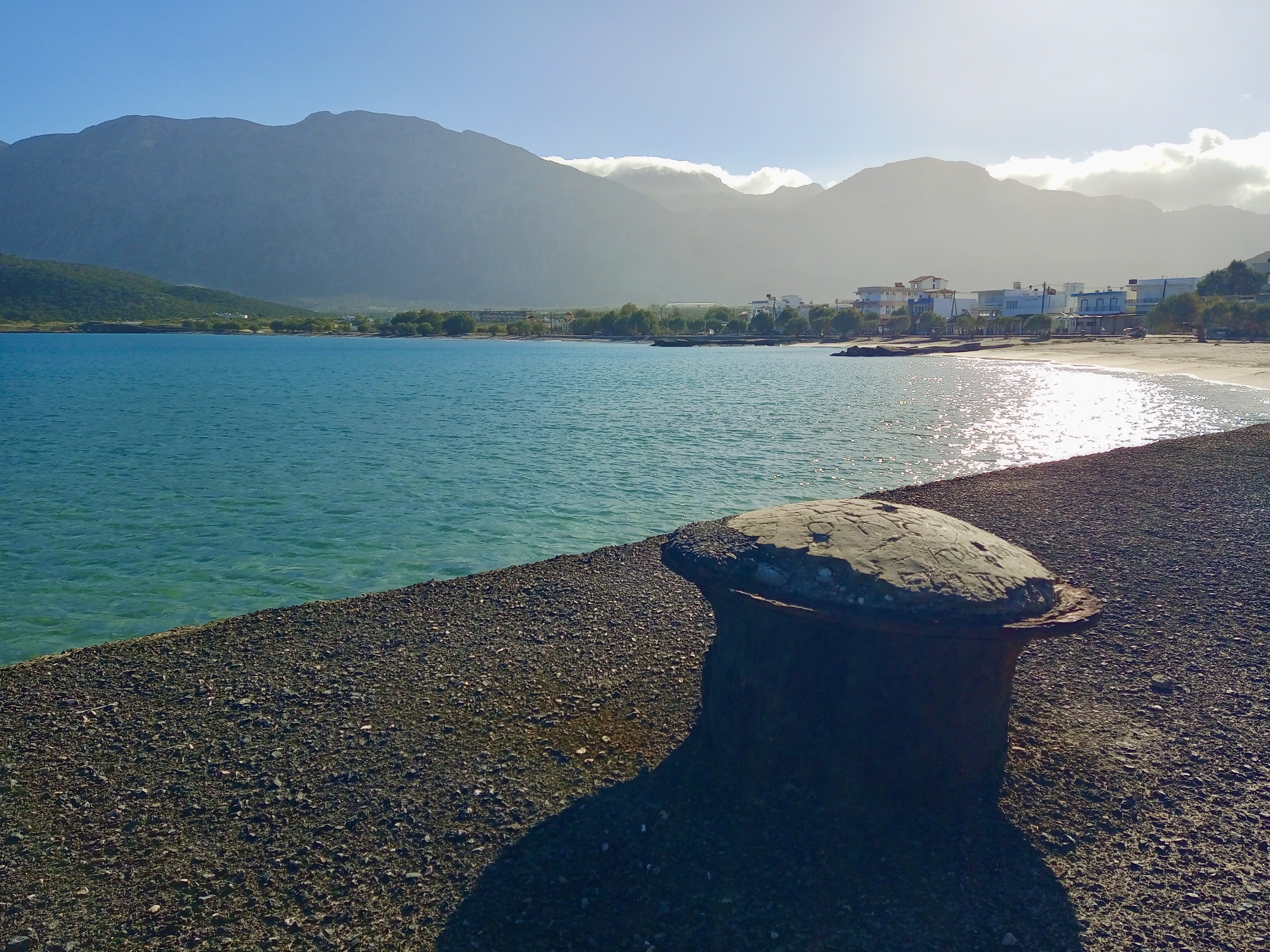
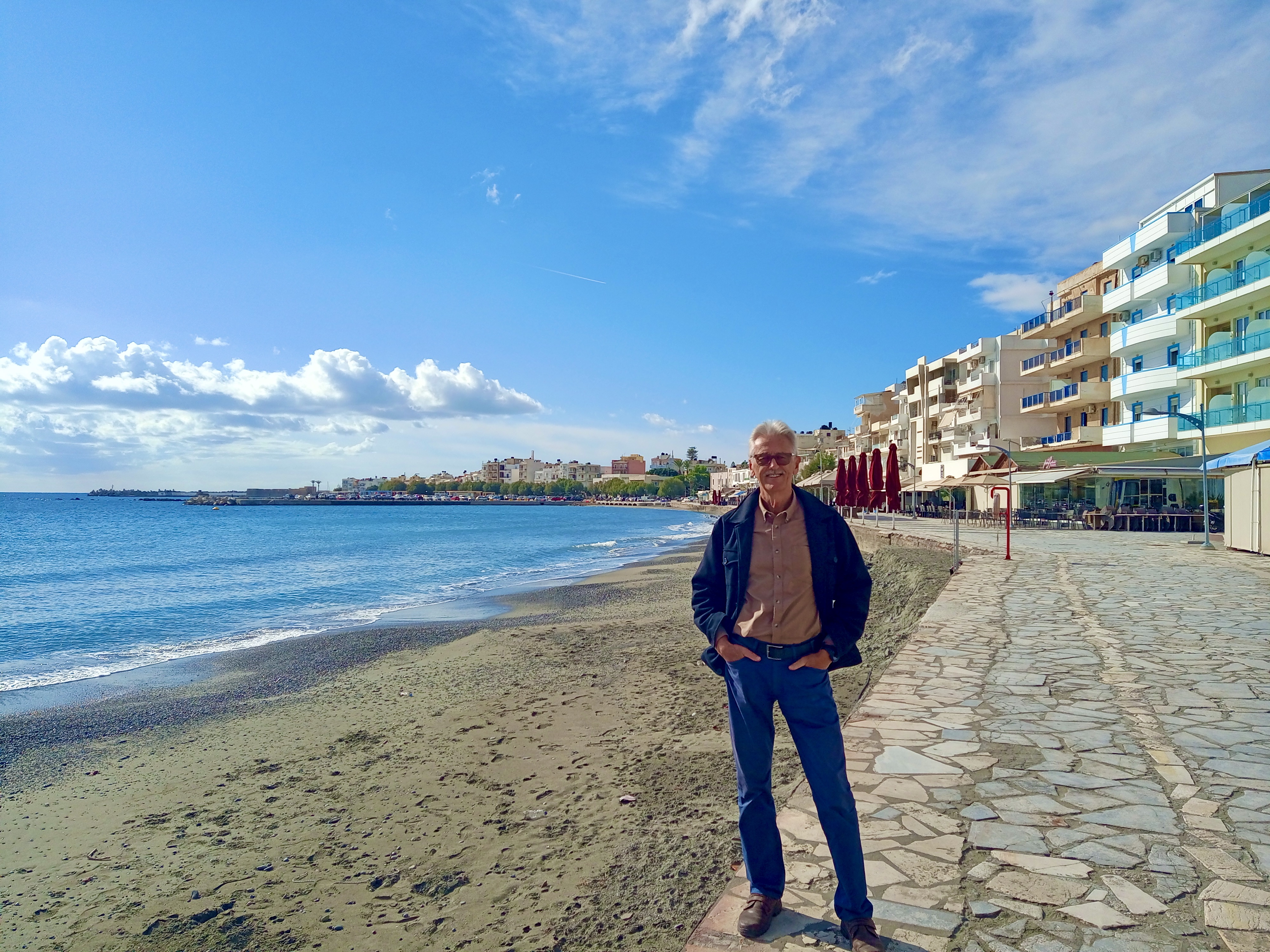
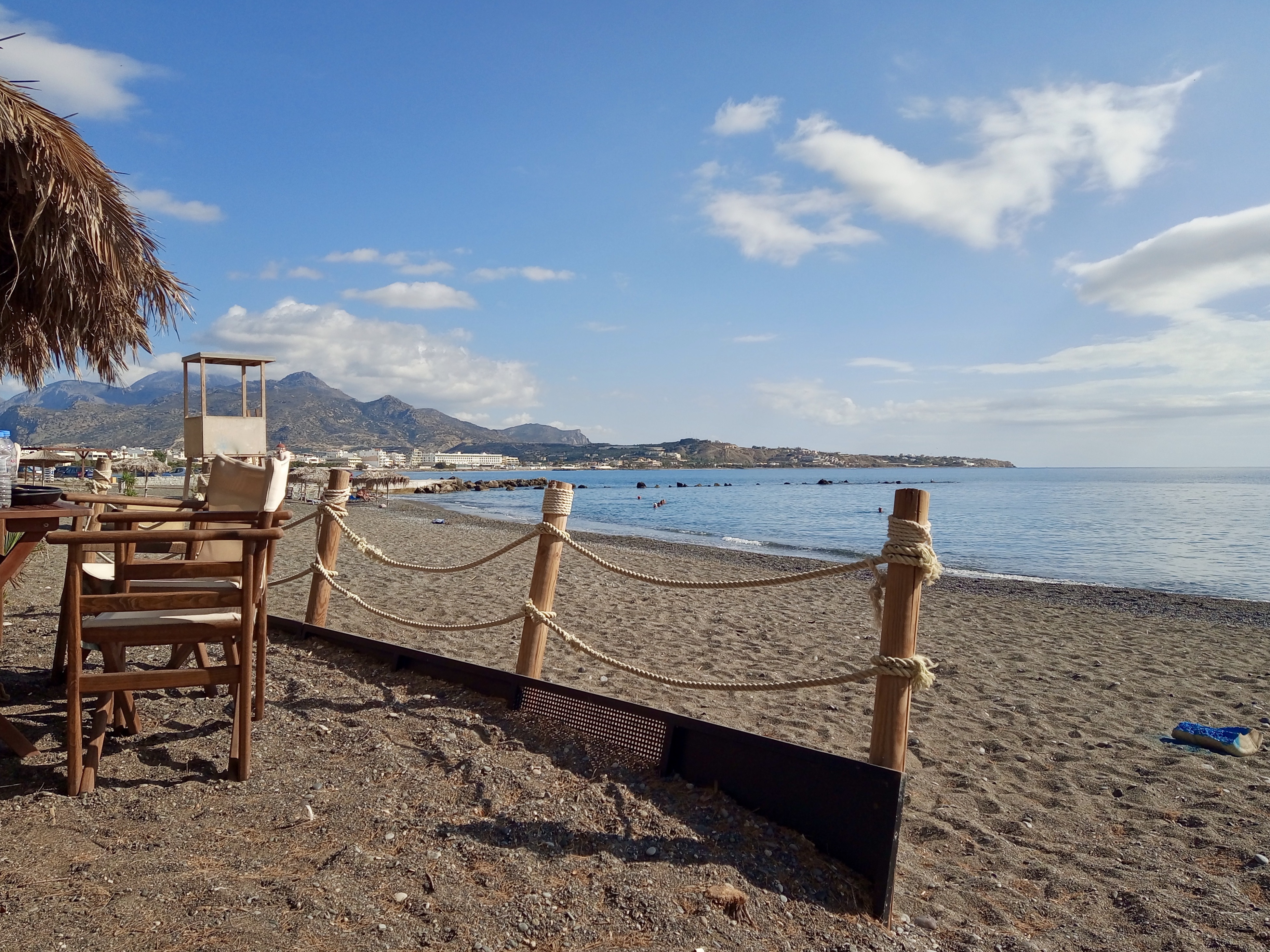
With one exception, the photos in the gallery at the top of this post were taken during a walk in the hills around the village a couple of days ago. The first one was taken on the beach in Ierapetra, but I guess that’s fairly self-evident. There are a couple more photos from that walk on the Facebook page, in case you wanted to take a look and haven’t already seen them.
You’ve probably noticed that my blog is a ‘Christmas free zone,’ right? I figured that there’s enough of that malarkey flooding the web right now that you don’t need me adding to it. I’m fully aware that my point of view is probably the exception, but I don’t really like Saturnalia much, to give the festival its more accurate title. It has about as much to do with Christ as a snowflake in August if you check the history books. Seems to me too that all the ‘festivals’ these days are getting bigger year on year. When I was a kid you never heard about Halloween, except to know what day it was. There will be those who disagree (and it’s everyone’s right, of course), but I believe that the ‘bigging up’ of Halloween began in the UK with the movie ET. Prior to that no one bothered with it. Back then it was much bigger in the USA than it was in Europe. Since then it’s become bigger every year, much to the delight of the commercial world, which, after all, is the major factor in the expanding of all the ‘celebrations,’ isn’t it?
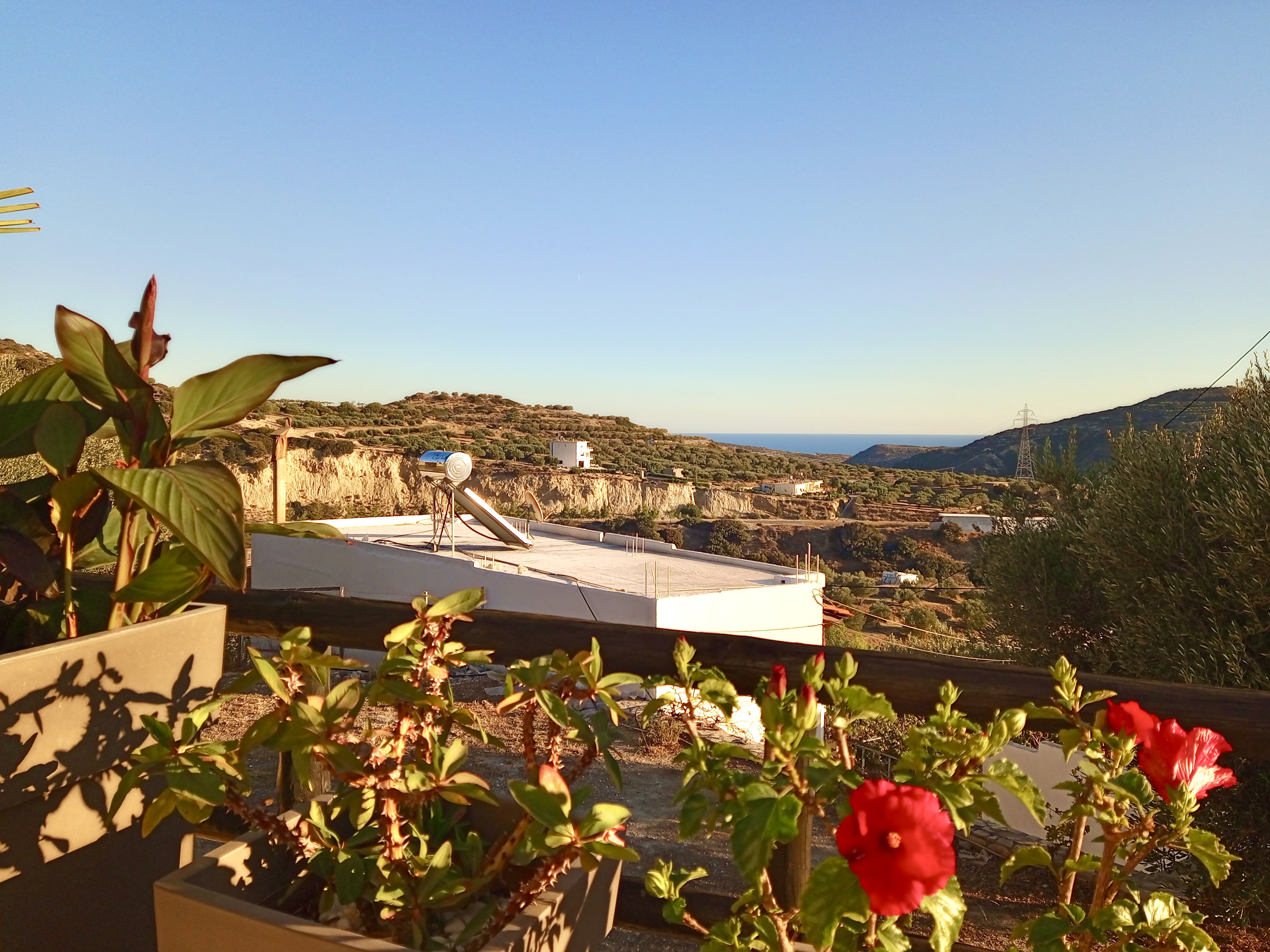
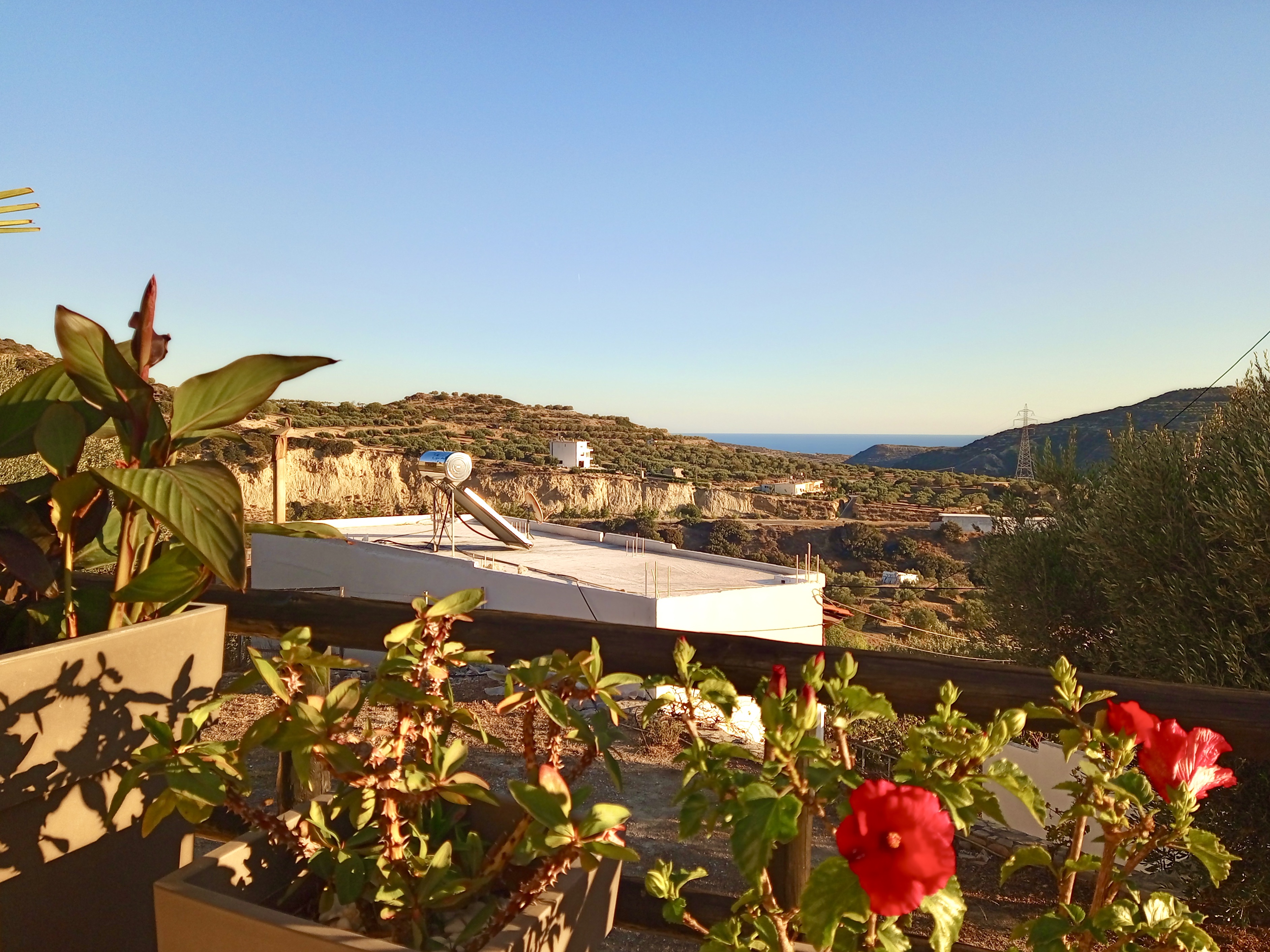
Here in our tiny village, life goes on very much the same all year round. Dimitri, who lives with his mum Maria in the house below ours, gets up at 6.00am every day of the year. December 25th will be no different. He farms for a living and is out of the house by 7.00am every day of his life. He has sheep, goats, ducks and chicken, plus arable crops too. Those things don’t pay much mind to what the date is, after all. Yesterday, as we inspected the flowers on our potted hibiscus plants on our terrace, he and Maria came walking up the hill below us. She had her arm through her son’s and looked decidedly frail. Most of the time she could pass for someone in her late forties, or maybe early fifties, but she is probably nearer to sixty, truth be told. But when we exchanged a few neighborly words with them, they told us that Maria had Covid – again. She’s had it, as has Dimitri, a few times already. Let’s face it, Covid-19 is with us for the long haul now, much like the flu or measles, and most people only suffer mild symptoms when they get it. Some though, they have it much worse, and it makes them feel very poorly. We wished her ‘perastika‘ as they went their way.
At this time of the year it’s a delight to rise at between 7.00am and 7.30am, as the light’s simply wonderful as the sun peeks over the hill to our left. I’m not going to pretend that they’re marvellous or anything, but I took the next bunch of shots all within ten minutes of each other while mooching around outside the house yesterday at around 7.00. to 7.15am –
•
Click HERE to go to my Amazon Author Page. There you can browse all of my written works.
The weather’s been rather typically winter-like this week. We finally had some real rain at last on Sunday, when it rained, occasionally heavily without becoming torrential, from late afternoon until not far short of midnight. Then, we woke up to bright clear skies on Monday and we’ve enjoyed crisp clear vivid days with the temperature just topping 20ºC ever since. The photos I’ll be posting below show just how lovely the light has been since the rains, which brought a smile not only to the farmers’ faces, but also to the plants in our garden.
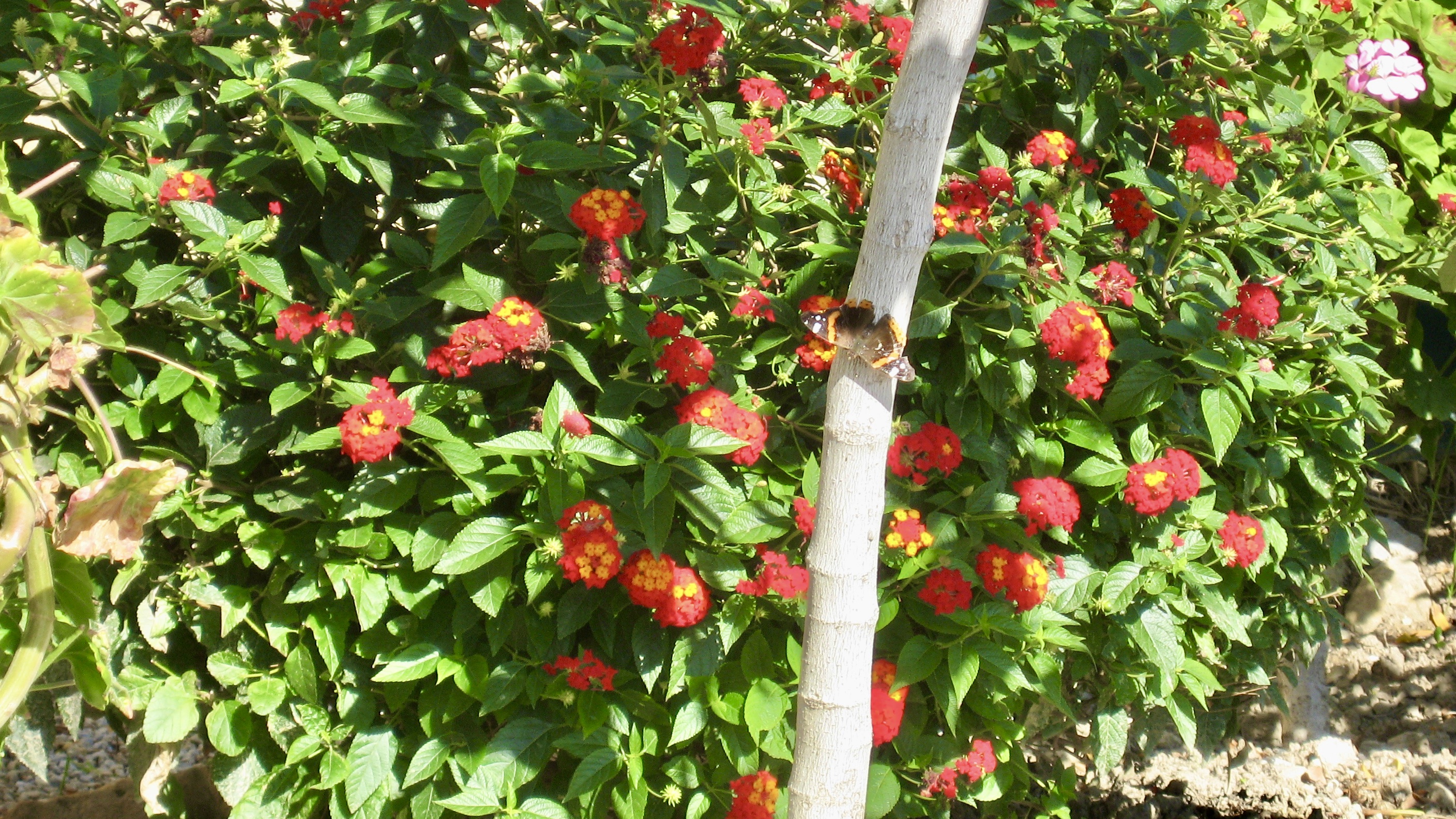
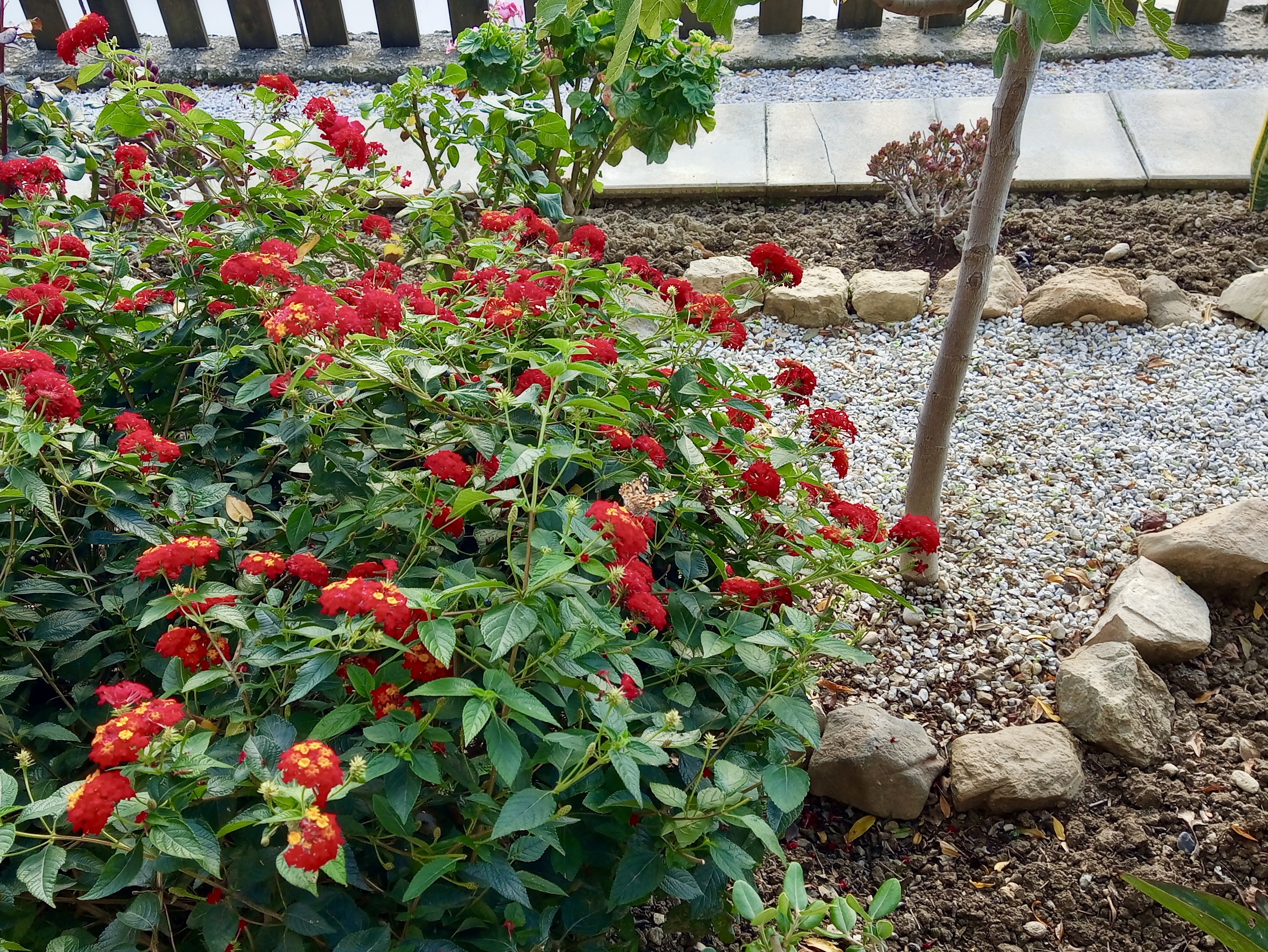
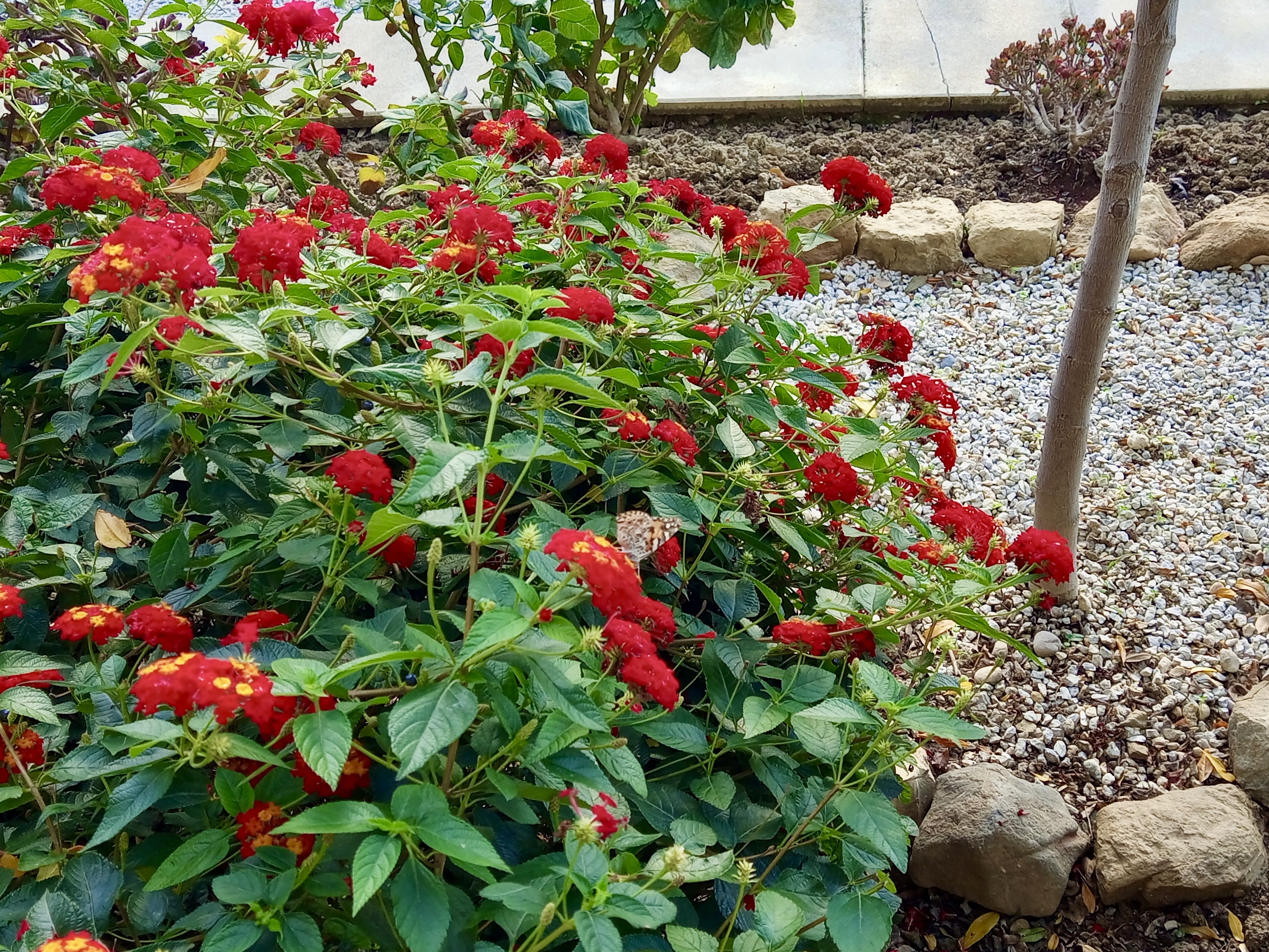
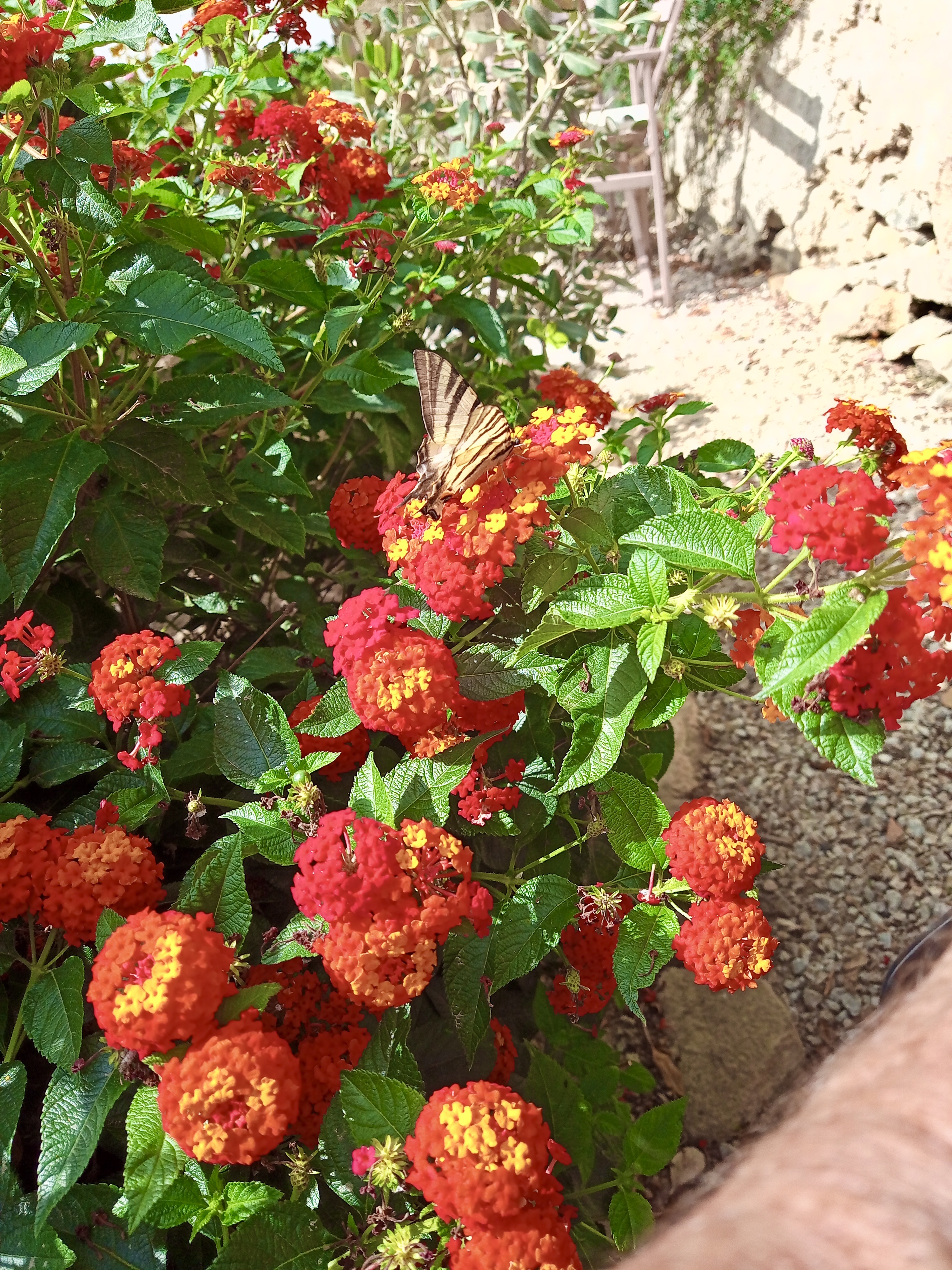
We had a swim just before the rains came, and it may well be the last one for a while, but we’ll see. Had we been in the town yesterday we may well have gone to the beach, as it was a beautifully warm and calm day, but we spent the day at home, pottering, which is something that brings us immense pleasure these days. The largest and most colourful of our lantana plants, as seen in a couple of photos in the previous post too, seems to be a butterfly magnet. This past few days the painted lady butterflies have still been all over it, and I’ve only just discovered, after doing a spot of research, that they actually migrate from Northern Europe to Africa at this time of the year, and make the return journey in springtime. They’re a bit like the poor relation of the magnificent and truly amazing Monarch of Continental America, in fact. How something so petite and delicate as a butterfly can make such an arduous journey is truly one of the marvels of the natural world. We theorised that these in the garden were taking some well-needed sustenance as they sucked the nectar from the bright scarlet flowers, before setting off across the Libyan Sea southwards.
As we stretched out on our sun loungers yesterday at around 11.30am to drink our coffees in what proved to be scorching hot sunshine ( took my togs off, I was that hot! Sorry ladies, too much information), we again saw the buzzards that live in the valley immediately below the village. OK, so further up the mountainside, in the towering crags above the village, we are fortunate enough to have a thriving colony of Griffon Vultures, which soar hundreds of feet higher than the buzzards, but a buzzard at close quarters is still an impressive bird, and the few that live with us soar on motionless wings above the steep ravine into which drops the hillside on which we sit as you get further down the ever-steepening slope, and they float by only fifty feet from our terrace at eye height or even lower. As they passed and re-passed our vantage point we could make out the individual feathers on their wings and backs as they glinted in the sunlight. Seeing such a big and powerful predator, or raptor, at such close quarters can stop you in your tracks, and I was soon using the bins to get an even closer look.
Last evening we went for a 45 minute walk up the lane towards Meseleri just before sunset. Some of the photos below (and the one at the top of this post) were taken during that walk. After a cloudless day we marvelled at the cumulus gathering over the hills bordering the Lasithi Plateau, which are clearly visible twenty kilometres or so across the valley to the west of us. The late afternoon sun’s rays streamed through them to give us a tableau that would have inspired Turner to put paint to canvas, although no artist could do as good a job as the Great One, really.
That last one’s not very clear, owing to the fact that my phone’s zoom is rubbish, but that’s a buzzard sitting on the post in the middle distance. He looked a lot closer to the naked eye! On our way back we passed Angla’i’a’s door, which was wide open behind her flyscreen. As you pass, it’s difficult to make anything out in the darkness beyond that screen door, and so we didn’t know whether she was about or not. We ought to have known better though, because when is she anywhere other than in her kitchen?
I called out a “kalispera!” just in case as we passed, and received an immediate response.
From within came the familiar sound of Angla’i’a’s voice as she replied, “And where have you two been, eh? Don’t pass by! Wait there!” We duly obeyed and stopped walking and seconds later she emerged from the screen door, wiping her hands with a dishcloth as she did so. “I thought you two had died, we haven’t seen you for so long. Why haven’t you dropped by, eh?”
“Oh” replied Yvonne, “what with you being Mayor and all, we don’t want to add to your already busy schedule. Anyway, we just seem to drop into a torporific routine at this time of the year, what with…”
“Not any more I’m not. They voted me out,” she replied, with a very distinct air of disappointment in her voice. The elections had taken place a month or more ago, and we’d kind of assumed that she’d be re-elected as a matter of course. We asked her, “So, who’s mayor now then?”
She replied with a name, and we couldn’t place the man, so she described him and then we knew who she meant. “It’s the fat bloke on the moped from up behind there,” she said as she pointed behind the house to further up in the village. “I’m still in the job until February, but then I step down and he takes over. Won’t get anything done though, you mark my words. Anyway, come on in and I’ll fix you both a coffee.”
On this occasion we declined, as we were due to go out later in the evening, but we promised to pass by sometime soon. As we turned to go, there was her 87 year-old hubby Giorgos crossing the road from his horafi, plastic bag full of freshly picked mandarins in one hand as the other one gripped the metal hand rail so that he could hobble up the stone steps to the level of the house. Once he reached the top, and we greeted him, she told him, “Give the children some of those, Giorgo!” That, in itself, is highly amusing, for she is only a couple of years my senior, and I passed seventy this past month.
Amid our vain protests that Giorgos may be a bit miffed at having laboured beneath the tree to pick them all, she grabbed the bag, opened it and began shoving the bright orange fruit three at a time into our hands. She didn’t stop until we’d filled the pockets of our fleeces too.
There’s absolutely no way you can resist such pressing kindness. As we again bade them good evening, Giorgo’s face seeming to us to bear signs of mixed feelings between his desire also to be kind to us, and the fact that he may have had other plans for his modest little harvest, we turned to see Maria from the house below ours busily sweeping up fallen leaves in the lane. Just then as our little group reached five in number, who should come coasting down the hill past our house on his moped but the newly elected mayor. We all bade him a good evening, and he returned the greeting, I can’t help thinking with a degree of smugness at seeing his predecessor in our company. Yes, we knew him by sight, but not on first-name terms. He is a little gruff by nature, giving insecure people the impression that he doesn’t like them, but I think (hopefully) that it’s just his way.
As I type this, it’s now the crack of dawn on Thursday December 14th, and I’ve just chopped up the fruit that we’ll be eating on top of our muesli for breakfast later, which gave me the opportunity to sample one of those mandarins. A lot of the ones produced in people’s gardens locally, although tasty, are also quite full of ‘pips,’ which can make eating them slightly tiresome. If the one I sampled is anything to go by, these are seedless and as sweet as sweet can be.
Turned out to have been a good idea to take that pre-sunset walk.
Above: How about a nice little round of ‘spot the cat’ then?
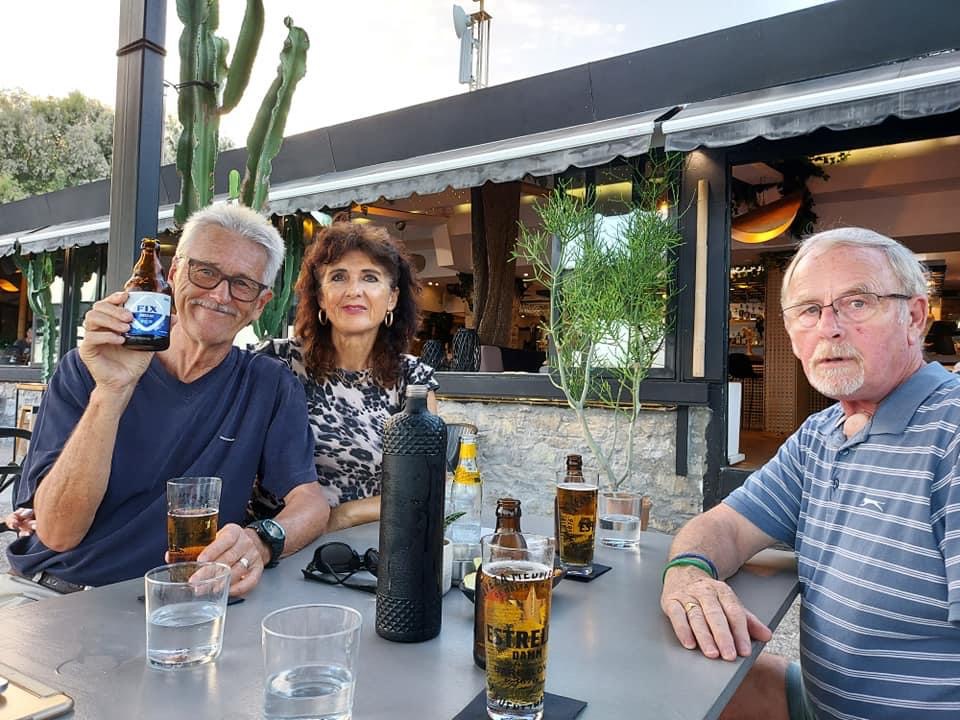
Finally, two blasts from the past, the first below was taken on Patmos in May 2019, and the second at the Waikiki Coffee Bar in Ierapetra on 28th September 2020. The person on the right is my sister’s hubby Martin.
•
Click HERE to go to my Amazon Author Page. There you can browse all of my written works.
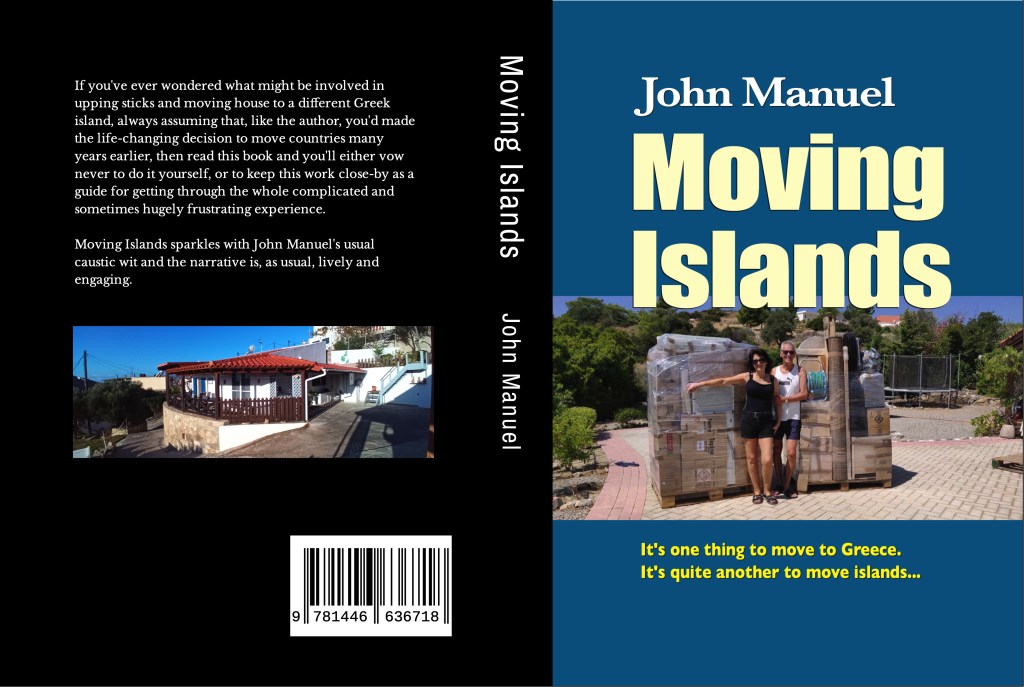
The new autobiographical memoir ‘Moving Islands’ is now ‘wrapped,’ in that the Kindle version’s on sale through Amazon and the paperback’s artwork, editing and proofing is now well under way. My part in the whole thing is done and dusted. Above is an image of the full cover, front and back, of the forthcoming paperback. If you click on it you’ll go straight to the Amazon page, if you’re happy to buy the Kindle version now. When it becomes available some time in the new year, the paperback will be on the same link, of course.
The work on the book is ‘a wrap’ but there was also a need for a different kind of wrap when we went out this morning. It’s the first cold day of this winter, with the midday temperature having been a very cool 15ºC, which won’t last, as it’s due to warm up again from tomorrow, but today’s conditions, with very British-looking cloudy skies, meant that we didn’t order iced coffees, but rather hot filter coffee, and we sat with a few friends indoors, a rare occurrence, even in winter.
As I type this at around 5.15 pm, it’s raining outside and so I thought I’d just post a bunch of photos from the past week or ten days to cheer myself up, as well as you! To be fair though, we love the rain and it’s really much needed after a very dry autumn so far. It actually makes it cozy to sit indoors with a hot drink, the heating on low and read and write in peace and quiet. The day before yesterday, the lantana in the upper garden was teeming with Painted Lady butterflies, and yesterday we treated ourselves to a new plant for one of the the corners up there, the kind that one might call ‘architectural.’ Its Greek name is Strelitsia Nicolai, and it’s in the Bird of Paradise family, although this one doesn’t flower, but is an evergreen and grows up to two metres tall. It looks a lot like a banana too, I think. If you click the link above you’ll see an image on that website, although the one we bought is much fuller and more developed than that. It took a bit of doing to get it into the car, I can tell you.
Anyway, to the photos…
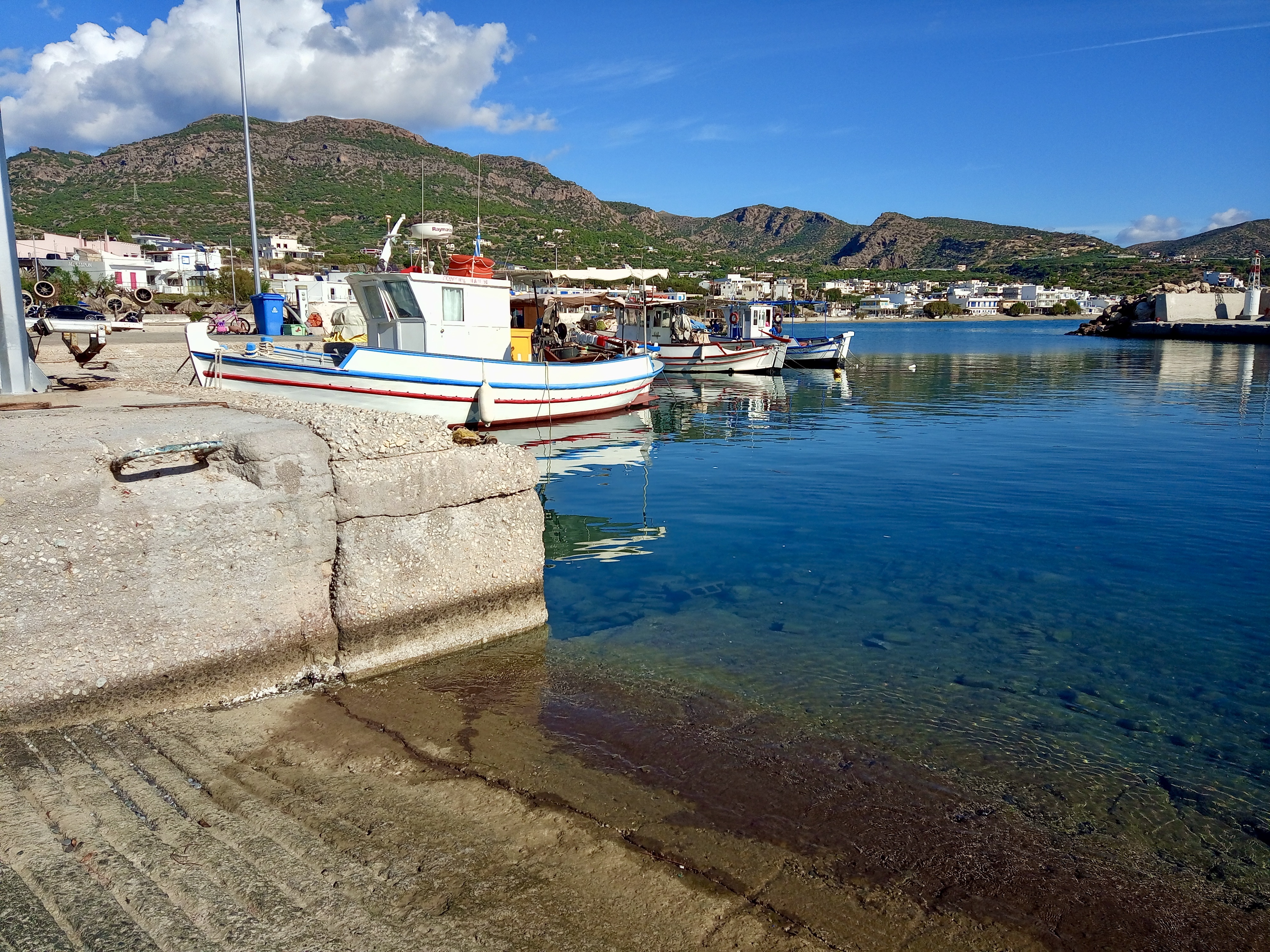
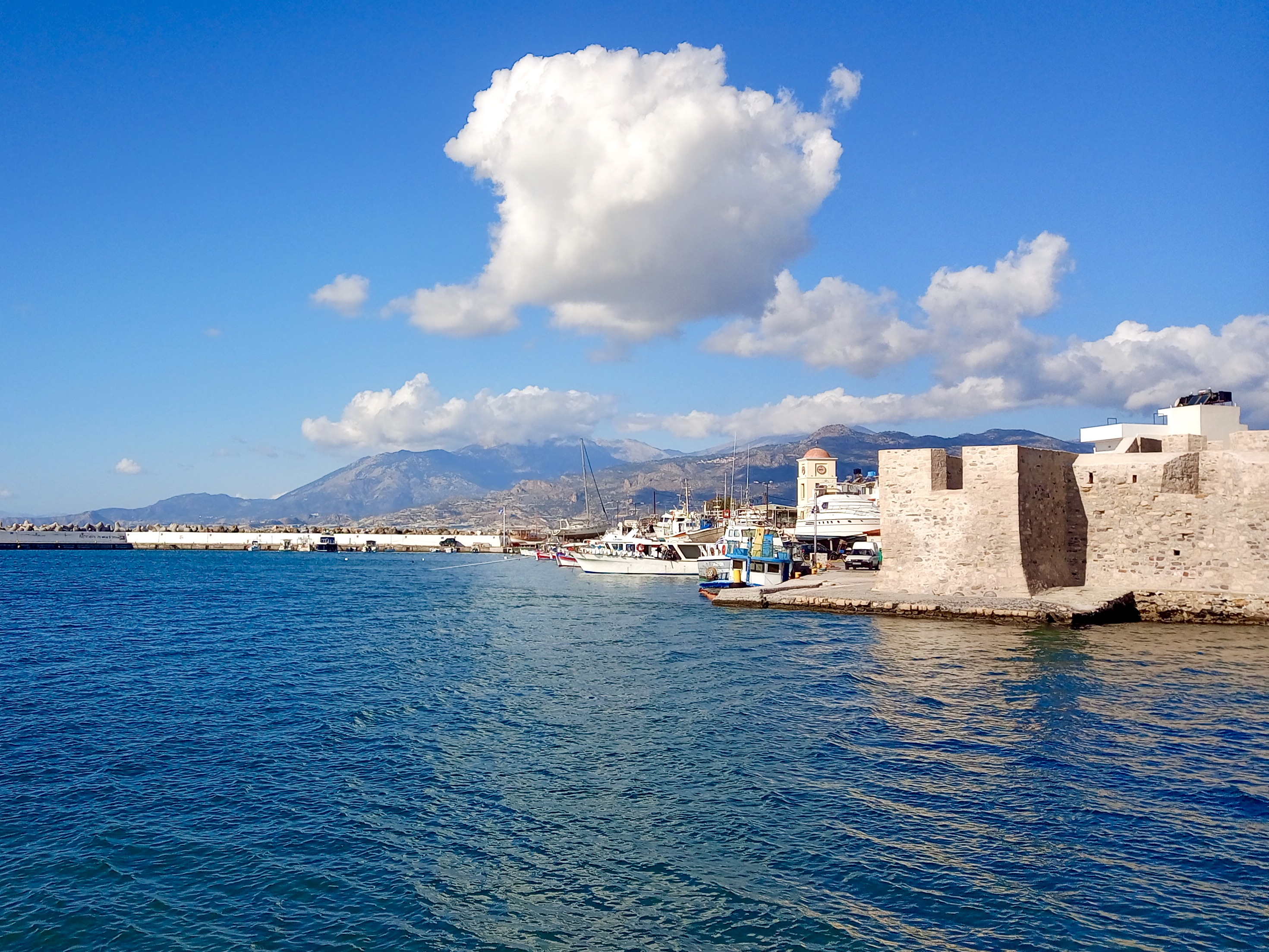
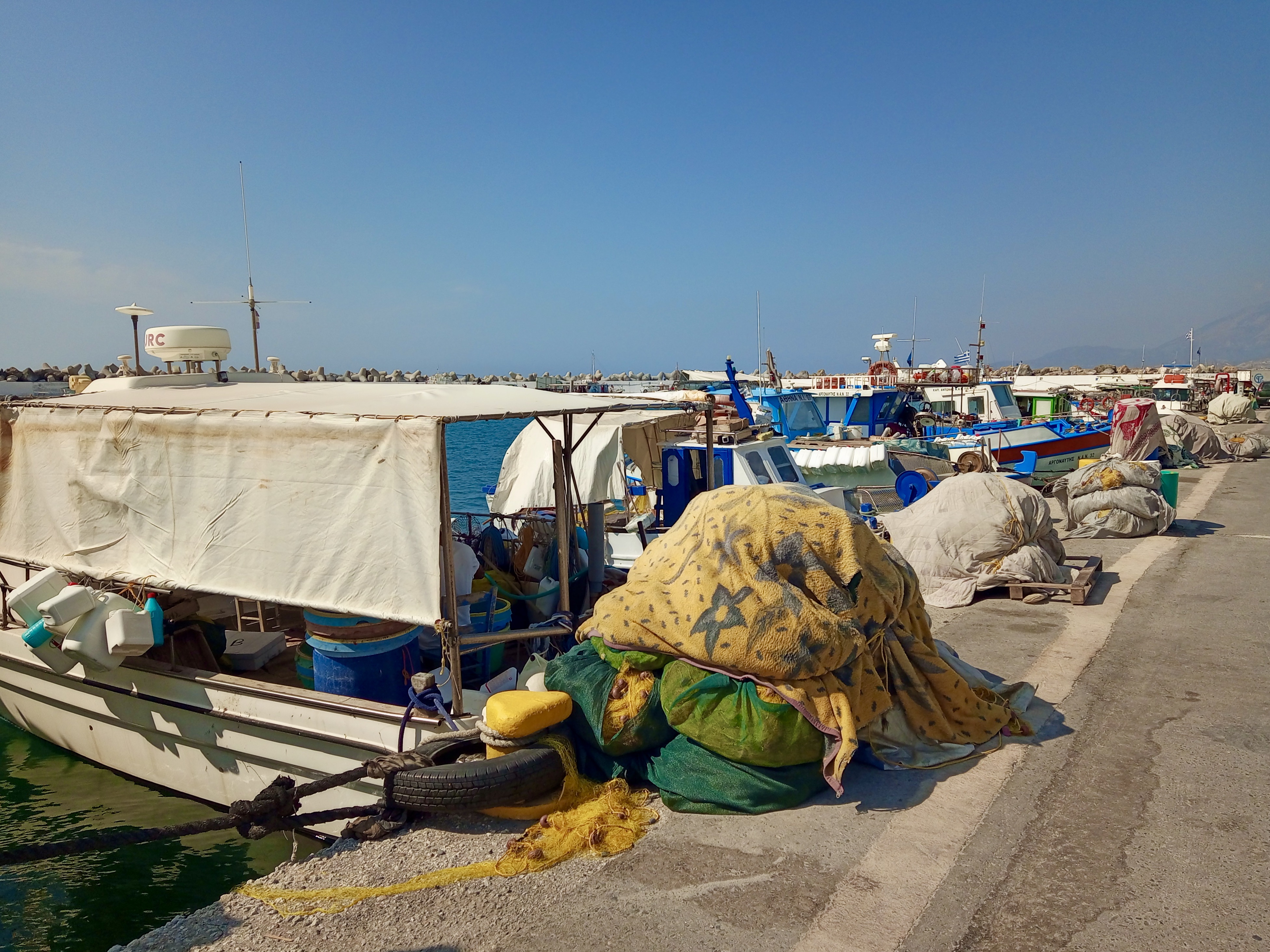
That lot above were taken in and around the harbour on Tuesday December 5th at around 10.30-11.00am. Yvonne was actually taking a swim while I wandered off to shoot these.
Above, the lantana I was talking about, although that’s a swallowtail from October 26th.
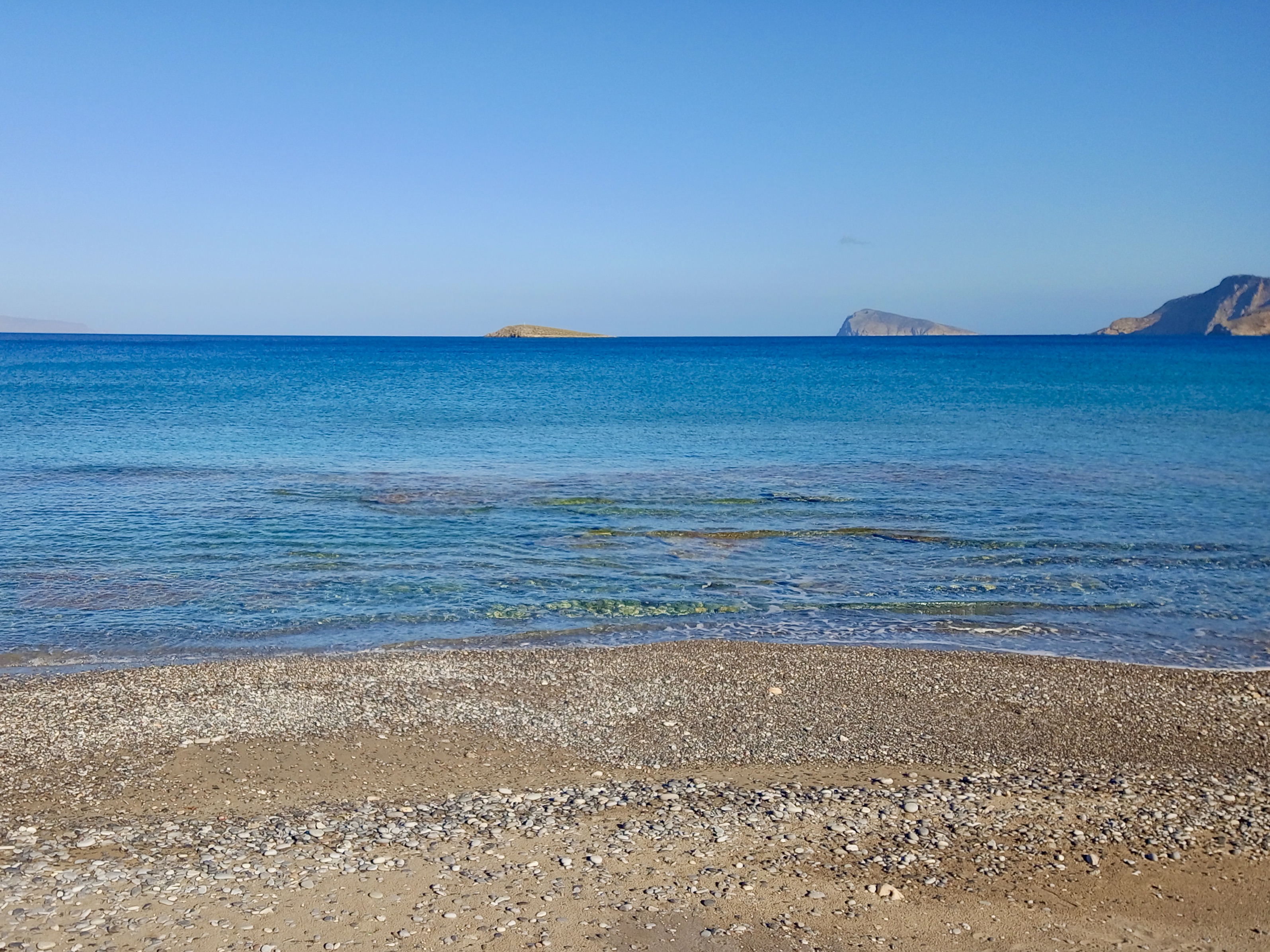
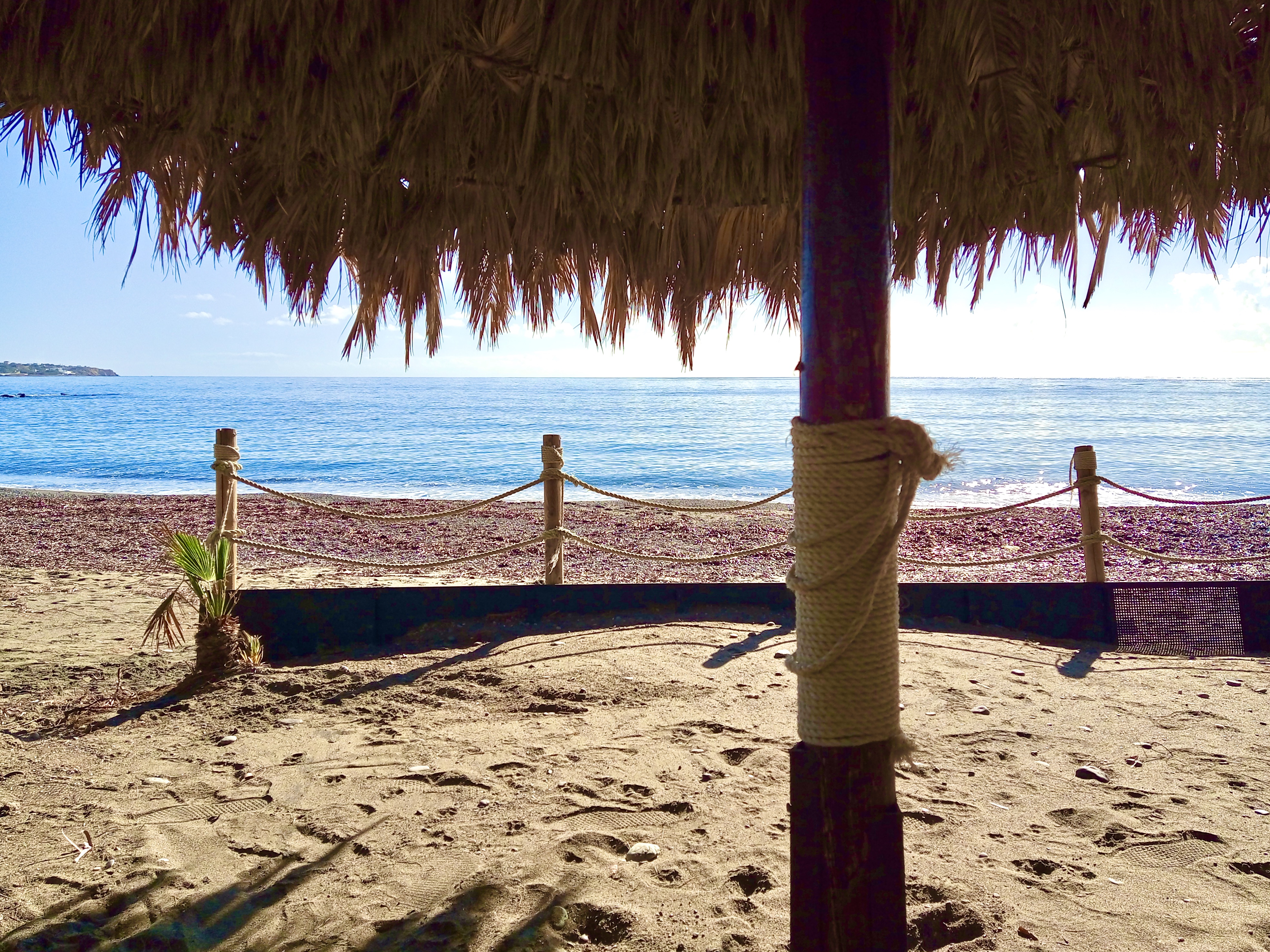
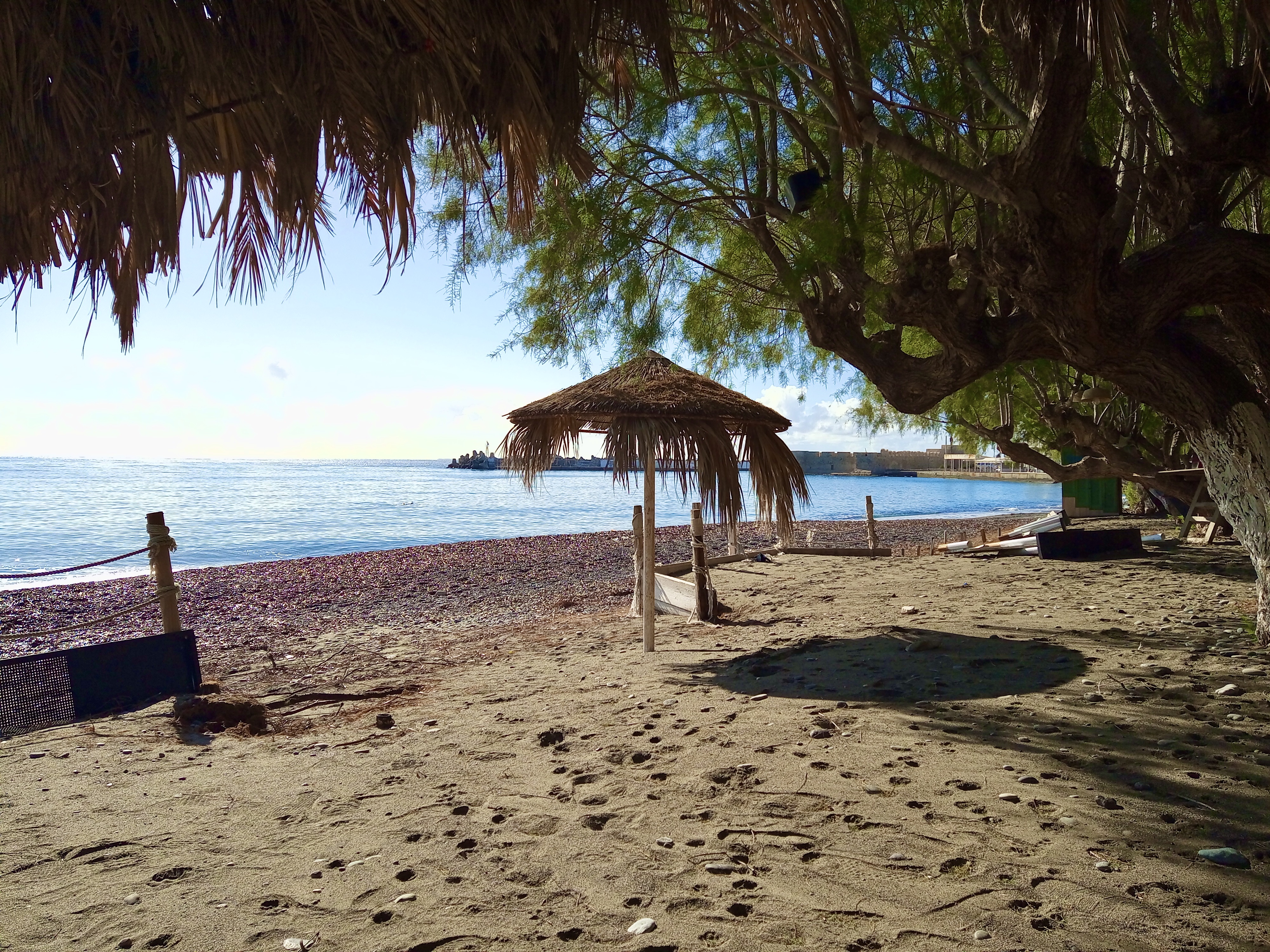
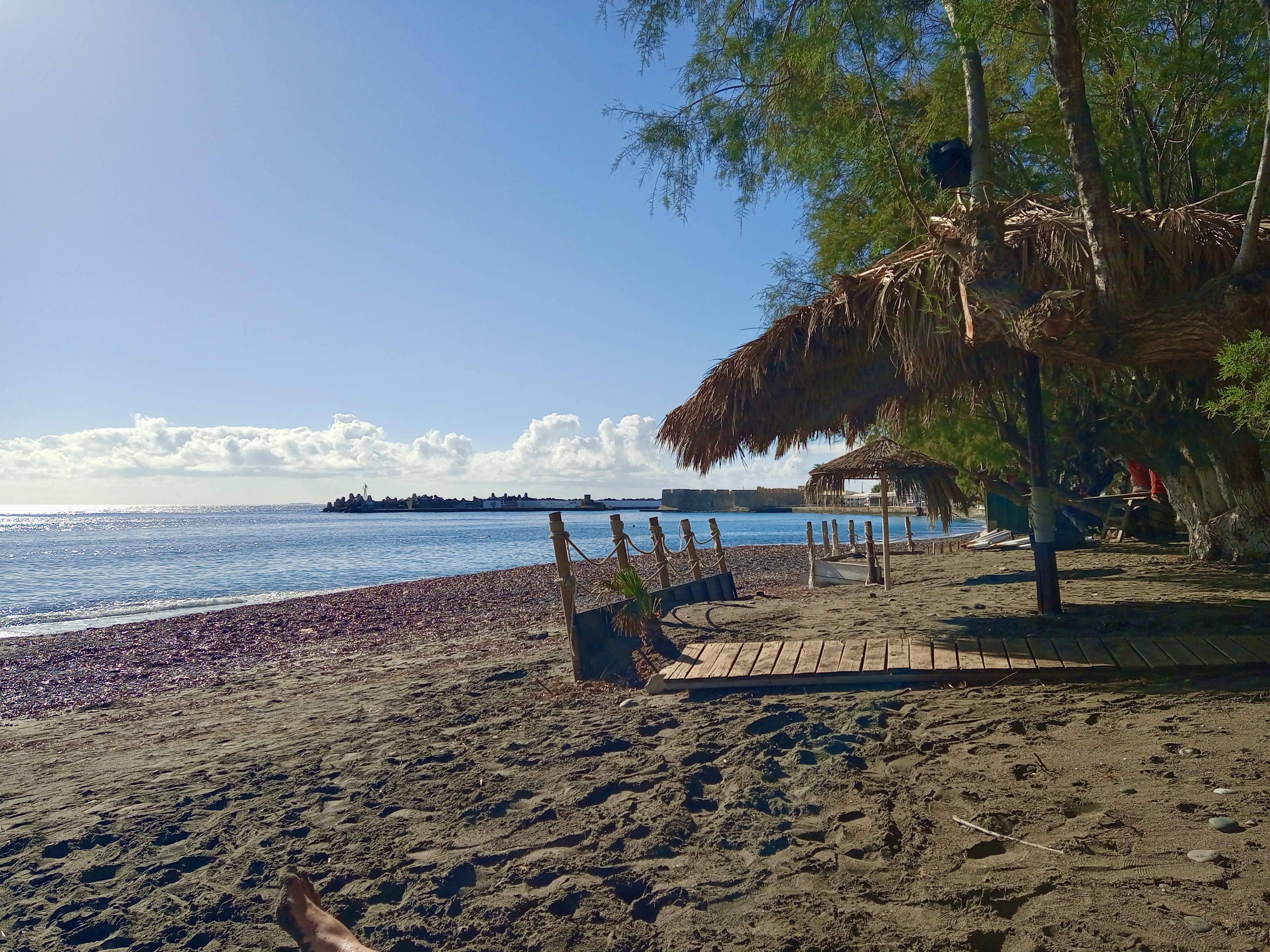
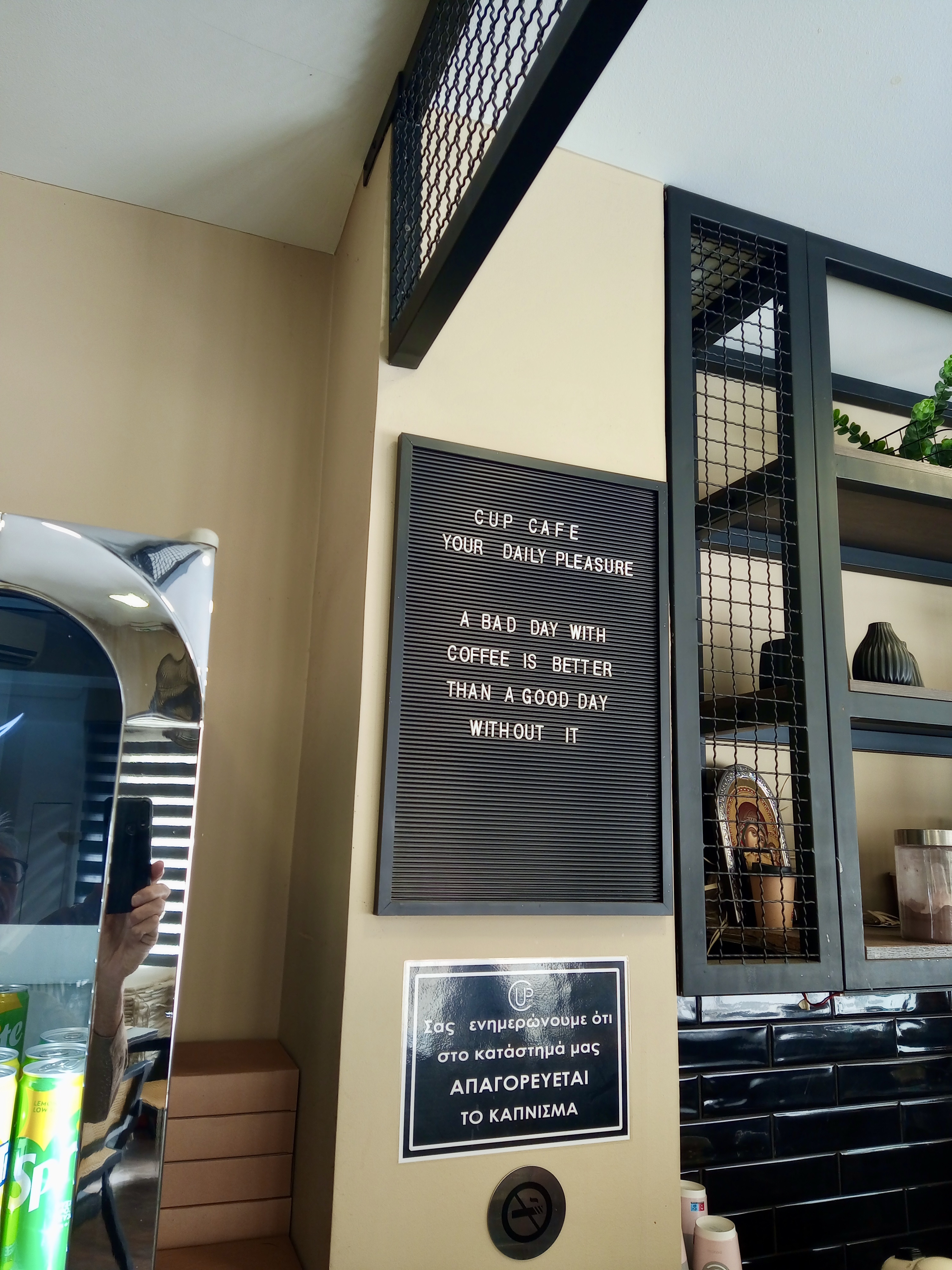
Above, how the town beach looks now. I rather like it, looks like a desert island from some angles, doesn’t it? Below is a sign that’s on the wall in one of our favourite coffee shops in the town, one that’s actually in a small square and not on the waterfront. It’s the Cup Café, and I agree with the sentiment. I’m not so impressed with the selection of photos on their Facebook page. I’ll take some myself some time and post them here.
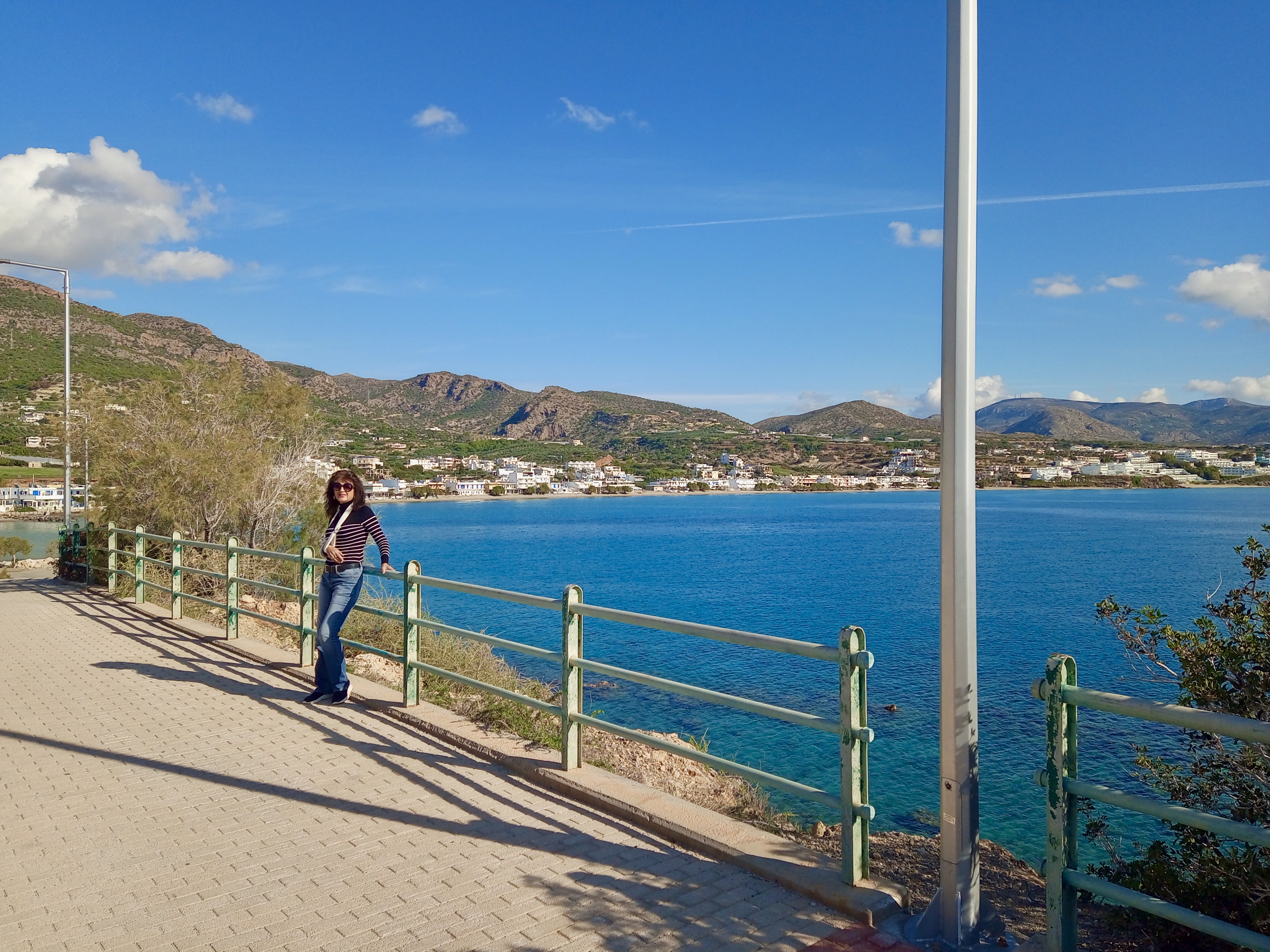
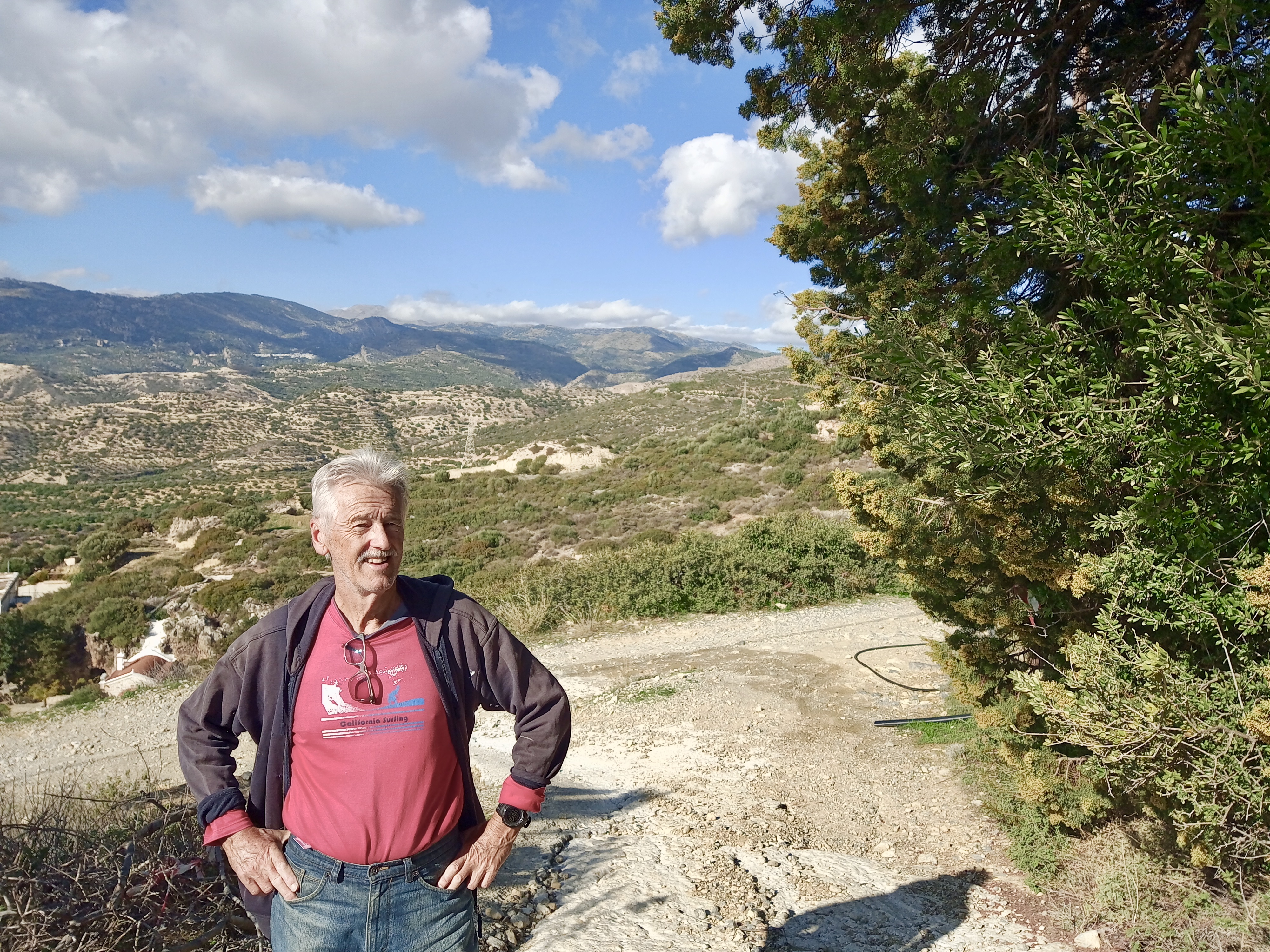
Finally, here’s me folks, on the seafront yesterday at around midday…
•
Click HERE to go to my Amazon Author Page. There you can browse all of my written works.
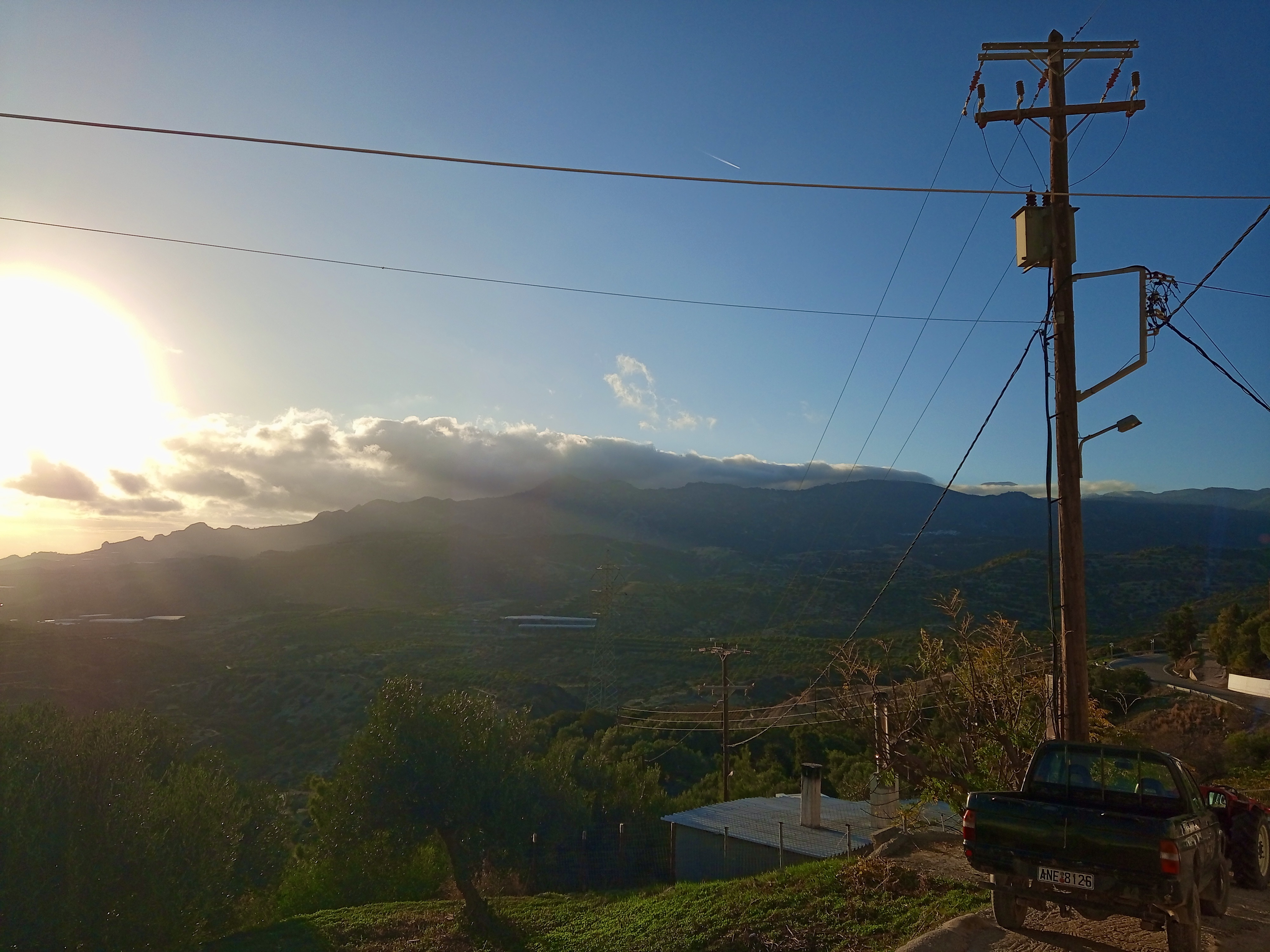
The above image shows our village to the right, and in the distance the surrounding hills of the Lasithi Plateau, which for the first time this winter began exhibiting clouds that signalled the approach of the changeable weather that accompanies the winter months. If you can make out the pylon just left of centre, then to its left is the village of Kalamafka, quite a bit higher in altitude than our village and thus far more often under, or even in, the clouds while we’re still enjoying sunshine. That photo was taken on Wednesday November 22nd, and it kind of marks the approach of the winter, finally, after having delayed itself by some weeks this year. In fact the whole year seems to have been like that. The summer arrived late, after a very strange and unusually cool and sometimes rainy June. But then, the rains that usually begin in October didn’t come until this past few days, and not before the locals had begun complaining, justifiably, that the citrus fruit and olive harvests were going to suffer as a result.
Another photo that I took minutes later just a few metres further along the road, and looking more to the left, around the mountain behind which lies the manmade lake that serves as a water reservoir for the Gra Ligia farmers and village, is this one…
I rather liked the shafts on sunlight creeping around the hill from the coast, nice eh? We’ve finally had some half-decent periods of rain lately and the garden’s looking much brighter as a result. Plants like our chrysanthemums and roses, which just about tolerate with disgust the hot summers here, show by their reaction that this is much more to their liking. Here below are some shots from the past week showing how clear and bright the atmosphere’s been when it’s been sunny, and such days are those ‘glad to be alive’ days when you just feel like getting outside and doing stuff. We have done too, and we’ve now pruned the two ancient olive trees in the lower garden for starters. I’ve been up in those trees wielding my chainsaw like a newly elected Argentinian president, so I have…
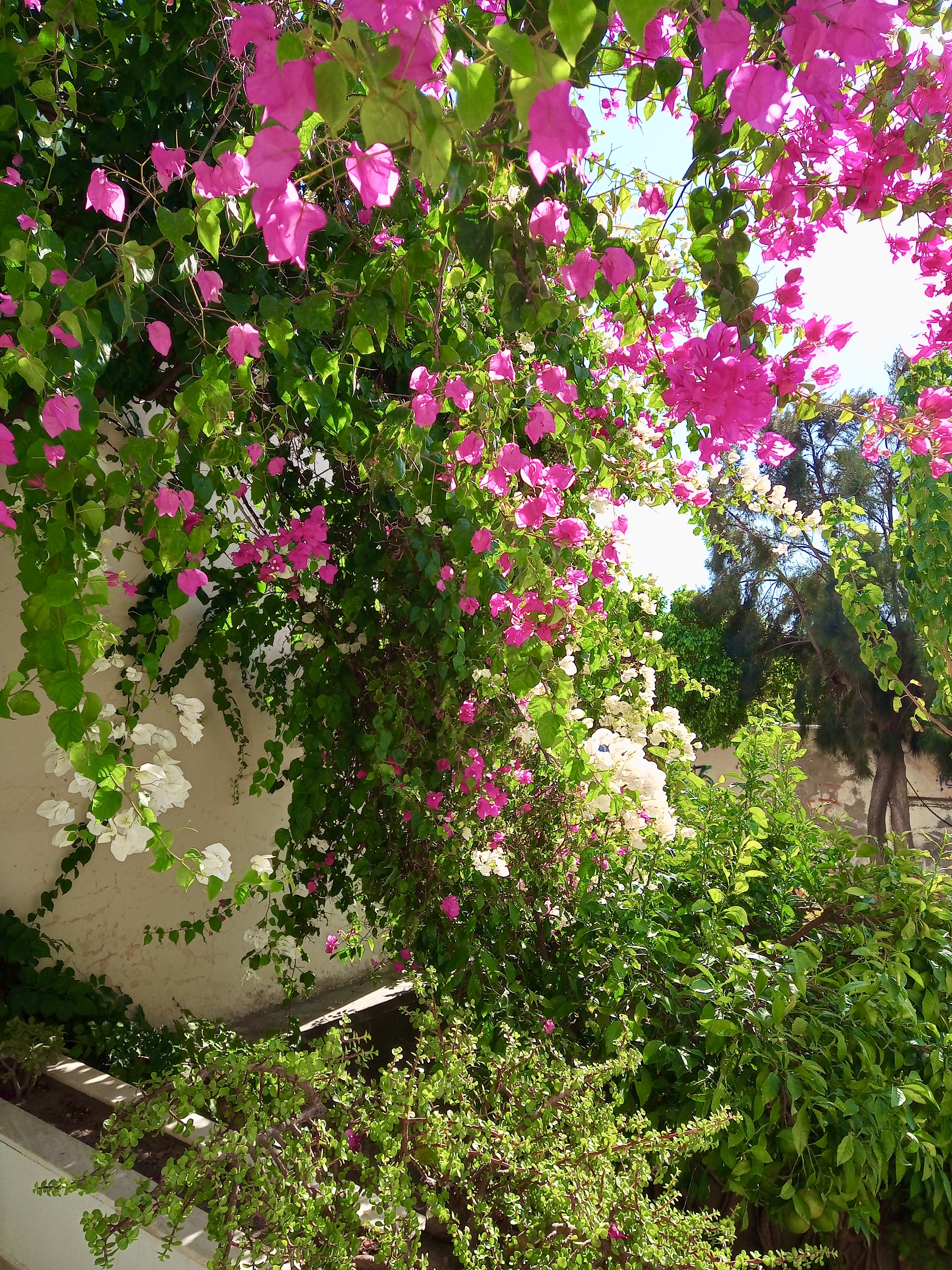
That last photo in the above gallery was taken in someone’s garden. I was just so enthralled by the wonderful variety of colour and texture of the plants that grow here and become vibrant after a little rain.
During one of the last occasions a couple of weeks ago when we drank iced coffees on the beach and took a swim, I was reminded of a story that Kostas, a retired gentleman with whom we’d often chat while on the beach this year (he was a constant presence in the mornings, as he’d do the same: drink a coffee, take a swim, then get on with his day) told us. As it happened, there was someone on the beach nearby with a rather tetchy child that we agreed needed a bit of old fashioned discipline. It reminded Kostas of something that he’d overheard a few days before. The sea was just a little ‘lumpy,’ without being too choppy, but Kostas said he’d overheard a mother shouting at her kid, who was trying to defy his mother by going into the sea alone. He was probably only about five or six and therefore needed to wait until his mum was ready to accompany him, so that she could keep him safe. He was having none of it, though, and kept threatening to go in alone, whereupon his mother shouted for all to hear, “Mano, if you go and get yourself drowned I’ll kill you!“
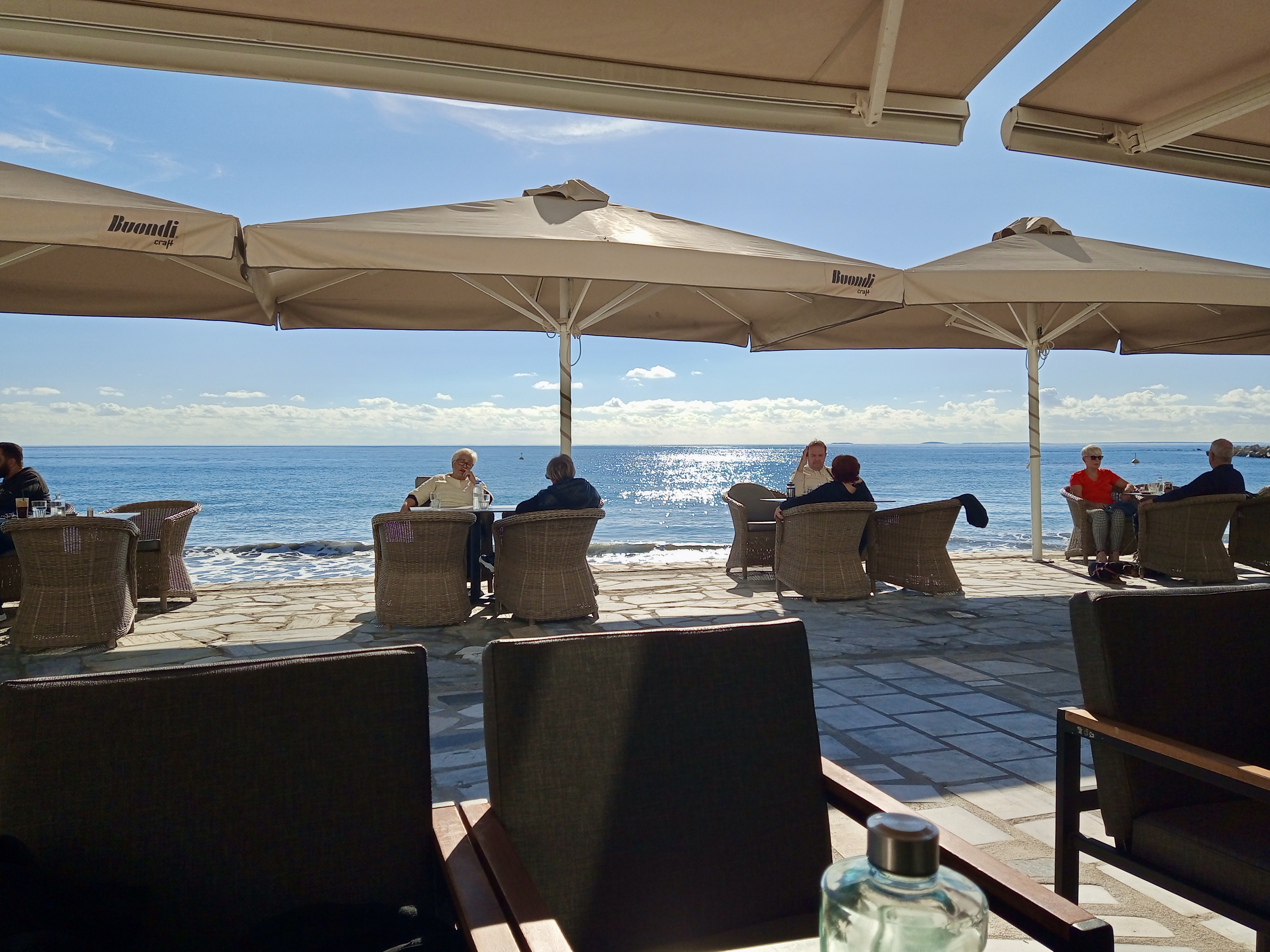
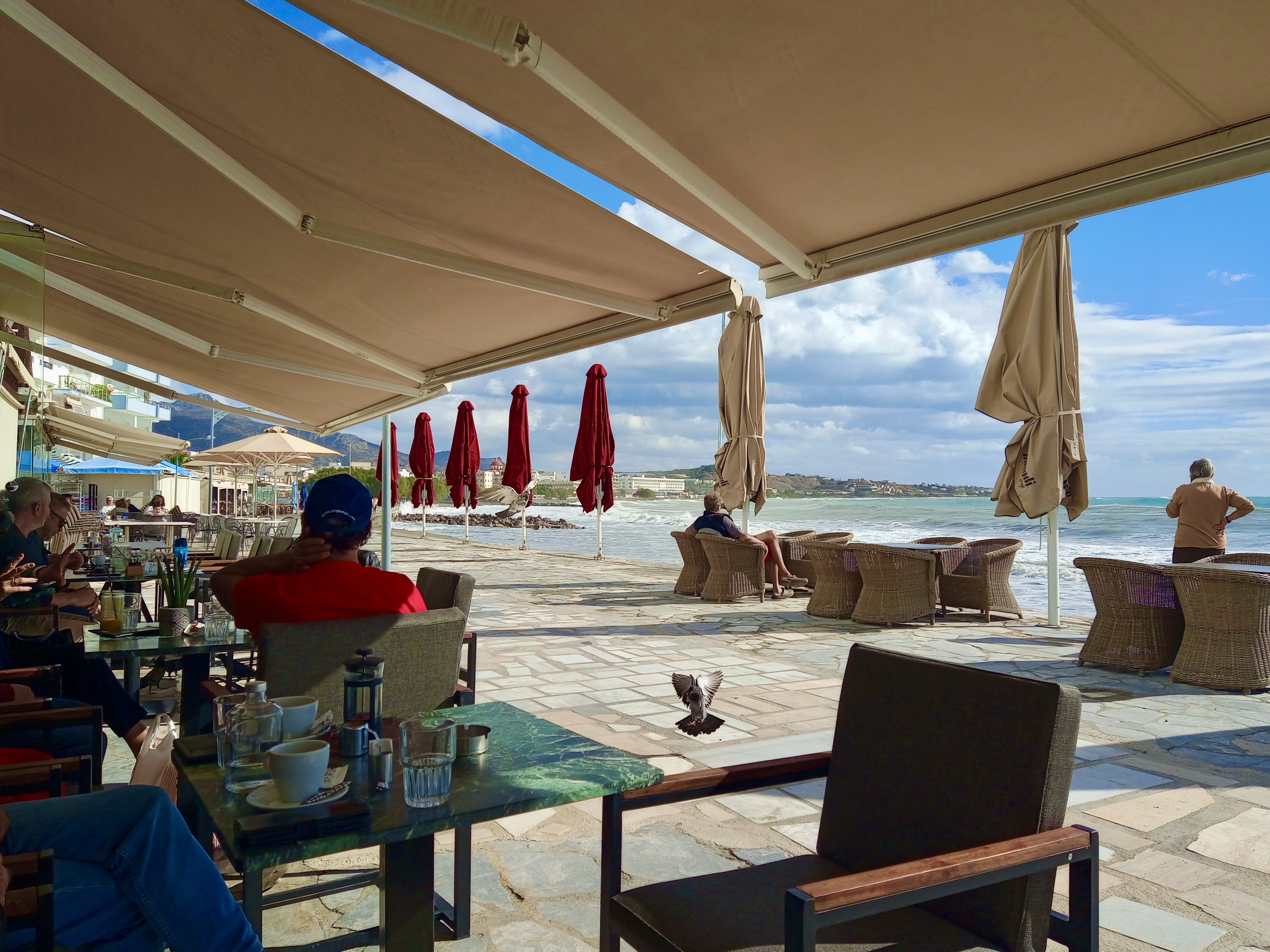
Last Sunday was a brilliantly fresh, clear and windy day. For a change the wind was in the south-south east, which direction it blows from very rarely. We went for a coffee at the Plaz Café on the promenade. The sea was ‘up,’ as they say, and had already removed the rather pointless artificial beach that the local council had installed with a few hundred tons of sand recently, in a vain attempt to stop the sea from further eroding the structure of the promenade. While we sat there enjoying what one used to call ‘the ozone,’ I took these…
Note the pigeon coming in to land in the middle shot. I didn’t even notice it while I took the picture, but if you zoom in on him you can see the rather elegant design of his wings as he uses them to slow his descent before alighting on the stone promenade. The best shots are sometimes the accidental ones. A sea like this may cause the café owners a little bother and make them have to dry out their seat cushions, but boy is it wonderful to witness. And finally, I also took this very brief video…
•
Click HERE to go to my Amazon Author Page. There you can browse all of my written works.
Well, it looked like the winter had arrived yesterday, with the temperature plummeting ten degrees C over the previous day, and for the first time since last spring not reaching 20º even at around midday. We also had some much needed rain, although still nothing like the amount we need, or usually receive, at this time of the year. Today, though, has been gorgeous, with 23ºC registering on the veranda, and we two busy hacking away at our two ancient olive trees in the lower garden.
It’s been very much photo-taking weather of late, including even yesterday for much of the time. So I’m going to make this post photo-heavy, but first, a lovely observation as we were sipping our coffees on the terrace at around midday. As we lay there on the sun loungers, to our right, across the lane and bordering on Evangelia’s chicken run, there’s an abandoned house. Nothing unusual there then, for a Greek village these days, sadly. The roof of that house, as you’d expect, is flat. I say ‘flat’ but, as it’s not been lived in for many a year, the whole thing, which is a crumbling cement-screed over a concrete superstructure, is very noticeably concave in the middle. Since there was at least some rain during the past 48 hours, there is now a lake, maybe a couple of metres across, on that roof. While we sipped our coffees, a flock of sparrows was enjoying some leisurely ‘bathtime’ antics, and it was a pure joy to watch.
I know, you’ve probably seen it yourself too, but with the hot sun beating down on the sail stretched above our heads, the sky not exhibiting even a postage stamp of cloud, those birds put on a lovely show for ten minutes or so, before something freaked them and they all flew off together. While they were there, though, it was so enjoyable to watch as they’d hop into the water and then begin flapping their wings for all they were worth to get the water all over their tiny little bodies. Then they’d stop momentarily, before doing it again until they were satisfied, at which point they’d hop to the edge, onto dry cement, and flap again, much like a dog does it seemed to me, to throw off any excess moisture that was surplus to requirements.
Meanwhile, in the olive tree beside us a warbler landed and chattered about for a while, no doubt consuming the odd insect or two before zooming off over the fence behind our heads. What really thrilled us though, and scenes like this have us constantly expressing thanks for being able to live where we do, was that level with our eyes and not more than thirty metres beyond the balustrade bordering the terrace, a buzzard was soaring, so close that you could easily see its eyes and the subtle colours of its wing feathers. They often soar within sight of the veranda, but this one today must have been interested in something in the olive grove below us to come so close, as it flew past us several times during the course of ten or fifteen minutes or so. I remember many years ago listening to a nature programme on the BBC (Radio 4 I think) where the presenter was talking to an expert on birds of prey. He said that if you have a healthy buzzard population (and we have griffon vultures too here) then the ecosystem is probably pretty healthy. He said this was due to the fact that the buzzard is at the top of the aerial food chain as a rule, meaning that for there to be buzzards there must also be a good population of other small birds and also earthbound rodents and mammals that serve as food for them.
This is encouraging because it’s a fact that a few kilometres below us, and thankfully behind a couple of modest mountains which obscure them from view, are the huge thermokipia (plastic, covered hothouses) that are used to cultivate fruit and vegetables on a grand scale in this area. Many of the farmers do use artificial fertilizers and pest control inside those massive structures, and this worries us sometimes. Up here though, just a few kilometres further up the mountainside, large birds of prey abound, and they treat us to a spectacular show of aerobatics quite frequently.
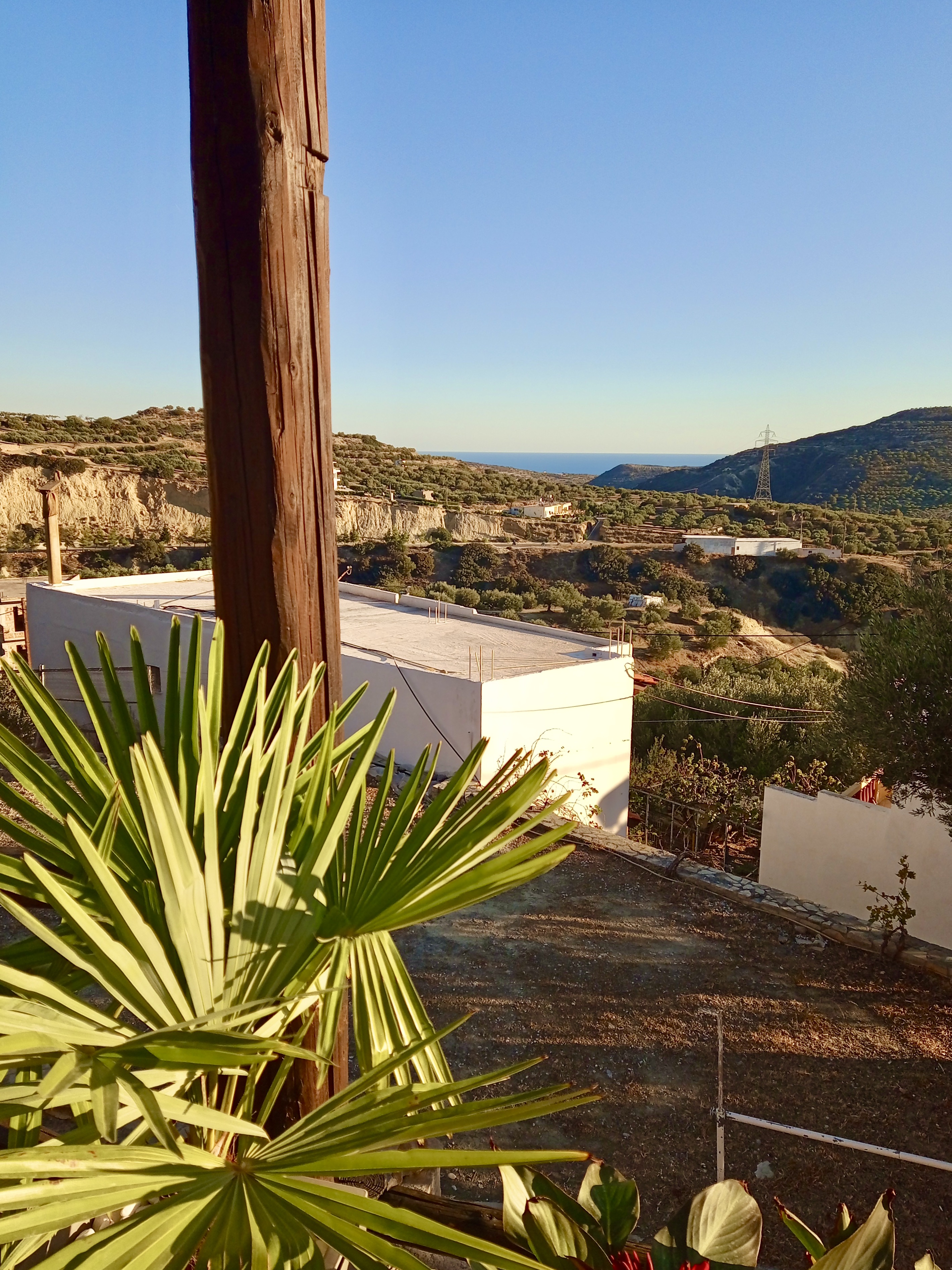
While we drank our coffees too, we remarked on the low humidity today, making the sea far below us very crystal clear and the horizon really sharp. So, I took these just a couple of hours ago…
Here are a few more from the past few days in and around the house and village…
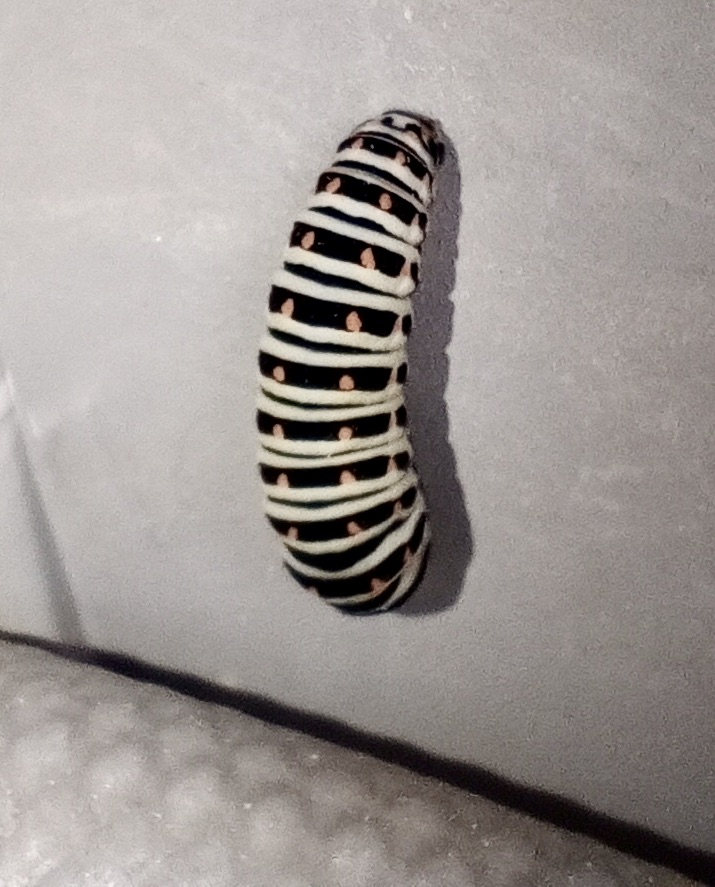
That final one above is of a butterfly larvae that I found attached to our wall-mounted hose reel, and I didn’t have the heart to knock it off. It’s about an inch and a half long. It looks like it’s the caterpillar of the swallowtail butterfly (by all means correct me if I’m wrong), which is the very one I snapped on the lantana in the same photo gallery above. Maybe once it’s been through its chrysalis stage and emerged as an adult I’ll be able to spot it and say, “that one lives because of me!”
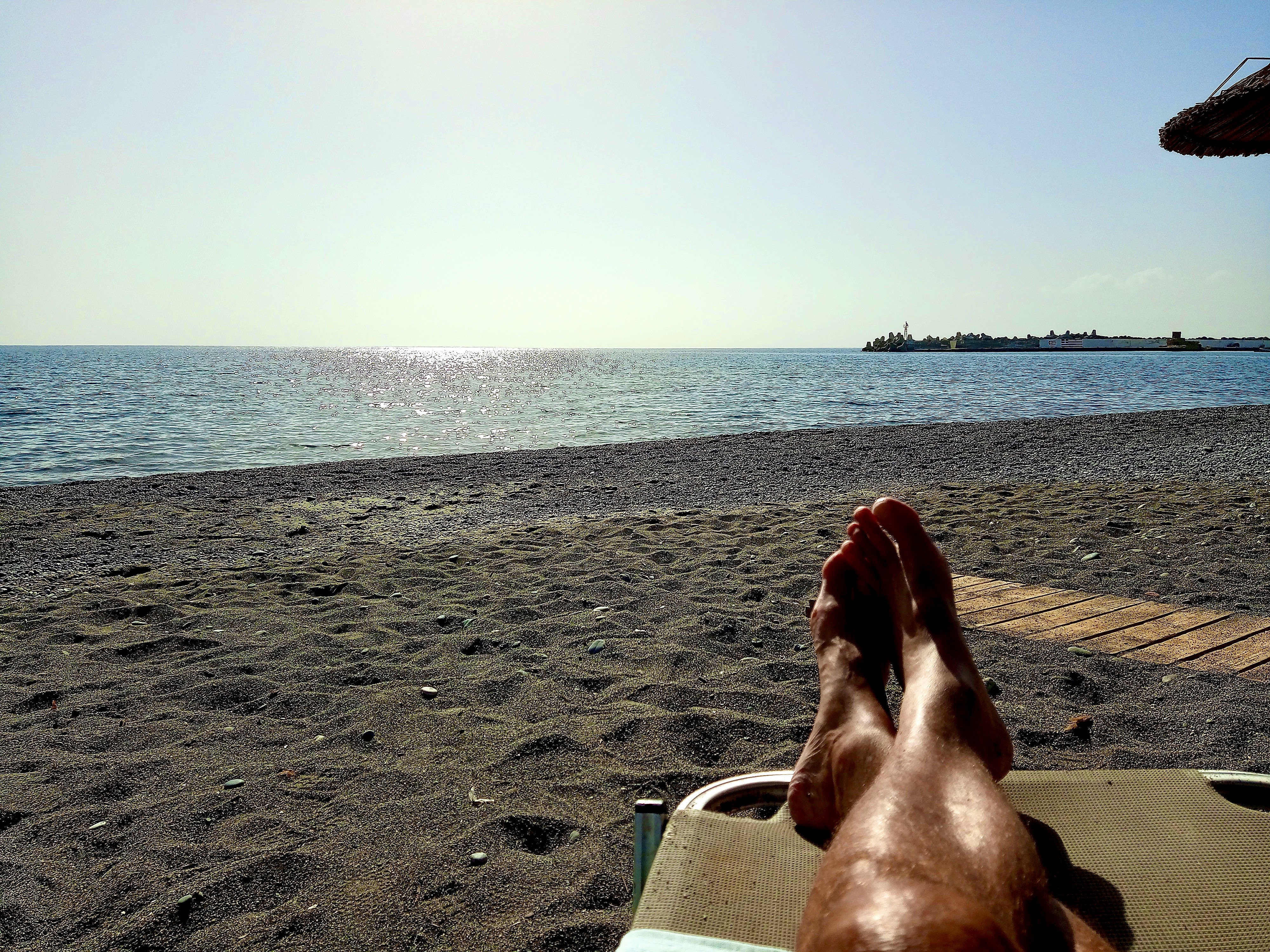
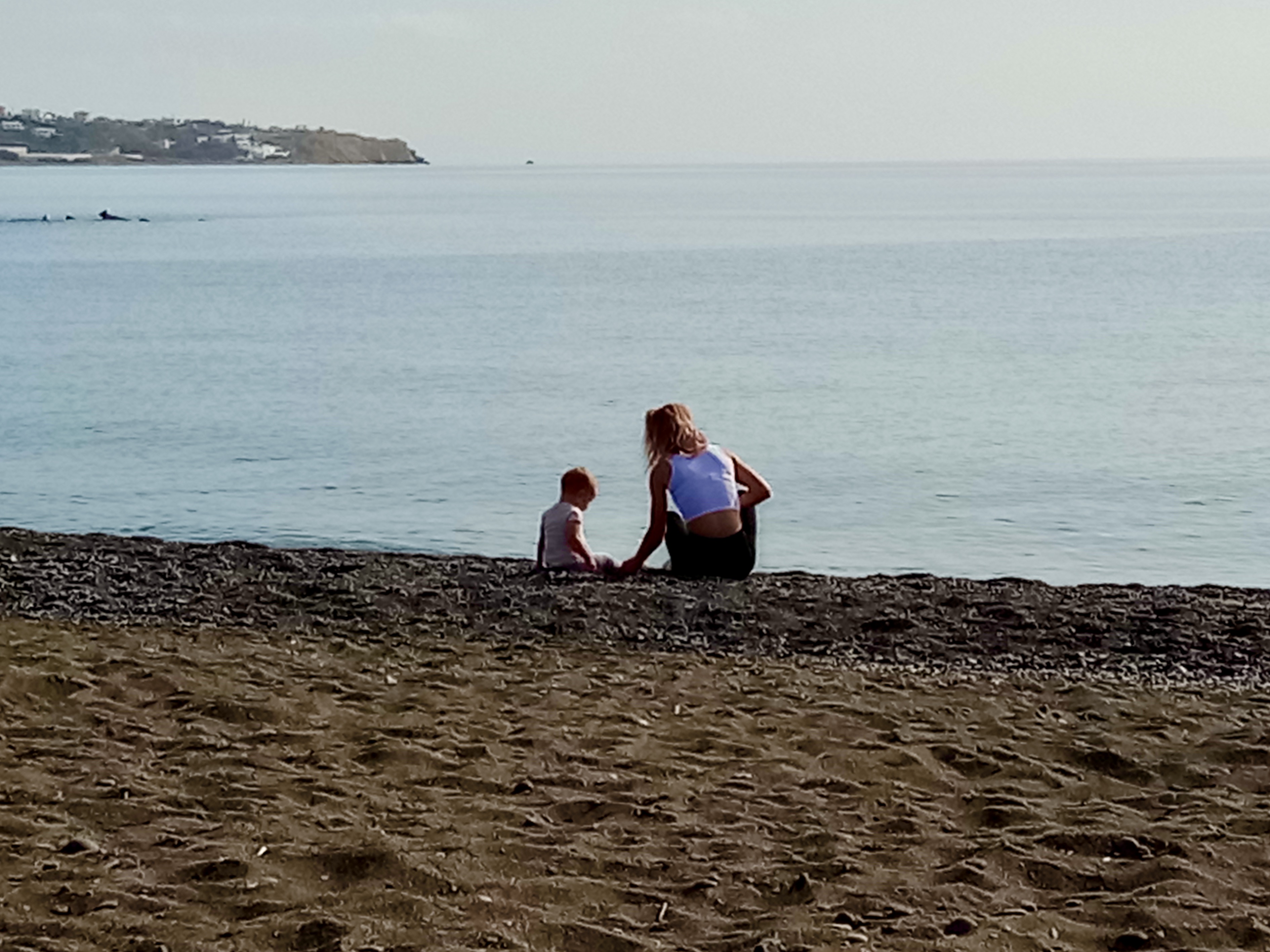
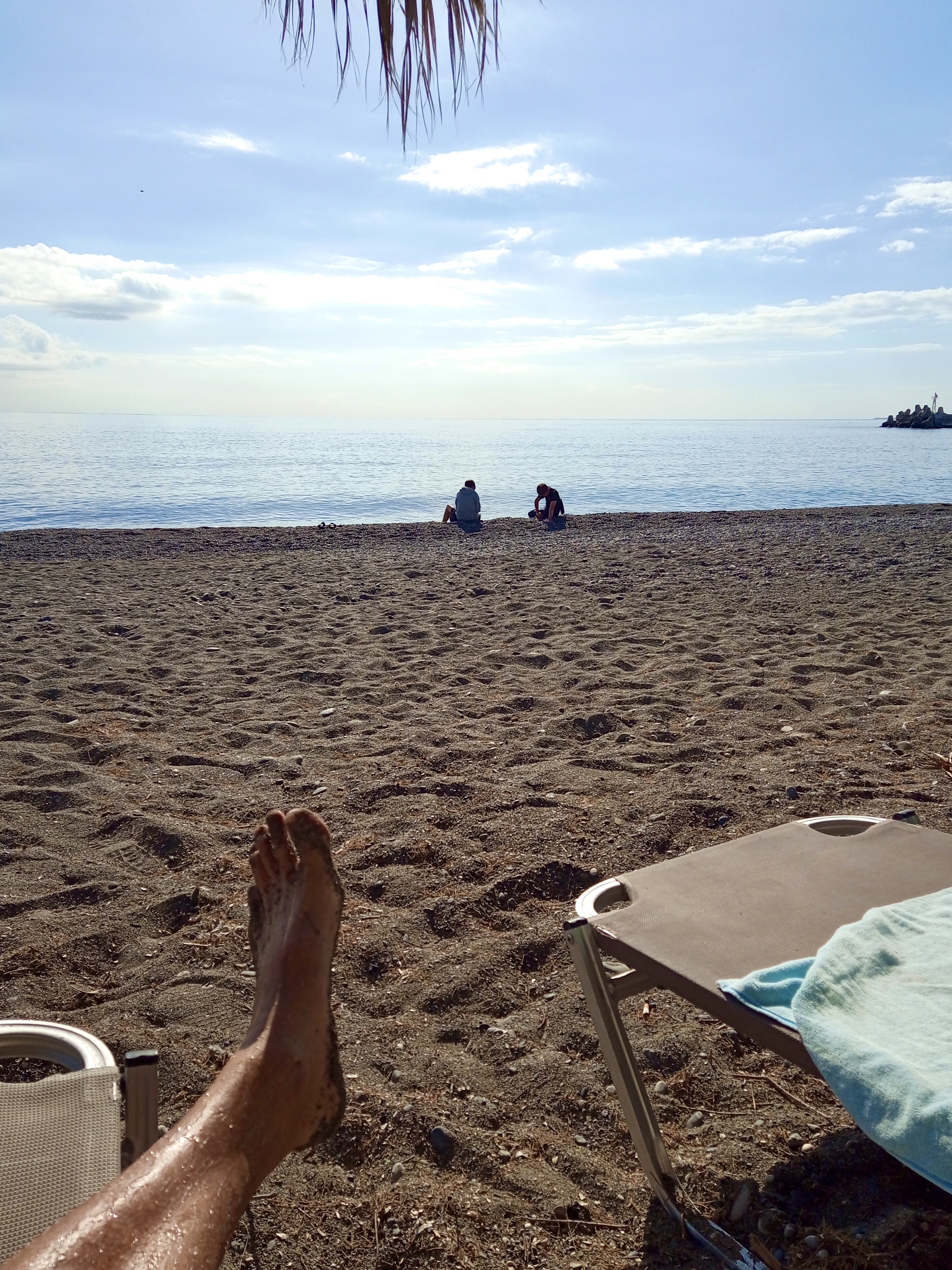
Above (and the shot at the top of this post): The beach has been simply magnificent this past couple of weeks, virtually empty, with the sea a sheet of glass and still really warm to swim in, we’re still swimming twice a week and drinking our iced coffees on the beach at the Chocolicious coffee bar, where they’ve now gathered their loungers into a pile behind the beach, but don’t mind at all if we unload a couple and use them just while we take a dip and sip away, before putting them back before we leave, of course. A couple of those photos make it look like the one-legged man strikes again. Sorry about that.
I know, I know, it sounds smug, and I really don’t mean to, but living here is an immense blessing and a privilege that we try never to take for granted, never letting a day go by without truly appreciating what we have.
•
Click HERE to go to my Amazon Author Page. There you can browse all of my written works.
Well, it finally looks like summer has given way to autumn. After what seems like weeks of almost identical daily temperatures in the upper twenties, and overnight ones of around 20, a slightly cooler air mass has drifted across the island and today we were able to get on with pruning our olive trees under a beautiful sky, peppered with fluffy clouds and sunny intervals. There was a good breeze too, something which we also haven’t seen around the house for what seems like weeks. As the morning morphed into early afternoon, the clouds over the mountain behind us grew darker and more threatening and, as we stuffed the last of the clippings from today’s pruning session into the final one of four black bags, there were spots of rain turning the ground into a massive polka-dot pattern. The temperature had been a much more tolerable 24ºC, so how can one complain when it’s almost the middle of November?
The village is waking up from the summer torpor too. Neighbours are busy outside their houses, washing down courtyards, making their way across the road to their horafia, looking for reasons to stand on a corner and chat, without the need to seek shade and relief from the relentless heat. Old Manolis is now regularly shuffling over to the kafeneio with his walking frame. He won’t give up, and why should he, until he’s forced to by the inevitable, which he hopes is still a little way down the line in the future. The locals in our village aren’t quite so preoccupied with the olive harvest this year, because the majority of those around here had a massive harvest last year, so this year’s a ‘fallow’ year for most of the trees on the slopes around us. Yet nevertheless there is still to be heard the sound of those whirring ‘agitators’ as those who do have some fruit to gather in are busy getting the trees to give them up and send them tumbling onto the nets spread wide below.
Even though the olives are being harvested in not anything like the quantity of last year, and hopefully of next, there are still battered pickup trucks wending their ways to the mill, heavily laden with hessian sacks or plastic crates, all stuffed with the little marble-sized black and green gems. Some of them have a scruffy dog hunched on the top of the pile, tongue flapping from the corner of its mouth as it enjoys its wind-blown ride; while others have the tools of the harvest roped precariously on to the top of their ‘mound.’ Olives are truly one of the most wonderful fruits known to man, the list of uses to which their oil, not to mention the whole fruit, can be put to is seemingly endless.
On Sunday November 5th we visited a village that we hadn’t ever been to before. If you examine a map of the area here in Southern Lasithi, in fact of most of the island in truth, you can readily pick out numerous villages, some small, and some tiny, dotted around the mountainsides, some of them apparently clinging to steep slopes in such a way as to almost defy gravity. Many of them take an age to reach, because the roads that lead to them are convoluted, twisty-turny and often only of single vehicle width, with not too clever a surface either, and the time it takes to reach many of these ancient settlements from what could laughingly be called a ‘main road’ can be half an hour, often more. So we found ourselves atSykologos, way up in the mountains somewhere between the village of Myrtos on the coast, and Viannos, in the mountains. Sykologos is only one of a dozen villages in the area, each of which takes nerves of steel to drive to, if you’re not initiated, that is. The name itself is quite strange, because if you say it quickly, it sounds like ‘Psychologos,‘ which means ‘Psychologist,’ a fact that doesn’t take a massive IQ to work out, right?
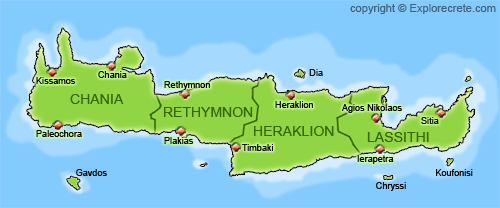
You don’t have to travel far west from Ierapetra to cross the county line from Lasithi into Heraklion. The municipal region of Heraklion, to the surprise of many, extends all the way from the north to the south coasts of the island, as, in fact, do all of the four main municipalities on Crete. Here’s a map showing all four…
You can see from the map that three of the four prefectures, or municipalities, are named after their main towns or cities, the only exception being Lasithi, in fact. Sykologos, incidentally, is somewhere south of the letter “i” in Heraklion on that map. Like I said, the name of the village may sound when spoken like ‘psychologist,’ but the attentive listener will note that the word begins with an ‘S’ and not the Greek ‘Psi’ [Ψ], and thus means something quite different. The Greek word for fig is [I’m going to spell it phonetically here] ‘seekoh,’ [σύκο], and the word for a fig tree is ‘seekyah,’ so you can see that the name of the village is more likely a corruption of the expression ‘fig reason,’ which may allude to the reason for the village’s existence in the first place. I say ‘fig reason,’ but in truth the Greek word ‘logos’ has innumerable meanings, depending on the context. No surprises there, then. Each of those above links to the village’s name sends you to a different website, but the third of those (the one in this paragraph) is the only one that suggests that the village’s name is actually derived from a corruption of the expression (in old Greek) ‘Fig collector.’ That’s most likely to be the right explanation, I feel.
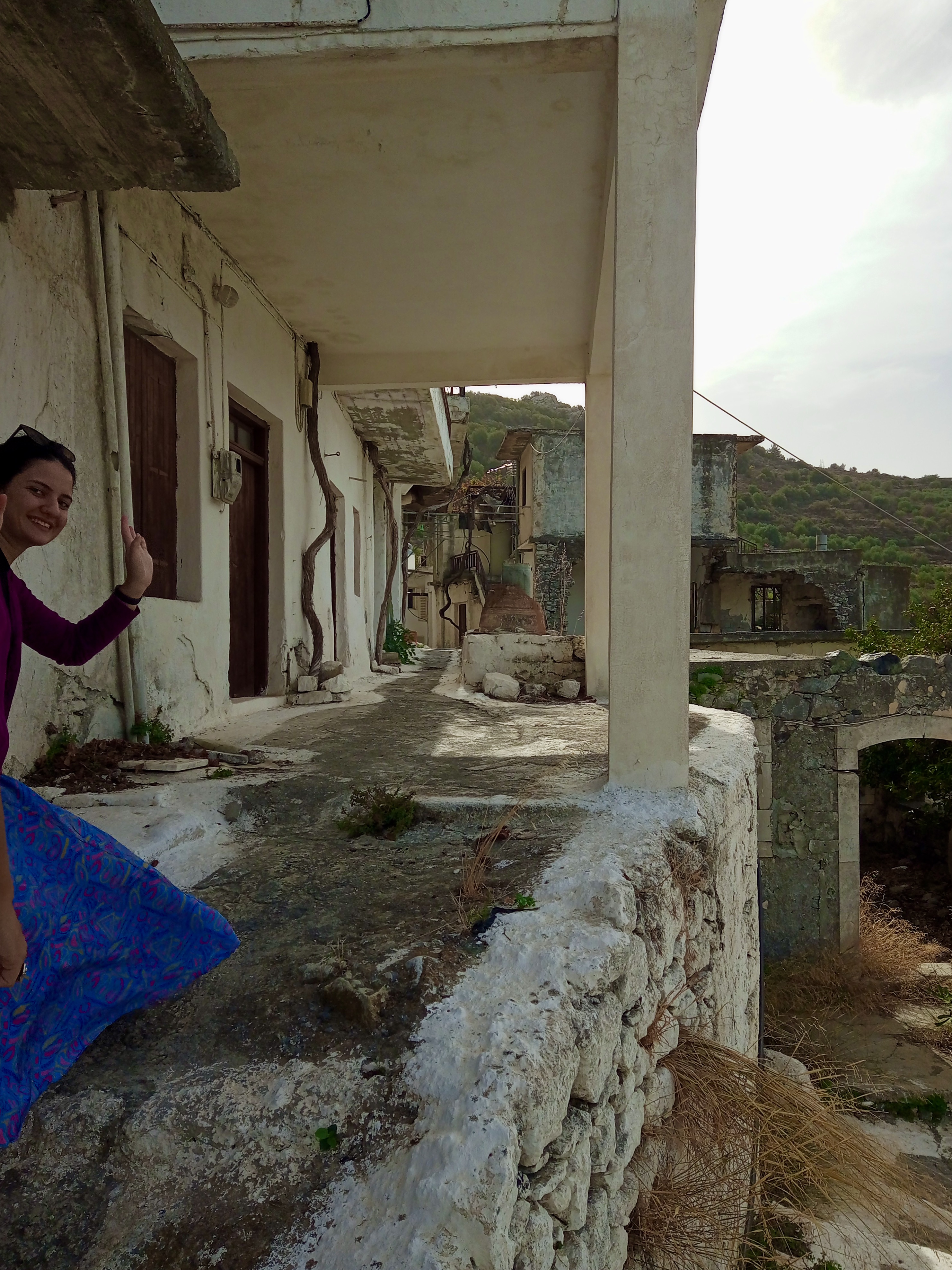
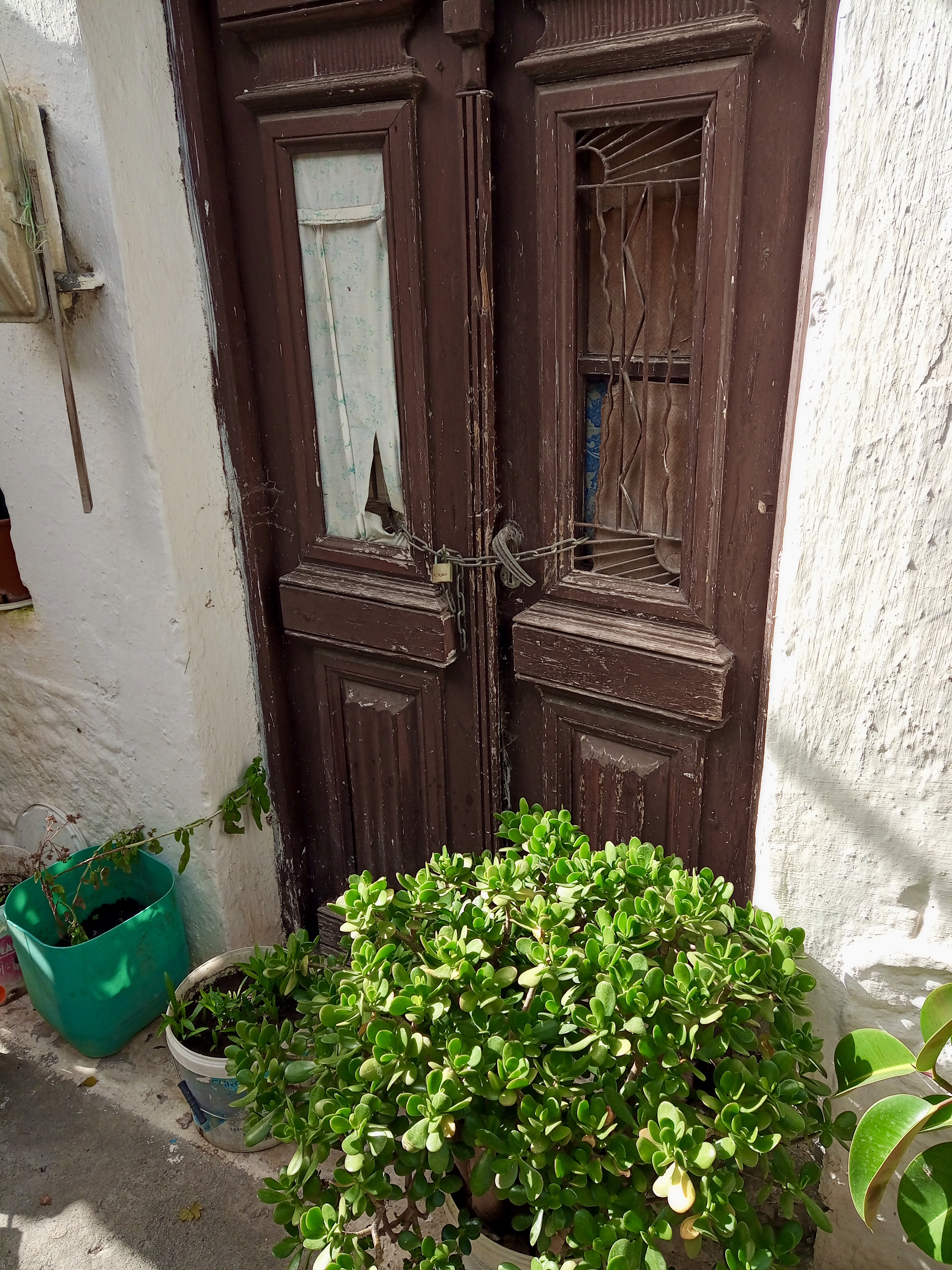
Anyway, it’s a truly remote village, which nevertheless has a couple of kafeneios and a tiny general store. The streets, with few exceptions, are completely inaccessible to vehicles, and I can’t imagine living there and having to go out to see a doctor, do some shopping, or even go down to the sea to swim. It would be a major expedition every time. It’s small wonder that many villagers in such places over the centuries will have spent their entire lives within a couple of square ‘stremmata’ of their front door. In times when every village subsisted on its own produce and was entirely without the need for contact with the outside world, that would have been OK I suppose, although had you grown up there and developed a curiosity about what was over the next hill, you’d have taken on a gargantuan task to do any such travelling. Nowadays, sadly, it’s a virtual impossibility to live somewhere and not have to go out in a vehicle a few times every week, and to do so even today in villages like Sykologos is still a major expedition. Here are a few of the photos I took while we were in the village…
On our way home, the small group of friends with whom we’d made the trip stopped on the sea front at Myrto for a coffee. It was gorgeous there on that Sunday, with rolling breakers crashing on to the beach below us and a warm breeze ruffling our hair and clothes. As we walked back to the car, I snapped this one…
See you next time.
•
Click HERE to go to my Amazon Author Page. There you can browse all of my written works.
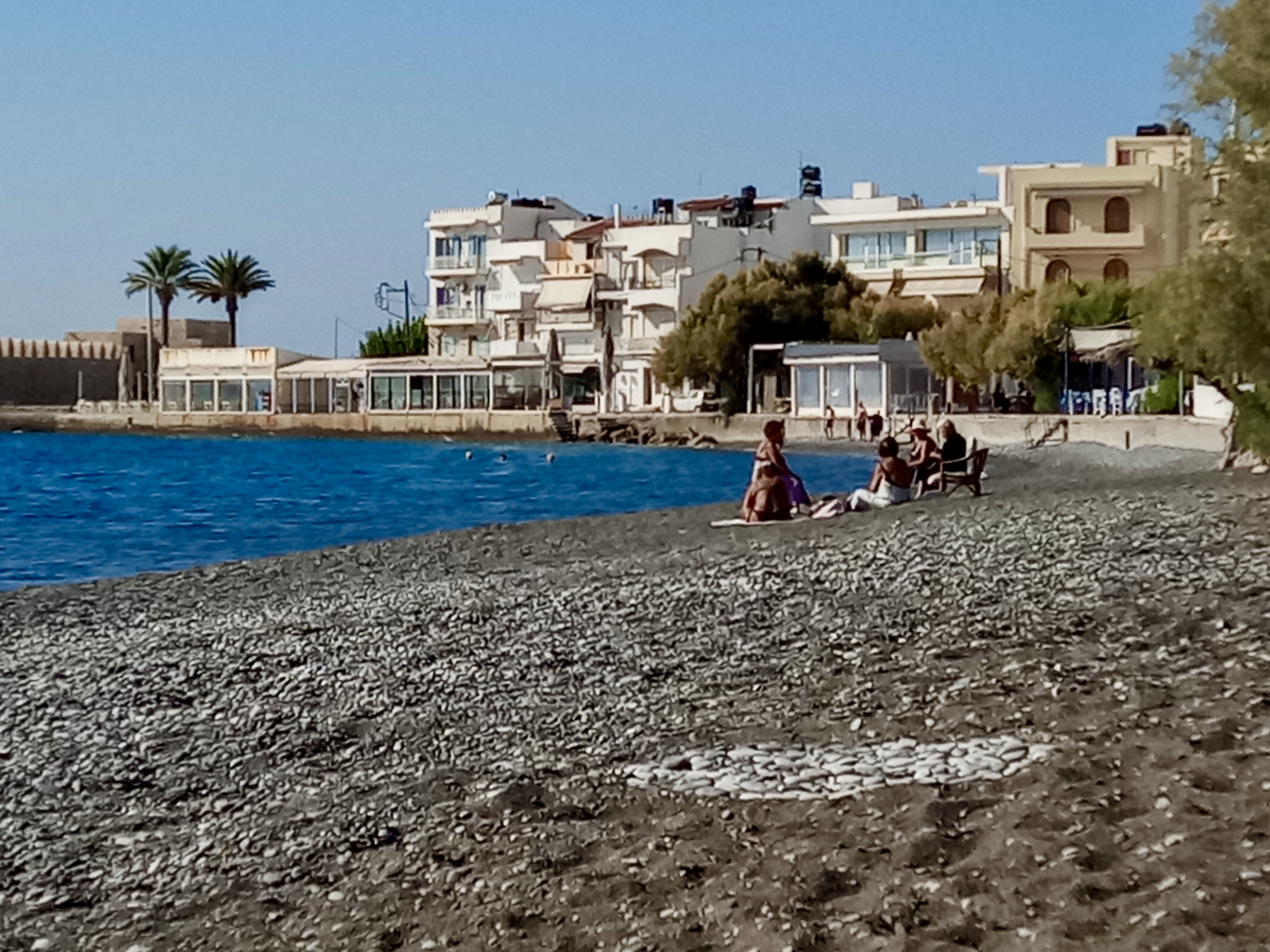
The above photo is taken on the town beach and it shows a gaggle of grannies. The culture here is great as respects ya-yades (grandmothers). Most mornings they can be seen either treading water in the sea, or sitting in small groups like this one putting the world to rights. Let’s face it, beats the bingo hall doesn’t it ladies? When they go into the water, they seldom swim anywhere, but rather tread water, their hands gently sweeping back and forth across the surface, as they natter away contentedly. Many of them do this daily well into their eighties, and it has to be said, the broadly held opinion here that sea bathing is good for the health does have some merit when you factor these women into the equation, doesn’t it. We’re certainly trying to keep up our regular dips well into winter time, if it’s liable to benefit us like it has these ladies.
I was talking to Taki, my coffee friend, earlier today and it came up that I’d been to see a doctor. Well, actually I’ve been to see two. Here, as I’ve mentioned many times, you can’t move for ‘ologists’ in the back streets around the town. I don’t remember ever seeing private ‘ology’ clinics in every side street back in the UK, correct me if I’m wrong. Back on Rhodes I’d been advised by my chiropractor to go see a neurologist about the slightly suspect reflexes in my right leg, which seem to be connected to my chronic ‘restless leg’ syndrome that I’ve had on and off for a couple of decades now. What with the move between islands and everything, oh and the tiny factor of a lockdown brought about by a worldwide pandemic, I had put it on the back burner until recently. I’d seen the sign outside one neurologist’s surgery quite a few times in the town, so I decided that I ought to fix an appointment and see if she could shed any light on my condition.
I don’t really want to go into all the sordid details here, except to say that my visit was indeed of some benefit and it also resulted in my getting my Greek health insurance sorted out, as it happened, much more easily than I’d expected. Back when I gave up work, I’d always intended to visit the IKA offices (only it’s no longer called ‘IKA’ by the government, even though all the great unwashed still refer to it as such. It’s more correctly known now as EFKA) and see about my health cover with the government scheme, but right about the time when I wanted to get it sorted, a pandemic struck, and the UK concurrently decided in its infinite wisdom to leave the European Union, throwing the proverbial spanner in the works of international cooperation on such matters.
I had actually paid one visit to EFKA just before the first lockdown kicked in, and I’d presented all the necessary papers to get my AMKA number activated to provide me with full health insurance cover, but the person behind the desk back then told me that my S1 form was out of date, even though I’d only just received it from the UK. Plus she said that since the UK had only just ceded from Europe, they didn’t know themselves how to handle people in my situation. I went to see the neurologist this past month and she asked me if I had insurance, to which I had to reply no, I didn’t. We’d taken out a modest private policy in order to get our biometric ID cards a couple of years back, but not renewed it a third time, because it was too expensive. This meant in practical terms that if I needed blood tests, or any type of scan, you name it really, then I’d be paying out some serious money.
If you want to get your blood tested here you have to turn up at the clinic waving a form from your GP or neurologist which confirms that you have insurance and that you only pay what’s called the ‘simetochi,’ which literally translates as ‘participation,’ but in the UK we’d call a ‘standing charge.’ The number of results that my neurologist wanted from my blood test totted up to a mere €300 plus without insurance. Cue another visit to the EFKA office. Back when I’d been told that my S1 was out of date, I’d duly gone back to the UK Department of Health, explained the problem to them over the phone and they’d promised to send me a new one. That ought to have sorted it, then, right?
True to their word, they did send me a new S1 (which is several pages long) and the dates on it were the same as the previous one. I couldn’t quite understand why the woman at EFKA had told me that the thing was out of date anyway, because the only date on the form relates to when I became a pensioner, thus it’s not an expiry date as such. Anyway, trying (but as usual, failing abysmally) to cut a long story short, this time I gathered up all my papers from when I’d worked on Rhodes (all those A4 photocopied forms that had been rubber stamped, you get the picture) along with my second S1, and trotted off to the Ierapetra EFKA office a couple of weeks ago. The lady who now serves the public behind the appropriate counter is now a different one, and she greeted me with a helpful smile. Good start, anyway.
“I was wondering,” I began trepidatiously, “if you could tell me if I’m entitled to health insurance cover, and, if so, what obtaining it may involve.” She asked me for my papers, so I handed the substantial wad over the counter for her to peruse. Her next words were, “Panayia mou!” At first that led me to feel some dismay, but she looked up at me with a smile and said, “Do you have a biometric residency permit?” Did I ‘eck as like? I handed it to her triumphantly, whereupon she asked if I’d mind while she made a phone call or two. I told her I’d all the time in the world if it meant that she could sort something out for me. She picked up the phone and evidently asked for guidance from some superior ranked individual, but since I understood perfectly what she was saying, I got the distinct impression that things were going OK. As she talked, the phone propped under her ear on her shoulder, she responded to instructions by tapping away at her keyboard while studying her computer screen. After around five minutes, during which she’d apologised to me several times for the delay, she put the receiver down, tapped away a few more times and re-examined the S1, which, remember, had the same date on it as the one that her predecessor had rejected two years ago, then looked up at me and said, “Everything seems to be in order Kyrie Manuel. If you could come back the day after tomorrow, I’ll give you a form to sign and you’ll be good to go. I’m sorry it’s the day after tomorrow, but tomorrow I’m off work you see. Is that OK for you?“
Now, what do you think, eh? I honestly couldn’t quite believe my ears. The S1 was valid (she told me she’d be processing it and then it would be returned to the UK to activate my cover) even though I was previously told that it wasn’t. That had cost me around €400 in two years minimum private health cover too. I went back two days later and she was as good as her word. She handed me a form to sign, then told me I was covered, right from that moment. No hassle, no frustration. It’s virtually unheard of in the history of ex-pats getting things done in Greek Government offices! All I needed to do from now on was to go into the office the first week of March every year to sign a statement confirming that I was still resident in Greece, and that was that.
I went to my GP to get the form for my blood test, and she printed out a two-page affair that I then was to present to the people at the clinic where they would be taking the blood sample. It detailed all the various things that the doctor/neurologist wanted to learn from the test, and each item was accompanied by a price. €30 here, €20 there, and the list was long. Like I said, it would have set me back in the region of €300. The actual ‘simetochi‘ payment was just €32. A couple of Greek friends told me that everyone pays that, that’s normal. Next is my MRI scan, since the neurologist wants to have a look and see if there are any mechanical issues in the spine affecting the nerves in my legs. A typical MRI scan without insurance is around €200 too. With my insurance form from the doc, I’ll only have to pay what all the Greek people pay, the ‘standing charge.’
No one wants to have health issues, but now that I’ve got my insurance sorted, I almost wanted to shout, “Bring ’em on, I’m ready.” I did say almost, mind you.
Returning to my chat with Taki, which is what kicked me off on this story, he asked me which neurologist I was seeing, as every Greek will do. They always want to know who your doctor is, what specialist you’re seeing, how much you’re earning, what you paid for your house, it’s the culture and you have to get used to it. The trouble is, as soon as you reply, you hear what I heard from Taki. “Oh I wouldn’t go to that Neurologist Gianni, we have reservations about her. She went to Denmark, you know.” Like going to Denmark was the kiss of death. “Anyway, who’s your GP?” I told him.
“Oh, I don’t think a lot of her. I could have recommended a doctor if you’d asked me.” Now, I love Taki, he’s a very good friend, but you can be certain that if I’d been talking to someone else, they’d have had a different point of view, and so on. The thing is, they’re all right in their own minds. I’d already talked to a female friend who works in Ierapetra hospital, and she gave glowing reports on both my neurologist and my GP. In fact, I decided to look up the neurologist on Google and the recommendations she has on there are all four and five star. You simply have to be strong in such circumstances and make your own decisions.
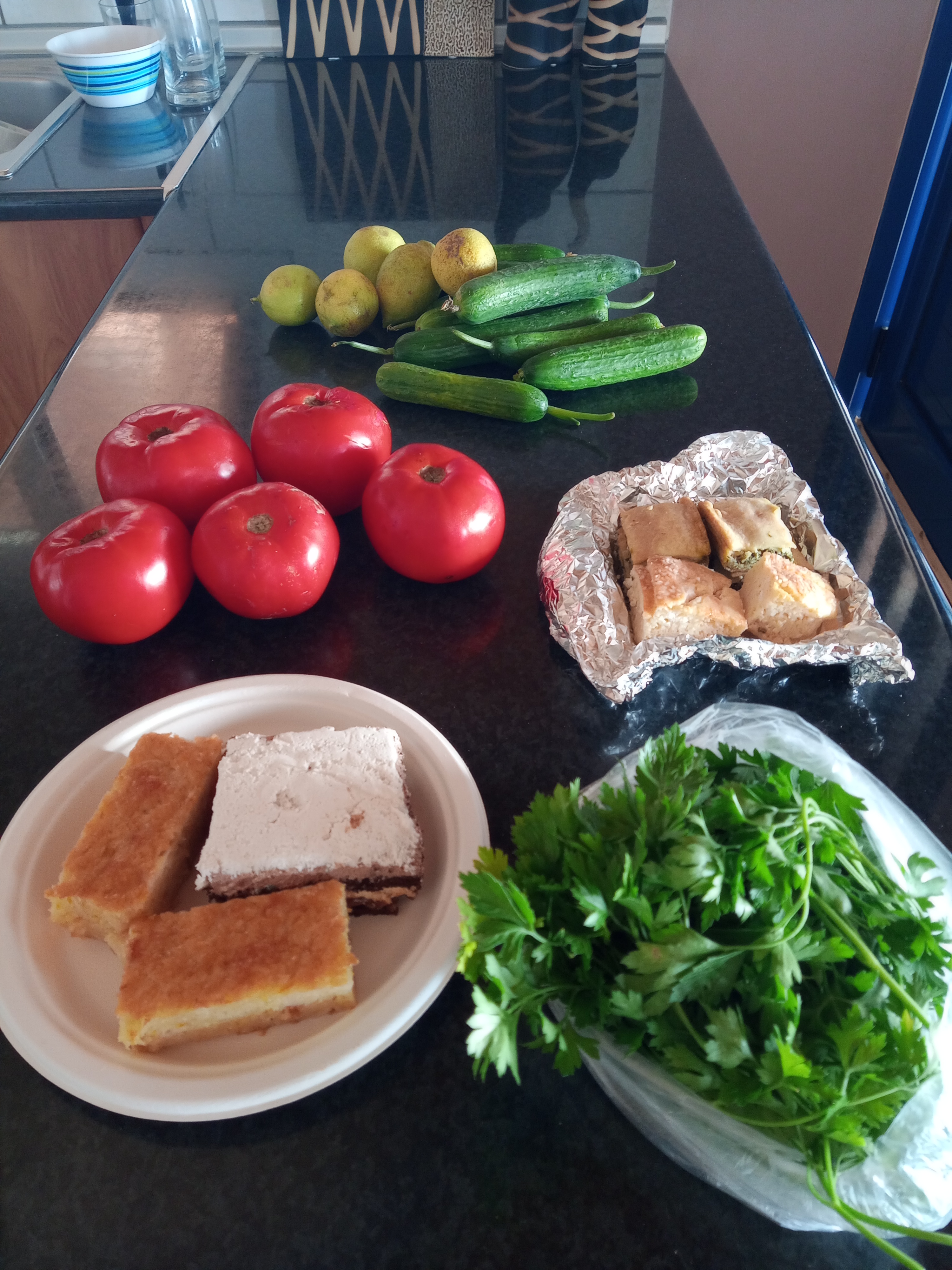
Diminutive Dimitri from down the lane turned up at the front door yesterday. We hadn’t been given any vegetables for a while and, even though we of course don’t expect anything, it was like he and his mum had read our minds. A few hours earlier we’d been helping his mum Maria sweep a lot of leaves from the steep lane leading up to Kyria Sofia’s house. The locals are nothing if not predictable in such circumstances. Do them a good turn and they’ll inevitably want to reward you, even though we don’t do it for that reason. He handed Yvonne a plastic bag full of produce from their own fields…
Yes, you’re right, there were also some tasty items that Maria had cooked, including a delicious portion of a large hortopita, plus some homemade portokalopita, yum!! Do we feel blessed living here? What do bears do in the forest, eh? More recent photos…
•
Click HERE to go to my Amazon Author Page. There you can browse all of my written works.











































 Accretions