Musings from South East Crete. Accretions: "Growth or increase by the gradual accumulation of additional layers or matter. A thing formed or added by gradual growth or increase." This is a spasmodic diary of life in south eastern Crete by writer John Manuel.
We’re currently experiencing what I can only call a series of ‘glad to be alive’ days. Every morning currently, we wake up to bright blue skies, almost non-existent winds and a temperature of around 20ºC at dawn. By 9.00am it’s climbed to 24º and by 1.00pm it’s knocking on the door of 30. Put simply, these are wonderful days, perfect weather conditions for breathing in the atmosphere, the ambience of simply being alive.
Each day when we wake up we throw all the windows and doors in the house open to allow the outside in. It’s actually a little warm for the time of year, but when it comes to sheer appreciation for and enjoyment of life, you can’t beat it. OK, so the rains are sorely needed now for the farmers, even for our garden, but that still doesn’t take away from the fact that all we need to wear each day is a pair of shorts and a vest top. Have I droned on enough about it, do you think?
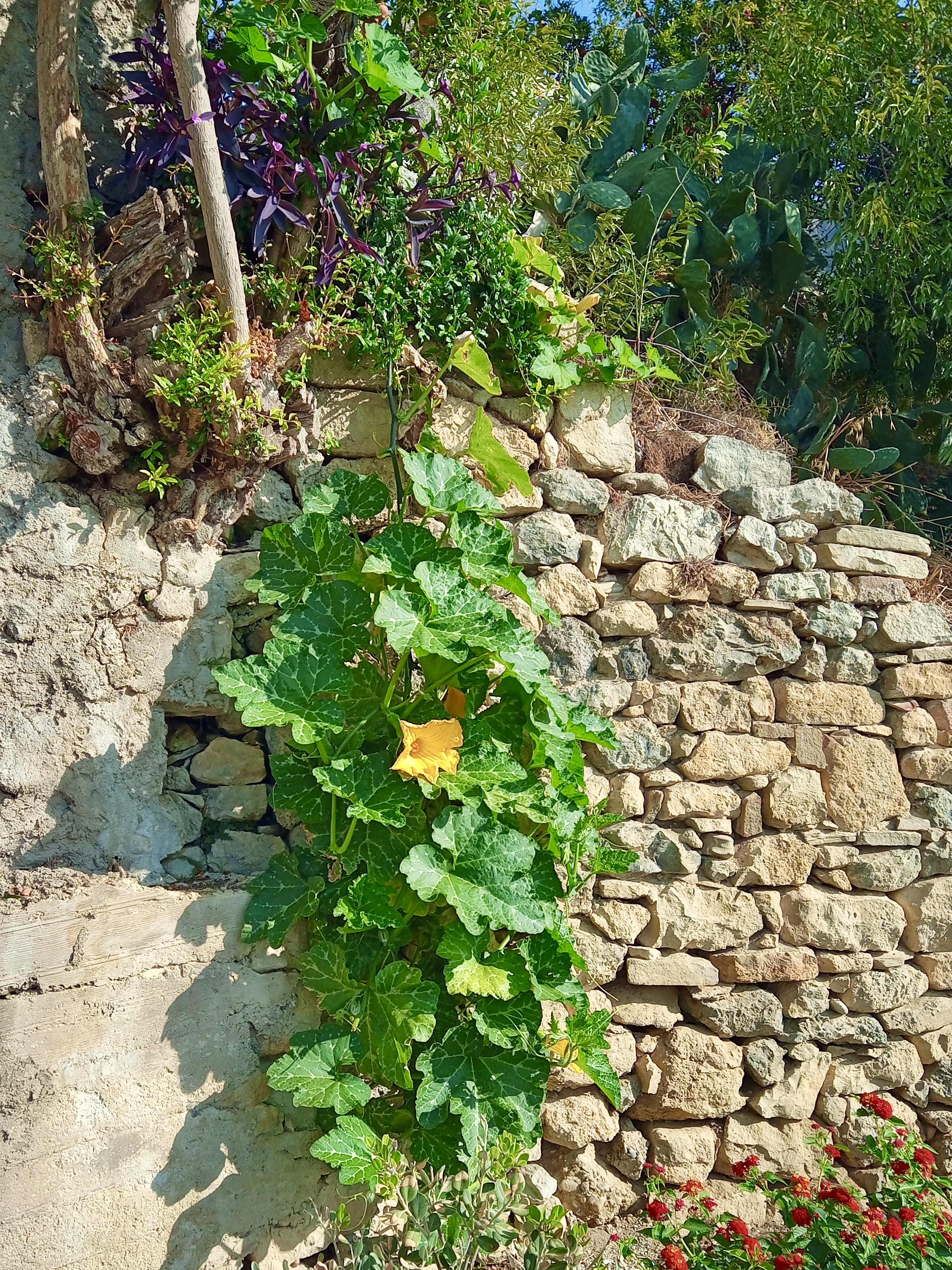
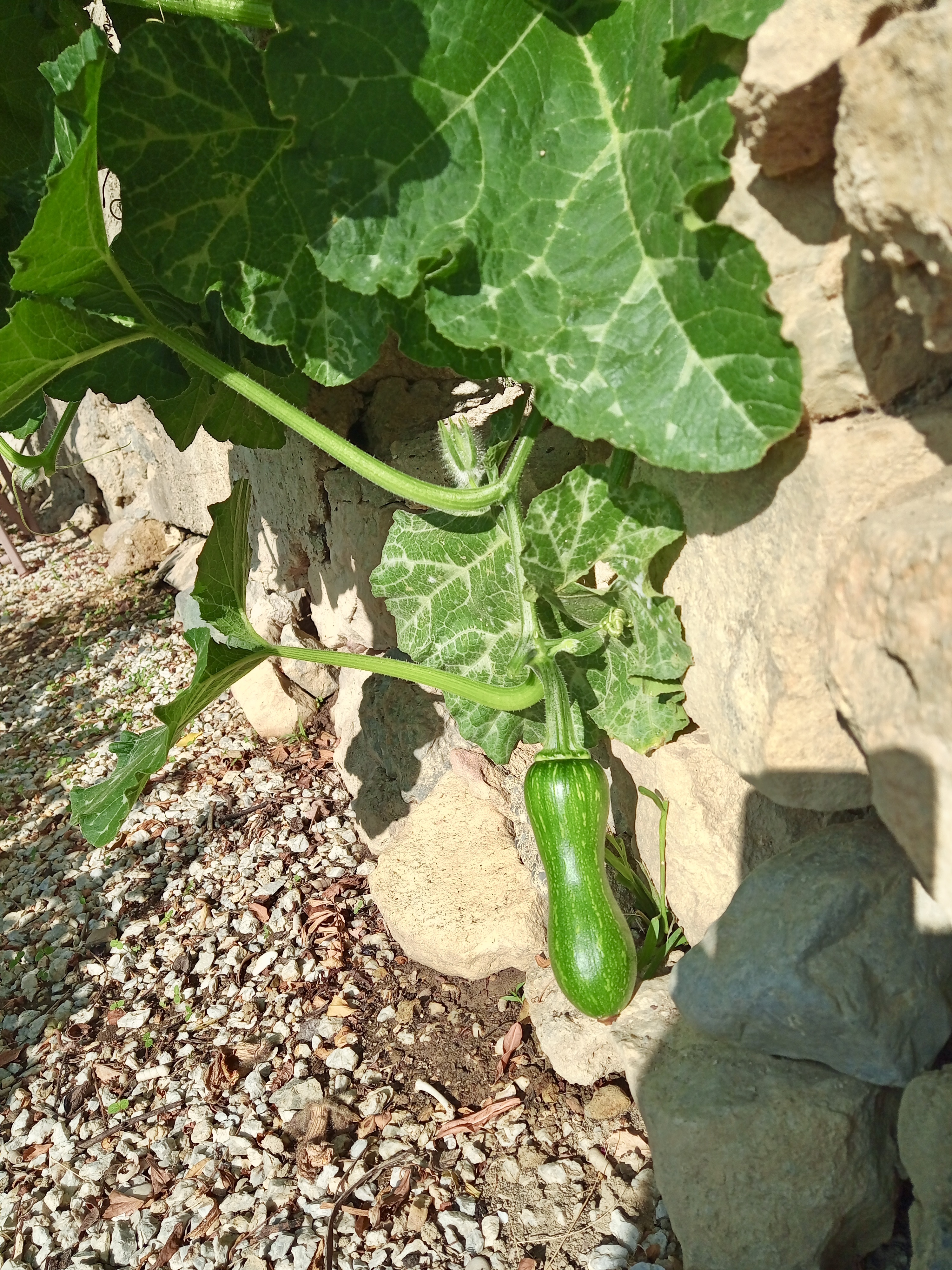
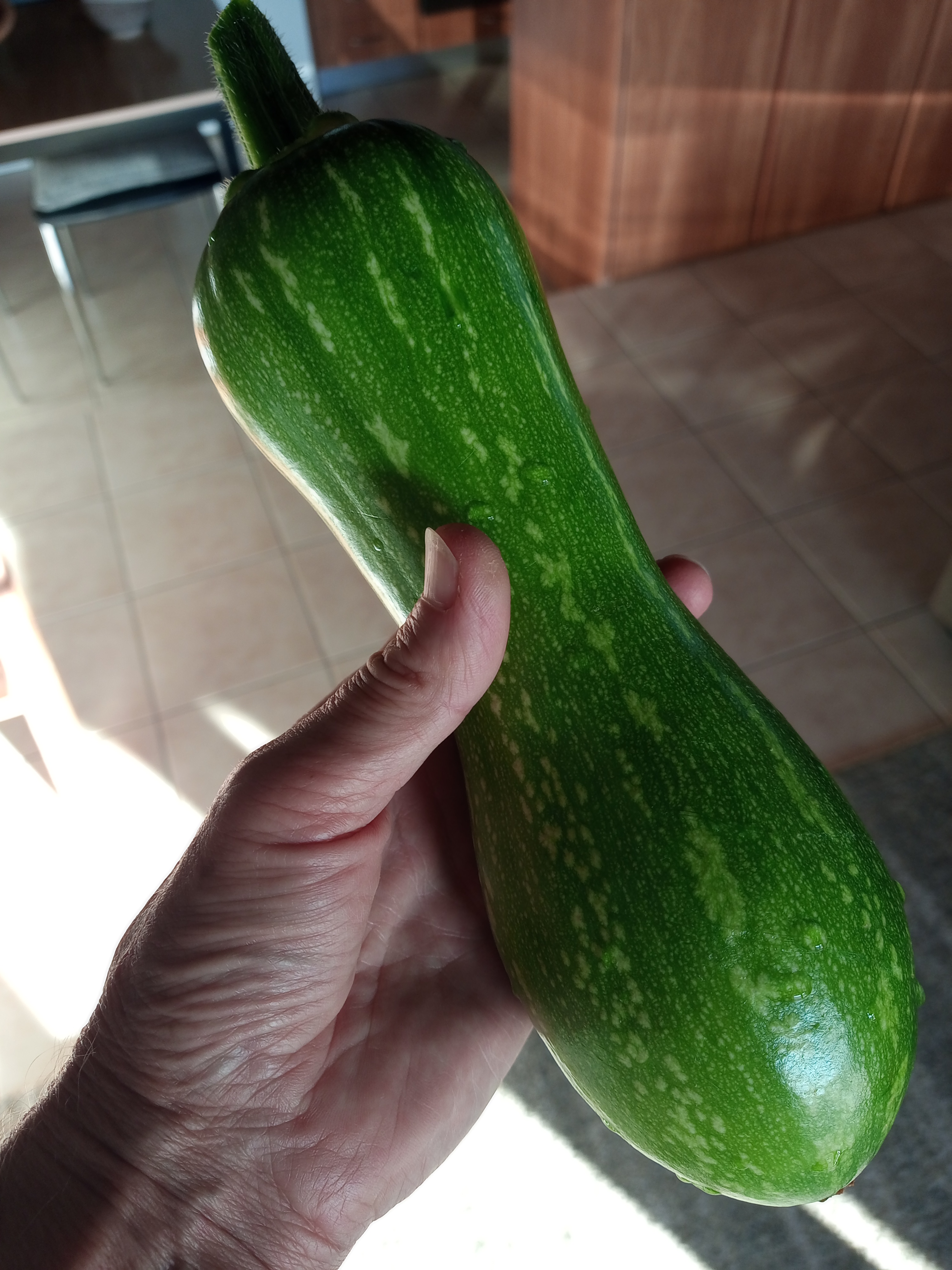
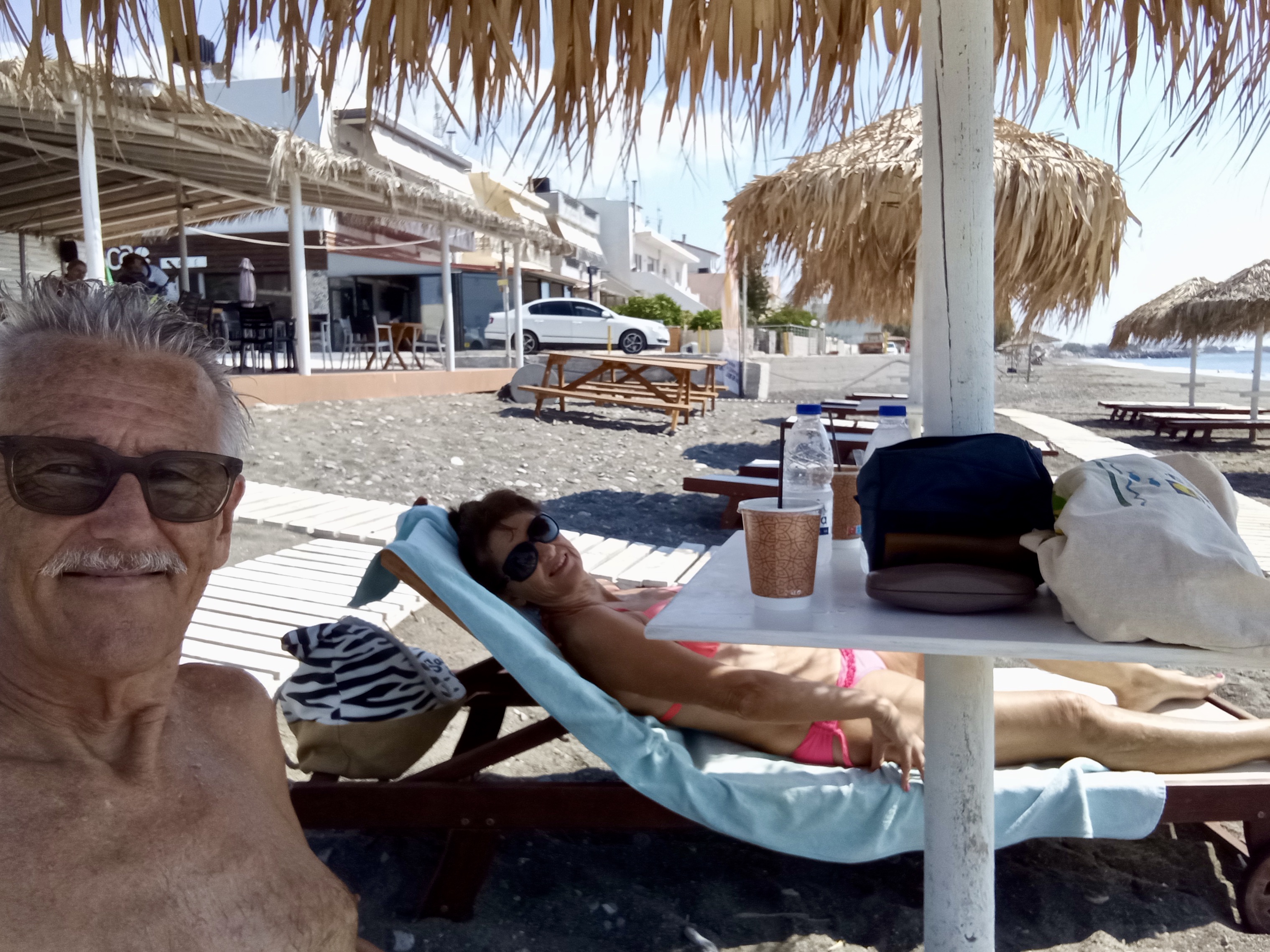
We ‘re still taking our iced coffees on the beach twice a week and still swimming in the warm sea. The sea temperature currently is around 25.5ºC, so it’s just perfect for immersing oneself and wallowing in the sheer sensual pleasure of feeling that warm water caressing your skin. In our upper garden at the house too, we have had the unexpected pleasure of a self-seeded courgette plant hanging down the wall and we’ve already harvested a few samples of its delicious produce…
It’s quite ironic really, since when we tried to grow some courgettes ourselves back on Rhodes it all went well for a while, in that the flowers bloomed and the fruit began to swell. But as soon as the baby courgettes began to get to a half-decent size, they all turned brown and rotted, every one. I’d done all the research too, and had the distinct impression that they’re among the easiest of vegetables to grow. You can’t over-water them, it said. You virtually can’t fail, it said. I did though (takes a sardonic bow). It’s one of the reasons (the other is that we get given so much veg anyway, plus it’s dirt cheap in the local stores in Ierapetra too) why when we began to plan the garden here we decided to keep it decorative. And then nature goes and gives us a massive accidental courgette plant that’s producing beautiful fruit. Sometimes you just can’t win, except when you do, if you see what I mean.
As I said in a previous post (in fact, it was probably the last one, I get so confused these days) I’ve backed up a little on photos owing to the triple post I wrote about our neighbours tragic story following the massive fires on Rhodes. So, here we go again with another batch from the last couple of weeks…
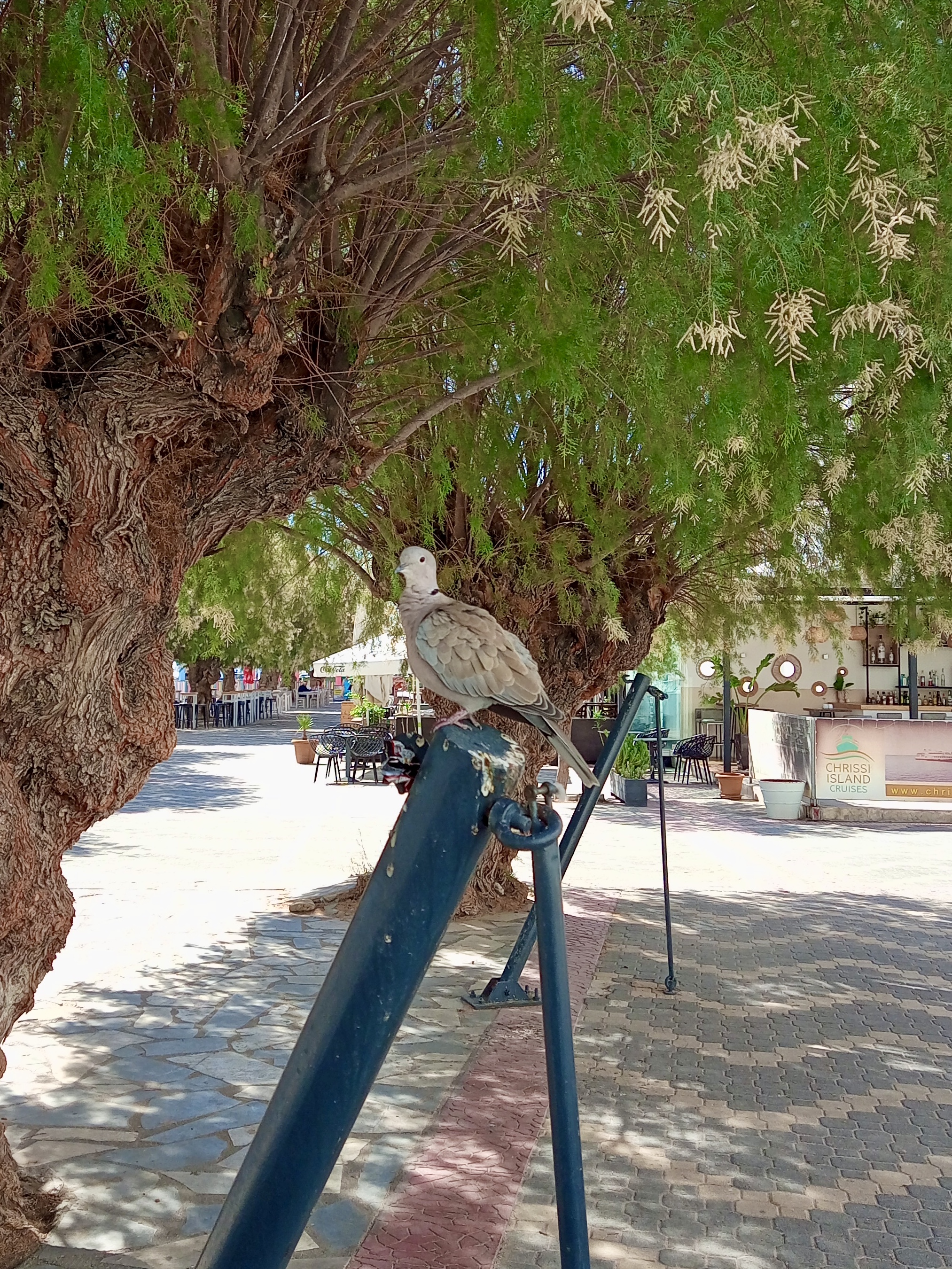
This little fella (above), a collared dove, was sitting on that post as we first glimpsed him (or her; since collared doves are among the few birds whose sexes are difficult to tell apart, bit like the modern youth of today when you come to think of it) and as we approached, and fully expected him to take flight, he decided to stay where he was. Probably a bit of a poser who loves to have his photo taken. I was happy to oblige.
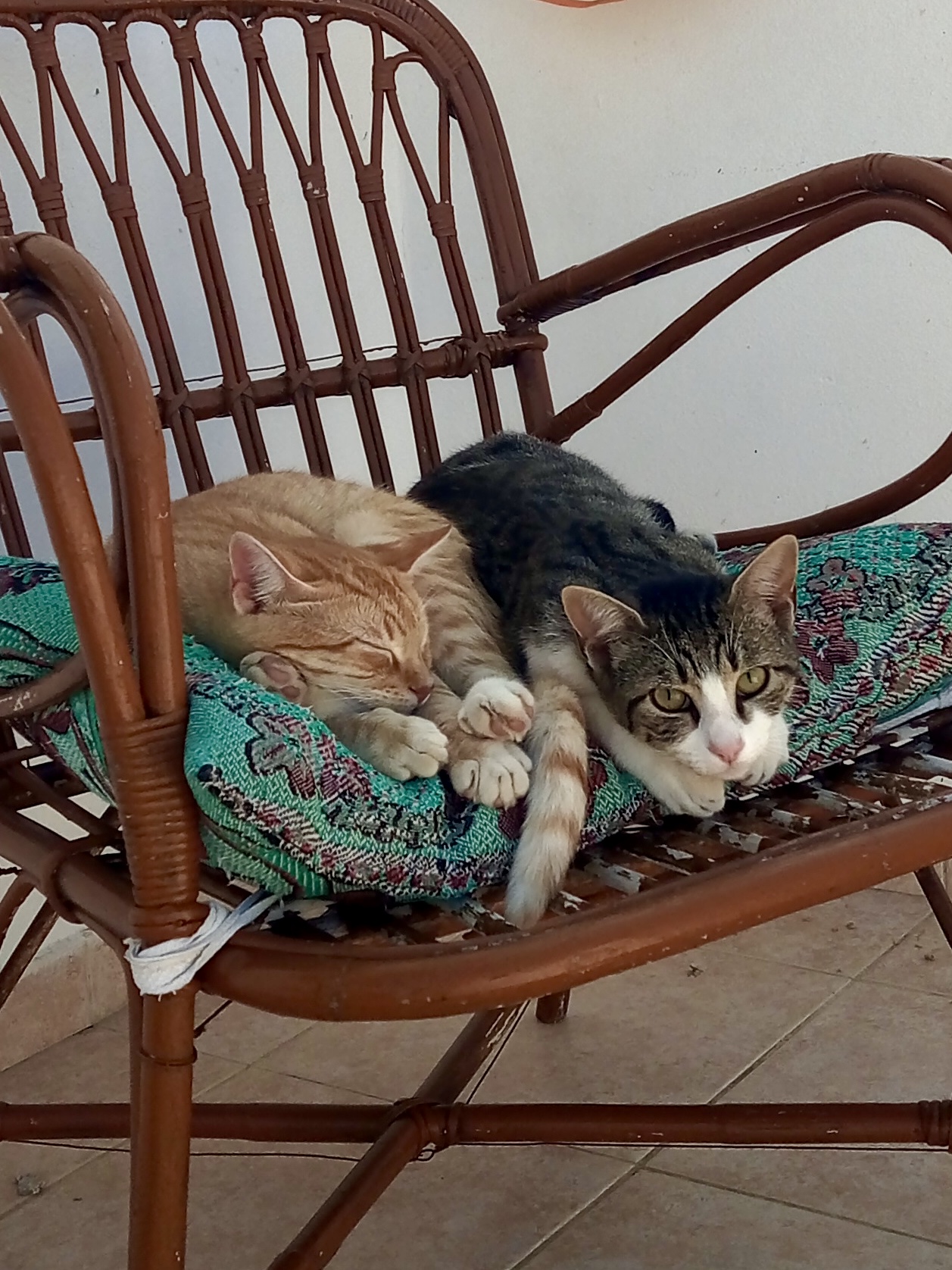
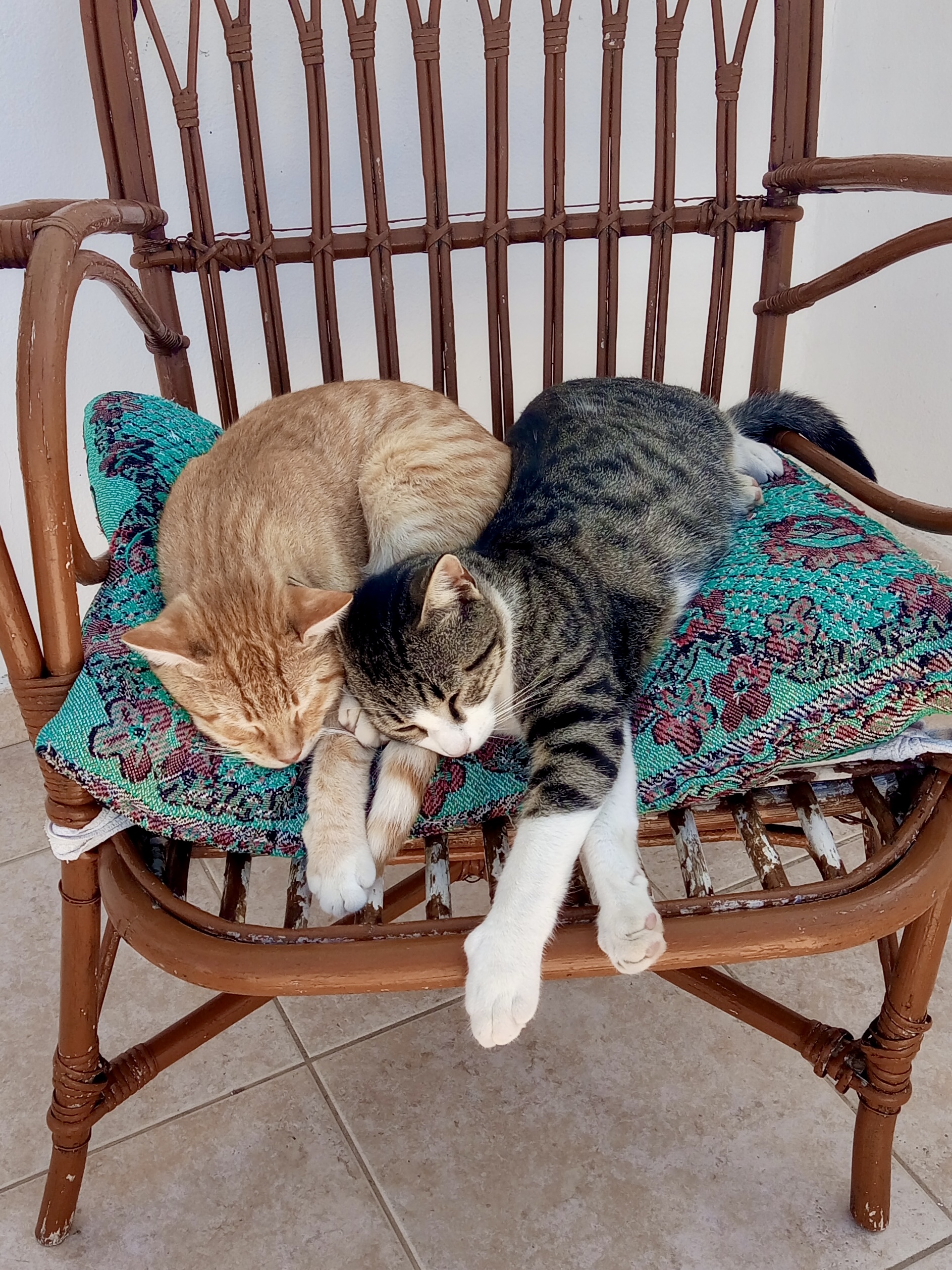
Above: We dropped in to see our friend Marika, a mere 87 years young, at her house in Meseleri a couple of weeks back. The two puddytats on the chair are apparently siblings. You wouldn’t think so to look at them, would you? She says they’re inseparable. All together now, “Aaaaaaaah, bless!”
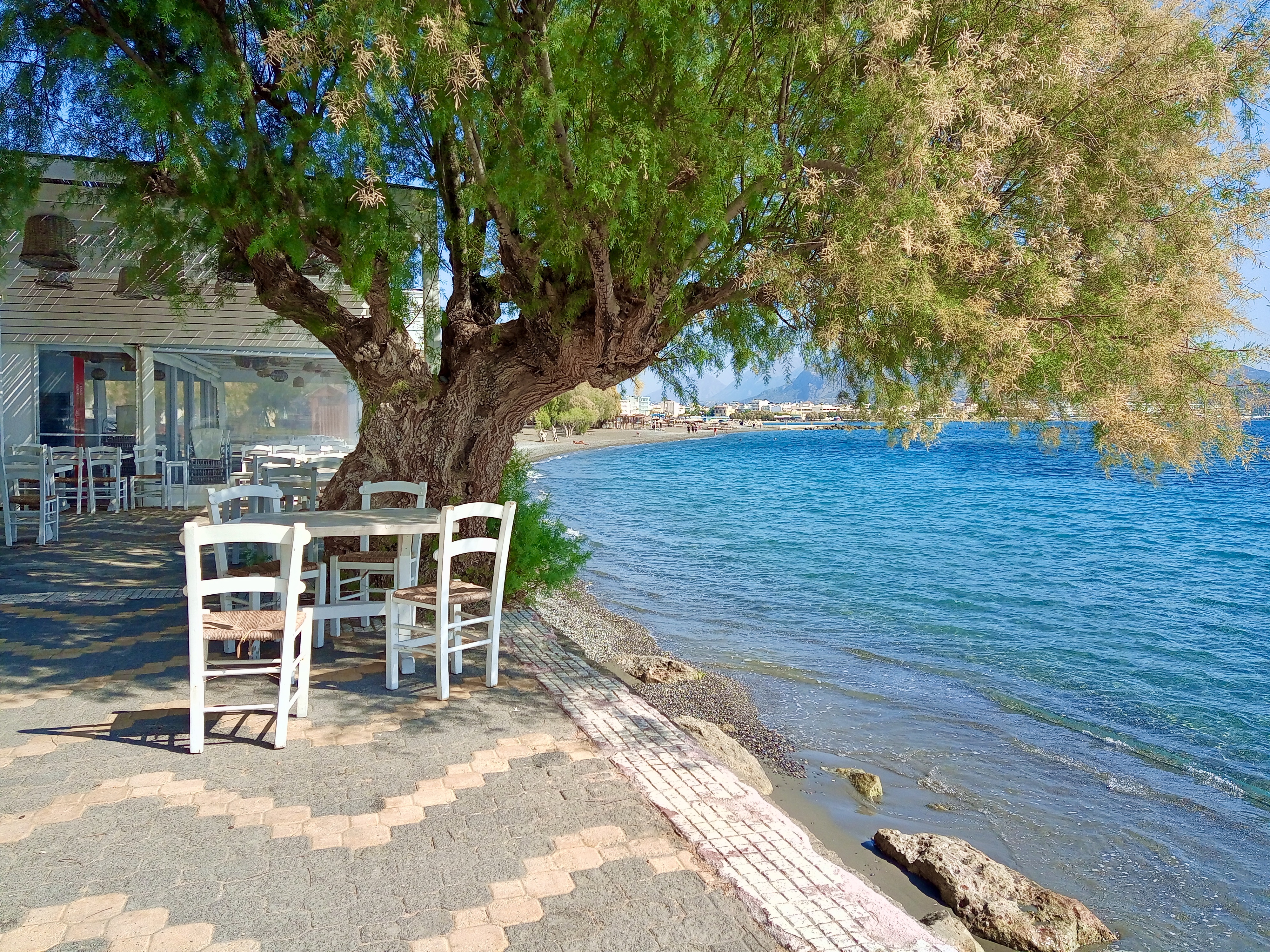
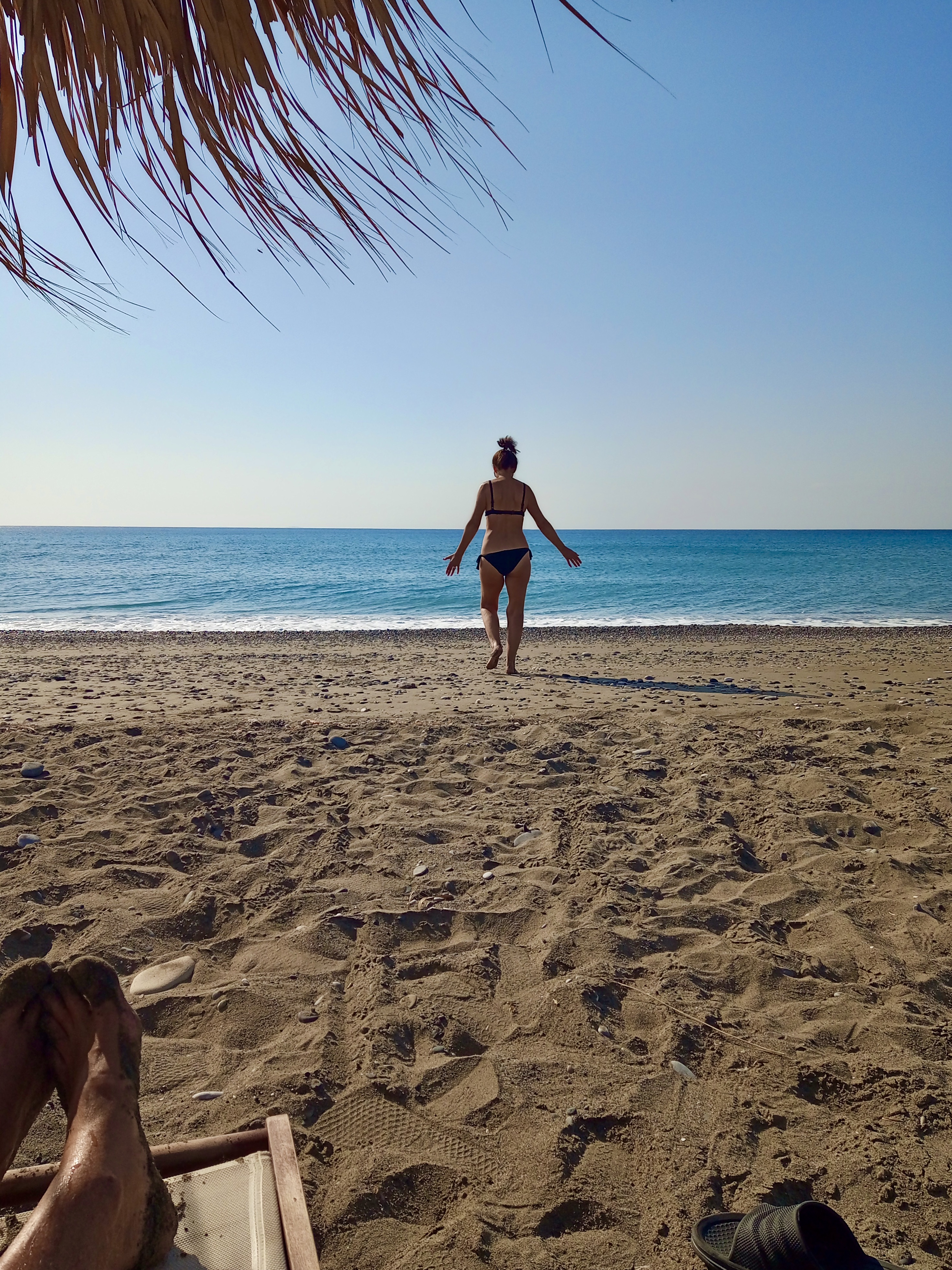
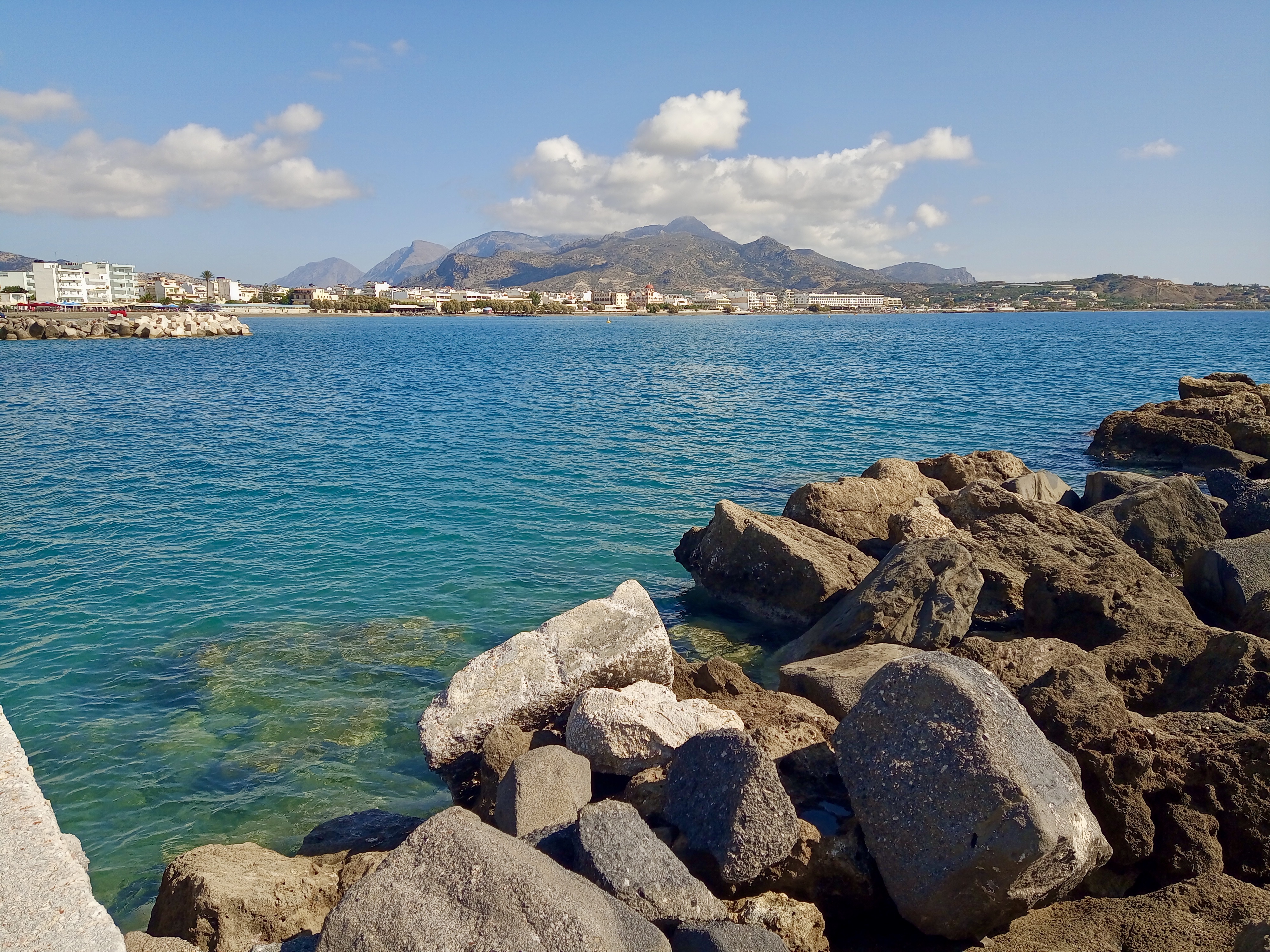
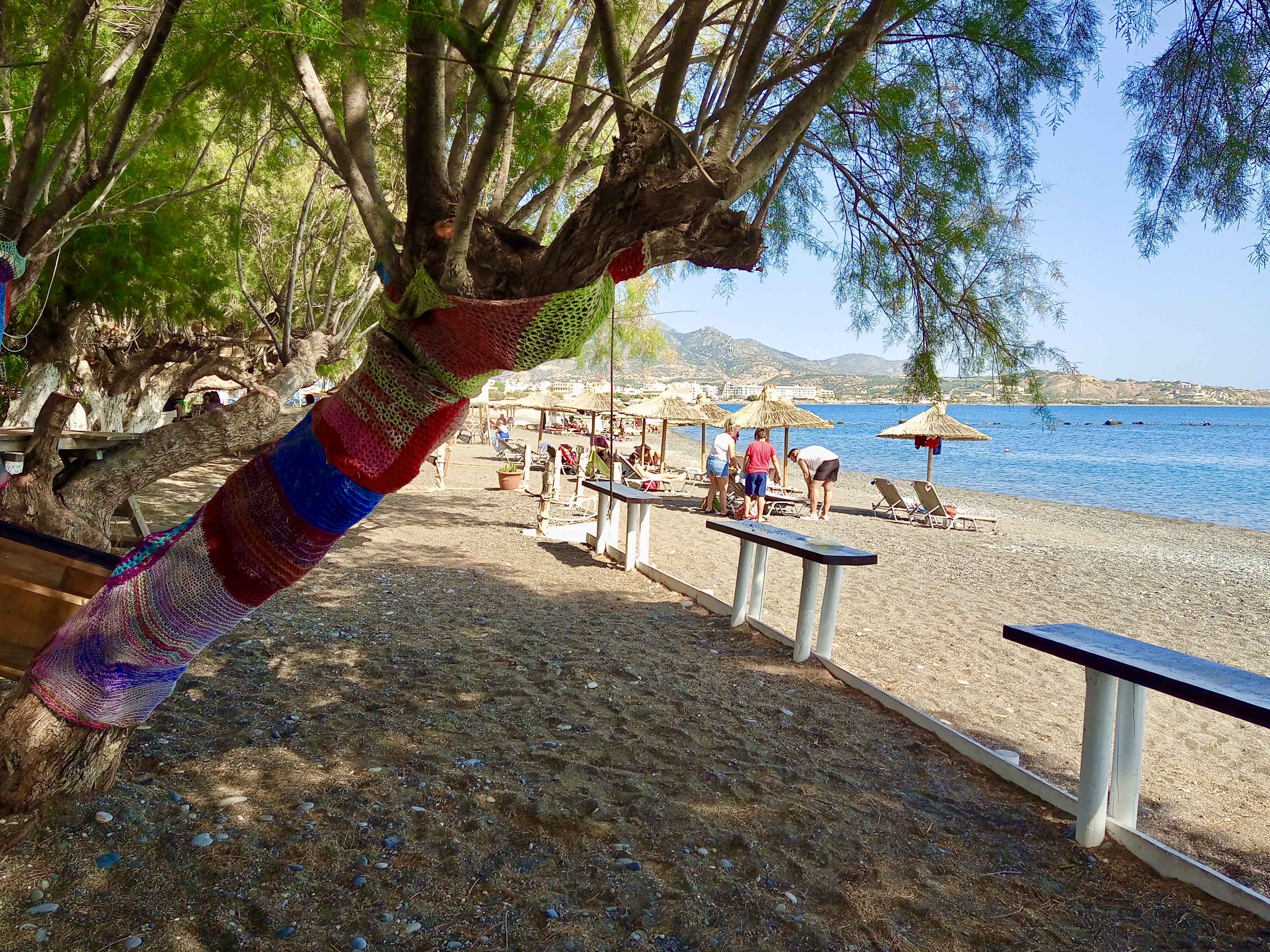
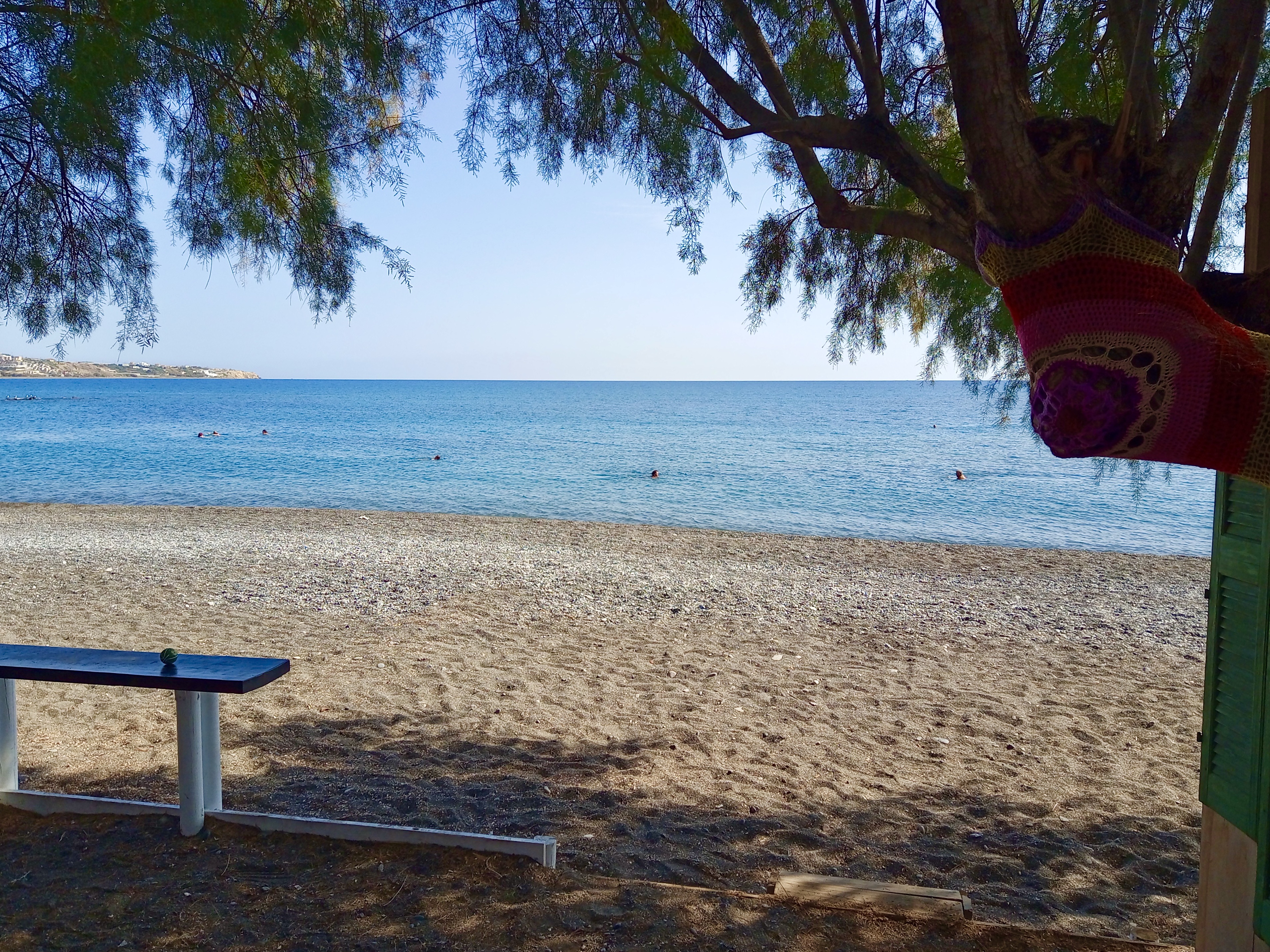
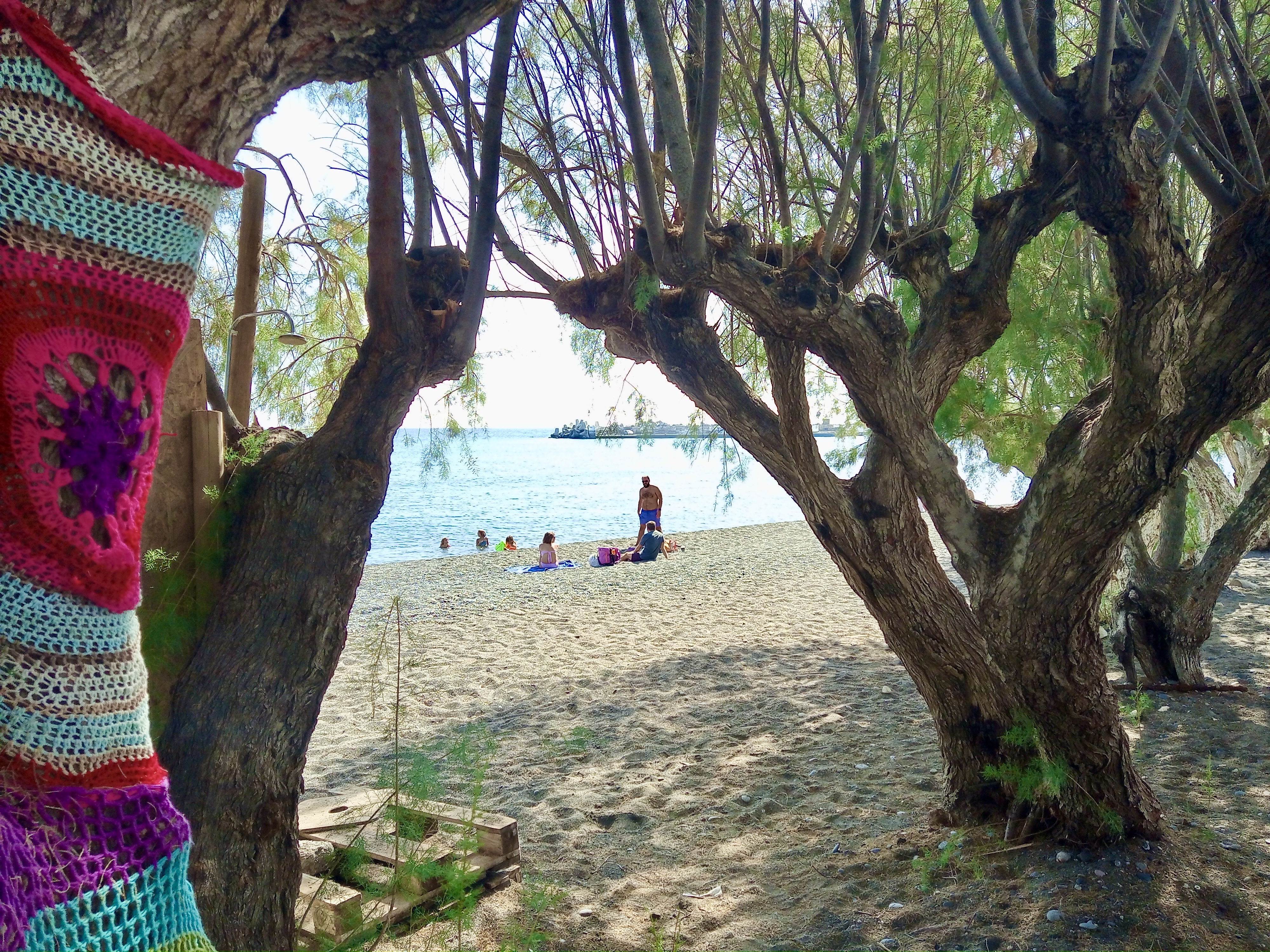
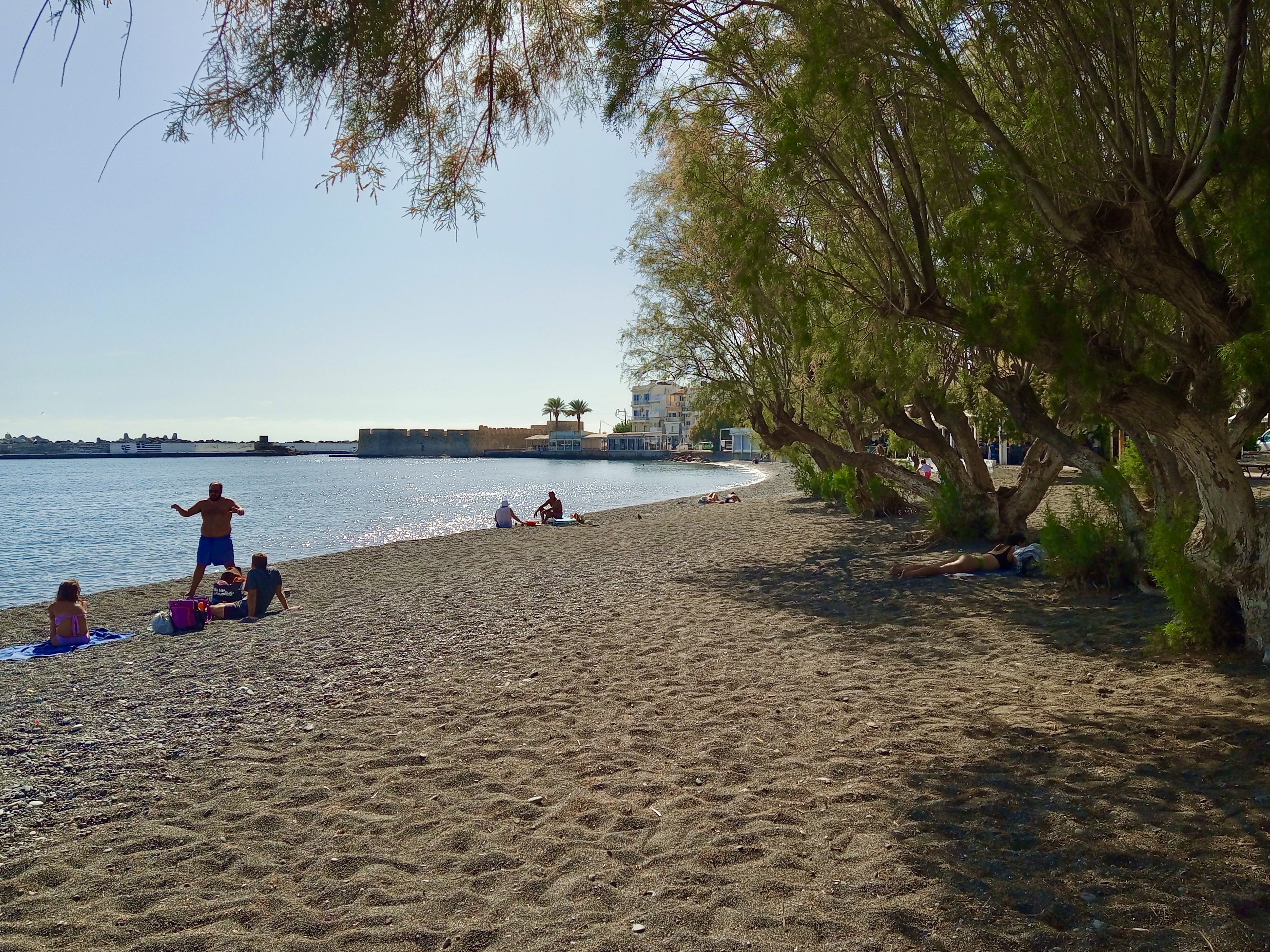
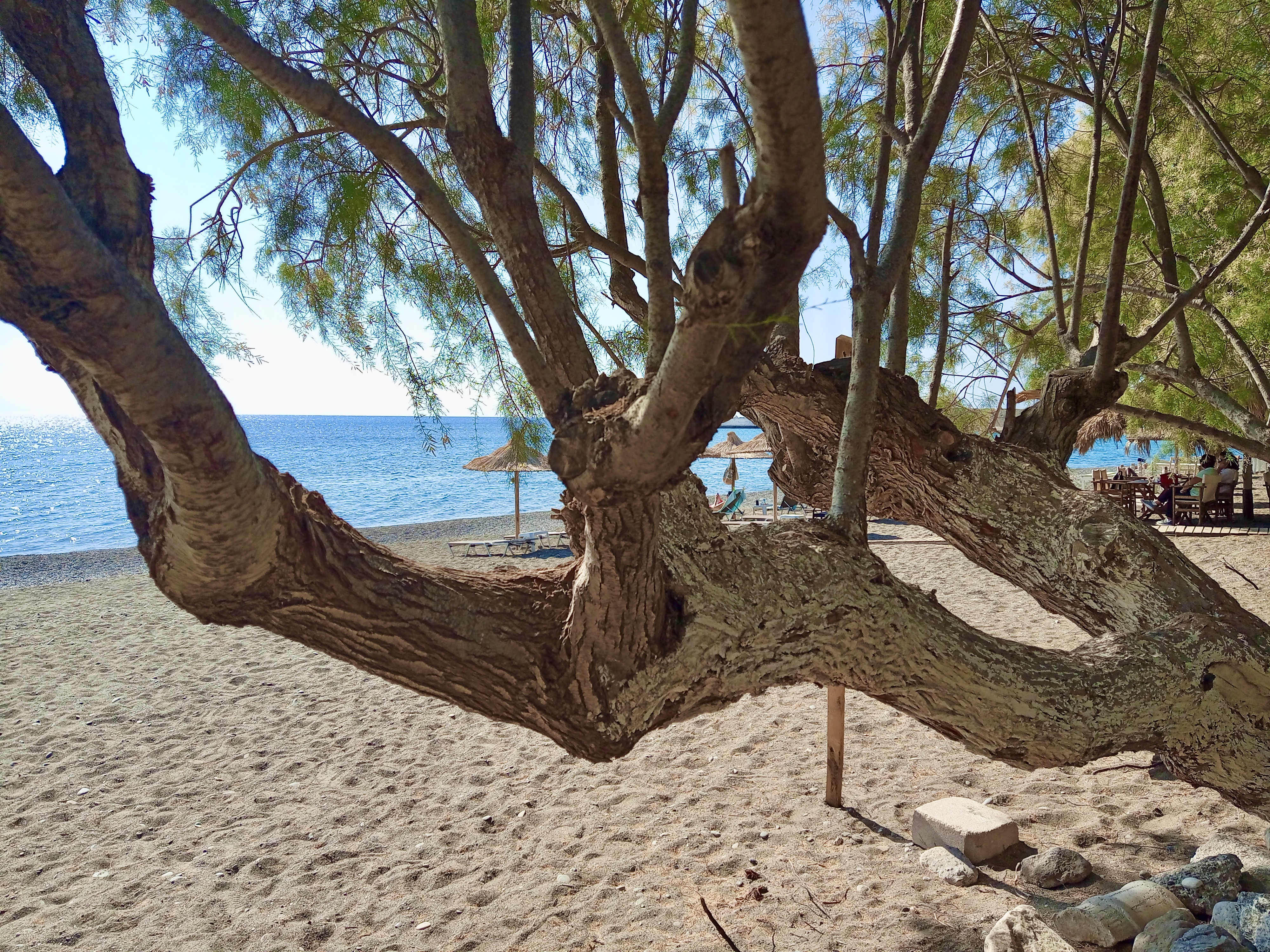
Below: Here is a collection of shots from the beach taken this past week or two. It’s a virtual impossibility to be there at the moment and not snap away…
I still have about 20 more recent photos in my ‘Facebook or Blog’ folder on the Mac, so I’ll post some more next time. Anyway, I’m off to the upper garden now to see if there are any more courgettes (zucchini for you good people across the pond, of course). Keep safe.
•
Click HERE to go to my Amazon Author Page. There you can browse all of my written works.
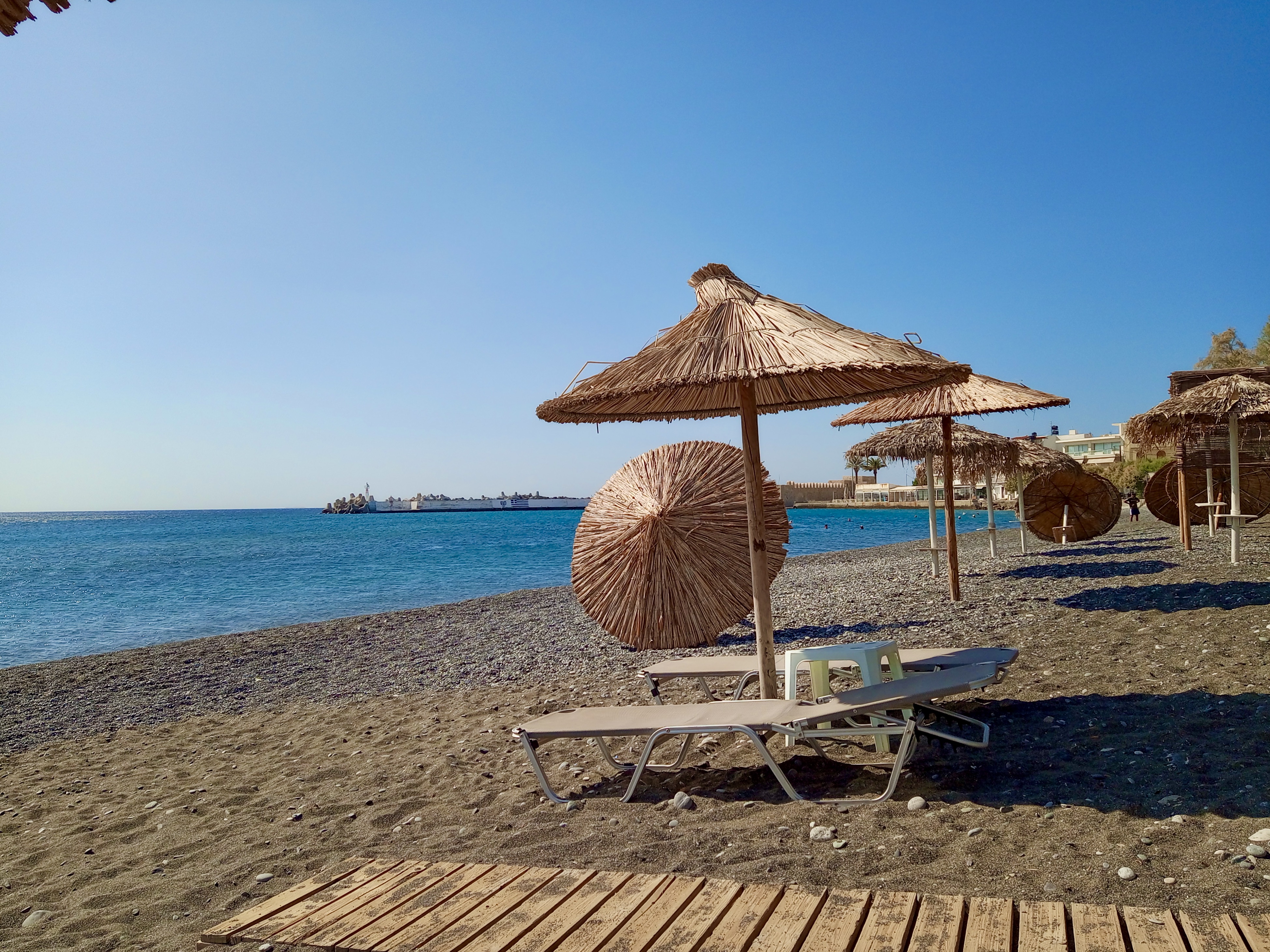
Actually, I’ve never tried to find out where the expression ‘Indian Summer’ comes from, and it doesn’t strictly apply here because we get October/November weather like this virtually every year, but it’s a decent enough title for this post. The above photo was taken on the town beach at 11.00am on Tuesday October 3rd. The one below is exactly the same spot last Tuesday, October 10th, at about the same time of day…
The loungers and umbrellas are being taken in early this year, but no matter, because one or two bars very kindly leave a few out for dedicated swimmers/sunbathers to use for an hour or two and they don’t even bother you. If you want a drink you go into the outdoor seating area behind the beach and order it, since the staff no longer ‘service’ the beach itself now. Talk about nice people, eh? I mean we could if we wanted to simply plonk ourselves down on those loungers, take a swim and dry off, then disappear and they wouldn’t make a cent out of us. Couple that with the fact that we’re now in the habit of always taking our own reusable insulated beakers with us, plus our own metal straws. When we turn up at the café we hand them our beakers and they fix our iced coffees in those, to reduce (albeit by an admittedly infinitesimal amount) wastage of cardboard cups with their domed plastic tops and plastic straws to boot. When we pay them, they ask take-away price instead of ‘drink-in’ price. Instead of €3.30 per coffee, we now pay €2.35. Can’t beat it, right?
Since I wrote three posts about the tragic story of our old neighbours on Rhodes, I’ve amassed quite a backlog of photos, so I just thought that this time I’d post a few of those and comment as and where necessary. Here goes then…
Above: A hoopoe, aren’t they gorgeous? They spend the summer months here and then, about now actually, they head off back to either East Africa or Pakistan (I kid you not) for the winter months. This is actually a few years old, but I found it whilst trawling through my old photos while looking for something else the other day and thought I’d post it here. I took it from our kitchen window at our old home in Kiotari, Rhodes, as it was mooching around very close to the house. It’s very seldom you’ll get as close as this to one normally. They’re about blackbird-sized and the crest on the top of their heads can be opened like a fan when they confront either a predator or a potential rival.
Above: The sleepy village of Kalamafka, high up on the slopes of the Lasithi Plateau, and visible from some ten kilometers away from our village way across a huge valley, well, two actually. We have a friend who lives there and a few of us paid her a well overdue visit on Sunday October 1st.
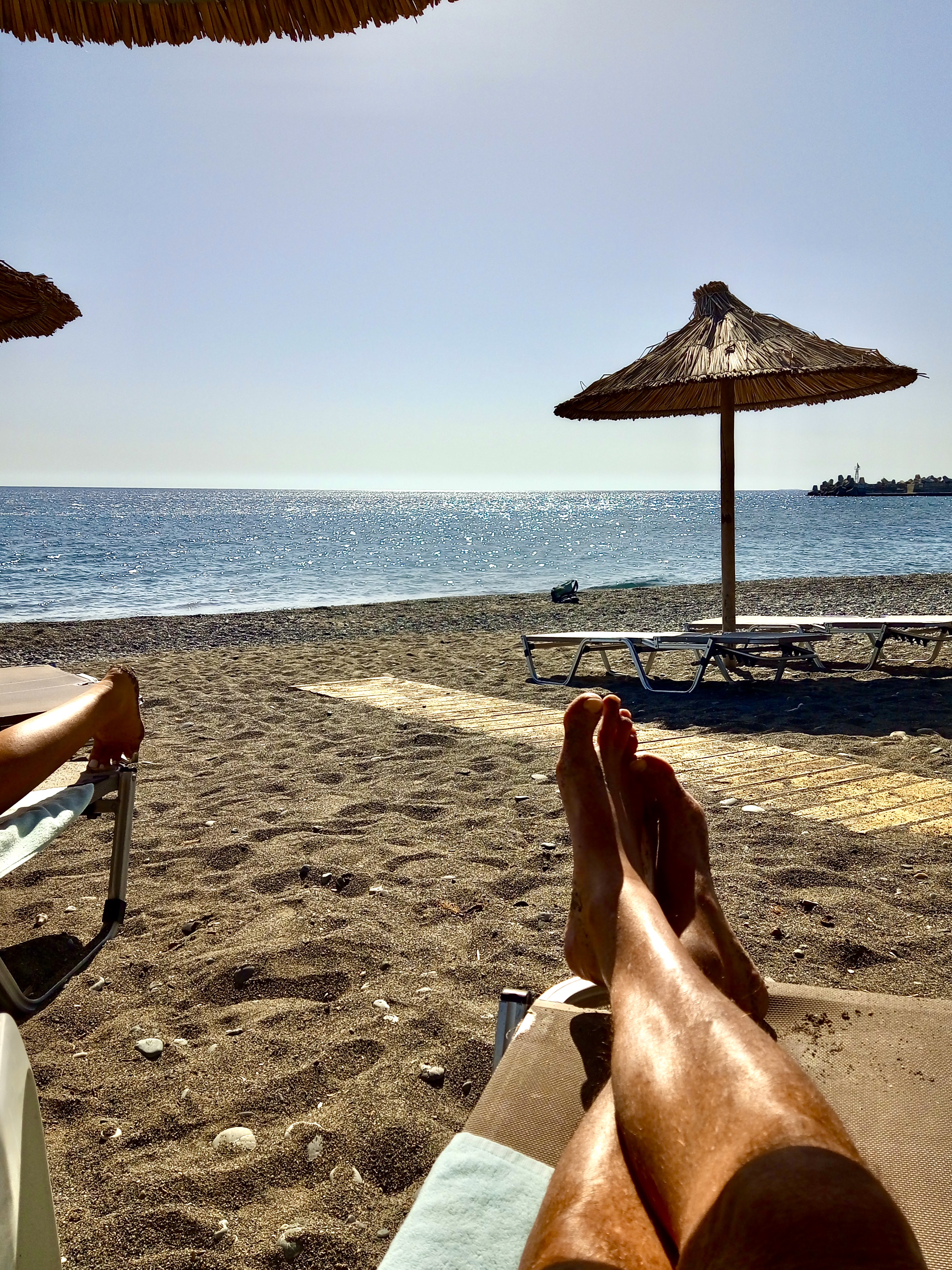
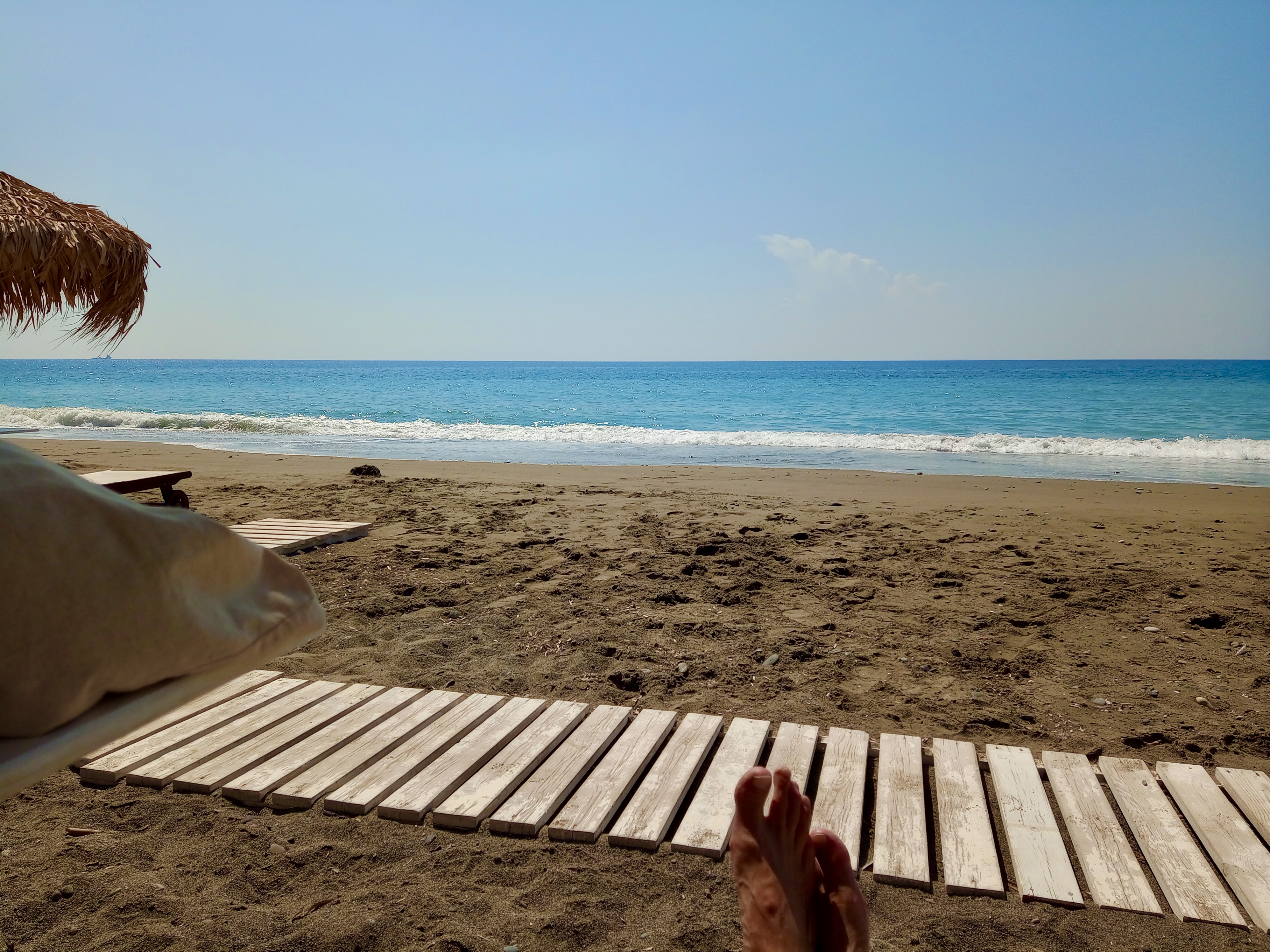
I’ve got so many more photos that it will be better to spread them over a few separate posts, so I’ll just finish off this one with the photo below. Returning to the ‘Indian summer’ theme, this past few weeks the weather here has been simply perfect. I know we need some rain, and we’ll be glad when it arrives, yet right now we’re waking up to bright sunny days of around 25-27ºC and nights are coming in at about 20ºC. The winds are light and the sea warm when you want to go bathing. It’s my favourite time of year because the weather’s bearable, which isn’t always the case during the months of high summer. So, to sum up what our days are like for the time being, here are my feet for your delectation and delight…
I hope that life is tolerable wherever you are. See you soon.
•
Click HERE to go to my Amazon Author Page. There you can browse all of my written works.
This will be the final instalment in this thoroughly sad story. It was with great reluctance that Ron and Janet agreed with their son Dale to go back to the UK, at least for a while, while they assessed what it might take to get the house habitable again, primarily the water supply, as explained in the last post. They made a couple of final visits to the villa, Ron now definitely showing signs of a possible mental breakdown about it all, which is understandable in the circumstances. He couldn’t seem to grasp why there was no water in the taps, no lights came on when he flipped a switch. When you consider the complete devastation that was in evidence right outside the front door, it must have been very fazing to go inside the house and have it all looking normal. To top all that, it was only hours before that everything about their happy life on Rhodes was as normal.
Now, some of these final details I may get slightly muddled, and Janet and Dale will forgive me for this, but the heart of the story is correct, it’s all true. When they returned to the villa a day or two before they were due to fly to the UK (something which Ron was thoroughly wretched about having to do), to add insult to injury, they discovered that some scum of the lowest of the low had broken in. It didn’t look like much had been taken, but there definitely had been a break-in, as the state of the front door testified. As if it wasn’t bad enough that their lovely settled life in the Rhodes sun had been well wrecked already, they now had to deal with the security issue. How on earth would they be able to keep the house secure now that there were no neighbours to keep an eye out? The house stood alone atop a one-kilometre long track with no prying eyes to see what went on up there. Dale reported the break-in to the local Police in Gennadi, who took a statement and then indicated that there wasn’t much they could do. Very reassuring, eh? OK, so the Police obviously had a lot on their hands, but I can’t imagine how I’d have felt if they gave me the brush-off in such circumstances.
Dale did all he could in the time he had available. He rigged up a couple of exterior motion-activated video cameras. With heavy hearts he and his parents then flew home to Cheshire. Ron and Janet no doubt gazing out of the aircraft window as it gained altitude and wondering when, if ever, they’d be able to resume their life there on a hillside on Rhodes.
The next day we received a message from Janet. They hadn’t been back in England even a whole day when Ron had died. He’d sat down in a chair and his heart had given out, it was as sudden and simple as that. I haven’t even mentioned the fact that they also had seven cats back at their home on Rhodes, only one of which had reappeared at the door looking extremely shabby, singed and ash-covered when they’d gone back to the villa, the fate of the other six Janet said they had no idea about. Now she’d lost her husband totally without warning. Dale actually sent me the coroner’s report when it was completed, and it definitely looked as though the stress had simply been too much for him. Had they not had this huge catastrophic event take over their lives just a day or two before, Ron would no doubt even then have still been sitting on his lounger on their terrace back at the house on Rhodes reading the Guardian on his tablet, one of the cats sprawled out beside him. His total reluctance to return to the UK climate from his hilltop Rhodean ‘Shangri La’ had weighed so heavily on him that his body just gave up.
There’s yet another devastating detail to add to this truly tragic story for our old friends and neighbours, the Griffins. A couple of days later Dale sent me a video. His camera had caught the house-breakers as they returned for a second time. Janet sent me a ‘still’ that I couldn’t really make out. Oh the image was clear enough all right, it showed their sun terrace and their front door, and closer to the camera their patio furniture. But just rising from one of the chairs around their table was a man in a camouflage jacket with his back to the camera. Seeing that image, it didn’t kind of compute in my mind. Dale’s video, however, showed this nasty lowlife as he charged the front door and gave it a huge flying kick, shattering the lock and sending the door flying open. He then ran straight inside the building without hesitation. I can’t imagine how Janet must have felt on seeing this brief clip of her beloved home on Rhodes, the place that she and Ron had sunk their lives into and had been their happy home for approaching two decades. Words fail me now, they really do. Janet is still over there in the UK, her son and daughter-in-law trying to give her emotional support, while every waking moment she not only desperately misses her husband of fifty years or so, but has the mental image of this total stranger smashing his way into her house and she knows that there’s nothing that she can do about it. When she does eventually get to return, what’s she going to find? All her worldly belongings, her whole life is invested in that house. Although she and Ron had taken what they could as they fled, there are still innumerable personal effects, belongings, furniture, everything that made up their life for the past almost two decades in there, and there’s this despicable youth rifling through it all.
Below is the video short that Dale sent me. The quality isn’t good, but imagine how you’d feel if this were your home and you were 2,000 miles away at the time…
There’s no happy ending to this story. What drove me to write about it was the fact that it all happened because a fire was started, allegedly deliberately (the truth will hopefully one day come out in the law courts) by a few greedy individuals with a plan to make some money out of a new wind farm. Even worse, it may simply have been some people playing around up in the forest out of pure devilment, arson pure and simple. It wouldn’t have been the first time. Like that Greek Fire Department official said whose words I quoted in the first of these three instalments, “Fires don’t start themselves very often.”
I’m sure that, if I were able, I’d discover many more stories about lives that have been destroyed by this, the worst wildfire in the island of Rhodes’ long history. But there can be few as tragic as this one, because in the space of a few days a good friend and neighbour of ours went from sipping his iced coffee under the brilliant blue sky of a Greek summer on the terrace of the home that he and his wife had built with the proceeds of many decades of damned hard work and toil during their careers back in the UK to losing his life through the sheer shock and stress of seeing all that they’d worked for go up in smoke. In fact, crazy as it may seem, it would probably have been better for them had their house been gutted like the ones either side of it. At least then they could have considered their option to rebuild, hopefully with the proceeds from an insurance payout, and there’d have been no immediate need to worry about the vulnerability of a lone house far from prying eyes.
The next time I post, I shall return to my usual upbeat positivity, but I had to tell you this story. For Janet’s sake I had to tell it. There is little justice in the world anyway, and even if the slimy git that broke into their house is ever caught – and sadly it isn’t very likely – whatever happens to him will not bring back the sovereign right of Janet to the security and integrity of her only home.
And for sure it will never bring back her husband, whom she had stood beside for so many years. During all the time we’d lived next door to the Griffins they’d been inseparable, as are my wife Yvonne and I. I can’t allow myself to even contemplate how I’d be feeling if I were in Janet’s shoes right now. Spare a thought for her. When all is said and done, she still misses Rhodes. We never ever thought about Ron or Janet as individuals, we always, without exception, thought about ‘Ron and Janet’ as an entity. What a tremendous example of a couple who weathered every storm that they encountered for many decades, until that is, they came face to face with the flames, those in all probability purposely-started flames, that brought it all crashing down.
Below is the view from the Griffin’s veranda of the landscape as it is now. The wall is their garden perimeter wall…
•
Click HERE to go to my Amazon Author Page. There you can browse all of my written works.
As the fires drew ever closer to our old home on Rhodes, here in Lasithi, Crete we became ever more glued to the Greek TV news. The announcement was made by the authorities that people in Kiotari had to evacuate as a safety precaution. Ron and Janet took what they could, and reluctantly fled down the track in their car, not knowing what they’d find when they returned. The TV pictures and video were bloodcurdling, and we could only imagine how we’d have felt if we’d still been living there ourselves. Back in August 2008 there had been a big fire in the South of the island and, at that time, two thirds of the sky above our house in Kiotari had turned the colour of a strong cup of tea. Ash and burnt pine needles rained down on us for several days and the Canadairs flew over so close to the ground that we could see the pilots through the windows. Drops of water sprinkled our faces as we gazed up at them.
This time though, Ron and Janet, not really having much of a clue as to what to do or where to go, chose to drive over to the other side of the island, where they assumed, rightly, that they’d be safe. They knew Kamiros Skala well, having often dined at one of the few waterside tavernas there, and that was where they spent the night, trying to bed down in the car, ever wondering what was happening back in their beautiful little valley in Kiotari. Next day they drove back, cautiously approaching their home in the hope that they’d be able to go back up the valley and inspect the site. The lane that leads most directly from the main road up the one kilometre or so distance to the three houses was impassable. The electricity posts had been burnt to the ground and the power cables were laying on the parched earth, making it far too dangerous to try and drive over them. Using the other, less direct lane, however, Ron and Janet made it to their house.
The scene that greeted them was like something out of a Francis Ford Coppola movie. Our old home, which was situated just fifty metres below theirs on the hillside, was still smouldering, flames still flickering on the ground in the garden around the building. It was completely devastated, nothing salvageable was left. The house immediately above theirs was also burnt out, as was all of the vegetation around all three houses. But, for some inexplicable reason, Ron and Janet’s house was still largely intact. The fires had swept right around the house, consuming virtually all of the vegetation in their garden, and yet, apart from a few singe marks and buckled panels on one wall, the house looked still habitable. Maybe there was some hope that their Greek idyll wasn’t to come to an end after all.
The house that we had lived in, where our landlords kept, among other things, two, and occasionally three boats (a jetRIB, a twin outboarded rigid-hulled inflatable and a speedboat) was indeed all gone up in smoke. Our landlords had a lot of personal belongings in that house since they used it many times each year for their summer holidays. In fact John (our landlord’s name is also John) even kept a 4×4 vehicle on the drive for much of the time but, when all is said and done, they would recover. They still had their permanent home in South Wales UK. Ron and Janet however, had burnt their bridges, this was their home for the duration, or such had been their plan. When they gingerly got out of the car to an overwhelming smell of burning and as a view nothing but charred countryside, they were in anguish over what was left of their garden, but heaved great sighs of relief and incredulity to see the house still standing proud. The roof was intact, the shutters still in place, the walls incredibly still white. Had Yvonne and I still been living in the house that had been our home for 14 years over there, we’d in all probability gone with Ron and Janet when evacuating. We would have returned to see everything apart from what we had with us in the car destroyed. Everything we owned would have been history.
They reached their terrace and subsequently their front door, still closed and looking unbelievably pristine. Inserting their key in the lock, they opened the door and went inside, and sure enough the inside looked as if nothing had happened. Their lovely home was still ‘in one piece’ as if by some weird miracle. The houses both sides of them, above and below, were smouldering, whilst theirs stood proud and intact. OK, so the outside environment was like something out of an apocalyptic movie, but at least their furniture, their appliances, their personal effects, everything was still usable, habitable. The only problem was, as they found out almost without at first having thought about it, there was no electricity and no water came out of the taps. There was also, of course, no internet. It took Ron a few hours to get his mind together, whilst Janet thought on her feet. Let’s get one thing clear here, although Ron was the wrong side of 75 years old, he was still, up until the previous day, a fit, strapping and largely healthy man who could walk for miles. When I spoke only a day later to their son Dale, who lives in Cheshire UK, he told me that the only concession Ron had made up until then to the fact that he was ‘getting on a bit’ was that he’d become somewhat forgetful of late, that was all.
Now, I need to explain something here about the water supply to those three houses. Without going into too much detail, the rising water main was located a couple of hundred metres down the valley below the altitude of the houses. This had meant that, when they were built, a purpose-designed system had to be installed that involved a couple of holding tanks, a couple of electrical relay switches, a powerful electric pump, float-switches in the tanks and several hundred metres of both pipework and cabling. This enabled the water from the ‘spitaki’ (as we used to call the little concrete-block hut that had been constructed around the lower holding tank, pump and rising water main) to be pumped up the valley to a massive holding tank some metres above the topmost of the three houses. That circular tank was as big as your front room and made of that heavy-duty black PVC/plastic that I believe is the same material that they make all the irrigation pipes out of too. Its sides were a quarter of an inch thick, extremely sun-resistant and durable. The water supply to all three houses came from that tank.
When Ron and Janet returned to their home, they were at first unaware of the fact that the holding tank at the top of the hill was no more. Where it had stood, submerged in the ground up to its flat-top in a specially dug pit, there was now a partially collapsed hole full of melted black plastic. This fact was only discovered by Dale (a qualified plumber) when he flew over on the first available plane to see what could be done for his mum and dad. In fact he was showing me a live video feed as he trekked up the hill to inspect the tank, following my instructions as to how to locate it.
The upshot of all of this was that, for the house to once again have a water supply was going to a be pretty major undertaking. At first they had no idea what their neighbour above might be planning to do, but they already knew that our landlords had their house on the market and so were more than likely to be applying for an insurance payout and walking away. At the very least they were looking at weeks and possibly months before they could actually live in the house again. The water company had strenuously resisted taking responsibility for the water supply beyond the ‘spitaki,’ even though it would send its representative up to the houses to read their meters, and thus it represented a massive problem for Ron and Janet. No doubt the electricity company would work as quickly as they could to restore power (but that too would involve sinking half a dozen new poles into the ground all the way up the valley), and there would be no expense involved in that, but the water problem was a serious one.
In short, in the space of 24 hours, Ron and Janet’s retirement idyll, their dream life on a Greek island, which had lasted for over a decade, was wrecked. Their son Dale was there in double-quick time to see what could be done to help his mum and dad, but to begin with they had no choice but to find a rented apartment and move out for a while, to give them thinking time. Ron was bewildered by it all, as it seemed this massive shock took its toll on his ability to cope mentally.
As if the foregoing wasn’t bad enough, there was more to come in the sequence of events that was to totally change Janet’s life forever, all in the space of a couple of days. And all as a result of an ‘alleged’ attempt to clear some ground for a wind farm. I’ll write a third ‘chapter’ next.
•
Click HERE to go to my Amazon Author Page. There you can browse all of my written works.
I agonised about whether to write this post, but eventually decided that I should go ahead. I’d like to point out before I start, though, that I first obtained permission from the person whom it primarily concerns before I even started, since it’s a personal story but one that I felt – in the end – ought to be told. There can be few who haven’t heard about the devastating fires on the island of Rhodes back in July this year. They destroyed no less than 15% of the island’s forest and green areas. Although a lot of the hinterland was affected, by far the worst inhabited affected area where there are also businesses and indeed tourist accommodation, was Kiotari, which was our home for 14 years from 2005 until 2019.
We often used to remark that our little valley, at the top of which were just the three houses (eventually), was one of the greenest, if not the greenest, valley on the island. It was blessed with dense forest, scrubland and open fields, and our three houses stood at the head of the valley, not more than a kilometre and a half from the beach, with views stretching down to the sea beyond. There were deer in the valley regularly, often right outside our front gate. There was a local shepherd who’d graze his substantial flock of sheep there all through the winter months, and regular herds of goats would meander the trodden paths that they themselves had made over the years, the sound of their bells reaching our ears as we pottered in our well-tended gardens. Above us would circle great birds of prey, and in summer the European Bee Eaters would arrive to grace the landscape with their presence, not to mention Swallows, Martins, Swifts and Wheatears.
From what I have read and heard, the fires were started a long way north of Kiotari, not all that far from the Elafos Hotel at Profitis Ilias, and that there have since been a few arrests made because, in all probability, the fires were started deliberately. I heard a Greek Fire Department official say on national TV whilst the fires were raging that, “Fires don’t start themselves very often.” He’s right, of course. Whereas it’s not impossible for circumstances to conspire for a fire to start spontaneously, by far the usual cause is either human stupidity, or human devilment (which rather involves the other reason too, doesn’t it?). One TV report showed a map of the area very close to Profitis Ilias where there had been a proposal to install a wind farm, and the proposal had been turned down, since the construction of said wind farm would have necessitated the cutting down of not a few valuable trees and natural habitat. The first reports showed that the fires were coincidentally positioned all across the area where the wind farm had been planned to go. Odd, eh? The only trouble was, the weather conditions in July this year were such that there would have been no way to contain any forest fires once they’d taken hold, as the subsequent disaster that unfolded well illustrated.
We were soon transfixed to our TV screens as the horror of just how extensive the fires were becoming became apparent and, as they grew closer and closer to our old home area, our thoughts turned to our old neighbours still living there, Ron and Janet Griffin. Now, if you’ve read any of my ‘Ramblings from Rhodes’ books, you’ll have encountered a couple called ‘Mac and Jane.’ Needless to say, their names were changed, but only slightly. I chose ‘Mac’ because when thinking of what to call Ron I could only think of ‘Ronald MacDonald,’ or ‘Mac,’ for short. In Janet’s case, using every bit of my extensive imagination, I simply removed the ’t’ from the end. In writing up this post I decided that there was nothing to be gained from continuing the subterfuge, and so here I’ll refer to them by their real names. Ron and Janet were the perfect neighbours for over ten years. Their house was the second of the three that were built at the head of our valley, and it stood about fifty metres up the hill from ours. We regularly sat on the terrace together over an iced coffee and put the world to rights, and Ron was always there when I needed another pair of hands for some DIY job or other, as I was for him. We would lend each other tools and always give them back as soon as we’d finished with them. On some occasions we had major problems with the water supply for the houses, and Ron and I would run up and down the steep hillside using our mobile phones to communicate, while we fixed electrical cables that had been chewed by mice, float switches that had gone ‘open circuit’ and a burnt out pump once too. If we travelled anywhere Ron and Janet would take us either to the port or to the airport, and we’d do the same for them, allowing whichever couple was travelling to leave their car at home on the drive.
In short, back in the summer of 2019 when we learned that we were to lose our rented home, it was a wrench leaving such great neighbours behind. They were going to miss us, and we them. As the fires this year swept across the island of Rhodes and grew ever closer to Kiotari, we wondered if our old home (still owned by our friends and landlords, who hadn’t yet found a buyer for it) would be affected, and even more so we worried about the Griffins, since their house was their sole home. They’d sold up in the UK in the early 2000’s to go and live the dream and had in fact been doing just that for well over ten years – until now. Ron simply loved his life on Rhodes. He used to hate the idea of going back to the UK, even though they’d usually do so once a year in order visit with relatives, particularly their son Dale and his wife and their young son, the grandchild who Janet naturally doted on. Ron loved the climate on Rhodes, and he loved the lifestyle that he and Janet had carved out. Despite all the bureaucracy and the frustrations that sometimes make your brow furrow, it was all worth it for the hot sunshine in January, and the long languid taverna evenings in a Rhodean summer time. Janet loves gardening, and was always busy in their extensive garden too.
Why did I call this post ‘Consequences?’ I’ll tell you. It’s because when people start fires, and it will be yet some months before whoever is charged with starting those on Rhodes in July 2023 are brought to court to answer for the charges against them, I wonder if they ever gave a moment’s thought to what the long-term effects might be of the avarice that ‘allegedly’ led them to set flame to undergrowth? They may have simply thought, ‘We’ll clear the area, and then we’ll get planning permission to build the wind farm. Cash in the bank. Slam dunk.’ Only, the extent to which those fires eventually devastated that island was in the end unprecedented. Many people in Kiotari lost their livelihoods, their homes, in fact all they had. One person that I know of, and there might well be others, lost his life. That person was our old friend Ron.
I’ve a lot more to relate about why I allege that our friend Ron lost his life as a direct result of those fires, and that’s for the next post. I want to tell the whole story as I see it, and it’s probably much too long for one single post. I said at the top of this piece that I agonised about writing this one up. As a rule I like to be positive, to write things that encourage people to want to experience Greece. I don’t generally like to dwell on the negatives. But what happened to our old neighbours, and indeed the house that we’d called home for 14 years, has had such an affect on us that I eventually felt compelled to tell the story as I see it. Like I said too, I wouldn’t even begin to write this awful tale, had I not first sought the permission of our friend and former neighbour Janet. If you like, by the time I’ve finished the whole tale, it will stand as my modest tribute to our old friends, and especially to her late husband Ron.
The next post will continue the story.
•
Click HERE to go to my Amazon Author Page. There you can browse all of my written works.
The chap in the orange shorts and top is Mihalis, the lifeguard on the town beach in Ierapetra. I took this one from our favourite spot on the beach, where we go for a swim twice a week (sometimes more) throughout the season. As you can see, Mihalis has just posted the red flag, meaning no swimming allowed owing to the difficult sea. This was at 10.00am on Friday September 8th. It was a day or two after those devastating floods hit central mainland Greece during what the meteorologists called ‘Storm Daniel.’ That link takes you to a site where the storm is decribed in more detail, but I’ll just quote one chilling statistic from that page here: “…rainfall in Greece on 5-6 September …a reported 750 mm falling in 24 hours at a station in the village of Zagora. This is the equivalent of about 18 months of rainfall…”
The worst we saw here was the sea becoming agitated for a couple of days, which on reflection almost makes one feel guilty when you see what happened to not only Greece, but of course to Libya as well. The town beach here in Ierapetra, since it has a permanent lifeguard stationed on it all through the summer months, is hence classed as an organised beach, which is intended as a protection for the public, not as a needless restriction. Since we plonk ourselves this close to Mihali and his girlfriend Stavroula (also a qualified lifeguard) a couple of times every week, we’ve become pretty friendly with them as the summer’s progressed. Life as a beach lifeguard isn’t as exciting, or indeed as easy as one might think. For people who only visit for a week or two during their vacation, when they see the likes of Mihali and Stavroula lounging in their beach chairs, idling away the time under a brilliant blue sky, they may be forgiven for thinking, ‘What a gig. I’d love some of that.’
The reality is that Mihalis and Stavroula are driven half mad with boredom most of the time. They can’t really read or listen to music, because they need to have an eye on the people using the beach (in both directions from their ‘station’) all of the time. They usually arrive around 10.00am and are there until late in the afternoon, even into the evening during the really lighter months. They have to prepare themselves a packed lunch, since once they start their shift there’s no sloping off for even a couple of minutes. Imagine what would happen if they were to be absent just when someone got into difficulty in the water. So they have to stay in situ all the time until they can knock off. Mihalis is a thinker, and we’ve had quite a few conversations about the state of the planet and the prospects for any young Greeks wanting to carve out some kind of career whilst not having to emigrate from their homeland. That’s why he’s not a happy bunny. The trouble is, opportunities for him to ‘get on’ in the world are limited. In fact he’s thinking of going to Australia next year, where he hopes that life may be better, or at least the wages.
So, when the dawn came on Friday September 8th and the sea was rough enough to tempt even a surfer to go in, Mihalis saw an opportunity to be ever so slightly more busy than he usually is. Normally the bathing’s very safe on this beach, and most of the sea bottom is sandy all along its length. But, when the sea gets like this (see below) it can carve out a shelf in the bottom just a couple of feet from the water line, causing the unexpected bather to stumble and fall over. Plus, around fifty metres out from the water’s edge there are in places some large rocks that rise up to within a couple of feet of the surface when it’s calm (they are what’s causing that secondary surf-line a little further out in the second photo below). In calm conditions it’s a nice place to go snorkeling, but when the sea’s like this, it presents some challenges that involve potential danger…
Most of the time, it’s like this…
Mihalis, having hoisted the red flag on Friday Sept. 8th, was then kept busy trying to keep would-be swimmers out of the water. In order to do this he was constantly having to blow his whistle to attract the attention of people blithely going in for a dip. In fact, I almost entitled this post ‘Whistle while you work,” good eh? Now, you might think, ‘What’s the big deal? I’ve seen waters much rougher than this,” and you’d be partly right. The problem is though, if lesser experienced ones were to see others already in the water, they would be tempted to go in themselves too, and they may not be at all ready for the buffeting they’d be going to experience. One shoulder-high wave knocking someone over could be all that’s needed for a drowning to take place.
At one point when his back was turned, four or five ya-yas went in about thirty metres out for a chat while treading water. When Mihalis saw them, he blew his whistle and told them through his loudhailer to get out of the water. One of them piped up in reply, “You don’t need to worry about us. We know the water, we’re in no danger.“
‘It’s not you I’m worried about!” Replied Mihalis,“It’s less experienced ones thinking that if you can go in then so can they. Now I’m giving you sixty seconds to get out or I’ll be taking your details and you’ll risk a fine!!” The old ladies reluctantly complied, but not without a fair degree of ‘mourmoura‘ in the process. During the hour and a half or so that we spent there that day, he was constantly running back and forth along the beach while people kept ignoring the red flag and trying to get in for a dip before he could spot them. His whistle was a constant feature.
At least he and Stavroula had something to be getting on with that day. The next day it was flat calm sea and business as usual. Here are some more photos from this past few days….
Above: See that turquoise flask with the flat top, well that’s one of two such re-usable ‘cups’ that we take with us to the beach every time. The straw is one of two metal ones that we re-use also. When we get to the Volta Café, either Maria (the owner) or Gianni (the regular waiter) takes them from us and they prepare our freddo espressos in them. It’s not much, but at least it’s a tiny effort to use less disposable coffee cups, plastic lids and black plastic straws. In fact, as I understand it, for some reason black plastic isn’t recyclable, and it does pain us to see how many café-bars still use those straws all the time, and they come wrapped in cellophane too. I”m not saying we’re anything special, but shouldn’t we all be making a bit of an effort to help the environment, eh? Oh, and the beer? Just a little extra I ordered when my coffee was all gone. The crisps are complimentary too. I bet they’d cost an extra couple of quid in a UK pub.
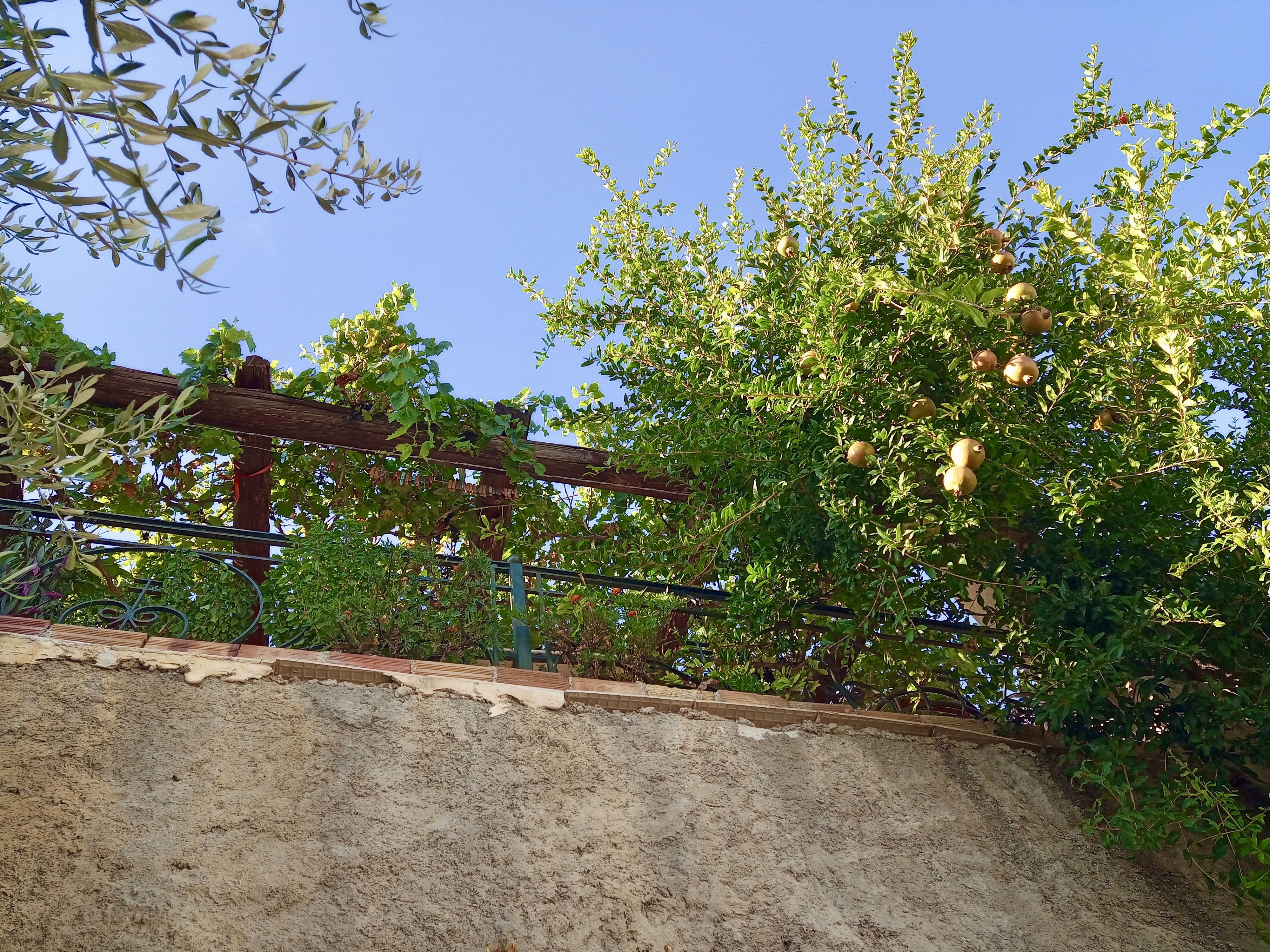
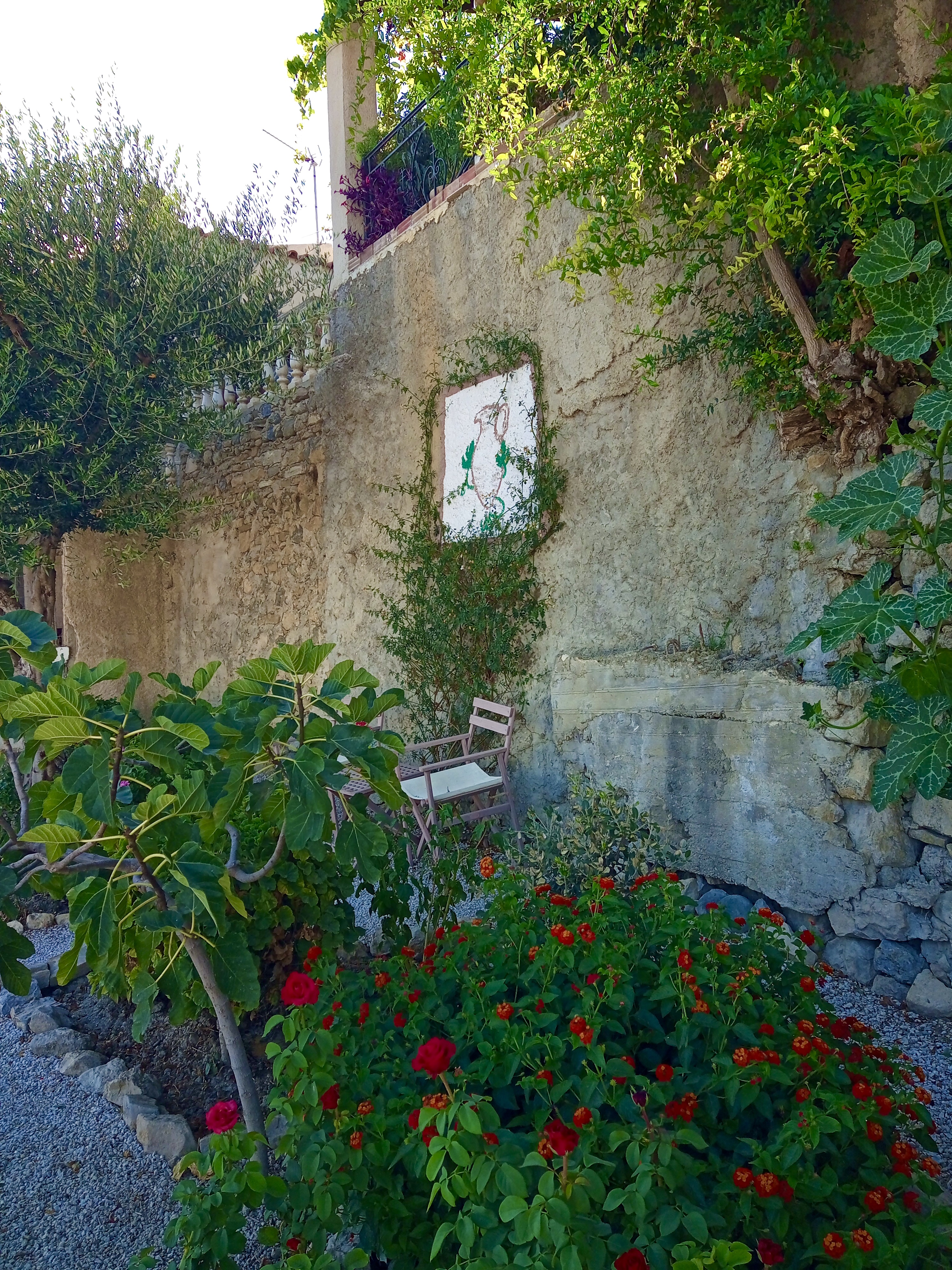
Above: Looking up from our upper garden, that self-seeded pomegranate’s doing well this year. The jasmine’s slowly framing the mural too, which is gratifying.
Above: The beach at Gra Ligia, which never gets any busier than this at any time during the summer.
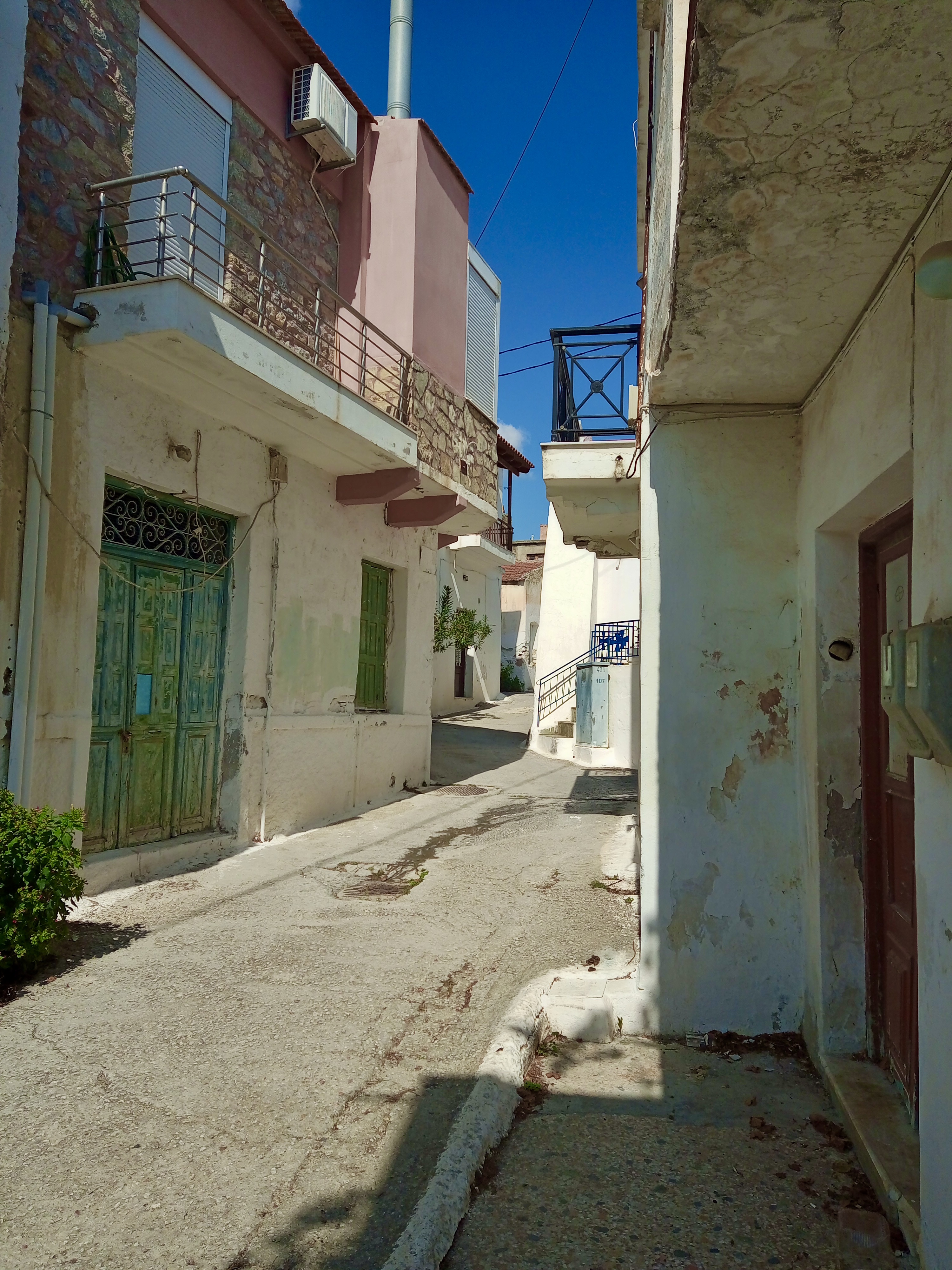
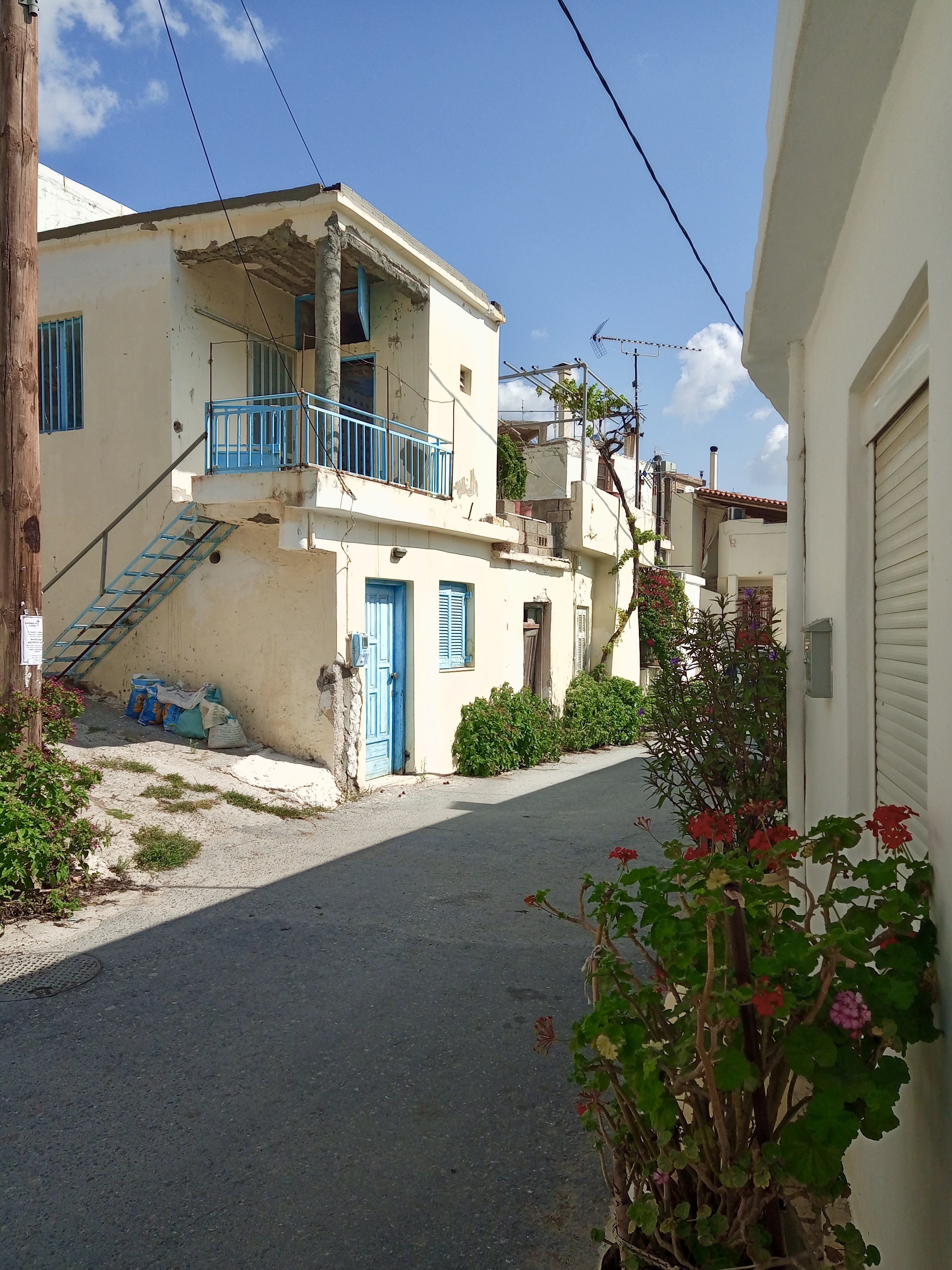
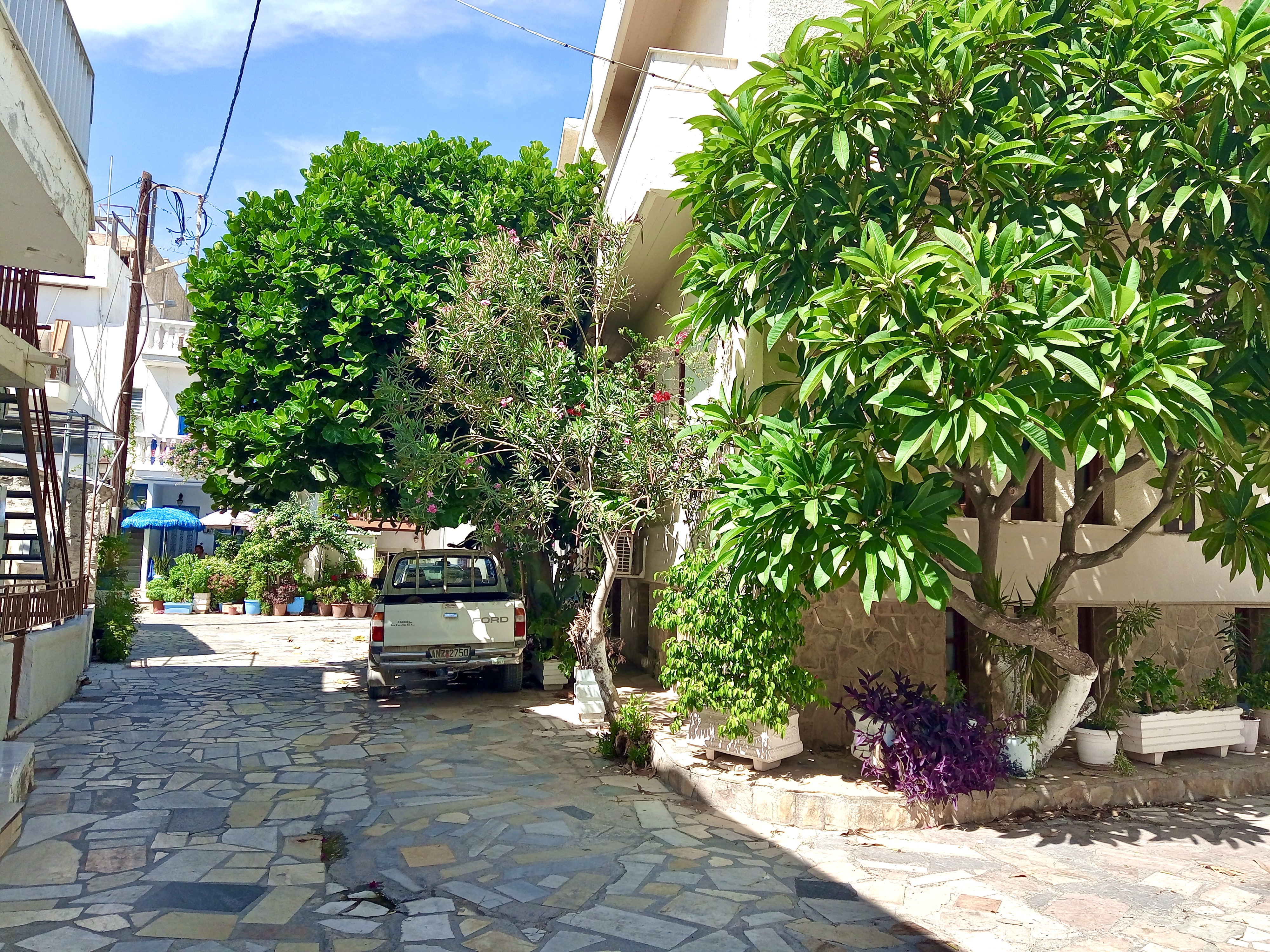
Above: And finally, two shots in the old town. I just like those little corners that spring surprises on you.
•
Click HERE to go to my Amazon Author Page. There you can browse all of my written works.
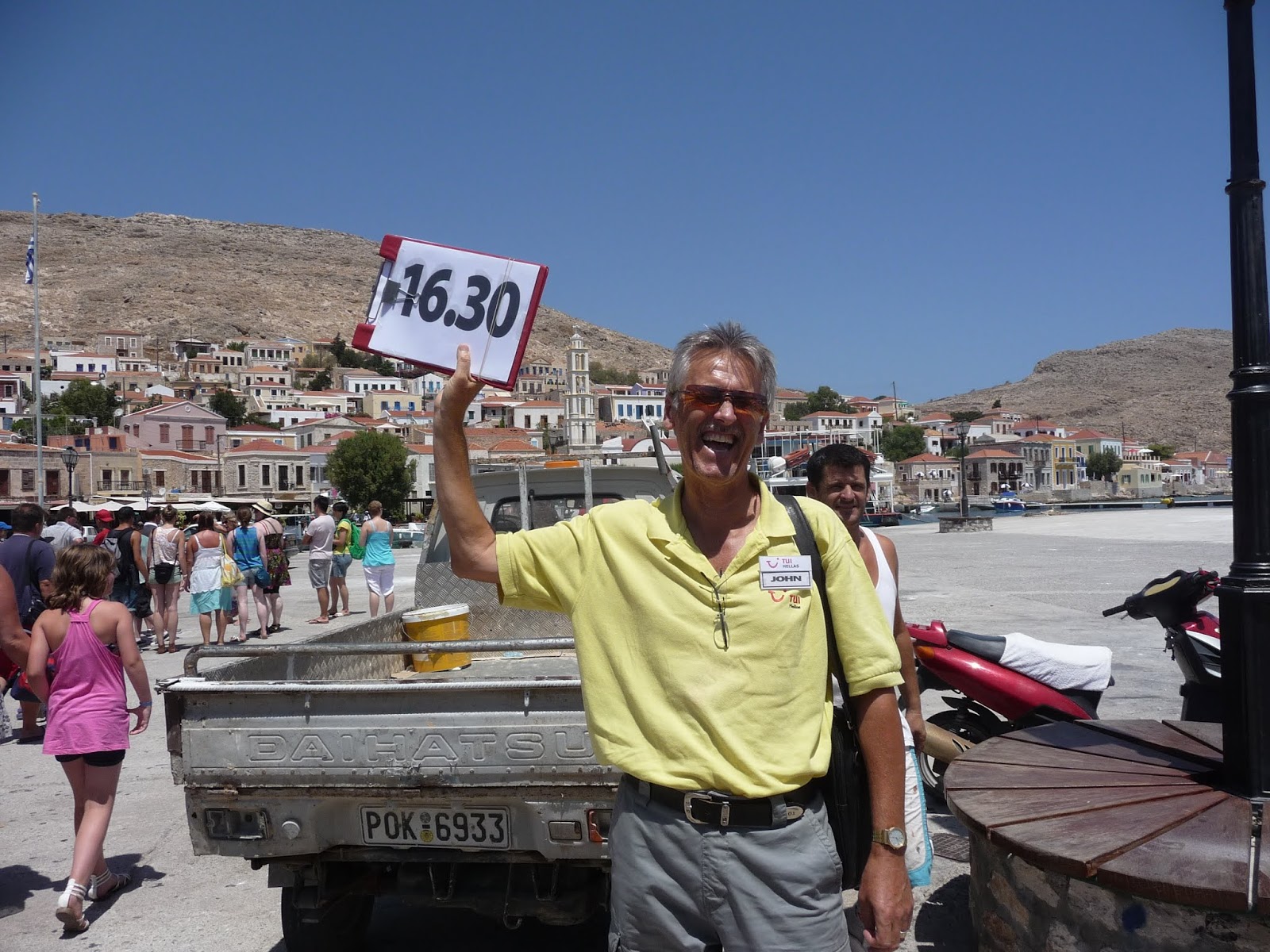
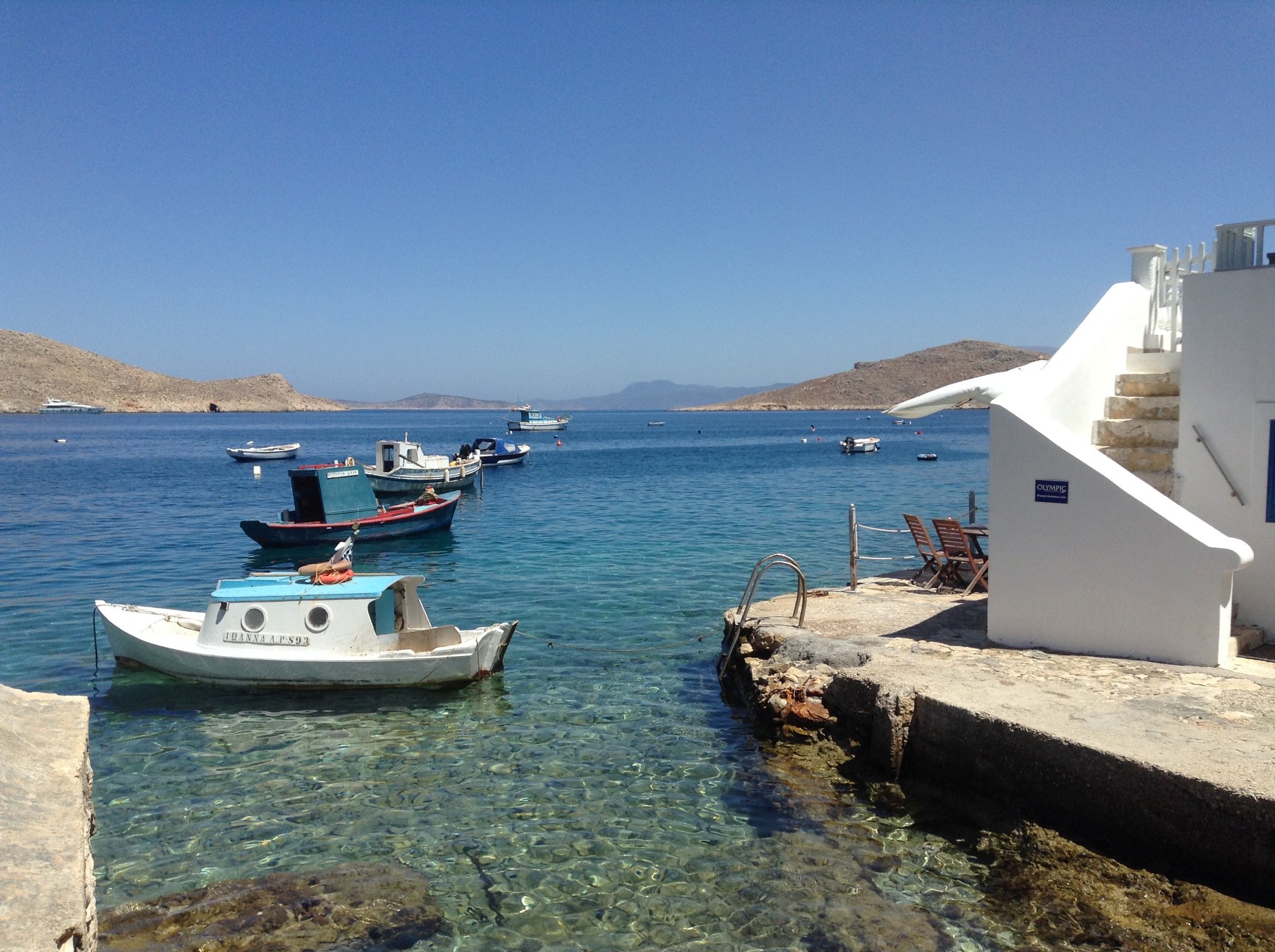
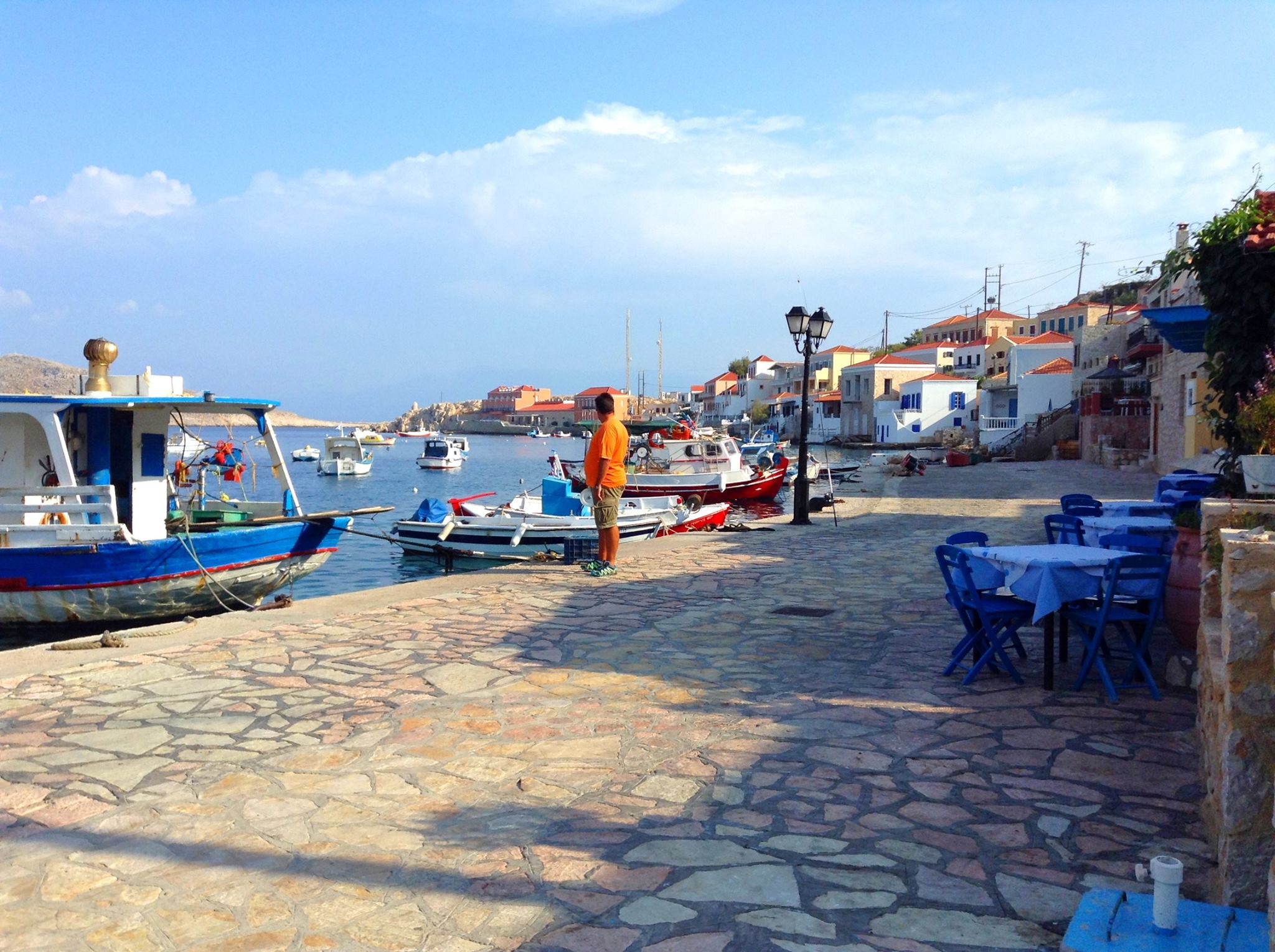
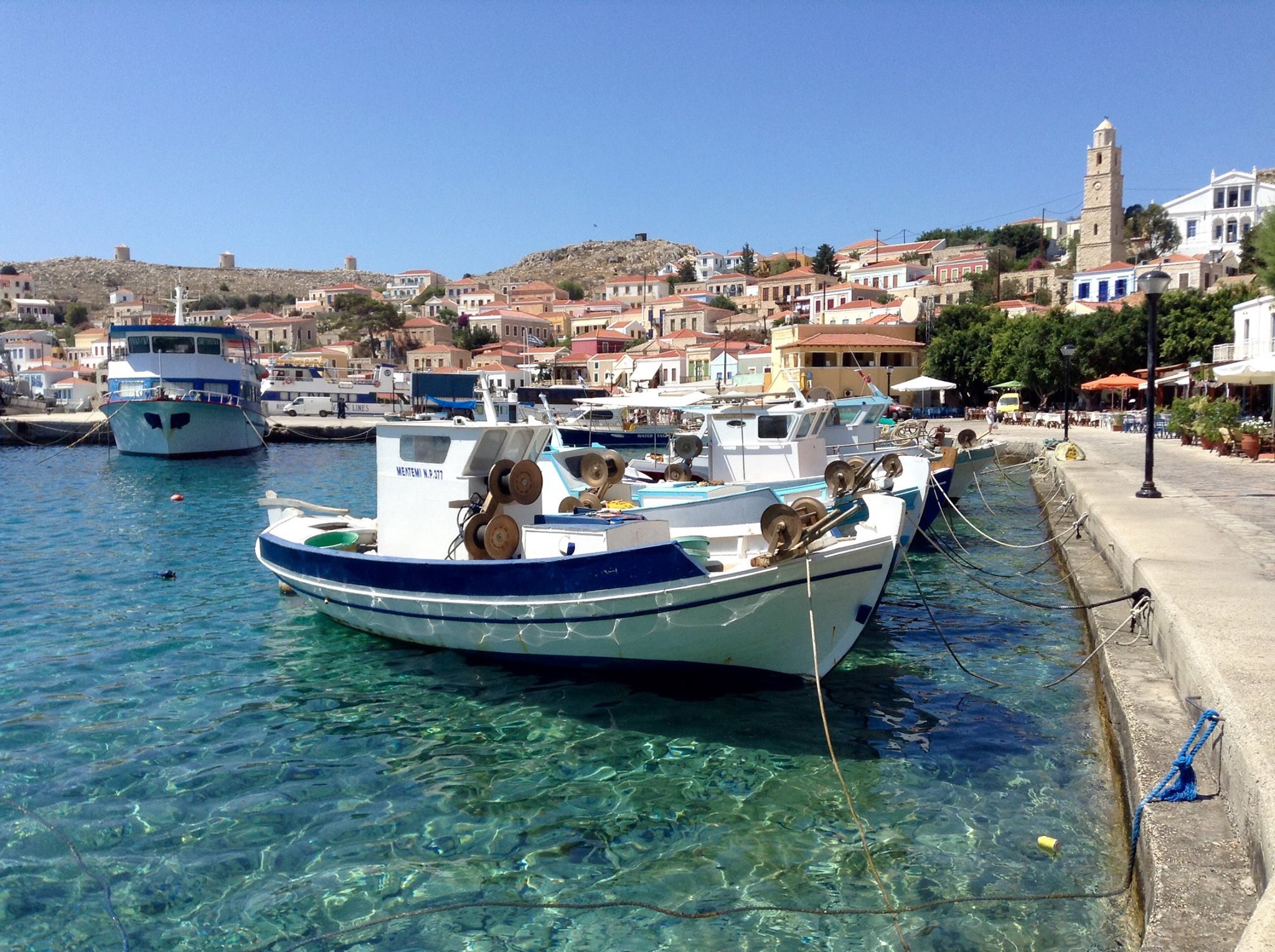
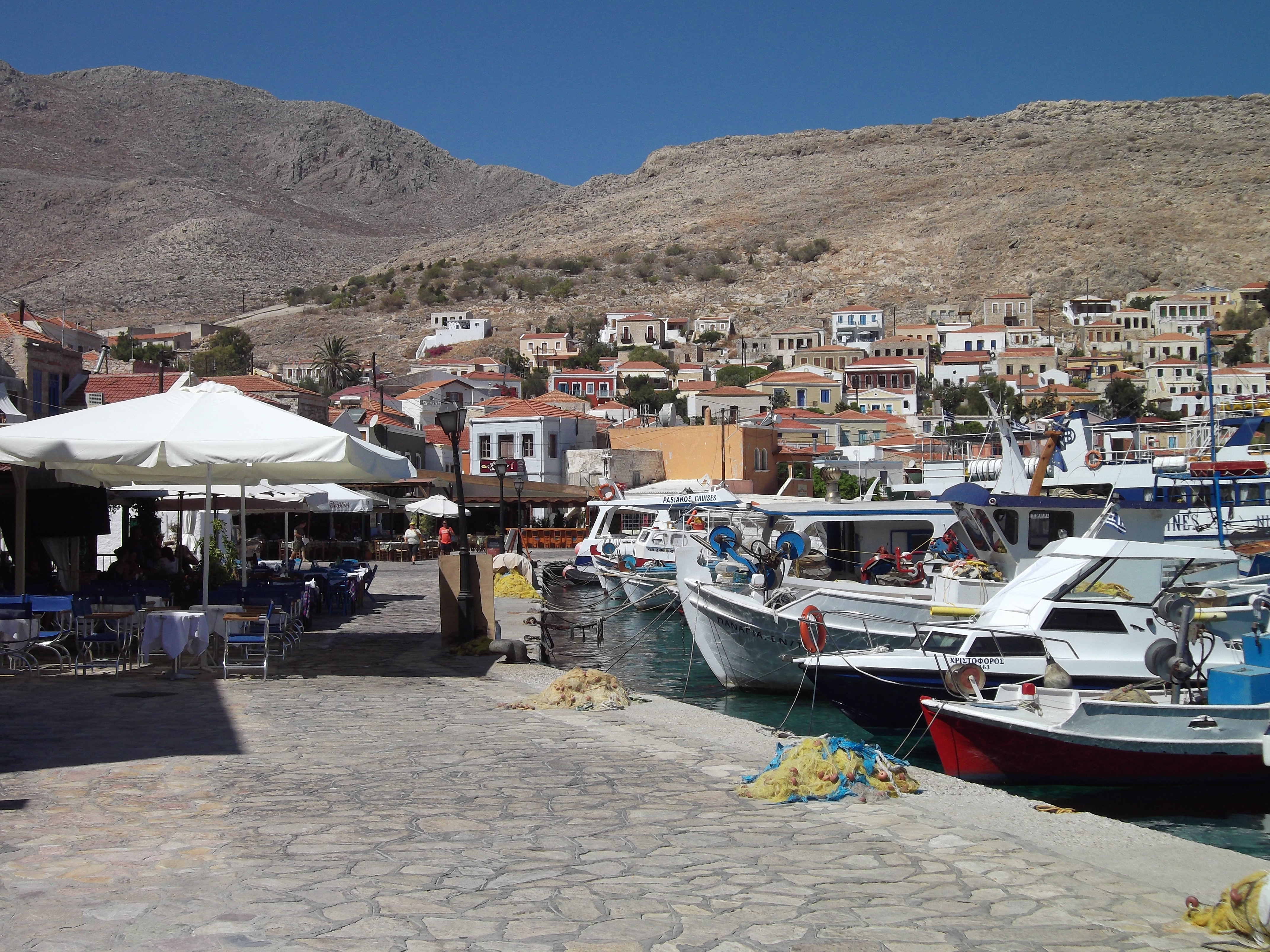
Way back in the mists of time, I used to do a regular excursion as an escort from Rhodes to Halki. In high season sometimes I’d do it two, even three times in a week. It was a long day out and the pay was rubbish but, to be honest, in general I enjoyed the work immensely for several reasons. One, the island of Halki is still probably one of my favourite places not only in Greece, but in the entire planet. It’s wonderfully small, sleepy, a long way from the major tourist traps of the world, and extremely photogenic. During my ten years as an escort, I worked for a number of different companies, and I did the Halki trip mainly for Travel Exchange and TUI. In both cases I had wonderful fellow workers to spend the time with and have, as a consequence, some indelible memories.
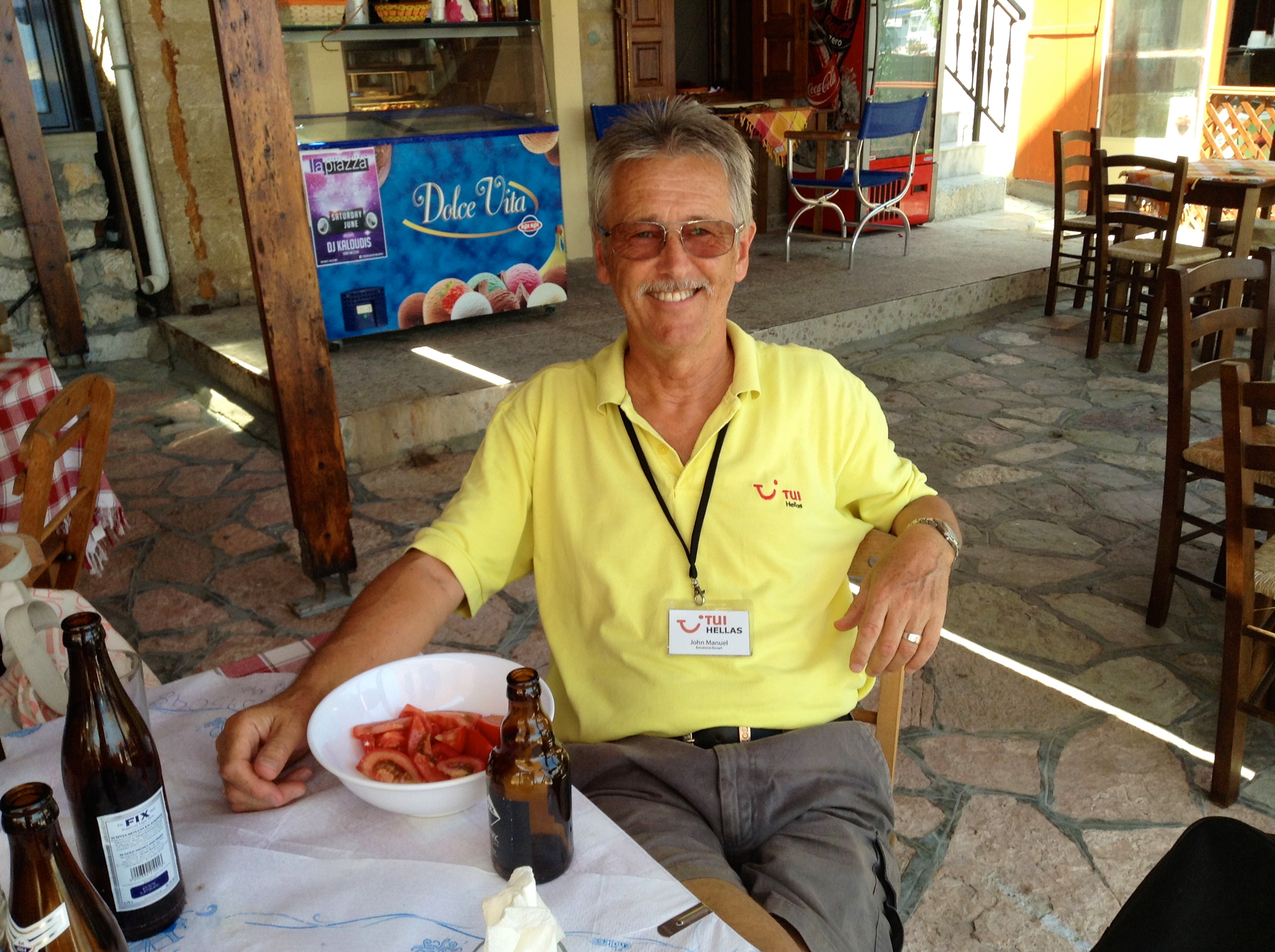
We’d usually do a slight detour to Butterfly Valley before heading down the west coast of Rhodes to the tiny port of Kamiros Skala, quite a few km further south from Ancient Kamiros. Arriving on the quayside, we’d shepherd our guests on board the boats and set out for the crossing of around 75 minutes from there to the picturesque harbour at Halki. While working for TUI, I had to wear a TUI polo shirt, but from the waist down (careful girls) I could wear whatever I wanted, which, inevitably would be a pair of tailored shorts from my own wardrobe. My fellow escorts would do the same (female or male, we all dressed the same) and so, apart from the fact we wore ID badges too, the guests could easily spot us on the quayside, especially for the return trip, when there’d be an almighty scrum to get back aboard before the boat cast off for the return trip, usually around 4.00pm, sometimes 4.15, and sometimes 4.30.
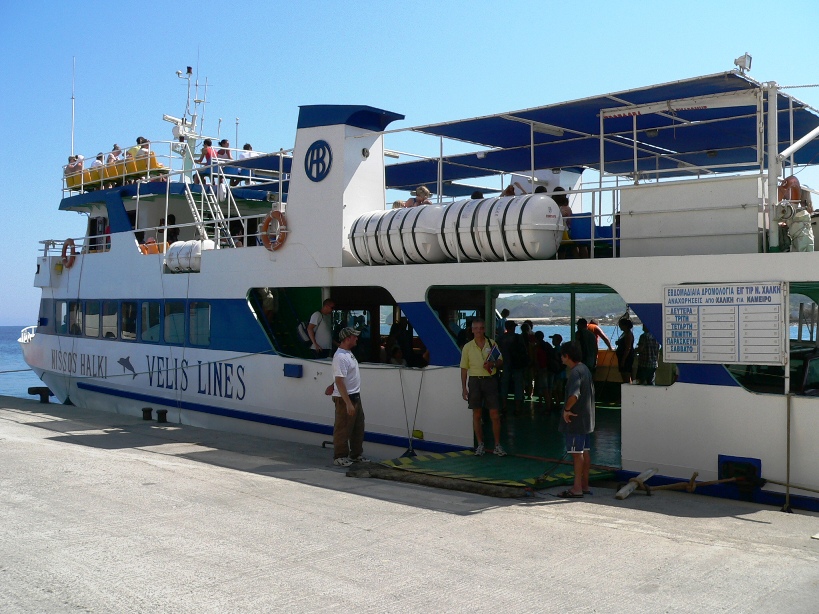
Nine times out of ten I’d be on board the Nissos Halki. Another boat that does the crossing and is of a similar age to the Nissos Halki is the Nikos Express, although she was a might slower and usually arrived a few minutes after us at the island. In the last few years during which I did the trip the brand new Fedon also joined the fray and cut around 20 minutes off the crossing time for those fortunate enough to get on board her. The Nissos Halki and the Nikos Express both had a small vehicle deck at the stern, capable of carrying up to four vehicles at a push. The Fedon has no vehicle deck, and was much sleeker as a result.
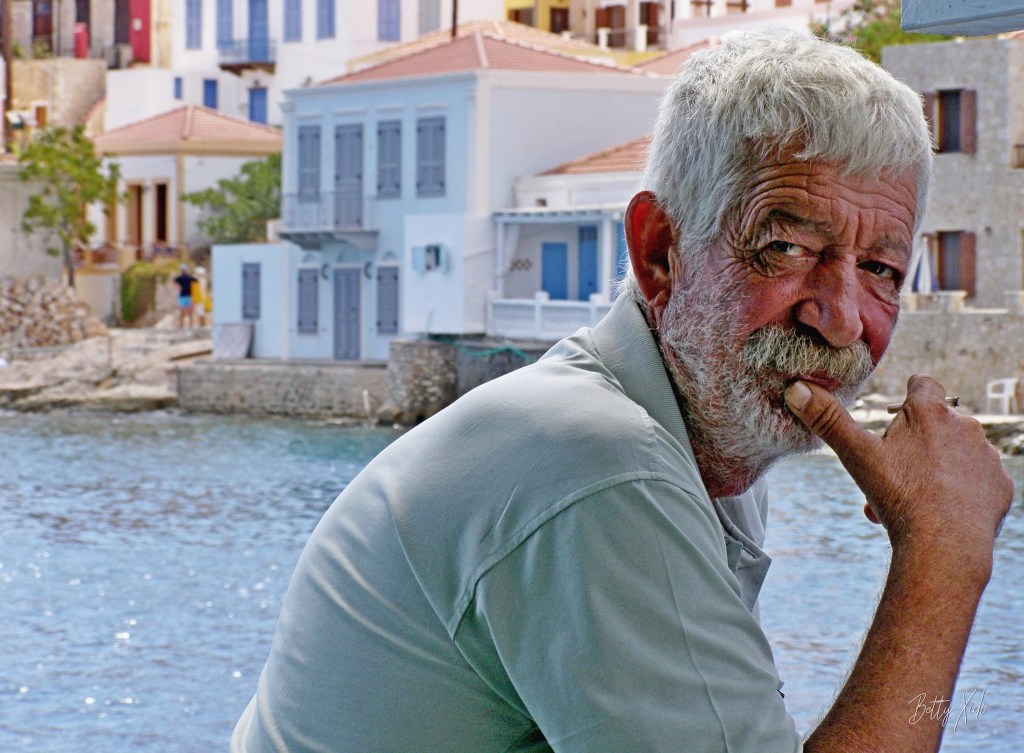
Once we cast off from Kamiros Skala us reps would make a bee-line for the open-air bar on the upper deck and procure ourselves an iced coffee, for which we didn’t ever have to pay, of course. Coffee in hand, we’d make our way back downstairs and either go into the air-conditioned salon, which in good weather was only ever occupied by a few locals, since all the tourists would be as high up on the superstructure as they could get in order to catch a few rays during the crossing, or we’d sit on a couple of plastic patio chairs that the crew kept on the vehicle deck, just near the doorway into the salon. Within ten minutes of having made our departure, we escorts would be nattering about our charges and all the dramas that we’d encountered since we’d last been together. Usually sitting along with us there were a couple of crew members, one of which was always Alexandros, the guy in Betty’s photo (next shot below). He’d be one of those who handled the mooring ropes whenever they tied up, or perhaps he’d operate the electric motor that raised or lowered the side ramp when we were at the quayside, since they hardly ever tied up astern-to-the-quay, but always port-side to it. Occasionally the electric motor would play up, and then a couple of crew would have to raise or lower the very heavy steel-plate ramp by hand pulley. You didn’t want to get in their way when they were doing that.
Photo courtesy of Betty Xidi Photography
During the almost ten years or so that I did the Halki excursion, Alexandros was a member of the crew on the Nissos Halki, and he looked as old when I first met him as he does now. Many Greek men who work out in the sun for decades, seem to acquire that leathery-look to their skin when still quite young. I’ve never seen a crew member applying suntan cream, that’s for sure. Alexandros still has a good head of grey hair, whereas some lose theirs early and thus may look older than their years. As we’d sit and chat in subdued tones during the crossing, crewmen like Alex would tell us stories about their years doing the back-and-forth trip, plus they’d regale us with anecdotes about island life, since they all had other work that they’d do in wintertime as well. In the course of one season alone, you very quickly became fast friends with the likes of him. After several years on the job, you were very easy in each other’s company.
So it was that one particular day, as we set sail from Kamiros Skala, I sat down on the vehicle deck with my coffee, having pulled up one of the rickety, cracked patio chairs, and began a conversation with Betty, Grace, Mihali, and whoever of the crew was around too. As we sat there I would often marvel at the fact that there’d be maybe two vehicles making the crossing this time, one of which was a van, and the other a pickup, and both were loaded down with supplies. They were always shoehorned in aboard among the pallets carrying white goods (new fridges and washing machines for island residents), crates laden with fruit and vegetables, and a variety of building materials like sheet-rock (plasterboard), cement bags and pipes for water etc. On more than one occasion we made the crossing with a coffin under a tarpaulin also installed on the rear deck.
On the day in question, I remember accidentally glancing down at my lap, you know how sometimes you get a sense that something’s not right, but you don’t really know what it might be (more than likely I sensed a bit of a draught around the old turntables)? Well, as I glanced down I got a full view of the front of my underpants, which thank goodness I am in the habit of wearing – most of the time anyway. The fly on my shorts was gaping open, owing to the fact that I was sitting down, you get the picture I’m sure. Thinking that it was just a matter of zipping them up, because it wouldn’t have been the first time I’d got dressed in a hurry and fled the house before zipping up my shorts, I went to do so, only to discover that the zipper was already at the top. The flaming zip had only gone and burst open hadn’t it. Since we were surrounded by a few dozen holidaymakers and they were looking to us with a degree of confidence, I didn’t think it would be a good idea to ask one of the girls I was working with to see if she could sort the problem out. Can you imagine what kind of photos would have soon been all over the social media if I’d done that? I hastily placed my clipboard over the offending wardrobe malfunction and asked around if anyone had a safety pin. No one did. I still had around 6 hours in the company of my guests to get through and so far I had no prospect of being able to close up the fly on my shorts. I occasionally like to be thought of as ‘flash,’ don’t we all chaps? But I didn’t want to be known by that epithet for the wrong reason.
Step into the breach (appropriate metaphor, eh?) Alexandros, crusty crew-member.
“Ela Gianni,” He said, and beckoned me go up the steps with him to the bridge. The bridge on these boats is only a few metres wide and very narrow. All along the panel below the front windows are the sparse controls for running the ship, but along the back wall (or is that a bulkhead?) is a padded bench, which we would occasionally employ in order to take a nap when we wanted to be somewhere where our guests couldn’t poke us when they wanted to ask some question or other. Alexandros bade me come with him into the bridge itself, and then he lifted up a section of the padded bench. Sorting among the ancient lifejackets, flares and other paraphernalia, he lifted out a fairly serviceable pair of shorts, kind of coffee-coloured. They looked to be an OK cut too, thank goodness. In fact, they were in pretty good condition and, most importantly, the zip was intact on the fly.
“Take these down to the WC Gianni, and try them on. I do use them quite often, but if they fit you well enough they’ll see you through today without risking arrest, won’t they?” He said that last bit with an ear-to-ear grin on his wizened face.
Off I trotted, down the stairs to the ship’s toilets, entered a cubicle and, to the gentle rocking of the boat as she made headway between the islands, I got my own shorts off, and Alex’s on. I was well impressed with the fit too. Phew, saved. Returning to the bridge, where Alexandros had remained, awaiting my verdict on the borrowed shorts, I thanked him profusely and did a twirl.
“Bravo, Gianni!” Was the chorus from all the crew inside the bridge, and Alex added, “But if you don’t mind, I’ll have them back on the next trip, OK?” I didn’t have a problem with that, of course.
Only, actually, I did. The following week, which was the final week in the season that we were doing the Halki trip until the next year, I was assigned to the Fedon, and not the Nissos Halki. I had packed the shorts in my rucksack with every intention of returning them to their rightful owner, honest. The only trouble was, once the day got under way, the fact that I was on the Fedon sent the shorts that lurked in the bottom of my bag to the back of my mind. In fact, I got home at around 9.00pm that evening, exhausted, as I usually was after having left the house at 6.00am that morning, and only then, as I sorted out the contents of the rucksack, did I discover Alex’s shorts, still there, neatly folded and protected by a plastic bag all ready to be given back.
In actual fact, I didn’t know at that point that we’d not be doing the Halki trip the next week, as the weather often dictated exactly when we stopped the trip from going. So I fully intended to have another go at giving them back the following week, but it wasn’t to be, as the trip was stopped for the winter. Alex and his shorts were parted and there wasn’t much that could be done about it until May the following year. The situation was further exacerbated when I changed my working arrangements and, although I hadn’t planned it this way, wound down my excursion work in readiness to give it up all together. I never did another Halki trip as an escort.
This would have been (the broken zip affair that is) around 2017-2018, not entirely sure now which, but, just yesterday, we went to the beach for an iced coffee and a swim at Gra Ligia and guess what shorts I wore? I’ve never been one to chuck out clothes that are still serviceable, however I’d procured them. I wonder whether Alexandros has forgiven me. I think, from what I know about him as a person, that he probably very soon realised what had happened and wished me well in my relationship with my newly-acquired cargo shorts. I suppose there’s always the possibility that we’ll once more set foot on Halki some day and, if we do, I’ll seek out my old friend and see if he wants his shorts back then.
Incidentally, not letting an opportunity slip, the wonderful island of Halki is the setting for the fictional island of Spilos, where most of the action takes place in my novel “Sometimes You Just Can’t Tell.” Just thought I’d slip that in…
•
Click HERE to go to my Amazon Author Page. There you can browse all of my written works.
Following my last post in which I unashamedly reminisced about the good old days of the small Greek tour operator, the response I received prompted me to go looking to see whether there were any half-decent small companies still out there providing the essential Greek experience. To be honest, I’ve been amazed at what I’ve found. So I thought I’d do a brief post full of links for anyone out there who might still be looking for a holiday in the ‘real’ Greece, away from the sun/sand/swimming pool/sweaty masses.
So, the list of links below is of current companies all of whom offer the true Greek experience. I can’t recommend any of them personally (oops, with the exception of Olympic, who I have even worked for while on Rhodes), as I’ve never used any of them, but their websites lead me to believe that, were I still a UK occupant, I’ve give them a try when looking to book my next visit to this exceptional and unique country.
Some of the links are to companies that don’t only offer Greece, but the Greek experience that they do offer looks authentic enough. Others are actually sites that list recommended operators that do Greek holidays of all types. Some too are also very location-specific, but nevertheless do offer a ‘real Greece’ experience in those locations…
If you know of any that I have not included in the above list and that would be worthy of inclusion, by all means get in touch. I’ll probably end up making a dedicated page on this blog to help readers on a permanent basis to find the genuine Greek experience, rather than the awful homogenous massive hotel breaks with zillions of other tourists in overly-developed destinations that so many people seem happy to accept.
•
Click HERE to go to my Amazon Author Page. There you can browse all of my written works.
We were recently lamenting those long gone days when, if you lived in the UK, there was an excellent choice of small tour operators that provided a superb choice of small places to stay in Greece. It seems to me that the golden age for a Greek holiday that delivered the true Greek experience was probably the 1980s-90s. Since then it’s been going downhill alarmingly fast.
When I try and think back now, names like Sunmed, Kosmar, Libra, Laskarina, Manos, Cosmos, Priceright and a few more besides spring to mind. We used to be able to go into a travel agent during late summer, and there’d already be available probably around five or six really good brochures for the following season from companies like those listed, offering holidays in Greece where you’d stay in small apartments near the beach, studios etc., and it seemed that self-catering was by far the most popular way to go. I particularly lament the demise of SunMed, which used to be the best brochure by far in the 1980s. In the 90s we booked a number of times with Libra Holidays, who even had their own airline, called Excel. Excel won awards a few years running for best European charter airline, and we always had a good experience flying with them and staying in Libra accommodation on islands like Samos, Symi, Skiathos, Thassos…
What a thrill it used to be to come back home from a two-week break in late September, nip into the travel agent, collect half a dozen brochures and then keep them on the coffee table for weeks while we browsed through them in the search for the next Greek experience. The choice was endless, it seemed, and the big conglomerates never entered into the picture. By the time they’d been in the house for a few weeks, those brochures would be full of turned down pages where the little photos of some accommodations that we were shortlisting would have pink highlighter circles drawn around them. The first time we were ever conscious of a larger company beginning to dominate the market was when Airtours came onto the scene. They seemed to grow quite aggressively and soon re-branded as MyTravel after a series of big negative stories hit the UK TV consumer programmes like the BBC’s ‘Watchdog’ for example. They finally died the death in 2007, when I think they were absorbed into the Thomas Cook Group.
All of those small operators used to offer really lovely ‘stay small’ holidays in beautiful locations where you couldn’t help but intermingle with local folk and end up perhaps being taught the Sirtaki, or being given tasty samples of something that the owner had baked or cooked in her own kitchen. A lot of people back then would return to the same accommodation year after year and felt as though they’d almost been accepted into the family of those who owned the small block of studios or apartments, maybe simply village rooms (as they used to call them) where they stayed.
I remember well when Libra Holidays finally bit the dust, and it was only months after they’d taken the disastrous decision to purchase another smaller company that was getting into debt and about to fold. We were already living on Rhodes by then. It was 2009 I seem to recall. I believe it was Kosmar, always a slightly less ‘polished’ outfit I remember, whom Libra had acquired, and pretty soon they went down as well. That was a big shame.
It seems to me that the only surviving holiday company in the spirit of those I’m talking about, at least for UK travellers, is OlympicHolidays (not to be confused with Olympic Airways, now wholly owned by Aegean), and I used to work for them in my first few seasons living on Rhodes. I did airport transfers for Olympic, purely on a piece-by-piece basis, although they did give me a day’s training and supplied me with a smart uniform, which consisted of a couple of white shirts with the logo front and back, and a couple of pairs of blue trousers (it was hideous having to wear long trousers, why couldn’t they have supplied shorts?) which were a nightmare to wear, because they were synthetic, not cotton, and thus made your legs sweat something awful all the time you had them on. They also gave me a posh rucksack and a clipboard. Looks like they’re still functioning, but they’re in an uphill battle against the big boys with their huge hotels and ‘all-inclusive’ mantra, which – if you’ve read any of my drivel for any length of time – you’ll know I hate with a deep passion.
If I still lived in the UK, and I have to admit that what life over there was like is fast becoming a distant memory now, since this last month we celebrated 18 years of permanent residence in Greece, I don’t really know how easy or hard it is to find an ‘authentic’ Greek holiday these days. Perhaps someone reading this in the UK will restore my faith by telling me that there are still some excellent small companies offering village room/studio/apartment holidays away from the sweaty hordes, eh?
And, if that’s not the case, then long live DIY holidays, where you book your own flight, find your own accommodation, and thus enjoy Greece for her real self, rather than simply a couple of weeks of sun, sea and swimming pools among a huge crowd of your compatriots, or maybe a bunch of tall Scandinavians, or towel-wielding Germans. No offence intended, because what I mean to say simply is that I don’t understand the attraction of going on holiday only to be surrounded by loads of other people who are on holiday too.
The photo at the top of this post was taken at Bali (pronounced Balee), a small ‘resort’ on the north coast of Crete about halfway between Heraklion and Rethymnon. Here are a couple more photos that I quite like…
Above: Approaching the island of Spinalonga for a visit in October 2020.
Above: That’s where we live folks!
Above: The climbing chickens belonging to our neighbour Evaggelia are at it again.
•
Click HERE to go to my Amazon Author Page. There you can browse all of my written works.
It’s proving to be a most tolerable August so far, and with only a week or so to go, it looks like staying that way. There has been another heatwave in northern Greece, but we’ve largely escaped it and the daytime temperatures here have been in the lower thirties this past couple of weeks, with overnight levels hovering in the mid-twenties, very acceptable. In the area around the north eastern town of Alexandroupoli there are currently a number of fires raging, sadly, whereas here in Lasithi the danger level has been reduced to the lowest, which isn’t always a good idea according to my thinking.
When the danger level is announced as low, I get the feeling that some people think that it’s OK then to light a barbecue in a risky location, say on a beach with trees and vegetation behind it, or on the edge of a village where there’s tinder-dry vegetation close by. At least if the danger level is ‘red’ then people know to be extra vigilant. There we are, just my thoughts on the matter. We did see a small fire a few kilometres away from us a couple of days ago, down near Gra Ligia, just a few hundred metres or so the other side of the lake, which is just behind the right hand of the two mountains that we see from our veranda. We woke up from an afternoon sleep and went outside to smell burning, not a good experience at this time of the year.
In very short order too, we heard and then saw in the distance a helicopter with one of those cables suspended beneath it, on the end of which is a huge ‘bag’ for scooping up water and then dropping on the fires. As we watched, a column of smoke arose and we wondered whether we were in for a major emergency or not. Full marks to the local Fire Department, which responded lightning fast and scrambled that helicopter, which I’m glad to say was able to douse the fire within an hour or so. We have some friends who live within a few hundred metres of where the fire began and I called them to ask what the situation was and whether they were in any danger. Giorgos told me that, thankfully, as the winds were extremely light, the fire didn’t spread at all quickly and the ‘copter, along with fire tenders on the ground, soon got it dealt with.
Unless you live in an area like this, you probably can’t imagine the feeling of relief one experiences when the smoke slowly disperses and the smell of burning dissipates. In fact, you’re on tenterhooks all through the summer until the first rains arrive. The countryside here right now is composed of brittle, yellow, bone-dry vegetation, with the exception only of the leaves on the olive trees. One carelessly thrown match or cigarette end could result in a tragedy, fact.
In the village here, the other day we had our first coffee and conversation with our neighbours at Angla’i’a & Giorgo’s house for months. Dimitris was there, as was Angla’i’a’s granddaughter, little Maria, who’s about 6 years old. Seeing the little clutch of ‘parea,’ old Manolis, who’s nearly ninety and only lives a few metres from Angla’ia’s, was soon heading our way using his walking frame. It’s sad to see him having to resort to using that frame whenever he goes out from the house now, but his smile is still as permanently fixed to his face as it ever was. And he doesn’t seem to let the fact that he needs to shuffle along with that contraption stop him from still getting all over the village. Well, almost all over, since he is no longer able to manage the hill up past our house at the top of which is his ‘apothiki‘ where he would make daily trips before the walking frame became a necessity.
Dimitris, who lives in the house below us with his mum Maria, as I’ve probably mentioned before, is of very slight stature, owing to a serious illness he suffered for most of the first 12 years of his life after having been born very prematurely. His mode of transport, since he’s too small to reach the pedals in a car or pickup, is a quad bike. Now, he’s an expert at handling it, having driven one for fifteen years now and counting, so it’s not quite the same as foolish tourists renting such death-traps while enjoying their week or two of sun. They are death-traps in the hands of inexperienced tourists, but not when driven by someone who uses theirs every day of their life. Lately we’ve heard Dimitri having a lot of trouble getting his going in the morning, and while we sat there sipping our ellinikos, we noticed that where Dimitris parks his quad, this time there was another right alongside it.
“What, you’re a two-quad family now then Dimitri?” I asked him.
“Yup,” he replied, “The old one’s a bit sick. Needs to retire, so I found another one.” Can’t say we were surprised, and the prospect of no longer having to hear his starter motor tanking on for ages while the sparks plugs failed to catch in the early morning was a nice one, have to admit.
It proved to be a pleasant interlude, and we commiserated with Angla’i’a, who was sporting a black eye where she’d slipped and fell on her front step a couple of days before. Her husband Giorgo was wincing at the pain in his back and leg too, so all-in-all we felt remarkably healthy for a while there. As we eventually got up to leave the usual scenario played itself out. I’d read somewhere recently that raki could actually be a good sleep aid, and, since I had none left at home, I asked if I could maybe buy a bottle from Giorgo, if he didn’t mind. If you mention buying raki from a store in the town you elicit a grimace from your neighbours, while they express disgust at the quality of the stuff you’d get from a shop. No, the only good raki is the stuff that they make themselves in the village. When I’d asked about buying some, the response had been, “We’ll see what we can do.”
As we bade our goodbyes, Angla’i’a disappeared for a few moments, then re-emerged from the house with a large carrier bag. She didn’t want us looking inside until we’d got home, which was only a matter of a few minutes anyway, so we thanked her and took off. Arriving in our kitchen, we opened the bag, which contained a few huge Cretan cucumbers, and a 1.5 litre bottle of raki.
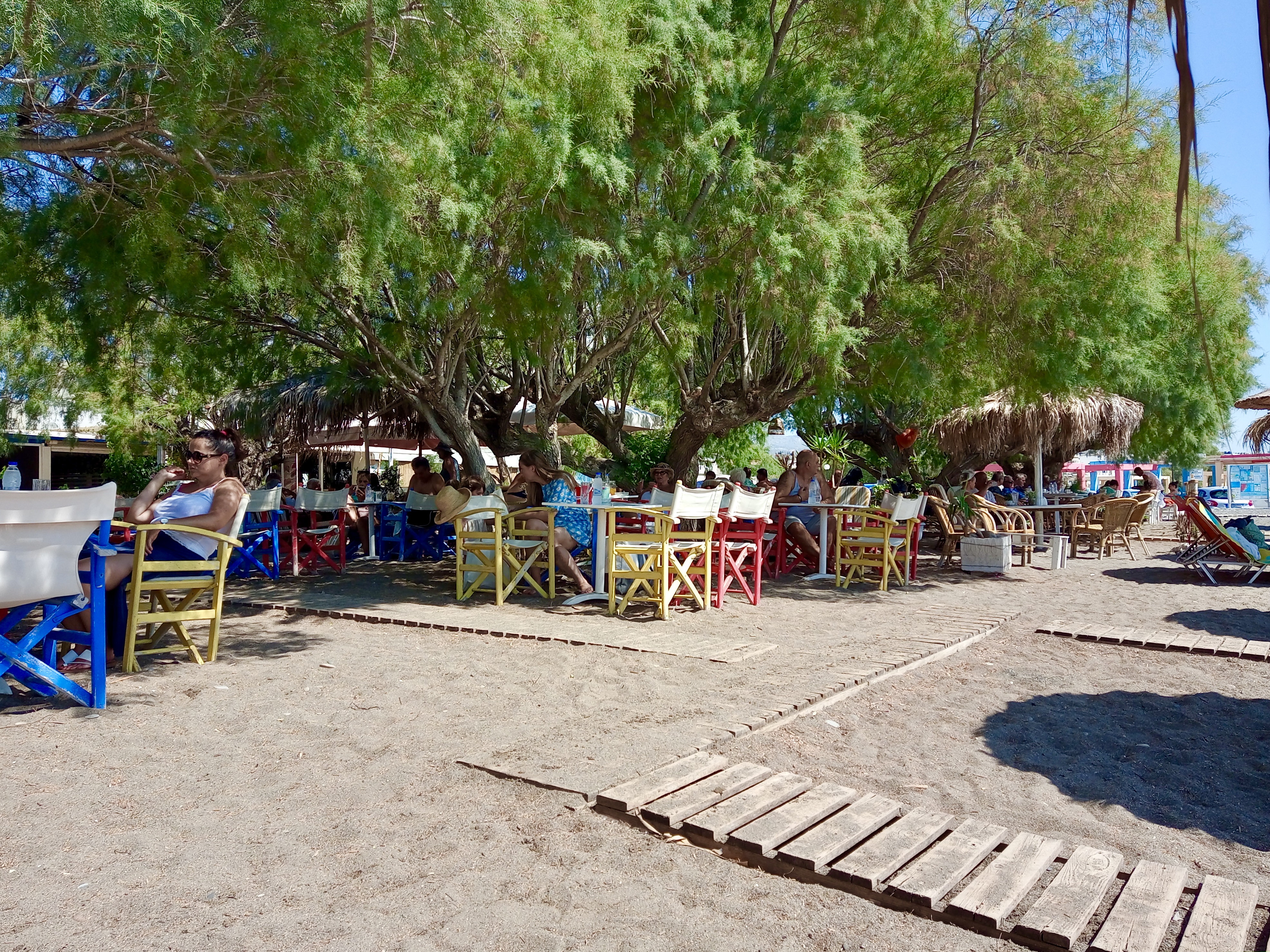
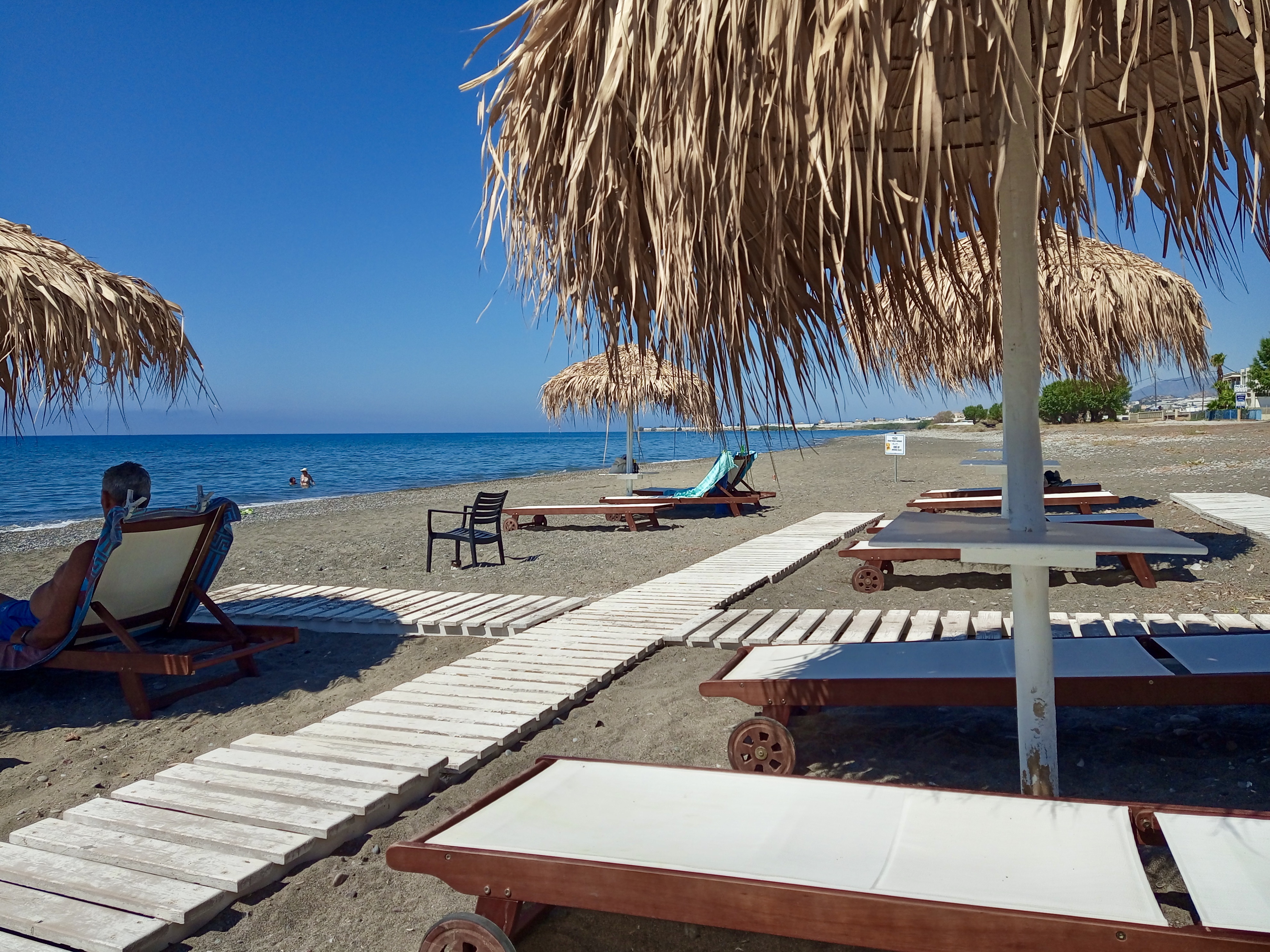
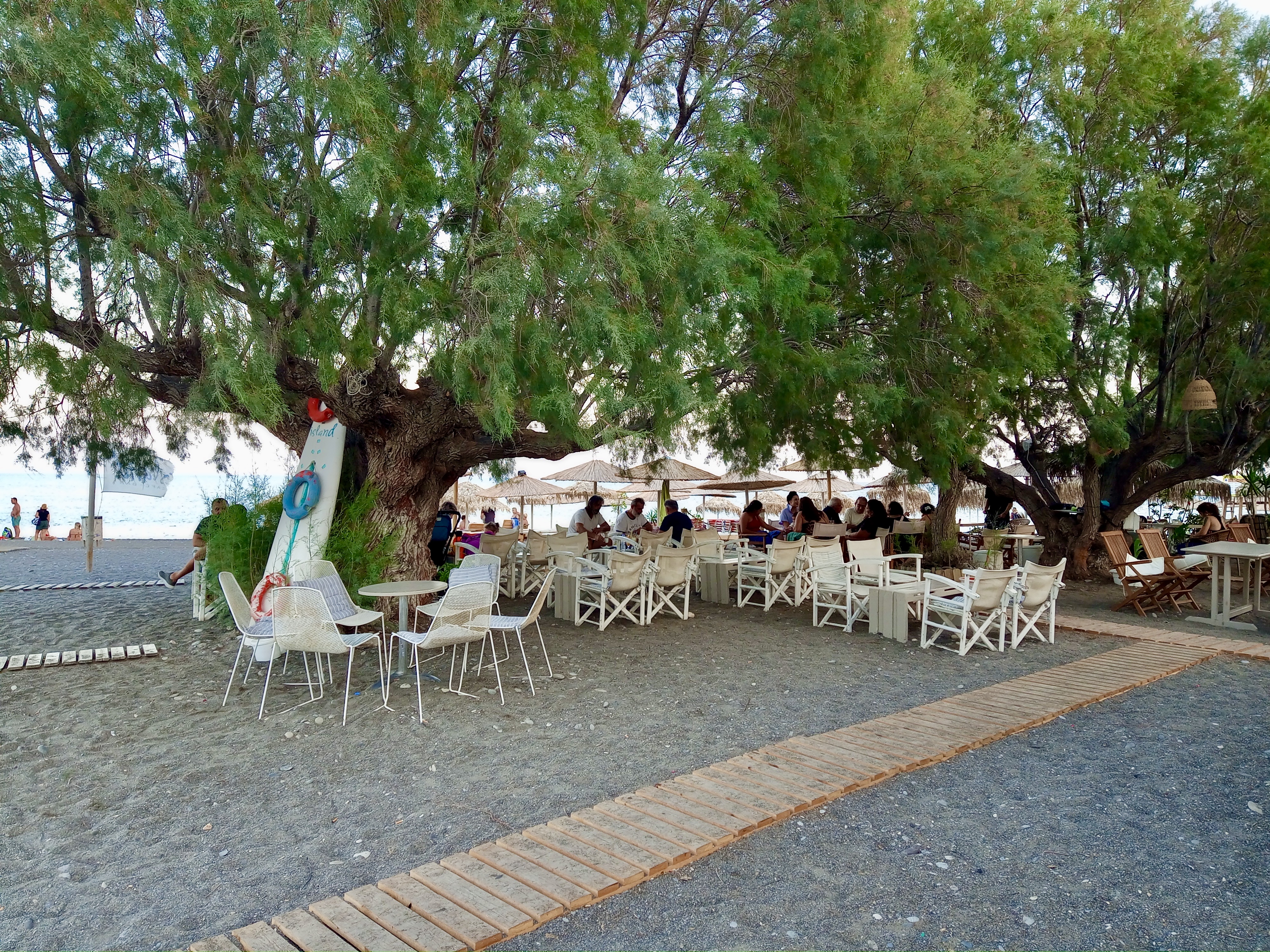
Regarding the photos in this post: The one at the top plus the last one in the ‘gallery’ are both taken on the town beach, where we take our iced coffee and have a dip twice a week. The last one was taken at 8.00pm, when the beach and sea are just perfect temperature-wise at this time of the year. The other beach shots are taken at the Kakao Bar at the far end of Gra Ligia beach, where you’re never overcrowded, not even in August. The one of Yvonne taking a refreshing sip of water is taken at the fountain just a few hundred metres outside the village, and when we’ve undertaken to do a short walk (which is the only type of walk you can attempt in high summer), it’s a truly luxurious experience to sip from that cool water as it emerges from the mountainside.
•
Click HERE to go to my Amazon Author Page. There you can browse all of my written works.


















 Accretions