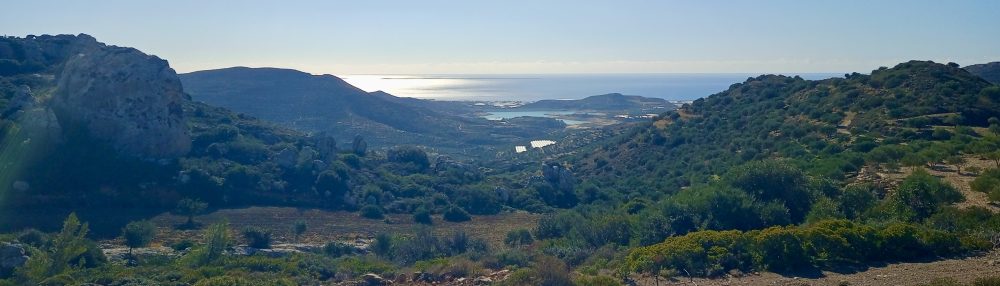
Tragana, talk and a couple of turtles

So, we finally got around to sitting down with our neighbours, former village mayor Angla’i’a and her hubby Giorgo a couple of weeks ago. As per usual, as soon as Angla’i’a caught sight of us through her screen door she told us (ordered us, more like) to sit at the outdoor table under the shade of their vast rubber tree and she’d be out in a minute with our Ellinikos. Of course, as always you don’t only get a cup of thick, syrupy Greek coffee, you also get a nibble or two, and in this case she served up a plate of koulourakia and another of melomakarona, both made by her own fair hand, naturally. Yummy. Outside her front door she had the other, larger table completely covered by a net, which was supported to keep it off the surface by a few sawn-off plastic water bottles (empty and upturned, of course). Spread across the surface of the table was, from where we were sitting, what looked like a mass of dried leaves.

Yvonne, curiosity getting the better of her, had to ask right away what it was that she and Giorgo had under that netting. Tarhana,” replied Angla’i’a, which is also known as ‘Tragana,’ apparently.

Once she told us we knew, because we’d come across the stuff before. In fact it was Angla’i’a who’d given us a jar of it a couple of years ago. If you’ve never seen it in the state in which people store it, when dried it looks like dehydrated soya mince, or some such. When we were given a glass jar full of it, Yvonne knew what it was, but had never had occasion to use it before. It’s not, to be brutally honest here, all that appetising in its dried state, I can tell you. If you clicked on that link above you’ll already have seen that it’s composed mainly of a fermented mixture of grain and yogurt or fermented milk, and has a texture of coarse, uneven crumbs, and it is usually made into a thick soup with water, stock, or milk. When we popped open the jar that Angla’i’a gave us we nearly threw up, it smelt that rank. In fact, even though it’s vegetarian, it does a pretty good job of making you think that it’s got some kind of rancid meat in it too.

Our curiosity satisfied, we moved the conversation along, since Giorgos had joined us and we wanted to ask after his knee problem. “Eh!” He replied, “it is what it is. I just put up with it.” It doesn’t stop him, a near 90 year-old, from getting up every morning, crossing the road and tending his horafi, where he still grows a selection of vegetables for the table. He reckons that he’s cut back how much he does there nowadays, but you could have fooled us. There had been another tremor a few hours before we sat down together, so we asked what they thought of the possibility of a big quake coming some time.

“Earthquakes don’t worry me, they don’t keep me awake at nights,” said Angla’i’a, “No, what worries me is fires.” That made some sense, because we get small quakes all the time here, which is a good thing and lessens the possibility of us getting a huge one some time. But every summer, by the time you get to the end of July/early August, the land is so dry that fires can start even with the sun’s rays being magnified through a half-empty discarded water bottle thrown carelessly out of a car window. The landscape is so parched that a cigarette end can result in many stremmata being consumed by flames within hours. It’s illegal to have bonfires after April and before the rains start, usually in late October or November, for obvious reasons. If you have a patch of land that’s overgrown with weeds, it’s law that you have to cut it and dispose of the cuttings, before a certain date (varies a bit each year) in April, or you risk a hefty fine.

We caught up with our neighbours and their news, which mainly consisted of Angla’i’a’s negative comments about our new mayor, Manoli, who’s actually her nephew. Seems, though, that there’s no love lost between them. We couldn’t help but remark on all the things he’s been doing, or getting done, around the village, to which her reply was, “Yeah well, they all hit the ground running when they’re first elected. They get paid for all kinds of stuff they do during the first year or two, then after that the funding dries up, so they make sure they get what they can out of the government at the start of their term, then they do naff-all, sit around in the kafeneion most of the time.” We were in no position to comment on such things, of course.

As always the clock caught up with us and it was time to take our leave. You never leave, though, without first being given a gift, and this time was no exception. “Hold on, before you go…” said Angla’i’a, already on her way into the kitchen through the screen door. She came out a few seconds later with a plastic bag stuffed full with Vlita, a kind of horta that’s a village staple for the table of modest rural folk. It grows wild, usually around the perimeter of an irrigated field, and consists of large dark green leaves. I can’t say I’m all that fond if it, but it’s a rich source of iron and Yvonne froze what Angla’i’a gave her and now adds it (finely chopped) to her bolognese and chilli sauces, curries and even a traditional lentil soup that she makes from time to time. On top of all the leaves was a plastic container inside of which were a dozen or so Melomakarona, which are more often made for special occasions like Easter, Christmas, name days etc. But many housewives make them simply because they want to, and we’re well glad that our friend is one such woman. They’re simply scrumptious and go excellently with an iced coffee on the veranda of a morning.

It was good to have once again spent some quality time with this humble, hospitable couple, who were the first to make us welcome when we first moved into our house in the village one month short of five years ago. They genuinely seem to miss us if we let a few months go by without dropping in for a chinwag. I don’t know where the time goes. Well, I do, it goes the same way as all the time before it, but it’s good sometimes to remember what’s truly important, and being good neighbours is well up there in the list, isn’t it.

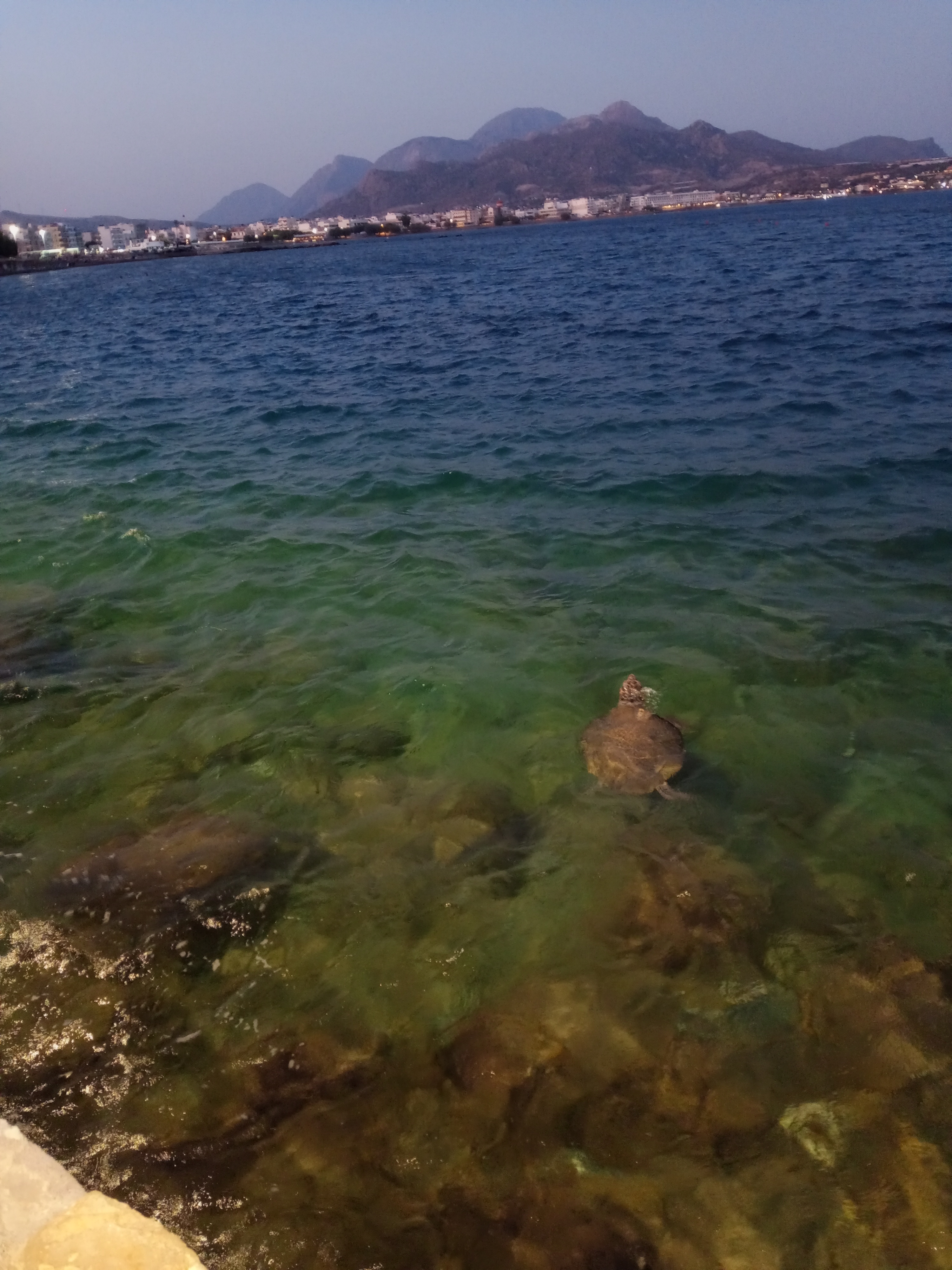
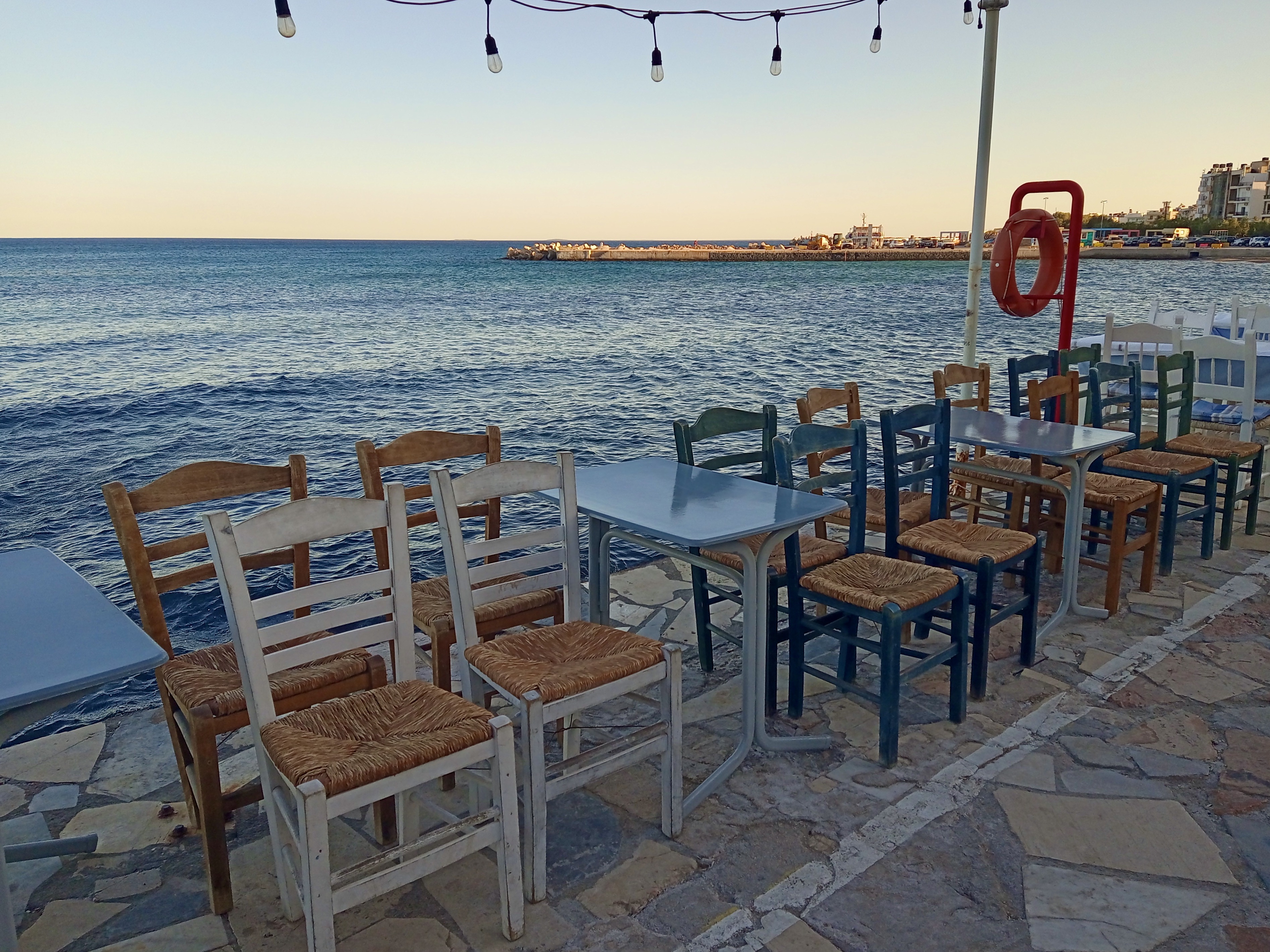
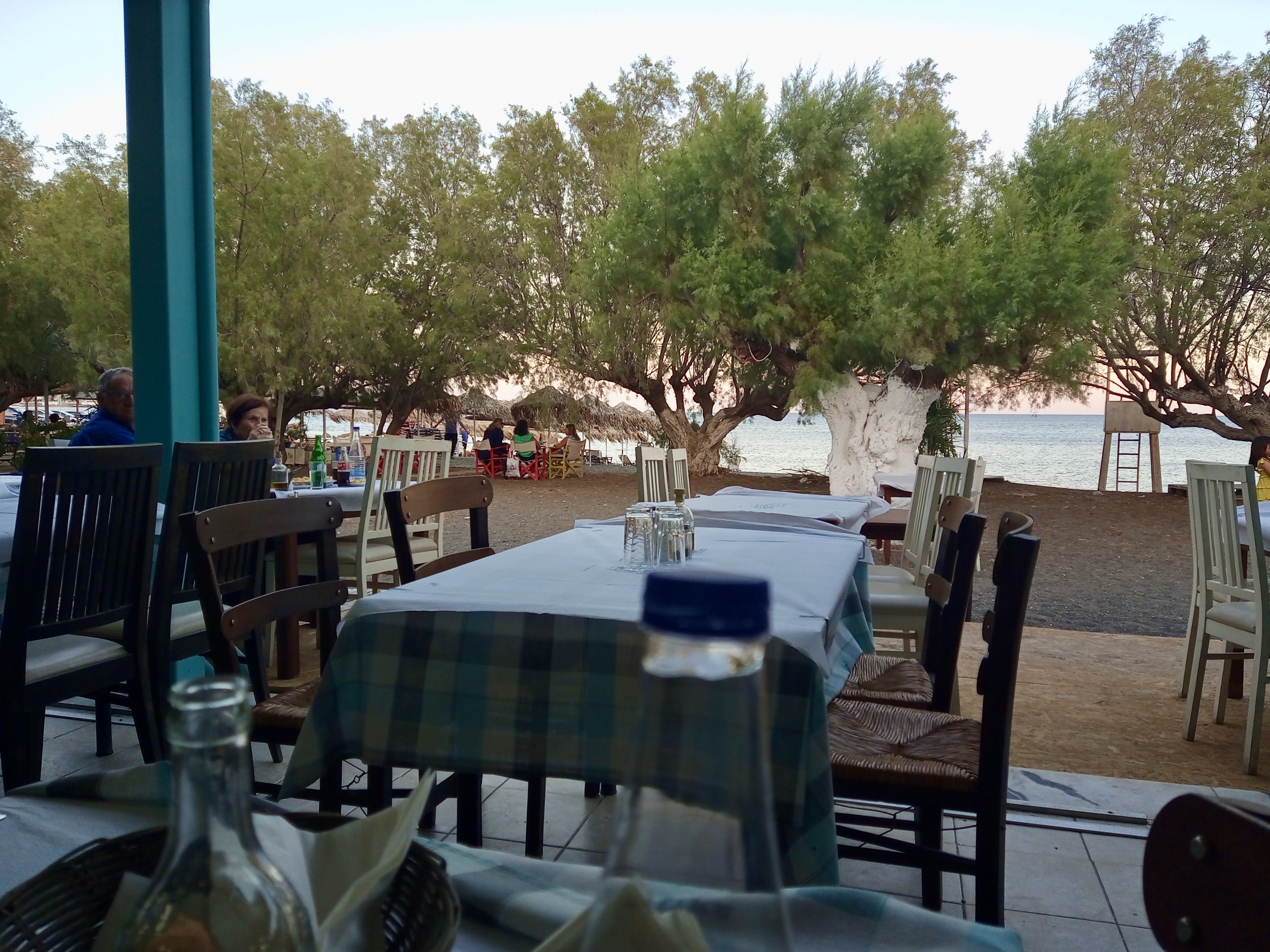
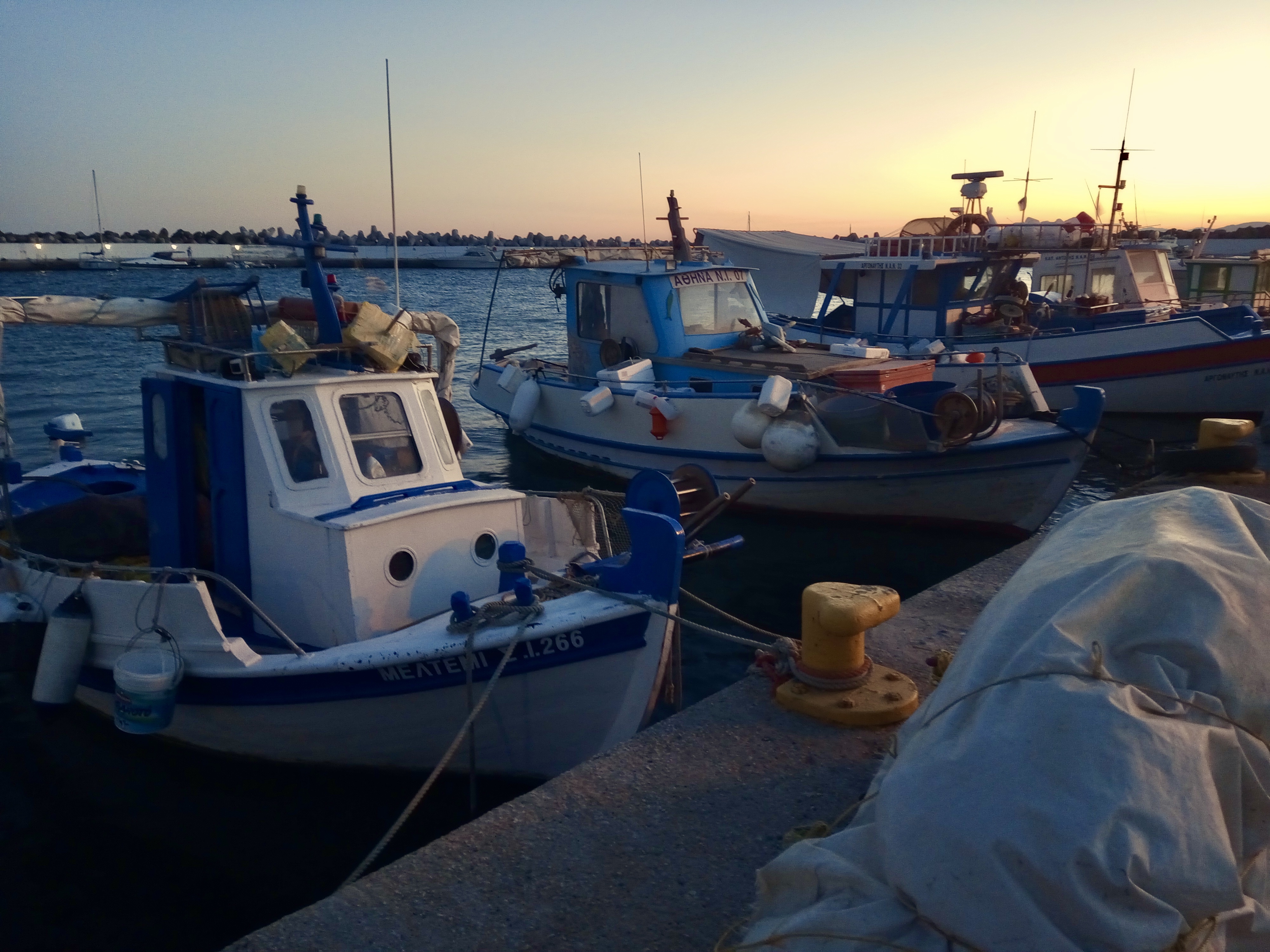
And so to the photos. The top photo on this post was taken at dusk as we ate a delicious meal at the waterside restaurant the Vira Potsi, right beside the Venetian Fortress that stands at the entrance to Ierapetra Harbour, last Monday evening. Not only did one turtle turn up, but a pair of them. My photos aren’t all that good, but here are the rest of them anyway, as just about everyone who was dining that evening crowded to the edge of the quay to strain to catch sight of these wonderful, elegant, gentle creatures…
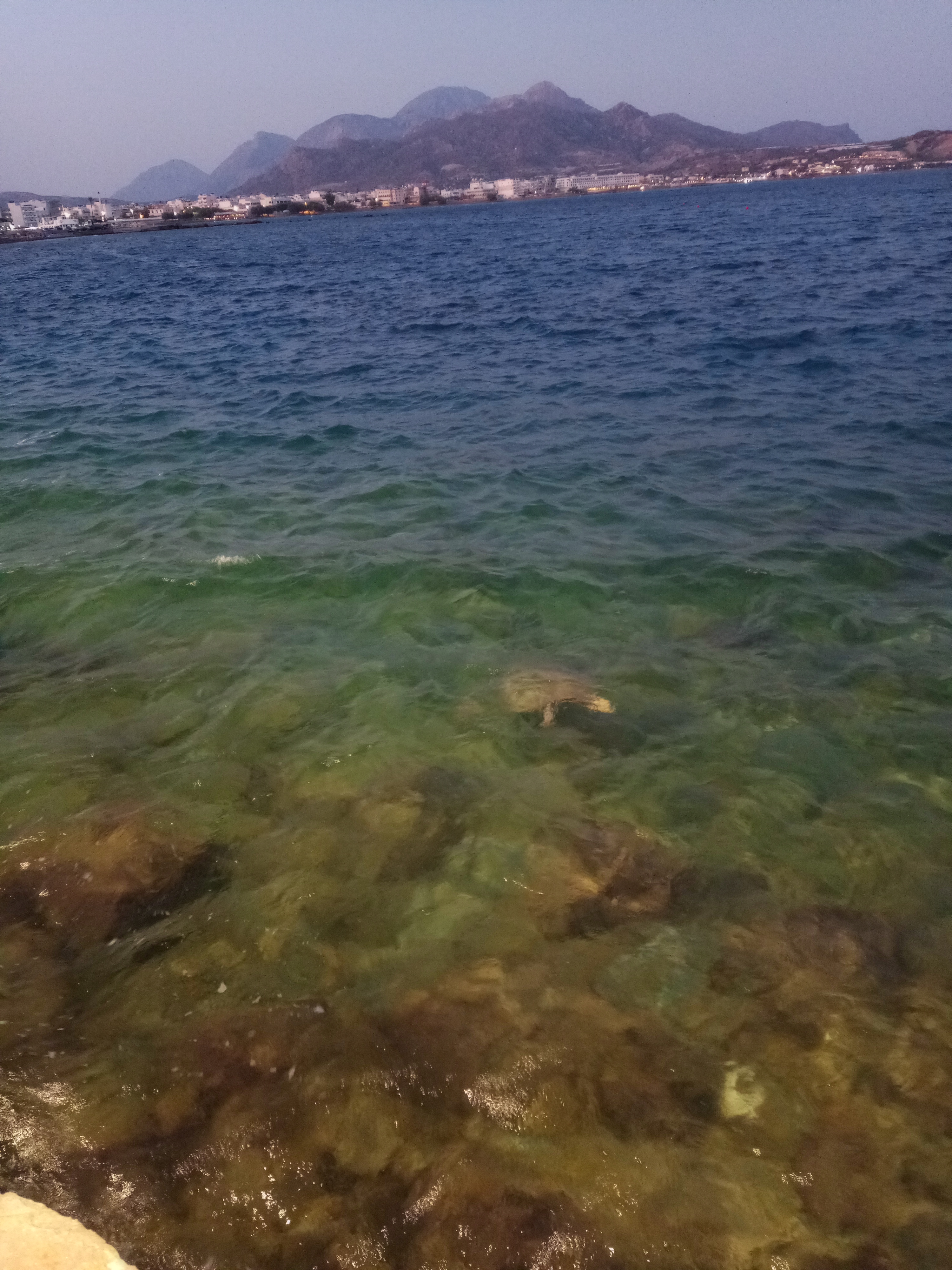
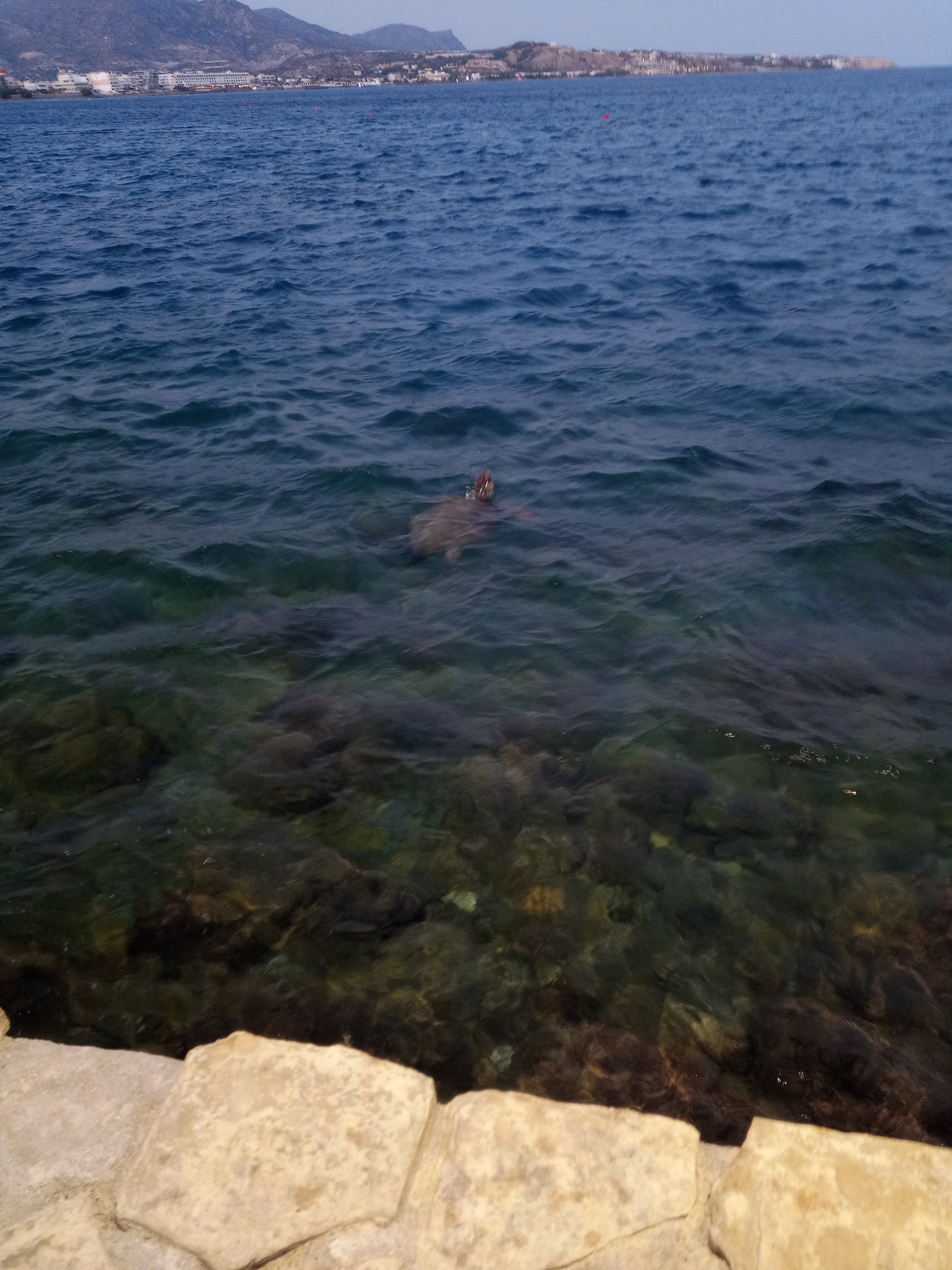
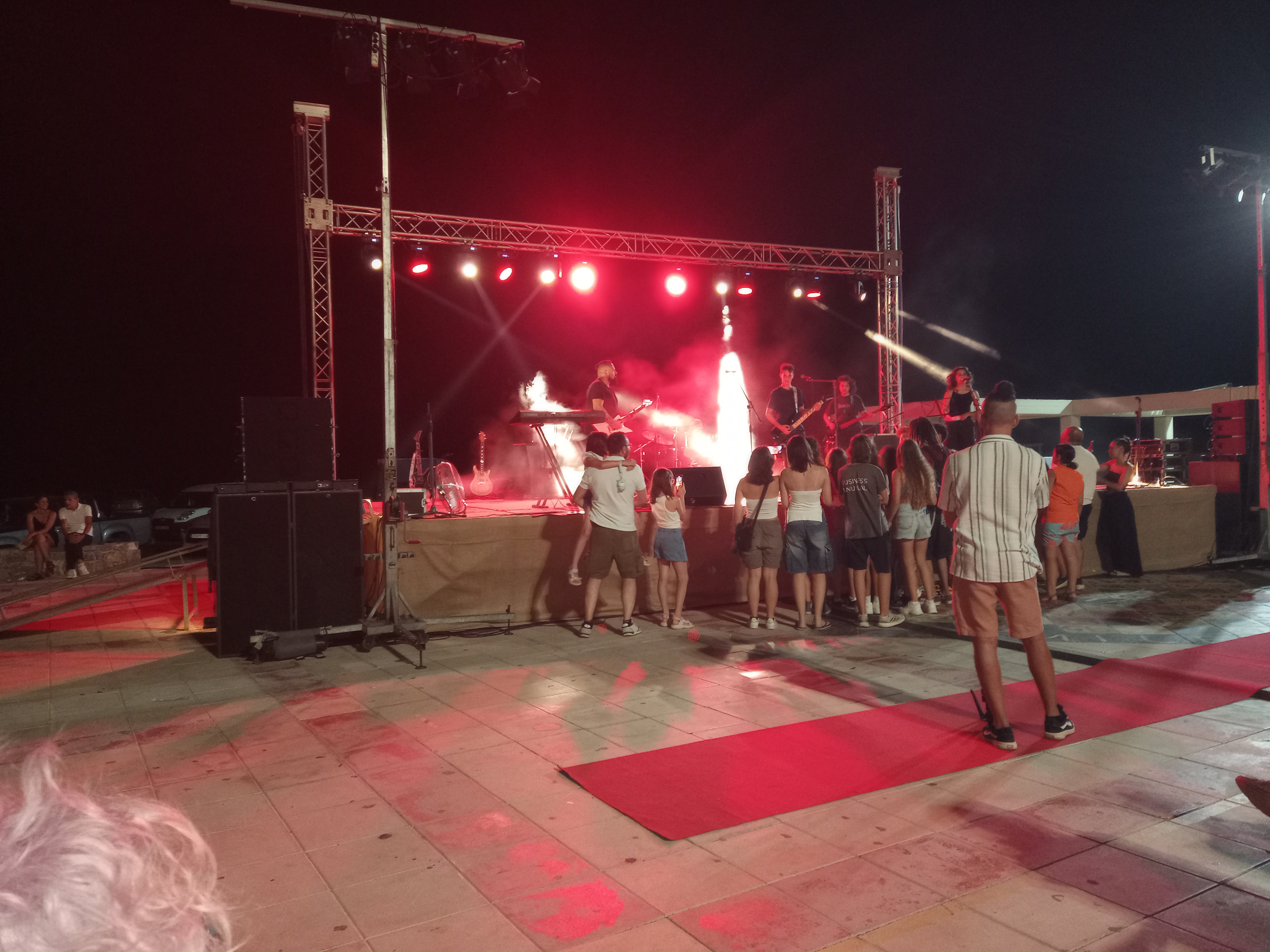
On Sunday evening there was a lively food and music festival on the waterfront in town too, all the food was contributed by restaurants and households in the surrounding area and it was all free to those who came along. The music ranged from traditional Rebetiko, through techno, to country and even a spot of heavy metal from a band of amateur school kids, rounding out the evening.

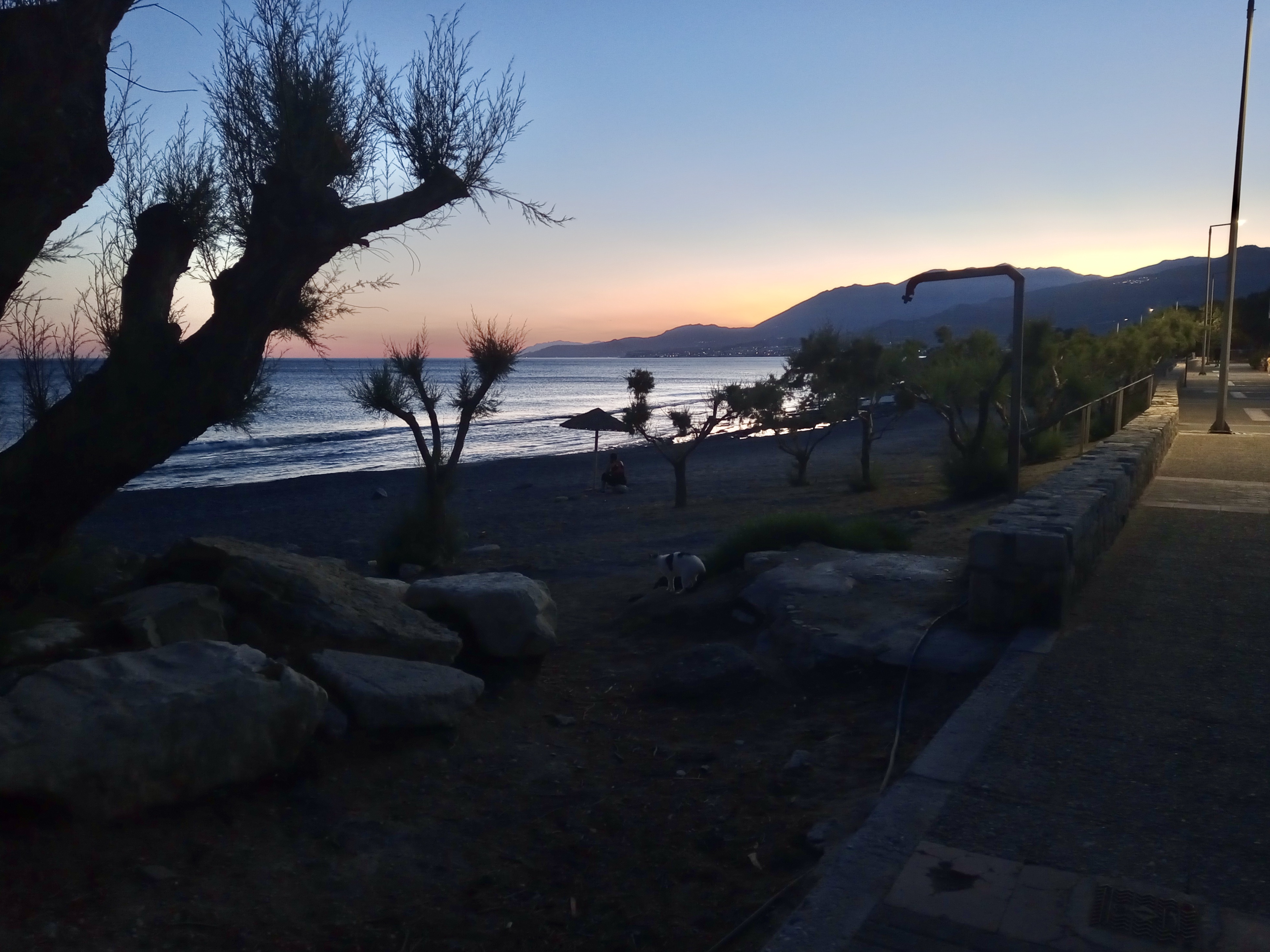
To round this one out, here are some more random photos that I quite like…

Click HERE to go to my Amazon Author Page. There you can browse and purchase all of my written works.

Avoiding the hordes

I was reading an article recently in the rather dubious UK newspaper the Daily Express, and it was all about how lovely is the island of Lefkada. I had no argument with the description of Lefkada at all, and none with the idea of promoting it as a place to visit. What I did find rather too difficult to swallow though, were the words, and I quote: “Any jaunt to Rhodes, Crete, or Mykonos – three of the best-known Greek islands – will inevitably involve negotiating hoards of tourists looking to go to the same restaurants, bars, and sun spots.

Now, as you’ll probably know, I lived on Rhodes for fourteen years, and have now been living in South East Crete for almost five. I’ll make no comment on Mykonos, since I don’t believe that it should be grouped along with the first two islands anyway. But, to read that the idea of coming to either Rhodes or Crete would inevitably involve negotiating “hoards of tourists looking to go to the same restaurants, bars, and sun spots” made me see red. Incidentally, adding to my feeling that’s it’s very poor journalism to so generalise, is the fact that the word ‘hoards’ is incorrect. If the writer was referring (and the context strongly indicates that he was) to large numbers of people, then the correct word is ‘hordes.’ Enough said on that then.

My view on how Rhodes has changed over the years still stands, and yet I can’t let that article pass without mentioning that there are nevertheless still many very quiet spots on that island where the true Grecophile can find the ‘real Greece,’ definitely away from the masses – fact. A true gem of a seaside village on Rhodes is Stegna, plus the area where we used to live, Kiotari, although having suffered the construction of a few huge A.I. hotels in recent years, nevertheless still offers quiet spots for those who look hard enough, as does the delightful village of Gennadi, just 4 km down the coast from there. Arhangelos itself, although quite a large village, is very essentially Greek, even during the tourist season, and I could go on.

Here on Crete it’s an even bigger insult to say that you’d be ‘negotiating the hordes,’ since Crete is a huge island, well over four hours from end-to-end by car and, I’d say, probably 80% of it is wild and unspoilt. Just because Crete has a number of airports and a few resorts that have become very well known as offering the kind of holiday that people who want a ‘lively’ time would look for, doesn’t mean that the entire island is crowded and noisy. Crete has too many untouched villages to even mention (among them the one where we’ve made our home, in fact) and miles of quiet coastline where you can find beaches with sparse numbers of sun worshippers, even in July and August. We’re fortunate enough to have landed in the municipality of Lasithi (there are only four such ‘counties’ on Crete, and they are Chania, Rethymnon, Heraklion and Lasithi. The first three are named after their main town, but are all primarily rural in the vast majority of their land area), and apart from a couple of tourist ‘hotspots’ like Agios Nikolaos and Elounda, the place is primarily agricultural and you most definitely won’t encounter any hordes. Lasithi is blessed with numerous wonderful beaches and coves, most of which are never overcrowded, and there are waterside tavernas, like the ones I’ve talked about in some of my recent posts, for example “Local Haunts” and “Food for Thought.”

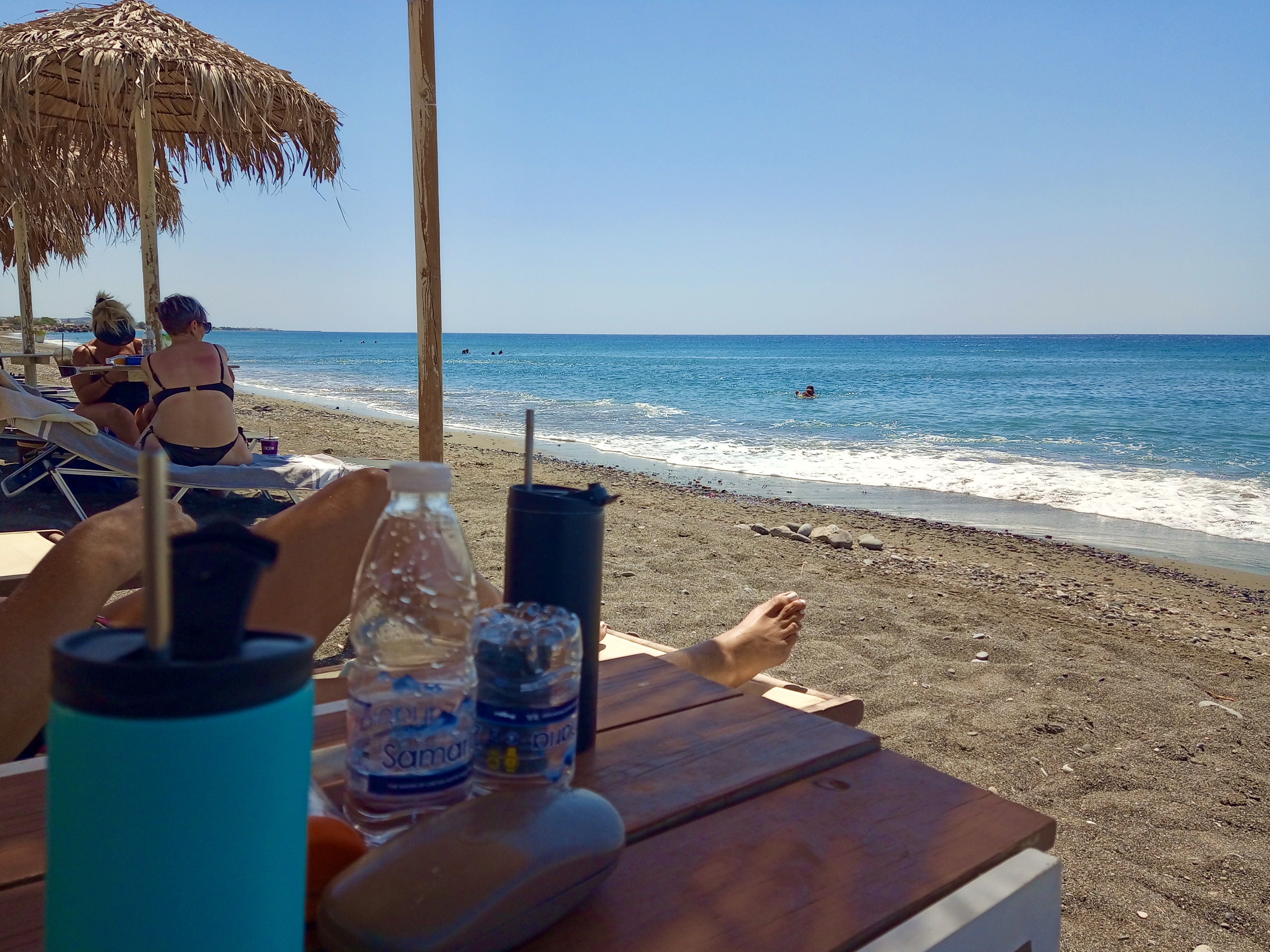
The photo at the top of this post was taken at one of our regular summertime haunts, the “Cacao” café at the Western extremity of the village of Gra Lygia. We go there usually on a Sunday, at around 11.30am, where we order a couple of freddo espressos and stretch out for an hour or two while taking the occasional swim. That photo above was taken on Sunday July 28th at precisely midday. The ones below were also taken on various Sundays over the past few weeks…

Looking at the above shots you’ll have noticed how crowded the place is. Why, you can’t even see the surface of the water for leaping bodies (heavy irony), eh? Gra Lygia beach is a couple of kilometres long, by the way, and is populated I’d say by 90% locals. Don’t come to Crete, you’ll be negotiating the tourist hordes…

Incidentally, I read a lot on Facebook about how much cash people have to shell out for a couple of sunbeds and an umbrella these days. Each to their own, of course, and I know that some people don’t like parasols and sun beds. OK, let’s not argue about that one. I happen to love them because at my time of life you want comfort, end of story. What I definitely do not like is when they’re so close together that if you stick your arm out you can end up molesting the woman on the lounger beside yours. That’s a real possibility in places where they take the mick out of the tourists, I’m afraid. Also, they need to be sparse enough for locals and others who don’t want to use them to be able to find a decent enough sized patch of beach to ‘camp’ on with their mats and towels. In such conditions, I don’t see anything wrong with them. What’s most wonderful about our area though, is the fact that almost all the cafés who have umbrella and beds around here don’t charge for them at all, as long as you buy a couple of drinks. In other words, the beach ‘furniture’ is simply an extension of the tables and chairs further back, and closer to the building. Now that’s reasonable, right?

The majority of local Greeks do not want to spend an entire day on the beach. We too tend to do what they do, which is to turn up, order a coffee, then spend an hour or two relaxing before leaving again. If you’re gonna be charged an arm and a leg for sun beds, you’re going to find that slightly galling, right? I’ve even talked to Greeks who’ve been visiting Ierapetra from the more touristy parts of the island, and they’ve not even known that sunbeds are free on our beaches, as long as you buy a drink. A mature couple was standing beside the beach last season, evidently Greek, when I said hello while passing. They asked me, “Excuse us, but how much are the beds here please?”

I was well pleased to be able to tell them how the system works on our beach, at which the wife remarked to her hubby, “It’s a different Crete down this way Manoli!” They were residents of Hersonissos, which is only just over an hour away by car, but may as well be the other side of the planet when it comes to the ‘hordes.’

The eagle-eyed amongst you will have spotted that our drinks in those photos are not in those ubiquitous cardboard cups with those dome-shaped plastic tops, through which you poke a plastic straw. For some time now we’ve been following the ‘green’ advice about carrying our own cups and straws with us. I’m not boasting or sounding off here, but we do truly believe that if everyone did that it would make a vast difference to the amount of trash that ends up in the environment. Our ‘flasks’ are double-skinned metal ones and they keep the drink cold for ever. In fact, even if we take a couple of hours to sip our coffees to the end, the ice is still intact inside. usually in this climate in those cardboard cups the ice is long gone within half an hour and what remains of your coffee becomes decidedly tepid, yuk. Our straws are aluminium and last forever. We simply wash them in some drinking water and lick them off before packing them away, then give them a thorough clean out when we’re doing the washing up back at home. All too often the straws given when you order an iced coffee are made of black plastic, which is the worst kind. I’ve read many times that for some reason black plastic is non-recyclable, which is why garden centres are switching from black to gray for pots in which they sell new plants and seedlings. Not only that, but when they bring you your drink the straws are packed in those annoying little see-through plastic sleeves, which instantly blow away on the breeze if you put them down even for a second. We’ve found that if you proffer your own reusable cups when ordering your coffee, the staff are only too pleased to take them from you and fix the coffee in them, thus saving the café the expense of buying ever more cardboard cups and plastic tops. The cups we use cost us about €8 each and we’ve now had them for almost ten years and counting. There’s an idea for you if you care about our planet.

Returning to the main theme of this post – by all means read that dubious article in Britain’s Daily Express, but if you feel like sending them some feedback, you’ll have my vote. The moral of this post then is – don’t believe everything you read in the papers!

Click HERE to go to my Amazon Author Page. There you can browse and purchase all of my written works.

Local haunts?

I don’t know why it’s taken me so long to notice this, but the other day, as we were walking through town to get to the beach for our regular freddo espresso and a swim (tough life, I know), I read a couple of those blue signs that are usually affixed to a corner of a building and that tell you the name of the road or street that you’re on. It suddenly struck me, after 47 years of either coming to Greece or living here, that almost all of them are some person’s name.

I got to thinking, how many street names in Greece do I either see or already know that aren’t named after some dead person or other? My home city is Bath, UK, and I began trawling through the names of city streets there that I can still recall. You’ll find Barton Street, Lower Borough Walls (and Upper too), New Bond Street, Milsom Street, Wood Street, Argyle Street, The Paragon, Hay Hill, Belmont, Guinea Lane, Upper Hedgemead Road and so it goes on. Regular street/road names in the UK are things like Acacia Avenue, Hill View, Church Close etc. 

Here, though, I’d say that 90% plus of the streets and roads are called by the first and last names of someone who’s died. Next time you’re walking around a Greek locale, take a look and see if you don’t agree. You’ll see streets with names like Adelfon Hana (Brothers Hana), Nikolas Anagnostakis, Stamatis Kokinakis, Georgos Papadopolis etc., in fact they’ve almost all got both the first and surname of whoever they’re named after (occasionally abbreviated in order to fit the name onto the sign, owing to the fact that Greek names do have the tendency to be rather long and stuffed full of syllables, don’t they) on them. Seems like not many are named after females, though, wonder why?

I just thought it was interesting, that’s all. 

The top photo this time was taken on Sunday at Gra Ligia, where we’d just been for a swim. When you live somewhere like this, it’s hard to imagine what it must be like to be among the hordes in the more over-touristified places, it really is. Couple more shots from Gra Ligia (on July 21st no less!!)…

In the previous post I mentioned that we finally got to eat at the beach taverna in Koutsouras called the Kalliotzina. Here are the photos I took during our wonderful meal there on Sunday evening July 14th…

The choccy pudding with ice cream, BTW, was the freebie! Definitely going to go there again for lunch some time. The menu shot shows the system that a lot of restaurants have adopted here these days, and it works really well. Instead of them bringing you a menu from which you verbally list your order to the waiter/waitress, you get a personal catalogue on which you write the number of whichever items you want (they give you a pen), before the staff take it to the kitchen and your food gets prepared. It works like a dream.

Finally, last night (Sunday 22nd) as we sat at one of our favourite waterfront restaurants, L’Angolo, where Nikoleta who runs the place and takes all the orders knows what we’re going to order before we even open our mouths these days, all the diners were enjoying the blood-red moonrise as the full moon crept over the horizon when a vibrant thumping sound began to emanate from further down the promenade. At first we thought that the Aperiton Café had a live band in, as they often do during the summer months, but no, it couldn’t have been, because the sound was growing louder. Something was making its way along the seafront in our direction. We soon found out what it was…

It did become a bit ear-splitting when they passed right by our table, but it was great fun and all for a very good cause, apparently. The crew wore t-shirts and vests emblazoned with the logo ‘Keep the Spirit Alive,’ so I Googled it today and found out that it’s a youth movement to keep alive the memory of a local man, Giorgo Kouvaki, who was a local physiotherapist, acupuncturist, musician and photographer who died prematurely a few years ago. Details about him can be found here. Below are a few stills from the occasion too…

In the last few frames you can spot the moon between the drummers as it had by this time lost its red hue and was climbing higher into the sky. It’s also visible in this below shot of Yvonne, as we’d just left the table and begun our walk back to the car…

I’ll be rambling on about our recent coffee with the neighbours in the next post (probably!).

Click HERE to go to my Amazon Author Page. There you can browse and purchase all of my written works.
Big

Water is becoming a hot potato of an issue in Greece these days. One sign we saw recently here on Crete read: “If you want water in your taps, turn off that hose.” When we lived on Rhodes it became common in the last few years for whole villages and sections of Rhodes Town to be cut off for hours at a time a few times each week in order to conserve the water supply. Yet all the while they go on building huge hotels with multiple pools and even with their own water parks to amuse the guests’ kids while the parents sip cool beers around the infinity pool unique to their own room. I found myself asking, ‘why has everything got to be so BIG these days?

Back in the good old days of holiday brochures (you remember those, when we used to get home in late September, then immediately make a beeline for the travel agent to pick up a clutch of next year’s because they were already on the shelves) I seem to remember that even hotels were modestly sized. I mean we never stayed in hotels if it were humanly possible to avoid them anyway, but even if there were some in the ‘resort’ where we would stay, they’d be set in modest gardens and quite unobtrusive to the area in general. They’d have a maximum of maybe only twenty rooms. In fact, here in Greece they were almost more often a glorified collection of rooms and studios, the only thing leading them to be described as a ‘hotel’ being the fact that they had a little reception desk and they served up a continental breakfast for those who wanted it. Lots of them didn’t even have a pool, or if they did, it wasn’t much bigger than the type you see in some peoples’ gardens.

This past few decades though, it seems that (and I’d wager it’s largely down to this whole ‘All Inclusive’ phenomenon) hotels in particular have been getting bigger and bigger. Hotels in the 21st century all seem to me to resemble massive villages. They have hundreds of rooms and loads of pools, they have multiple restaurants and faux-tavernas set in their extensive manicured gardens. They have their own exclusive beaches where only people with the correct armband can avail themselves of a drink from the chic beach bar that’s set up exclusively for the use of the guests. You even see staff going around the place in golf carts, the grounds are that huge, and the buildings so many. You know what? Such edifices, such altars to mass tourism, are primarily for the making of huge profits and not for the enriching of the travel experience of the punters, that’s how I see it.

On top of that, they are a disaster for the environment too. Over the almost two decades that we’ve lived here in Greece, we’ve seen hundreds of stremmata (the Greek measurement of land area, equivalent to 1,000 square metres) which once were wild land, eaten up by these immense monstrosities. Vast car parks and turning areas for coaches create water run-off issues during the winter months too, ironically. Wildlife and wild plants disappear, and no one seems to notice. Where we used to live in Kiotari, Rhodes, we found a lovely patch of Sea Lavender growing on a sloping hillside only a hundred metres or so from the unspoilt nearby beach. Sea Lavender is a beautiful plant which grows to maybe two feet in height and, when picked (leaving the rootstock in the ground, of course), will keep its gorgeous rich purple colour long after it’s dried out in the vase. In case you don’t know what it looks like here it is…

Image courtesy of Plantura Magazine

Sea Lavender is not all that easy to find in the wild these days, sadly. The only patch we ever saw during 14 years on Rhodes was the one I refer to above. The problem was, the plants were growing only metres from the existing perimeter fence of a large hotel, and the hotel’s owners had expansion plans. We watched helplessly as the bulldozers moved in and another hundred stremmata of wild land disappeared under the newly expanded hotel complex. The sea lavender never stood a chance.

The water problem is ironic isn’t it; I mean here we are on an island surrounded by an inexhaustible supply of the stuff, yet on land the drinkable version is becoming more and more scarce. The tiny island of Halki, where we not only passed some idyllic short breaks while living on Rhodes, but I also visited several times a week during the high season in my job as an excursion escort, solved their acute water shortage some years ago now. When I first set foot there, we’d often tie up the small ferry on which my guests and I had made the crossing from Rhodes at the stone jetty in Nimborio, the only settlement on the whole island, to see a huge rusting hulk of a tanker occupying most of the waterfront. It was the water supply ship that came in from Kalathos Bay on Rhodes, stopping off at Halki and other islands too (I think Symi may have also been on the route, but my memory about that’s not what it was these days). That ship would come in a few times a week, responding to a request from the island’s mayor when they knew that supplies of drinking water were running low. It was unsightly, to say the least, and could have benefitted from a rub down with some emery paper and a good coat of paint, and it would stay tied up to the quay for several hours while water was pumped from its hold to a concrete reservoir on the hillside above the village.

Discussions began, easily more than ten years ago now, with the community of Halkiots living in Tarpon Springs, Florida USA, where more people with roots on Halki now live than actually still live on the island. These Greeks, whose ancestors had emigrated to the USA when the sponge diving industry died in the Dodecanese Islands in the early 1900’s, were always looking for ways to send financial help to their relatives back on Halki. The outcome was that, with help from the Tarpon Springs Greeks, and a 5-year loan from the bank, Halki constructed its own desalination plant in a quiet bay where it would be unnoticed by residents and visitors alike, just a couple of kilometres around the coast from the harbour. The investment was substantial, but since I got the story from the then mayor of the island, and he said that they’d pay thousands of Euros for every visit of the ‘water boat’ from Rhodes, they knew that within five years the plant would have paid for itself and the islanders would have an endless supply of good quality drinking water from then on.

I well remember the poor pressure in a Halki tap while trying to wash my hands after a visit to a taverna lavatory. I also remember that the water that came out of the taps wasn’t at all enjoyable to drink either. I was on the island one summer’s day and talking to Manoli, the Mayor and son of Lefkosia, whose taverna was named after her, when there was no water at all, for it had run out before the boat could get there. Not long after that I remember also remarking to him that I couldn’t believe how the water pressure had improved. It fair gushed out of the tap while I washed my hands. Smiling, he told me that the desalination plant was now commissioned, on-line and supplying the islanders with fresh, potable water at a good pressure. That was when he told me about the financial plan for the project.

The reason why I’m banging on about Halki is that I fail to understand how a small island like that can fix the problem, yet wealthy islands like Rhodes can’t. Decades ago there was a desalination plant installed on Symi, but it was only a short time before tourism really began to take off. If you’ve been to Symi you’ll have seen the square at the back of the bay, just behind the small bridge in the corner of the harbour. Guess what, that was where they’d installed the plant. Dosy or what? Of course, they realised very quickly once tourism began to gather momentum that it was an eyesore and so it was soon dismantled again, the parts stored away in some shed or other, and forgotten about. From that time on they resorted to ordering their water by boat from Rhodes again. Someone may correct me, but the last time I checked, Symi still didn’t have its own operational desalination plant.

Going back to the thought about holiday brochures, maybe my memory’s defective, but I’m sure that most of the accommodation on offer back then was village rooms, studios, apartments and villas. I don’t remember ever seeing huge faceless hotel complexes in them, and, of course, ‘All Inclusive’ still hadn’t been thought up. Can’t help wishing that it never had been either. Even here, in this still quiet little backwater of Crete where tourism is still a long way behind the coastal strip from Malia to Chania, things are subtly changing. A few km outside Ierapetra heading East they’ve opened a hotel that reminds me (sadly) of the ones that Rhodes is now bursting with. It seems that they always want to build them on what in the UK would be called ‘greenfield sites’ too. But the worst thing of all is, why do they have to be so flamin’ big? I know, I probably already know the answer to that one, it’s because it makes more money for the owners to ship people in larger numbers. So the planes get bigger and more frequent, and the airports become inadequate and they build bigger ones, like they’re doing right now on Crete. The new airport that’s eating up a whole stack of stremmata in the hills above Heraklion is due to open in 2027 I believe. It’ll open up the South coast of the island and slowly start to wreck the remote beauty of that whole area, I fear. It’ll turn Siteia which is still just about a hidden gem into a theme park in time, and they have their own modest airport there anyway.

We can’t go back in time. We can’t halt ‘progress,’ if that’s what we’re supposed to call it, but this relentless drive to build everything bigger and (supposedly) better does depress me. Sorry to be on a downer folks. Just trying to be realistic. Next post I’ll be as cheery as usual, promise!! I know, how about a couple of photos to cheer us up?

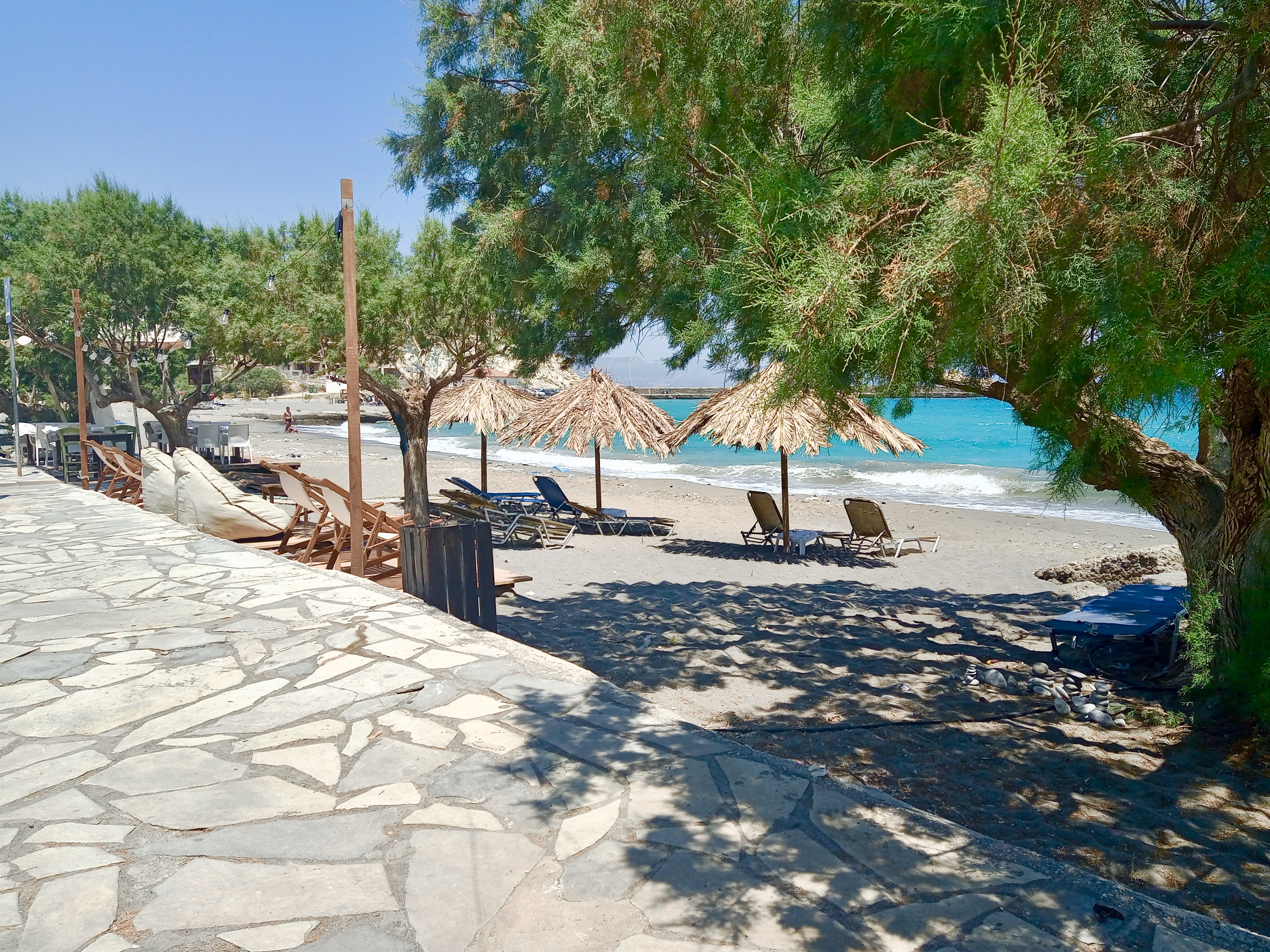
By the way, before we get to them, the one at the top of this post was taken on Sunday at Pachi Ammos, where it was very windy, but that was good because it helped us cope with the temperature. Now Pachi Ammos, in case you’re interested, is still a quiet, essentially “Greek” place to stay BTW. Right, here we are then…

When I sat down to write this post I had all kinds of other stuff in mind. I intended to talk about the fact that we have eventually been able to eat at the wonderful Kalliotzina taverna right on the beach at Koutsouras. A few weeks ago we’d gone there on a Tuesday lunchtime, only to find that they were closed on Tuesdays, so we’d ended up at the one nextdoor, which was pretty good anyway. I talked about this in the post called ‘Food For Thought’ which I posted on May 30th. For the first time in what seems like months we actually got around to sitting down over a Greek coffee with Angla’i’a and Giorgo the other day too. I had some thoughts too about the obsession that they seem to have here in Greece with naming streets after dead people as well. Never mind, all in good time.

I’ll return to the main theme of this post to finish off with, though. There has been a lot of talk lately in the local media here about the problem of over-tourism. It’s getting on the TV news quite often about what’s happening in Spain, where locals are demonstrating about their home towns becoming nothing but ‘theme parks,’ while they shoot water pistols at tourists eating in the local restaurants. It’s still some way from that scenario here, although there are parts of Greece where it’s a definite problem (Mykonos, Santorini, the Acropolis in Athens to name a few), but I’ll finish with a quote from a Cretan newspaper from a few days ago. It said this:

“Last year, a whopping 33 million tourists visited Greece—over thrice the country’s population. More tourism means a greater economic boost by propping up local business activities. But they’ve resulted in a disproportionate strain on infrastructure, housing and environmental resources. These are particularly pressing as Greece grapples with the aftermath of wildfires in recent years.”

Hmmm, eh? When I worked as an excursion escort I used to think that in general (with some slight reservations) tourism was a good thing. It’s far more complicated than that now though. Watch this space.

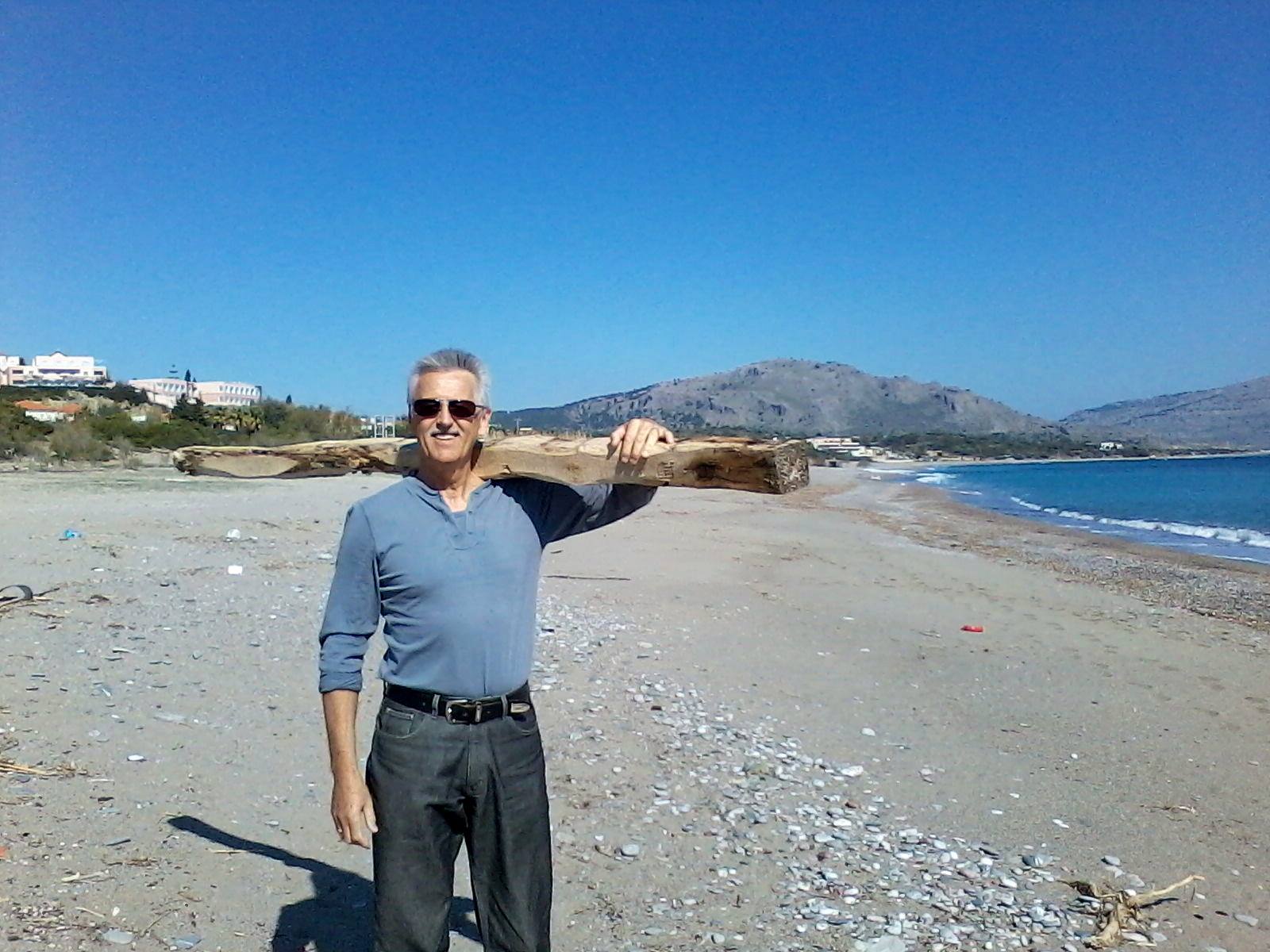
To absolutely finish this one off, definitely, with no further addenda, Here’s a photo of a fairly macho me taken in February 2014 back on Rhodes, when we used to scavenge the beach in wintertime for fuel for our stove (me Tarzan…) –

Yes, I thought that one would give you a laugh.

Click HERE to go to my Amazon Author Page. There you can browse and purchase all of my written works.

Random ramblings

Above: I’m sure a lot of people will have come across this ‘phenomenon’, but it always makes me smile. What’s wrong with the above photo? I’ll tell you, there’s pepper in the salt cellar and guess what’s in that pepper shaker. Yup, right first time, salt! This was at the Gorgona Taverna on the seafront behind the town beach in Ierapetra a couple of Sundays ago. The meal was excellent, as was the value for money, but one needed to clock what was going on with those shakers before bringing about a ‘seasoning disaster,’ right? It’s something we’ve come across often over the decades that we’ve spent either visiting Greece or living here. I’m not really sure why it happens so frequently, but it’s worth a mention, if only for the quirkiness of it.

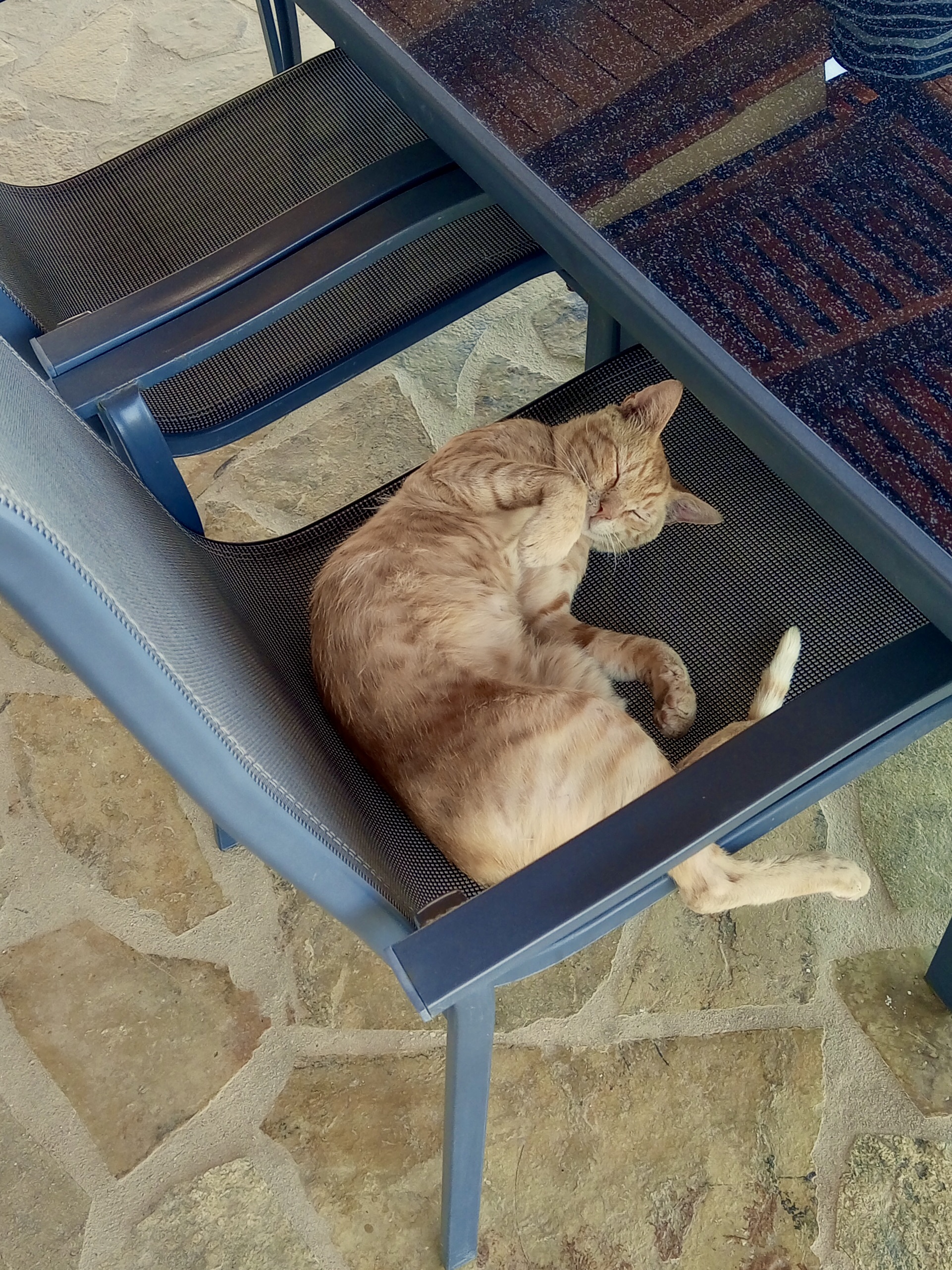
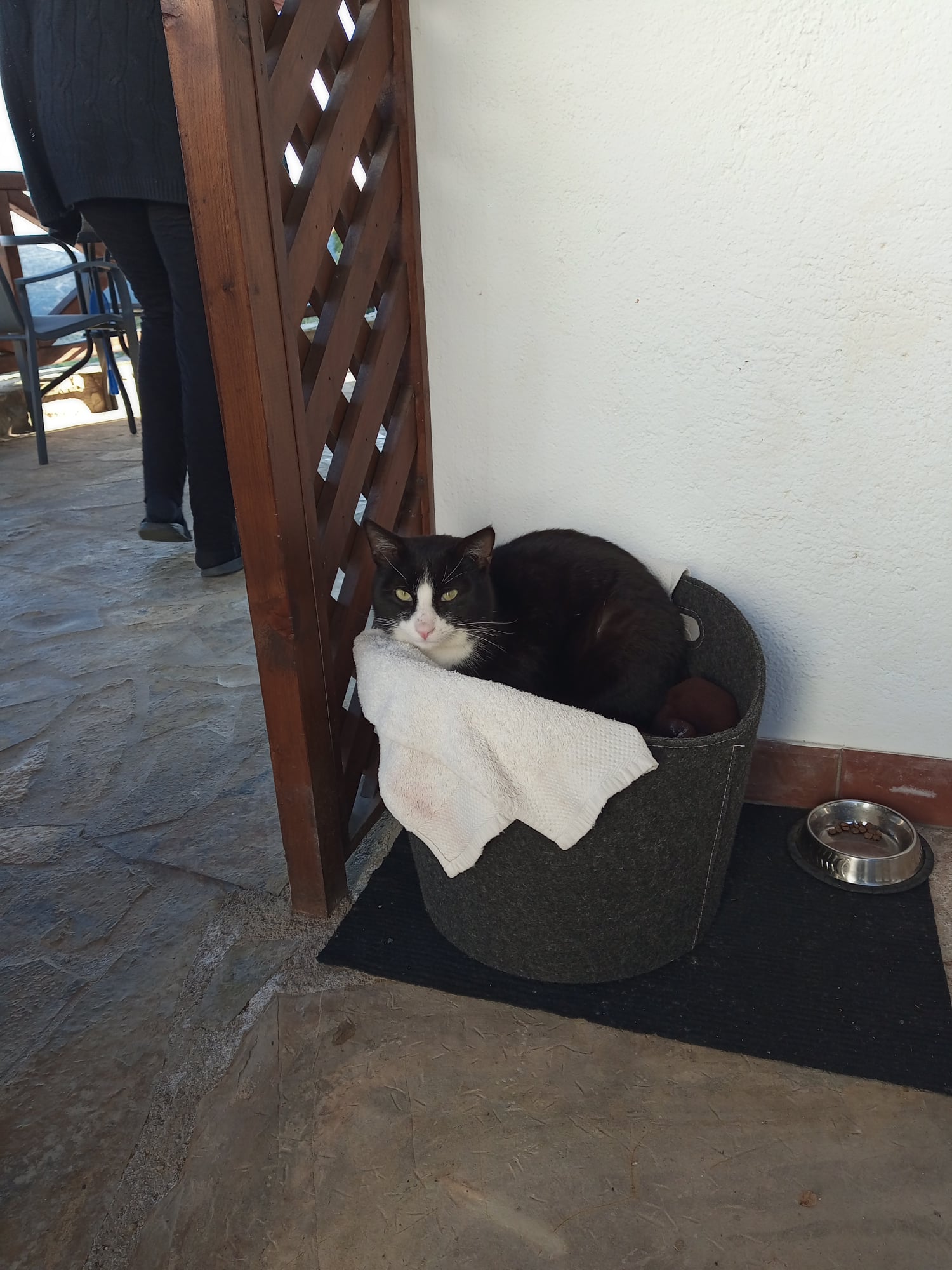
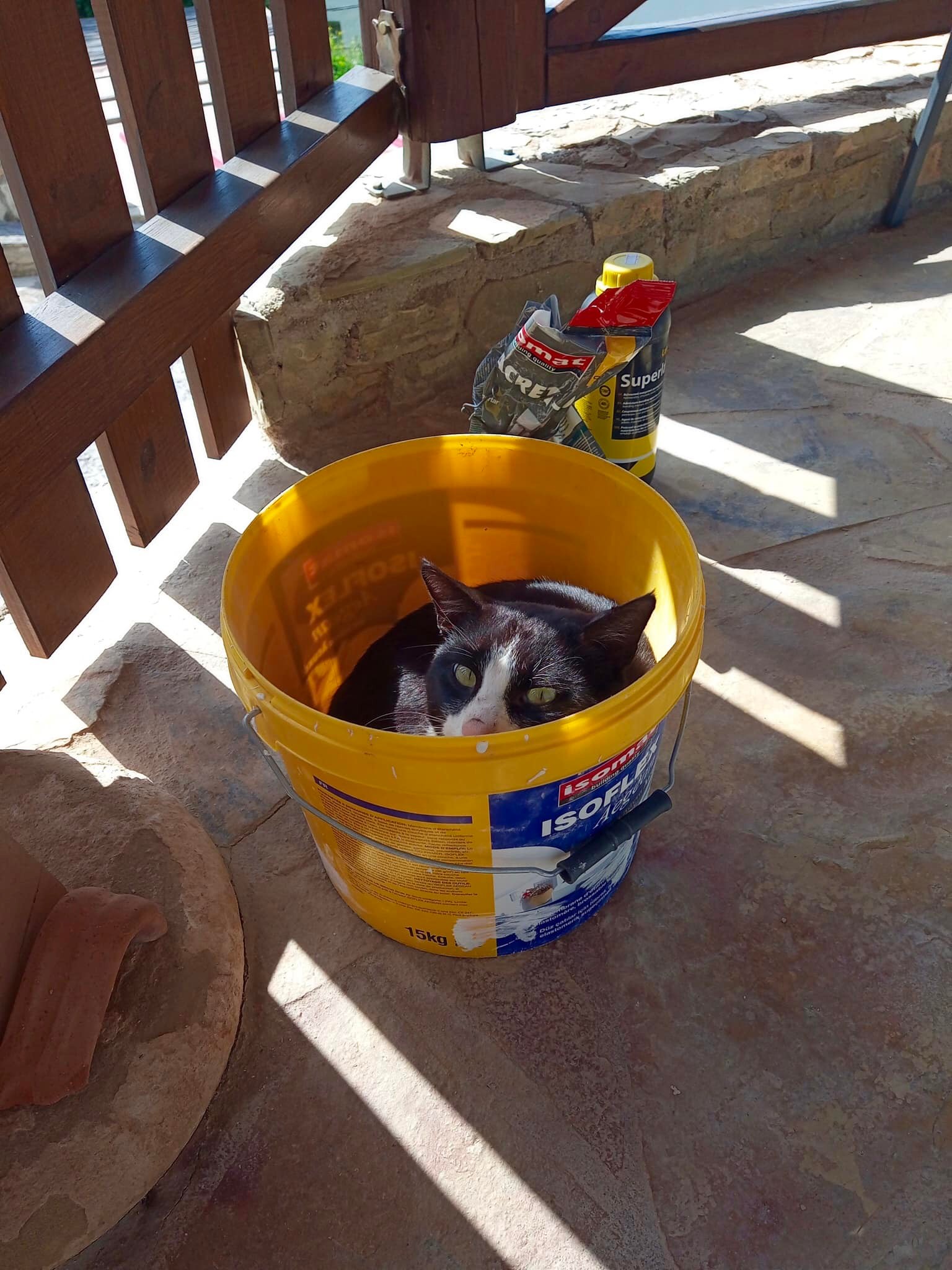
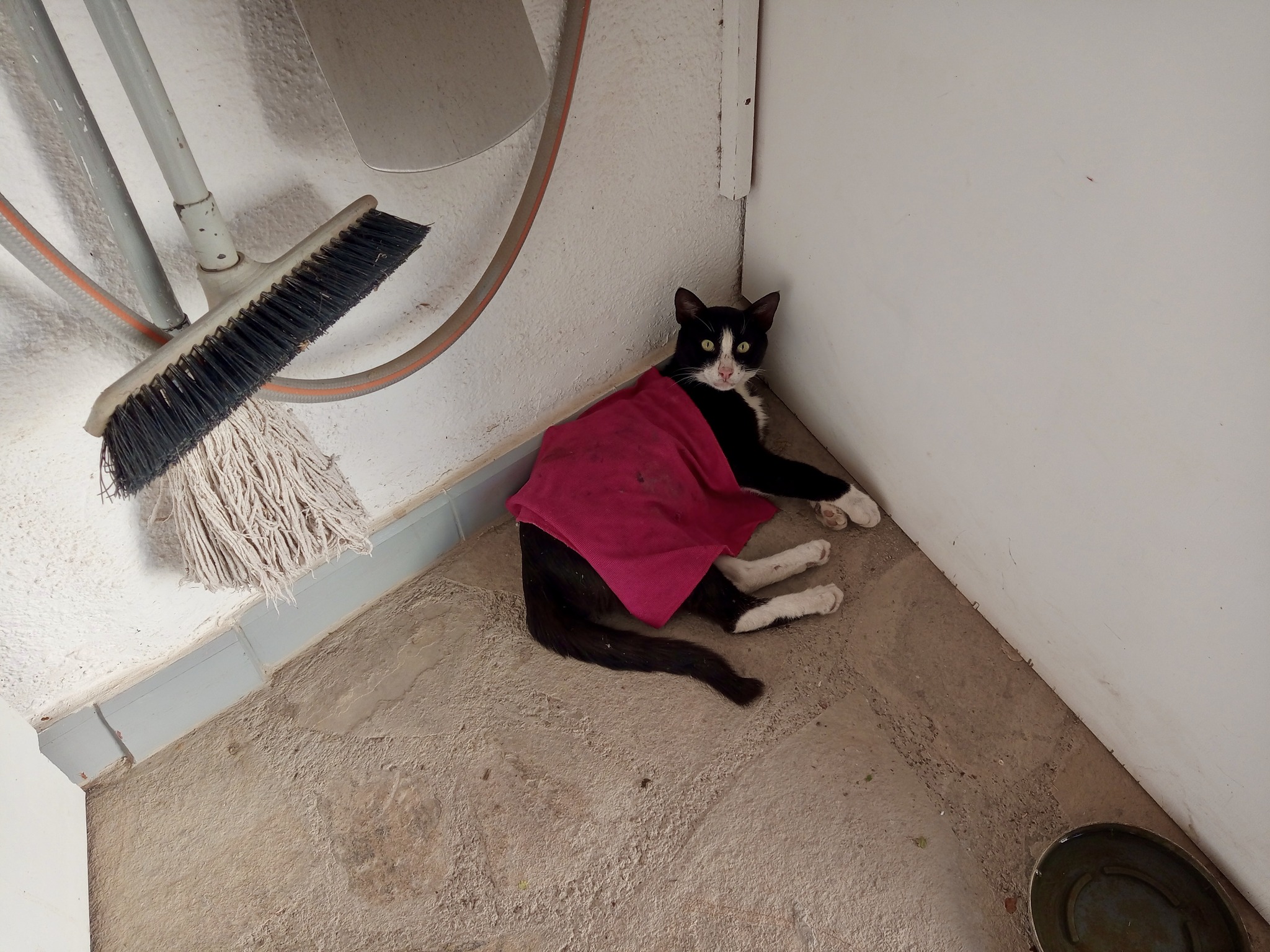
Further to the post I wrote about the local cats, These below show just how comfy ‘Ginge’ is with our veranda as a safe place to relax, plus the same goes for ‘White Sock’ on the stairs going up to the upper garden. The little tykes…

Below: A rather nice specimen of Campsis Grandiflora, otherwise known as either Chinese or Common Trumpet Creeper. It’s quite popular in gardens around the periphery of the town and, I have to say, it does brighten up a plain-looking street…

Yvonne, my wife (in case you’ve recently come to the party), is always on the lookout for an opportunity to dance. It’s in her blood I suppose. She only has to hear the right rhythm or beat to break out into a Tsifteteli, or a Kalamatiano, it’s just the way she is. Although we have fallen in love with our new home here on Crete, the only slight downside to living here is that most live music (and almost every weekend there’s some to be had in the mountain villages around us in this area) is Cretan, not Rebetiko, which Yvonne’s much more familiar with. Cretan music is more generally based around the use of the Lyra, a sort of squat violin played vertically whilst it sits on the leg of the seated musician, who then attacks it with a bow which he saws horizontally backwards and forwards. Rebetiko is more often Bouzouki based and Yvonne is familiar with just about all of the various dances that it includes, which are listed under the subheading Rhythms in the Wikipedia article to which the above link takes you.

About four decades ago, when we first used to come to Greece for holidays, and to visit my wife’s in-laws, you could find live music, even if it was only one bouzouki player, but would often be also a guitarist and a keyboard player too, almost everywhere. Lots of tavernas would have a small space cleared for the moment when the ‘Kefi’ would take someone and they’d get up from their chair perhaps to begin with a Zeibekiko. As the decades have passed this has gradually died away as tourism has grown and restaurateurs have covered those spaces with a few more tables to maximise their income. These days it’s very, very rare to come across a taverna where there will be impromptu dancing. So, what happened to us last Saturday night was all the more pleasing.

We had occasion to stay a couple of nights at a place called Ammoudara Beach, west of Heraklion. To be honest, and not wishing to upset anyone who might like the place, we hated it. It reminded us so much of Ialysos on Rhodes, which was a place we avoided like the plague during the 14 years that we spent on the island. It’s tourism at its worst in my humble opinion, full as it is with big hotels, fancy bars thumping out loud music and souvenir shops full of tat. The kinds of tourists you see walking the pavement could never in general be described as Grecophiles, but rather those who simply want sunshine, booze and evening entertainment consisting of karaoke and the like. Each to his own, of course, but it’s not for us.

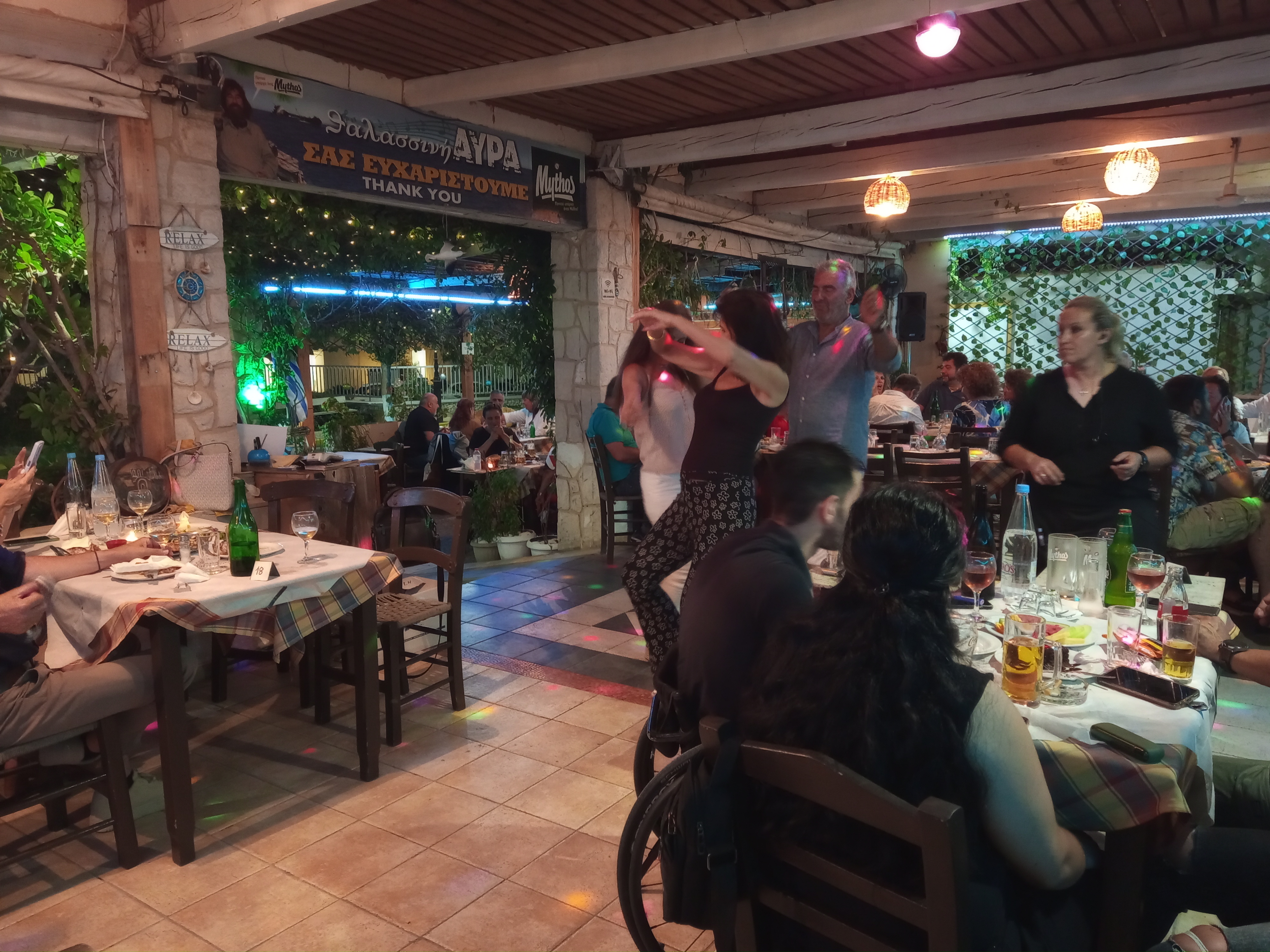
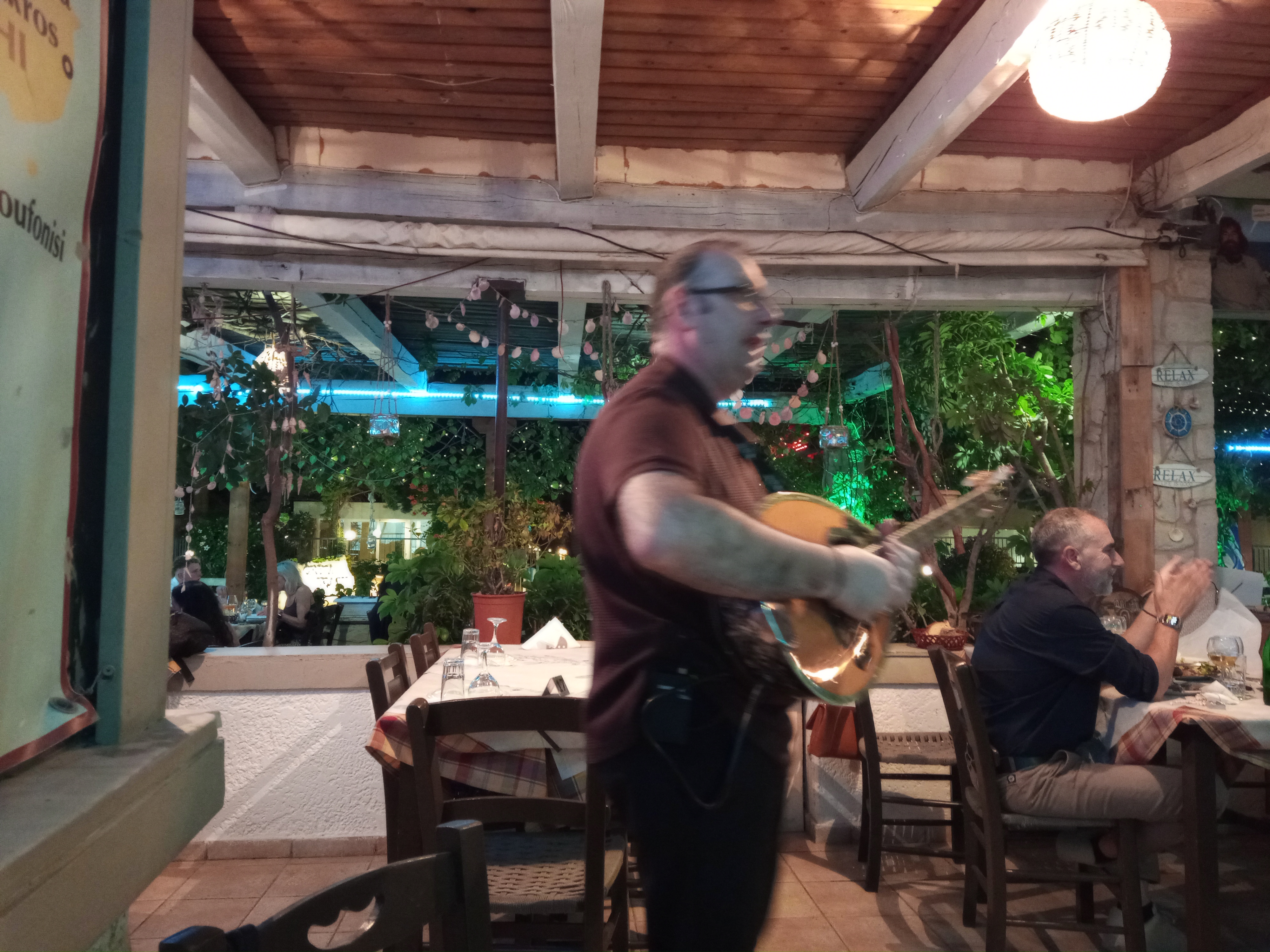
However, since we were in a small AirBnB apartment for a couple of nights, we had little choice but to wander the main street in search of somewhere to eat that wasn’t a rip-off and would hopefully be reasonably priced. Eventually we wandered into a place called Thalassini Avra (Θαλασσινή Αυρα – Sea Breeze), at around 9.00pm, just when the last of the tourists were finishing their meals. As I’ve often observed, if you go to a restaurant where the locals eat, they’ll only begin to arrive after 9.00pm and often much later. When we got there we were pleased to hear that the music being played was Laika, or Rebetiko. In fact there was a modest band playing and a bouzouki player was wandering among the tables, his instrument connected to the amp by wireless connection. There was also a female singer doing the rounds among the tables too. ‘Of all places to find something like this,’ we thought. Down where we live, where it’s mainly Greeks around you when you go out for the evening, there’s nothing, or at least, usually nothing. Here, in over-tourist-land, we found a taverna with live music, and it wasn’t Cretan. Of course, earlier in the evening it’s a good way to get the tourists in anyway, but the true test of such a restaurant is if it gradually fills with Greeks as the hours approach midnight.

Well, to cut a long story short, the place eventually packed out with Greeks, and here’s the result…

Yes, that’s Yvonne with the fancy pattern on her ‘trousers.’ Here are the photos too…

By the time I took those above, there wasn’t a tourist in the place. Life’s full of surprises, isn’t it?

Click HERE to go to my Amazon Author Page. There you can browse and purchase all of my written works.

How does your gardenia grow?

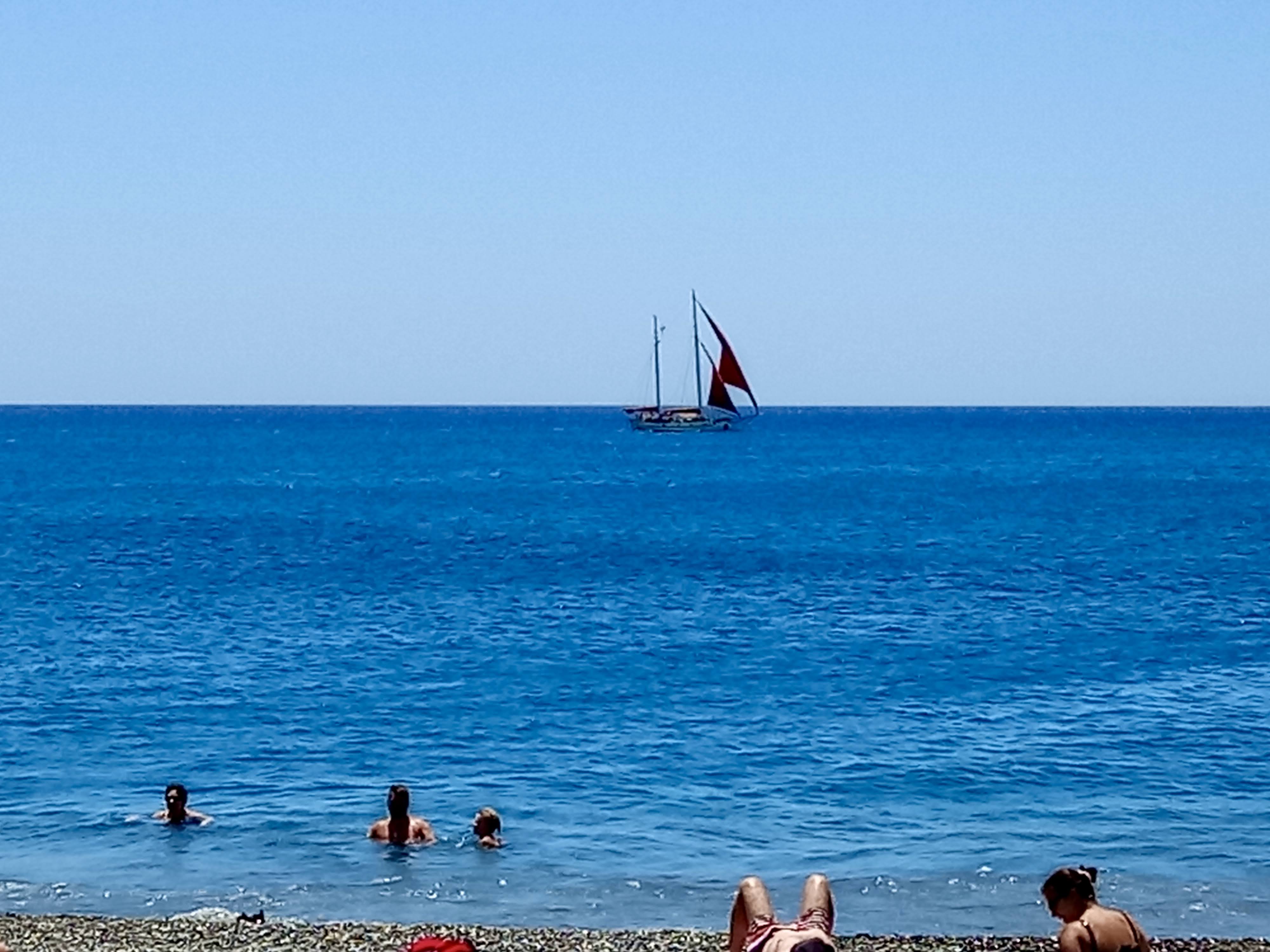
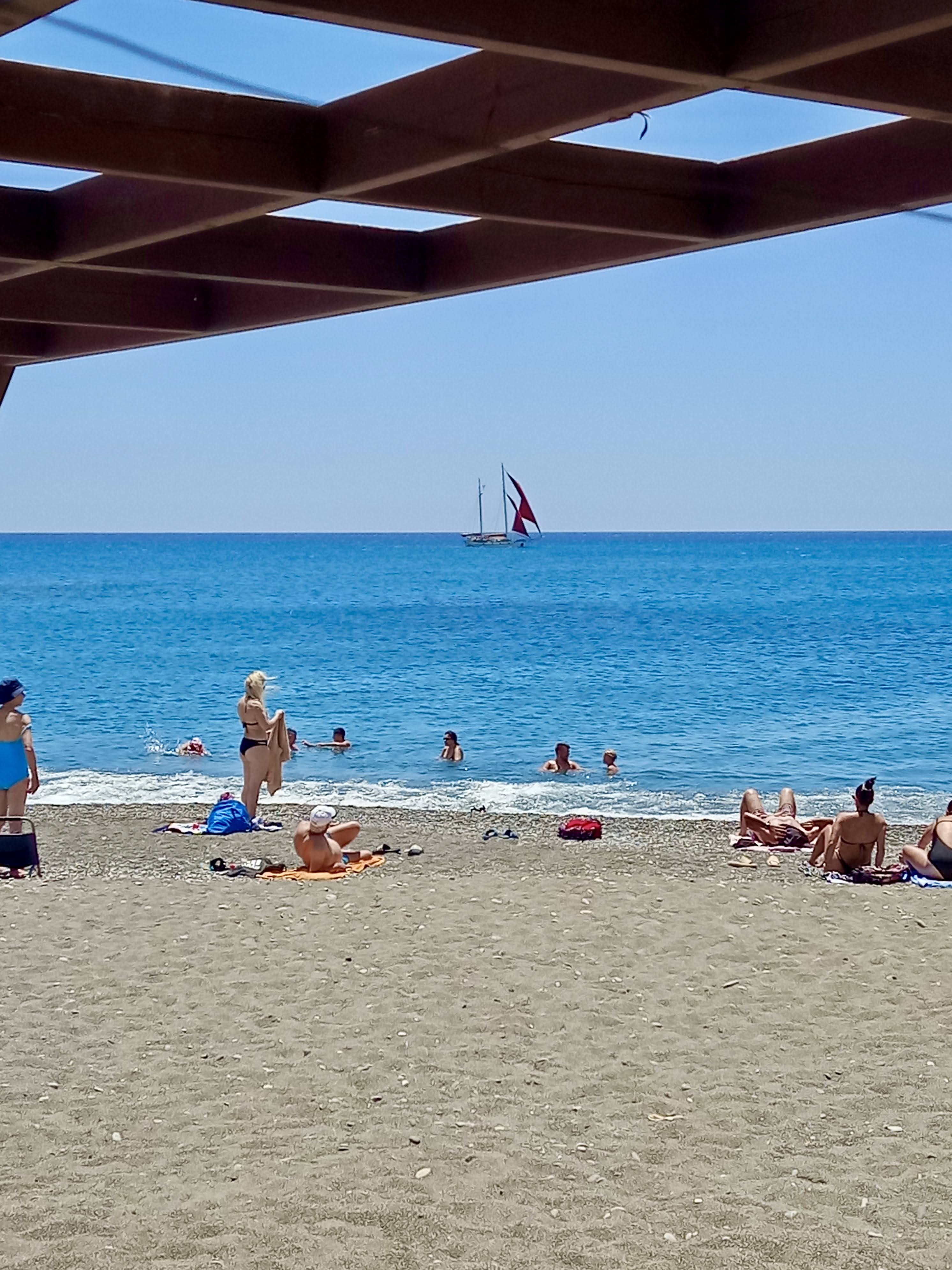
The above shot of a Ketch (watch as the aficionados shoot me down in flames here, since I know very little about such technical details!) passing our local beach was taken a few days ago. I don’t know what it is about such sailing vessels, especially those that look like they have some history behind them, but they evoke such romantic visions of past times when these vessels roamed the oceans all the time, but they do look so – well – just right, don’t they? I took another as well, so here it is…

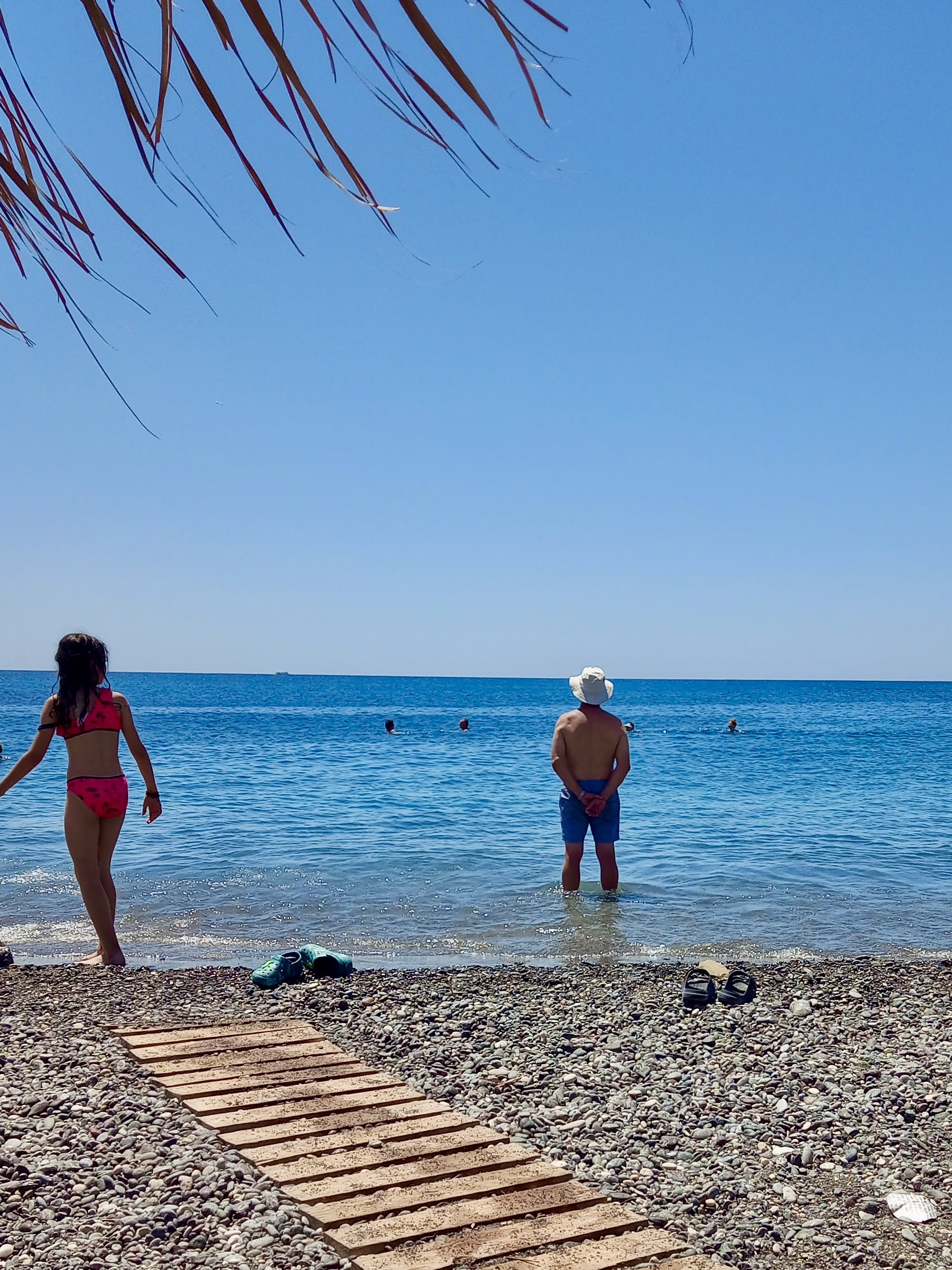
On the same day, I was rather amused by this bloke…

He stood there like that for at least half an hour or so, then he turned around and did the same thing again, but this time facing the beach. You won’t be surprised to learn that, when I heard him talking to his family a little later on, he was British! The hat is a good indicator (such sartorial elegance), as is the fact that he was evidently simply trying to brown himself off. Apart from when they go into the water to cool off, the locals simply never stay in the sun for more than a minute or two. Up until this year, and this is our fifth summer in our ‘new’ home, we’ve hardly ever heard an English voice in Ierapetra. This year, though, we’ve heard them more often, and so I did a little research, only to discover that this is the first season that TUI have contracted with a hotel a little way along the coast towards Makry Gialos, and thus I suppose we can expect to hear and see British tourists around the place a little more often now.

I called this post How does your gardenia grow? because we were talking with some locals recently about the gardenia plants in their garden. Gardenias evoke such vivid memories for me because, when I first visited Greece, which was in September of 1977, we stayed with Yvonne’s relatives in Athens for three weeks, during which we also passed a few days on my first ever Greek Island, which was Poros, in the Saronic Gulf. Incidentally, if you click on that Poros link, you’ll go to the official tourist info site for that delightful island. Just out of interest, if you look at the banner photo at the top of that page, the small village rooms where we stayed (and did so four more times over the succeeding five years) are smack in the middle of the photo, slightly right of centre. For me to try and explain exactly which rooms they are would be a bit of a struggle, but suffice it to say that once you’ve started your whole Greek experience in such circumstances, you begin to understand why I so hate big hotels, and especially the All-Inclusive variety. OK, so I had a Greek mother-in-law to make all the arrangements to begin with; but the only way, in my humble view, to truly enjoy Greece and to ‘feel’ the country, is to stay in modest accommodation in the thick of things, not out on some limb amongst a few hundred of either your own compatriots, or a mix of northern Europeans.

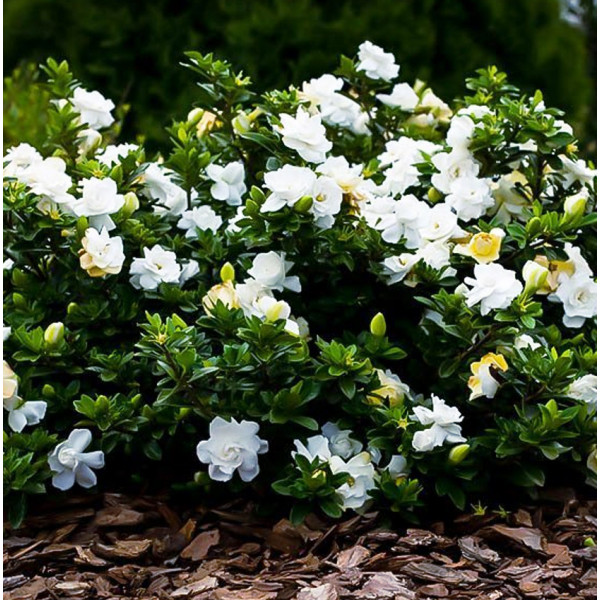
My wife’s Uncle Theodorakis grew gardenias for a living. Back then, when I first went to his house in Kato Patissia (which was a very different place in 1977 than it is these days, sad to say) the scent of these waxy, lush, creamy white flowers was heady indeed as you entered his nursery, which was situated along a fairly nondescript suburban street, oddly enough. The reason for its quite urban situation wasn’t hard to understand, because that nursery had been there since the days when Athens was more a collection of small villages that the urban conurbation that is has since become. Uncle Theodorakis made his living out of gardenias and nothing else. We’ve toyed with the idea of planting them in our garden here, but we’re a little worried about how you look after them, to be truthful. If you want to know what they look like, here’s a photo…

Gardenia bush photo courtesy of https://thessfyta.gr/

Theodorakis would sell the flowers to night clubs and restaurants, anywhere where there would be live music. Most people are aware that the most popular way of showing appreciation for musicians, singers and dancers during a Greek knees-up used to be by smashing plates. What perhaps you may not be aware of was that the plates that they would smash were more often than not specially made for the purpose and often not glazed in a kiln. Some years ago the Greek government of the time passed a new law (as long ago as 1969, in fact) prohibiting the smashing of plates, because the shards could injure people. It took a few decades for that law to actually bite, since during my early visits to the country throughout the seventies and eighties, plate smashing was alive and well, since I saw it many times. I used to marvel at how the staff in the club would brush all the fragments into piles along the side of the dance floor with stiff brushes, before they got going on yet another session.

When you entered the wooden gate into Uncle Theodoraki’s nursery, you passed through a few metres of rich, shiny foliage until you reached the few steps up to the veranda along the front of the house. Once you’d penetrated the gardenia ‘forest’ by but a few metres, you could have been forgiven for thinking that you were somewhere out in the wilds, the city street from which you’d just gained access seeming a whole world away. The plants were either growing out of huge terracotta pots, or were planted up in smaller pots on wooden benches, thus making the foliage and the luscious blooms around shoulder/head height. You’d have to gently nudge some delicate branches aside to avoid them brushing against you as you walked. Next time you’re near a gardenia plant, make sure you smell the flowers. Mind you, if it’s in bloom you won’t have much difficulty in doing that, because their smell is quite strong, especially if you’re near them in the early morning or early evening hours. It’s also one of the loveliest natural aromas you’re ever likely to enjoy.

Small wonder, then, that my first ever experience of gardenias, which was a mere 47 years ago, is still with me today, especially when I’m fortunate enough to be near to a gardenia plant nowadays.

Going back to the whole plate smashing thing, I only mentioned it because, owing to the new law, plates began to be replaced by flowers, and occasionally paper serviettes. If you go to a popular bouzoukia these days, by the time you reach about 3.00am, the dance floor (and often the singers sing from there, in amongst the revellers) is almost knee deep in paper serviettes, red carnation flowers and white gardenias, although these days the gardenias have lost a lot of ground to the carnations, which are cheaper. Where do the patrons get these flowers from? If you sit at a table in a bouzoukia (different link to the previous one), you’ll see members of staff regularly circulating amongst the customers carrying little wicker baskets of them, sometimes piled ten high on their arm. If you approve of either the bouzouki player or the singer, you show that approval by purchasing a basket of blossoms, getting up and then moving as close to the musician as you can before throwing the contents of the basket all over them. There is also another way of showing your appreciation, if you happen to be well-heeled enough (or want to give the impression that you are), and that’s to order a bottle of champagne from a waiter, who’ll then take it right up to the singer or bouzouki player, pop the cork while standing beside them, and then making a great show of pouring the effervescent liquid into a flute and handing it to the recipient, while pointing at you with the other hand to show them who’d shelled out for it. Aah, those were the days, when I had the stamina and the appetite to be out until dawn.

These photos below were all taken either at night, or at dusk either in the village or down in the town recently. Hope you like them…

Click HERE to go to my Amazon Author Page. There you can browse all of my written works.

That [those] darned cat [cats]

Cats, of course, are famously more independent than dogs, don’t require taking for walks and don’t wake up the neighbourhood in the dead of the night by barking for an hour without seeming to have any logical reason for doing so, apart – that is – from the desire to make sure that if they can’t sleep, then they’re going to make flippin’ sure that no one else does either. OK, yes, now and then a couple of local male cats will have a slanging match and go at each other hammer and tongs with their claws, but it doesn’t usually last long, although sadly it often results in the loser in the altercation coming off with a torn ear, or a nasty wound about its head or neck that would require a visit to the local A&E were it a human.

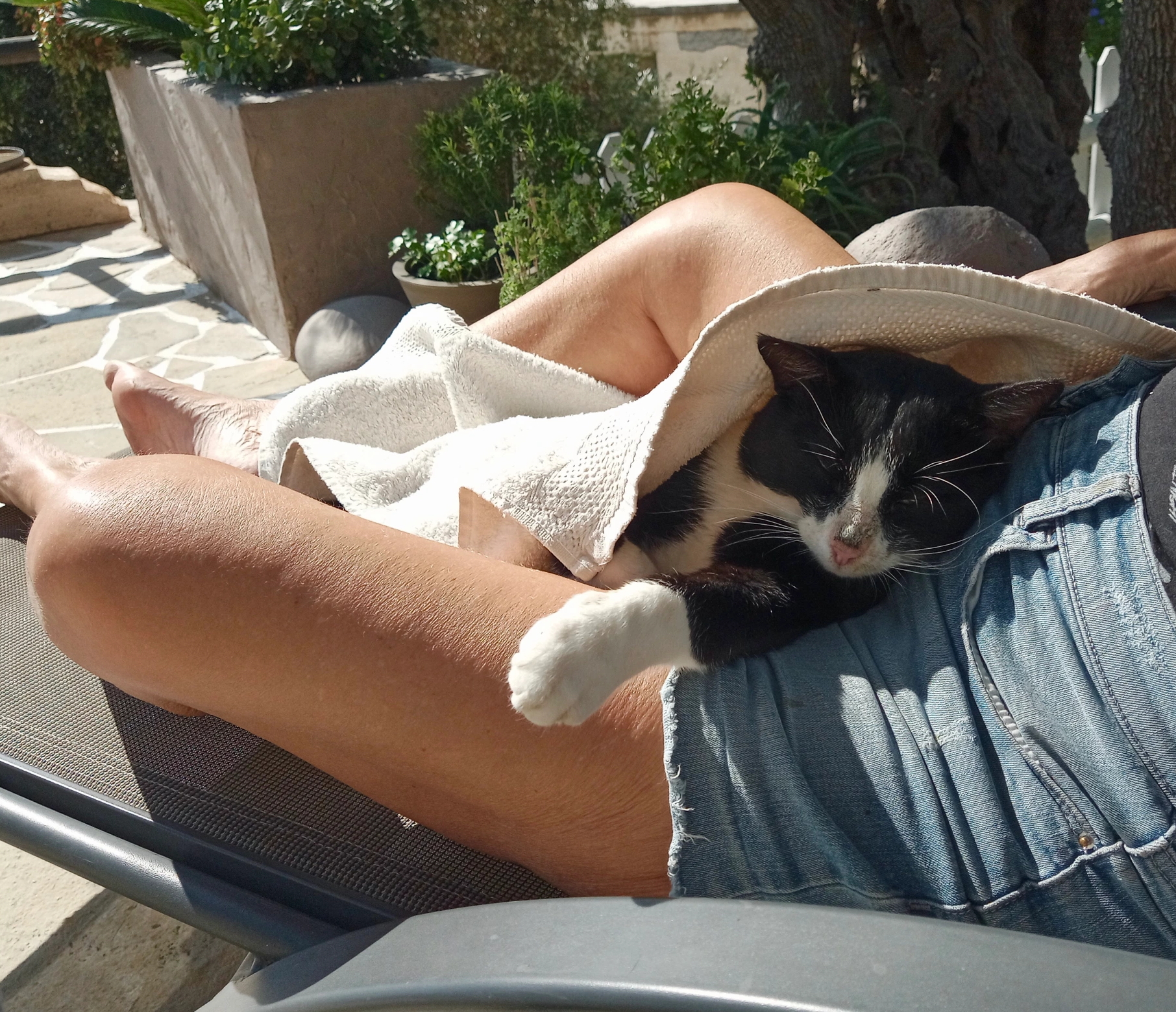
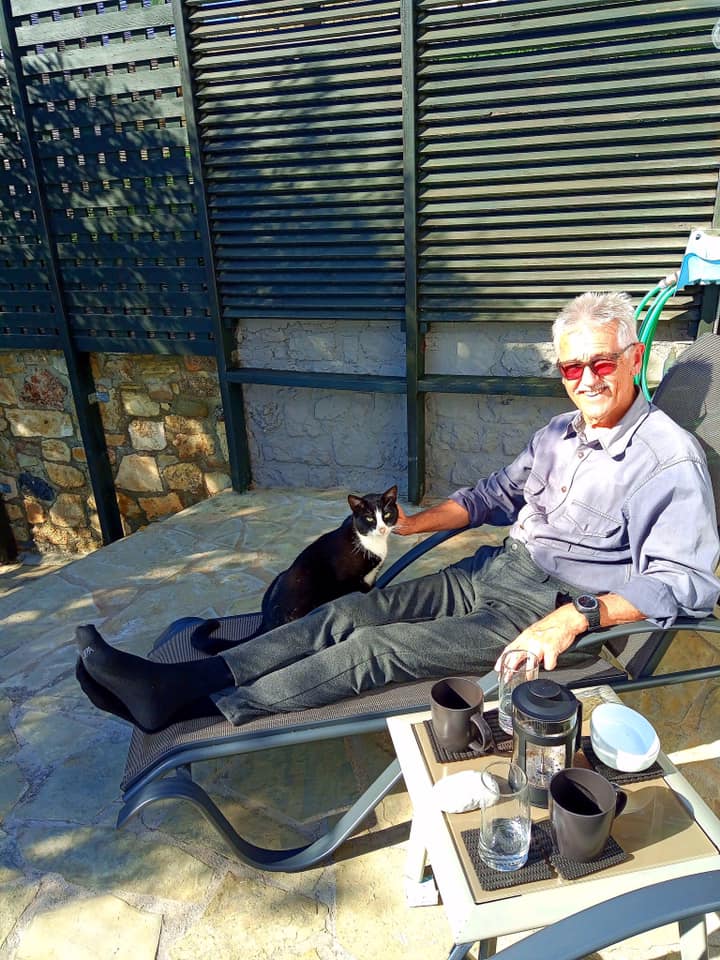
The beloved and I have always understood that to own a pet is a great responsibility, and it requires much sacrifice, which is precisely why we’ve spent most of our married life not owning one. In times past when my parents were alive we’d sometimes spend a few weeks back in the UK and to worry about what to do with a pet during that time was a principal reason why we decided against the whole venture. A couple of years ago however (and I know I’ve mentioned this before), a small black and white kitten (feral, of course) took to following me around the garden, to the extent that he quite stole my heart. The little perisher wheedled his way into our affections, so we started buying food for him and, before long, he’d well and truly got his paws under the table and was to all intents and purposes our cat. He lived with us for a couple of years while he grew into a formidable and handsome male, with a glossy coat and gentle disposition. We could do anything with our Mavkos, and he’d revel in the attention. Here are some photos of him, even though it still pains me to look at them (as I shall explain below) –

We became so soft on that cat that we’d also buy little packets of treats for him and he always knew exactly when it was time for coffee on the terrace. He might be nowhere to be found, but as soon as we opened that screen door with the tray in hand he’d come trotting around the corner of the house from the veranda and insist that he got his little dish of treats before ever we could settle down for our coffee. Once he’d finished his little dish of ‘nuggets’ as we used to call them, he’d sit there between our two sun loungers and look first one way, then the other, before deciding which of us would receive the privilege of having him curl up between our legs, his head on a human thigh, where he’d expect to be smoothed and tickled for half an hour or so.

Then, one day, about a year ago now I suppose, he started with his absences. At first he’d be gone for four or five days, then turn up like butter wouldn’t melt, usually around coffee time, and expect his treats and cuddles quite as usual. These absences gradually increased in length and we were sure that he’d found another house in the village where they’d taken to this amazingly affectionate cat that was obviously at home around humans and begun feeding him there too. Frankly, we were OK with this because the first time we’d been away while he was ‘our cat’, as it were, we’d enlisted the help of Angla’i’a to come and feed him while we were away. She’s no longer in a position to do that, because her legs won’t get her up the fifty metres or so of our drive any more, it’s simply too steep for her. So to be able to go away and not have to worry about Mavkos was a blessing.

The problem was, and anyone who knows cats will also know this, you never really own a cat, it’s more that he or she deigns to live with you. It seems to me that loads of cats the world over have more than one home, often without the original owner ever finding out. Back on Rhodes we’d hosted our neighbours’ cat each time they’d gone to the UK for a month or so each spring. The cat was called Simba and wasn’t even originally theirs to begin with. He’d moved in with the couple who’d bought the house that was built above and behind their place, and had belonged to Nicola, the new resident there. The trouble was, the more dogs that Nicola adopted, the more time Simba would spend on Ron and Janet’s terrace with them until, inevitably, he decided to throw his lot in with them to escape the hassle. When they went away he’d move effortlessly down the hill to our place and was effectively our cat for the duration of their absence. When Ron would come home he’d be very keen to collect Simba, since he’d missed that cat terribly. It’s not surprising really, because he and Simba were virtually inseparable all the time that Ron was at home. Simba would follow him all around the garden, sprawl on his lap while Ron read the papers on his Kindle device during the daytime and flop onto the sofa with Ron of an evening. When they got back to Rhodes from the UK, the simple act of Ron carrying Simba back up the hill to their terrace was the signal for the cat to return home, whenceforth it would be our turn to miss him for a while!

So, with all the above in mind, you’ll understand how we felt when Mavkos simply didn’t come back any more. Simba had disappeared a couple of years before we left Rhodes, and when he first went away Ron was beside himself. He’d wander the dirt tracks and forest trails around the house calling for the cat to come home, but he never did. There were no other houses within a sensible distance for a cat to relocate to when we lived in Kiotari, so we had to conclude that one of two things had happened to Simba. Either he’d been poisoned (a regular and barbaric habit of some of the locals in rural areas around the Greek islands), or, somewhat like an elephant, Simba had known that he was unwell and was going to die, and so went off to curl up in some concealed nook somewhere to go to sleep for good.

Once it had become apparent that we were to experience a similar loss with Mavkos, I ended up really identifying with Ron and how he’d felt at the loss of Simba. In fact on more than one occasion I scoured the village hoping to find where he’d decamped to with the idea of trying to coax him home, or at the very least making sure that he was happy and well cared for. No joy.

Mavkos came back just one more time, after a gap of about three months. At least we were relieved to see that he was OK physically and seemed to be well fed. He turned up right on cue as we were settling down to sip our iced coffees on the terrace one morning, only we didn’t have any packets of treats for him this time, so we fed him a few small chunks of Graviera (he loved cheese!). After that, he trotted off and we have never seen him since.

Our experience with Mavkos led us to decide that never again would we adopt a cat. To be honest, a lot of ex-pats take one look at a feral cat and decide, “Oh look! Isn’t he cute! Lets’ adopt him/her.” And they do. Unless you catch a feral cat at less than six months of age though, even though it can well acquire the habit of coming to you for food, it’ll never allow you to stroke it or pet it. After about 6 months it’s too late. After our own experience though, garnered over 19 years of living on a Greek island, we well understand how it is that lots of ex-pats end up caring for lots of cats, sometimes well into double figures. They simply look so cute. The fact is, though, that they are wild animals and their resemblance to the domestic cat is not really a good thing. As ferals they live off vermin and insects, and during the winter months they’ll eat vegetation too. When well-meaning foreigners turn up here and start feeding them cat food, they get lazy and no longer have to go hunting for rats, mice and lizards on which to survive. I once watched a feral cat on Symi chase down and devour a Symi spider, and it was not a pretty sight. That said, it was however somewhat reassuring, because if you’ve ever seen a Symi spider (and I talk about them quite a bit in my ‘Ramblings From Rhodes’ book series) then you’ll know that for the arachnophobe they’re a total nightmare. They’re easily as big as a tarantula and when one walks across the path that you’re following you hang back out of respect and let it go its way. We’ve stayed in various accommodations on Symi and once or twice had to deal with one of these monsters and it’s a daunting task, I can tell you. So, to be aware that the feral cats eat them is comfort indeed. But then, if those cats are used to being fed by well-meaning (although IMHO missguided) ex-pats, then they’ll have no need any more to hunt down their food. They thus become part-domesticated and the vermin population of the area prospers.

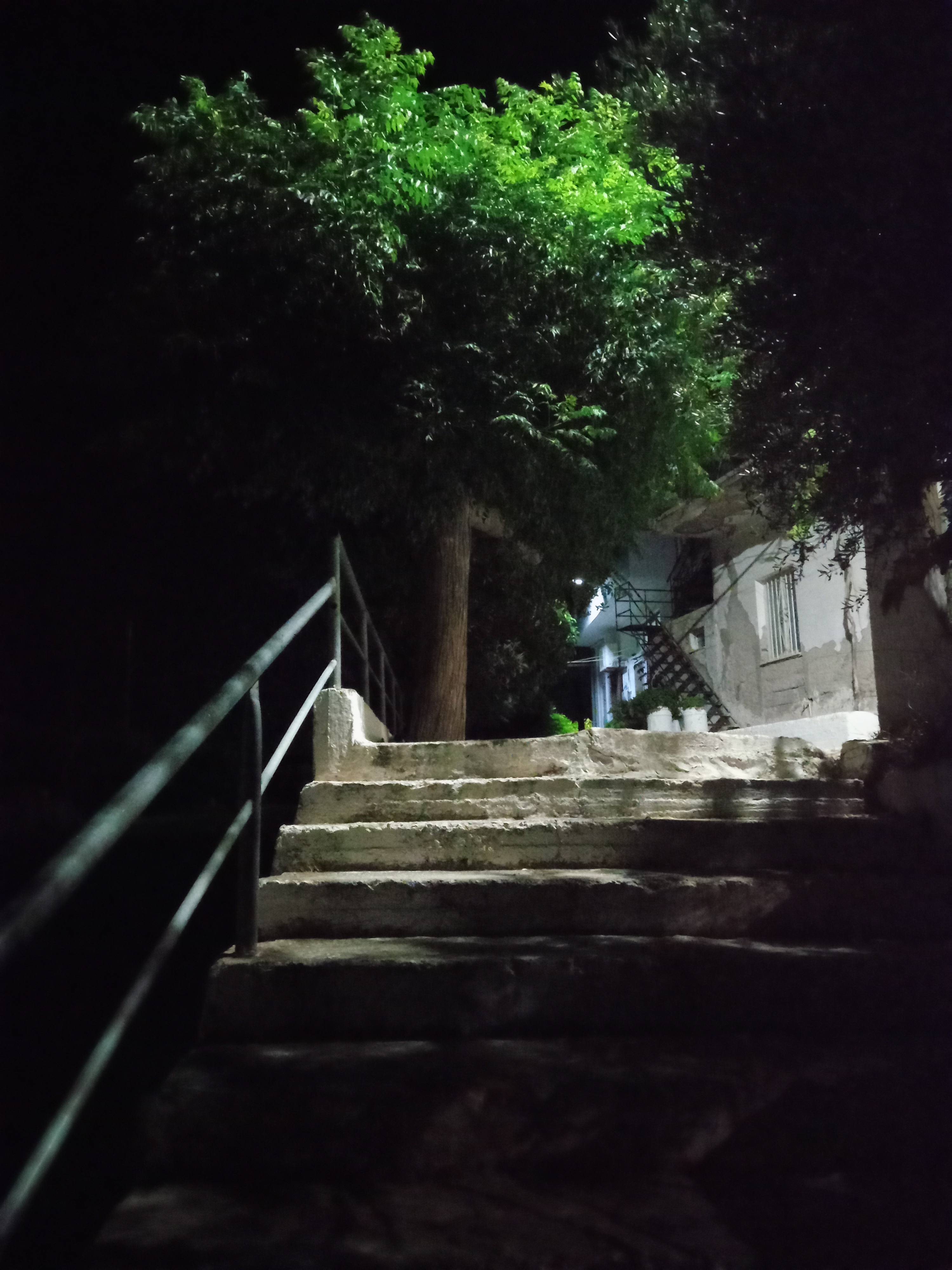
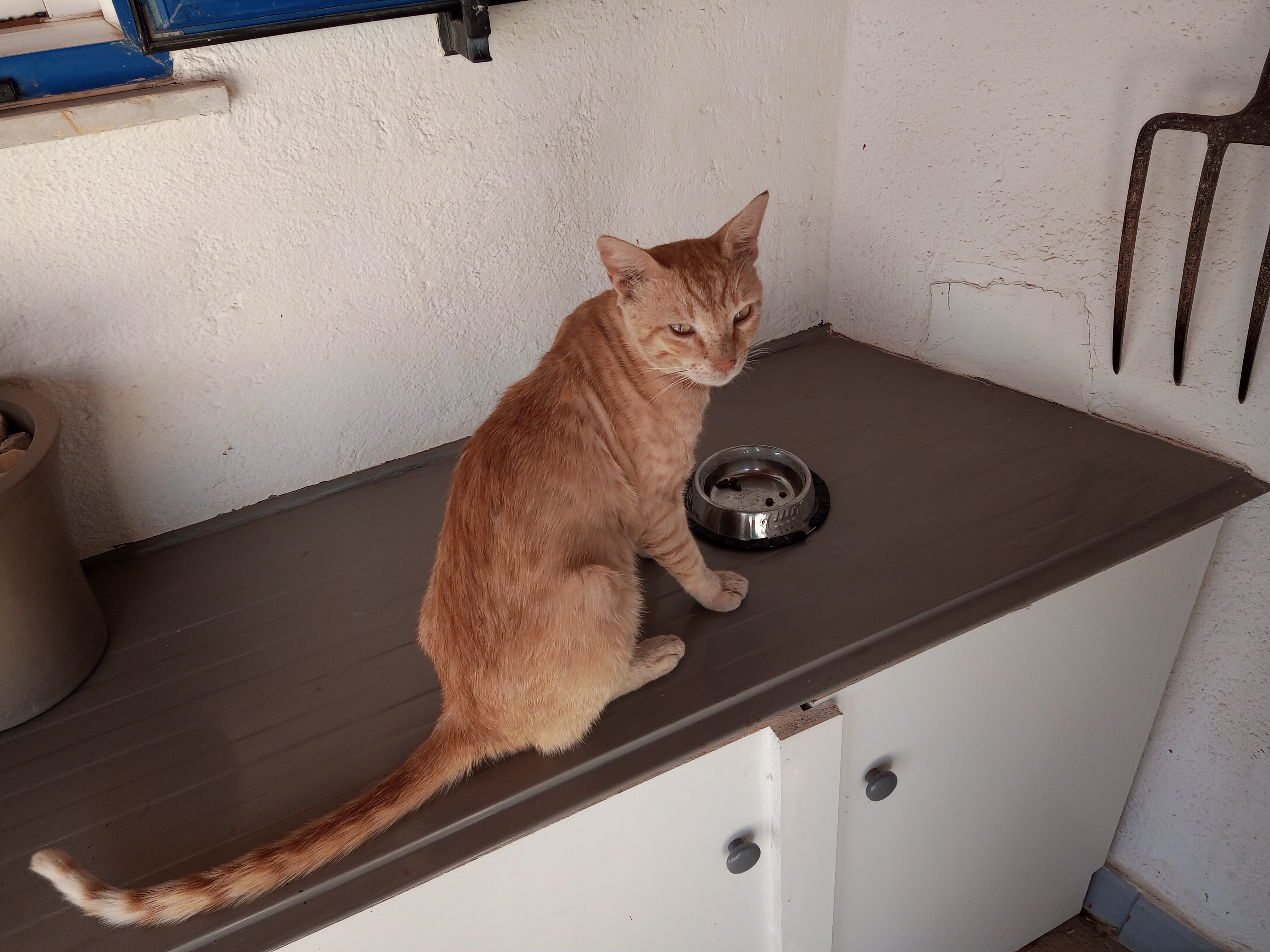
So, determined as we are not to become owners of another cat, you can understand how hard is our internal battle not to get too soft on White Sock, Groucho, Woebegone and Ginge, the ferals that regularly hang around our door when we’re pottering about at home. See, even to have given them names is to almost lose the battle, I know. It’s White Sock who’s dozing on the steps up to our upper garden in the photo at the top of this post. It’s also him staring in through the mozzie screen of my office while I write upstairs in the first shot below. There’s cunning old Ginge in the second shot below, scoffing a little food that we, in a moment of weakness, put out for him…

Here’s Groucho, the crafty little…

I don’t have a photo of Woebegone, so-named because he always looks like he has the cares of the world on his shoulders. Don’t let anyone tell you that cats can’t show feelings in their facial expression. Woebegone has a way of looking at you that says, “Poor me. No one loves me and the other male cats always pick on little old me.” It’s true, I tell you.

So, here’s the situation at present as I see it. Those puddytats mentioned above by name we do occasionally put food out for. What we are determined not to do though, is to feed them daily. That would be the beginning of enslavement, and we’re not prepared for that. Plus, we shall be going to the UK in September, and we don’t want them to suffer on account of our absence. It takes nerves of steel, I can tell you, not to rush to the cupboard and pour some cat food into a dish when Ginge is meowing at the front door, but it’s for his own good. Once you learn to be firm, you soon notice too that the cats don’t starve. None of them turns up looking emaciated, so they do OK. They’re first of all feral cats and must be allowed to remain so.

Dammit, Ginge even wants to be smoothed now. Courage, John, courage!!

Click HERE to go to my Amazon Author Page. There you can browse all of my written works.

For Michael

You know, I’ve read so many ill-informed comments from people on social media about the awfully sad death of Dr. Michael Mosley on Symi, that I decided to express my view in a simple blog post. These two questions have annoyed me somewhat:

“How could his wife have let him go off on a walk like that?” 

“How could someone get lost on such a small island?”

The sad fact is that, no matter how well-informed someone may be, they’re not always ready for the realities of walking in the midday sun when the temperatures are in the upper thirties, maybe forty C. 

The only reason I feel qualified to talk about this particular tragedy is the fact that, apart from anyone who actually lives on Symi, I probably know as much about the terrain where the good doctor went walking as does anyone. My wife and I not only spent a number of 3-week holidays on the island before ever we moved to Rhodes in 2005, but for ten years I was an excursion escort on Rhodes, taking guests to Symi sometimes twice a week for much of that time. We also spent a couple of short breaks there during November while living on Rhodes.

We’ve spent many happy hours on Ag. Nikolaos beach from where Doctor Mosley set out, and the coastal walk from Pedi to that beach is tricky, but well trodden and, as long as you watch where you’re putting your feet, you can manage it without incident. Setting out from Pedi along the coast Eastward, you simply follow a series of red paint dots which are to be found on various rocks along the way. The last fifty metres is a steep downward climb to the beach itself, and thus when you’re returning to Pedi, you start out climbing upward until it levels out somewhat. 

There are various theories about what Dr. Mosley did once he’d reached the North end of Pedi beach, and the roads at that end of the bay can confuse a walker. It’s very easy to be disoriented when it comes to which way is North for example. I’ve stood at that spot many times and, when we first went there, thought that a quick trek over the mountain at the far end of that side of the bay would in all probability bring us down in no time to Symi’s main town and harbour. In fact, the size of the peninsula at the far end of which sits the rather remote tiny resort of Agia Marina is very deceiving. Plus, the terrain there is like another planet, as it’s virtually totally devoid of vegetation, and thus affords no shade, and it’s very uneven and rocky underfoot. It’s what I’d call ankle-twisting, or even ankle-breaking territory. It’s not the kind of landscape that anyone should attempt to traverse alone, or at the very least without a mobile phone. 

Yvonne and I once actually made the very walk that brought about Dr. Mosley’s death, although there were two of us, and we didn’t attempt it at the hottest part of the day. We did, however, make it to Agia Marina, which, although pleasant enough, didn’t leave us wanting to make another visit. It’s surrounded by the most barren hillsides you can imagine, and the best way to get there is by sea. To make that walk you need at least a litre of water each, plus it would be a good idea to carry a few energy bars too. A high factor sun cream all over any exposed skin is a must, as is a hat. At least Michael had an umbrella with him, so that was a help.

Of course I’m in no position to draw definite conclusions, but on studying all the reports and seeing the videos on the TV news, my firm belief is that he thought he was making a shortcut back to his accommodation in Symi Harbour. He’d left the beach telling his wife that he didn’t feel so well, probably a touch of sunstroke I’d imagine anyway, since they’d already walked out to the beach earlier in the day. If he’d gone left instead of right at the North end of Pedi bay, he’d have made the climb on an asphalt road into Chorio, the village that sits in the shallow valley high above Symi Harbour and affords views both down to Pedi and to the harbour, if you know where to go and stand. From Chorio it would have been a simple, if slightly arduous descent down the Kali Strata, and he’d have got back to his accommodation safely.

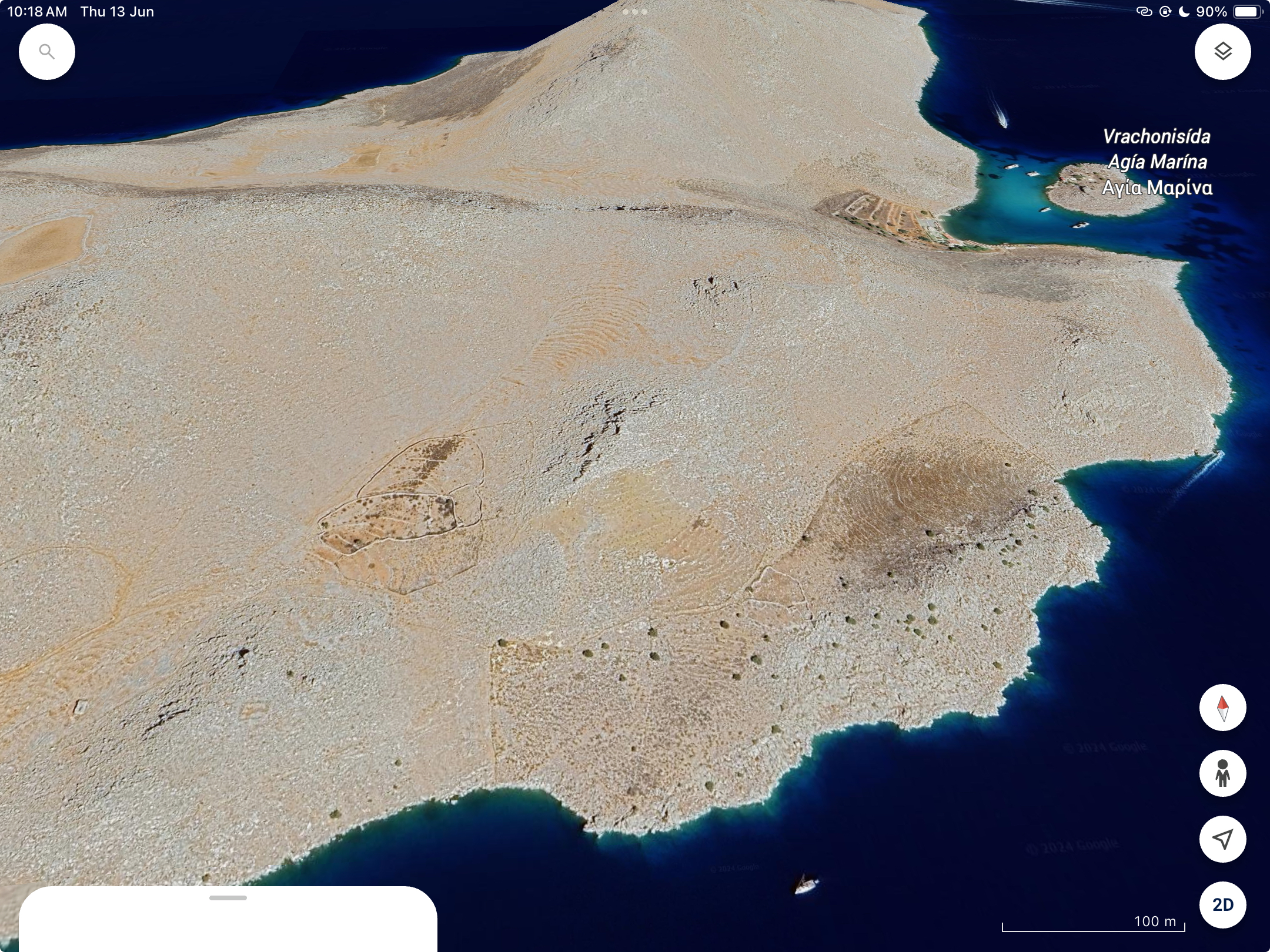
Once he’d committed himself to attempting to climb the mountain between Pedi and Agia Marina, he probably reached the point where he felt he had no choice but to press on, even though the landscape before him probably didn’t turn out to be what he’d expected to see. When we did the walk, we knew we were heading for Agia Marina, but I theorise that once he caught sight of the place, he thought that his best bet was to head there and ask for assistance, probably a boat, to get back to the harbour. If you take a look at some of these screenshots I’ve taken, courtesy of Google Earth Pro, you can see just how large the peninsula is that separates Pedi from the bay to the East of Symi Harbour. Also, it’s obvious that, once he’d set out to climb that hill, he was going in the opposite direction to the one he wanted, but without knowing it.

How people can ask questions like, “How could his wife have let him go off on a walk like that?” It’s beyond me. He was a grown man, a sensible and very fit man, by and large. He would have given his wife no reason to assume that he couldn’t have made it back to their accommodation, surely. There’s even a bus (used to be a 15 seater, not sure if it is these days) that goes between the two bays regularly.

As for the other question, “How could someone get lost on such a small island?” – Once again, to ask such a question is to misunderstand the meaning of the word ‘small.’ Looking at the screenshots I’ve posted here (see below), one can easily see that a walk on such a headland is going to be gruelling to say the least. Symi may be a ‘small’ island in comparison to other islands, but how long does a walk need to be in 38-41ºC when one probably doesn’t have enough water or food to embark upon it to begin with? The pathways on that peninsula are rough to say the least, and you do encounter a few stone walls that need to be either crossed, or negotiated around.

Below: The second photo shows the location of Chorio, with the Symi waterfront just visible to the far left. Agia Marina (where he was found) is that tiny bay at the far right end of the peninsula, where there is also a small island off shore. The last shot below gives an indication of the extreme barrenness of the terrain he would have been walking across.

There, that’s what I think. I believe that the good doctor was a victim of a mistaken sense of direction, that’s all. Sadly, he lost his strength just metres short of his goal and, had he not collapsed behind a wall, would have soon been spotted by people within the boundary of the Agia Marina resort and assistance would have surely been rendered. Circumstances conspired against him. It’s desperately sad, and one cannot but ache for his wife and family, not to mention all those who’ve enjoyed and benefited from his informative and entertaining TV presentations in recent years.

Below: Setting out from the far end of Pedi Bay (opposite side to the Ag. Nikolaos path) –

All screenshots courtesy of Google Earth Pro, except this one, which is a still from a beautiful video of Pedi on the Eagle Eyes From the Sky YouTube channel.

Don’t please, either, believe people who spout on social media about how this affects Symi’s reputation as a place to visit. Talk about irresponsible and ill-informed. I read some bloke’s comment on Facebook, something like, “Symi’s not so nice a place to go now then, is it?” That’s balderdash, pure and simple. Lots of people have met their deaths or been seriously injured in remote places in the UK, leave alone a beautiful Greek island. It’s nothing to do with Symi or its terrain, but everything to do with a few unfortunate circumstances catching up with the unwitting victim.

I doubt that she’ll ever read this, but I wish to extend my deepest sympathies to Dr. Claire Bailey Mosley, Dr. Michael’s loving wife, and indeed to their children. I, like many others, have enjoyed immensely her husband’s TV shows over the years, and the fact that he cared deeply about people and their health always shone through.

Click HERE to go to my Amazon Author Page. There you can browse all of my written works.

Burnt hands and a barn owl (or two)

June has come in with a bang. We’re being hit with a heatwave that is bringing us August temperature in the first week of June. As I type this the shutters are all closed and we’re only venturing outside when absolutely necessary. I hope it’s not a harbinger of the entire summer before us. The thermometer in the shade on the veranda reads 40ºC and, since there’s virtually no wind, it feels like you’re stepping into the oven when you go out the front door. I can only imagine with a large degree of horror what those people in India must be going through right now, where the reports are that temperatures are nearer to 50ºC than they are to 40.

Since we’re not even taking our iced coffees out on the terrace at the moment, any social intercourse with our neighbours is currently severely limited. Mind you, we always know that Evangelia, who’s (I’m sure I’ve mentioned this before) nearer to 90 than she is to 80 these days, is OK. See, she has a very distinctive sneeze. When we first heard it a few years ago we thought that it was either some species of bird that we weren’t familiar with, or maybe a small child being chastised in a corporal manner by its parent. Most days she sneezes at least once or twice and, if we don’t have any radio or music playing, we hear it over here. When it happens we look at each other with a knowing glance and without words communicate the fact that she’s OK, she’s ‘about’ as it were. Only a few days ago, when we actually had a slight breeze and the heatwave hadn’t yet hit us, she’d reminded us that we would always be welcome to go over to her house for a Greek coffee at around 5.00pm any day. Her daily programme never changes, and ours doesn’t a great deal either. The only problem is, we usually sleep from around 4.00pm until 5.30, or even later, and she goes for her siesta at 12 midday. She’s up and about again while we’re sipping our Earl Grey after lunch and thinking about going to bed.

Still, one day it’ll all come together. We’d like to sit with her again, since its been probably a couple of years since the last time, and whenever we’re in the lower garden, just across the steep lane from her tiny alleyway, she tends to have the knack of appearing in order to exchange a few neighbourly words.

I was trudging around Dingly Dell the other day, since I’d failed to drop off to sleep during the afternoon, and I came across one of the local goat herds. You don’t have to see them to know that they’re in the vicinity, because the clanging of their bells (I wonder if they ever get driven mad by those things hanging permanently around their necks) signals that they’re approaching, or that you’re approaching them. On this particular occasion, as they came into view, I also heard the telltale sound of the goatherd whistling and calling to them, usually to get them to go in a specific direction. I stopped in order to ascertain where the goatherd was, because, if he wanted the goats to pass anywhere near my position, I might well have proven to be a nuisance. Goats here will generally avoid any humans with whom they’re not familiar, and so, if I come into their field of vision, they’ll change direction so as not to allow me to get within about ten metres of them. I stood stock still as a couple of goats emerged from the undergrowth onto the lane a little way ahead of me, and scanning the hillside I could see the goatherd a couple of hundred metres across the valley.

I decided to retrace my steps a couple of hundred metres or so, so as to not impede the goatherd’s work. Within minutes the bells had receded to a distant tinkle and the sound of a moped could be heard approaching along the very uneven and occasionally steep path that I was following. Soon, rounding the corner in front of me came the Honda 90 in question, and riding it was none other than Manolis, our new village mayor. On seeing me he skidded to a halt in order to exchange a few neighbourly words, but I couldn’t help noticing that both of his hands were heavily bandaged up, with only the tips of his fingers showing. After both of us had discerned that the other was OK, I couldn’t help but point to his hands and ask what had happened to them.

“Oh, nothing,” he told me.

“Nothing?” I replied.

Well, I had a little accident with some revma.”

Now, in case you’re not familiar with the Greek word ‘revma‘ it literally means ‘flow,’ but is invariably a reference to mains electricity. The voltage here in Greece is similar to that in the UK, it’s about 220v, whereas in the UK it’s 240. It’s so similar that, as long as you have the correct adapter, any device bought in the UK will work just fine over here, and vice versa. If we have a power cut, or – to use the current in vogue expression – outage (See my dystopian short story of the same name, which I rather neatly chose to call ‘Outage.’ Oh yes, I know how to keep in with the trendy youth), people will simply say, “We’ve lost revma.” or “We don’t have any revma.”

So, for Manolis to dismiss the cause of his injuries as ‘nothing’ was to minimise the fact that he’d evidently been tinkering around with some mains electricity and gone and got his hands burnt in the process. Ouch. I asked him if it still hurt, and received a vigorous nod of the head to affirm that it did. The nod was accompanied by a knowing smile too, bless him. Now, my Dad (and here’s another pretext for using the term ‘bless him‘) had been an electrical engineer and knew all too well about the dangers of fiddling around with live cables and fuse boxes and the like. So, armed with the knowledge that my Dad had imparted to me when I was a lad, I knew what could well have happened in Manoli’s case. Judging by the bandages (which he still sports a week or so later) he had a close brush with death, to be honest.

Nevertheless, he restarted the machine, shrugged his shoulders as if to say, ‘I’ve experienced worse,’ gave me a wave and was off down the track in a cloud of yellow dust. They’re a tough breed these Greek villagers.

Just before I post some recent photos of the garden and village, I am so excited to report that we’ve now had two sightings of barn owls within fifty metres or so of the house this past week or so. Barn owls are unmistakable, as they look almost completely white and somewhat ghostly from underneath while flying and they also don’t make a sound. They fly ‘silent,’ which is one way in which they can catch their prey unprepared. One was perched on an electricity post and took off as we got near to it while doing one of our hikes around the village on a sleepless night during the small hours. The other was sitting on the veranda wall of our neighbour’s house, surveying the olive grove below, and took off as I came within a few metres of it, not actually aware of its presence until it took flight. We hear Scops Owls every night here these days, but they tend to nest in tree cavities, of which there’s an abundant supply on these olive tree clad slopes. Barn owls have the propensity to make use of derelict structures too, and will prefer an open window or roof space on a disused building more often than not. This was why we never saw them in the valley where we used to live on Rhodes, even though we’d often seen them in and around nearby villages.

Here in the village there is an abundant supply of disused buildings, which is sad in one way, but rather fortuitous when it comes to barn owls. It’s not very likely that I’ll ever get the chance to photograph one, but if I do, it’ll sure as eggs is eggs get posted on the blog here. Here are some photos. Mainly the garden, but also in the village…

Click HERE to go to my Amazon Author Page. There you can browse all of my written works.

Food for thought

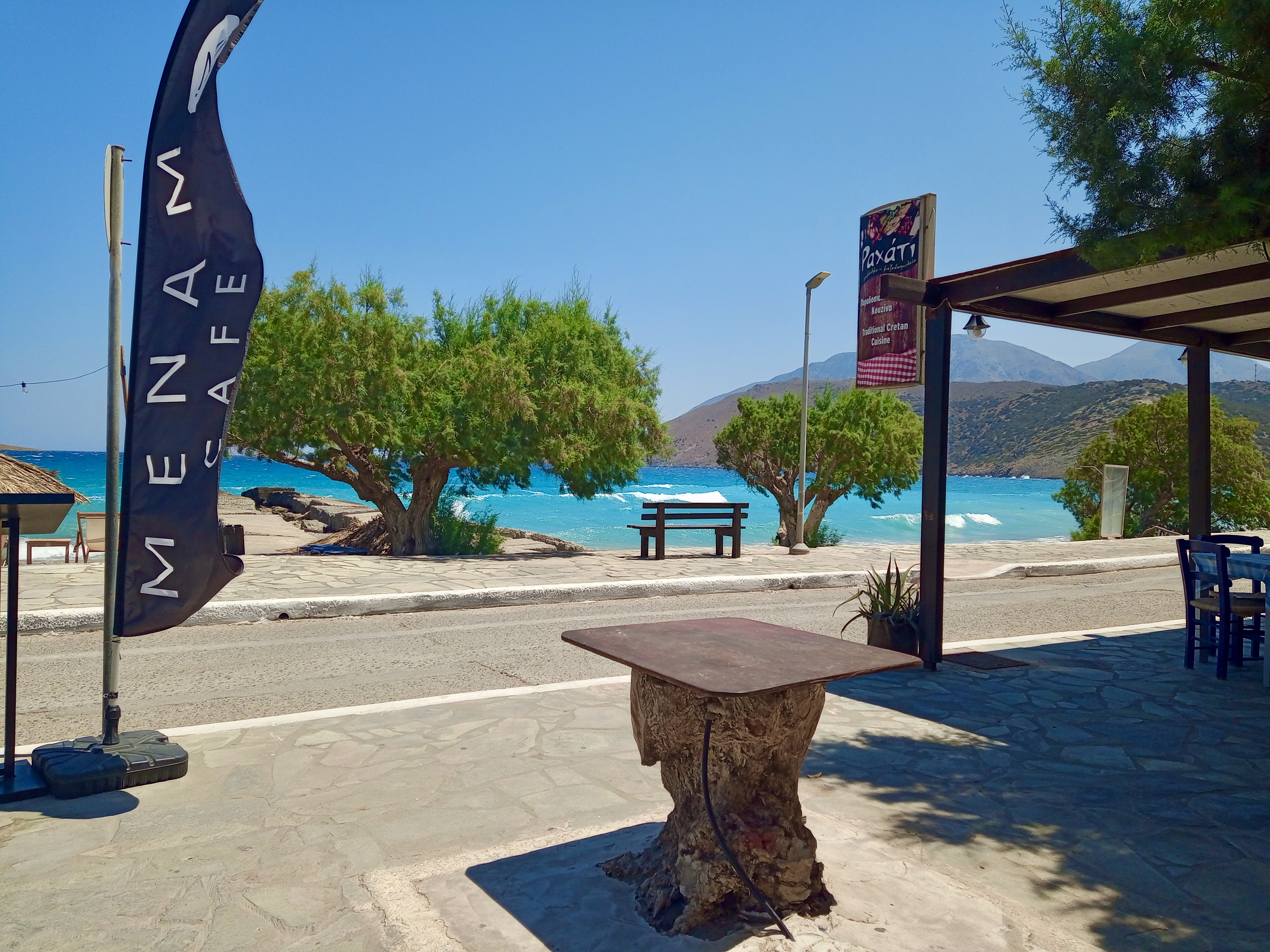
The photo above was taken Tuesday May 28th. It’s the Robinson Taverna at Koutsouras, Lasithi, Crete, not twenty minutes along the coast from where we live. It’s only taken us nearly five years to come across it, but boy was it worth it. We actually intended to eat at the restaurant next door, which is called Kaliotzina, but as we walked down the thirty metres or so of lane between the coast road and the sea front, there was a sign saying ‘Sorry! Closed on Tuesdays.’ The whole expedition could have been a disaster, but fortunately we decided to walk on down to the front anyway, and that was when we spotted the Robinson next door, and there were diners there, so it was obviously open for business, phew.

Here are a few shots of the (closed) Kaliotzina…

We decided to go there after I’d seen a few photos on a local Greek-speaking Facebook group, and it had looked so idyllic a setting that we had to go and investigate. Since the season’s now well under way we didn’t for a moment think that it would be closed, but there you are, it was what it was, I suppose. Frankly, although we’ll surely be going back to give the Kaliotzina a try another day, we were really taken with the Robinson, and even preferred the layout and look of the place. The only thing I couldn’t get my head around was why it was called the ‘Robinson.’ I mean, what kind of name is that for a very traditional Cretan eating place? Curious eh? I meant to ask the lady who served us where the name came from, but didn’t get around to it in the end. Next time I’ll be more diligent.

Here are some more photos taken while we ate a lovely, lazy lunch, while a turtle mooched around in the waters below us, occasionally breaking the surface to take in some air…

When I first set foot in Greece, way back in the 1970’s, island-hopping was dead cheap. Boat/ferry ticket prices were laughably low and you could simply amble on and off whichever ferry you wanted to use. When you found an island that you wanted to stay on for a while, you’d stroll off the ramp on to the quayside to be met by a plethora of locals all touting for business for their ‘village rooms’ or ‘studios.’ We used to love staying in ‘village rooms,’ where you’d have a shared shower room at one end of the hallway and a shared refrigerator at the other end. The daily rates were a pittance and you could spend three weeks drifting around the country, eating for a fiver a night too, and go home with half your spending money still in your back pocket.

Many’s the time that we came across some young person from Ireland, England or Finland who’d arrived on some island, got an unofficial job in a local taverna, and stayed for the summer. They’d go back to the UK to resume their University course in September. In the meantime they’d work in the kitchen, or clearing tables in exchange for room and board, nothing more. I mean, OK, it’s not good for the government to have to chase businesses to get them to pay their taxes, and there ought not to be exploitation of workers who may not have any rights if they work illegally, but still, those days were so good for the likes of us, who went to Greece to spend mere pennies on excellent food, watch impromptu displays of the local dances in any number of small traditional tavernas where they’d either break out the bouzouki from its case on a whim, or simply play a record on an old jukebox, but as the evening wore on and midnight came and went, what began as a quiet meal out turned into a rather good knees-up, where the draught retsina flowed from those little aluminium jugs and Ouzo was in abundance too.

I’m so glad that I got the chance to experience the Greece of the 1970s, but at least tavernas like the Robinson put me in mind of that era, when you could eat beside the sea in a place that, yes, OK, has some tourists in, but is not overrun by them. We actually enjoyed a really interesting conversation with the couple on the next table, who were from a small village near Frankfurt in Germany. They were called Stefan and Alexa (she’s heard all the jokes by now) and it seems that intellectually we had much in common. That’s Alexa in the photos by the way. They were the kinds of tourists that we used to be too, always staying small, concerned about the local economy and the environment in equal measure. And best of all, Stefan liked my kind of music, a double whammy. We talked 70’s prog rock for ages. The conversation only started because the lady serving us remarked on the turtle having put in an appearance and Alexa was “Wow”-ing when it broke the surface with its head. Needless to say we had to ask what was going on and thus the conversation began, they inviting us to share another carafe of house wine before we all paid our bills and retired to our beds for the afternoon (or what was left of it).
Just before I close this one, I wanted to return briefly to Sitia and its restaurants. If you’re lucky enough to be going there some time, then I can heartily recommend a couple. We tried virtually all of the waterfront restaurants while we were there, and settled on a couple that we easily liked the most. A common general name for a restaurant in this region is a ‘Rakadiko,’ which I believe is a local term. We certainly never came across it in Rhodes or any of the other islands that we’ve visited over the decades, although having now done some Googling I find that there are ‘rakadika‘ as far away as Piraeus. So you’ll notice that quite a few call themselves, for example, ‘To Ρακάδικο του Αντώνη.’

OK, so we don’t eat meat, which means I can’t review the quality of meat dishes in these eateries, but when it comes to portion sizes and prices, there were two that stood out for us, and which we visited numerous times as a result. They were:

To Limani

Rakadiko Inodion (Οινωδείον)

Dishes we particularly enjoyed were the grilled mushrooms (Μανιτάρια Σχαράς) which were usually the Portobello type, sliced, very yummy. The word ‘s’chara‘ basically means ‘grilled’ by the way. The portion at To Limani is legendary. The fava was delicious too, and if you order a green (lettuce) salad it’s usually massive and contains a few other things like spring onions and baby tomatoes, all dressed in Balsamic cream and olive oil. The courgette rissoles were wonderful (kolokithokeftedes). The Limani does the best fasolakia we’ve ever eaten anywhere, and they also do gigantes, which isn’t always easy to find on a menu these days. A few of photos in this vein below…

Click HERE to go to my Amazon Author Page. There you can browse all of my written works.