Musings from South East Crete. Accretions: "Growth or increase by the gradual accumulation of additional layers or matter. A thing formed or added by gradual growth or increase." This is a spasmodic diary of life in south eastern Crete by writer John Manuel.
Although I have no plans to post on this blog for an indefinite period (never say never though), Please do ‘tune in’ to my Facebook page ‘John Manuel – the Books‘ for regular posts including photographs, brief notes about my writings, daily life in Crete and so on.
if you’ve been a follower of this blog, then many thanks from the bottom of my heart, and do please go check out the Facebook page if you’re a sucker for punishment, and I’ll still keep you posted about what’s going on in this tiny corner of a very mad world, plus post links to other Greek themed reading material that I found interesting and can recommend for fellow Grecophiles.
Na eiste oloi sas kala!
•
Maybe think about supporting me by purchasing one of my written works. Your support would be very much appreciated, rest assured.
This isn’t easy, but my mind’s made up. I’ve decided to knock it on the head, pack it in, call it a day, as regards the blog. I’ve thoroughly enjoyed this past decade and half, during which I’ve been posting first on my ‘Ramblings from Rhodes’ blog, and more recently, as in from late 2019, here on my Cretan blog, but in all honesty I don’t have the appetite for it any more. I’m more than grateful for my modest but loyal readership out there, some of whom I know have been reading my drivel almost since the very start back around 2009-2010 when we lived on Rhodes and my writing ‘career’ was still very much in its infancy.
Looking around on line, it’s clear that my absence will not cause much of a vacuum, since it seems to me that over the years that I’ve been doing this the internet has almost become crowded with others doing something similar. I shouldn’t be surprised really, because Greece is such a wonderful country (warts and all) that it’s no surprise that among the ex-pats moving here there will surely be a lot of people who simply want to share their own personal experience of this extraordinary part of our planet with anyone who’ll listen, even if it’s with their eyes rather than their ears.
Of course, I won’t be taking the blog down as such, it’ll still be here for reference, but, as from this post onwards, I’ll in all probability not be adding any more for an indefinite period. I remember an old friend back on Rhodes who used to run a taverna on Stegna Beach, and she used to refer to ‘την παύση μου’ when she talked about the business being wound up. It always struck me as one of those expressions that doesn’t translate all that well, since the literal translation of ‘μια παύση’ means ‘a pause,’ when in actuality it was a finish, a winding up, a termination of the business. Sometimes locals here will say ‘I took a pause’ when they mean they stopped, as in – for example – working for a living, when they retired.
So here I am folks, and I’m ‘pausing,’ only most likely in a permanent sense. If you’ve enjoyed my writing over the years, then I thank you sincerely from the bottom of my heart for taking the time in your precious lives to do so. Every second is a valuable commodity, and to think that you may have spent untold seconds, minutes and – in the case of my books – hours reading what I’ve written is, to me, an inestimable privilege.
The books, all seventeen of them, plus my one short story, ‘Outage’ will all remain on Amazon and available (with the sole exception of the short story), both as paperbacks as well as Kindle downloads, indefinitely. If you haven’t yet read all of them (or indeed any of them!) I can only invite you to do so, since they don’t cost much more than a cup of coffee in the case of the downloads, and you’ll be making an aging would-be writer very happy if you do.
I’ll also keep the facebook page ‘John Manuel – the Books’ going for a while yet too. There I shall announce it as soon as the latest book ‘Everything You Ever Wanted to Know About Greece’ etc finally comes out as a paperback, plus I’ll probably still post the odd link to other Greek info that may be of interest to those who follow it. I’ll also post photos there from time to time, new as well as old, as they take my fancy, or I think that you might just like to see them.
Right now I don’t see myself writing another book but, never say never, as the saying goes. When I first sat down to write ‘Feta Compli!’ all those years ago, I thought that I probably only had the one book in me. I ended up writing eight non-fiction works, so I was a bit out with that prediction, wasn’t I? Also, when I wrote the first novel, ‘The View From Kleoboulos’ I never dreamed that I’d ever write another, and I ended up writing nine. I have to admit though, that as regards any ideas for a new plot, I’m currently experiencing a monumental writer’s block, so no use holding your breath there either.
Once again, thank you so, so much for granting me the time to become a small part of your life, if only for a few minutes. It’s a privilege I shall never, ever take for granted, I assure you. I wish you all the best, and do please carry on reading about all things Greek. In this currently extremely volatile world, we need places like Greece and her islands to bring us a little respite, a little sanity, even if the Greeks themselves can appear a little mad now and then. Oh, and I have no intention of retiring from being an Admin on the Facebook group ‘A Good Greek Read,’ either. There’ll be no ‘pause’ where that’s concerned.
But right now, well, it’s time I took a pause. Thank you, thank you for having been there. I hope that whatever you may have read of my writings, either here or in the books, has brought you some small enjoyment and that you’ll always think well of me.
John Manuel
Lasithi, Crete,
February 24th 2026
•
If you’ve enjoyed my blog posts, then maybe think about supporting me by purchasing one of my written works. Your support would be very much appreciated, rest assured.Click HERE to go to my Amazon Author Page.
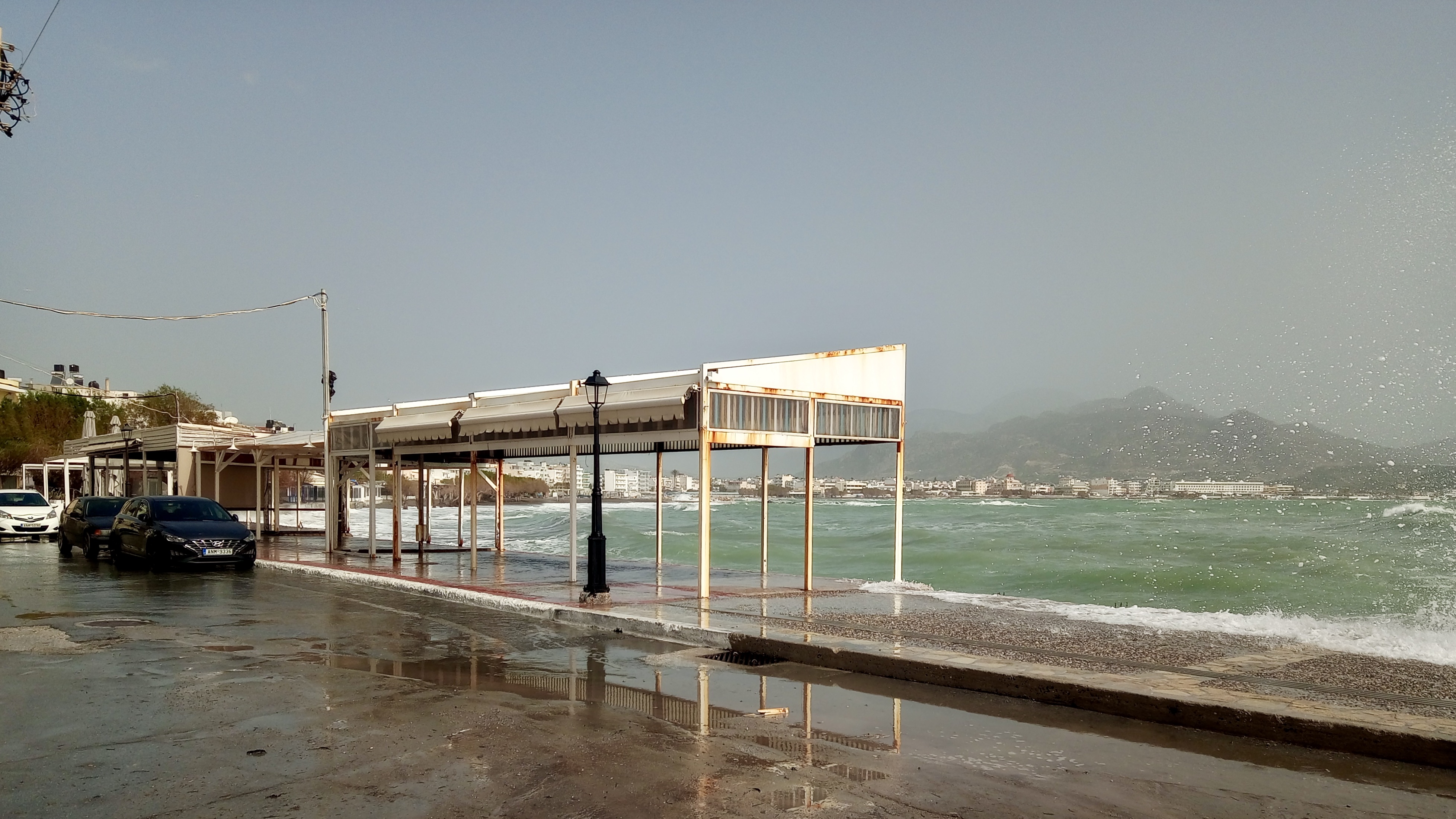
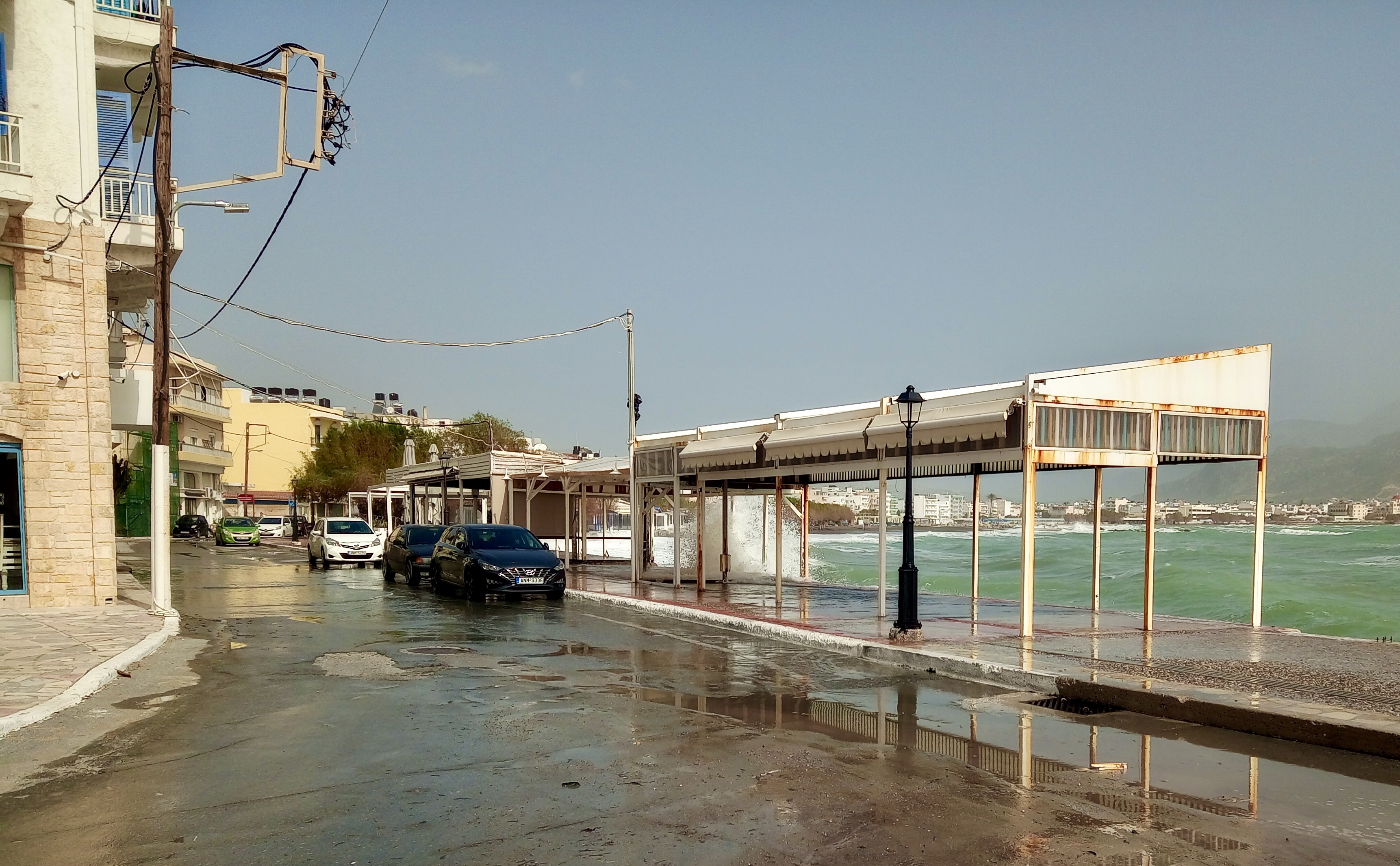
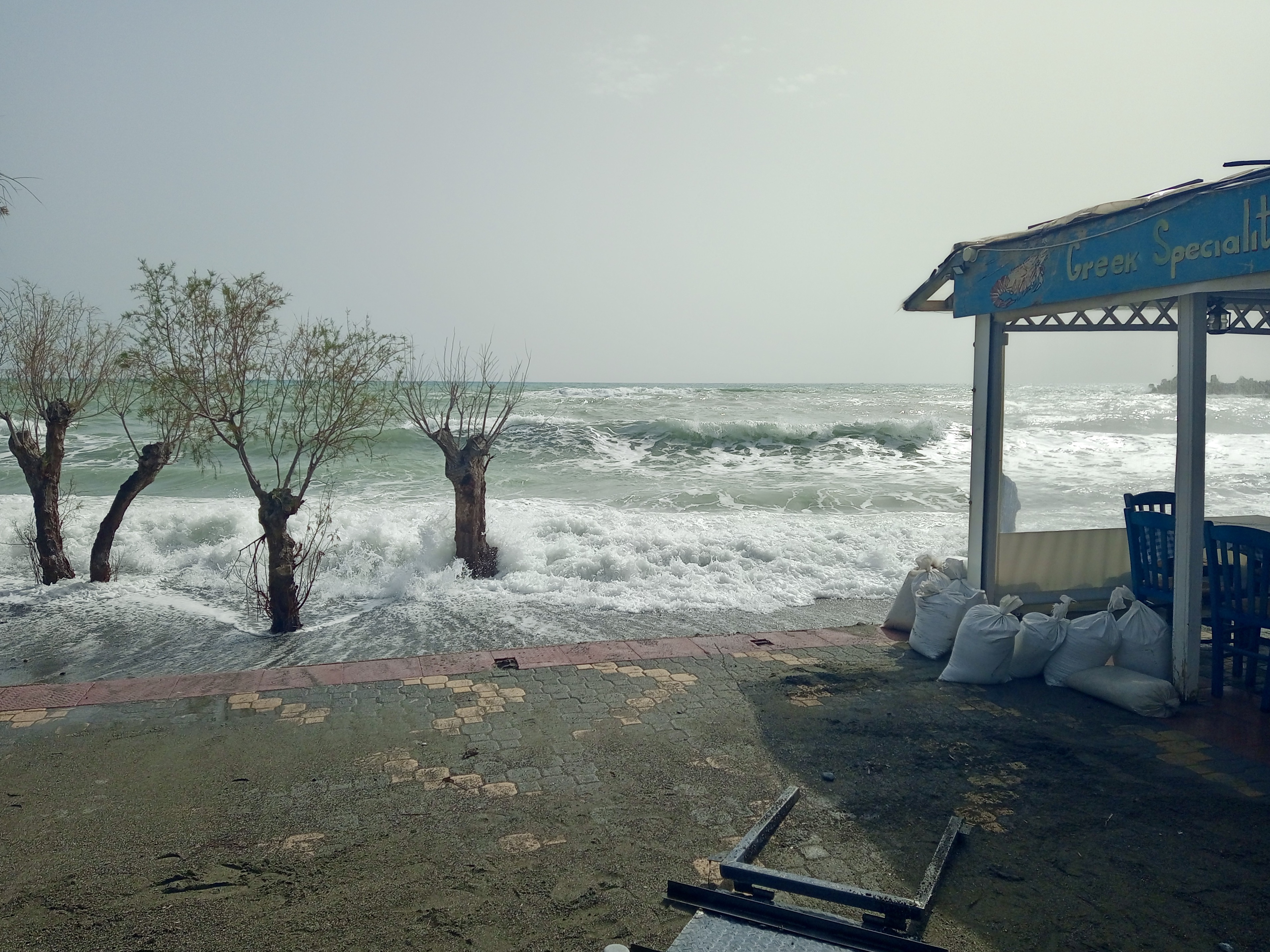
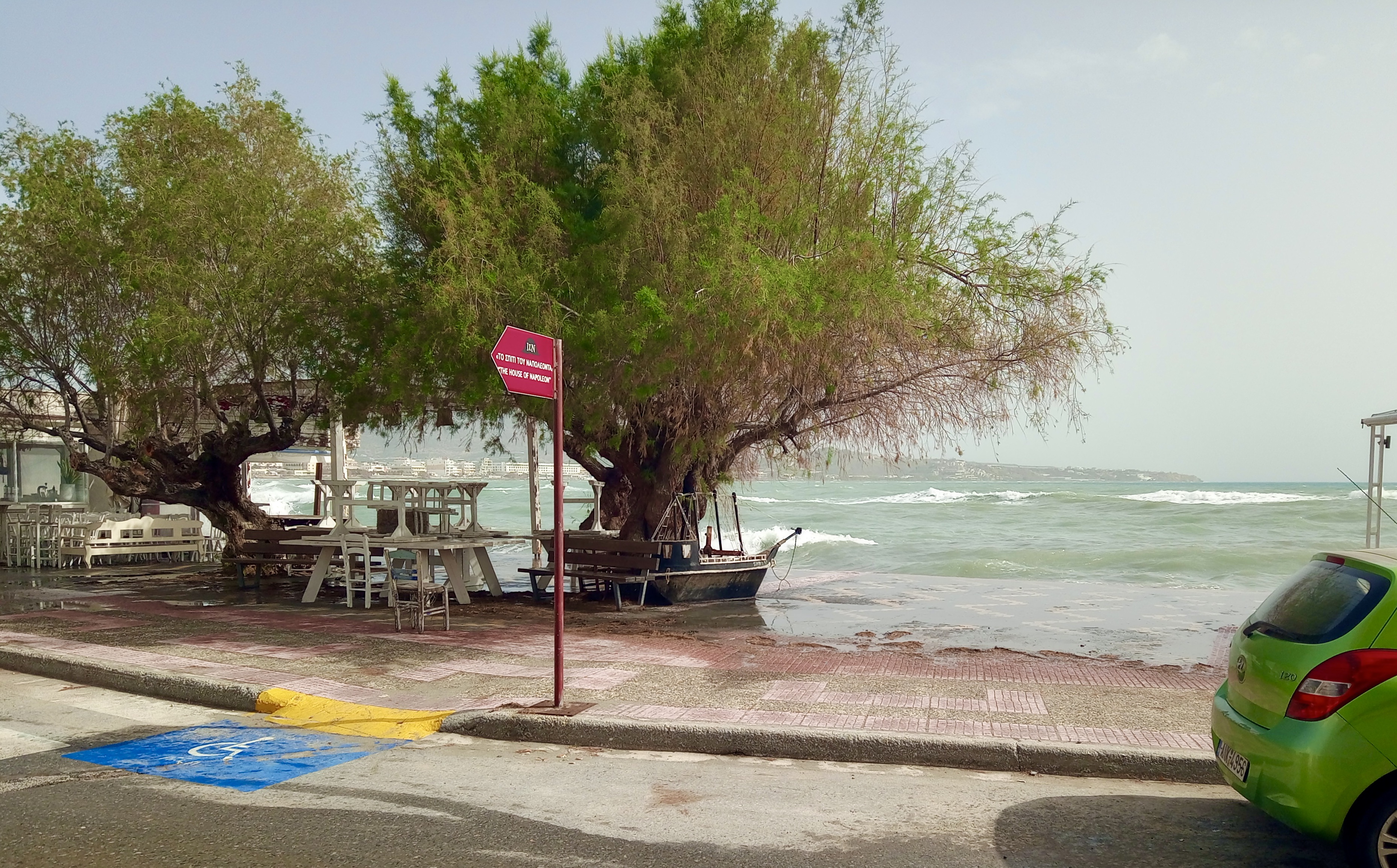
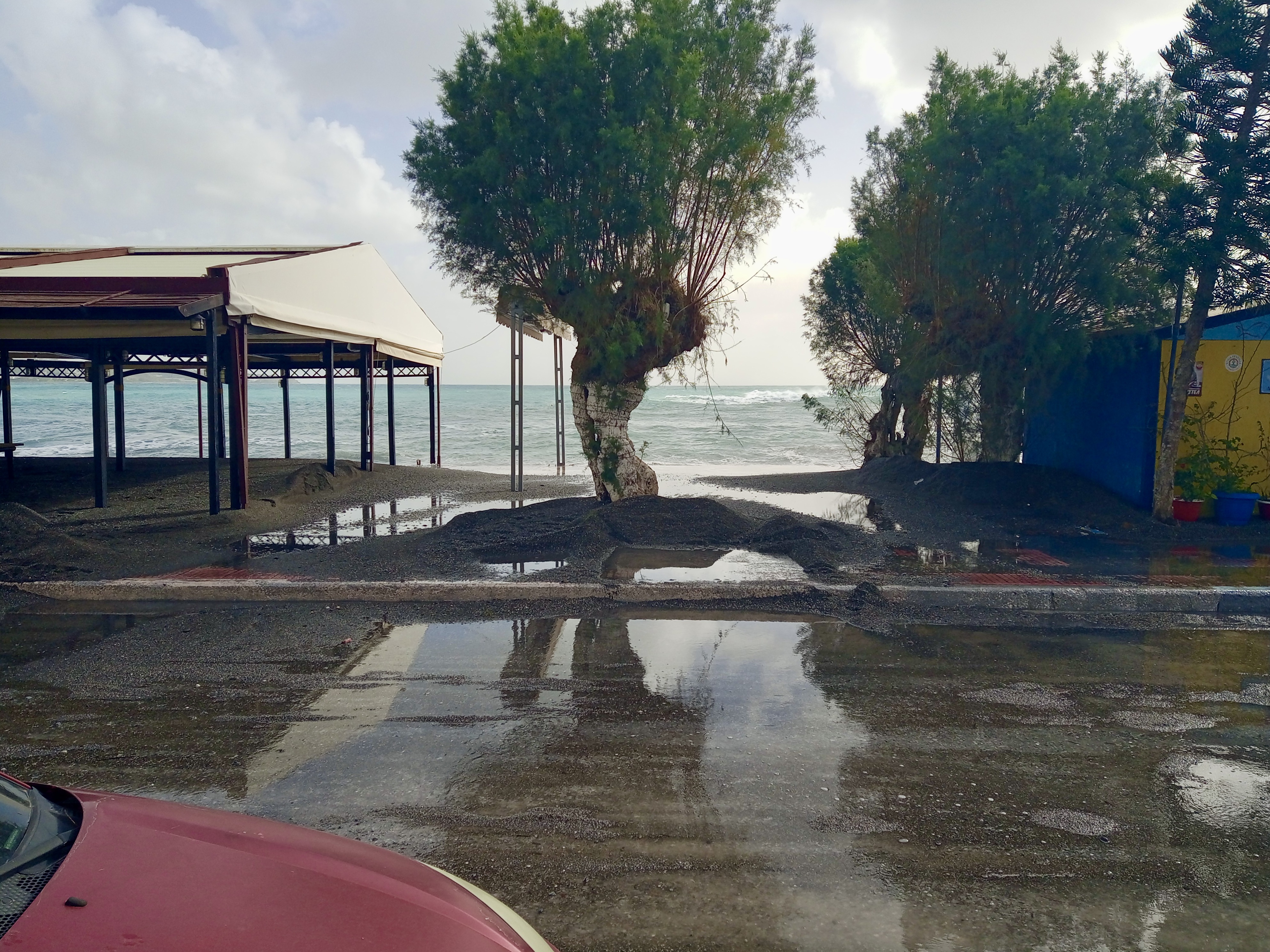
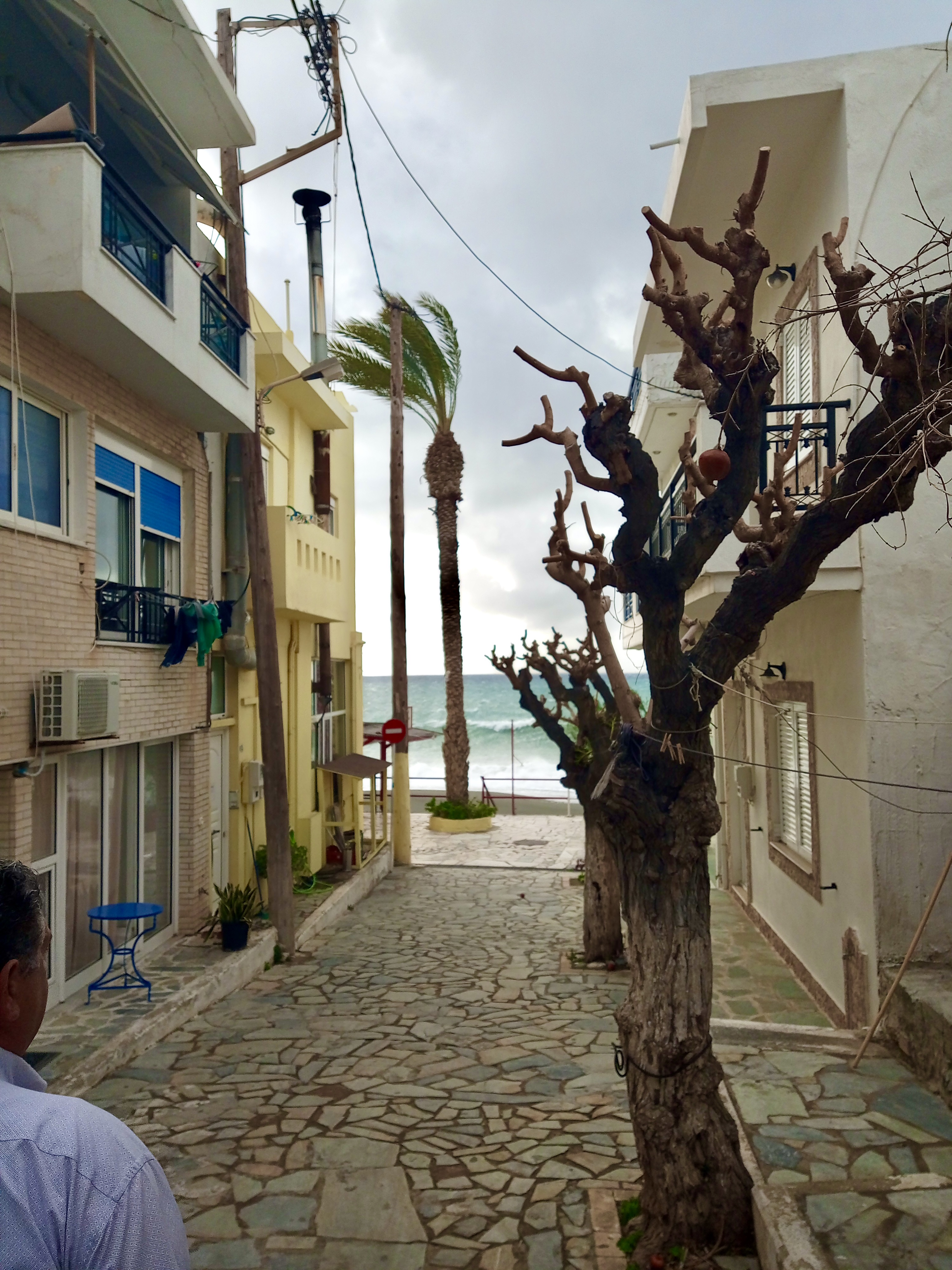
Of course, there’s probably not a soul who’s unaware of the extreme weather that’s been battering most of Europe this past couple of months and, notwithstanding some pretty unpleasant results of the sea’s incursion along the waterfront in Ierapetra, we’ve actually got off pretty lightly here in comparison to many other places, I know. I was talking to our friend Mihali the other evening, and he’s almost seventy now and was born in the village of Orino, up in the mountains to the east of the town, so – apart from a few years in his twenties when he lived in Athens – he’s lived here all his life. He told me that this past couple of months of southerlies has been without precedent.
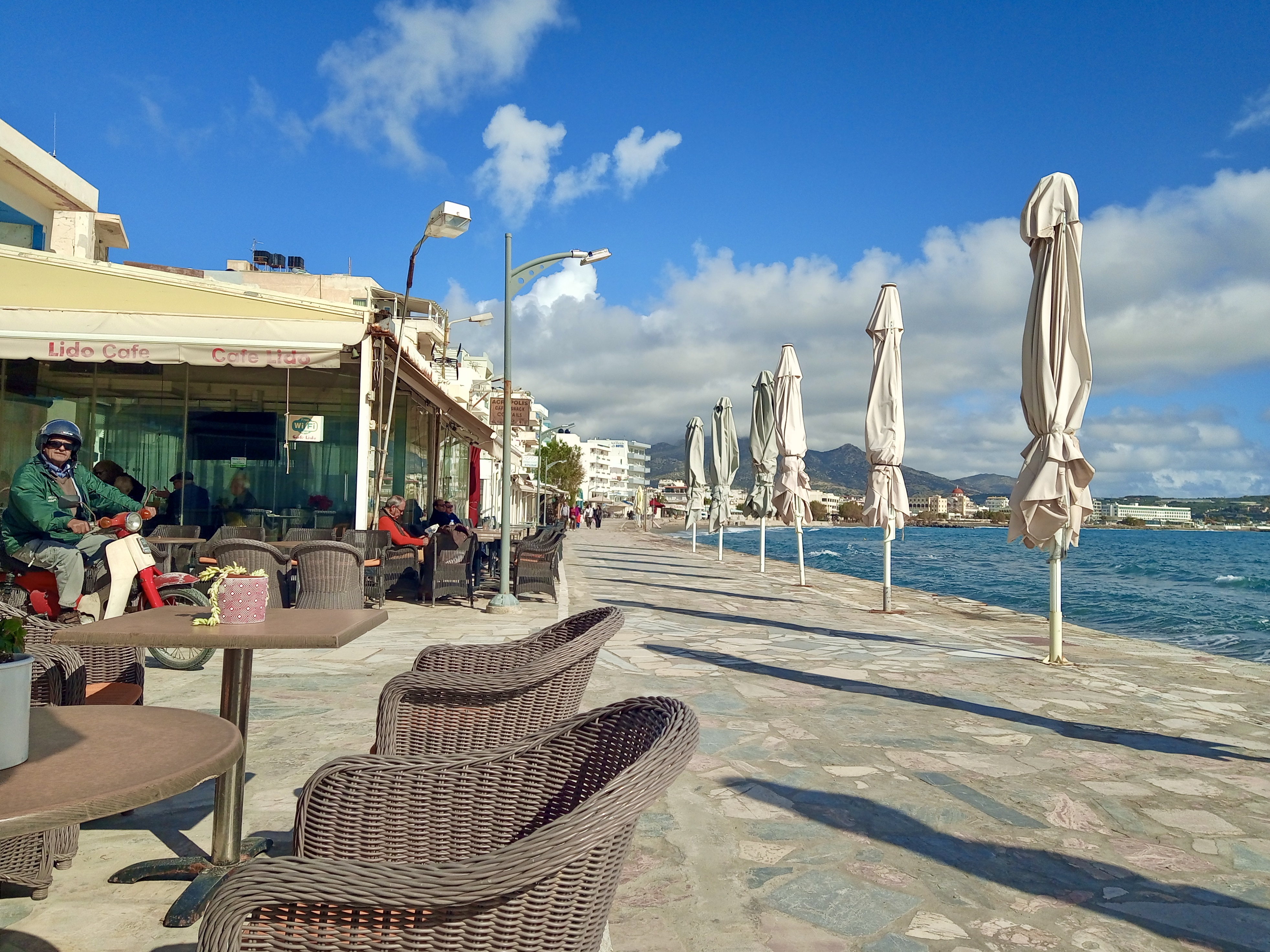
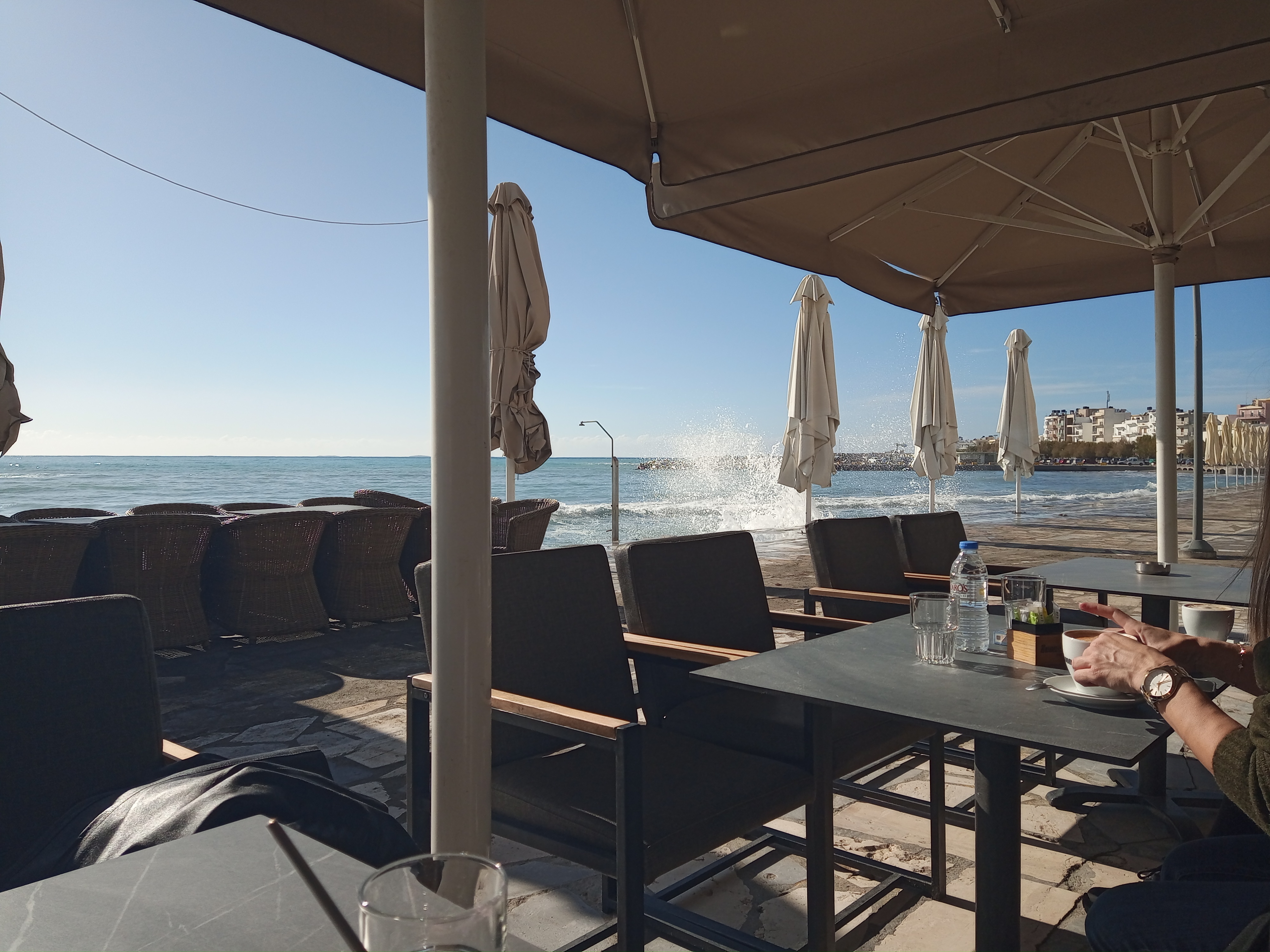
If you look at Ierapetra’s location along the south coast of Crete, it’s fairly evident that it’s exposed to the open sea and that there’s no land at all between us and North Africa, which is about 300-400km to the south, depending on where you make landfall. The nearest African country to us is Lybia. The prevailing winds in this area, however, are northerlies, which means that this part of the Cretan coast is usually well protected, and suffers a lot less wind than the north of the island. As a result, there is a stone ‘promenade’ along part of the town’s shoreline, and a beach a little further along to the south and west. Behind the beach is a series of bars and restaurants, all of which are within metres of the water’s edge. It doesn’t take a rocket scientist to realise that, were the winds to remain from the south for any length of time, the coastline of the town would suffer damage, and that’s exactly what’s been happening this past couple of months.
The weather itself hasn’t been all that extreme. Each week we’ve had the usual clutch of bright sunny days, interspersed with some much needed rain, and the locals rejoice in this, since once the early summer arrives the rainfall is virtually nil until October/November – if we’re lucky that is. Last year the rains didn’t really arrive until the very end of December, but it does seem to have caught up somewhat since then.
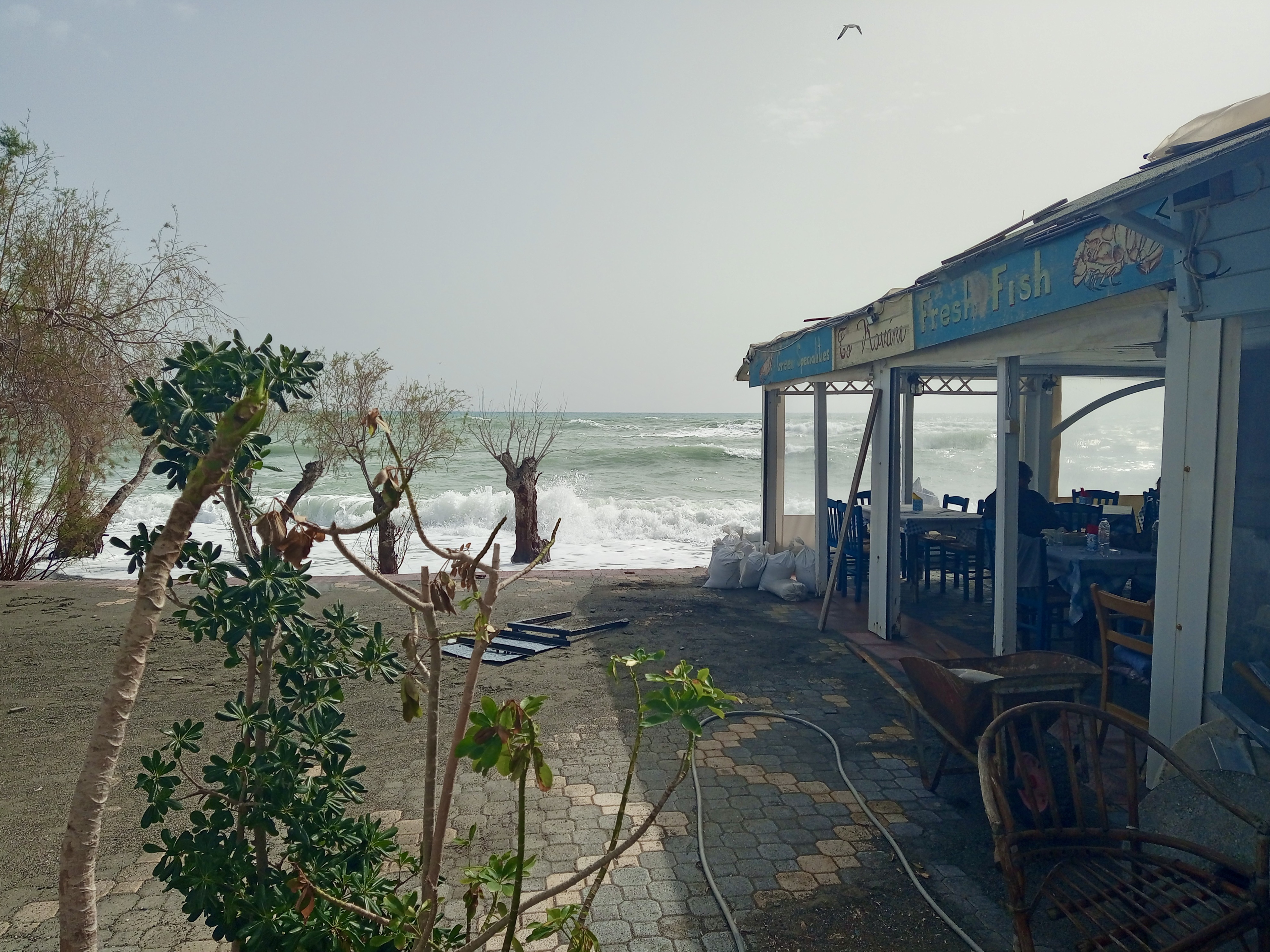
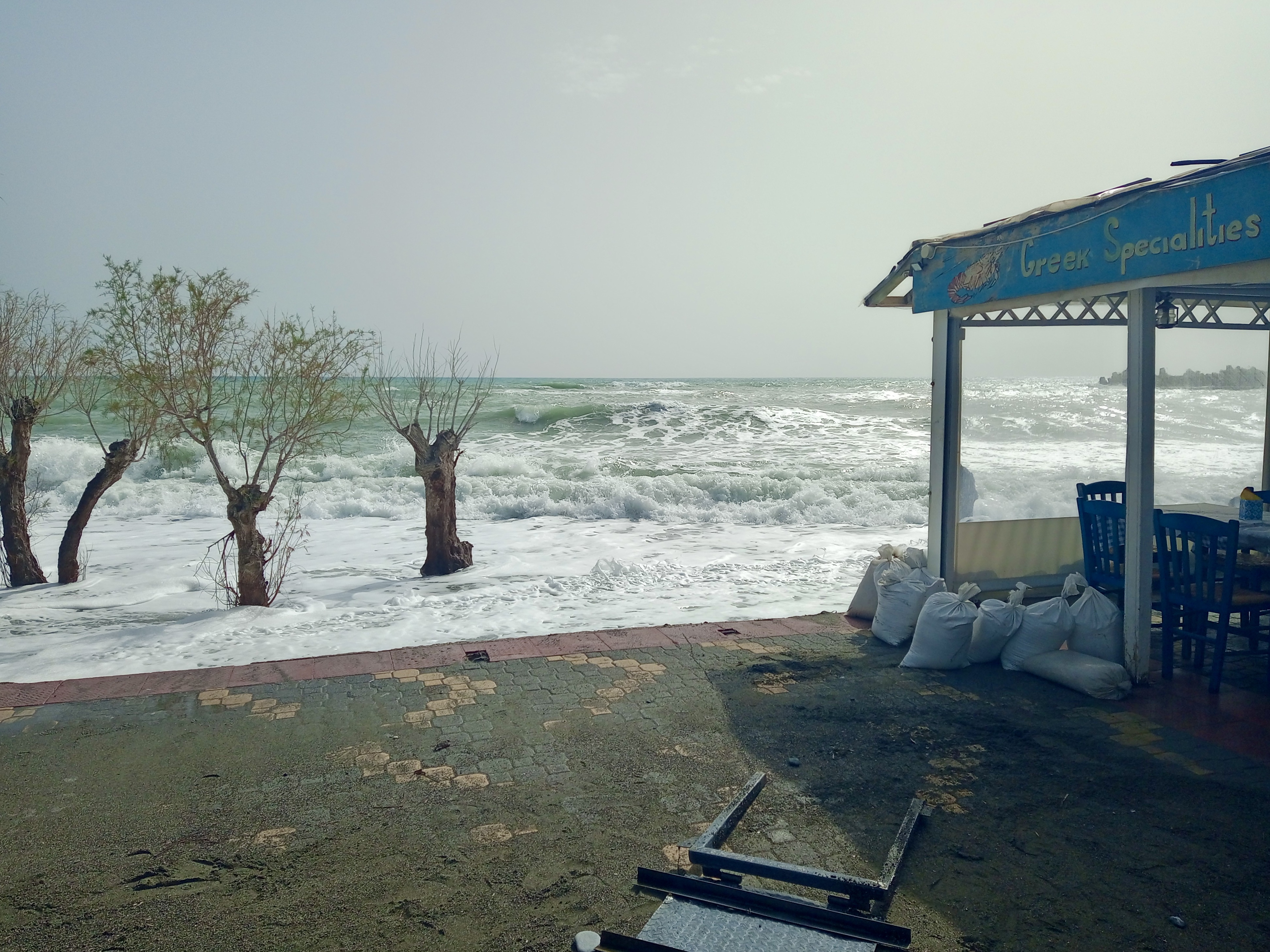
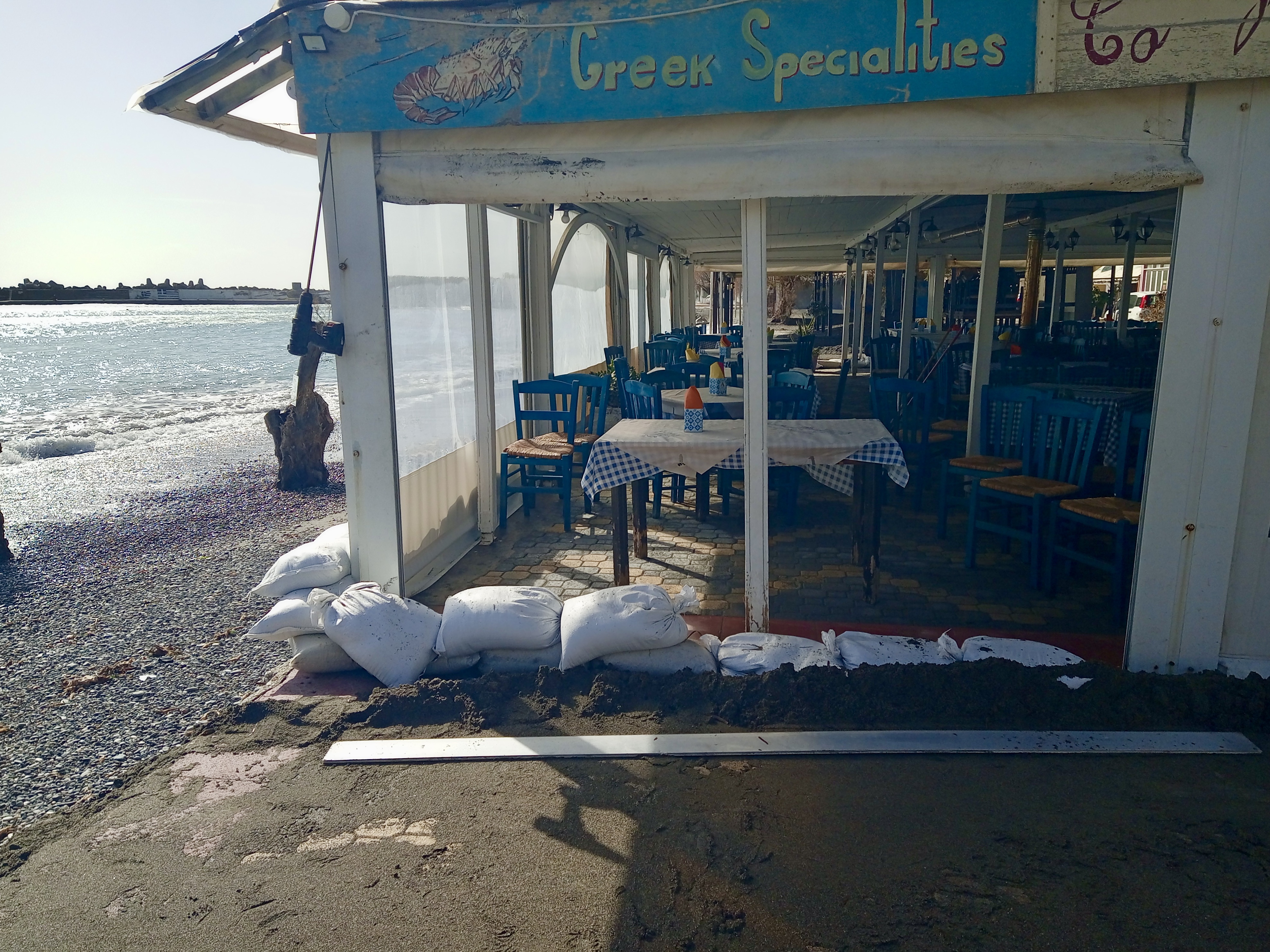
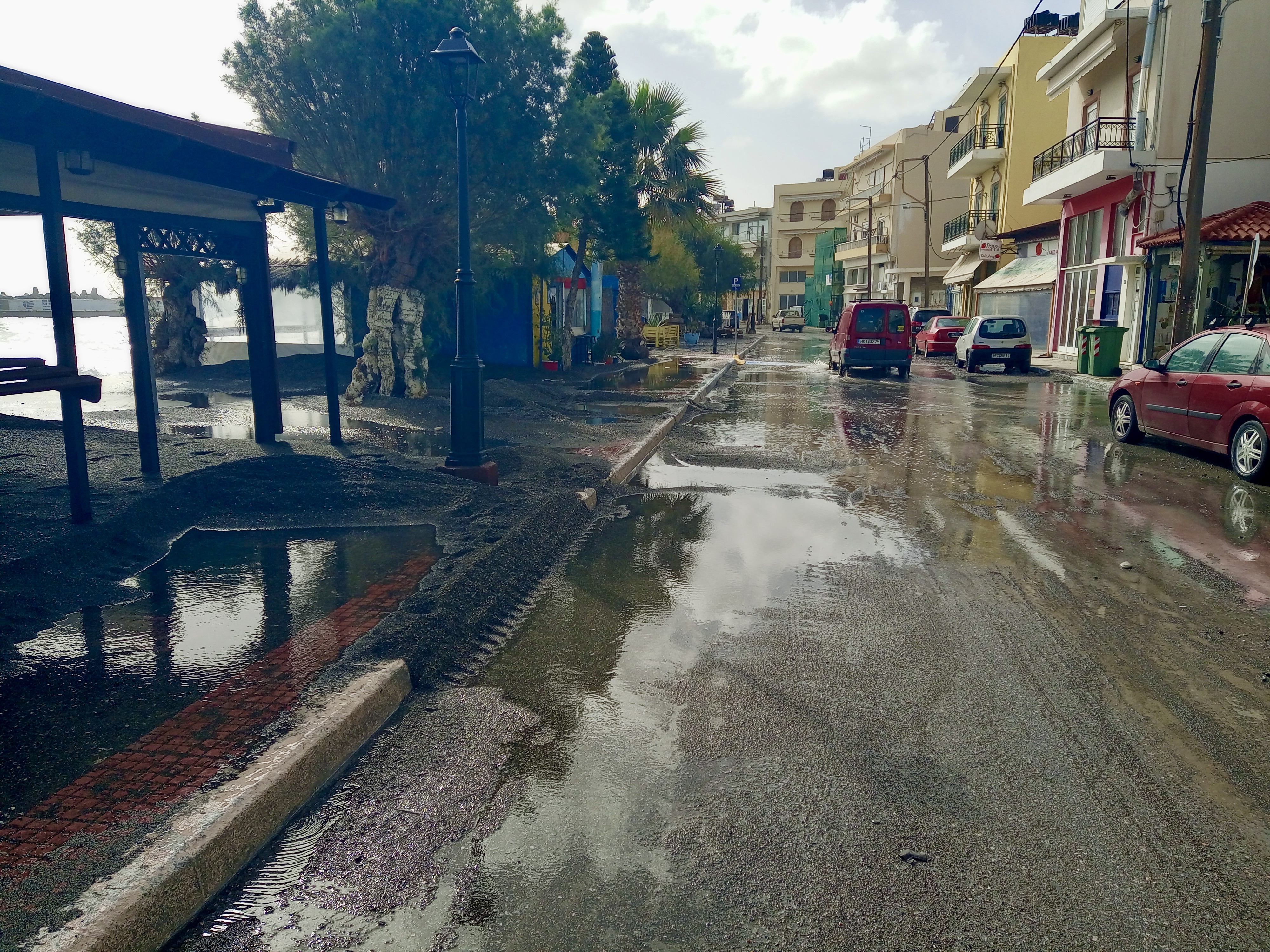
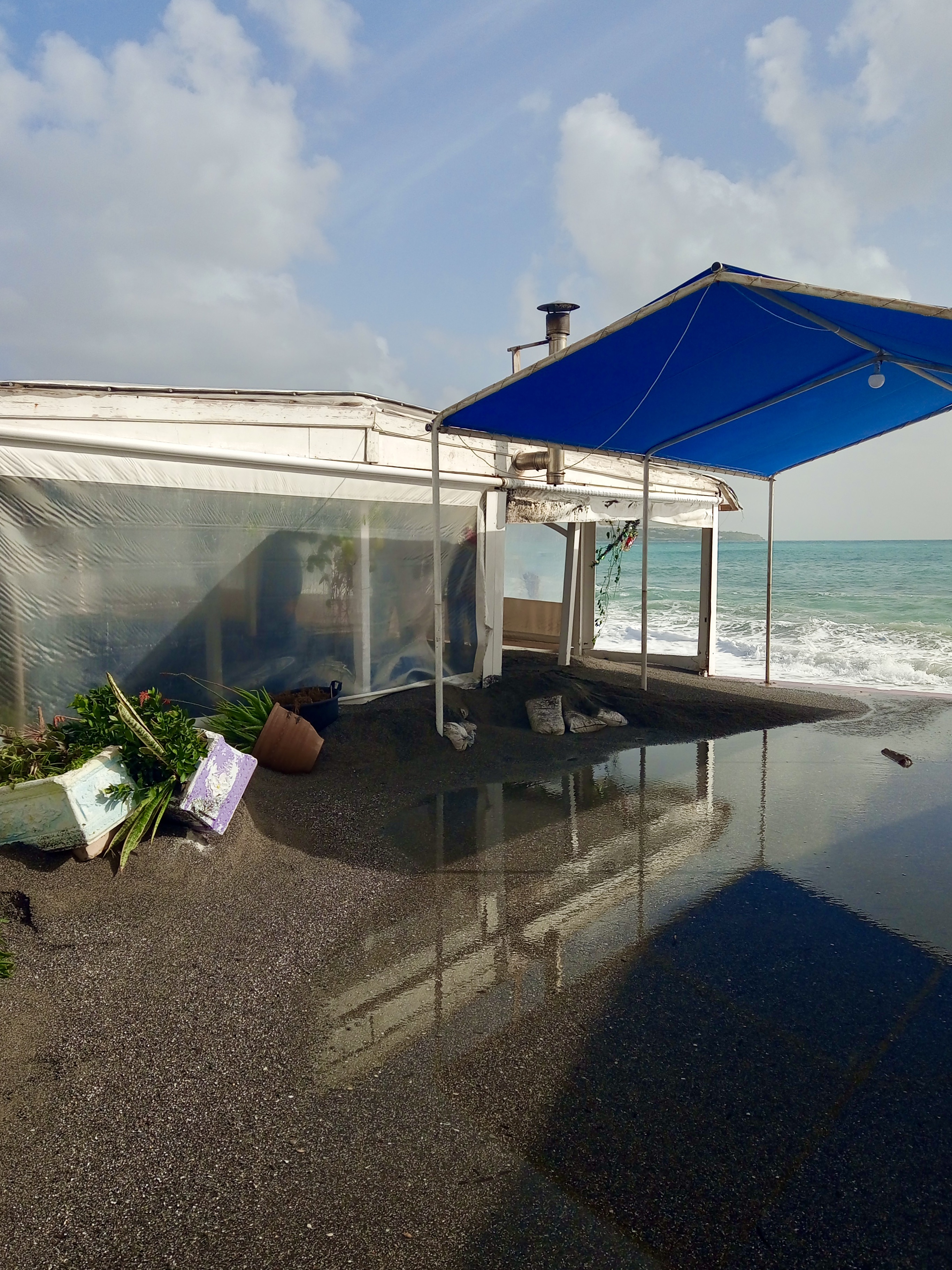
I’ve talked a few times during my posts this winter about the Konaki taverna, run by our good friend Yianni, and how he was faced with a metre-deep pile of sand and shingle that the sea deposited on his terrace a couple of weeks ago. At one point he’d completed a mammoth clear-up, and then it happened all over again. This time he had place some sandbags along the front to try and reduce the damage, but they were only partially successful. And he’s not the only one. Just about all the businesses from the Napoleon restaurant along to the Bira Potsi, adjacent to the fortress at the harbour entrance, have suffered. The road behind the restaurants and bars, across which the waiters scurry bringing food and drinks to their clientele, has been turned into a saltwater river innumerable times now, and the result has been that it had to be closed while the cleanup took place.
We watch a particularly good weather forecast on Greek TV and it always gives a prognosis for up to a week in advance and, sadly, apart from the occasional day here and there, the winds have stubbornly refused to swing back around to the normal direction. Due north of us is the coastal village of Pachi Ammos, at the southernmost extremity of Mirabello Bay, where the sea is invariably much rougher than it is here in Ierapetra, but all the local Facebook groups around here have been showing photos of a flat calm sea up there. Whilst this is nice for them, it’s not the norm. So, we wait and hope that the normal weather patterns will return soon.
On a positive note, our neighbour Maria (Diminutive Dimitri’s mum) dropped by the day before yesterday to bring us some cooked food that she’d prepared. She did this last year too at about this time, and we think it has to do with the fact that the Greeks (at least the more religious ones) are about to enter Greek Lent (Sarakosti), the most significant fasting period in the Orthodox calendar, which lasts roughly 48 days from ‘Clean Monday’ until Easter Sunday. This year that’s from February 23 to April 11. Maria starts to cook vegetarian with a vengeance, and she brought us a lovely casserole which was laced with all kinds of fresh herbs, it was delicious. She told us that her boys (her three sons, only one of which still lives at home) turned their noses up at it, and by the sound of it they’re not as likely to be abstaining from their carnivorous habits as she will be for the duration.
Their loss was our gain I’d say.
And so to the photos. By the way, the video at the top was shot last Wednesday at around 11.00am.
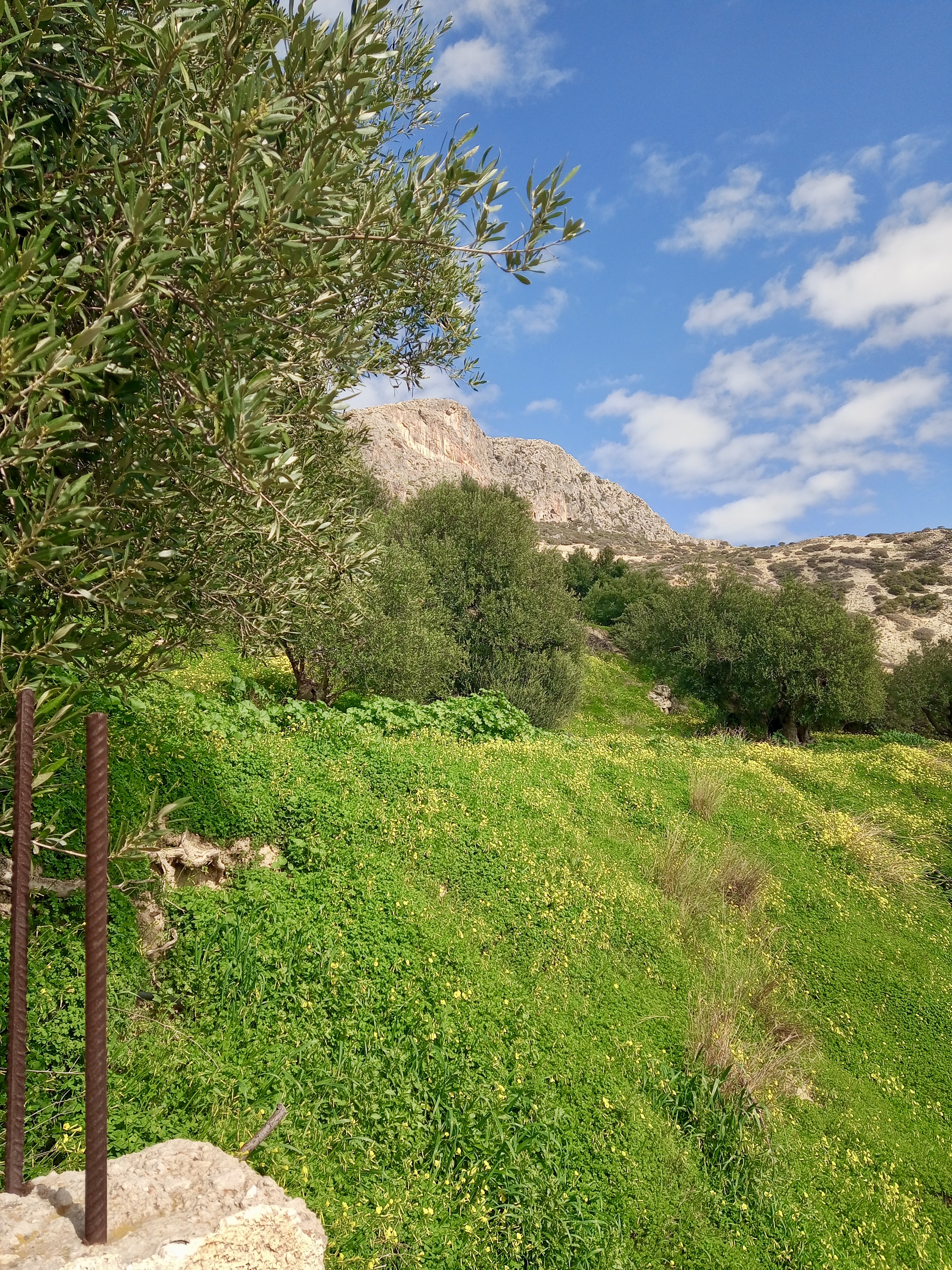
Above: The hillside just near our house. Isn’t it lovely at this time of the year? We occasionally see badgers in this field too.
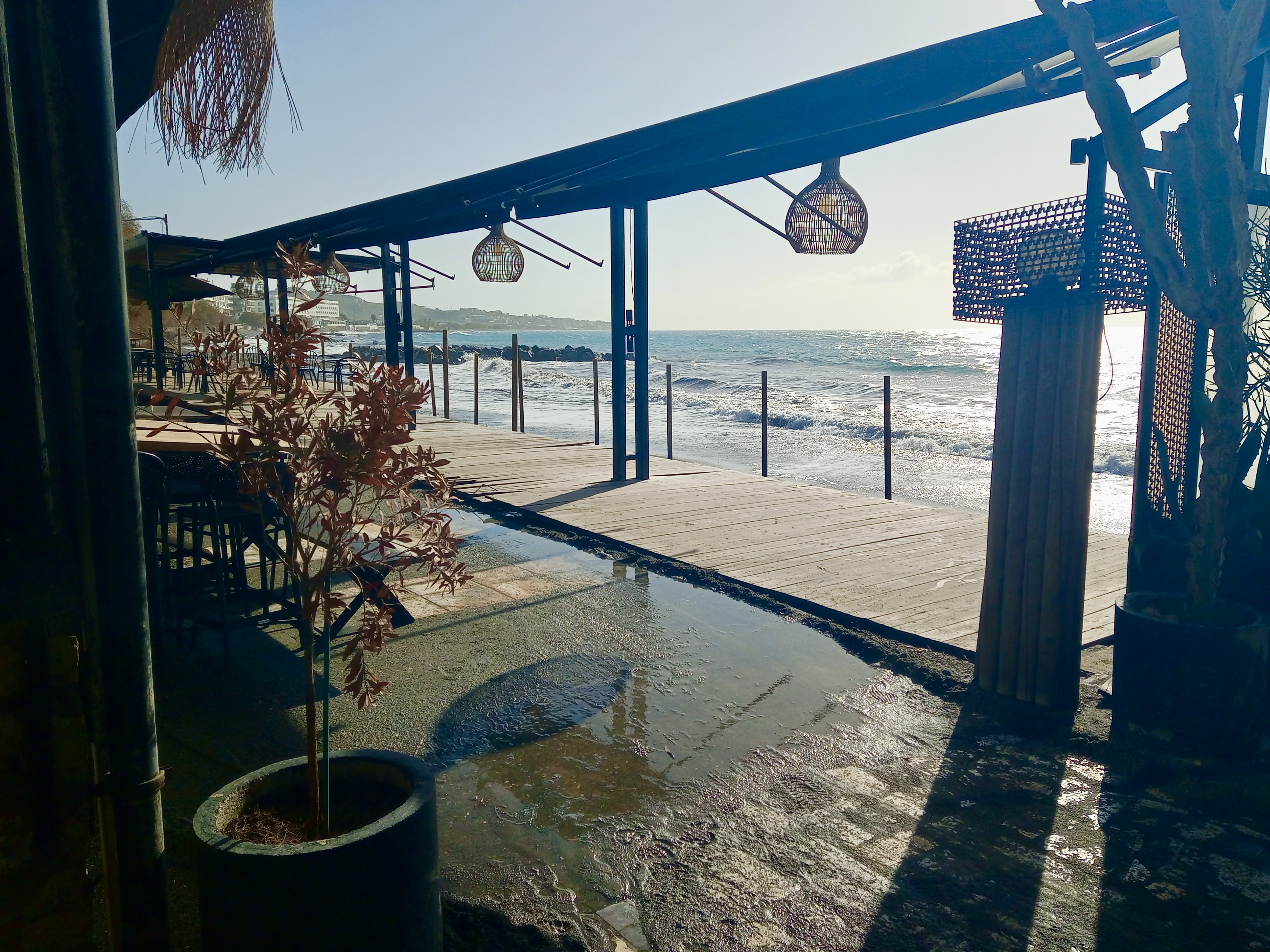
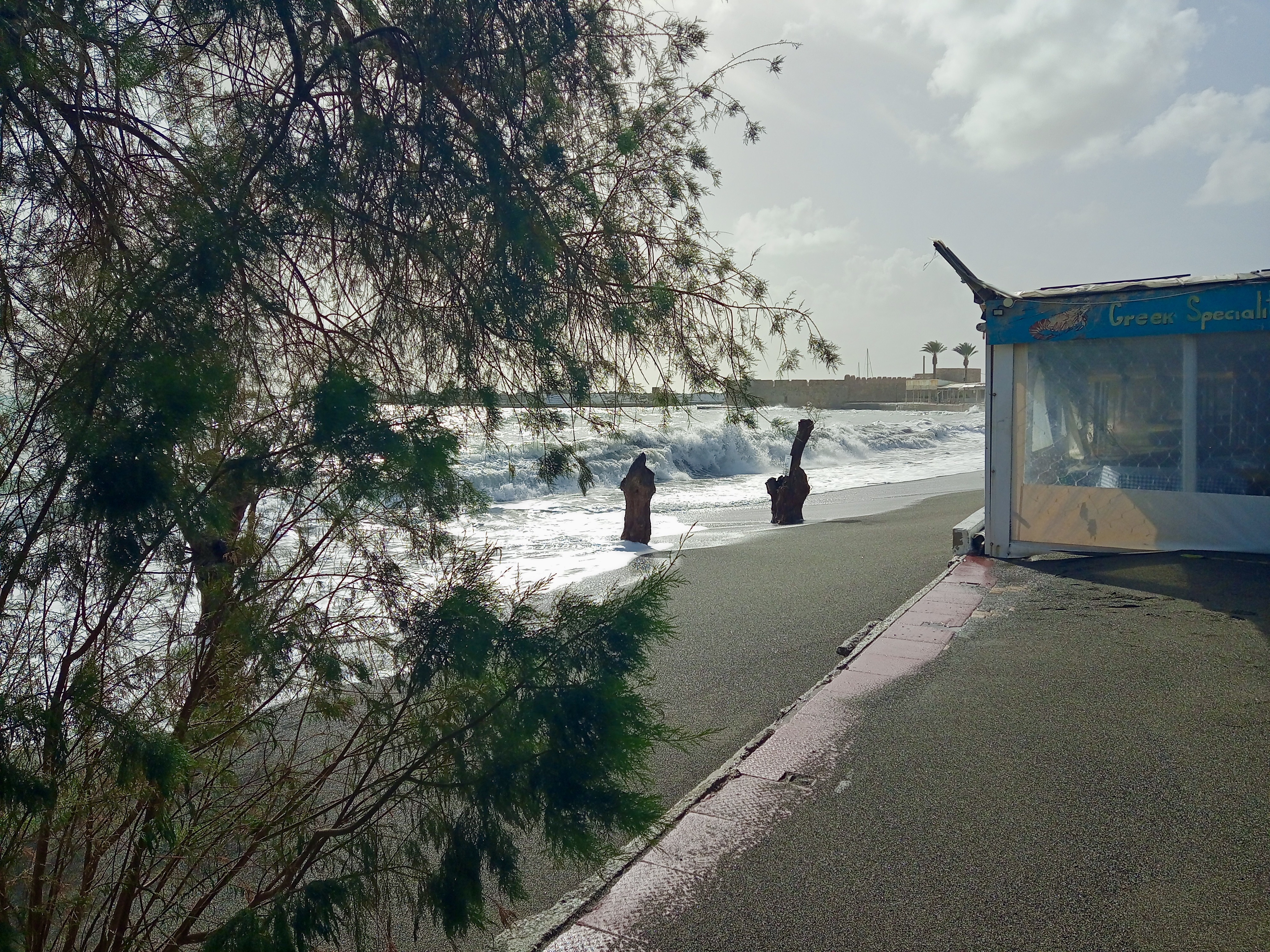
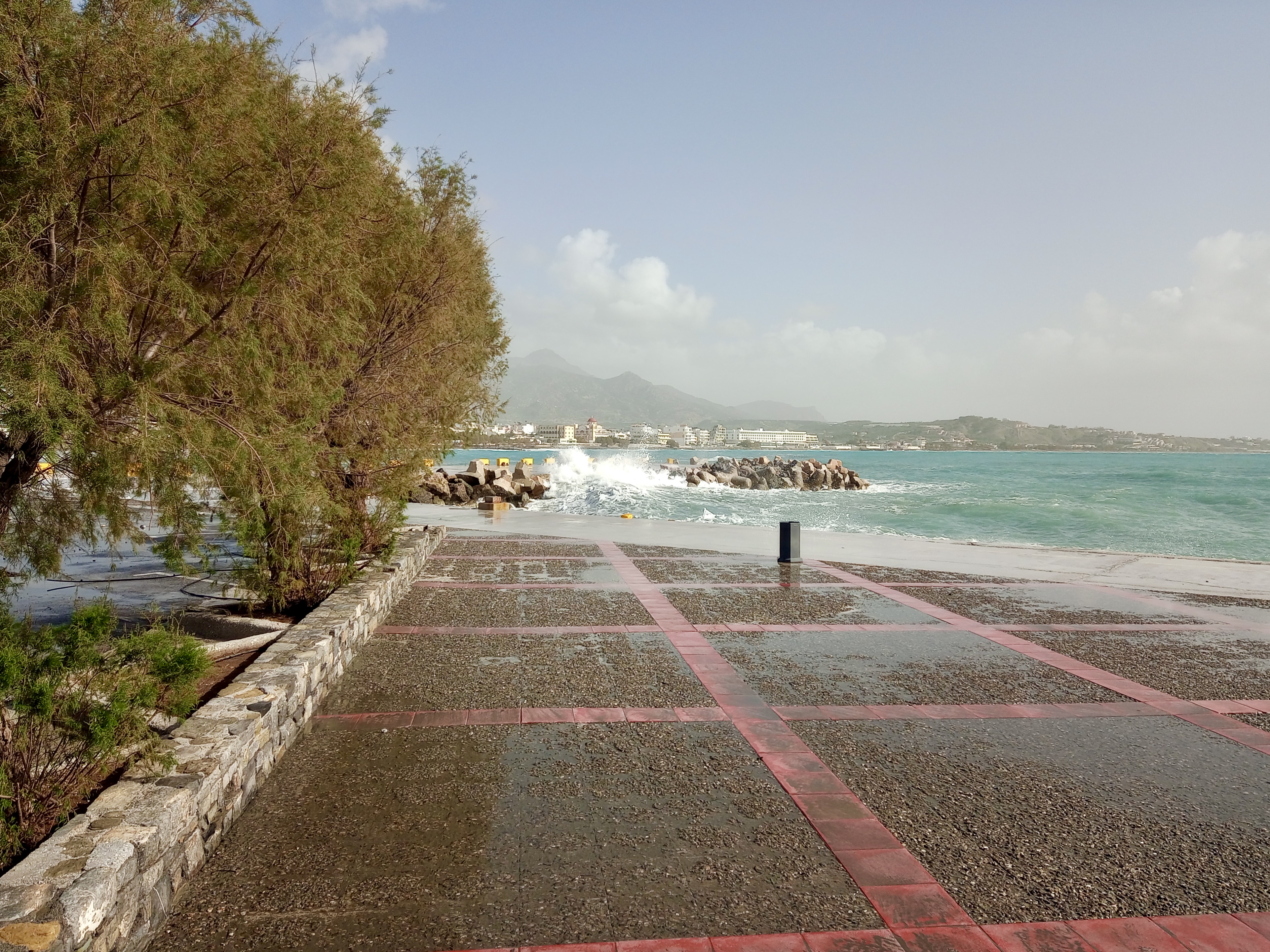
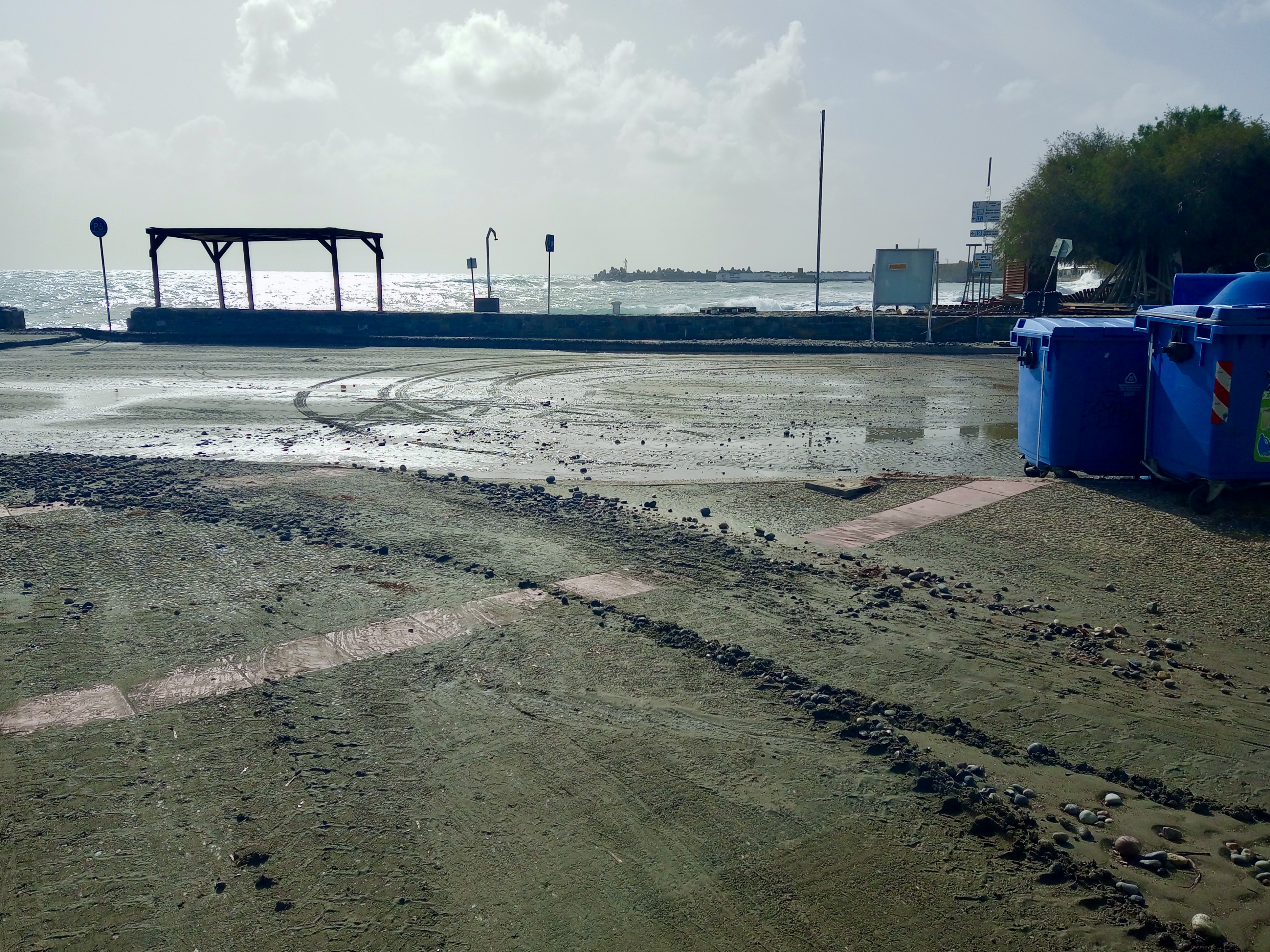
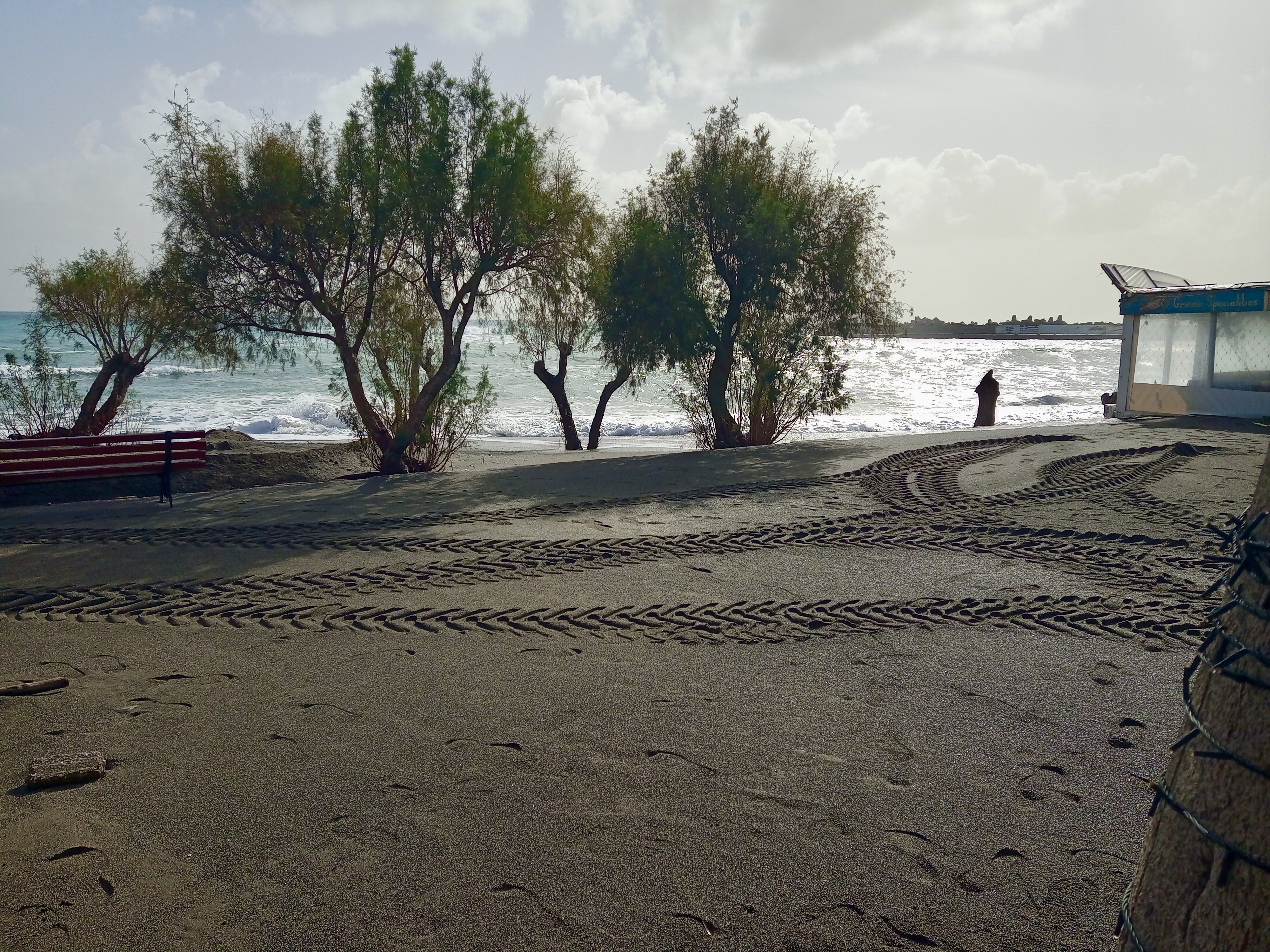
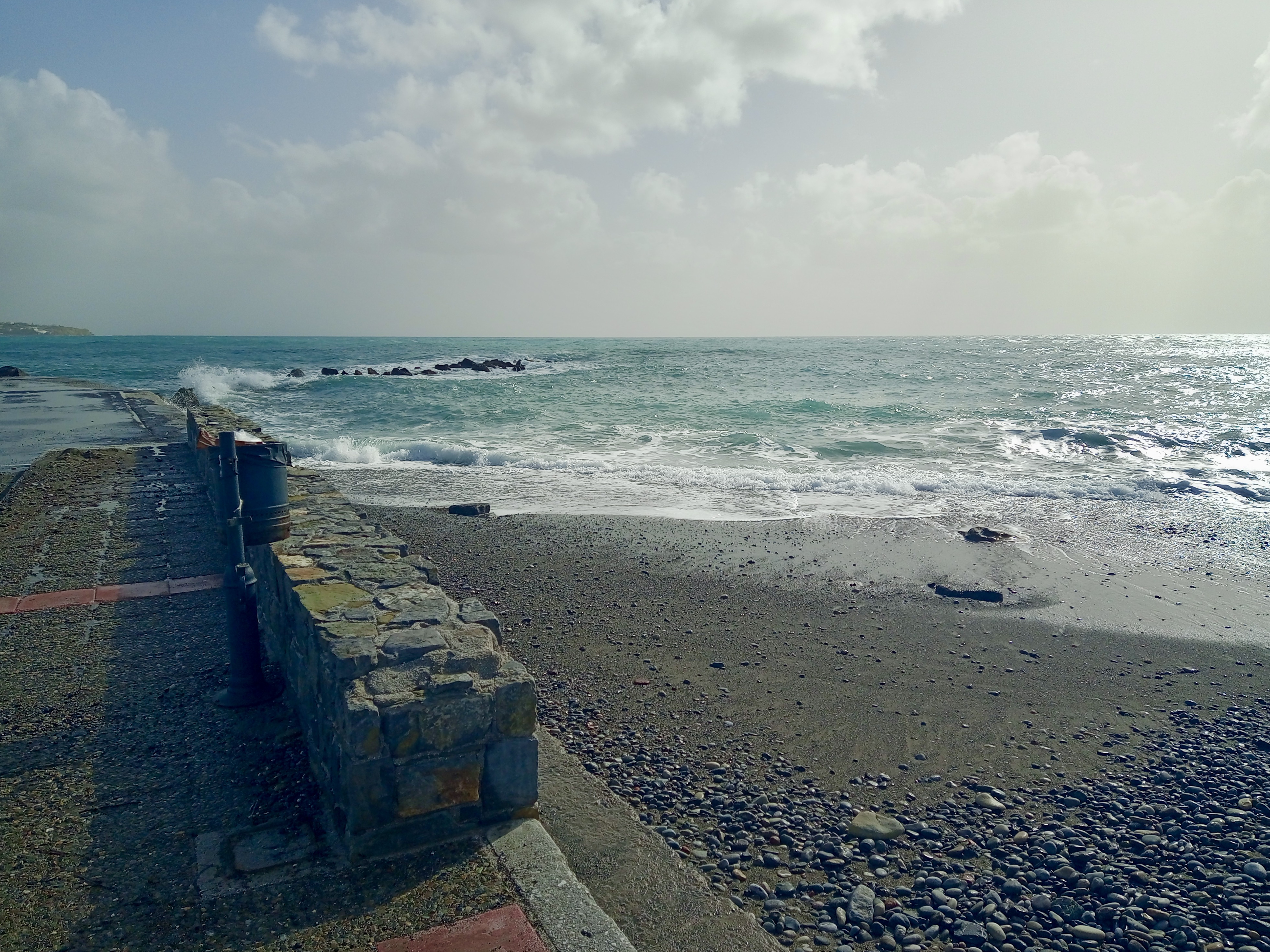
Above: All these were also shot on Feb 18th, along the stretch of seafront that I was talking about at the start of this post. You can see Yianni’s sandbags.
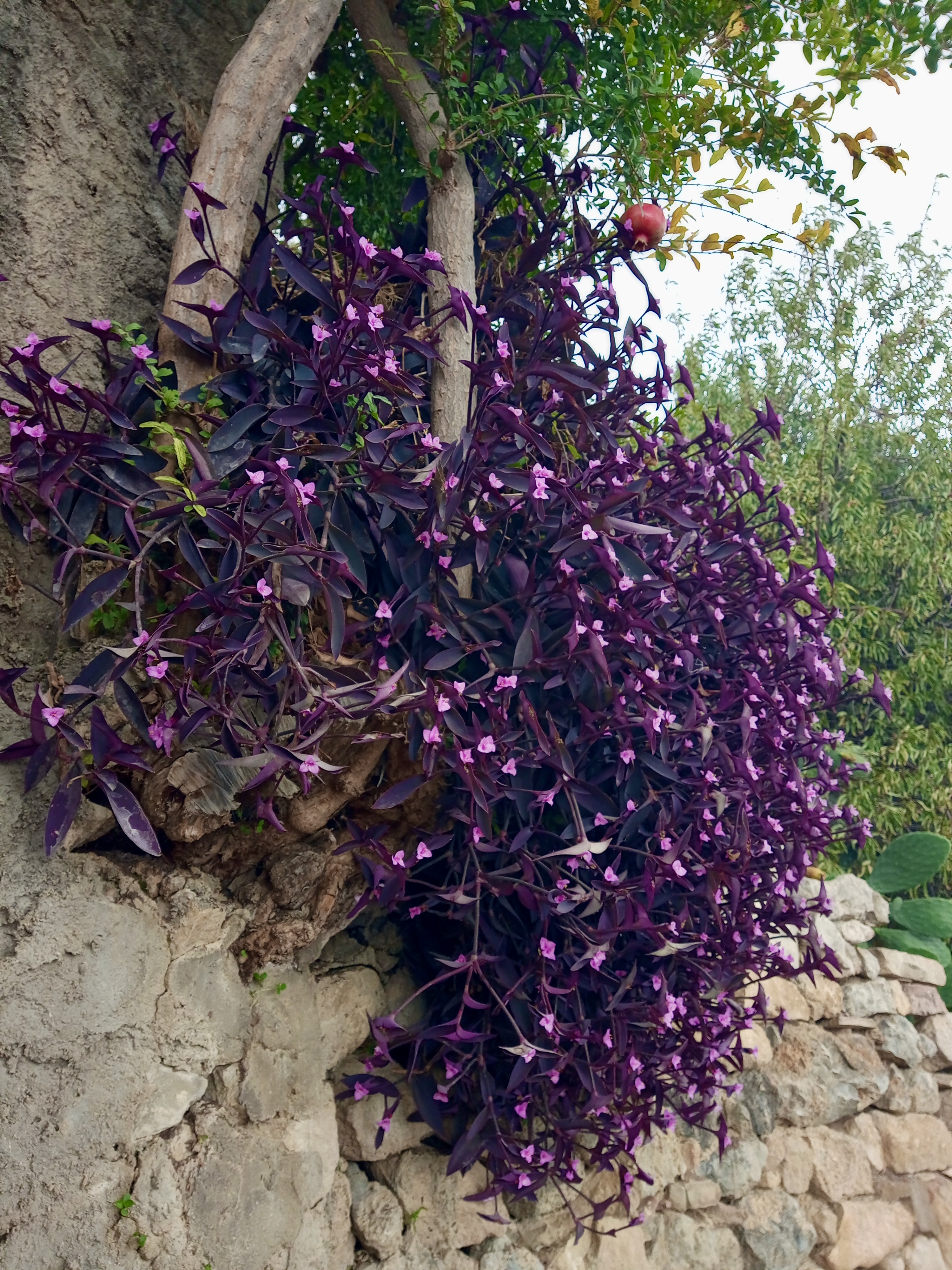
Above: This wonderful Purple Heart (Tradescantia Pallida) has seeded itself on the wall behind our upper garden. Isn’t it glorious?
•
If you enjoy my blog posts, then maybe think about supporting me by purchasing one of my written works. Your support would be very much appreciated, rest assured.Click HERE to go to my Amazon Author Page.
A couple of years ago the local authority added a few hundred tons of sand to the seafront in an effort to slow down the erosion of the stone ‘promenade’ from here at the Waikiki Bar(above) all the way southwards to the L’Angolo restaurant. The idea was to create a bit of a beach to prevent the sea from battering the promenade during the winter months, since there has been quite a bit of damage over the years and it’ll cost millions to fully repair it. During the first summer that this new ‘beach’ existed the sand caused the bar owners and restaurateurs all along the front a fair bit of bother because, when there was a breeze, you could sit at one of the tables on the waterfront and get sandblasted. The sand would get into everything, your food, your drinks, it would cover the newly laid tablecloths, crockery and cutlery – in short it was a blooming nightmare on windy days.
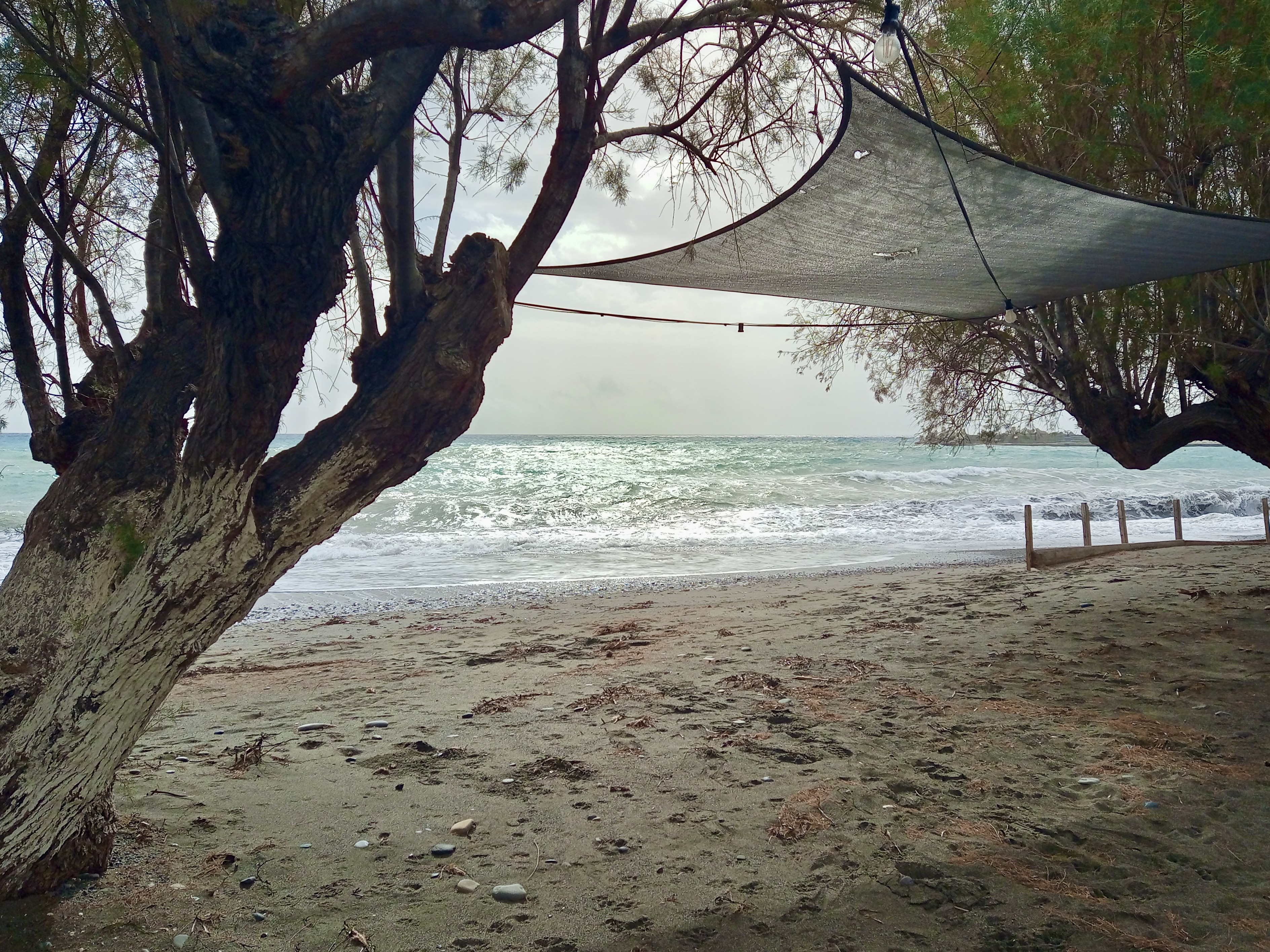
For a while the sand stayed put, but with each passing winter the sea has taken away more and more of it, until now when the sea is once again lapping at several hundred metres of the quayside, or promenade, once again. For a couple of years the Waikiki had a beach that was twice as wide as it had been for ages below its boardwalk section, enabling the owners to place a few more umbrellas there for customers to use while taking a dip. As of now though, after the wildest winter in living memory, most of the beach below the Waikiki is gone again, as you can see in the photo at the top. I say the ‘wildest winter’ because that’s what it’s been for most of Europe, although in fact we here have got off lightly by comparison to many other places.
I reported in this post though, about how our good friend Yianni had suffered when a few tons of sand were deposited all over his taverna’s beachside terrace, and it meant that he couldn’t open for what turned out to be a couple of weeks. There are no guarantees that it won’t happen again, but he’s had to do a massive clear-up in order to be able to get some income coming in, since he is normally open all winter long. Fortunately, although there has been some rough weather and high seas since it happened, the wind’s direction has been kinder to that stretch of beach and they haven’t had a repeat of that awful Thursday a couple of weeks ago, although they have come close once or twice. In fact, The Konaki is now open and we’re going there for lunch this coming Sunday, all being well. I took this shot below a couple of days ago, and Yianni’s sandbags are clearly visible as he attempts to limit any further damage…
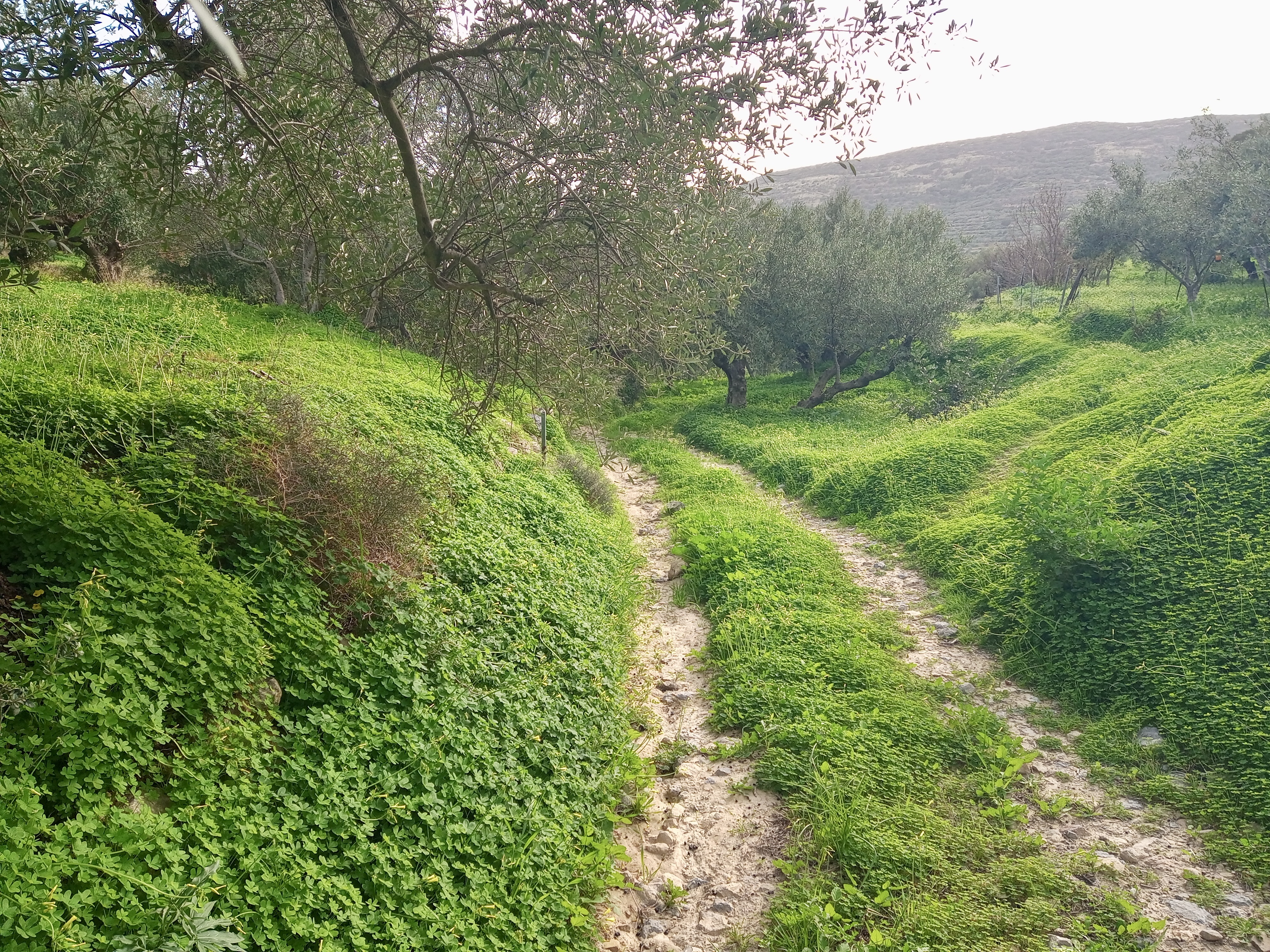
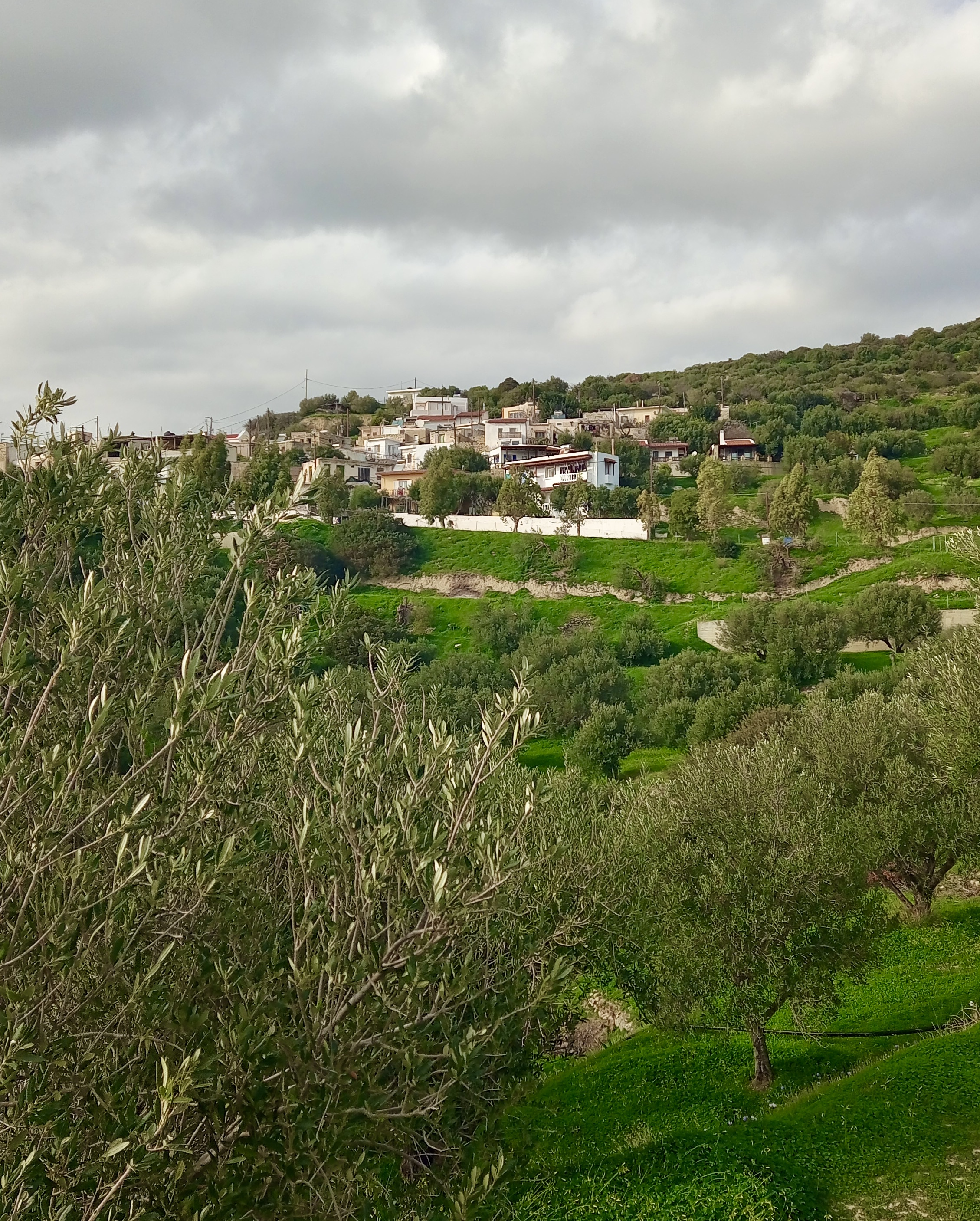
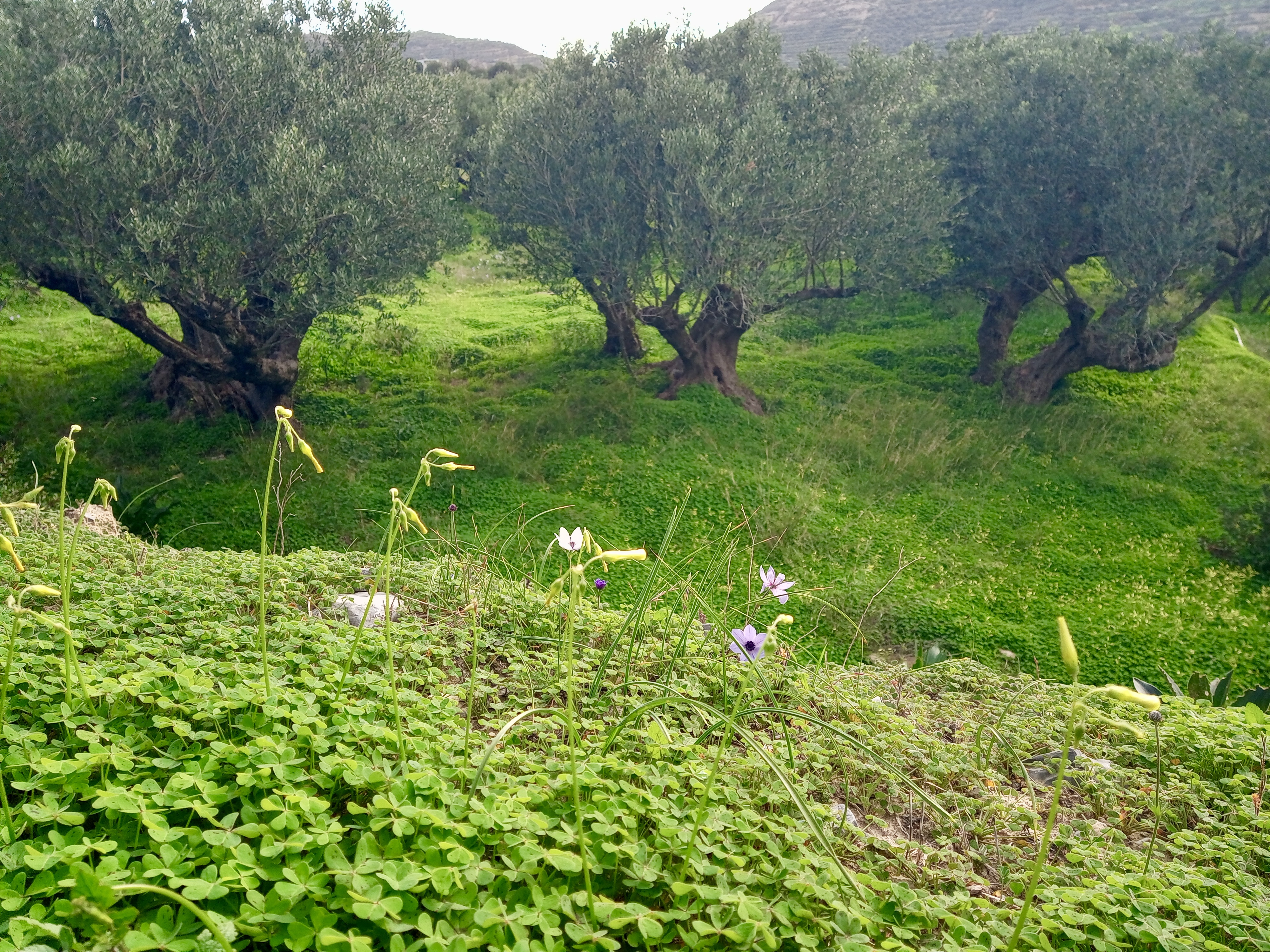
On a slightly lighter note, one of the wonderful things about this time of the year is just how green the countryside becomes, something that summer visitors seldom get to see. Here are three shots taken just near the village during a walk this week…
Our house is visible in the centre photo. If you can see the canopy over a veranda just above and behind the white house almost in the centre of the shot, that’s our place (you can, of course, click on the photos for a larger view). The white house is actually the home of Maria and her son Dimitri, who left a plastic bag full to bursting outside our door again yesterday (we found it when we came home from shopping in town), full of peppers and cucumbers from their ‘horafia.’
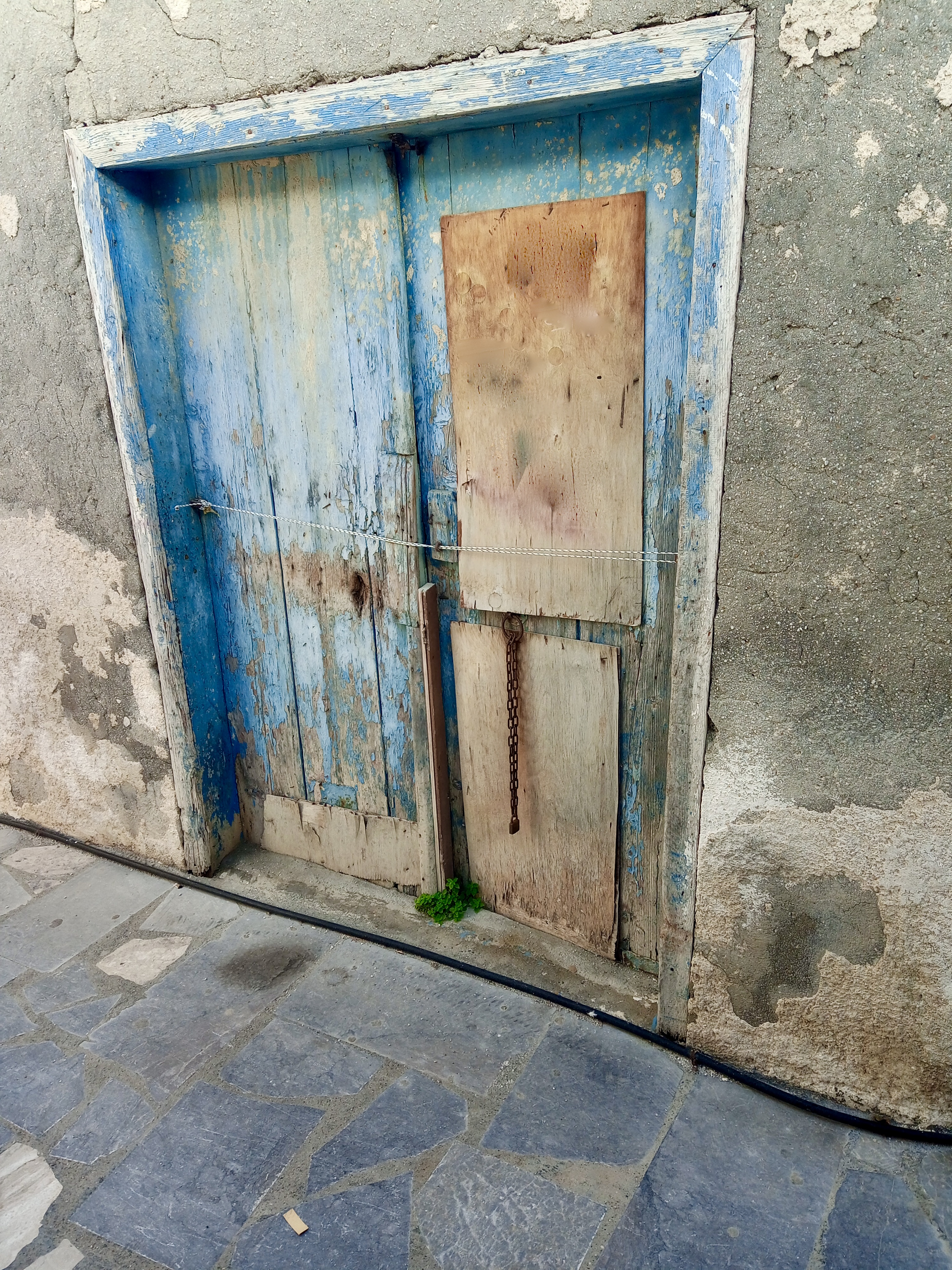
If doorways could talk, eh? Here’s one in Ierapetra Old Town that I liked the look of as we walked past it…
•
If you enjoy my blog posts, then maybe think about supporting me by purchasing one of my written works. Your support would be very much appreciated, rest assured.Click HERE to go to my Amazon Author Page.
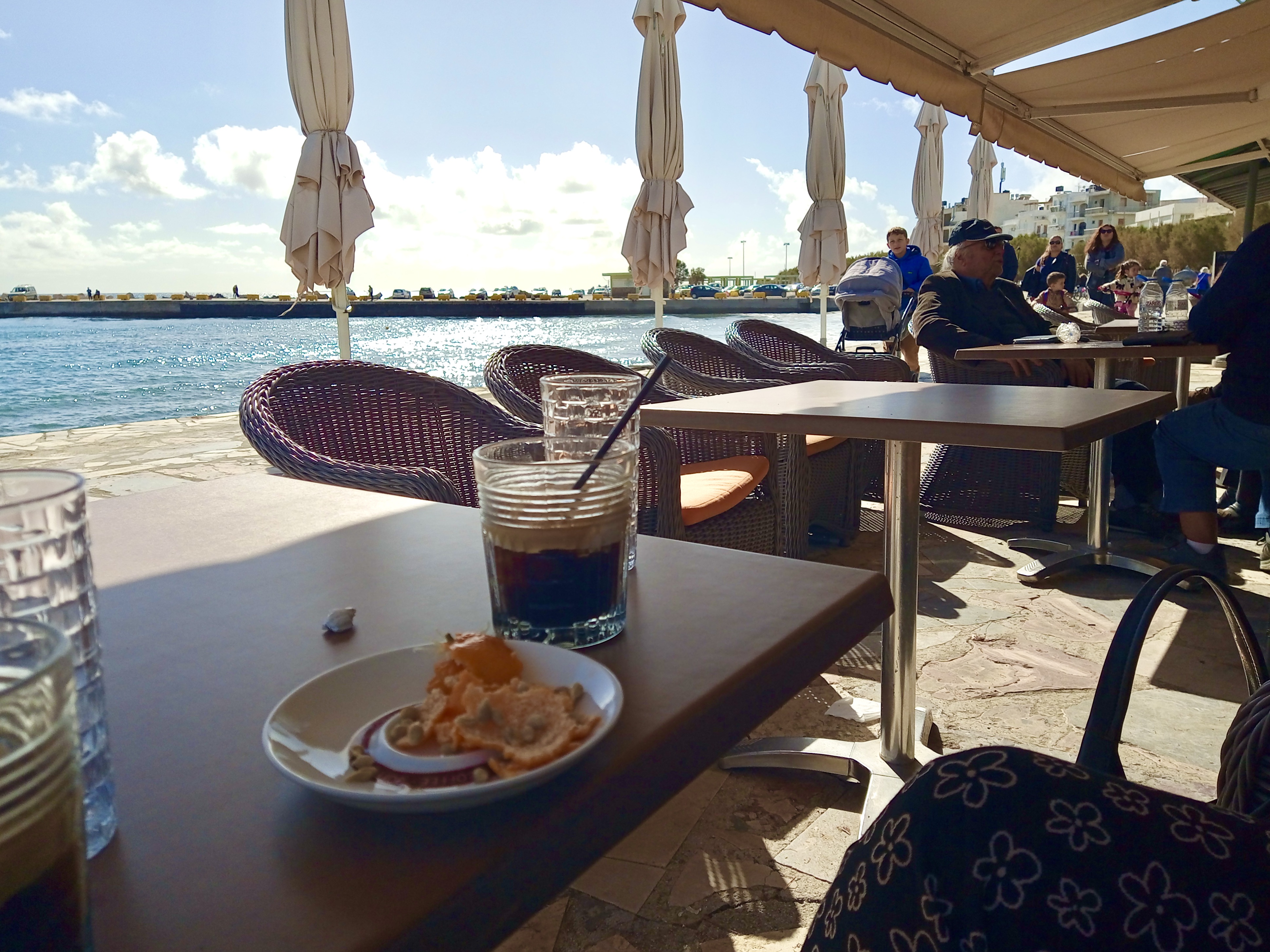
We were sitting in the Kougioumoutsakis corner café at the beach end of the street called Dimokratias the other day, just across the road from the Archeological Museum, and something happened that reminded us of one of the really nice things about the culture here. It wasn’t anything spectacular, just a small ‘event’ that illustrated just how much respect is shown to older people in this society.
We like it in the Kougioumoutsakis, but it isn’t always easy to sit there because it’s a small café that, like most of them, has its regulars, and if they’re all in at the same time, we can’t find a table and so have to move on and go get our coffee somewhere else. It’s not a hard decision; well, actually, it can be, because we have a half a dozen or so favourite cafés now in the town and making the decision can be more difficult than you’d think. We usually manage though.
So, there we were, having arrived when a table was empty, and thus we were able to sit down and pretty soon were in conversation with a few of the regulars. When we first used to sit there the talk was all about where we were from, where we now lived, how we learned the language, whether we live here all year round, who we bought our house from, and so it goes on. In fact, the man we bought our house from was very well known in the area. His name was Giorgos Anifantakis, and he had a nickname ‘Rebetis’ that everyone knew him by. When we were going through the round of making new acquaintances when we first moved here, we only had to tell those who enquired that we’d bought the house from ‘Rebeti’ and they all knew not only him, but the house too.
In fact, he died rather unexpectedly just last week, as it happens. We attended his funeral here in the village and it was standing room only, there were that many people present. The circumstances surrounding his death were tragic too, as he’d fallen asleep in bed, a cigarette still burning, and his apartment had caught fire. The day he died there were reports in the local media showing a fire truck parked outside his home, but the stories were light on detail, merely stating that a 70 year-old man had died in his bed and how tragic it was, plus warnings about how dangerous it is to smoke in bed, as would be expected. The photo of the fire appliance was taken at night and so it wasn’t immediately apparent as to the location. Only as we spoke to locals at the café the following day did someone tell us whom it was that had died, and it came as a shock. Anyway, I’m going off course a little in mentioning Giorgo’s death, but still it leaves us (and many others) in shock, sadly.
While we sat enjoying both the company and the coffee, a car pulled up at the kerb and a young man jumped out of the driver’s seat, ran around to the back door, opened it and began helping an evidently frail older gentleman to get out of the vehicle. Instantly the young waiter from the café/bar ran over to offer assistance and the older man was aided to shuffle with some difficulty towards one of the occupied tables on the terrace. Now, this table already had four or five people sitting around it and, on the face of it, it looked like there was no room for an extra person to join them. There occurred a commotion, though, as everyone shifted along a bit, a chair was grabbed from a neighbouring table, after the person grabbing it had enquired from the couple sitting there if that chair was surplus to requirements, and it was inserted in the gap that had been created by the already present group, and the elderly arrival given every assistance needed to get himself installed upon it at the table. Once installed, those around the table, who included a couple of middle aged women, a younger man, and two other guys who may well have been the husbands of the women, all took their turns in getting up (where necessary) embracing the older fellow with warm hugs and double cheek kisses and making him feel a lot like royalty, it seemed to us.
Now, you might be forgiven for thinking, ‘what’s so special about that then?’ But this kind of occurrence is not rare, and it well illustrates how people treat their seniors here in Greece. We see it time and again, how people take great care to show the utmost respect to their old folk and accord them almost VIP treatment wherever they go. It’s no coincidence that there are still very few old folks’ homes in Greece, because it’s anathema to most Greeks to abdicate their responsibility toward them. There are, of course, cases where medical aid is needed on a daily basis for some who’ve become infirm, or maybe suffering from dementia but, by and large, a Greek family surrounds its old folk with round the clock care as a matter of honour. And before anyone reaches for the mouse to send a message slating me for knocking what happens in UK families, I’m not knocking my compatriots, OK? We’re all products of the culture in which we’re nurtured and, as such, that’s why we do the things that we do. The difference in the two cultures is, however, evident in this aspect of society.
A few metres up the lane from our garden gate there lives an old lady called Sofia, I’ve mentioned her now and then on this blog. She’s a tiny frail old thing who always dresses entirely in black and is never to be seen without her babushka, or head scarf (in Greek typically a Tsembéri, or Mantili), tied neatly and firmly with a knot under her leathery chin. She has a daughter and granddaughter both of whom live down in the town, six kilometres from here, yet they never fail to come up every day, driving up the extremely steep slope to Sofia’s front door, and bring her food, clean and tidy her modest home, and sometimes patiently take her for a short walk (which requires in itself a lot of patience, because Sofia can hardly put one foot in front of the other more that once every couple of minutes) around a couple of blocks to help her get out of the house and get some much needed exercise. Sofia’s house has no outdoor area at all. Her front door is also the main light source for her lounge/dining room/ kitchen, the only other being a small window over her kitchen sink. The door opens directly on to the steep street outside, and it’s at this door that she puts down scraps for the local cat population, five or six of which often gather at the same time each day, safe in the knowledge that she’ll emerge and place a crumpled piece of aluminium foil on the ground with some leftovers in it for them to fight over.
In the UK I’d say that the majority of people in Sofia’s situation and state of health (she has mild dementia) would long ago been placed in a ‘home.’ Sofia is adamant that she’s not going anywhere, and her progeny accept this.
Back on Rhodes, in the village of Kalathos, where a lot of our Greek friends lived during our fourteen years on that island, there were four siblings of a similar age to Yvonne and I, three brothers and a sister, who cared for their mother in her own home after their father had died in his nineties. Petros, who worked six months a year as a night porter in a hotel in nearby Pefkos, was in his mid sixties when he’d forsake his comfy bed and loyal wife to go up into the village and give his sister some respite by sitting all night (when he wasn’t working) with his mother, who herself by this time was pushing 100 years of age, and resolutely refused to have a foreign live-in helper in the house. A lot of families do employ, for example, Bulgarian women, whose family all still live back in their home country, to live in as 24/7 carers and housekeepers for their aging parents, who can’t be left on their own. Petros’ mother, when they tried this arrangement, made life so miserable for the carers that none of them could stick it, and each time a new one was found they’d never last more than a couple of weeks before handing in their resignation. So, the siblings, despite themselves moving from middle age to the next stage in their lives, took it upon themselves to work shifts around the clock to keep their mother secure in her own home. She needed to get up and go to the toilet five or six times during a night, and Petros had to assist his mother through the process just as his sister did when it was her turn. I never heard either of them complain. Despite the pressure on them, and the hardship of keeping it all together, they considered it their unquestionable duty to provide care for the woman who’d nurtured them throughout their childhood.
It’s still a very family-oriented society here, and it’s born out by the fact that, as I mentioned in another post recently, Greek people generally never lose contact with their roots. They all love and cherish their home village, and their parents’ or grandparents’ generation have often never moved house in their entire lives. They still live in the house where they were born, and will in all probability die there too. It’s no accident that, as an upshot of this, crime levels in villages such as ours are extremely low, because everyone knows everyone. Kids can play safely out of sight of their parents’ watchful eyes, since everywhere in the village they’re surrounded by neighbours who serve as their extended family.
In short, it’s this kind of society that produces a deep calm and contentment among folk who often have very little materially. It bears out the truth of the old adage, ‘the best things in life are free.’
Photo time…
Above: Two photos taken as we were going into the Chocolicious café near the beach on Sunday morning. The winds continue to be mainly from the south, making any cleanup operation difficult, because what progress they may make can easily be undone within the space of a few hours if the winds get up again.
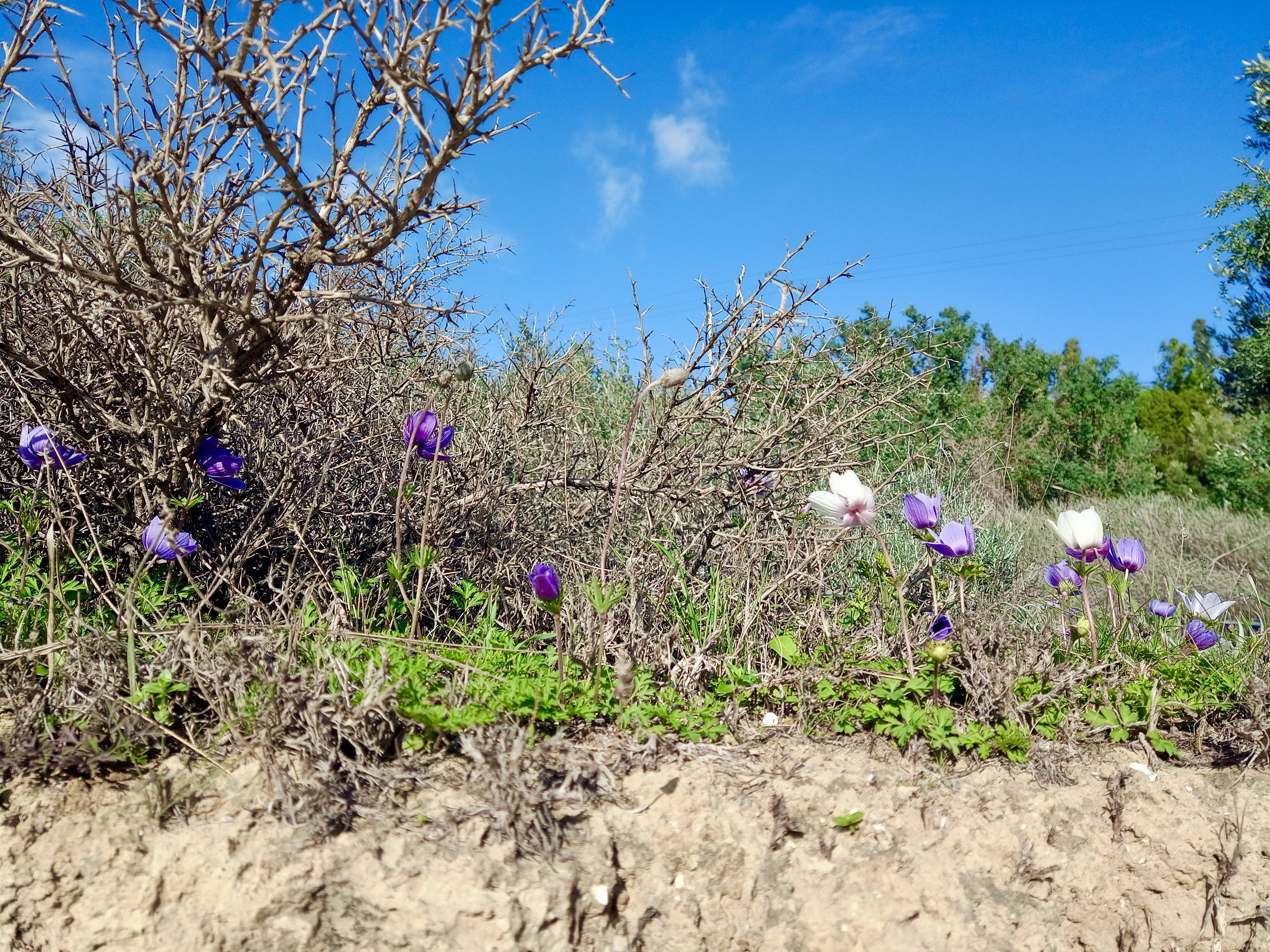
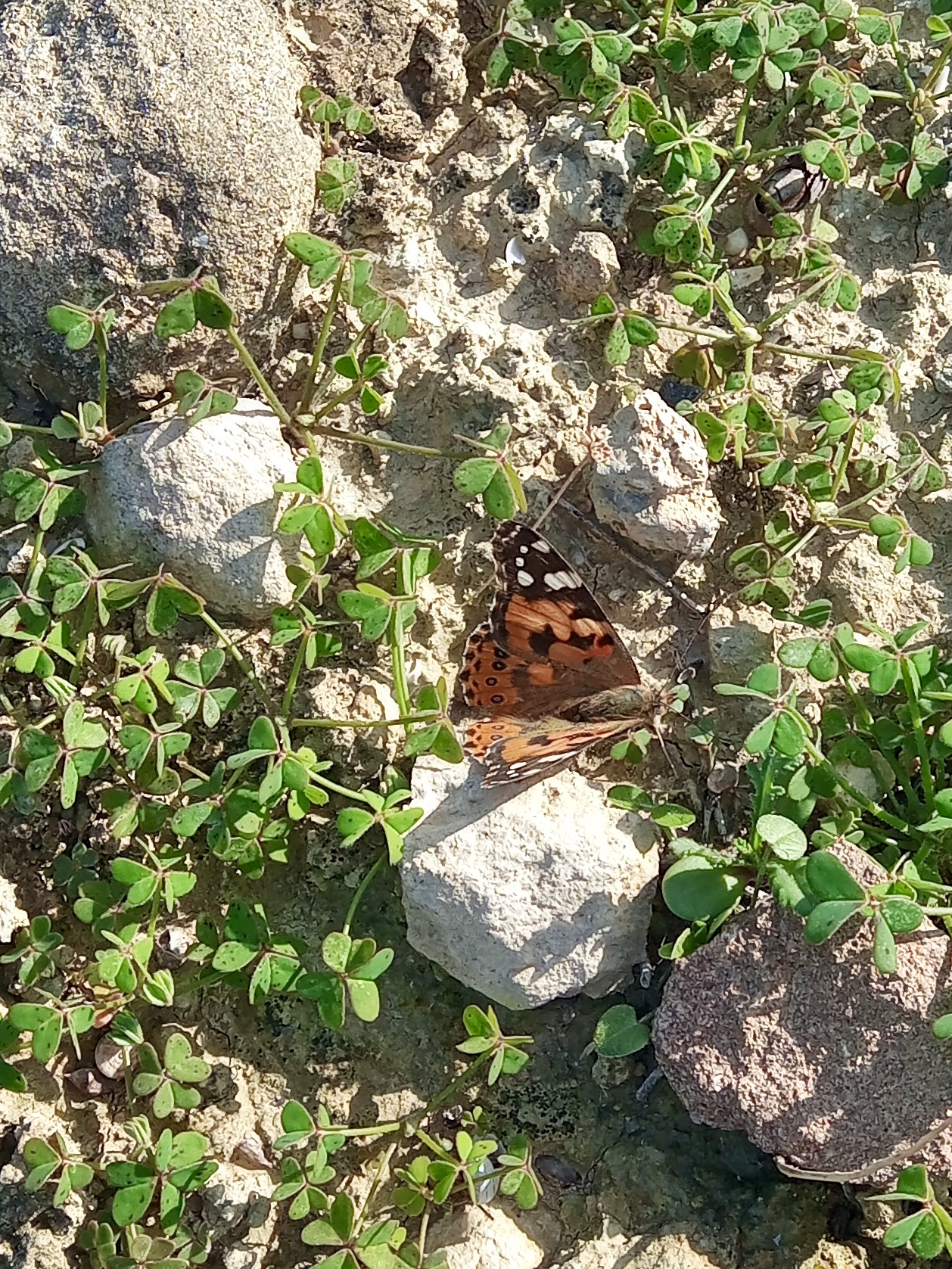
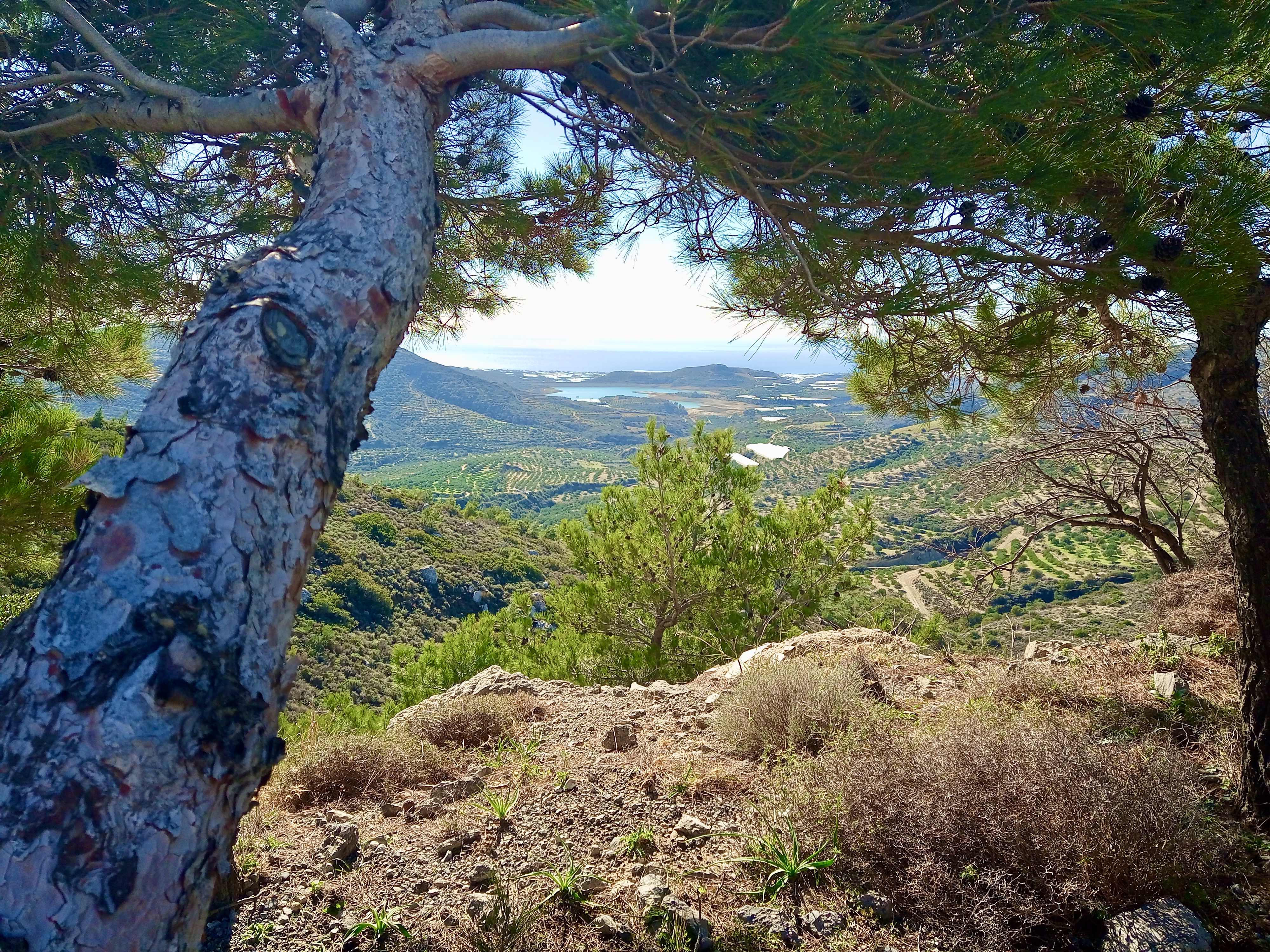
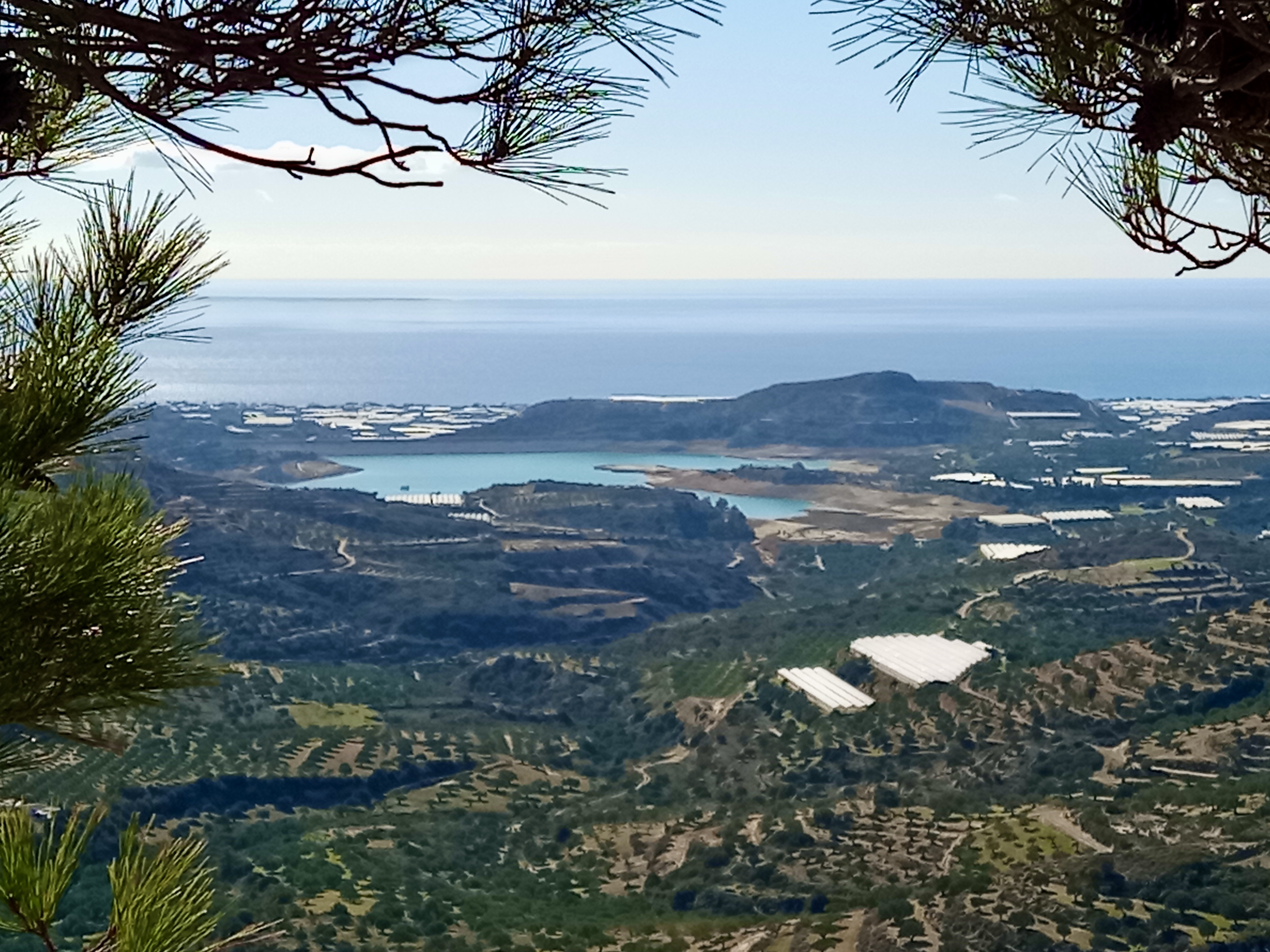
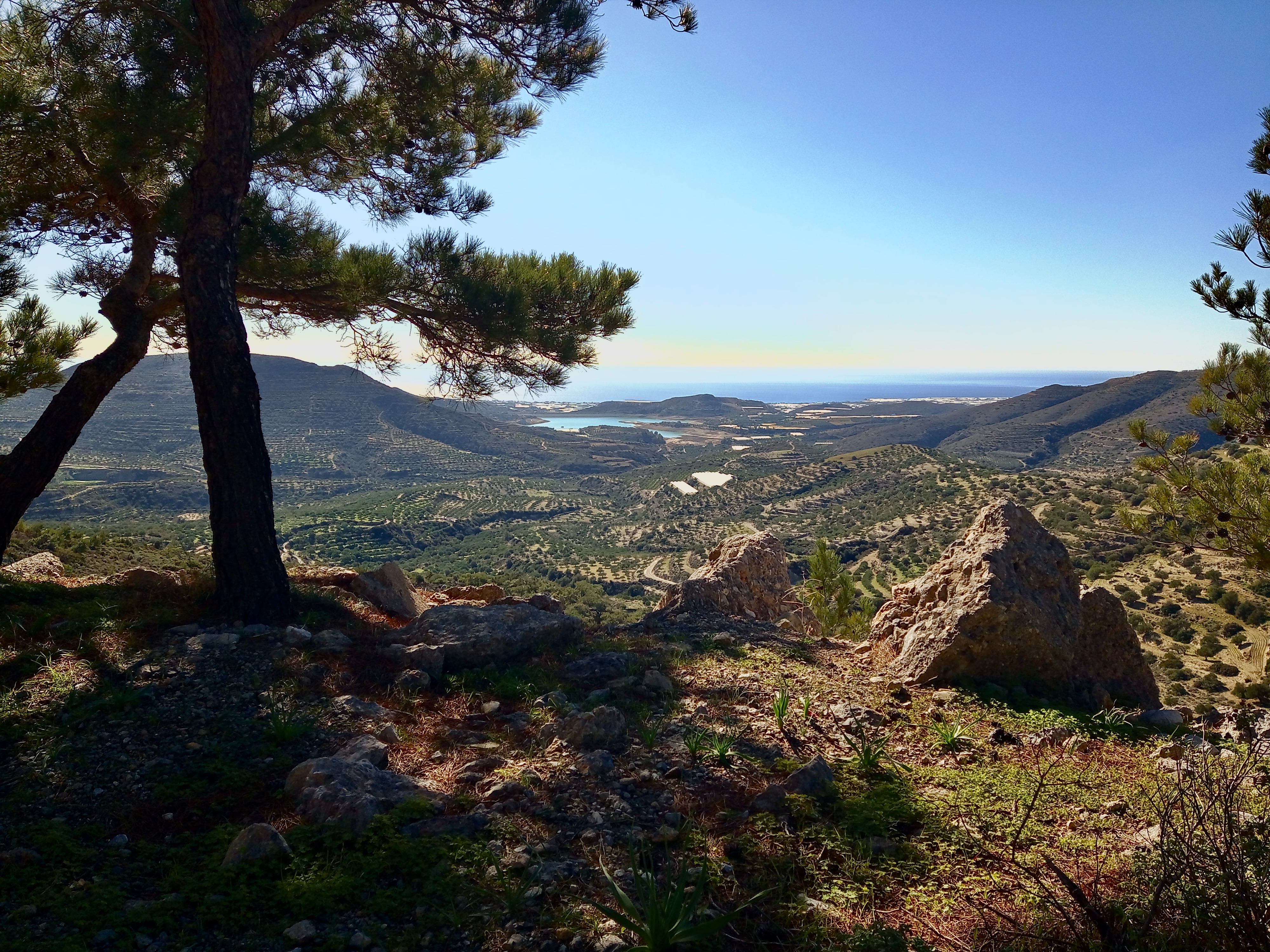
Photo at the top of this post: Taken during an hour-long walk in the area surrounding the village this past couple of days. The anemones have been late this year, I assume owing to the very dry December, although the rains have certainly made up for that during January, and the reservoir is filling nicely, causing a lot of farmers to repeat the phrase “Doxa to Theo!” frequently. It was during the same walk that I spied this lovely Painted Lady butterfly warming itself in the sunlight…
•
If you enjoy my blog posts, then maybe think about supporting me by purchasing one of my written works. Your support would be very much appreciated, rest assured.Click HERE to go to my Amazon Author Page.
I don’t know whether it’s to do with the jet stream, climate change, or that it’s simply one of those winters, but the wind has been in the south far more often than is the norm recently, and when you couple that with the fact that it’s reached gale force a few times, the result has been disaster for a few of the waterfront restaurants down in the town, including our beloved Konaki, run by our good friend Yianni, he of the declining tooth population.
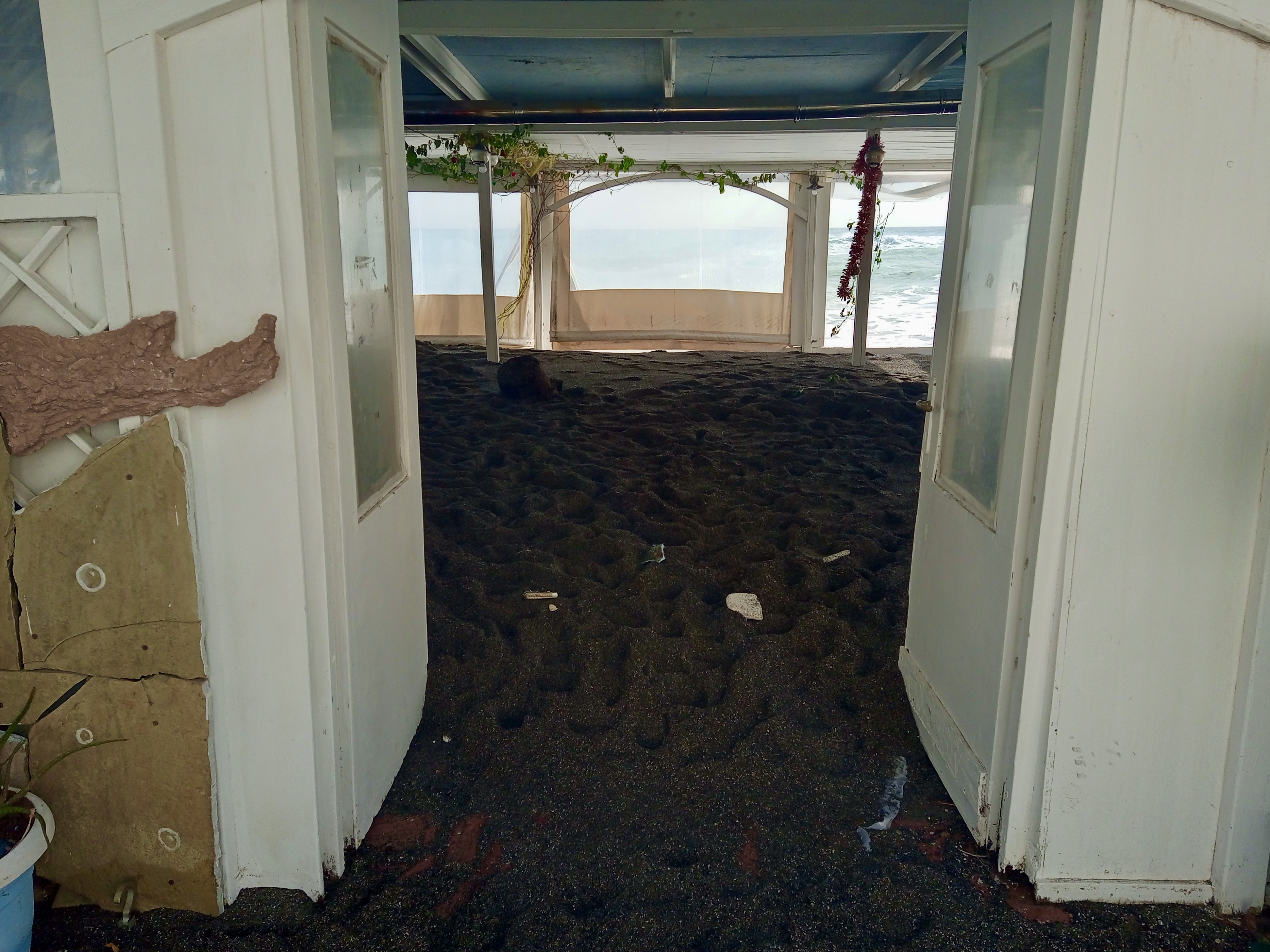
The photo at the top of this post shows just how close to the sea Yianni’s place is, and in the foreground, where you see all that sand, well that’s actually a paved terrace normally. All that sand was deposited there by an angry sea on Thursday, January 22nd. During that day the sea charged right through the restaurant and on to to the road behind it, which subsequently had to be closed for a day or two as a result…
Bear in mind that I took these photos during the following day, Friday January 23rd, as the restaurant and bar owners along the front were attempting a cleanup operation. When we reached the door of the Konaki, this was what we saw…
What you’re looking at there is a pile of sand at least a metre high, and it was all deposited there by the sea. As we stood and gaped at this awful scene, Yiannis approached us from the restaurant building across the road. He looked extremely flustered and very dirty, as he was in the middle of trying to shovel all those tons of sand back on to the beach. What he needed in there was a mini JCB, but he didn’t have one and, anyway, whilst it may have helped with the sand extraction, it would have caused other issues with the structure of the ‘pergola,’ as they call these covered terraces along the back of the beach.
We offered to roll our sleeves up and to help, but he had a team of family members and friends all doing what they could and, although he thanked us for our willing spirit, we weren’t dressed for the kind of work that was involved. We felt so bad for him because his is one of the few restaurants along the back of the beach that stays open all winter, and we and many of our friends go there often on bright sunny days during these off-season months. We asked him if he was used to this kind of problem during the winter months, to which he replied (as we’d expected and suspected):
“No, no. We often have the sea creep under the polythene screens during winter storms, but never in thirty years of running this place have I seen this. Sand a metre deep in the middle of the taverna floor is unheard of.” We were so, so sad to hear him say this, because he was close to tears as he spoke. When you consider that there are also electrical sockets in there powering his fridges, where he keeps drinks and fresh fish, plus a house phone and the cash register, as well as a mini sound system that he uses to play music for his diners, and all that had been swamped by seawater and sand, I dreaded to think of what it was all going to cost him.
Where you see all that sand is usually where there would be the tables and chairs, replete with blue and white check tablecloths. The restaurant floor usually looks like this…
Since it was on the Friday when we had this conversation with Yianni, I thought that maybe he’d have it all cleaned up and be able to open again by Sunday. How wrong I was. He told us that he didn’t think that was likely, and he was right. Just a few days later the sea became just as agitated as it had been on that Thursday, and all the cleanup work that the restaurateurs had done was undone again. In fact, I’m typing this on Thursday January 29th and the southerly winds are again up to gale force. It’s heartbreaking because those who do open at this time of the year are losing a lot of income, plus the cost of the repairs after the cleanup will no doubt be considerable. As of today the forecast is still for the winds to remain in the south for days to come, which is extremely bad news indeed. To have the winds in the south for as long as they have been this past couple of weeks is unprecedented.
Here are the other photos I took after the first storm…
What’s doubly frustrating is the fact that between the storms, the weather has been like this…
OK, so one of the above shots shows the sea creating a spume of spray along the promenade, but that doesn’t cause all that much bother there. The beach where all the damage has been done is a few hundred yards to the right of this area. Spare a thought for the likes of Yianni, and let’s hope that the winds will soon swing around to their prevailing direction, which is north to northwest, soon.
•
If you enjoy my blog posts, then maybe think about supporting me by purchasing one of my written works. Your support would be very much appreciated, rest assured.Click HERE to go to my Amazon Author Page.
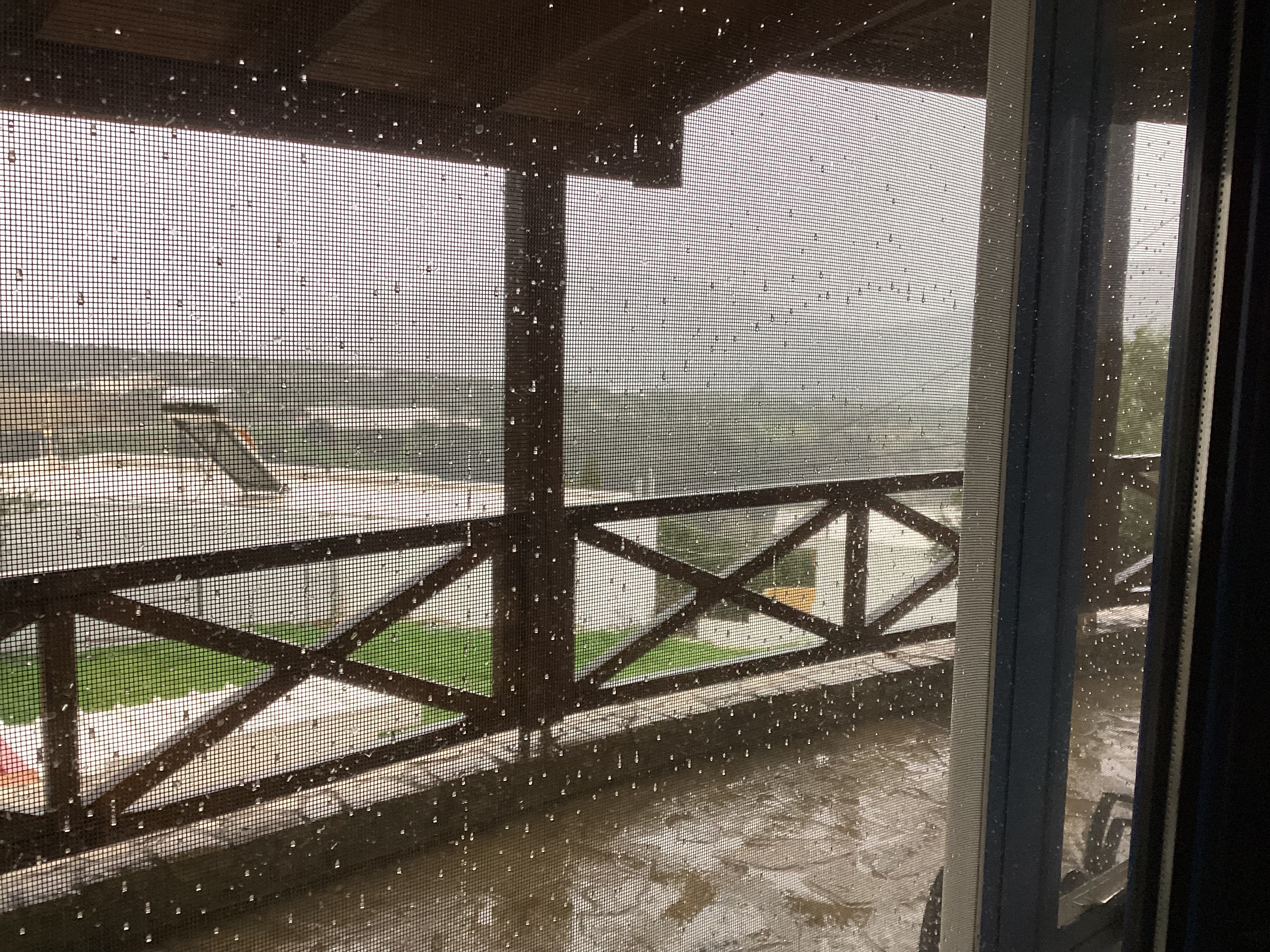
Well folks, if it makes you feel any better, the weather here’s diabolical at the moment. OK, so we don’t get this kind of weather too often, but when we do, it throws it all at us, and that’s what it’s doing today. The prevailing winds here are north to north west, which means that the western end of the island as well as the north coast in general tend to see more of the bad weather during the winter than we do, but today the wind’s blowing south, south east, so it’s coming straight up the valley and hitting our veranda full on. The sea down on Ierapetra seafront is definitely crashing over the promenade.
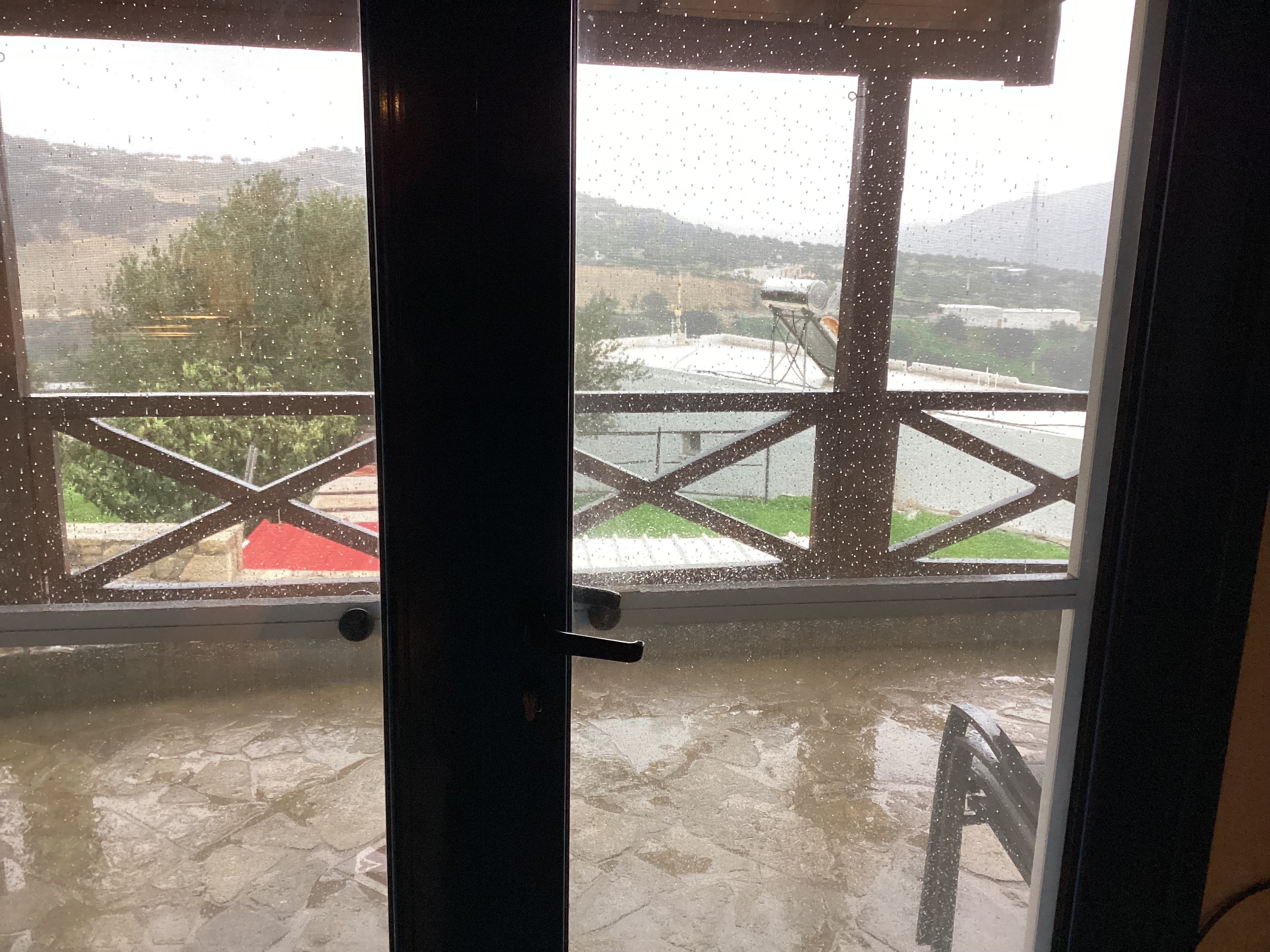
Usually, when it rains here in winter, we can still sit out on the veranda to drink our coffee in the mornings, because the rain seldom gets the place wet at all. When the wind’s in this direction though, the veranda gets soaked, and we even have droplets of water on the mosquito nets in front of our French windows…
Nice, eh? It’s one of those days when you simply need to keep the house warm and be sure to have a good book in front of you. Either that or write a blog post. It’s a bit of a stark contrast with this time last year, when we had three weeks of unbroken sunshine in January and temperatures around the 20ºC mark for most of the time. Outside at the moment it’s around 11ºC, which for us is flippin’ freezing.
Still, in general, such weather doesn’t usually last long, and tomorrow the forecast is sunny and 17º, so I guess we can’t complain too much. We heat our hot water using our roof-mounted solar heating system, the kind you see on top of just about every house in Greece. You know the setup, there’s a glass panel (which the Greeks amusingly call the kathrefti, meaning ‘mirror’) and, above that, the horizontally mounted cylinder, which the locals call the ‘boiler,’ and that’s exactly how they pronounce it by the way, as it’s an anglicisation. A lot of people also have an electric immersion heater element fitted inside the cylinder, so that on days like this you can flip a switch in your fuse panel on the wall and heat the water electrically. We opted not to bother with that and, to be honest, most winters (and this is now our seventh in this house) we’ve never experienced more than a handful of days on which we didn’t have any hot water in the taps. I’ve a sneaking suspicion though that todays’ going to be one of those days.
I’ve got to say, too, that the local farmers (and that’s what most people are in this area) are loving it. For the reservoir to fill up to an acceptable level, and one that gives them the chance of having enough water to get them through the coming summer, they often tell us that however much rain we get during the winter months, it’s never enough. In the previous post you’ll have seen the photos I took showing the reservoir below us, and maybe you can’t tell, especially if you’re not from around these parts, but it’s still only a little more than half-full at the moment, having reached its lowest ever level by the time we got to the back end of last year. The current level, though, is at least evidence that this winter’s rains have been giving it a helping hand, and it’s hoped that if we continue to get a little rain every week then it’ll be full by the time the summer hits us with a vengeance. Judging by how much rain we’ve been getting this past few years though, it’s doubtful.
Mind you, as I sit here typing this and gazing up at the scene outside through the French windows, I could be forgiven for thinking that I ought to consider following Noah’s example when it comes to building projects.
Now, with all this talk about rain, you’re probably (if you’re not comatose by now) wondering why this post is called ‘furry, fluffy floors.’ That has to do with the locals’ quaint habit of covering every available surface with shaggy rugs and throws from December through March every year. We first came across this custom during our 14 years on Rhodes. Friends’ homes, whom we’d frequented often during the summer months, all of which have cool ceramic tiled floors, or maybe that polished crushed marble effect that seems to have gone out of fashion in recent times, seldom sported any floor coverings, since to walk barefoot on such floors during a Greek summer is a way of cooling oneself down a little. Come winter, though, it’s ‘all change.’
It seemed to us that just about everyone had a stash somewhere of really shaggy rugs and blankets and, once the evenings get a bit cooler and the winter months arrive, out of that ‘stash’ they’ll extract all these brightly coloured shaggy whatnots and throw them all over the floors and furniture. The first time we visited Mihali and Soula’s house back on Rhodes during the first winter we were there it came as a bit of a shock. Their normally sparse lounge and dining room was now knee deep in shaggy pile and fluff. Not only that, but the normally subdued colour palette was now visually smashed to smithereens because all their ‘throws’ and rugs were in garish colours, from bright orange, through chocolate brown, to red and pink stripes, aaaargh.
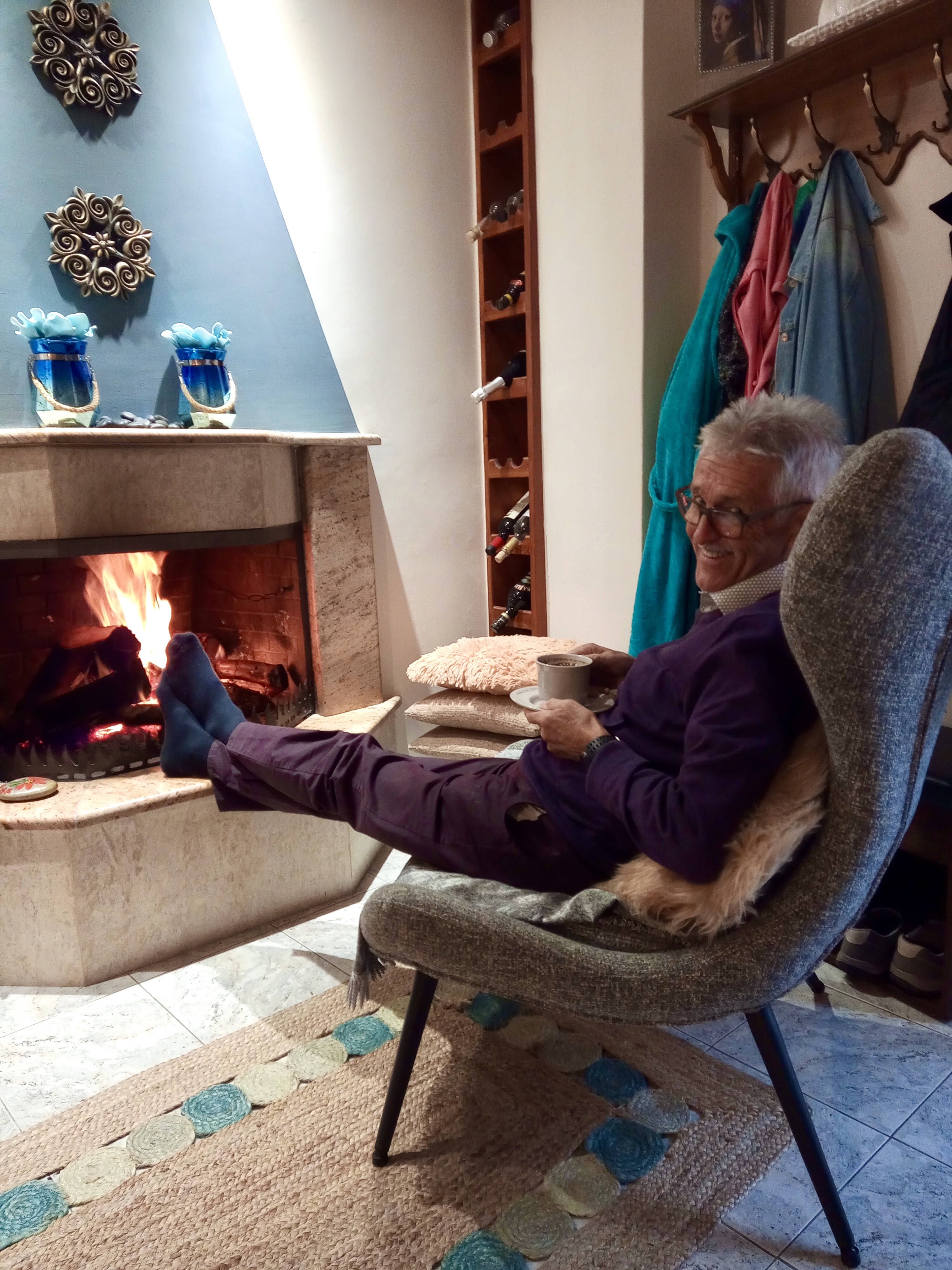
Not many Greek homes don’t have a ‘tzaki,’ or open hearth as we’d call it in the UK, on which they burn copious quantities of wood, the heat from which largely just goes straight up the chimney. In order to get any benefit at all from it you have to sit right on top of it, barely escaping third degree burns on your tootsies. So they’ll happily chuck a very, very shaggy rug on the floor right up to the edge of the hearth, in many cases. Why there aren’t more house fires from stray embers and sparks is beyond me.
This was taken at some friends’ house in Myrtos, not our place. Our place is below…
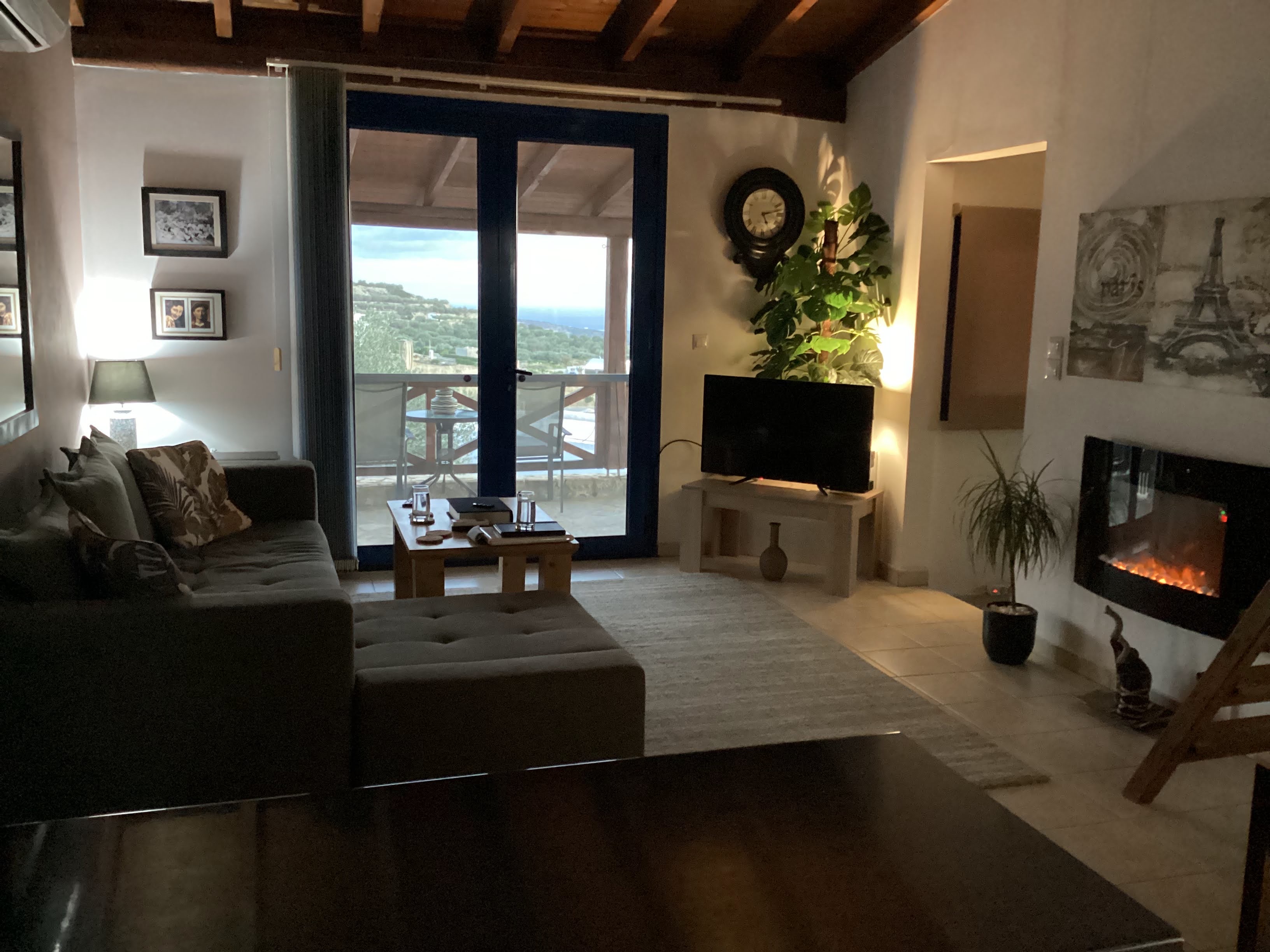
A couple of years ago, as the summer was drawing to a close, one of our friends, whom I shall call Despoina, came up to lunch with her hubby Manoli. As they were leaving, she told us that she was going to give us something, because she couldn’t bear to see our house without its share of shagpile for the winter months. Despite our trying our level best to express our desire not to have such a ‘luxury,’ she still rocked up a couple of days later with a huge two metre square rug with pile that must have been at least three inches deep. Had it actually been sheepskin, it would have needed about six sheep, maybe more, to make one of that size. The thing weighed a ton and I’m not exaggerating, and she proceeded to march into our lounge and cast it upon the floor, all the time looking sideways at us with that ‘aren’t you grateful that I’ve saved you from getting frostbite in your toes this winter’ look in her eyes.
Once she’d gone, and we knew that she wouldn’t probably be dropping by again for at least a number of weeks, we immediately took it up again and tried to fold it up and put it away somewhere. That was when another conundrum struck us. Where on earth do you store such a thing? It would have totally consumed one section of our wardrobes, even if we’d had one to spare, which we didn’t. In the end, almost wrecking my hands and sustaining several blisters in the process, I attacked it with some robust dressmaker’s scissors and cut the thing in two. At least then we were able to stuff the two parts into huge heavy-duty polythene bags, the type you get from a dry cleaners. I don’t know where we got them from, but at least we had them. We learned that they all got these rugs and throws dry cleaned every spring before stowing them away for the summer, but exactly where they found to stow all of the dozen or so that most of them kept is still a mystery to us.
We eventually quietly disposed of the one that Despoina had given us by leaving the two parts beside a wheelie bin, the standard way of passing unwanted yet still serviceable household items and clothes on in these parts. We just had to hope that she wouldn’t remember it, or indeed pass by that particular bin before someone had spotted it and rescued it for their own place.
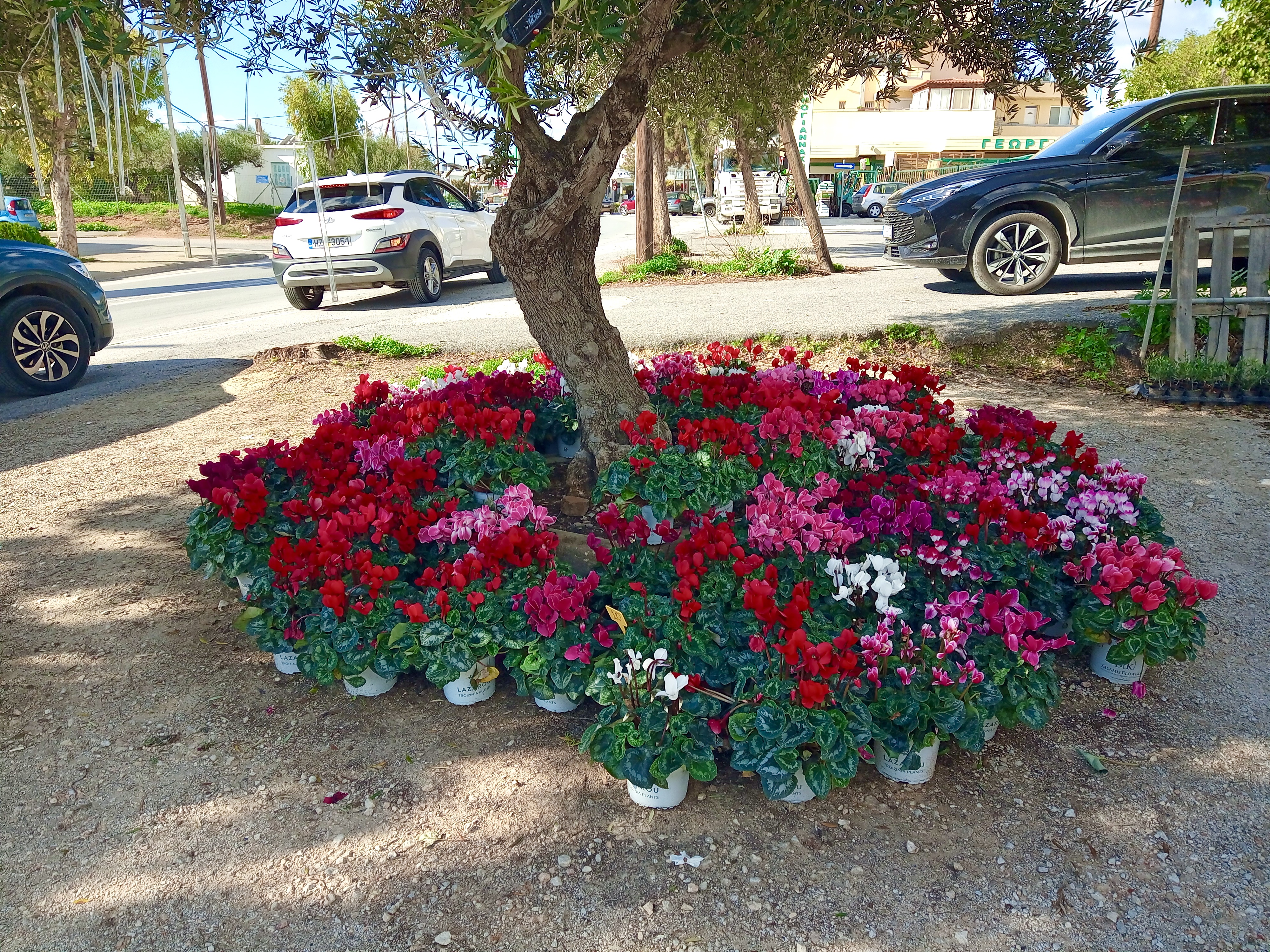
Here’s a nice shot from outside a garden centre in Ierapetra a week or so ago…
Yes, that’s right, they’re all cyclamen.
•
If you enjoy my blog posts, then maybe think about supporting me by purchasing one of my written works. Your support would be very much appreciated, rest assured.Click HERE to go to my Amazon Author Page.
I went for a brief power walk last evening, which involved me going just a few hundred metres north of the village and then back again. It was while I was standing very still, gazing at the huge sweeping valley below me, extending all the way around the mountain opposite to the Bramiana Lake just above Gra Ligia, and westwards to the foothills of the Lasithi Plateau and the high villages of Kalamafka and Anatoli, which are often lost in the mists of low cloud at this time of the year, and which are swathed in gloom from around mid afternoon, owing to the fact that they’re on the eastern slopes of snow-peaked mountains, behind which the sun sinks early in its westward track on those shorter winter days, that I heard my first blackbird song of 2026.
Now, I’m no ornithological scholar, but from a few decades ago, when we used to live in the beautiful Vale of Glamorgan in South Wales UK, both Yvonne and I did become keen birdwatchers, albeit amateur ones. We bought a selection of books to identify wild birds and took great delight in counting the number of species we’d spot during our country walks around the area of the village of St. Athan, where we lived during our final five years in the UK before relocating to Greece in August of 2005.
We’d often arrive back at our modest little bungalow having counted well over 20 different bird species. Out would come the books and – over a cup of hot chocolate – we’d thumb through the pages scanning colour illustrations checking on some of the ID’s and reading up on the habits and habitats of those birds that we’d seen through our pocket binoculars. Among the ones that we’d get especially excited about were the bullfinch and the gold crest and, as each spring approached, we’d scan the skies for the early arrivals of the summer swallow population, maybe swifts and martins too. On frosty winter days we’d thrill to see a flock of fieldfare on the frigid, white-coated grass in a meadow glimpsed through a farm gate near St. Mary Church, for example.
It was during those days that we learned something about the blackbird’s song. Firstly, it’s only the males that sing and, secondly, they only sing in the UK from around mid-February until some time in August. The rest of the year the most sound you’d get from a blackbird would be the brief chatter one would make as it took off from a bush in the hedgerow and flew further away when we’d come too close and disturbed it.
When we first arrived in Rhodes, we’d been excited to learn what bird species we’d be likely to see around us, since the house we were living in was on a rural hillside, far from most human habitation. What surprised us the most was just how many of the species that we’d lived amongst in the UK that were also present in the southern Aegean. Of course, there are some that we see both back on Rhodes and here in Lasithi on a regular basis that we’d never seen in the UK, although, in the far south of the British Isles, some of these species do occasionally venture when it’s a hot summer, which is, of course, becoming more often this past few years.
Actually, in the valley where we lived for fourteen years on Rhodes, we’d usually hear blackbirds, but seldom see any. They were always present, but for some reason not often within a few hundred metres of our garden, even though we’d regularly hear their song. Here though, for whatever reason, we get them very close to the house, even though we’re on the furthest edge of a tiny village. It’s been my experience that blackbirds sing broadly in the same months here as they do in the UK, but, what I heard last evening suggests that, owing to the warmer climate maybe, they may begin singing a month or so earlier.
I’m only going on about blackbird song because, if you’re familiar with it, you’ll know that seldom does a songbird sing more beautifully than a blackbird perched atop a large shrub or in a modest tree. The song of the blackbird is one of nature’s most evocative and beautiful gifts for your ears in my humble opinion. Plus, when I hear one sing, if I close my eyes, I can imagine myself back in the rolling green British countryside at the best time of the year. If you can hear the blackbird singing in the UK, then you know that the prospect of spring is either near, or that it’s indeed upon us, or that the early part of the summer has still not passed, leading to the inevitable decline in the weather patterns as the year moves deeper into its second half, meaning that the best of the weather for that year is behind you and the shorter days, falling leaves and eventual bare trees are what you now have to look forward to. As long and the blackbird is singing, you have hope.
Here, OK, so the weather’s a lot more reliable than it is in the UK and, even when the blackbird ceases to sing for another year during August, you still have months of cloudless skies and swim opportunities ahead of you. You still have warm evenings when you can sit beside the sea and enjoy a meal at a restaurant in good company and with a starry sky and vivid moon to keep you company. But every time I hear the blackbird, it gives me fond memories of our lives back in our country of origin. Don’t get me wrong, I have zero regrets about the path we’ve chosen to follow in life, but that doesn’t stop me thinking back to good times in rich, green meadows and pints on country pub lawns.
The blackbird is a good companion. Listen out for him. If you live in the UK, then you may yet have a few weeks to wait until he starts to sing, but, if you live anywhere near us, maybe you too have already heard your first blackbird song of 2026, and have found it a joy, as I did last evening, just as the sun was setting.
Above gallery: Taken at around midday yesterday (January 15th), on the road between our village and Meseleri, at the spot where you can gaze down upon the reservoir and out across the villages of Gra Ligia and Stomio to the sea beyond.
Above gallery: A few shots taken in Myrtos on a blustery and showery day last Sunday.
Above: One of a bougainvillea in the village just a few metres up the hill from our home and two of our terrace in the sunshine just after a shower.
•
If you enjoy my blog posts, then maybe think about supporting me by purchasing one of my written works. Your support would be very much appreciated, rest assured.Click HERE to go to my Amazon Author Page.
Today was one of those days that my dear old dad would have described as ‘glorious.’ A cloudless sky, very little wind, and a temperature of around 19-20ºC made it the kind of day that makes us truly love the winter months here on Crete. Not every day’s like this, of course but, to our delight, plenty enough are, because it’s the kind of weather that means you can get out and about without worrying about getting so, so hot and sweaty that you want to hide from the fierceness of the burning sun, as is the case in the summer months. No, today was perfect outdoor weather. So out we went.
I’d recently seen a photo that intrigued me on one of the local Facebook groups for this area. It showed a gorge that was truly spectacular and I was very excited to read that it was less than half an hour away from our front door. All we needed was the right day to go and explore it, and today was that day.
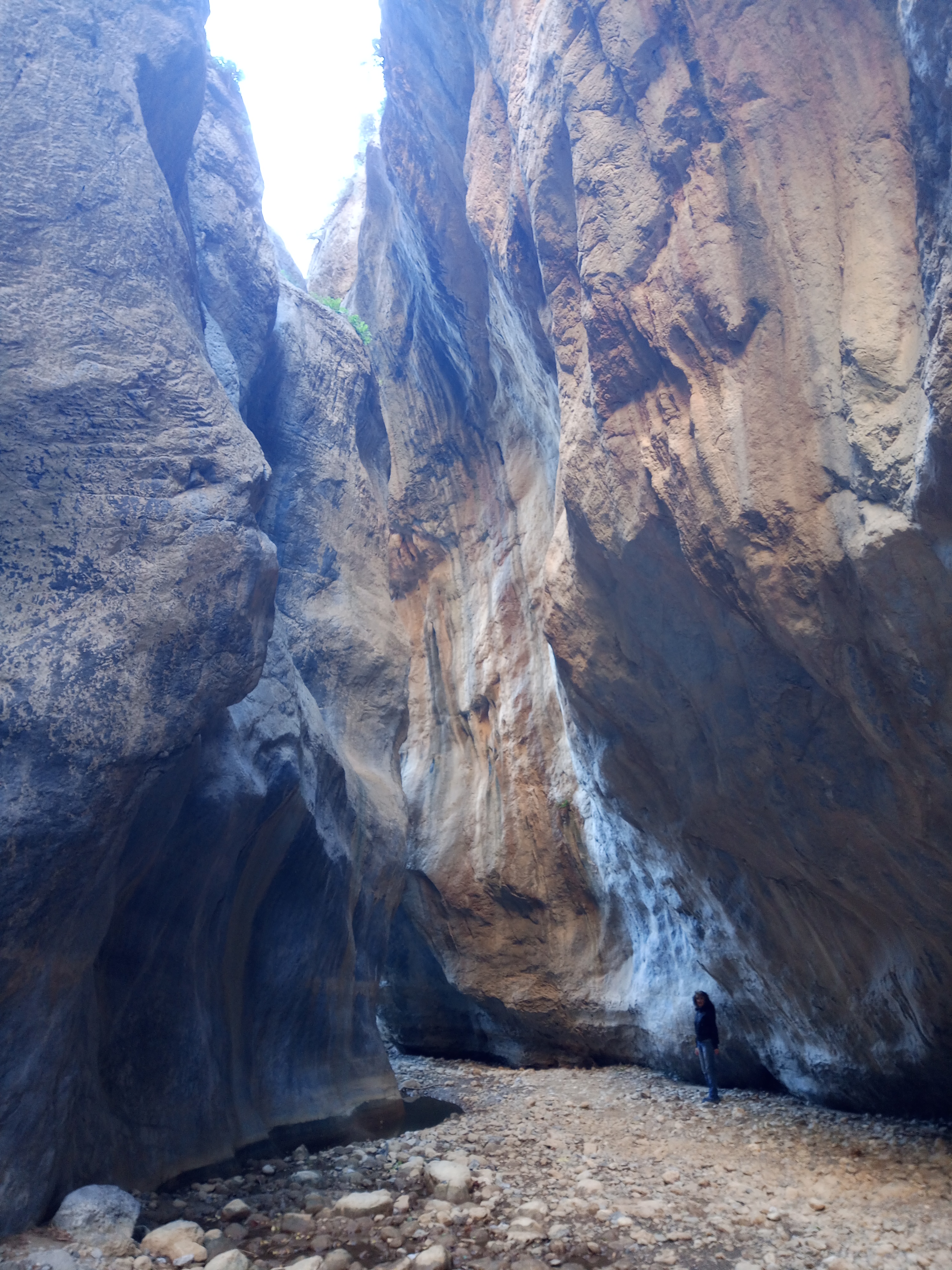
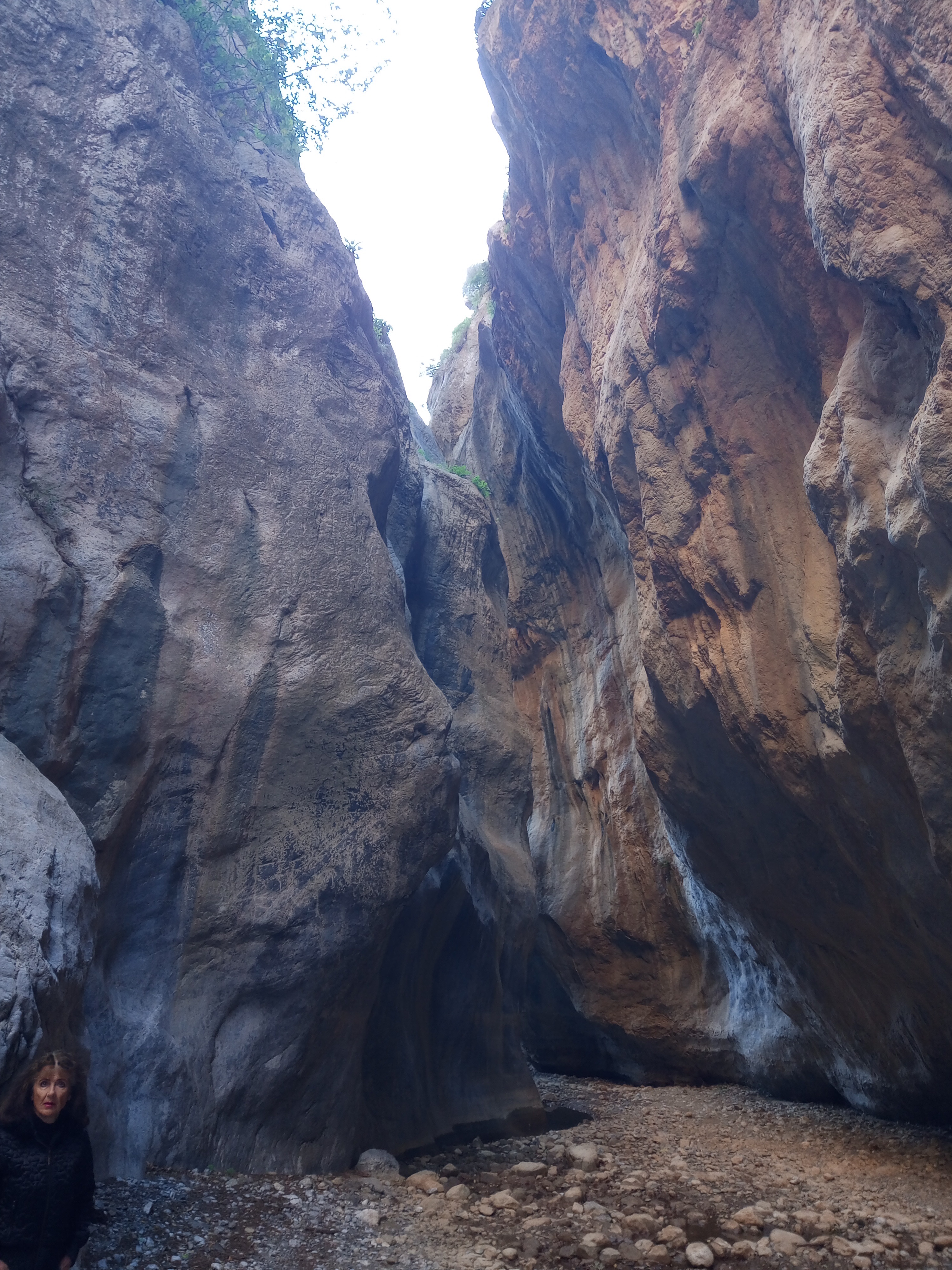
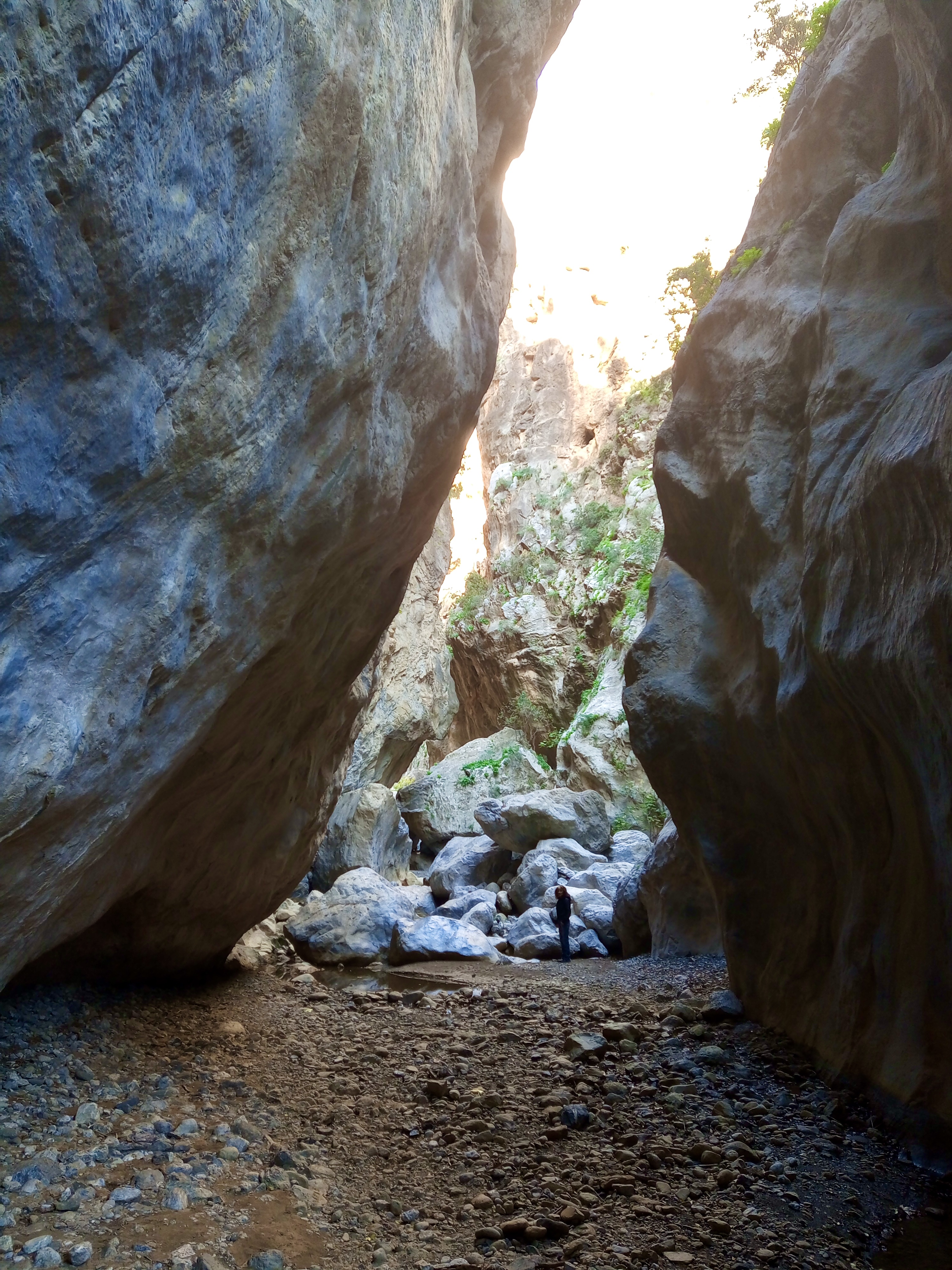
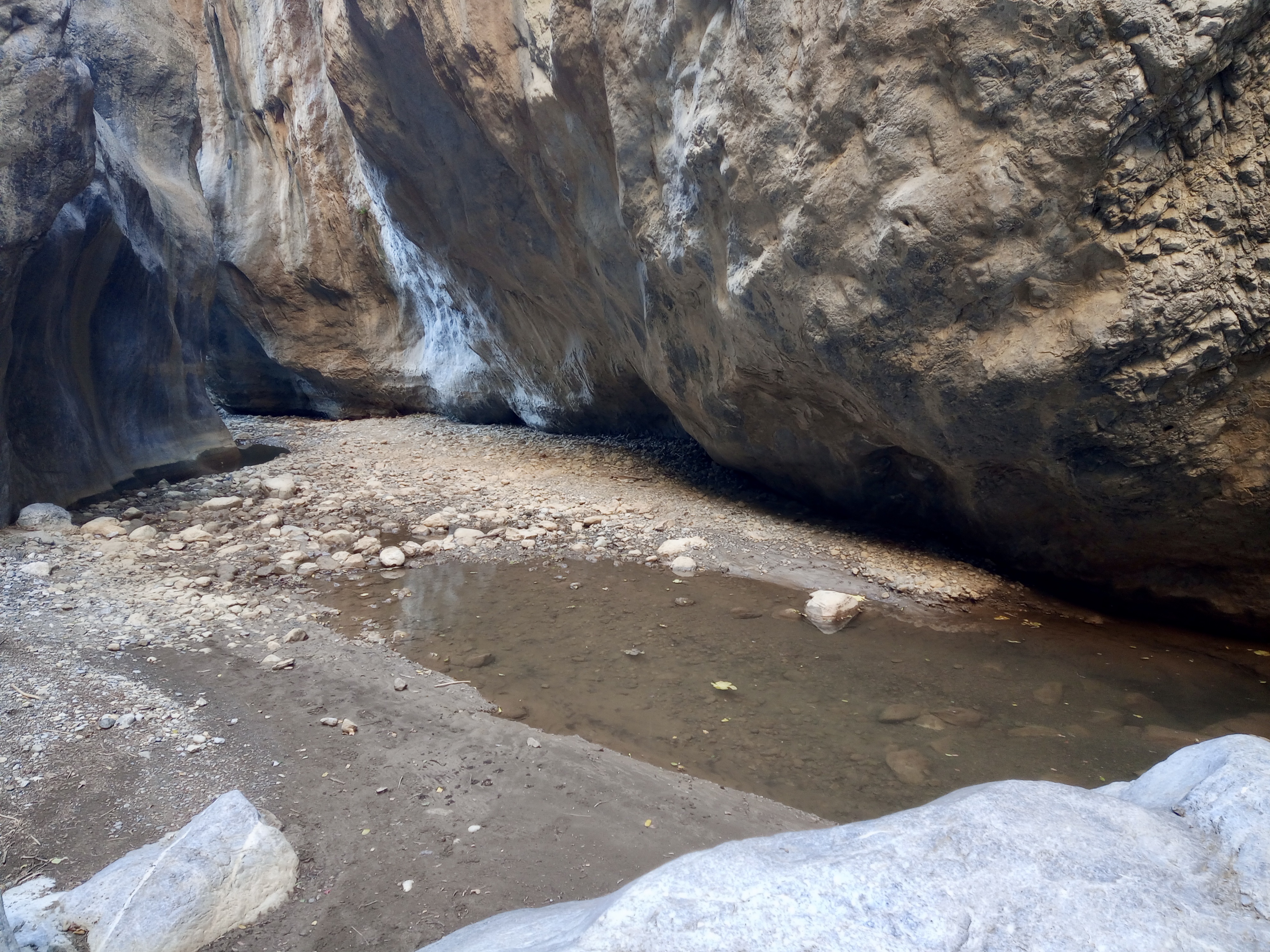
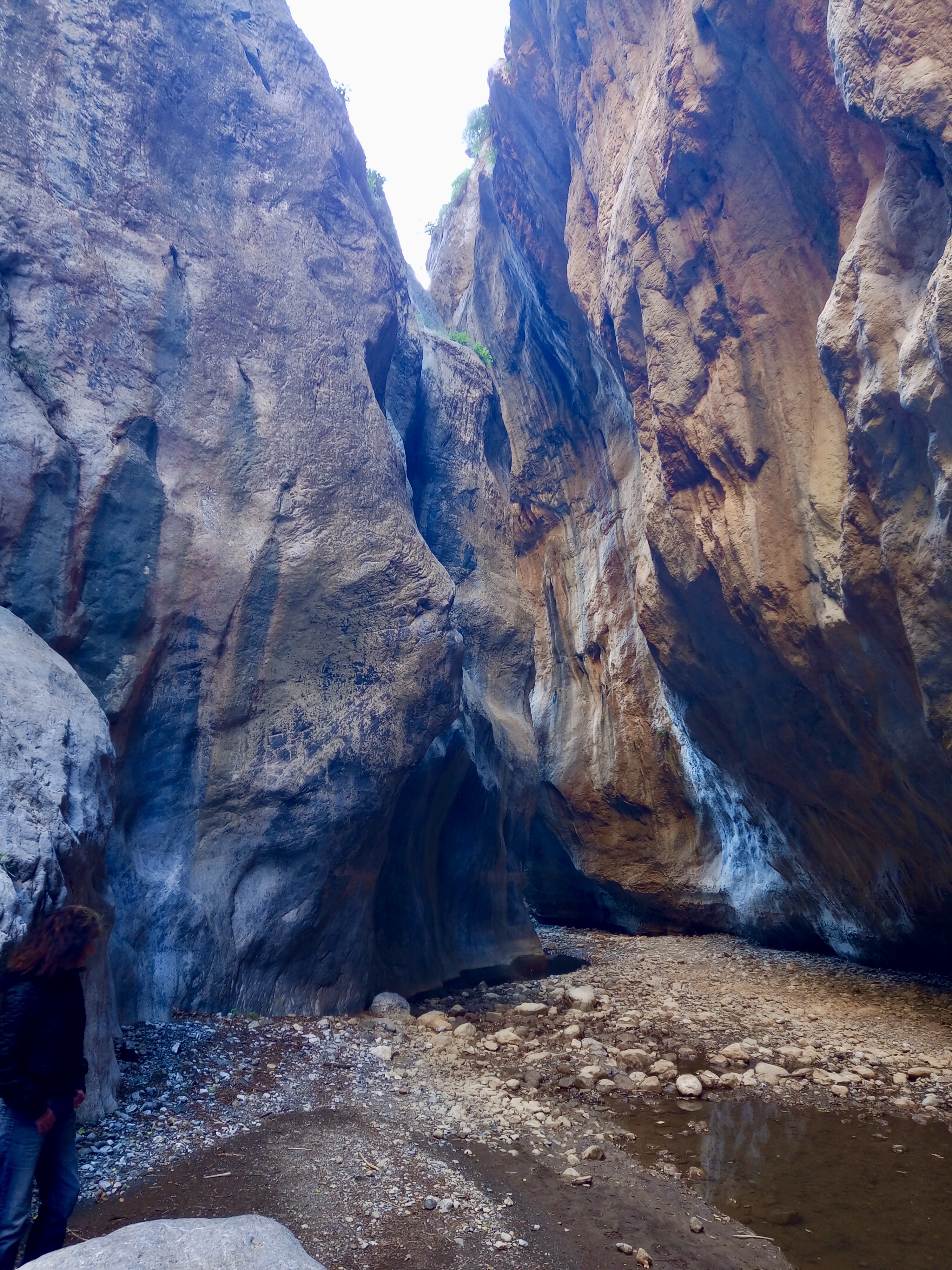
The gorge is called Sarakinas, and it’s situated up in the hills not far above the village of Myrtos, on the coast west of Ierapetra. Head up the road towards Viannou and only a few hundred metres up you’ll see a sign on the right for the village of Mythi. Follow the twisty-turny road to the village, then, once you reach it, there is a sign telling you which way to the gorge, or ‘canyon’ as the sign says. That’s only part of the story though, because you’ll soon arrive at a crossroads where, guess what, there is no sign telling you which way to go now.
As it happened, right beside the road on your left at that junction there’s a modest little café/bar, and emerging from among the few tables was a wizened old guy who looked like a werewolf who’d been drawing his pension for about a century or so. He was about to cross the narrow road in front of us with his walking frame (his ‘pi’ as the Greeks call them), so I opened my door and called out to him, asking him if he knew the right road to take in order to reach the canyon, the Greek word for which is ‘ferangi.’
He seemed delighted that I’d chosen to ask him, and enthusiastically pointed, precariously taking one hand off his frame, to indicate that we were to turn right, and it was only about another kilometre or so to the gorge, where there is a modest parking area. Off we went.
Mythi village, by the way, seemed to us to be quite well kept, with a couple of bars and a taverna or two. Many of the houses looked far too smart to be owned by locals, and so we got the impression that there was possibly a high percentage of foreigners who either lived there, or owned properties that were in all probability rented out via AirBnB or the like. Since it’s only five minutes by road from Myrtos, that figured. I’d imagine that it’s a much less sleepy community in the summertime.
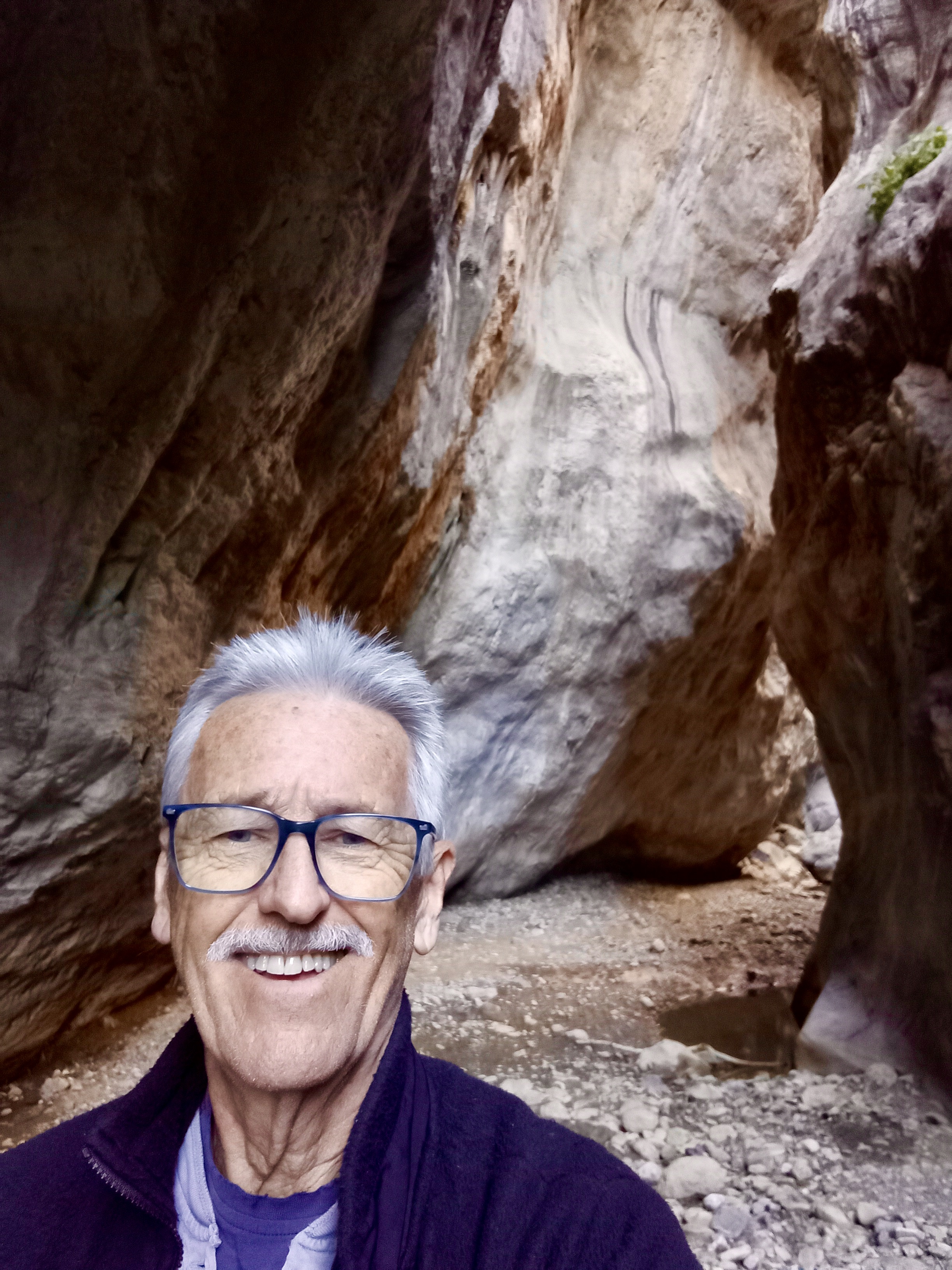
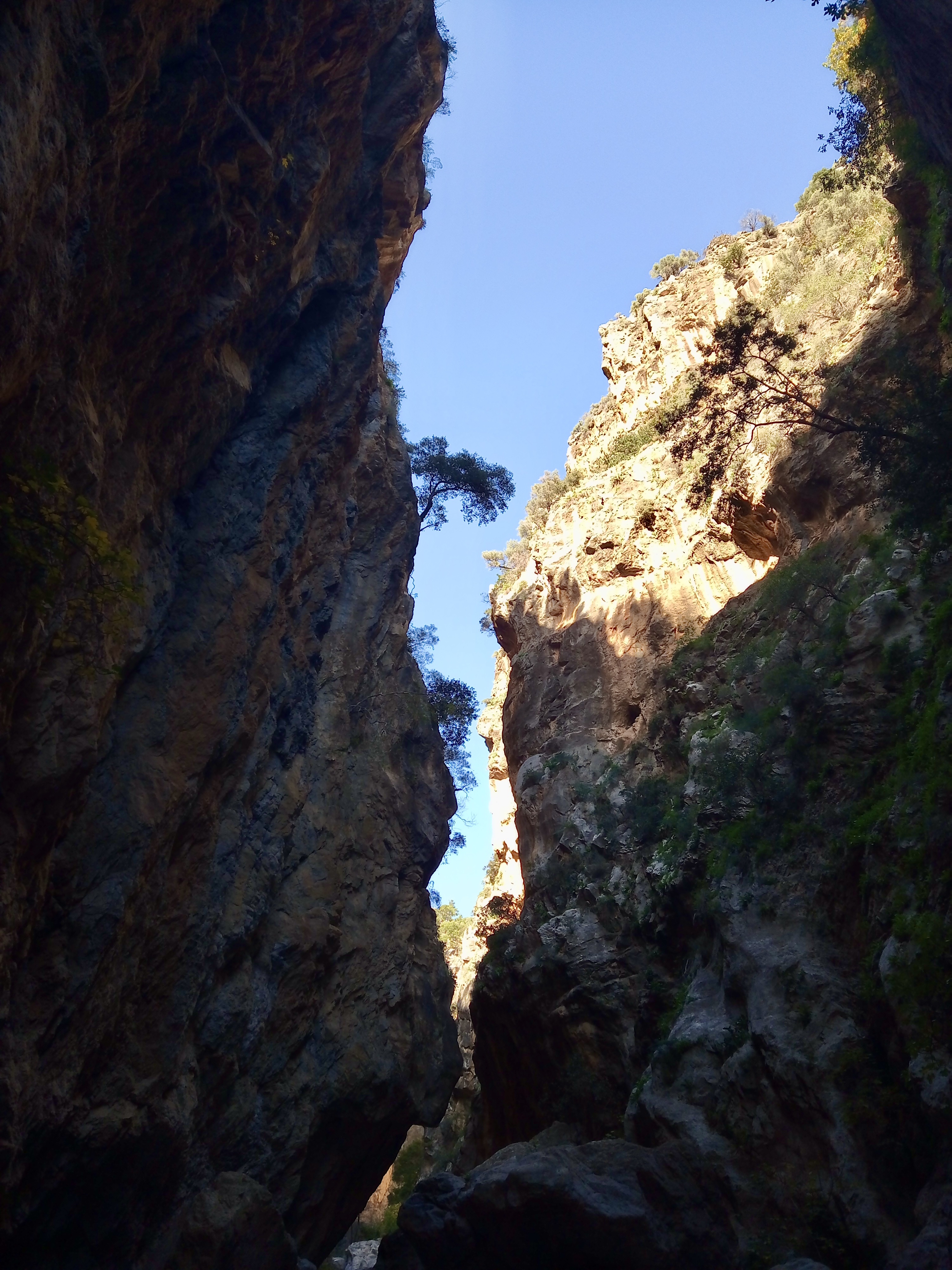
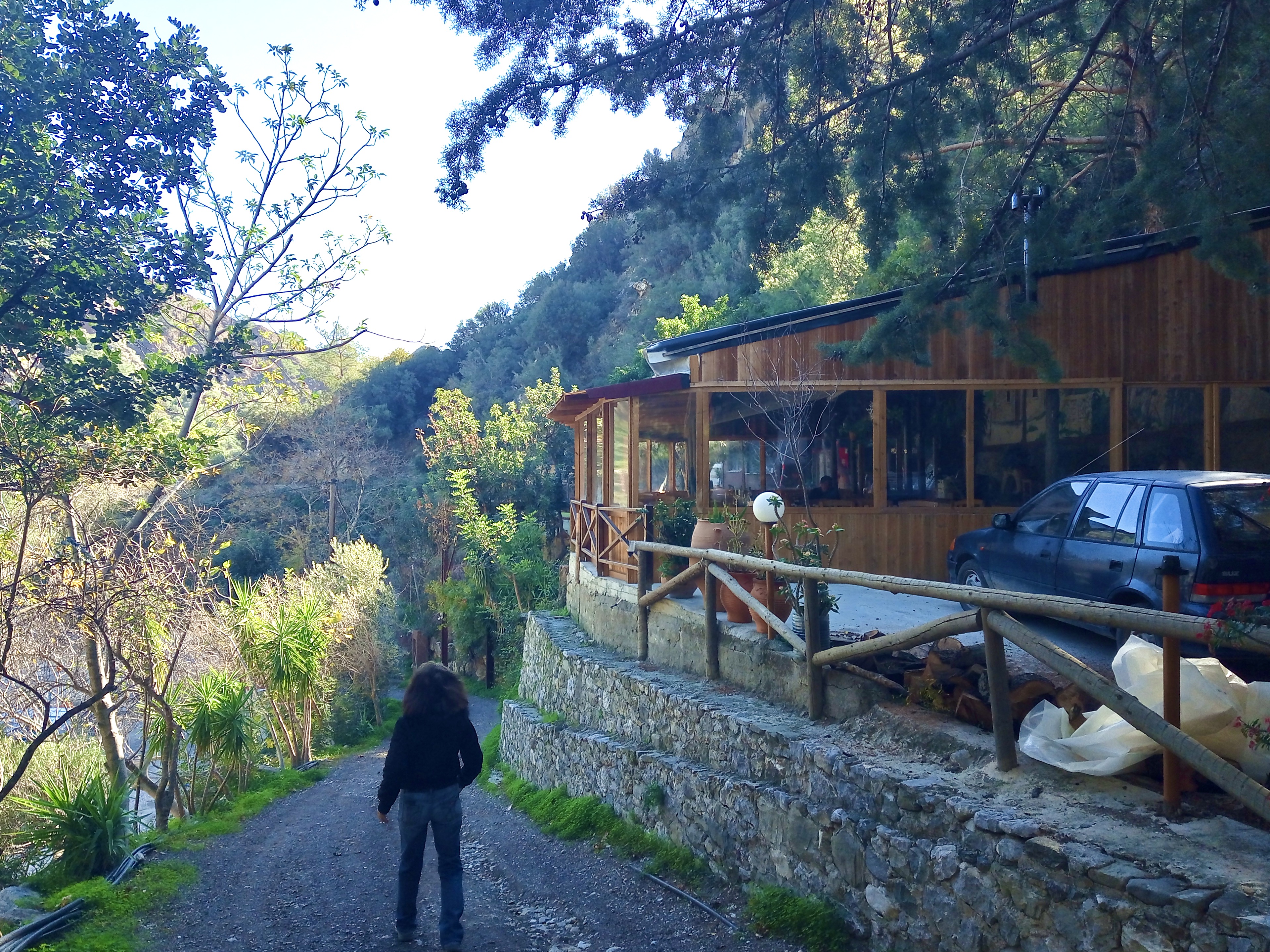
Anyway, it’s easy enough to get to the gorge’s southernmost entry point, which isn’t all that attractive since there’s a large concrete installation right beside the car park, where the sound of water pumps humming is pretty loud. Don’t let that put you off though. Take the walking path that ascends to the left of the pumping station and you’ll soon pass a pretty little taverna above and to the left where the owner was chainsawing logs as we passed and confirmed that we were heading in the right direction for the gorge. In very short order, this is what you’re confronted with…
As you can see from the third of those photos, the path soon peters out and you have to set off on a stony slope (photo 4) down to the dried riverbed, where, as long as you persevere, you’ll soon be rewarded with this…
The ones in the above gallery where Yvonne is in shot give you an idea of the scale of what you’re walking through. Oh yes, it’s impressive all right. We eventually reach the point where, in order to negotiate your way to the upper part of the gorge, you need to become a mountaineer, so we called it a halt there, as those last two photos show above.
Heading back, we were soon descending the path beside the little taverna, just metres above the car park again…
And, not many minutes later, we were strolling along Myrtos seafront, which is very different at this time of the year from how it appears to the tourist during the summer…
If you do find yourselves in our neck of the woods this coming summer, I’d highly recommend a visit to the Sarakinas Gorge, although it’s not for anyone who’s not too steady on their feet, or hasn’t got a sturdy pair of walking boots with them. It would be the height of folly to attempt it in flip flops, OK? You have been warned.
•
If you enjoy my blog posts, then maybe think about supporting me by purchasing one of my written works. Your support would be very much appreciated, rest assured.Click HERE to go to my Amazon Author Page.
Firstly, to put your mind at rest here, there will be no mention of native American headdresses, fireman’s outfits or helmeted highway patrol officers prancing around and singing about a young mens’ youth hostel chain; no. We’ve been talking a lot lately about how much more rooted the Greeks are to their place of origin than British people appear to be these days. Everyone in Greece, it seems, is strongly attached to their home village, or even suburb, and – if due to whatever reason they’ve had to move away – they always head back there whenever the opportunity arises; which would, of course, include bank holidays and celebrations, not to mention retirement.
In the UK, it seems to us that people no longer have an attachment to where they were born and raised. Even the fact that properties are referred to as ‘starter homes’ indicates clearly that a house is considered an asset that will be bought and sold as people move through their working lives. People dream of retiring to the coast, or maybe too, of course, somewhere abroad. In Greece, when people reach retirement, if they have moved away, they’ll more often than not want to go home to the village where they were raised, where they still have lots of surviving family and, no doubt too, they’ll still have a property that’s waiting for them to move back in.
If you watch the TV and listen to the conversation on a quiz show between the show’s host and a contestant, invariably they’ll ask the question, ‘Where are you from?’ The reply will always be either the actual place where the person was born and raised and still lives, or, if they’ve moved away, they’ll always be sure to make the point that, although they now live in, say, downtown Athens, they’re actually from – and here they’ll name their home village – with a great degree of pride too, I might add.
Still in Greece, by and large, people are very reluctant to sell a house. Here, that building is their heritage, it’s what keeps them grounded, it goes a long way towards helping them keep mentally and emotionally stable, content. I’ve read articles by psychologists who suggest that people who move home often (and that’s far more common in the UK than it is here in Greece) actually do harm to their sense of wellbeing and emotional stability. It seems that identifying with your place of origin is important for the soul, bringing a stability that is lost to those who simply view a house as an asset to be bought and sold. In short, if you sever your roots, you suffer emotionally, and often end up being much more susceptible to stress and anxiety.
We know of so many cases where Greeks have lived and worked abroad, in such faraway places as the USA, Canada or Australia, yet when they reach retirement they pack up and move back to their place of origin here in Greece. It’s like they have a ‘homing’ instinct that kicks in as soon as circumstances allow for it. We also have a few friends who live in the US, for example, who are almost unbearably torn because they’ve had children in Baltimore, for example, who’ve now grown up and have kids of their own and view themselves as Americans first and Greeks second (if it factors in their thinking at all), and the parents (who’ve now become grandparents) feel an unsolvable heartache, owing to the fact that they’ve retired and want to go back to their little village on the Greek island where they were born, yet fear that doing so will mean not seeing their kids and grandkids from one year to the next. We knew one couple to whom we became quite close during our years on Rhodes who hailed from Kattavia, a tiny village right in the south of the island, and because they couldn’t bear not to see their kids and grandkids, would fly over to Rhodes for maybe four or five months each year, but went back to America every time so that they wouldn’t lose that close contact with their family. The journey was a long one, with a couple of changes of plane, and they did this well into their late seventies, but still couldn’t move back for good, even though that was what their hearts yearned to do.
I’ve lost count, actually, of the number of older couples that we’ve met during our 20 years here in Greece who’ve come back to their ‘katagogi’ as the Greeks call it, which means literally their place of ‘origin’ to live out their golden years among friends and family around whom they grew up.
A Greek’s attachment to his or her place of origin is all consuming, truly it is. Here still, even though things are slowly changing, there are villages like ours (I say ‘ours’, but you know what I mean, it’s ‘ours’ in the sense that we’ve adopted it as our forever home, but we’re still basically interlopers) whose inhabitants consist of many folk in their seventies through nineties who’ve hardly ever travelled as far as the nearest town, leave alone to another country. Our near neighbours across the lane include Kyria Evangelia, who’s now touching 90, and has never been anywhere more than about 20 kilometres away from the house where she was born, raised, married, brought up three kids, widowed and now potters around in her twilight years. She still lives in the same house, which has never been brought into the 21st century. She still goes outdoors to get from her kitchen to her ‘saloni’ (lounge) and also to her bathroom. The tiny street in which she lives also serves as her hallway.
Yvonne and I have moved house more often during our fifty years of marriage than we’d originally have anticipated. It’s not always been through choice, though and, oddly enough, the longest period of time that we’ve lived anywhere in one place was the 14 years we spent on Rhodes. We’ve never moved simply as a means of climbing the ‘property ladder’ though, or indeed as a means of making more money. In the six years since we arrived here in the village, it’s been a therapeutic experience for us. That stability which we’ve witnessed among our Greek neighbours, that joy that they derive from moving amongst the same close friends, neighbours and family throughout their lives, has rubbed off on us, and we love it.
I don’t think we’ll be putting our house on the market for the foreseeable future.
Photo time...
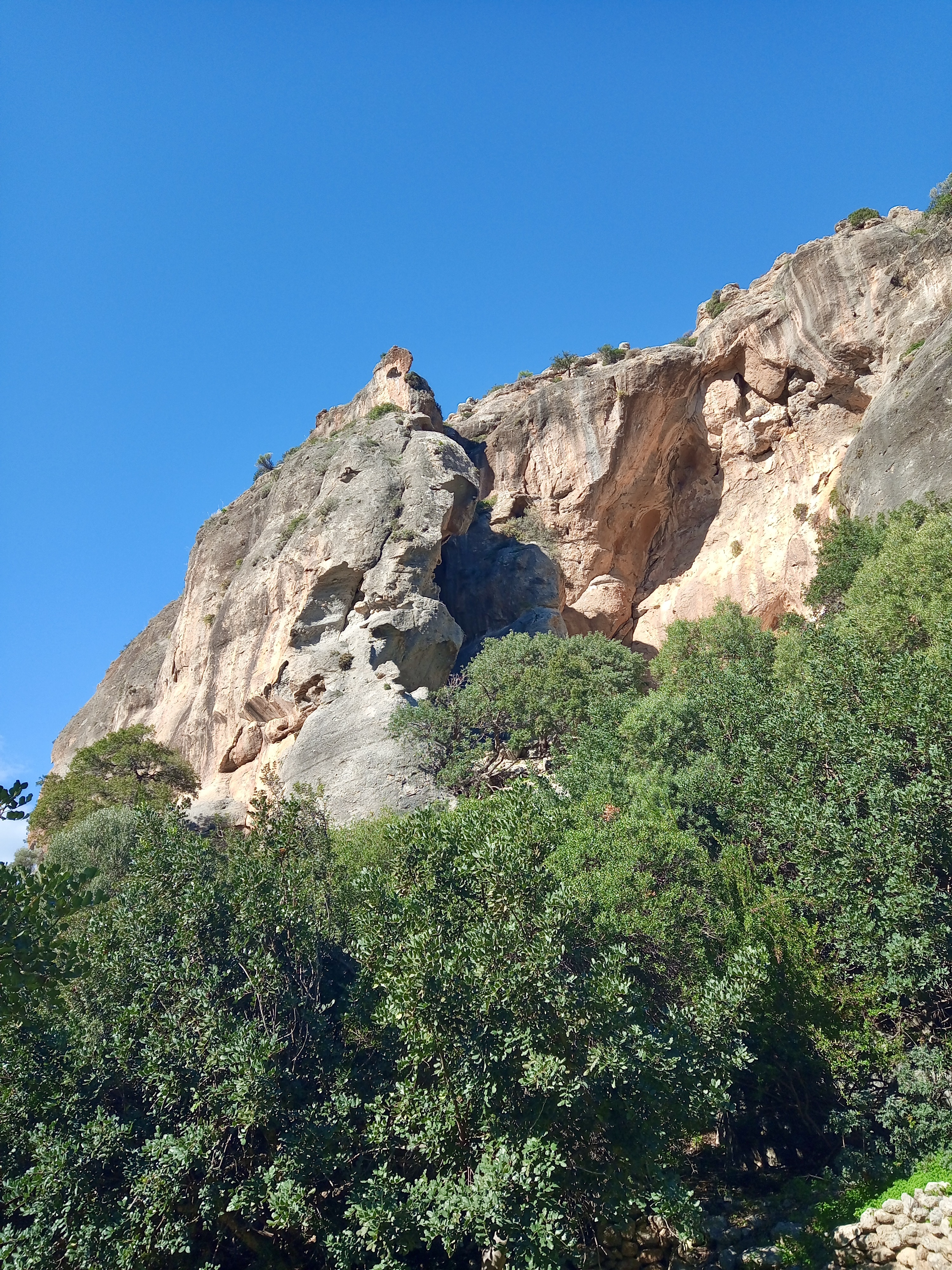
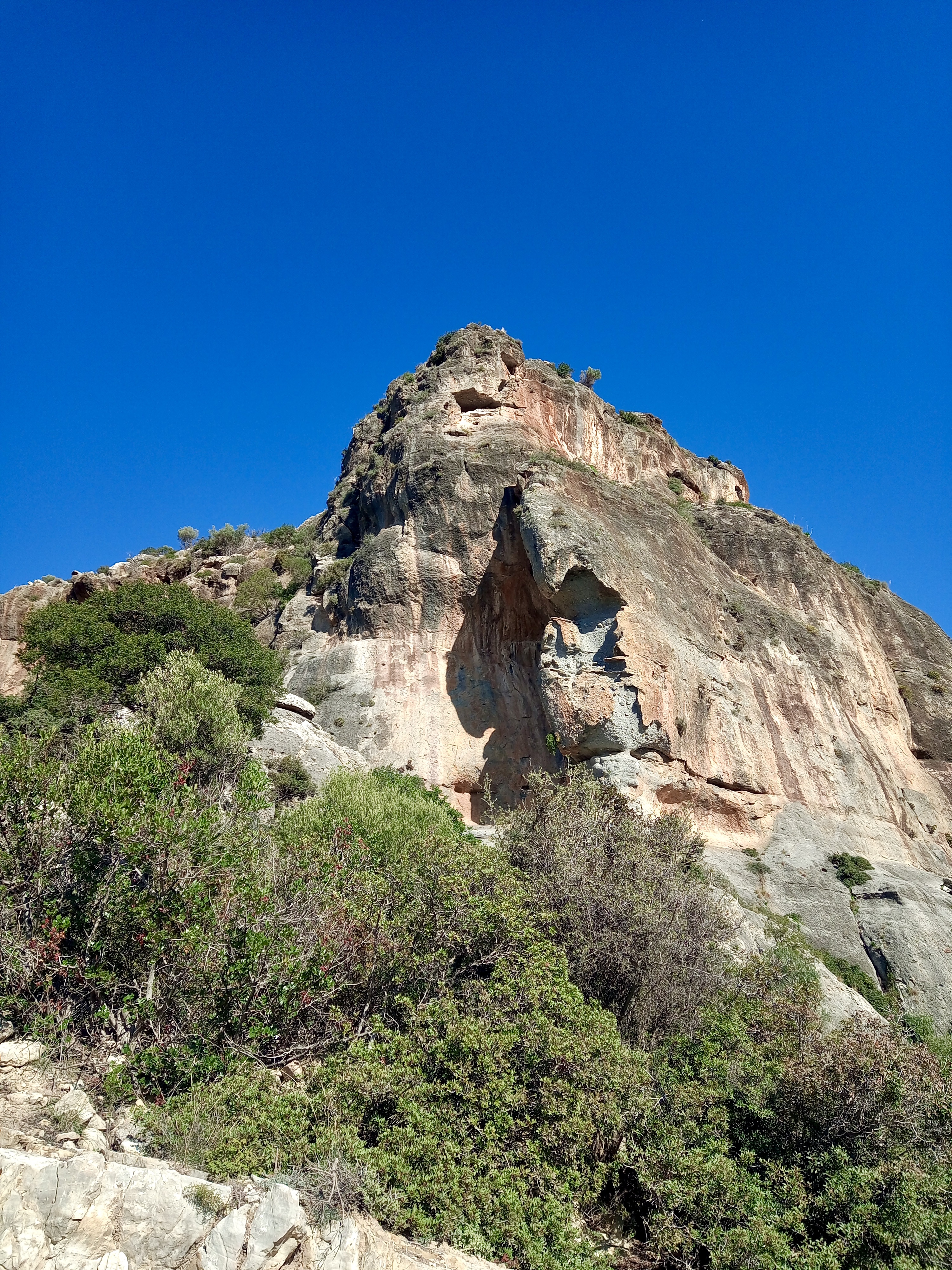
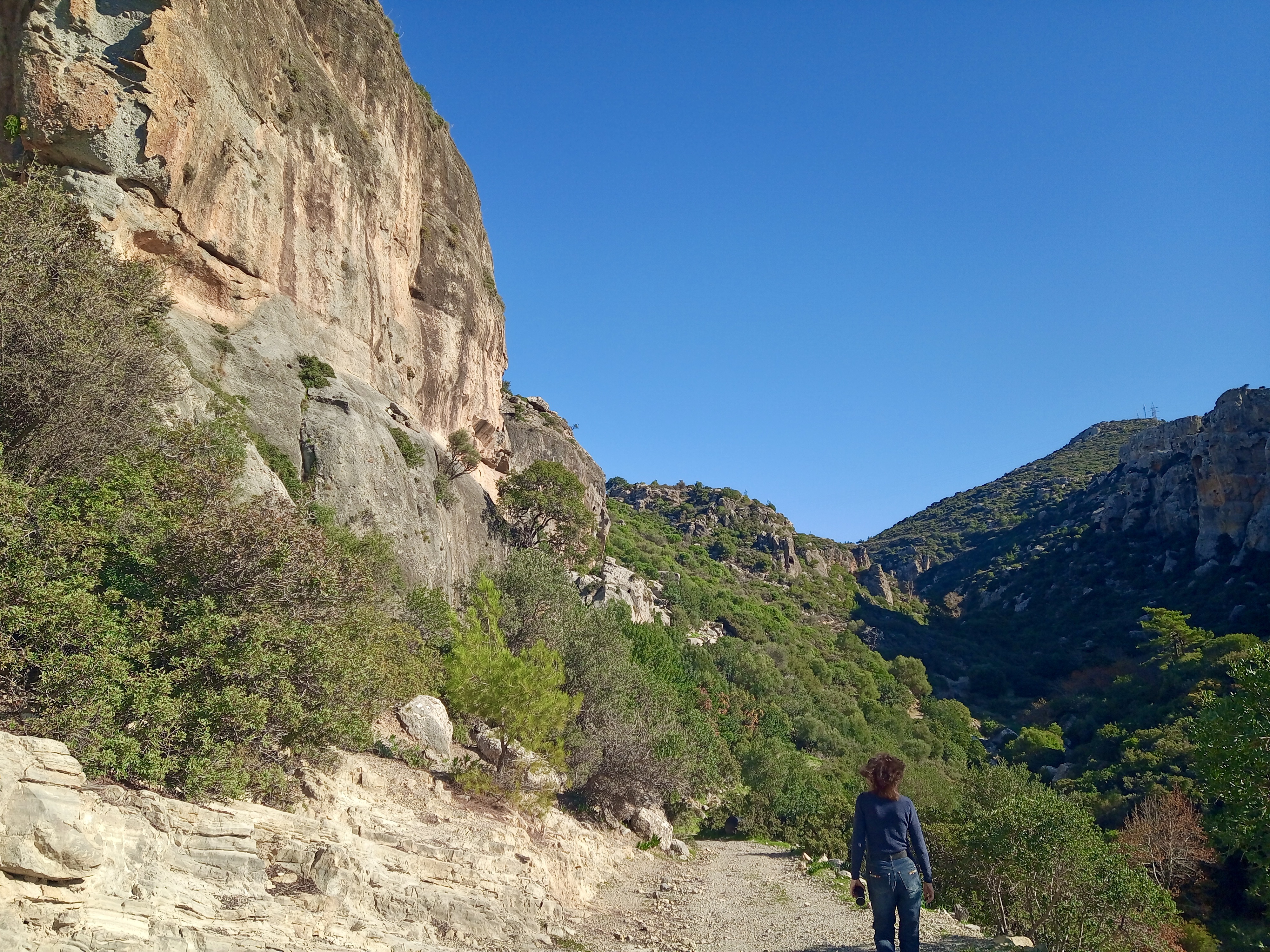
Above gallery (click on them to get a better view): These were taken just the other day, when we took a walk to the mouth of the steep gorge that sits just south of Meseleri. It’s very dramatic and, owing to the density of the undergrowth, impossible to navigate on foot from one end to the other. The best one can do is to walk down to the southern mouth and gaze upwards in awe. It’s well worth the effort though, because you can look at the Griffon vulture colony there and marvel at these majestic birds as they either sit way above you, staring down with disdain, or soar on the thermals right over your head. The two photos with the red circles indicate where a Griffon was sitting sunning itself the whole time we were there. Sadly I don’t have a zoom on my phone’s camera (well, apart from the digital one that ends up blurring the shot) and so you have to look carefully to see that bird, but he or she’s there, trust me.
Above gallery: These were taken last Sunday, when we took a walk on the sea front and fishing harbour, then went to lunch at the Konaki restaurant.
And, finally, one from the archive. This is my sister-in-law Christina with uncle Theodoraki, taken some years ago, not long before he died. Theodoraki was an accomplished accordion player, and I have fond memories of one night at a taverna on the waterfront at Kalamos, where he whipped out his instrument (they can’t touch you for it) after we’d eaten and serenaded us under a clear view of the Milky Way, with the waters of the Aegean lapping just feet away. He used to grow gardenias for a living and, if you visited his nursery, the aroma was overwhelming and quite heavenly. The nursery was slap bang in the middle of the Kato Patissia area of Athens, which back then was a very nice area. Sadly, it’s a bit run down these days.
•
If you enjoy my blog posts, then maybe think about supporting me by purchasing one of my written works. Your support would be very much appreciated, rest assured.Click HERE to go to my Amazon Author Page.















 Accretions