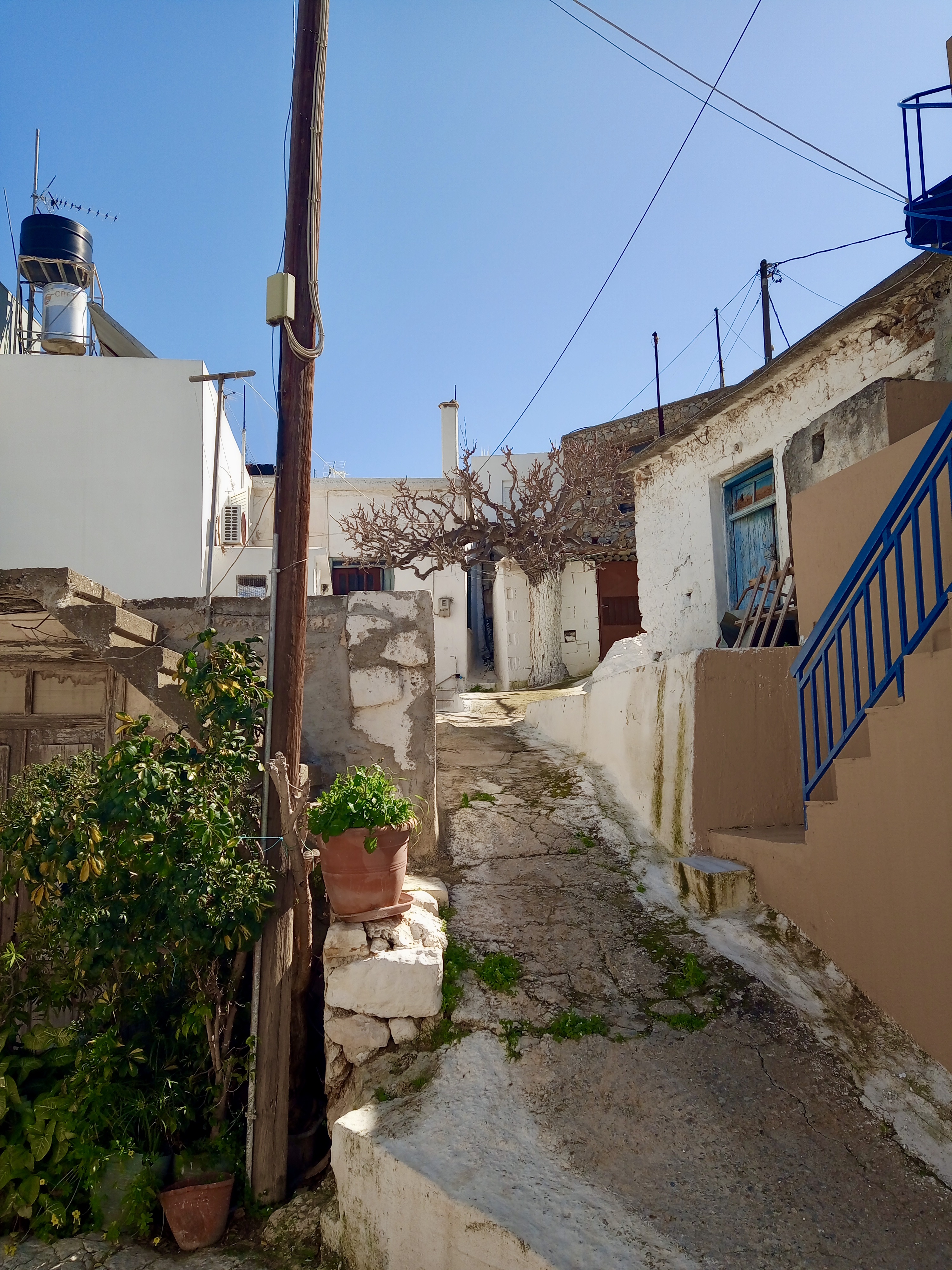
And then one day you find, ten years have got behind you…

I’m sure that there will be many ex-pat UK citizens reading this who’ll already know what I’m about to tell you, but for the sake of those who perhaps don’t, I’m going to anyway, because things just got a little easier when it comes to UK government bureaucracy. Yes, I did say UK Government, and not Greek.

We’re now in our twentieth year of living full-time in Greece and, to coin the old chestnut, ‘where have all those years gone? I really don’t know where the time goes.’ Well, I do actually, it goes the same way as all the time that preceded it, and so on.

A UK passport lasts for ten years of course, and thus (I know, you’re probably already ahead of me) we’ve just had to apply for new ones for the second time since becoming permanent residents of Greece. The last time we renewed our UK passports from here was in 2015, and I did it ‘online,’ although I have to say that the expression ‘online’ was pretty misleading when you consider the process that we had to go through back then. Yes, you had to log into the gov.uk website and follow the procedure outlined there for renewing passports while living abroad, but the process was very soon a physical paper chase rather than a completely online experience.

I remember very clearly that one reached a web page where one had to download the application form, print it out, then fill it all in, plus get a passport photo taken, which had to comply with very strict parameters as regards facial expression, background and size of the physical print that had to be submitted along with the form. The form was several pages long, as it had to serve various purposes, only one of which was applying for a renewal of an existing passport. I’d taken a few passport photos myself for friends while living on Rhodes back then, and the photos had been accepted as valid in every case except one. In that particular case our friend had sent off the application (registered mail, of course) to the UK Passport Office, and a week or two later heard back with the comment that the photo was for some reason not acceptable and another one needed to be submitted instead. Fortunately, there was no hurry, or it may have been a tad difficult, not to say embarrassing, for me, since I’d assured our friend that I knew what I was doing, oops.

Anyway, the form needed countersigning by a trustworthy witness, plus the photo needed signing on the back by a professional person of some kind, so we’d got our local doctor down the road in Gennadi to do that for us. After that photographic failure, we’d decided to go to a local photographer’s studio in Arhangelos to get ours done, so as to be doubly sure that the process wouldn’t be de-railed by my having transgressed against the guidelines in some obscure way.

We’d had to send the forms off, along with our old expiring passports and a couple of photos, in an A4 jiffy bag, via registered post. Oh, and as regards payment, I’d had to do that online as soon as I started the process and downloaded the forms. Talk about paying up-front.

So, here we are ten years later, and we needed to go through the whole process all over again, except, we didn’t. Last week I went on to the gov.uk website, fully expecting to have to go get our photos taken (payment involved there too, of course) down in the town, plus I fully expected that we’d then need to make an appointment to see our doctor here in order to get her to sign the photos and countersign the forms etc etc.

Well slap me in the face with a wet fish if things haven’t significantly improved over there in Blighty, me hearties! Now, if you’re an expat living overseas and you are facing the prospect of having to renew your UK passport, take heart, because I’m here to tell you that it’s a damn sight easier now than it was ten years ago. If you’ve already done it recently, OK, take that smug look off your face and go do some gardening or something, because this post is for those who are just coming up to the time when they need to do what we’ve just done and don’t yet know how much easier it’s going to be.

Logging on to the website (gov.uk passport renewals) I just followed the instructions, and the whole form can now be filled out on the website. When you reach the part about submitting your photo, they give you lots of guidelines about how to do it yourself if you want to, although you’re free to get a local studio to do it if you prefer. If you do get a studio to do it, they have instructions too about a code number that they use to submit the photo digitally without printing it out. If you do it yourself, gone are the parameters about size, you simply have to make sure that you get the pose right, the background right, and the facial expression right, then they tell you that you needn’t worry about cropping the shot, because they’ll do it for you. Plus, once you upload your shot, they have an ‘acceptometer‘ dial that shows you the degree of likelihood that your shot will be acceptable. If it falls into the red, then simply try again with another shot. If it’s in the green, you’re good to go.

My own photo (which I succeeded in taking myself using my mobile phone), was OK first time, whereas the one I took of my wife looked a bit iffy, being in the doubtful zone on the meter. So I simply opened the photo in Pixelmator Pro (if you expected me to say Photoshop there, do yourself a favour and check out Pixelmator [also available on the Apple App Store], because it’s a whole lot cheaper and does everything that Photoshop does, and I’m not kidding you either), did some retouching and re-submitted it. Bingo! It was well into the green.

Still expecting to maybe have to print the whole thing out, I got to the final declaration page, where it also stipulates what other documents you may need to supply to make sure that your application is accepted. Guess what, if you’re a resident of Greece then you should by now have your shiny credit-card-sized biometric Residency Permit, right? All that is required, assuming you have that permit, is a colour photocopy of it, popped into a small jiffy bag along with your old passport, sent off registered post, and you’re done. I scanned our permits on my Epson scanner using my laptop. To be doubly sure, I scanned both sides, then printed them out and popped the prints into the envelope with our old passports (separate envelopes BTW, as each application is unique and should not be submitted two [or more] at a time).

Once my documents arrived at the UK Passport Office I received a prompt email informing me of their safe arrival. A couple of days later I received another email telling me that my application had been accepted and that my passport was going to print, and then a day later yet another email arrived telling me that it was now being printed and would be coming back to me via secure courier within the next couple of weeks. They also said that they’d inform me once it had been despatched.

Whatever you say about UK government inefficiency, I have to say that having completed both of our passport renewals with minimum fuss within an hour or so, and having done so from home, and the only minor inconvenience was queueing up at the Elta office to send them off, I’m well impressed with the service. If it’s something you’re contemplating doing some time soon, take heart, it’s a cinch, it really is.

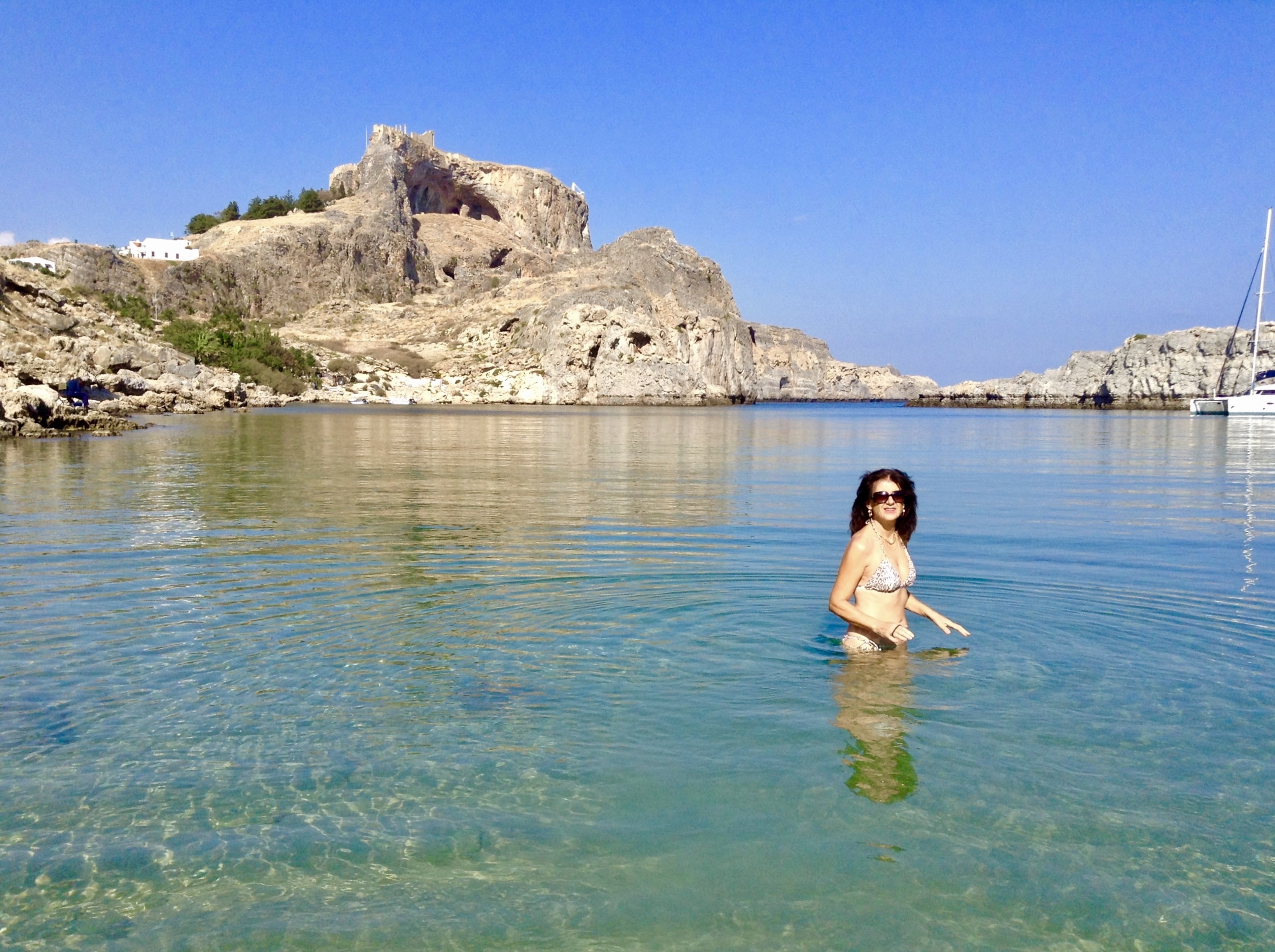
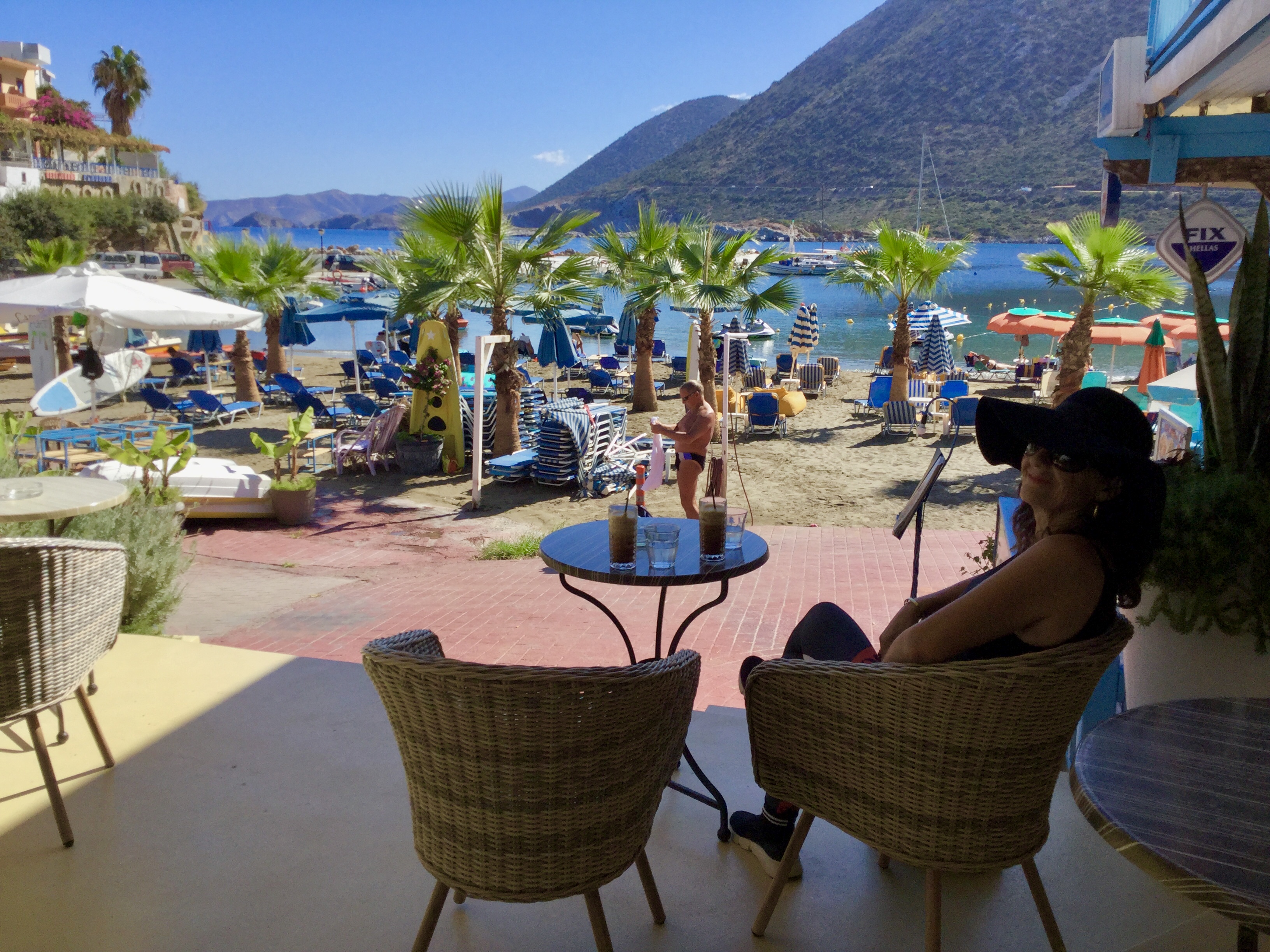
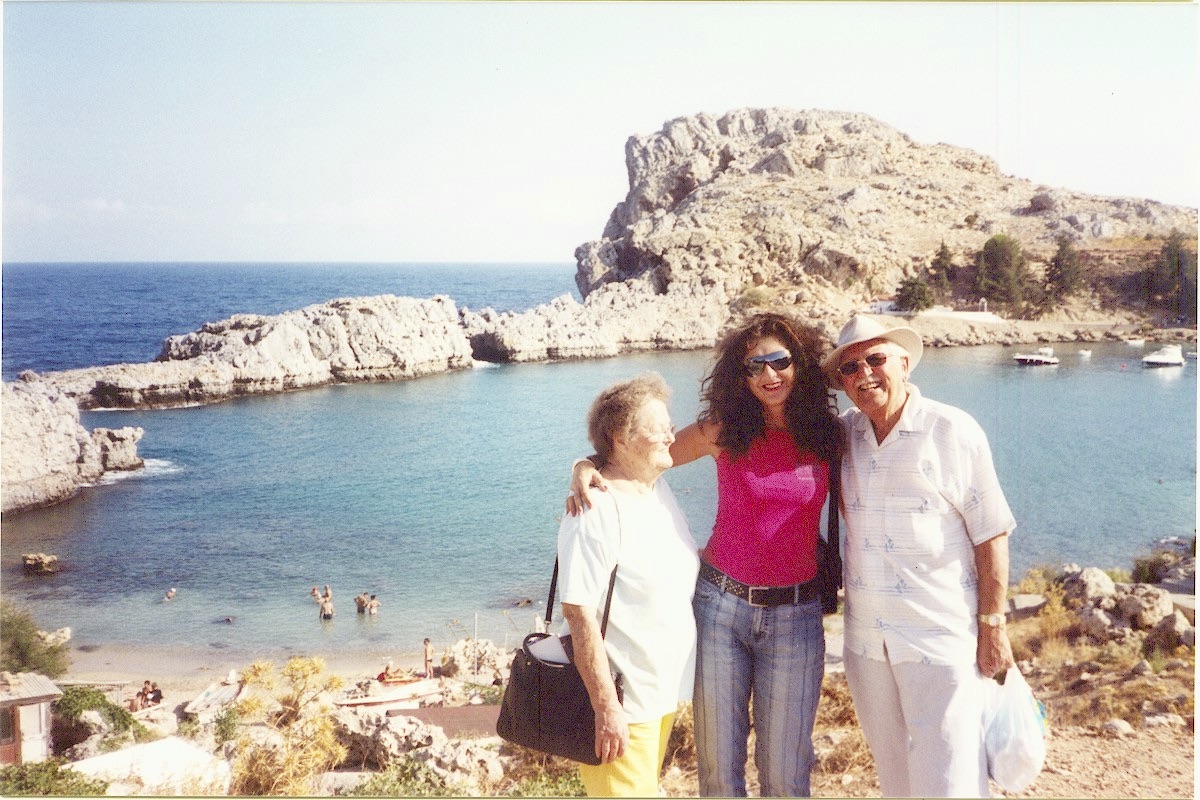
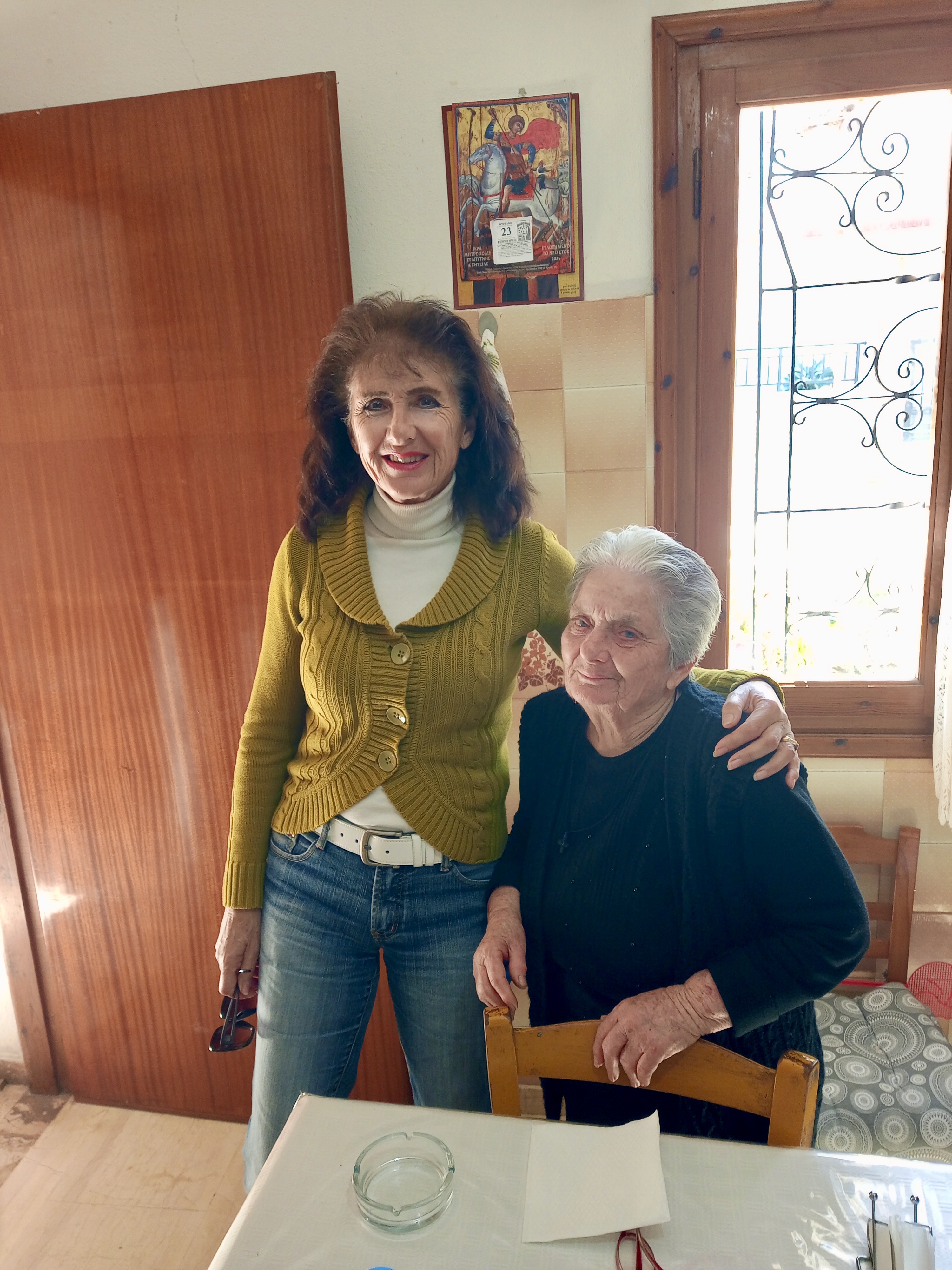
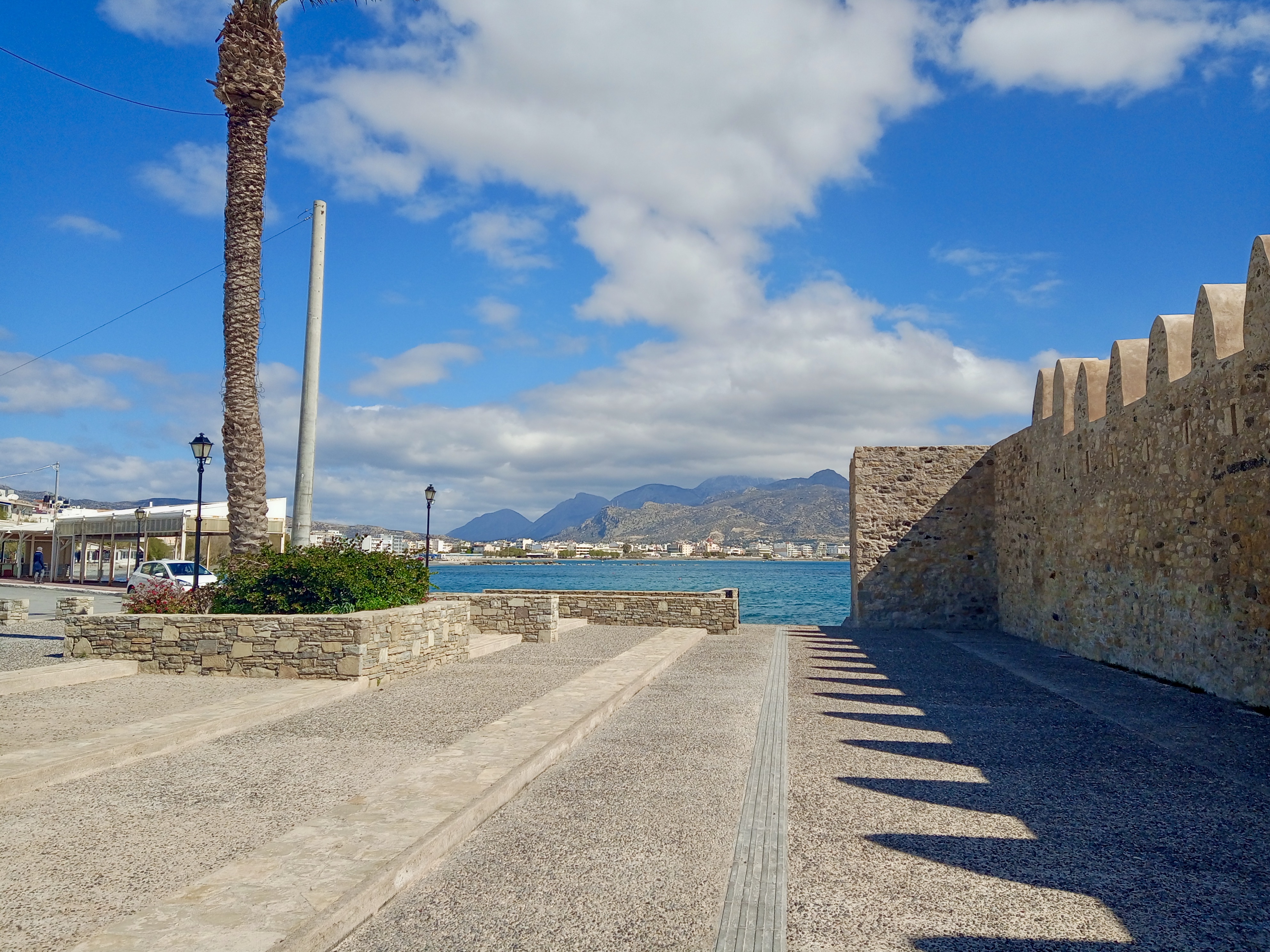
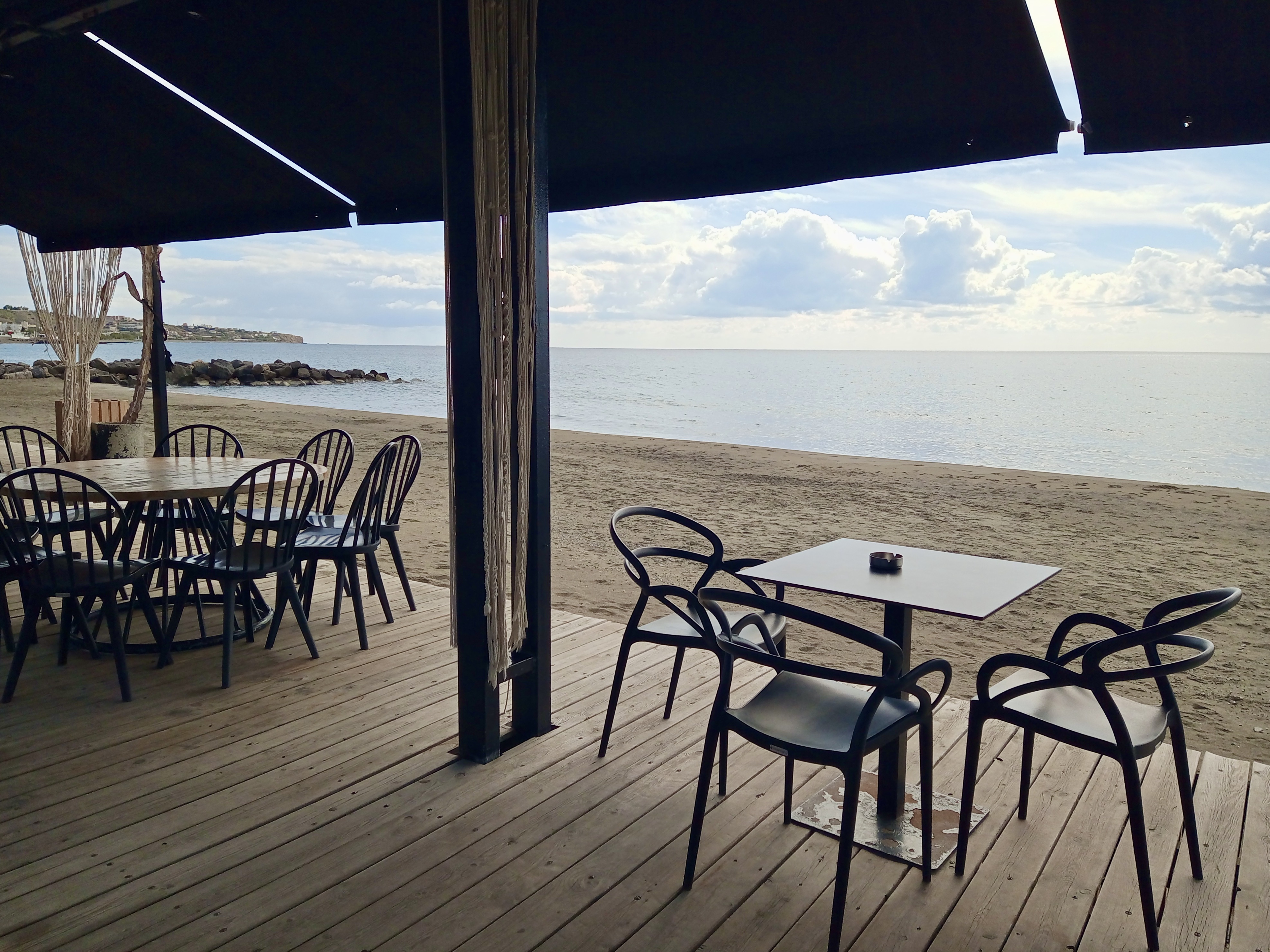
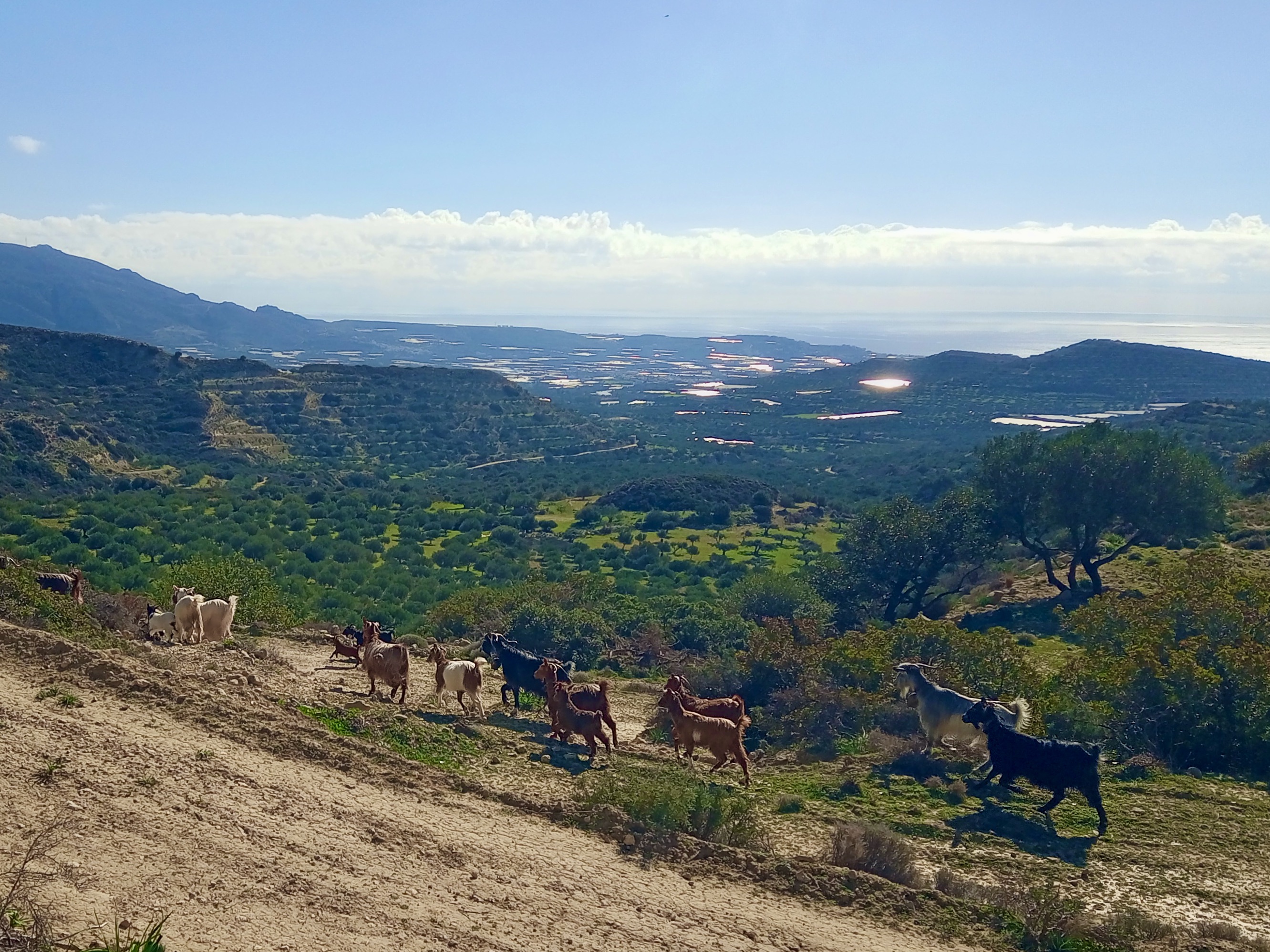
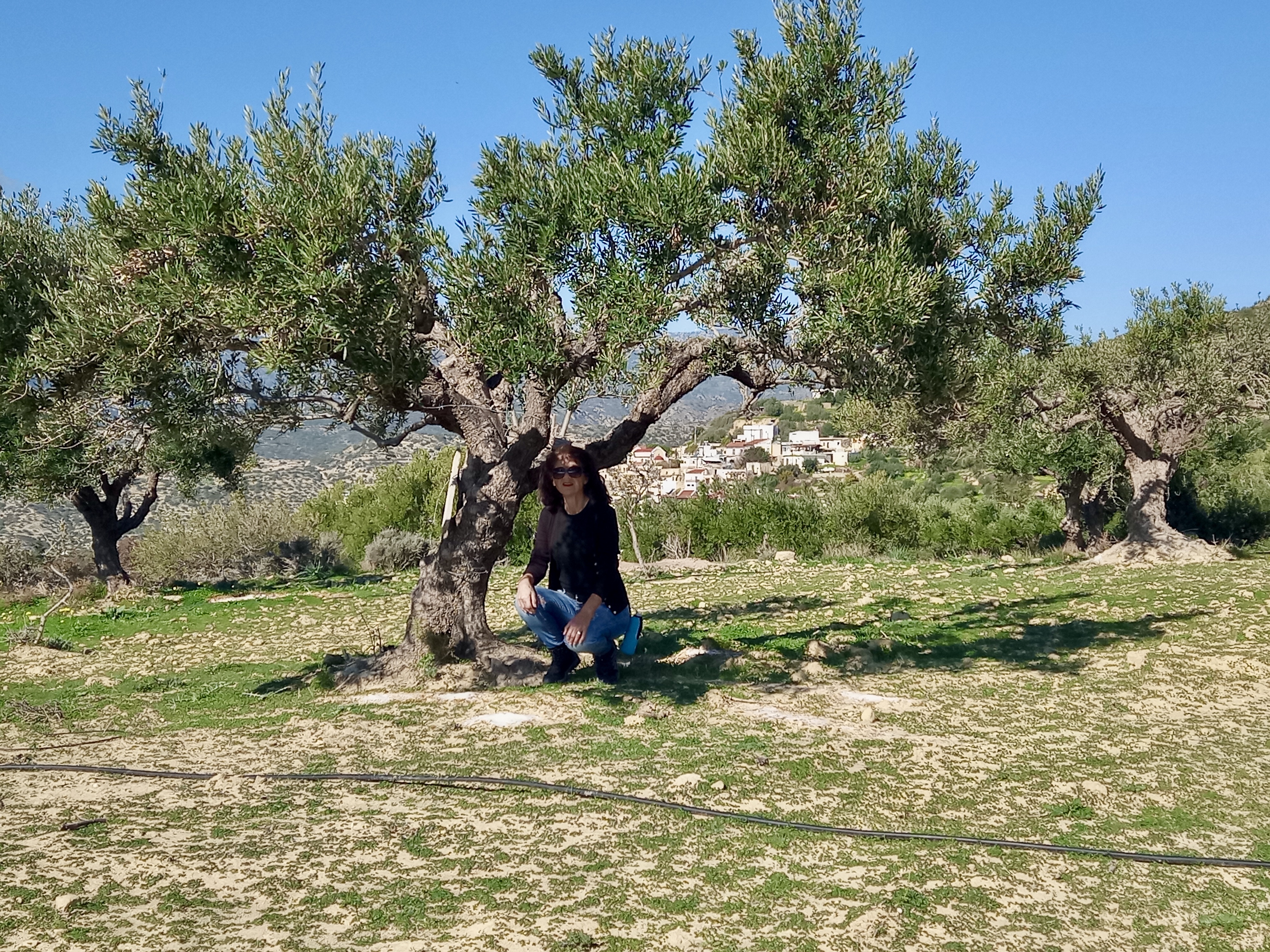
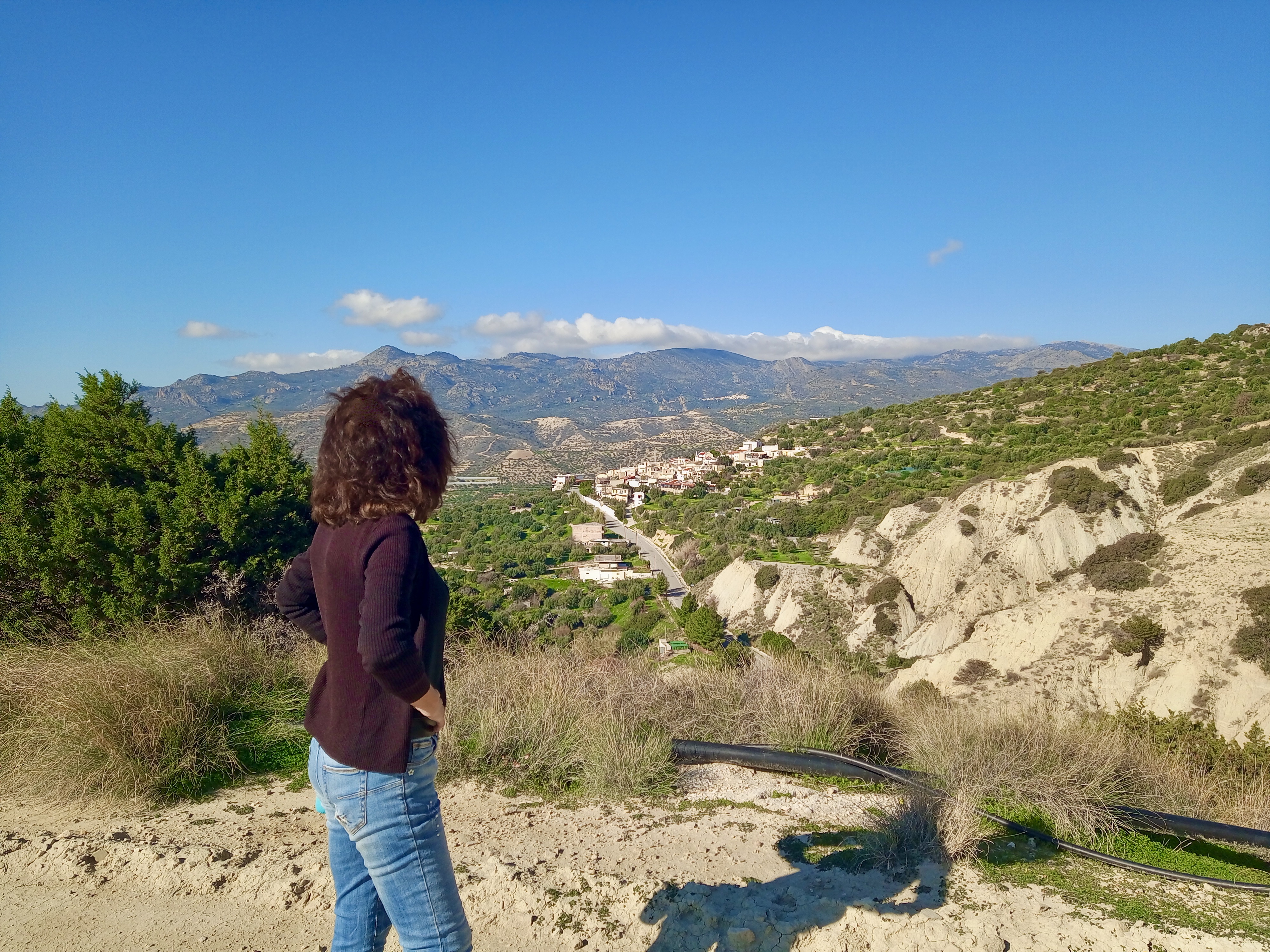
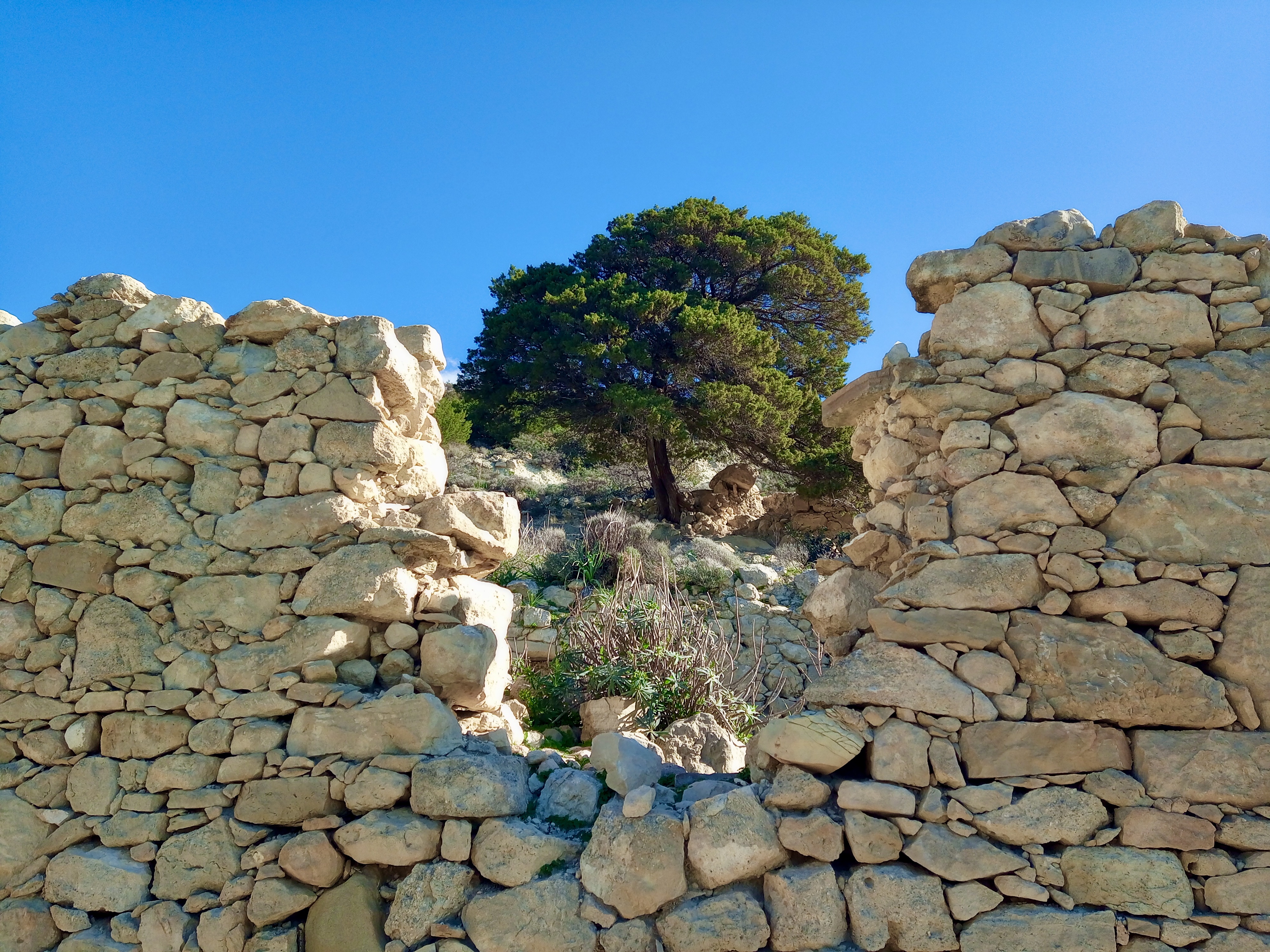
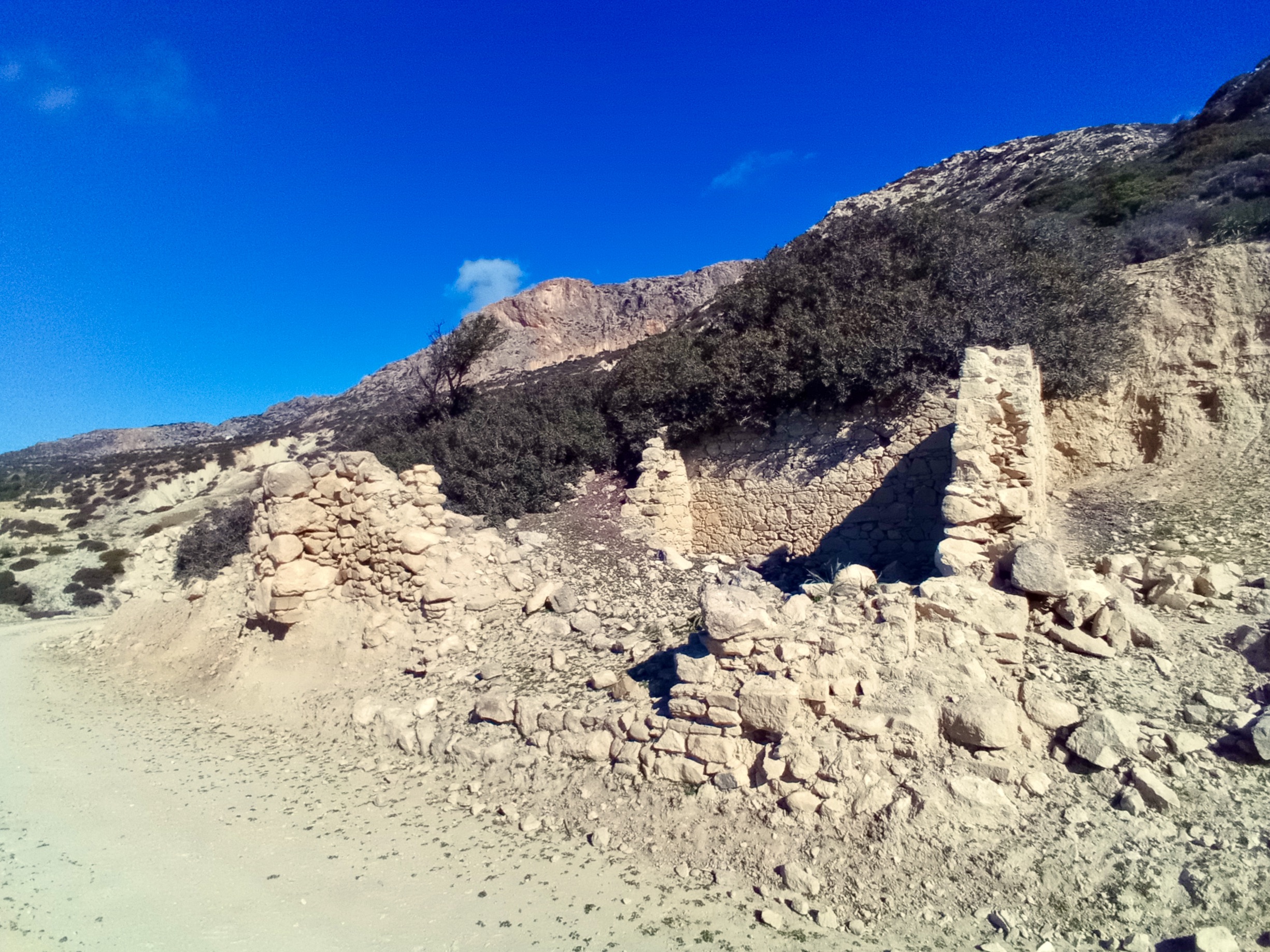
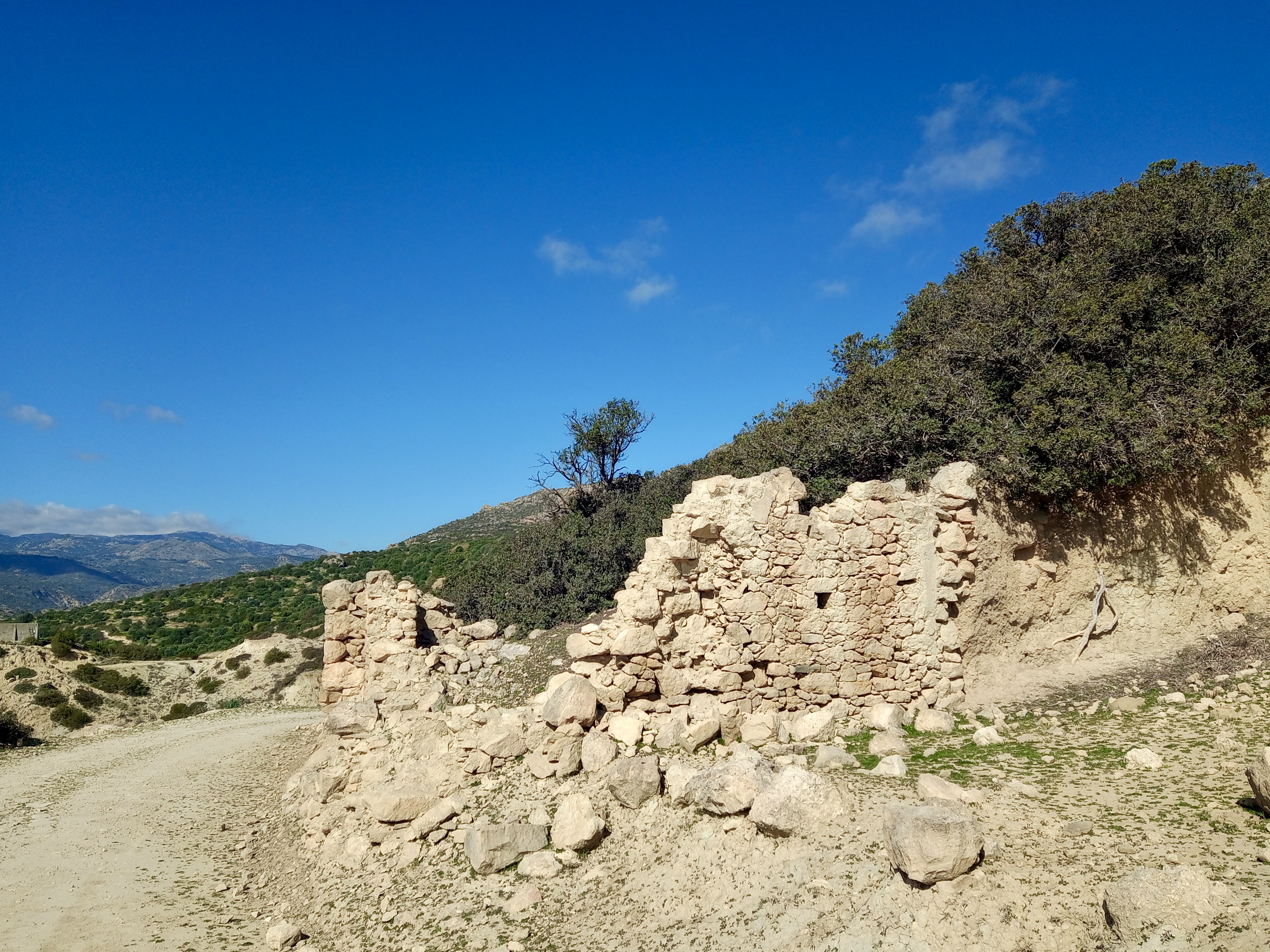
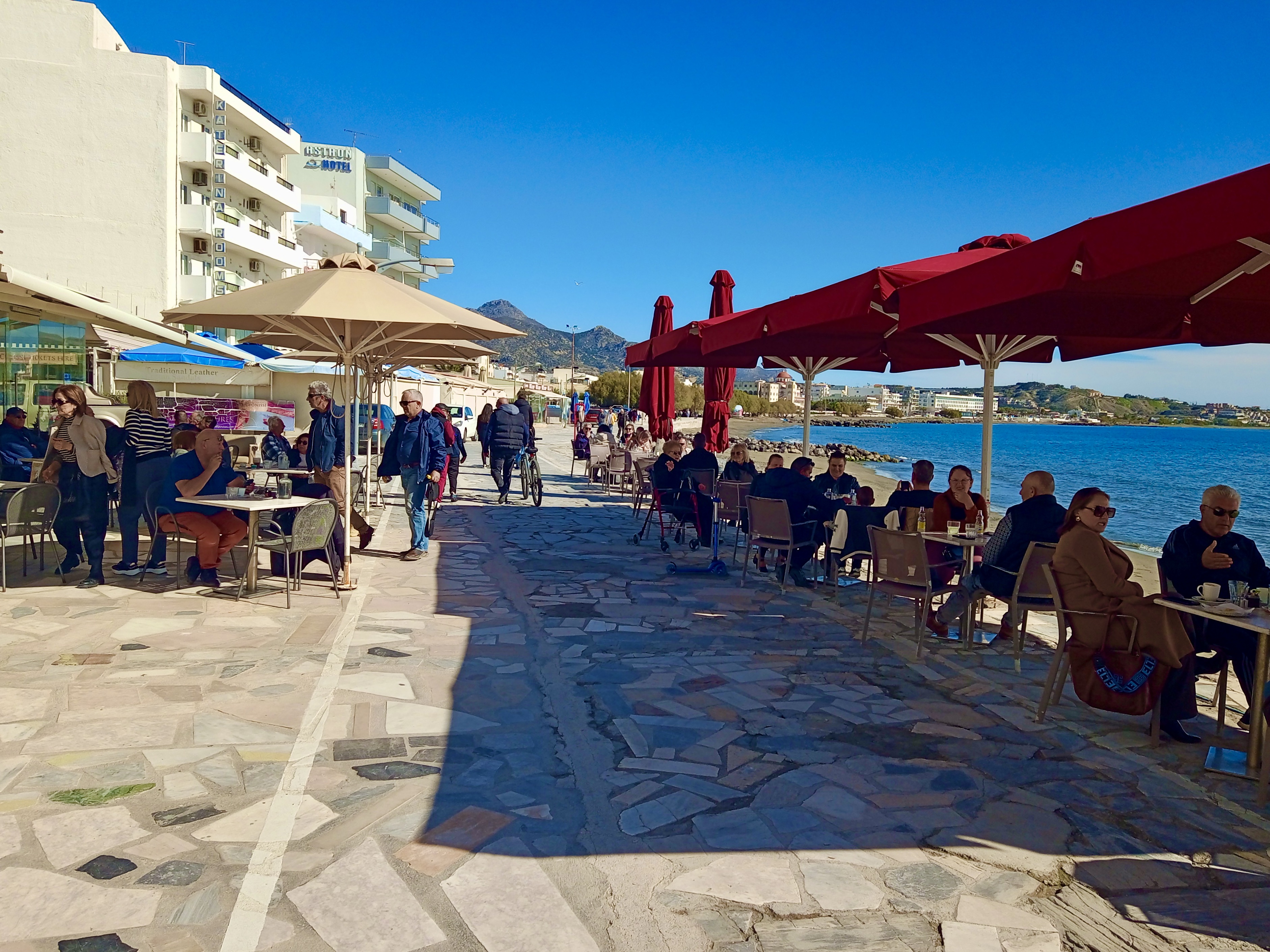
The photo at the top of this post was taken almost ten years ago, when my Dad (bless him) was still with us and he used to worship the ground that Yvonne walked on. Here we were teaching him to say words like ‘parakalo‘ and ‘euharisto.’ Plus, he’d already become a huge fan of iced coffee. The ones below, however, are only just over two years old. I took them in December of 2022 in Agios Nikolaos, after having come across that heron completely by accident…

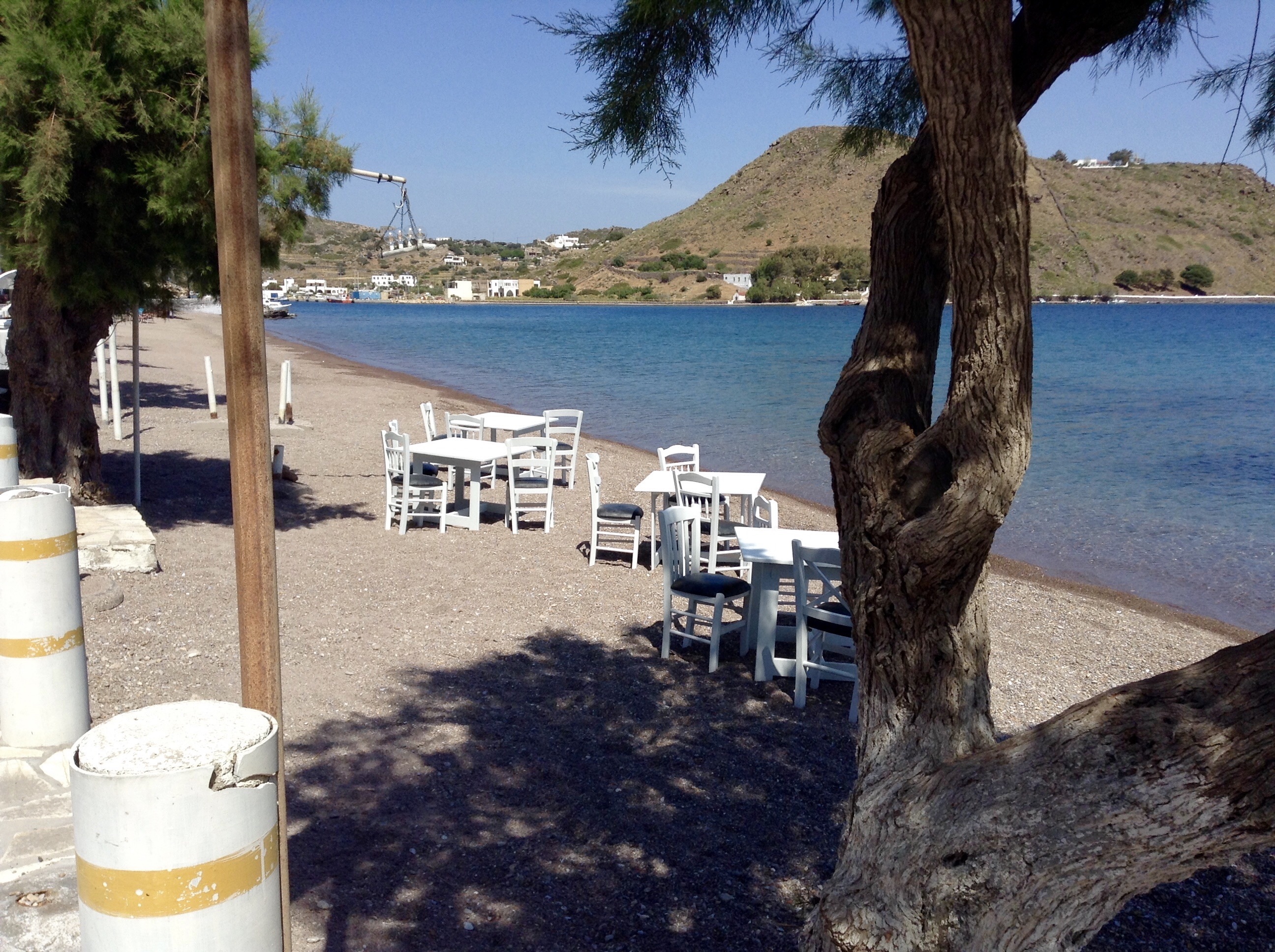
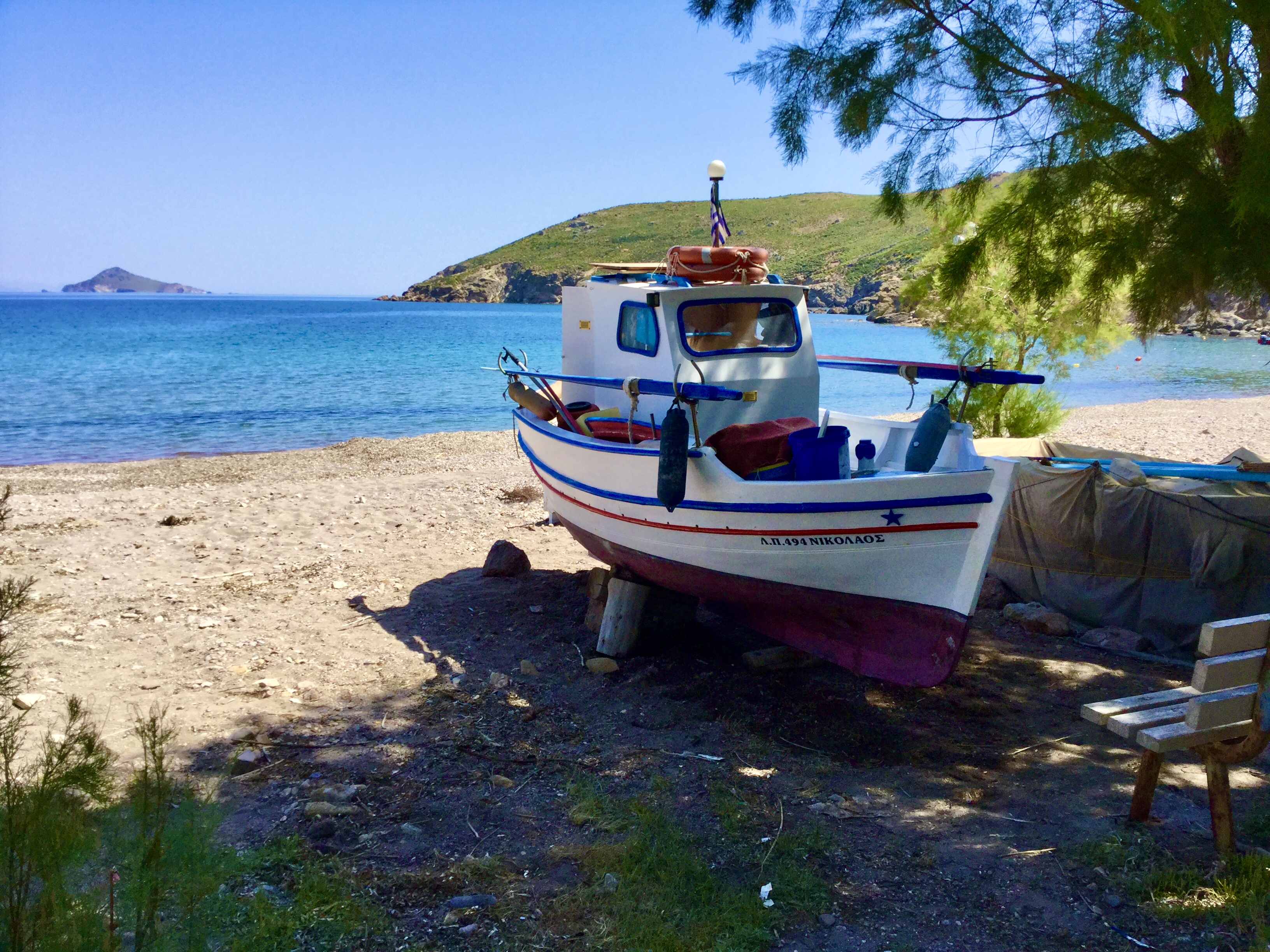
And, finally, here’s one of my favourites from the beautiful island of Patmos, taken in May of 2019…

Click HERE to go to my Amazon Author Page, where you can browse and purchase all of my written works.

Sonic booms and bags of vegetables

Recently we’ve been hearing sonic booms quite often in the skies above us. I don’t know whether it has anything to do with the conflicts going on further east in the Mediterranean, maybe the Turkish government rattling its sabres again, or whether it’s simply the Greek military conducting exercises way above us, but it’s tended to send my mind back around 50 years. A few times this past couple of weeks our windows have rattled with the ‘boom.’

When I was a much younger man, living in Bath in the West of England, we used to not only hear Concorde conducting test flights above us, but we also would quite often get a pretty good bird’s eye view of her as she passed overhead. I have to say that the memory of seeing that exquisitely beautiful (if not particularly environmentally friendly) passenger aircraft conducting test flights out of Filton and Fairford over West Country skies was always a thrill. When she first began commercial flights we’d hear sonic booms quite often as the aircraft broke the sound barrier whilst heading out across the Atlantic, and we got quite used to it, even though eventually Concorde was banned from cresting the sound barrier whilst still over land to avoid disturbing the residents far below.

Anyway, because of that rather sweet memory, the recent sonic booms haven’t really disturbed me so much as sent me into frequent reflective reveries. Ah, the complex workings of the human mind, eh?

As I mentioned in the previous post, we’ve had a new fence built behind the sun terrace in our ‘lower’ garden, and we asked the guys who did the work to take the old wood from the rotting fence away with them, with the exception of all the ‘slats,’ as I would call them. Although the upright posts were full of dry rot, the horizontal slats were in fairly good shape and we thought that they’d be good fuel for our neighbours’ ‘tzaki,’ or fireplace. Once the carpenters had finished the work and left, I trotted down to Maria and Dimitri’s and knocked the door. Maria answered and I told her about the slats. They were piled up just inside the gate in the lower garden, so if Dimitris was able when he had a moment to peek over the fence and take a look, if he decided that they could use the wood, we’d be only too happy to let them have it. A couple of days later, as we were sipping our coffees on the terrace, enjoying the warm January sunshine (just to rub it in, sorry. See photos below, the first of which shows what the old fence used to look like), we heard Dimitri’s squeaky voice calling as he’d arrive at our front door. 

We called him around to the terrace, and he appeared carrying a large plastic bag full to bursting (as per usual) with fruit and vegetables from their fields. “No,” he told us, “we can’t use the wood, sorry. It’s been treated, and the stain, or varnish [whatever you call it] would make the house smell and, anyway, to be honest we’ve piles of wood from the olive harvest this year, but thanks anyway for the offer.”

It was no problem, we told him, we’d get shot of it ourselves. Now, this was where the fruit and vegetables came in. You only have to offer your neighbours something and, whether they can use it or not, they respond with a return act of kindness, or gratitude if you like. So, as he waved us a cheery goodbye and headed off back to his sheep and goats, we took a peek inside the bag to discover beef tomatoes, Cretan cucumbers, peppers, carrots and some mandarins that were as big as regular oranges. Once again we were overwhelmed with produce. Mental note: Find things to do for the neighbours a little more often…

Above: A selection of photos from our walk down to the reservoir [Bramiana lake] on Friday morning. That sign about no swimming shows just how low the level still is, despite the recent rains.

Mavkos has done a bunk yet again, after making us think he was back for good and getting all affectionate and everything. Haven’t seen him in weeks, but looks like Ginge is getting his feet well under the table now in his stead. In fact Ginge is even more affectionate than Mavkos was, although it’s probably only cupboard love…

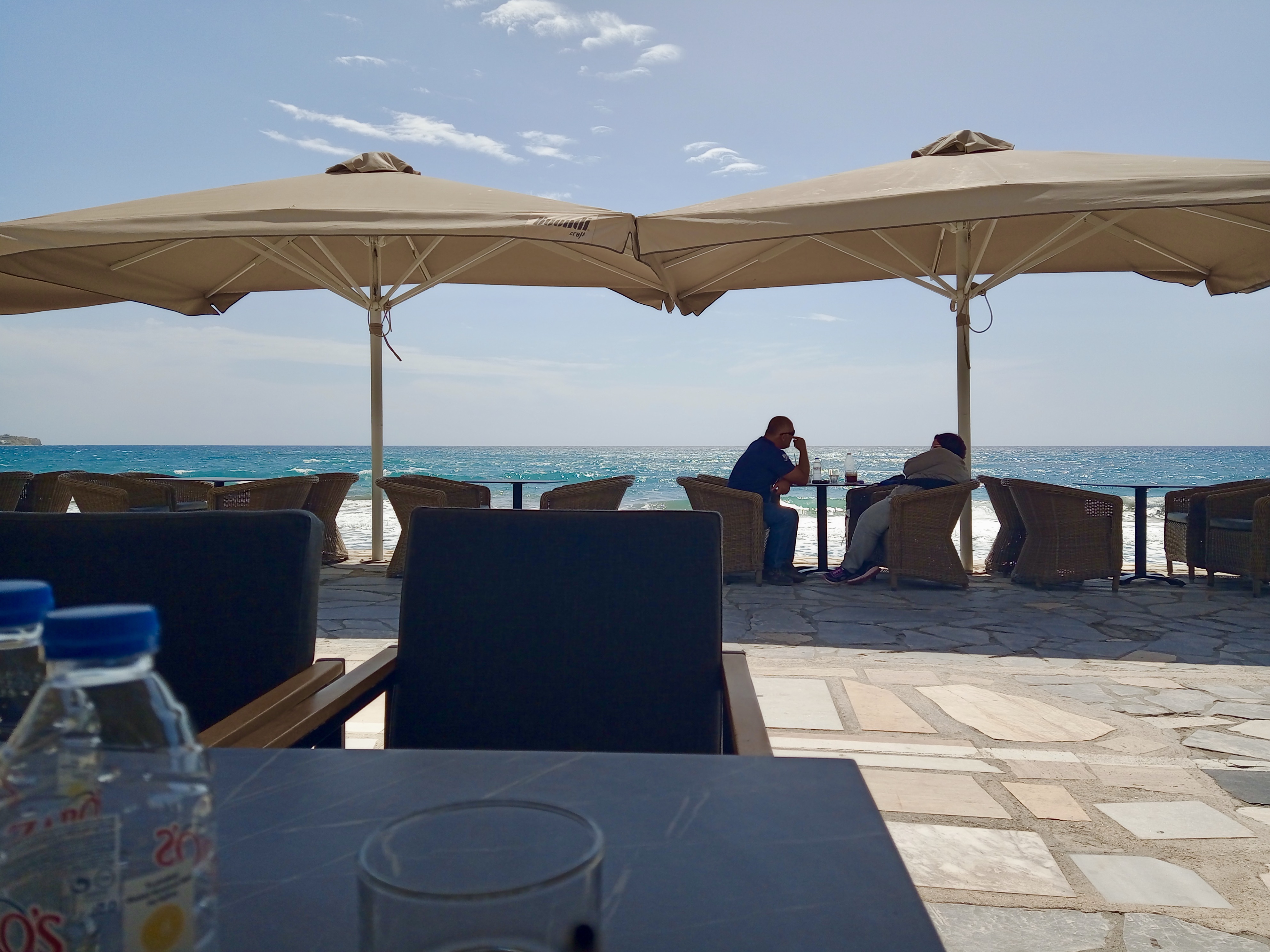
The photo at the top of this post was taken yesterday (Sunday 19th) at around 1.05pm as we were walking to the newly reopened taverna just at the end of that building you can see on the right. It’s just beyond the southern end of the fishing harbour and it’s called the Μεζενελο (pronounced ‘Mezenelo’) and it sits just a little back from the beach, but with a superb view of the snowy peaks to the west. Must admit, it’ll very likely be added to our list of favourites, since the staff were lovely, the food excellent and we both ate a good lunch (washed down with a bottle of Retsina, as per usual) for the princely sum of €25. No contest. Oh, and they played traditional (Laika) music, so the beloved was well pleased, even though it was all I could do to stop her getting up to dance (although, she did shimmy her way to the toilets and back again). When we got there the place was still quite empty. By the time we left, it was packed…

Just one from the archive this time; this one’s from May of 2019, and it’s Taverna Ta Kavourakia on Kampos Beach, Patmos…

Click HERE to go to my Amazon Author Page, where you can browse and purchase all of my written works.
Fabulous weather and fixing fences

I recently read a very good blog post about Crete during the winter time (click here to see for yourself). The only thing that surprised me was the temperatures that Mr. Kretaner (not sure if that’s his real name) says he experiences during the winter months, as they seemed to be regularly 4-5ºC below what we experience here in the Ierapetra area. Mind you, on close re-reading I seem to have missed this comment first time around, which probably accounts for it; he says, and I quote: “Are there any regions of Crete that remain relatively warm throughout the winter? The southern coast tends to be warmer in winter. I’m particularly fond of spots like Plakias or Ierapetra. They’re sheltered from northern winds and get more sunshine.” That will account for it then, I see on further research that he lives in Elounda, towards the north of the island.

It’s all been happening this past week or so. Stelios, the master carpenter, was here for two days with his trusty helper Niko, and they were constructing a new section of fence behind our sun terrace. The previous fencing was becoming riddled with dry rot and the way it had been constructed allowed people from above and behind (where there’s a sort of ‘mound’ of ground that’s not used for very much) to peep through the slats at us. Not that there’s anyone up there very often, but it has been known and, since that’s the area where we have our outdoor shower and we tend to use it several times a day in high summer, it wasn’t all that ideal really. So now we have a brand new fence, this time white rather than stained wood, and it’s made that area totally private. We’re well chuffed with the result…

We’ve been trying to get a few walks in but, up until about a week ago the weather had been very changeable and you could risk getting a kilometre or so from home only to get rained on pretty heavily, which kind of thwarted our attempts at getting some good, healthy, brisk walking done. For the past few days though, it’s been ruddy marvellous, with temperatures cresting the 20-21ºC mark a few times, ideal weather, too, for a spot of outdoor work, which was why Stelios was able to schedule in the construction of the fence. It’s heartrending to watch the fires in L.A. and almost as distressing to see the cold temperatures being experience in the UK and much of Northern Europe, where the minus temperatures have meant that travel has been severely affected, according to the TV news. I continue to wonder at why the majority of houses in the US seem to be made of wood though.

The other day, when we were managing to do a short walk, we came home passing Manoli’s house, he who is close enough to ninety years of age as to be able to feel its breath. Well, there he was, stood outside his front door, small mirror hanging on the house wall, having a shave with one of those cut throat razors. You know the type, they must have been the ones used by Sweeney Todd I suppose, and one slip with one of those blades and it would be curtains, know what I mean?

Manolis was stood with his back to us, walking frame between himself and the wall, dragging the blade cross his wizened cheeks. The mirror was so badly stained as to resemble a map of the local rural area, but he was getting on with the job anyway. We didn’t hail him, even though it went against the grain, because we both had visions of being responsible for our elderly neighbour having slit his own throat in surprise. We wouldn’t want that on our conscience, so we’ll hopefully catch up with him, and his smooth-as-silk cheeks, when we drop into Angla’i’a and Giorgo’s for coffee in the next few days. Manolis has an uncanny knack of being able to drop by at the same time, and then manoeuvring himself into one of Angla’i’a’s patio chairs.

The snow on the mountain peaks is truly magnificent now, and we’ve been expressing our awe as we’ve walked around the village, from the top of which we can see some of them, way across twenty kilometres of undulating valley floor to the perimeter mountains of the Lasithi plateau way above Kalamafka.

Photos coming up, some of which are from the archive, some bang up to date…

Above: The local village sign that was erected a couple of years ago when Angla’i’a was still village mayor. Only this past few months, though, has it been painted like this, and we reckon it’s a pretty good job all in all.

Above: This little lot were all taken in the village this past week or so, at varying times of the day.

Above: Taken at 11.45am last Tuesday at Kougioumoutzakis bakery/café, although we always call it ‘Elenis’ for obvious reasons! The cat was curled up on the chair next to me, so I absentmindedly began to stroke its head. It didn’t take long for him to decide that he wanted more of this, so he climbed across on to my lap and demanded I pamper him some more, so I, always the softy when it comes to friendly puddytats, duly obliged and made a new friend for life. Sitting just out of shot was Yakobos, Eleni’s son (we think) who serves behind the counter and at table too. He said the cat wasn’t theirs, but lived over the way (across a fairly busy road junction) and he was in the habit of arriving at the café most mornings in the hope of getting a spot of pampering, so he came up trumps on Tuesday. He didn’t do so well in the titbits stakes though, because we were eating kourabiedies, which I don’t think appeal to cats all that much. After an enjoyable 15 minutes chat with Yakobo, we went to settle the bill (two freddos for €5, can’t knock that) and found that Eleni hadn’t put the kourabiedes on the tab. When I pointed this out, she said that Yakobos had treated us to those. He must have taken to us when he learned that we lived in the same village that his mum and grandparents came from. It’s not what you know, eh?

Incidentally, the photo at the top of this post was taken on Patmos during April 2018, when we spent three weeks there. I really shouldn’t be sooo naughty when it comes to what I eat, but a slice of strawberry cheesecake was simply begging me to eat it that particular day, and I couldn’t deny it the privilege. Finally, this one below was taken the other day at the Plaz café here in Ierapetra…

Click HERE to go to my Amazon Author Page, where you can browse and purchase all of my written works.
The inevitable

I suppose it was always going to happen sooner or later. You know how I’ve often mentioned that it’s a constant source of amusement to me that in every Greek kitchen cupboard or drawer somewhere in a Greek home you’ll find a blood pressure monitor, right? And I’ve often banged on about how in the UK I don’t think I ever knew anyone who had one in their home, whereas just about everyone over here does. I’ve talked before about the fact that, in just about every Greek kitchen that I’ve ever visited, there’s at least one drawer stacked so full of drugs that you could open a pharmacy, yeah? I’ve observed that I’ve known groups of Greek women who get together for coffee in someone’s home, and for a topic of discussion, they get out the blood pressure monitor and all take their blood pressure as something that’s kind of accepted as normal. It’s frequently done as though it were the most natural thing in the world over coffee and kourabiedes or melomakarona, maybe even croissants (Incidentally, the Greeks seem to be mad for croissants, as one of their major TV ads – fronted by a top flight basketball player trying to assert that your life just wouldn’t be complete without a chocolate croissant from a major confectionary/bakery brand pre-packed in colourful foil in your sports bag or school tuck box, I kid you not, will confirm).

Well, it’s rather embarrassing to have to admit that we bought ourselves a blood pressure monitor this week. In our defence though, it was on the advice of a doctor in the local hospital. Yvonne’s had a few weird things going on lately (no need to go into the details) and it prompted us to drop by the hospital in town a few days ago, just to get it checked out. Even though we’re both very ‘alternative’ when it comes to treating ailments and general health maintenance, there’s no substitute for at the very least getting whatever is ailing you diagnosed by the medical profession, now, is there? Anyway, she ended up spending 6 hours in the outpatients’ department and they gave her a full roadworthiness test.

At this point I must spring aggressively to the defence of the Greek system. I’ve read comments by a lot of expats, who were either here on vacation or had moved over here, to the effect that the Greek medical care system wasn’t up to much. Well I must strongly disagree. On two previous occasions since moving here to the Ierapetra area we’ve had cause to take my wife to the hospital after she’d either felt something odd was going on inside, or had fallen and cracked her shoulder blade. On each occasion the local medical team has been so thorough as to check out every part of her with great diligence. They do scans, take x-rays, blood tests, and all kinds of examinations that I’m sure would not have been done were she in the UK. By the time they’ve finished with you, you walk out of there with a huge white envelope containing all kinds of reports, together with your x-rays, and, as long as you’re insured (which residents here ought to be, and that involves having what’s called an AMKA [Αριθμός Μητρώου Κοινωνικής Ασφάλισης] number) you don’t shell out a bean, not a penny. In the UK we’d say ‘she’s had a thorough MOT’ [Ministry of Transport vehicle roadworthiness test).

This visit, as I said, involved her staying for 6 hours, during which they actually took her blood three times, sent her along a couple of corridors to the lab to get it tested and then, after she’d returned, learnt the results through their internal computer system. She told me that, apart from one doctor (whom we shall just call ‘Mr. Grumpy’) all the staff were kindness itself, and were working their flaming socks off, the place was that busy, and this during Christmas week too. Critics, leave off, OK?

When I eventually returned to pick her up (owing to how much time she was there, I’d had to go out and get on with some errands we needed doing in the town area) she told me that the diagnosis was nothing to worry about other than that her blood pressure was a bit high. The female doctor who kind of ‘signed her off,’ as it were, said that she ought to take her blood pressure twice a day for a while, record the readings and see it if came down at all, since they understood that part of the reason for her high reading whilst she was in there were down to her anxiety at having to be in the hospital in the first place. She said that this doctor expressed surprise that we didn’t already have a blood pressure monitor in the house, ‘Odd these foreigners, aren’t they,’ she probably thought.

And thus, my friends, however the process played out, we became even more like the locals this past few days, since we’ve now got a blood pressure monitor in the home. Tell you what, however else we become even more assimilated, we’re definitely not going down the ‘lace doily on top of every piece of furniture’ route, all right? Good, I’m glad we’ve established that.

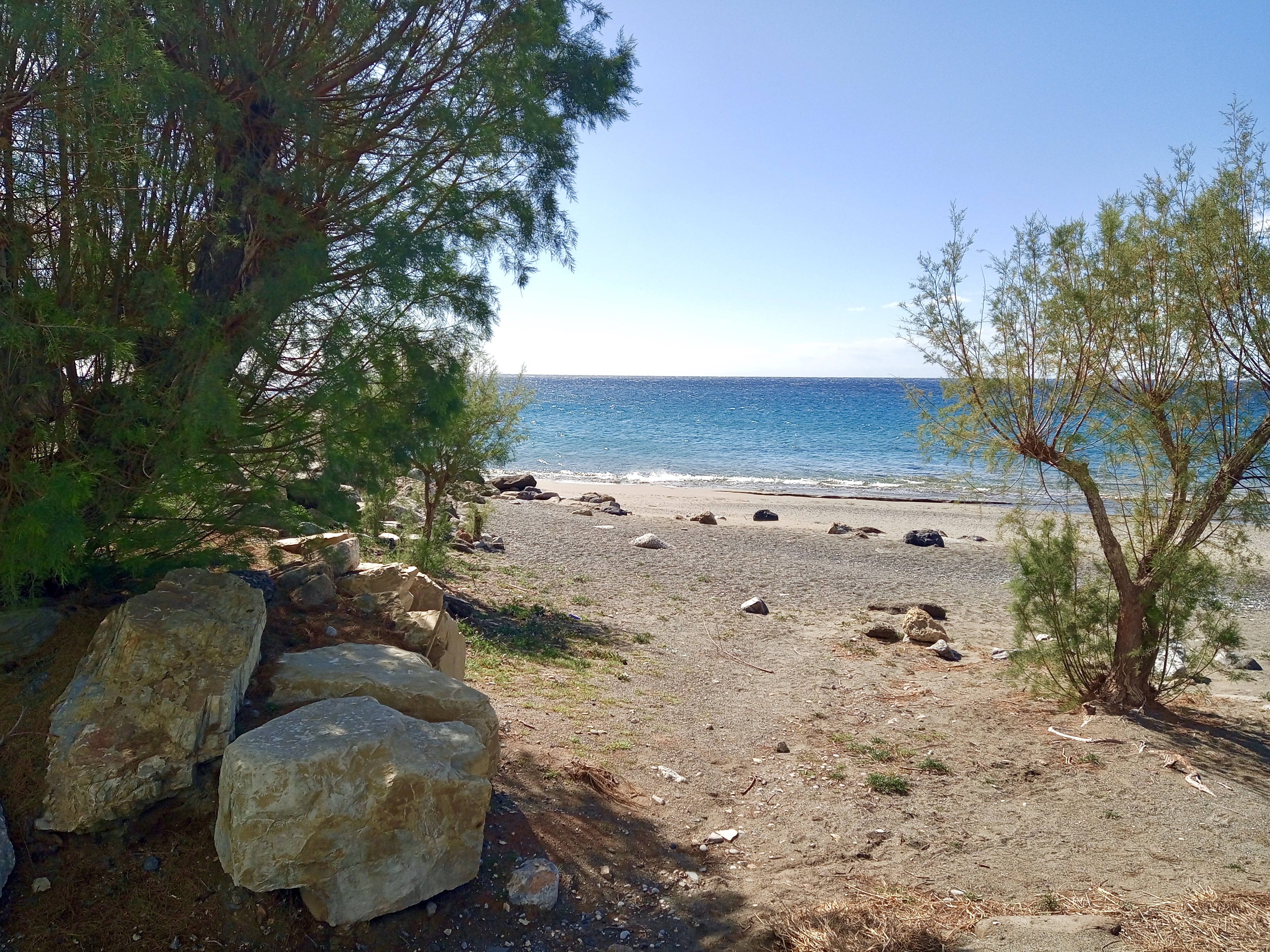
Here are some photos; some recent, some from my archive. Oh, firstly, the one at the top of this post was taken during our very enjoyable Boxing Day walk along the length of Pachi Ammos Bay. The rest of the shots I took then are in this first gallery below…

If you study the first one in that series above carefully, you’ll see that behind that rather unattractive see-through curtain fence, there’s an archaeological site of an ancient villa. There are a couple of major sites a little further away from the village, the most notable of which is Gournia, but this one here doesn’t even get a mention anywhere that I can find on line. That’s the thing about Greece in general, there is just so much archaeology, that they have an embarrassment of riches here.

Above: from April 2016, during a visit to Paros.

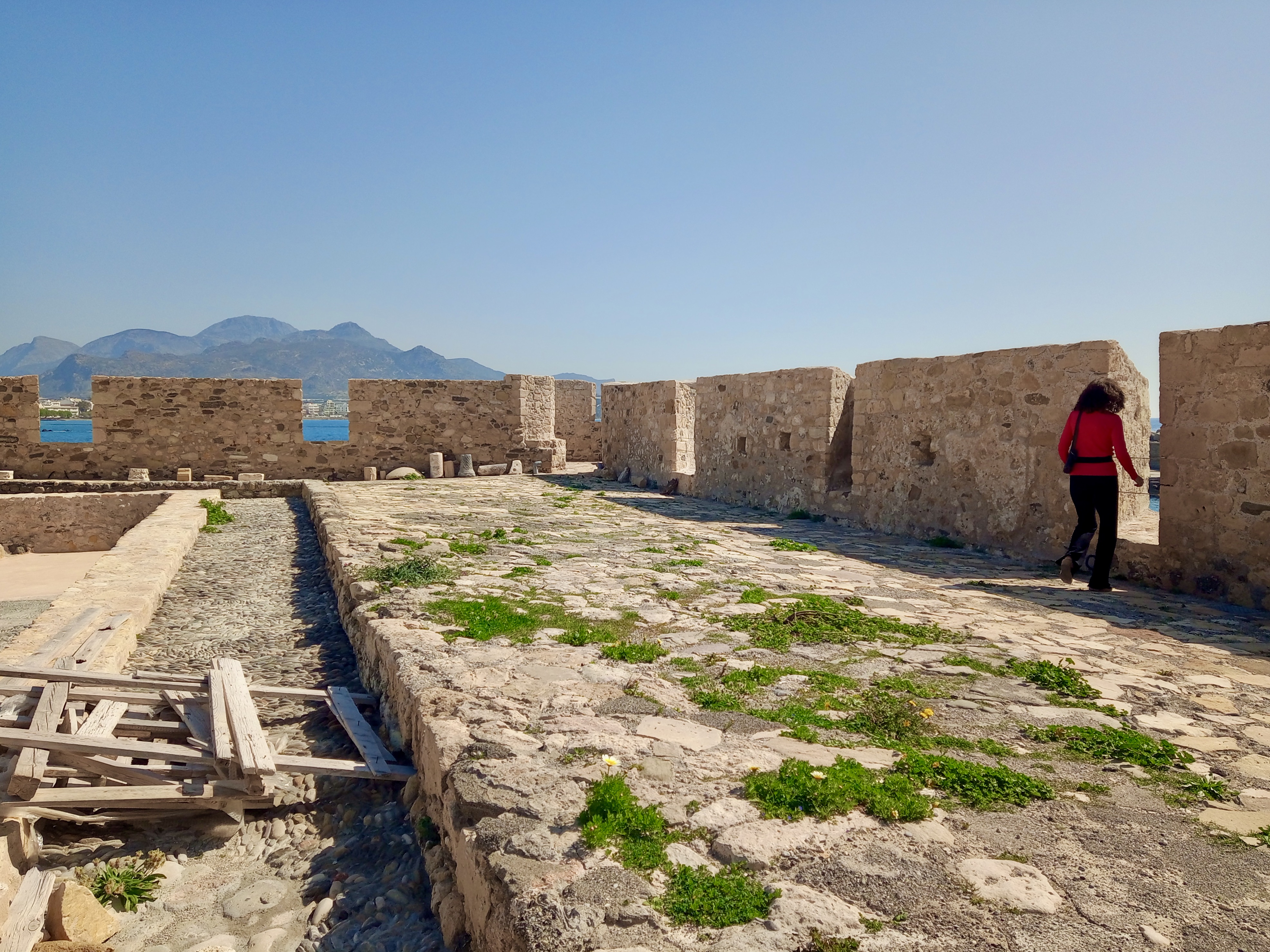
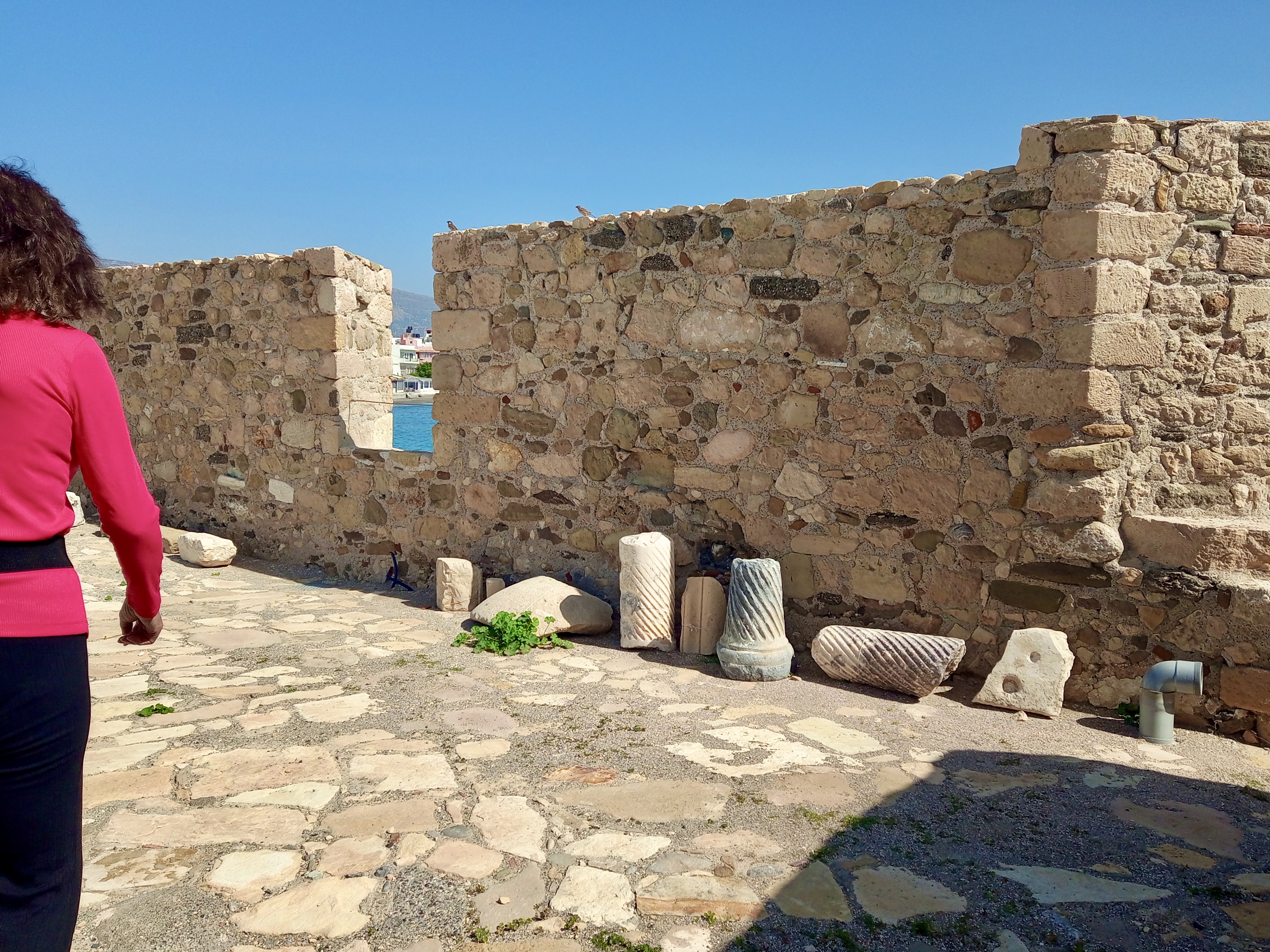
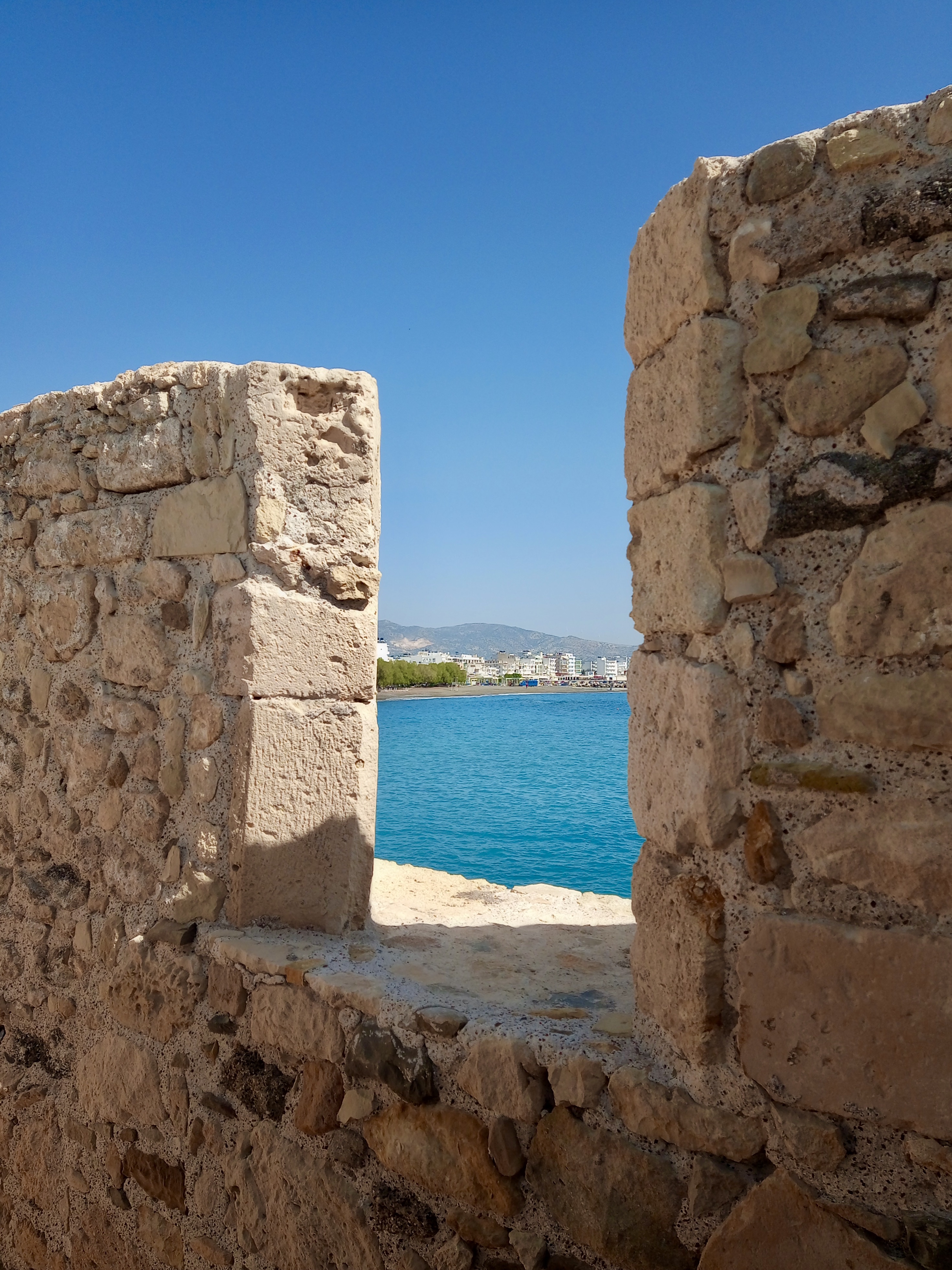
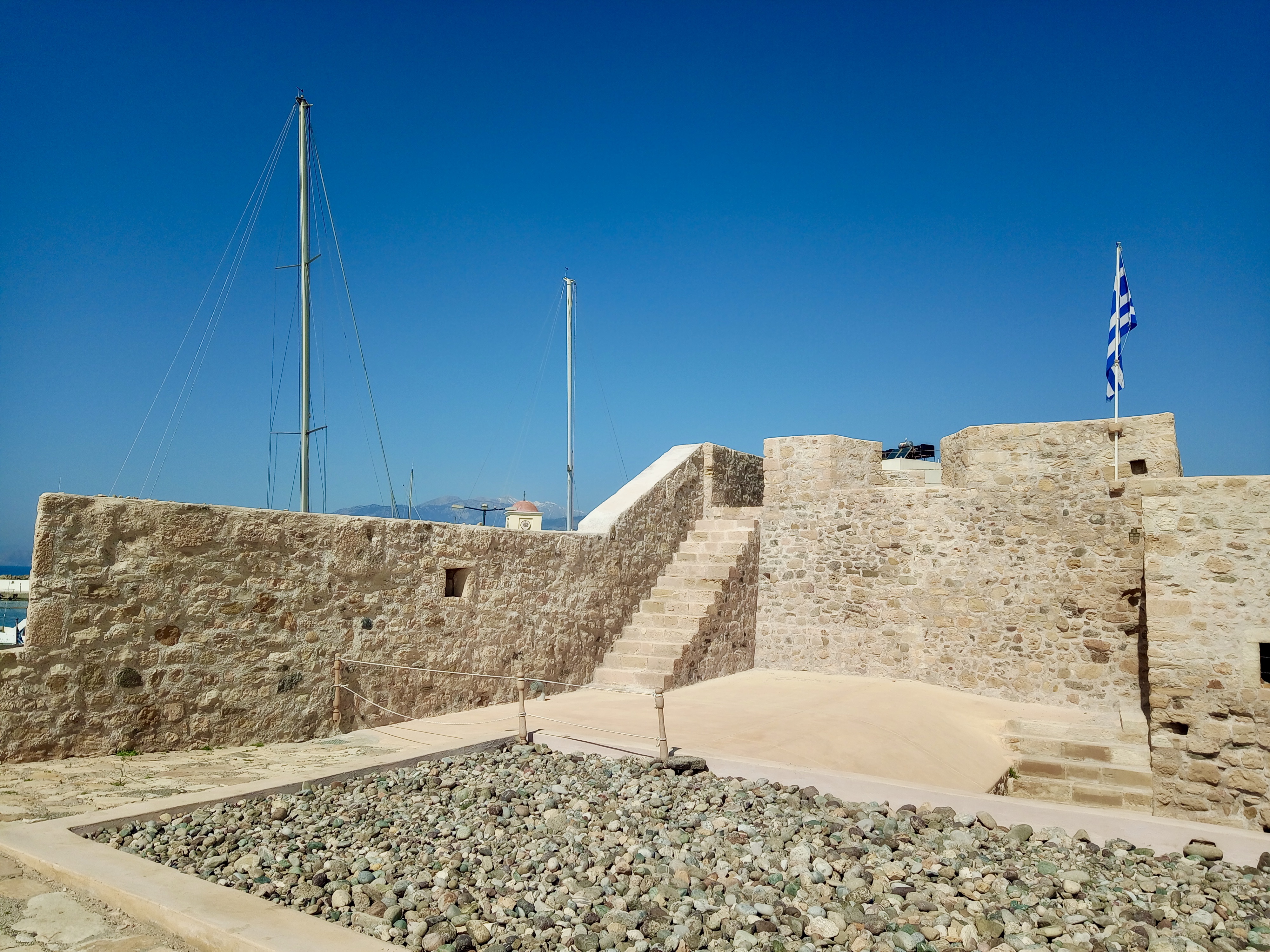
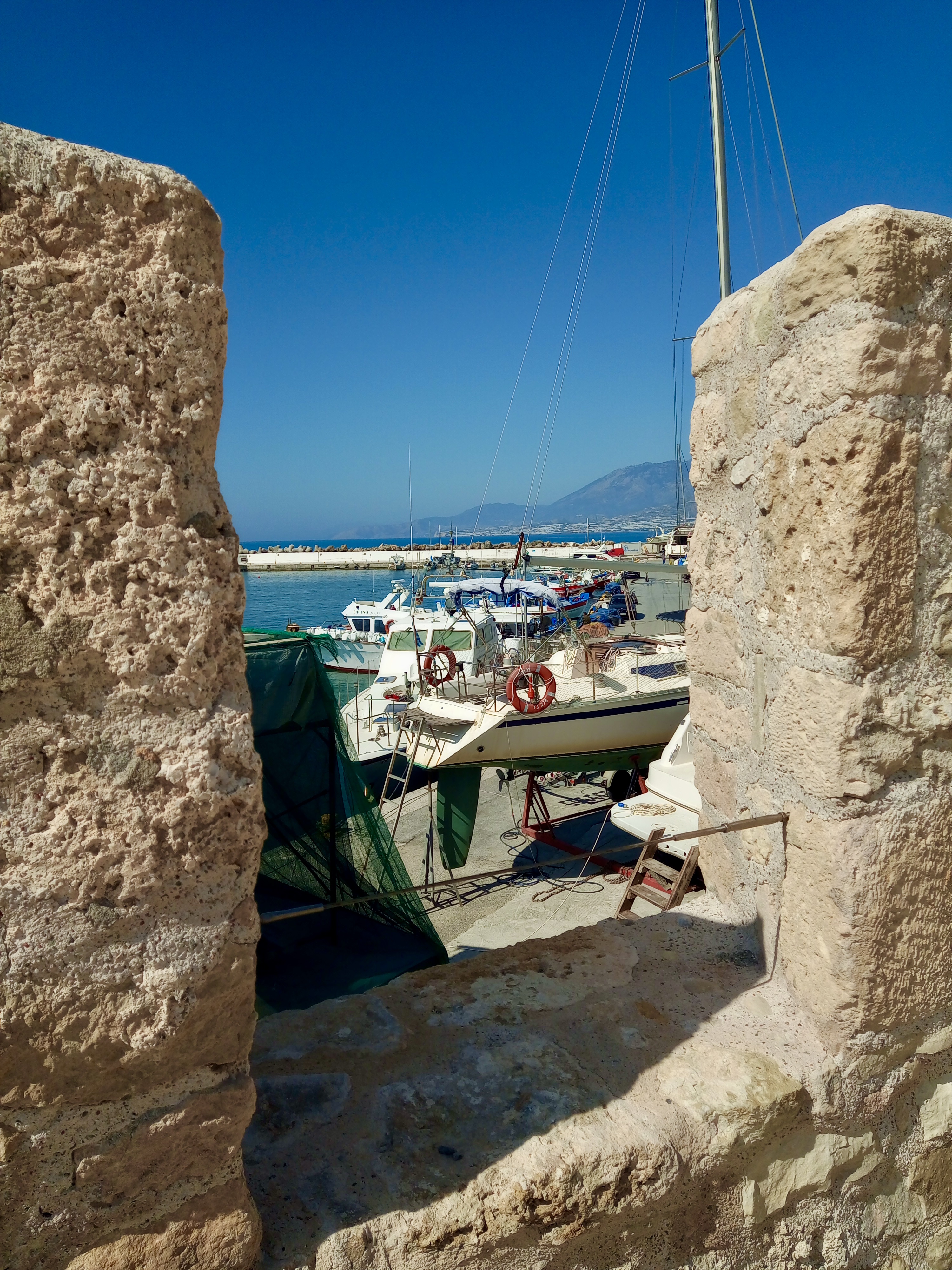
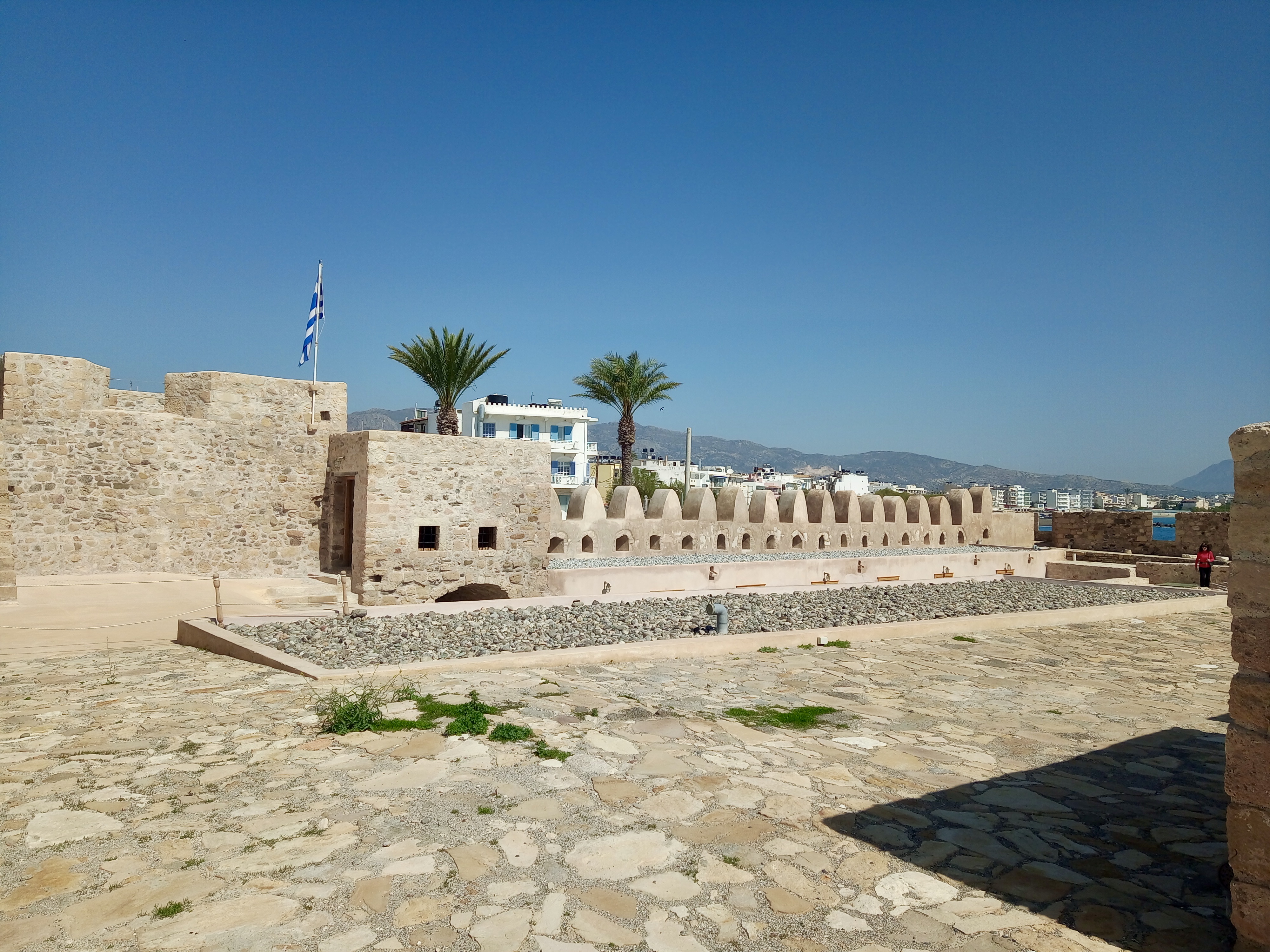
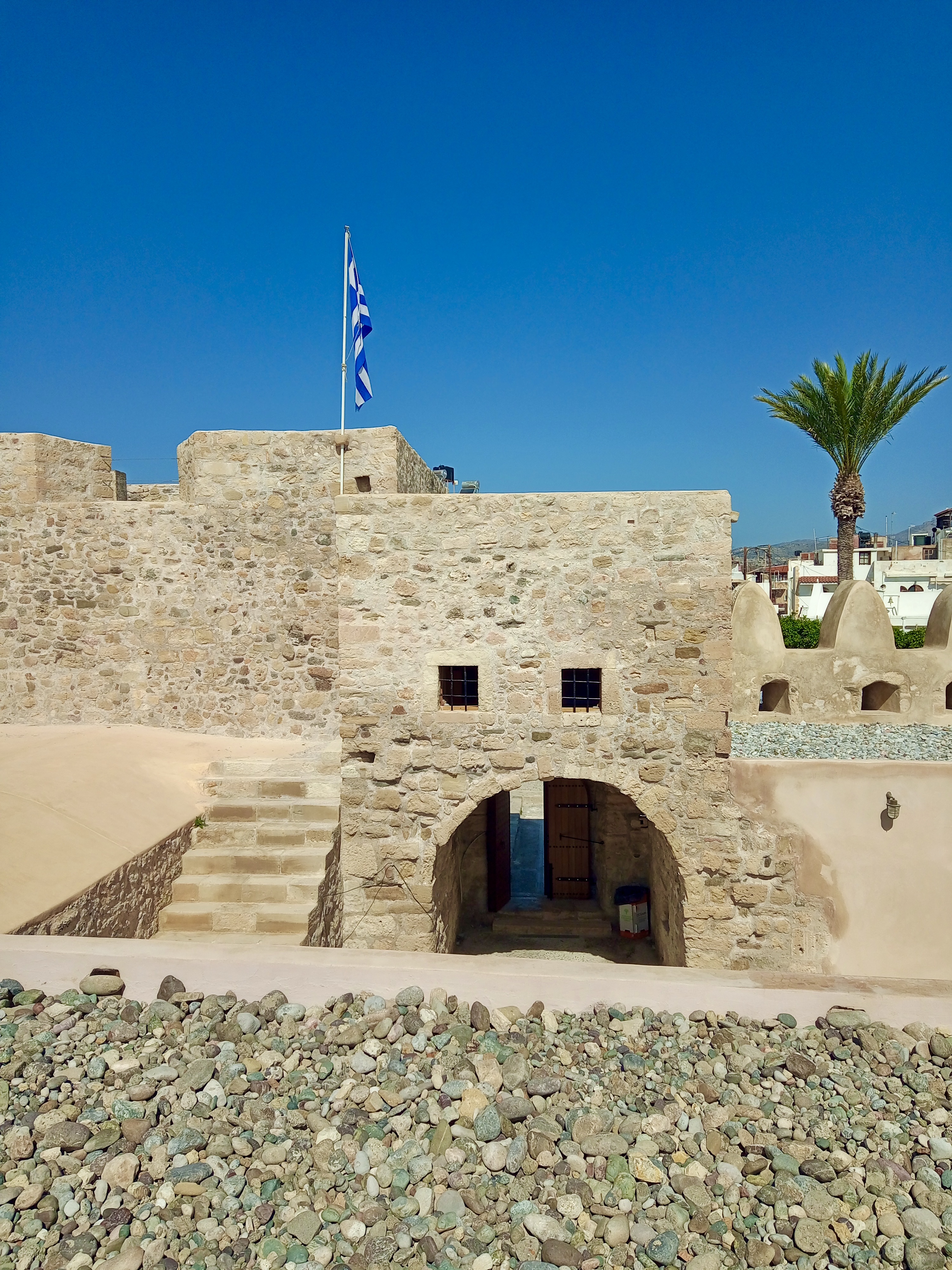
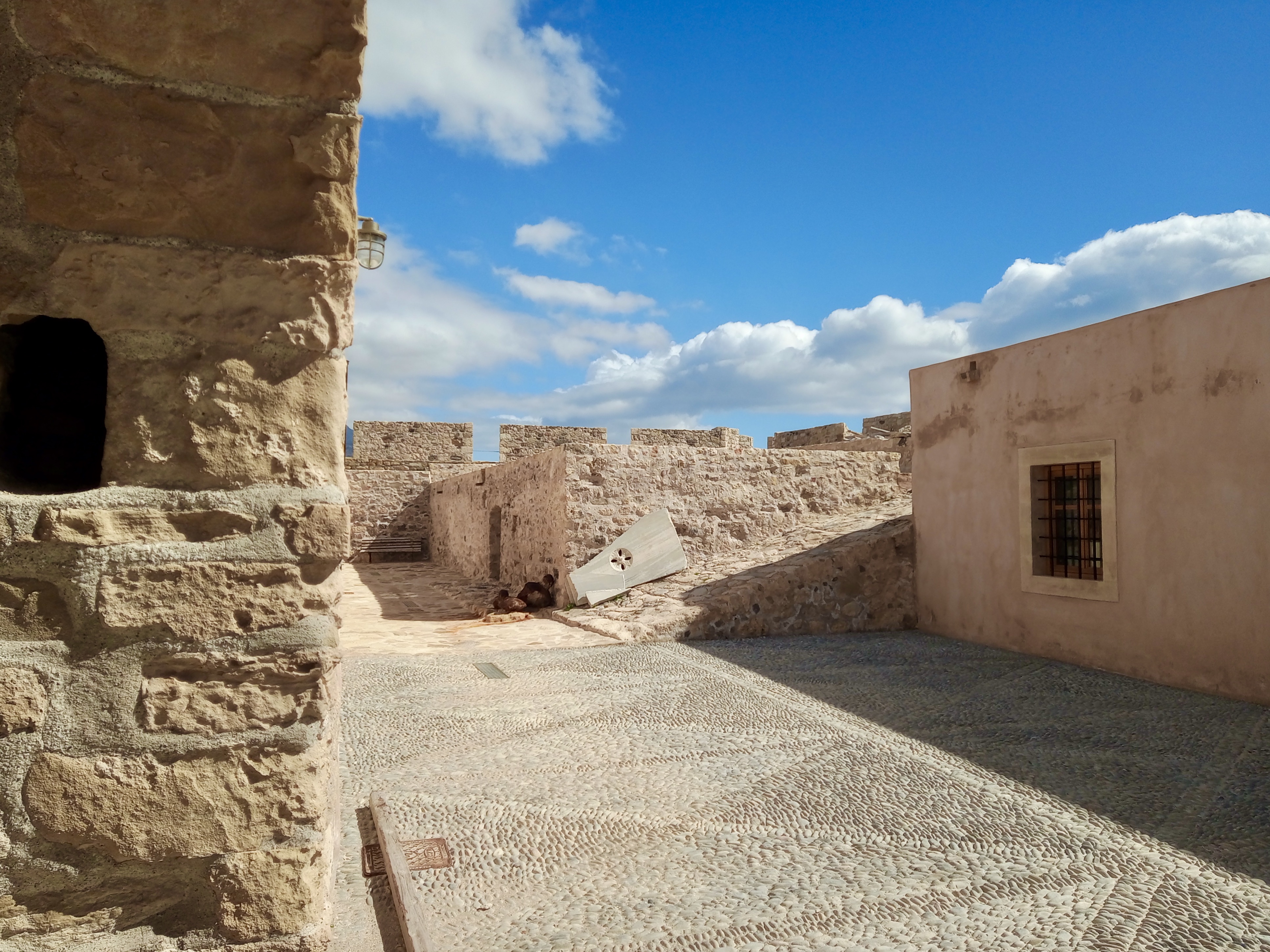
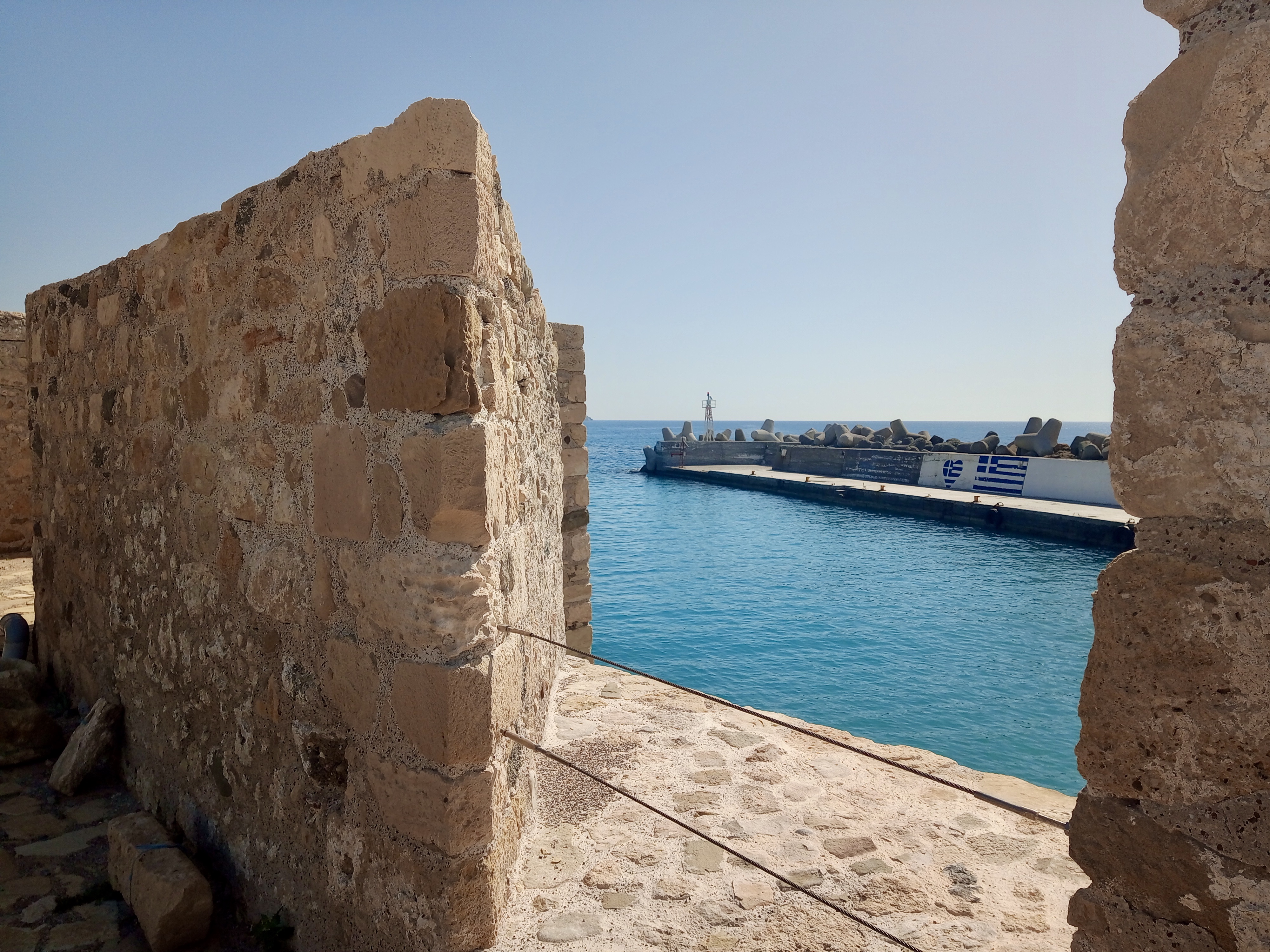
Above: Peeping through the doorway of the renovated fortress at the harbour end of Ierapetra seafront. It’s still not reopened to the public after more that 5 years of working on it. I’m dying to get inside again, since the last time we were able to do so was when we visited Ierapetra from Rhodes during November 2015, four years before we moved here.

Above: Traditional kafeneio in the square on Patmos, May 2019.

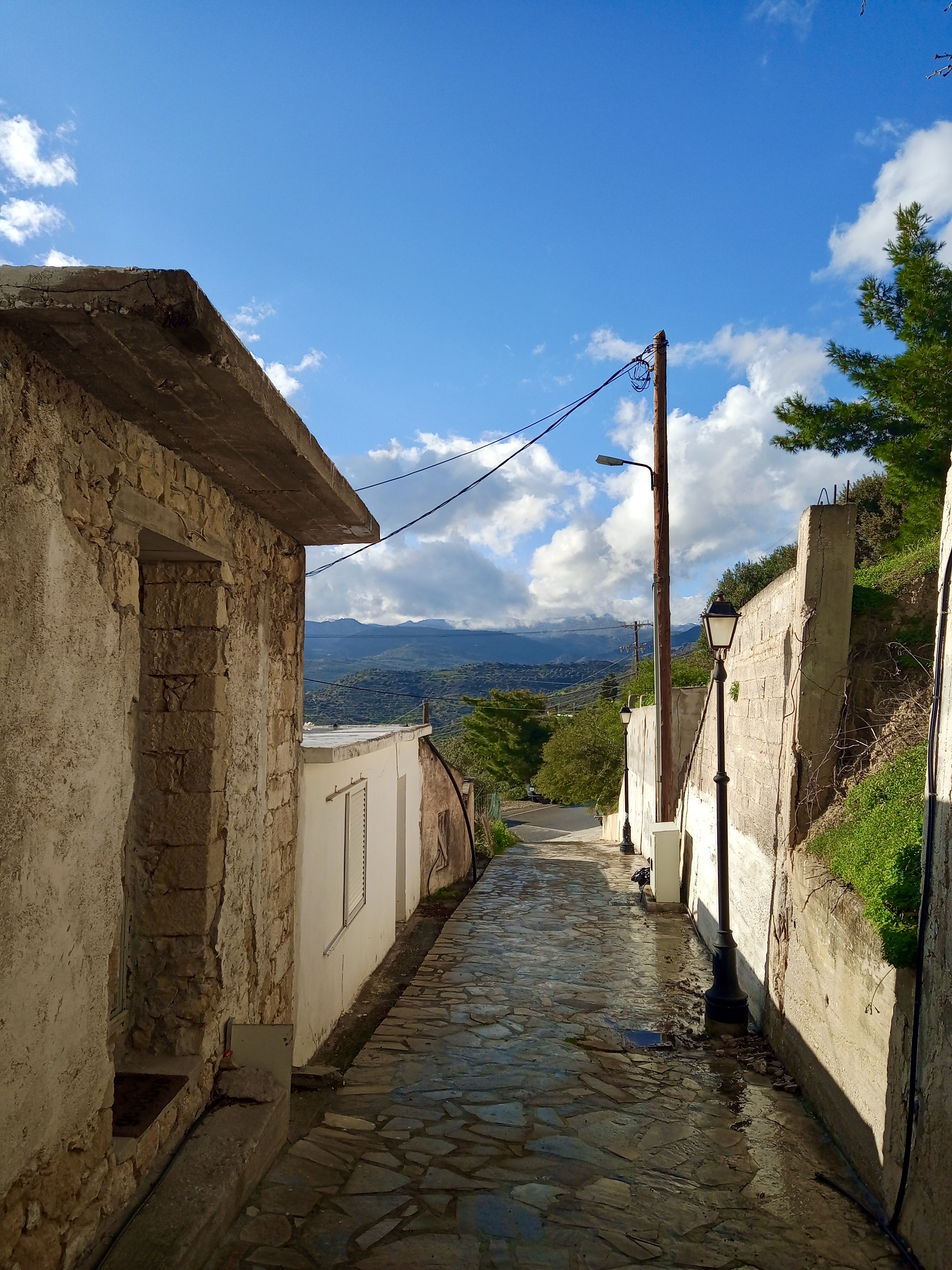
Both of the above: During a walk up the lane towards Meseleri yesterday afternoon at around 3.50pm. Above Yvonne’s left hand is the village of Kalamafka. Above her right, and the photo on the right as well, was the first view we got this winter of the mountain we call the ‘kourabieda’ with its first dusting of snow. It’ll look like that for a few months now, if things go as normal. It’s one of the peaks that surround the Lasithi Plateau.

Click HERE to go to my Amazon Author Page, where you can browse and purchase all of my written works.
A few thousand words

Progress on the new book is now up to around 17,000 words. I’m almost (but not quite) sure that it’s going to be called ‘Everything You Ever Wanted to Know About Greece But Were too Embarrassed to Ask,’ with a very subtle nod in the direction of Woody Allen. You either know what I mean by that or you don’t. If you don’t, it doesn’t matter anyway.

Catchy title, eh? OK, when the cover is designed it’s going to stress just a few of those words, with the rest in a somewhat smaller font size, but I can’t think of a better way to describe what the book’s all about, which is everything there is to know about Greece. Well, I’ll qualify that, everything you’d need to know to win the specialist round about Greece in your local pub quiz, how’s that?

I’m not rushing the writing, and so can’t give you any idea about when it’s likely to come out but, now and then, when I get inspired, I put a bit of a spurt on, so I’ll get there in the end, honest. I get these mad periods when I suddenly remember a whole bunch of ‘stuff’ that I think may amuse the reader, and it’s at those times when I rush upstairs to my mancave and bash away. The book is intended, while – yes – being informative, primarily to amuse and entertain. I have vain ambitions to imitate the wit and writing style of those superb books by Ekaterina Botziou. if you haven’t read ‘Theseus & the Mother-in-Law and other Myths & Legends’ or ‘Greek Expectations: The Last Moussaka Standing’ yet, take my tip, get them and do so forthwith, right away, or if not, sooner. Be ready for people to look at you gone off though, should you be foolish enough to read them in public anywhere. Those around you are sure to think that you’ve forgotten to take your medication when they see the tears rolling down your face and that manic grin that’ll be plastered all over it.

Anyway (which, incidentally, is a word I use far too often, I know), in the meantime, I’ve decided to run a few posts of nostalgic photos from yesteryear, starting right here, as it happens:

Above: This one was taken (frighteningly) way back in 1993, a mere 31 years ago, during our first ever visit to Symi. We used to walk from the harbour area to Nymborio beach, but occasionally get the boat back at the end of the day. This was during one of those lovely leisurely chugs back to Symi harbour.

Above: Same day, same trip back, but this was just as we were about to tie up and disembark.

Above: This is the Triton, one of at least two boats with that name which operate on Rhodes doing excursions. This photo is from July 2016, because during the high season I’d have two boats under my charge. Sometimes I’d be onboard the Triton, and other times, as in this case, the Madelena. One of these days, if I live long enough, I’ll write a book about my ten years as an excursion escort.

User Comments

Above: Taken in March 2020, literally days before the first Covid-19 lockdown hit us all, about thirty of us took a few vehicles up to a small plateau in the mountains above Kefalovrisi and Amiras, where we had a picnic and kicked a ball around for a few hours. The ‘road’ up to the plateau almost wrecked my car’s suspension, it was so rough in places. Those who had 4x4s were laughing, of course.

Above: taken at the Panorama café/taverna on the road from Pachi Ammos to Sitia, this was the last time we had the opportunity to spend time with my sister Jane while her hubby Martin was still alive.

Above: two photos at the same taverna. but on different occasions. It’s the wonderful Hiona on the east coast near Palaikastro, Lasithi. The one on the left (July 2020) is Yvonne with two girlfriends (we were three couples having a day out together) and the one on the right (October 2021) was with one different couple, the wife of which we knew from Rhodes many years ago, and her second hubby, who hails from up north somewhere near the town of Drama, where they actually get cold winters!

That’ll do for now folks. Don’t overdo it with the fatty food and booze, now, will you. I don’t want to lose my audience for frivolous reasons! Next post will contain a bunch more blasts from the past.

Click HERE to go to my Amazon Author Page, where you can browse and purchase all of my written works.

Sights and smells

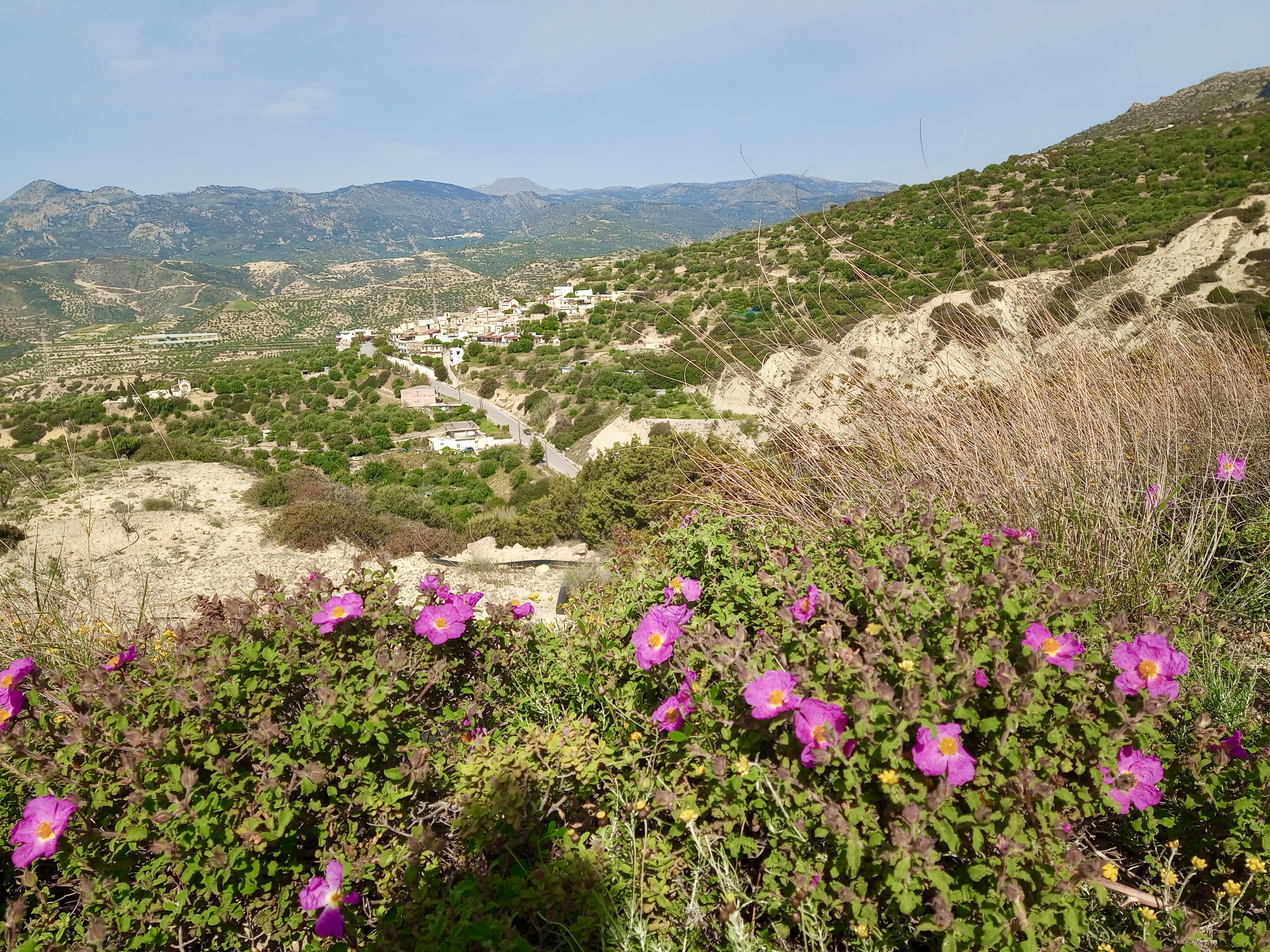
The photo above was taken almost one year ago, on December 20th (the eve of the shortest day) 2023. Our house is just visible as one of those with the terracotta roofs lower left of centre. This was around 11.00am. These next few below were taken during an afternoon walk we did on November 27th this year, between 3.00pm and 3.30pm. Thus the one above and those below are separated by around 11 months.

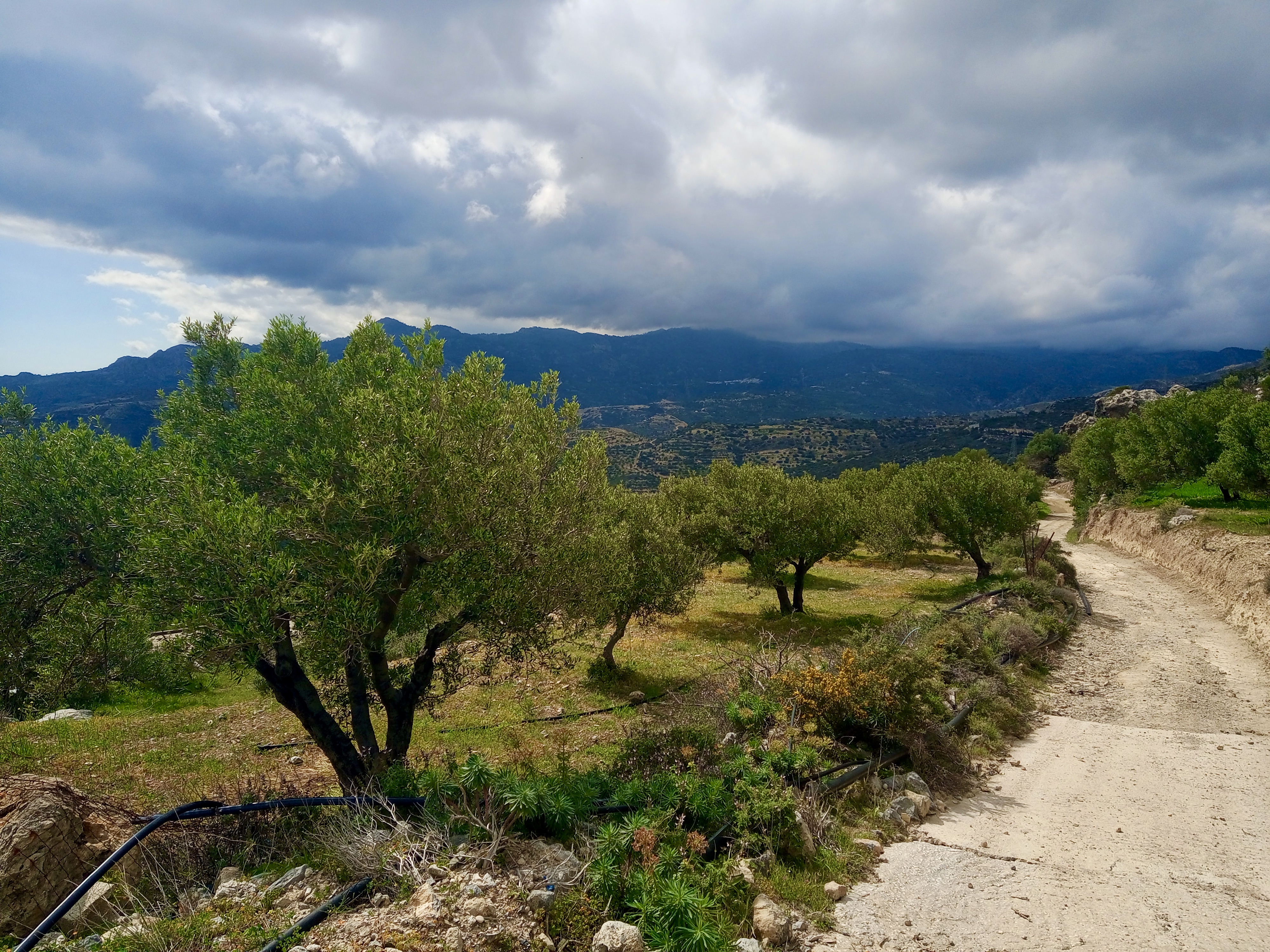
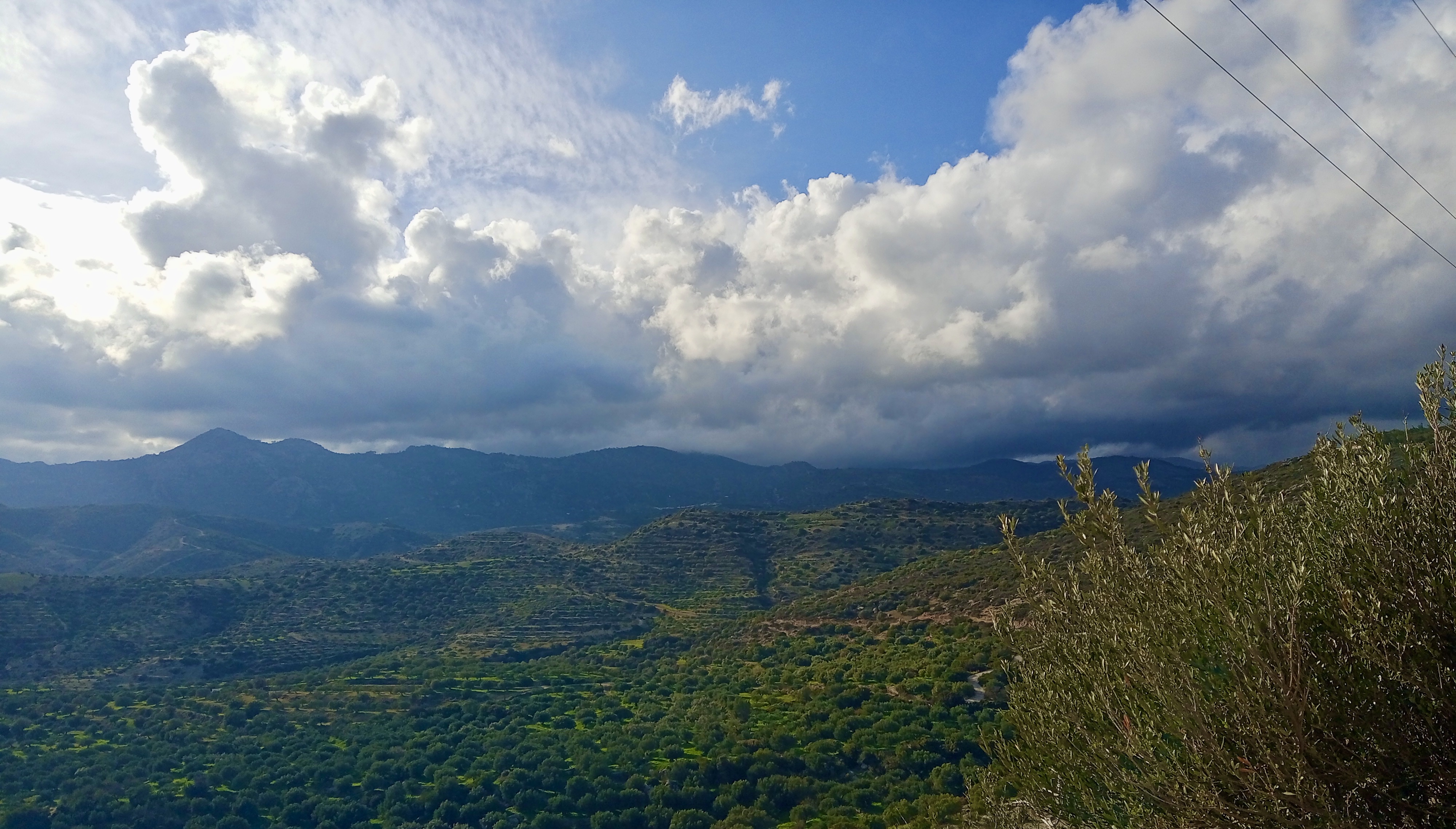
This more recent group was taken from a different perspective and a little farther from the village, so that we could show the frequent weather phenomenon that we get around here. Those heavy threatening-looking clouds in the distance are hanging over the Lasithi Plateau, which is just behind those mountains. It doesn’t look all that far away, but to get there by road would take about an hour, owing to the convoluted route that you’d have to take. The common denominator in all of them is that they include the village in-shot somewhere. That phenomenon that I refer to is in fact something similar to what we used to witness when we lived in Kiotari on Rhodes. It’s brought about by the fact that a little further inland from us the land rises sharply to a much higher altitude (and it’s higher here than it was on Rhodes), thus making the water in the atmosphere condense and produce those clouds. Often when the wind’s in the North, those clouds will hang heavily over the mountains behind us and to the West and, as they get blown downward towards the village, they break up, and we can watch them dispersing to nothing before they ever get far enough South to block out the sun.

The photos well illustrate that the Lasithi Plateau has its very own micro-climate, and it usually means that in the winter months they’re often immersed in fog, which is actually a low blanket of cloud, and often experience snow, whilst we here are enjoying sunshine and temperatures around the 20ºC mark.

We had a run of around ten days at the end of November into December when we had quite a lot of showers, some of them heavy. The farmers and villagers were delighted, of course, but it’s still nowhere near enough. But then, you could have a deluge that lasts a week and still some would say, “Oh I don’t know. We need a lot more than this really” (as I reach for my snorkel). Still, the garden’s looking a lot better for it and we haven’t needed to water for a while. This past few days, though, have actually been truly lovely, the kinds of days that would grace any self-respecting British summer, I’d say. The strawberries that we planted in the new bed that I constructed out of bricks with a cement render are actually flowering!

The smell of woodsmoke drifts across the village as the evenings draw upon us now. People (as I’ve banged on about often enough before) in traditionally-built houses, whose walls are single skin brick, with cement render outside and a layer of plaster added on the inside, need some form of heating in the evenings, even though so far this winter the temperature in the village hasn’t dropped below about 10 and is usually somewhere between 12 and 15 overnight. We usually put on a little heating, in the form of thermostatically controlled convector heaters, some time around 7.00pm, as there’s no need for heating during the daylight hours at all. These past few days we have been blessed with some really lovely warm sunshine and, as we enjoyed our coffee, we watched today, fascinated, as the mousmoula [loquat] tree below our veranda was alive with an assortment of wildlife. I’m only sorry I don’t have the equipment for taking zoomed photos to show you, but we used our mini-binoculars to study Painted Lady and Red Admiral butterflies gorging on the nectar in the myriad white flowers that are now adorning the tree, even while much of last year’s fruit is also still hanging there, all shrivelled and rotting.

That old, rotting fruit is nevertheless good for a host of insects, which in turn attracts some beautiful and dainty warblers into the tree’s foliage, and we watch as they busily flit from branch to branch, enjoying their local fast-food joint with relish. I’m pretty sure that they are warblers, but as to which type I confess I don’t have much of a clue. There are Leaf Warblers, Willow Warblers, Greenish Warblers and Wood Warblers for starters, and they all look pretty similar to me. Who cares anyway? They’re a delight to watch, that’s what counts.

Here are a few more recent photos, with comments underneath where appropriate…

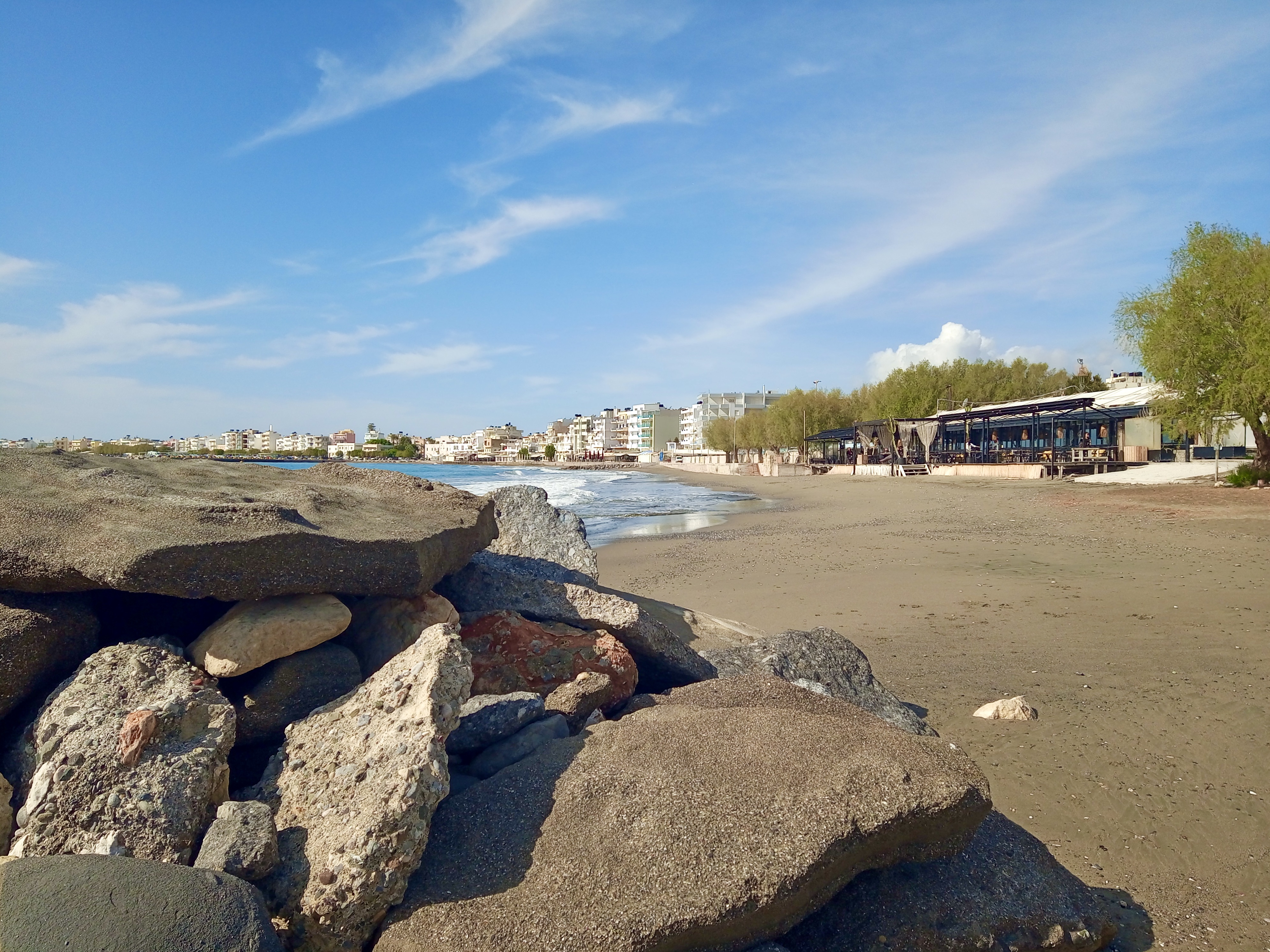
Above: The town beach at 11.30am on November 29th. We both had a swim, but I have to admit that you do need to stay in the water a while in order to get over the initial shock of coldness. The water’s not actually that cold, but it can feel pretty chilly when you first get in. If you swim around a while though, it soon begins to feel a lot more comfortable. The sea temperature is around 19ºC apparently. When you consider that a couple of months ago it was 26ºC, then it’s understandable that it feels a mite cooler now.

Above: The back of the beach viewed through the ‘pergola’ belonging to the Island Café/bar.

Above: There’s a new café that’s opened in the square in Ierapetra. We’re pretty sure that it’s the same folks who used to run the ‘Pickup’ in Dimokratias, because this one opened the same week that the other one closed, plus we know the young guy who shoots all over town delivering coffees on his electric scooter, and we’ve seen him in there a few times. Two freddo espressos and two bottles of water for €5, very impressive!

Actually, in that photo too you can see some of the Christmas decorations that are now festooning the town. That store with the massive baubles has really pushed the boat out, and they look much more imposing when you see them up close. I do get a bit tired of so-called experts among the ex-pat community who comment on social media when someone posts a question about Christmas in Greece, saying that the Greeks don’t go much on Christmas, as they make much, much more of Greek Easter. I beg to differ. OK, probably a few decades ago that may have been true, and, yes, Easter is still top of the list for excesses, but the voracious appetite that the commercial world has for ever more profit has seen to it that Christmas has grown exponentially in Greece this past few decades, fact.

If you watch Greek TV these days, you’d see that from some time in late October the commercials become ever more tuned to the Christmas indulgences. They’re all there, the perfume ads, the ads for alcoholic drinks (primarily expensive spirits of course, after all, Christmas is for the kids, right?), the brown goods ads (your partner surely needs a brand new coffee machine or maybe an air-fryer, right?). There’s one particular chain of stores in Greece, it’s called Jumbo, that runs a particularly expensive and extravagant daily ad campaign on the telly right up until Dec 25th and beyond. The Jumbo ads count down the days one by one, and they go on for an age. They’re testament to all that’s wrong with the celebration really. They stress the materialistic theme of this winter extravaganza to the extreme, and they well demonstrate, as do the inflatable Santas you can see suspended from people’s balconies around the villages and towns, that Christmas is well and truly well observed in modern Greece all right.

Just returning to Jumbo for a moment, if you’ve ever been in one of their stores, you can’t fail to have noticed that probably half of the store is kind of Habitat with tat, whilst the other half is given over to indulging children to the enth degree. There are aisles twice as high as a man stacked up with plastic and packaging fit to give an environmentalist a nervous breakdown, believe me. I can’t walk along those ‘corridors’ without marvelling at where all that plastic and cellophane is going to go once it leaves the store. How many kids these days don’t get fed up with their new plastic toy in pretty short order? Where’s all that plastic going to be in a few weeks time? You’ll be seeing it piled up beside the dumpsters in the streets, cluttering up ditches beside rural roads, no doubt too becoming a large percentage of the landfill that still goes on apace, sadly, here to quite a large extent.

I know, I sound very negative, don’t I? Sorry about that, but there it is. I have to admit to finding Jumbo quite useful for some home products too, so here’s Mr. Hypocrisy talking I suppose.

Oh, I nearly forgot. We went to the mill to pick up our ‘huge’ harvest of olive oil. Like I said, they told us it would be a couple of days, but the very next day called to say that it was ready. We drove back to the mill, wondering all the while how much our little tree in the upper garden would have netted us in oil. Of course, we were under no illusions about how our 33kg of olives had been processed. They’d very likely have been shoved through the process by being included with a much larger haul. It made complete sense, and that was even how our five sacks had been processed back on Rhodes all those years ago. We reckoned on around 7 or 8 kilos, and we were soon to find out.

As I walked back into the building, and saw great drums and metal cans stacked head high, all awaiting collection, I looked around for the modest stainless steel vat that we’d left here for the purpose of having our oil poured straight into it. It’s got a tap in the bottom, so that we can draw oil as and when we need back home in the kitchen. I couldn’t see it right away, so I went to the office, knocked and went inside. My friend the big tall grey haired gruff chap who’d helped us the previous day saw me and waved for me to wait while he finished a phone conversation that he was having. Once he’d shoved his mobile on to the desk, among a wad of disorganised (well, that’s how it looked, but he probably knew where everything was I suppose) paperwork, he got up and said, “OK, come with me.”

So, following, I went with him a full twenty feet from the office door and there, looking incredibly small amongst all the piled up massive receptacles all full of freshly pressed oil, was our little stainless steel ‘bin,’ sitting on the floor and how it hadn’t been kicked over by this time I’ll never know. Nevertheless, he signalled for me to pick it up and go, and made as if to return to the office.

Now, in normal circumstances, when people take pallet loads of olives to the mill in sacks, the usual deal is that they allow the mill to keep, say 3%, of their yield in oil as payment for the job. The mill then sells that oil on directly to its regular customers, thus making the money they need in order to function. For the mill to keep a percentage of our little haul would have been a bit difficult, but I felt the need to suggest I pay them for turning our olives into oil at any rate, so I tapped him on the sleeve as he was starting to walk away.

Hold on,” I said, “How much do I owe you?

That same bemused smile appeared on his bristly chin as I’d seen the previous day when he’d first clapped eyes on our mammoth harvest. Through his grin, he said to me, “Forget it. it’s only a piddling amount anyway. You go and enjoy your oil! Bye!” and he was off.

What a gent, eh? We drove home through some drizzling rain well satisfied that our couple of days work of extracting the olives from the branches of our tree had paid us a small dividend. Once we got home I was able to weigh the oil, and we reckon we’ve netted about 7 kilos. It’ll hardly feed the five thousand but, when you consider how much that little lot would cost (and it’s extra, extra virgin, after all) in the local supermarket, it’s paid for a full tank of petrol, or a week and a half’s shopping, so that’s not bad is it. We reckon it’s anywhere between €60-80 worth – for free!

Finally, I went out for a walk around ‘Dingly Dell’ just before sunset this evening. I took these two as I descended the pathway back into the village at around 5.00pm…

Click HERE to go to my Amazon Author Page, where you can browse and purchase all of my written works.

Going back on my word

I know I said in the previous post that we didn’t have the appetite any more for harvesting olives, and broadly speaking, that still holds, but…

There’s been a slight change of tack, because on close inspection we found that the olive tree in our upper garden was so heavily laden with fruit that it seemed to us a crime not to think about harvesting it. We have three trees in the garden in total, two in the lower garden and one up top. The two below are centuries old and were evidently in place long before our house was ever constructed. When the builder (and previous occupant of the house) from whom we bought it had the place designed and built, a lot of landscaping was required to excavate our steep driveway, and a huge retaining wall needed to be built, but those two stately aged trees were carefully preserved in their places. It may have something to do with government regulations about the importance of preserving olive trees, I don’t know. I have heard that such legislation exists, but I’ve never researched it.

Either way, it doesn’t matter. Those two older trees add such a wonderfully architectural and sculptural atmosphere to the garden, not to say giving it a thoroughly traditional Grecian feel, that we’ve loved them from the moment we first saw them. Last year I gave them a severe ‘haircut’ since they do have the habit of showering olives all over our terrace and lower beds during the winter months, so this year they only sport a thick canopy of smaller leaf-laden shoots that have provided shade during the summer months (as we’d hoped that they would) but have not put forth any fruit this season.

The tree in the upper garden, however, is much younger and looks like it was planted probably when the house was built, which was about 16-17 years ago now. I didn’t attack it all that much last year and this year, as a result, it’s decided to go into ‘turbo’ mode and produce a truly abundant harvest. We went up there a week or so ago to think about doing some routine maintenance to the paths and beds, and couldn’t help looking up and seeing the branches, and noting how heavily laden they were. There was nothing for it, we had to harvest those olives.

The thing is, if you know anything about olive harvesting then you’ll know that for every kilo of olives you take to the mill, you get about 20-30% of that weight back in oil, depending on the type of olive and how ripe they are etc. In order to harvest, say, 100 kilos of oil, you’d need to take around 4-500 kilos of olives to be processed. Small wonder that locals usually have hundreds of trees on their family’s land and they often take several weeks to harvest them all, not to mention the commercial growers who hire casual labourers to help with the harvest, usually every other year. On average, judging by our tree, one tree can yield anything from 25 to 50 kilos of olives, which means that each tree produces around anywhere from 6 to 12 kilos of oil. Here, they always do it by weight but, to be honest, a kilo of oil isn’t much different to a litre. The accepted conversion rate is 1.09 litres per kilogram.

Round here they take their olives to the local mill in hessian sacks weighing in at about 60 kilos per sack. Thus each sack will yield around 12-15 kilos of oil. The last time we took any olives to a mill for processing was on Rhodes around 15 years ago. That was when our good friend Manolis, the “Six Million Drachma Man” as we used to call him ( see chapter 13 of “Moussaka to My Ears”) kindly gave us the olives we’d harvested with him on one occasion, which meant that we were able to take 5 sacks to the mill, and drove home satisfied with a haul of around 65 kilos of oil. That was enough to see us through the best part of two years. 

Anyway, we set to the work and began harvesting our tree. The work took us two days and by the time we’d finished we had around 30-35 kilos of olives, which we’d stashed into four plastic buckets and also half-filled the yellow mop-bucket we uses to clean the floors (we didn’t have any sacks). Time to head off to the mill.

Now, at this time of year the olive mills are working flat out seven days a week. Farmers and families are all totally immersed in their olive harvest and, even though it’s hard manual labour, families and village communities enjoy it, especially when they end up driving off to the mill in pickups loaded down to the buffers with sacks piled precariously high on the back. 

We well remember when we harvested olives with ‘Dimitri the Horse’ back on Rhodes (see chapter 4 of ‘Moussaka’, ‘The Passers by’). There were sublime moments while we took short breaks and sat on the tailgate of Dimitri’s pickup, taking bites out of chunks of village bread, chewing on beef tomatoes and sipping hot coffee, while a few metres away, at least on one occasion we witnessed a baby goat being born right there before our eyes. Huge birds of prey mewed while they circled high above us and – at least at one of Dimitri’s many olive groves – his ducks and geese cackled as they foraged nearby. This time of the year the skies are usually blue, with broken clouds scudding around. Occasionally it’ll rain and you have to take shelter for half an hour or so, but the sun soon comes out again and, once you get cracking with the work, even in late November-early December, you’re taking off your fleece to work in just a t-shirt because the sun’s too hot on your back.

So, this year, as we made ready our modest haul of olives, I checked on the location of the nearest mill, which was fortunately only ten or fifteen minutes away, and we set off with the boot laden with our precious cargo. The mill here on the outskirts of Ierapetra is significantly larger than the one we used to go to in Arhangelos on Rhodes. There, they had one olive processing plant installed, which was about thirty metres long and all gleaming stainless steel. Olives are poured into a hopper at one end, where they’re also weighed, then they travel on a conveyor belt to a washing station, plus a section where leaves and small twigs are separated out, before the olives go into the mill-proper. At the other end of the ‘plant’ is the huge stainless steel receptacle into which your extracted oil is poured, gleaming green and still piping hot from the machinery. You can dip you finger in it at this stage and lick it. In this hopper the oil is weighed, the final tally glowing out at you from a red digital display screen, then the oil can be pumped into your receptacles using a tube and gun that suspiciously resembles the gun at a petrol pump in the local filling station (you chums across the pond, that would be a pump at your local gas station, of course). Here in the mill we went to at Ierapetra there must have been a dozen of these processing mechanisms, the place was that big. 

As we drove into the huge parking area within the gates of the mill’s compound, we soon got the measure of how insignificant our little harvest was. All around us were wooden pallets piled with bulging hessian sacks, each with a paper label bearing the name of the owners of those olives. Pickup trucks were everywhere, unloading sacks, doing three-point turns, and narrowly avoiding the forklifts that were ferrying the pallets into the building through a huge roller door. Even from outside the building the sound of the machinery within was pretty loud. You had to shout to hear each other speaking once you got out of the vehicle.

I looked around for an entrance that might show me how to find the office. Rough looking farmers were trudging about everywhere, all of whom took no notice of me whatsoever. Old ladies wearing headscarves gazed at us in a bemused fashion from the open windows of pickup truck cabs. I eventually entered the building and found the office, which was just like the one back on Rhodes, in that it’s constructed of a few white aluminium window panels, primarily to reduce the noise within, the lower three feet of which were opaque white. Inside sat a few grizzly looking chaps, busy with paperwork, computer screens and cell-phones. Men were opening the door of this office and going in and out at will, so I decided that the only way to get some attention was to follow suit, even though the sign on the glass panel of the door read: ‘No entry to non-staff.’

Once inside I waited while a couple of chaps before me were served, and then a huge bloke with three or four days growth of white beard and a still good head of thick white hair turned to me from his seat at the desk and asked what I wanted.

“Well, um, we only have the one tree at home, but we couldn’t not harvest it, since it was so, so full this year. So we’ve brought our olives along in the car. I think we have maybe around 30 or 35 kilos, but that’s it.” 

This chap stared at me for a moment, during  which I thought he might be deciding whether to hit me or something. But then he burst out laughing and said, “You better show me where it is then.”

I led him outside to the car, where the boot was already open, and he stared in disbelief at our five buckets of olives. Right beside the car was a pallet stacked high with about twenty sacks, and here was this odd couple with five buckets of olives. 

“Sack?” He asked, evidently meaning, “Do you not have one, then?”

Well, no, sorry, is that a problem?” Again he chuckled, evidently finding this whole thing quite funny, and told me to hold on, while he strode back into the building. While he was gone, a forklift passed within millimetres of the car and the driver, glancing at our harvest cried out “Bravo sas! You did well!” He may have been being sarcastic, but we actually decided that he was truly commending us for not wasting even one tree’s worth of olives.

Our helper soon re emerged, carrying an empty sack, which he then held open while Yvonne and I emptied our buckets into it. By the time our receptacles were all empty, the sack was barely two thirds full. “All right,” our friend said (and, incidentally, I’m over six feet tall, and my head was about the height of his chin!), “Come back into the office and we’ll take your details. It’ll probably be a couple of days, is that OK?” 

No doubt exuding a great expression of relief, I answered that yes, that was just fine. Back in the office he asked to me write down my name and number and told me that they’d call when the oil was ready. This was Thursday. Today has been Friday and they called this afternoon to tell me we could come and get our oil. Now, even if we net around 8 or 9 kilos of oil, that will save us, at today’s retail prices, anything from €50 to €90, so we’re not complaining.

So, in the morning we’re off to the mill to see what we’ve got to bring home with us. Whatever it amounts to, I’m glad I went back on my word.

Here are some photos of an excellent lunch we had at the La Strada restaurant near the front in Ierapetra on November 29th. That dish that looks like meat is actually grilled mushrooms, and they were superb!

Finally, just a few from our visit to Agios Nikolaos last Tuesday, under mainly cloudy skies…

Click HERE to go to my Amazon Author Page, where you can browse and purchase all of my written works.

Round and around

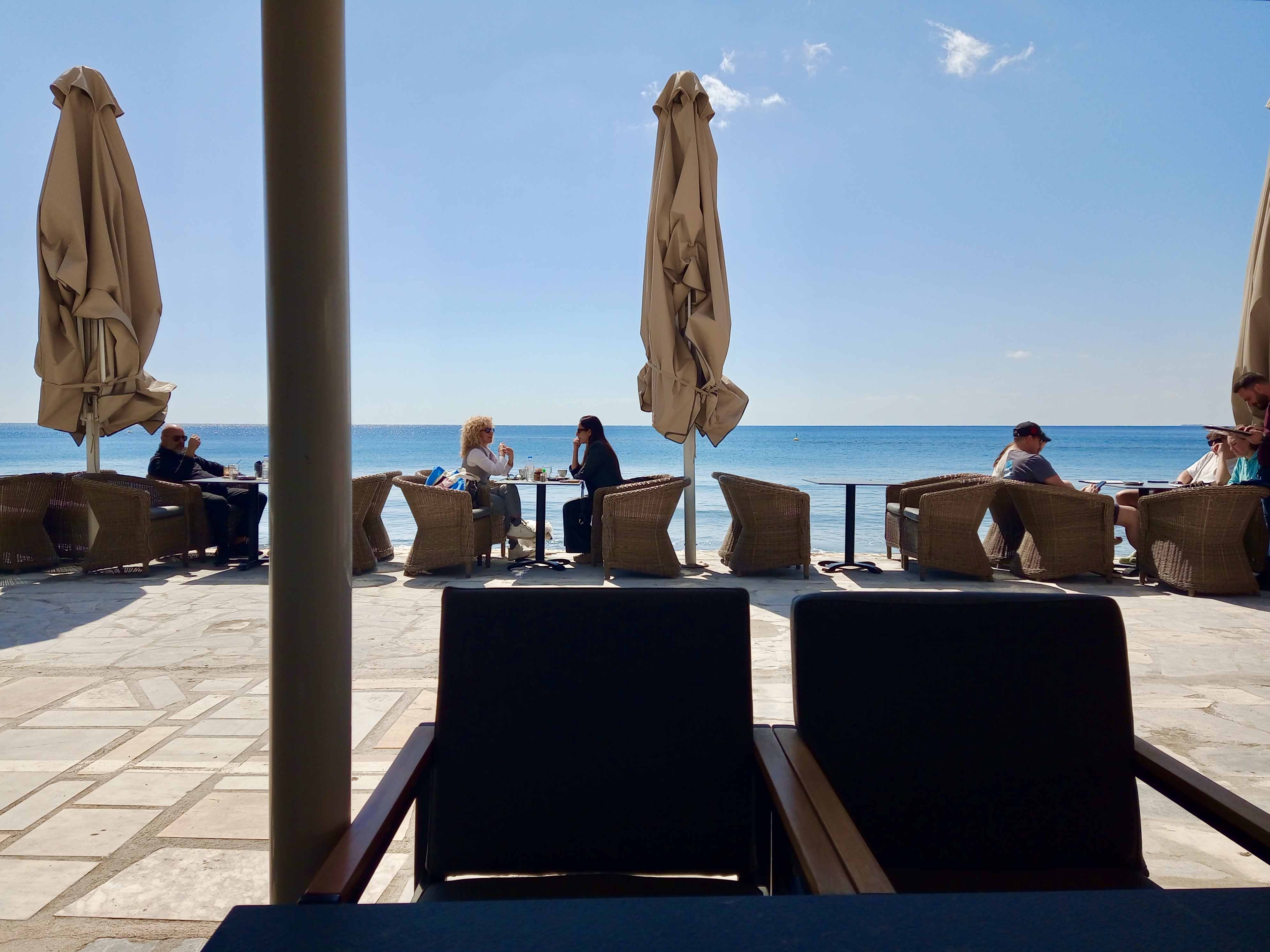
I know, yet another shot of the sea front from our favourite café. But the light on the water was so perfect at 12.50pm yesterday. That’s my excuse, anyway.

It’s a two edged sword really, this having lived in this country for over 19 years now. We’re already three months into our twentieth year here and, what I mean is, we’ve been here so long that we’ve well and truly settled into the rhythm of the seasons, and no time of the year reminds me more of this than this time, November. All around the village and, indeed our house, you hear the sounds of the olive harvest going on in earnest. All the pickup trucks on the road are laden either with empty sacks or crates, diesel generators and long poles with those plastic hair-brushy things on the end for agitating the upper branches of the trees to release the fruit, or laden with crates and sacks full-to-bursting as they make their way to the local mill.

And it is good, it is right. It is the way of life in this region stretching back for millennia. The tools may have changed a little in recent decades but, for the rest of the past stretching back into near eternity, the ‘weapons’ needed to agitate the upper branches were ten-foot-long whips cut from trees or shrubs, then stripped of their side shoots, the only criteria being that they’re bendy so that a) they won’t snap off during the work and b) they’ll do a better job of forcing the olives to separate from the branches and twigs in order to tumble into the nets that have been spread out below, but the task is essentially the same.

Even though the work could almost be described as brutal, the way it scratches your forearms, fatigues virtually every muscle in your body and probably hastens the onset of arthritis in your damp knees, it’s also a joyous time for the local people. Families turn out together, often involving not only those who live in the villages and in closer proximity to the trees, but also their relatives who’ve made a life in the town or city, where they can earn a better living, will take time out to spend a week or three out in the sticks with their relatives who still till the land and live off their home-grown vegetables, all setting to work in unison. Once each family has harvested their trees, and some of them own hundreds, the resulting oil is shared out among the family members and friends and they’ll be well stocked for, hopefully, another year.

Many of our Greek friends who are town dwellers will be absent from their homes from dawn until sundown seven days a week for as much as three or four weeks, and anything else in life that they might normally do, whether it be tending a small urban garden, tackling some small DIY project in the home, or taking the car for a service, goes onto the back burner. Not a few of those whom we might regularly take coffee with once or twice a week will not be available for such socialising until all the olives are safely gathered in, and the oil stored in vats, barrels and bottles somewhere. 

We tend to avoid participating in the olive harvest these days, mainly because we’ve done it  many times in the past and, to be totally honest, we don’t have the appetite for the strenuous exertion that it involves any more. 

That brings me back to why I say that being immersed in the rhythm of the seasons here is a two-edged sword. Yes, we’re in the ‘groove’ as it were, but it’s also a reminder that we’re nigh on two decades older than we were when we drove all the way across Europe in our trusty 15-year-old Mitsubishi L300 long-wheelbase van, full of bright-eyed optimism and anticipation as to what our future life was going to be (see the full story of the journey in my first book, “Feta Compli!”). I have to say, as a positive, that it hasn’t disappointed, oh no. Getting used to the bureaucracy was a real challenge, true, but you adjust. You take it all on board and, in the end, accept the inevitable. You’re going to spend a lot of time walking around the town carrying sheaves of A4 photocopies as you go from government office to government office. But you get it all done in the end, and a lot of other positive things well make up for that.

I was in the Post Office (ELTA) down in the town the other day, a place which, like any branch of any Greek bank, I try to avoid as much as possible since there’s the danger of a large chunk of my time on this earth being chipped away, in order to collect a couple of packages, since the ‘postie’ had left a chit in our mailbox in the village informing us that something had come. All I needed to do was to collect the packages, but as I entered the building I was not surprised at all to see that, of the three ‘stations’ behind the desk in order to service the members of the general public, only one was occupied. The woman behind the glass screen was doing what they all do, talking on her phone (it was tucked between her ear and right shoulder) whilst also staring at her computer screen. Somewhere nearby a printer burst into life and spat out a couple of A4 sheets, whereupon she slowly got up, phone still in place, and sauntered over to collect the printouts, before returning to her chair to proffer them to the elderly couple who were standing at the desk, their fingers resting on yet more pieces of paper that they’d evidently needed to have with them in order to complete whatever transaction it was that they’d come there for.

I was about third in the queue, and there was no sign of anyone else taking up their position behind any of the other two desks, when a bloke entered the building with his wife. They were two behind me, and so knew that they were facing probably half an hour’s wait before finally getting to the desk that was occupied by the woman who was actually serving people. The same scenario began to play out that I’ve seen so many times before. This chap was probably around sixty, and evidently not a particularly patient man. Before a couple of minutes had passed, his dissatisfaction at seeing only one of three serving positions occupied boiled over into a shouting fit.

“Dropi!! Dropi Ellada!!” He said, at a volume loud enough to be heard by pedestrians passing the door outside on the street. It means basically, ‘shame on Greece!’ He went on to postulate (loudly) that this was the reason why Greece was in such a mess financially; it seemed to him that if all the post offices in the land had enough staff to serve the patient public, then all the country’s woes would be behind us. His wife made a few vain attempts to mention that the poor woman behind the desk wasn’t to blame, but he carried on regardless. At least it entertained us all while we waited I suppose. Before I knew it I’d made it to the desk to present my little form in order to collect my parcels before I needed another shave. So at least I could thank this bloke for that.

I didn’t like to mention that Greece’s financial position is much improved this past few years anyway, why rob him of his moment of glory?

So, here we are then, already progressing through our twentieth year as residents of Greece and none the worst for it. Apart from being almost twenty years older that is. Every silver lining has a cloud, I suppose.

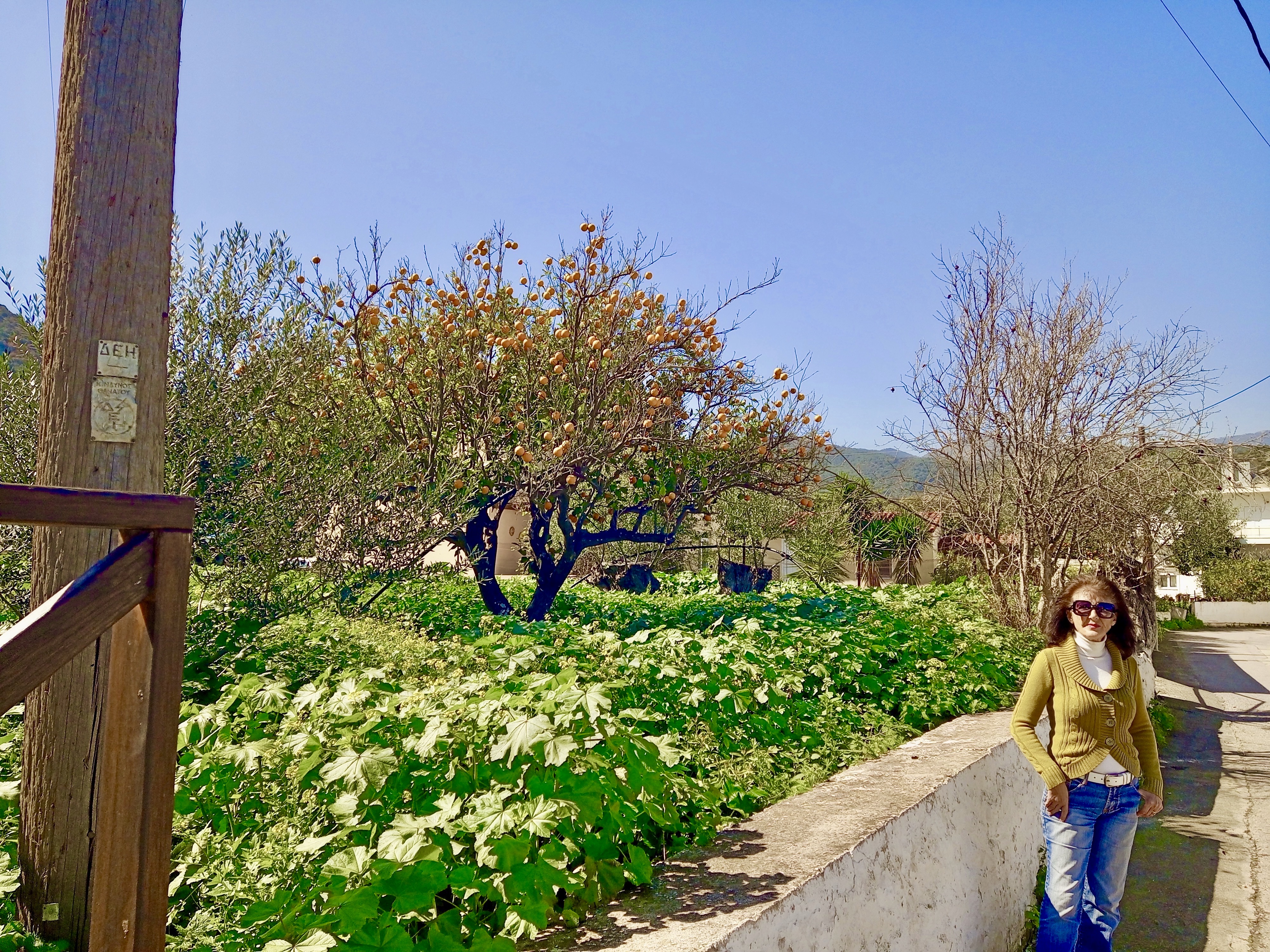
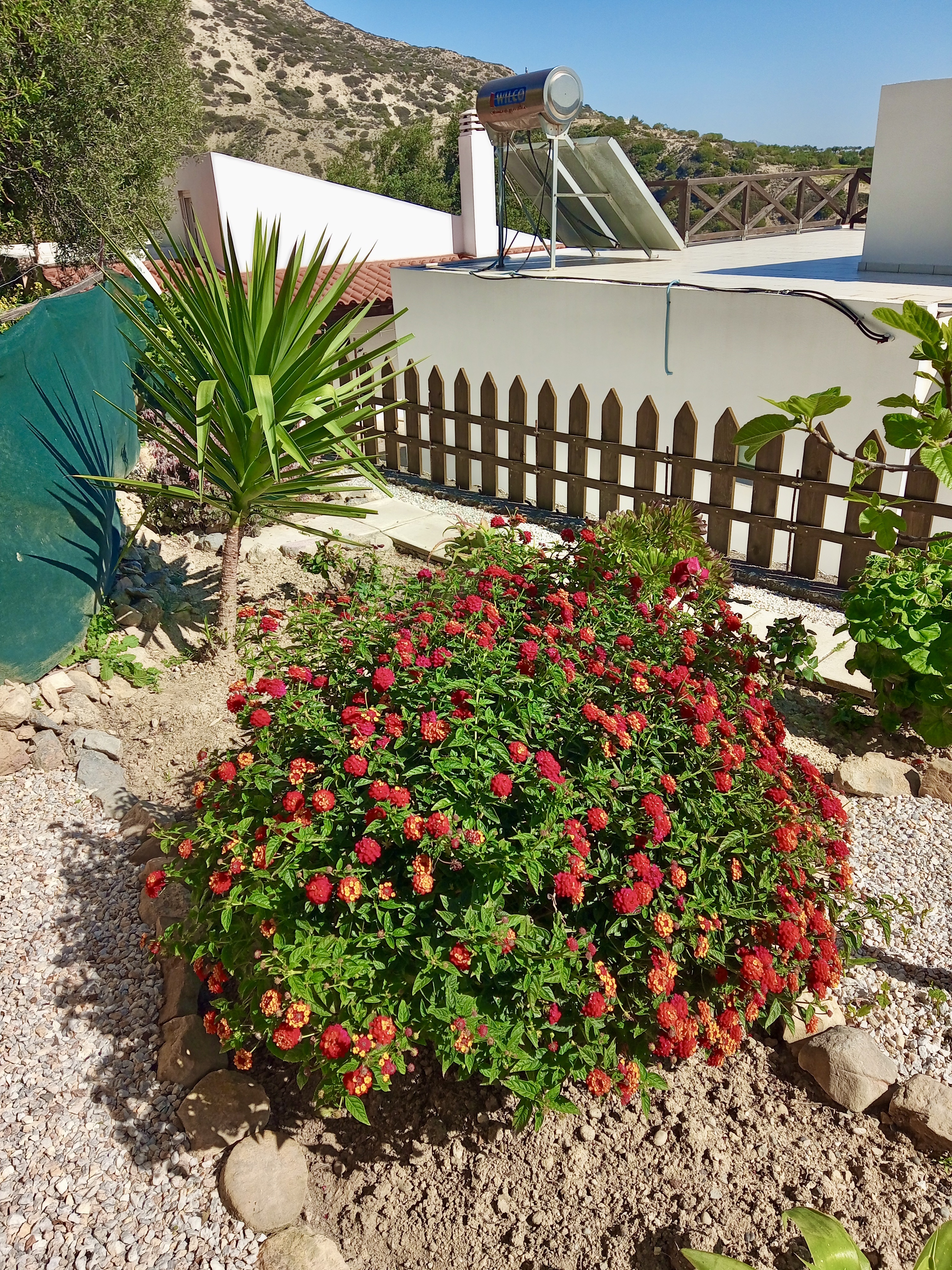
In the gallery above: Yvonne and I are increasingly using our ‘Xenona‘ as a reading room. The light’s lovely in there during the morning hours. The veranda and sun deck display our new ‘winter arrangement.’ The new bed I’ve built now has been planted up, and we’re hoping to harvest some juicy strawberries as a result. The chairs and table beside the front door are yet another seating area we can use, in this case especially when the cold wind blows during the winter months, or if it’s raining. When we used to live on Rhodes we seemed to be forever adding to the areas where we had seating in the garden and we’ve still not broken the habit! The tree with the ripening oranges is a common sight at this time of the year, and I have to say it’s joyous to see them. The one of Yvonne leaning over a wall was taken during a late afternoon walk up the road towards Meseleri a few days ago.

Click HERE to go to my Amazon Author Page, where you can browse and purchase all of my written works.

Come rain, come shine, come the winter months

Winter’s drawing on, and the smell of woodsmoke is again to be detected across the village as the sun sinks behind the hills far to our west. We’re once again thankful that our house is not of traditional construction and has cavity walls with excellent insulation in the gaps. Greek houses are, by and large, single-skin brick, concrete and render, meaning that, once the evenings become a little chillier, the condensation begins to run down the interior walls, and thus, come the spring, there is often a mass of black mould to be cleaned off, often with the use of quite strong-smelling chemicals. Completely by chance, as it happens, both our rented home back on Rhodes and this one were built using a similar construction method, the interior walls being ‘dry-lining’ and neither house suffers any condensation on the walls at all. Phew, eh?

It’s November 20th as I type this, and we haven’t as yet had any need to use any heating in the evenings. The nights of late have seen temperatures of around 14-16 and the daytime temperatures are a very pleasant 20-24 when the sun’s shining, which it usually is. Houses built the traditional way, however, are already seeing smoke rising from their chimneys and cowls after dark. Outside of most of our neighbours’ homes there are now stockpiles of logs for the winter months.

There has been some rain, and at times it’s been heavy, but it hasn’t lasted for long and the locals, although they’ve begun the olive harvest in earnest, are still complaining that we need a great deal more for the olives to fatten up. Mainland Greece and the Ionian, however, have seen a great deal of rain this past couple of weeks, and I’ve read that the price of olive oil is finally expected to come down before much longer, owing to a better harvest this year in general. The increase in olive oil prices has been eye-wateringly huge this past year or so. A 5 litre can of extra virgin about 18 months ago cost around €20. Right now it’s hovering between around €35 and €75, depending in where you go searching for it. When you consider that it’s a staple of the diet here in Greece, for those who don’t have their own trees to harvest, it’s a major inflationary worry when it comes to the household budget.

Even our source dried up a few months ago. We’re in the habit of getting ours from our neighbours Maria and Dimitri, but they ran out back in September. Dimitri assured me that, once they’d harvested this autumn, I’d be able to get more from him, but in the interim I had to buy some from some people we know down in the town, and unfortunately we paid €7.00 a kilo, gulp. Usually Dimitri lets us have 5 litres for €20. I’ve tried to get him to take more, but he’s been very reluctant to accept it, although I did get him to take €25 from me the last time. After all, he’s a farmer, it’s his living.

A couple of weeks ago the local paper and a couple of Greek language Facebook pages were encouraging folk to resort to prayer in order for it to rain. I must say that I think the almighty has a few more important things on his mind right now (especially when you consider that one of the world’s ‘greatest’ nations has just elected a thick-brained, climate-change denying megalomaniac as their President, and another already has a manic, paranoid dictator at the helm), but such is the simplicity of the faith of many subjective believers. Now that it’s rained a couple of times you can be sure that some of them are nipping off to church to light a candle and thank him upstairs for answering their prayers. I kind of hesitate to ask them, but – if it was simply down to him – why was he so late in the first place, then?

Must say I still think it incredible that the nations of Europe haven’t implemented what they all agreed to quite a few years ago, and that was to call a halt to this outdated idea of putting the clocks back every autumn. I really don’t like it getting dark quite so early, even though over here we have quite a bit more daylight than they do in the UK at this time of the year. The only plus point, as I’ve probably mentioned before, is that we can switch on our mock-‘tsaki’ and watch the pseudo-flames, which I must say are incredibly realistic (see video at the top of this post). Even without switching on the heat function, it just makes the room feel cosier once all the blinds are closed for the night.

Photo time then…

Above: What do you reckon, then? Won’t win any prizes for bricklaying, but I’m rather proud of the new and slightly smaller raised bed I’m constructing to go with the larger one I built during the pandemic. It will, needless to say, be rendered and painted white in due course. Hopefully we’ll get a few herbs to grow in it.

Above: About 1.00pm on the beach on the 19th. Sorry about the bod, folks, don’t get too excited, girls.

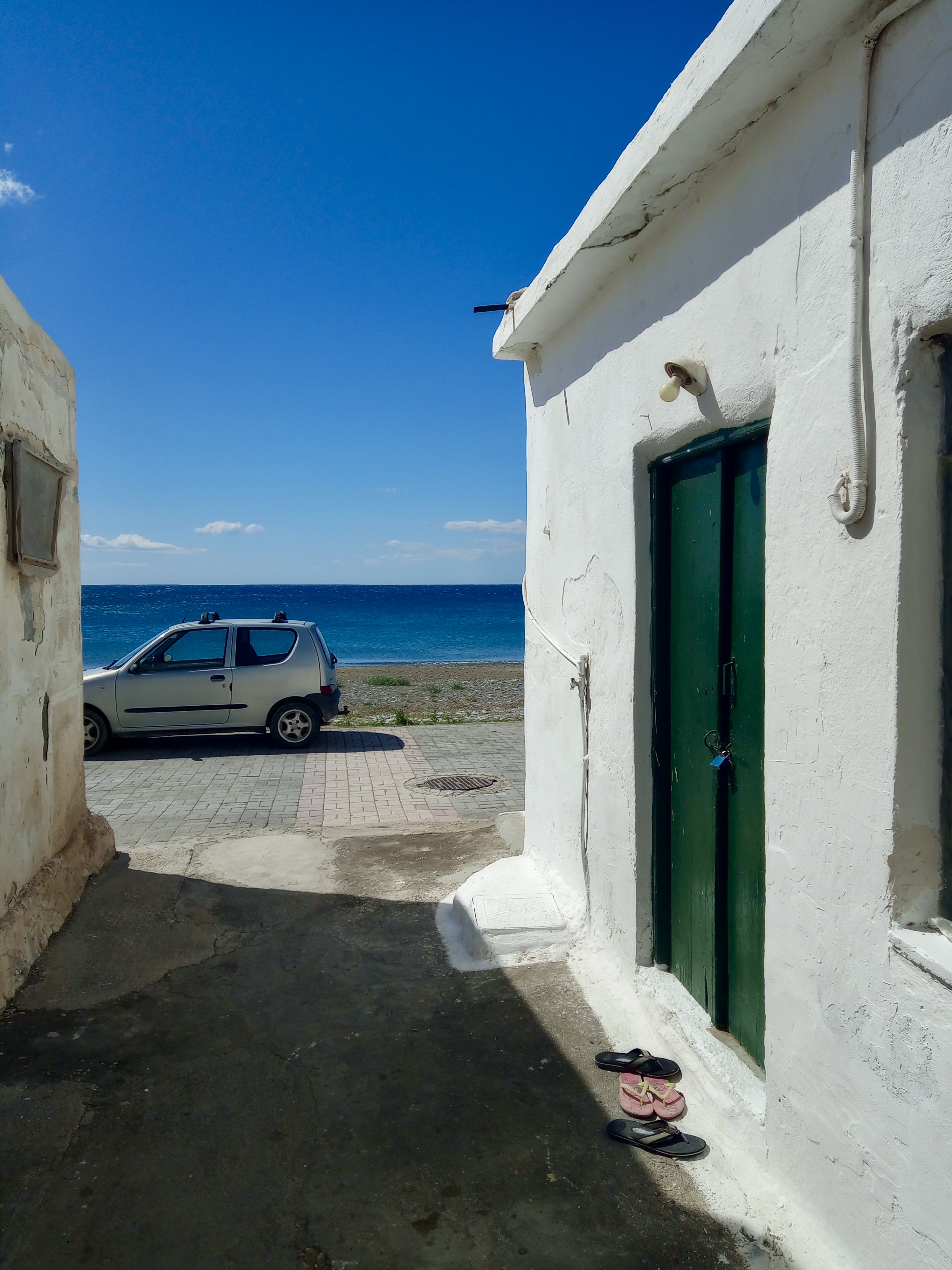
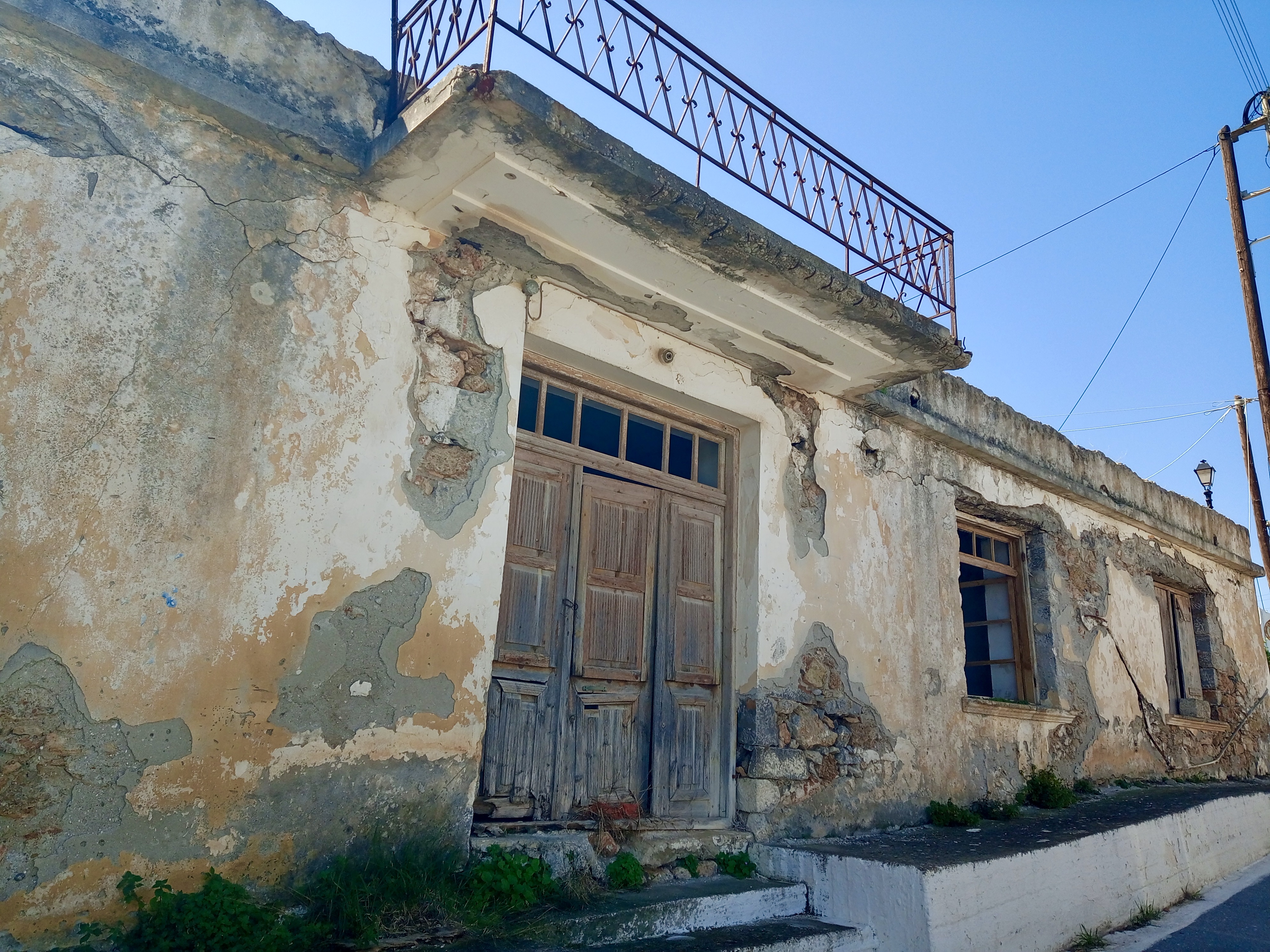
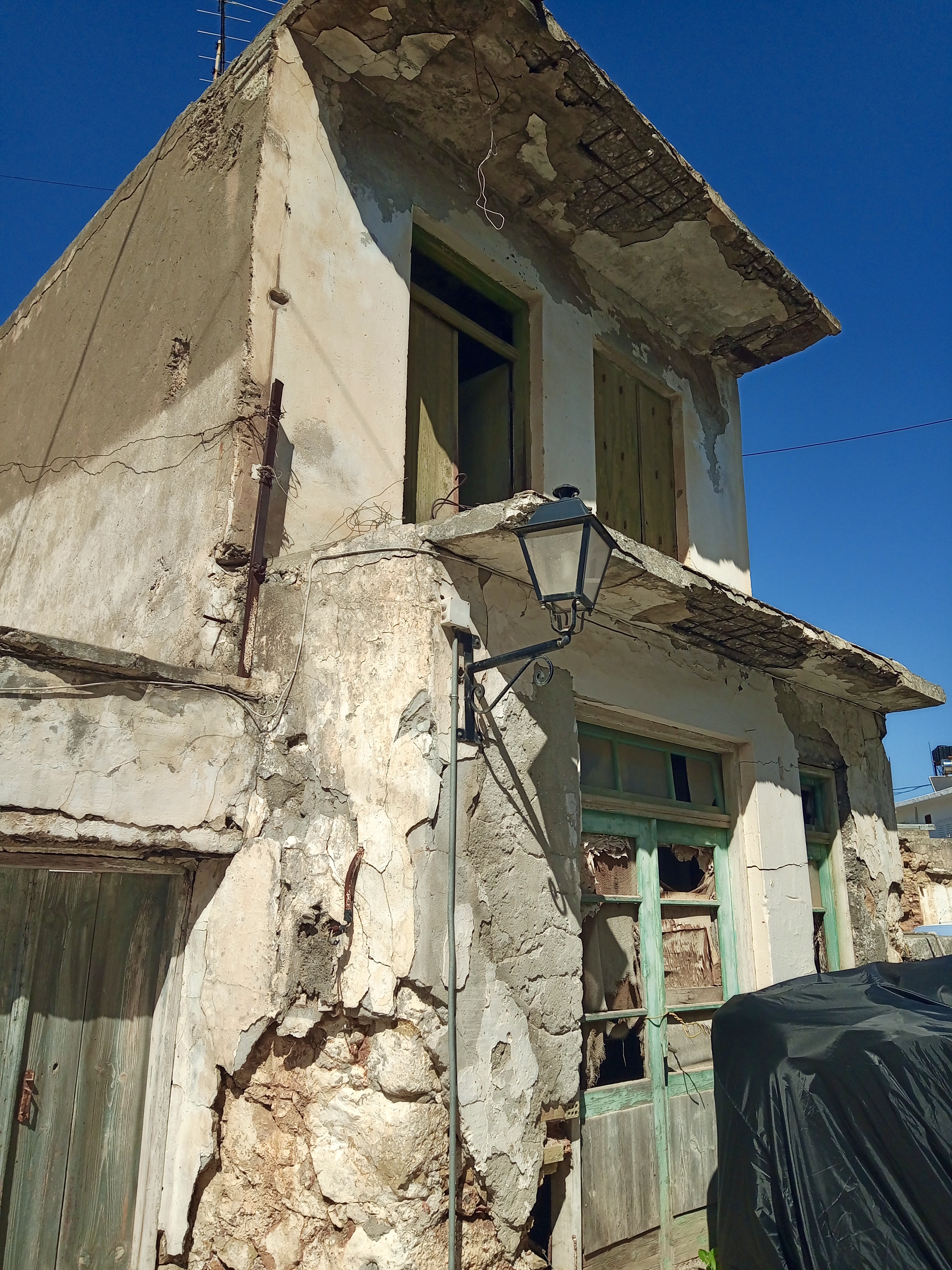
Above: Three shots from our evening walk today. The first is yet another old door that would have a few stories to tell if it could talk. The same applies to the middle shot, which I took through a broken door glass. That cottage has been left exactly as it was when the last occupant died a couple of years ago. I find it so melancholic to study the objects in that room and wonder about the lives that were lived there. The surviving relatives, as is so often the case in Greece, have just left the place closed up and haven’t as yet done anything to work towards either renovating or selling the property on. The third shot shows both Whitesock and Groucho, studying us as we arrive back at our rear garden gate after a half-hour walk.

Click HERE to go to my Amazon Author Page, where you can browse and purchase all of my written works.
Getting all reflective/Do I have to spell it out?

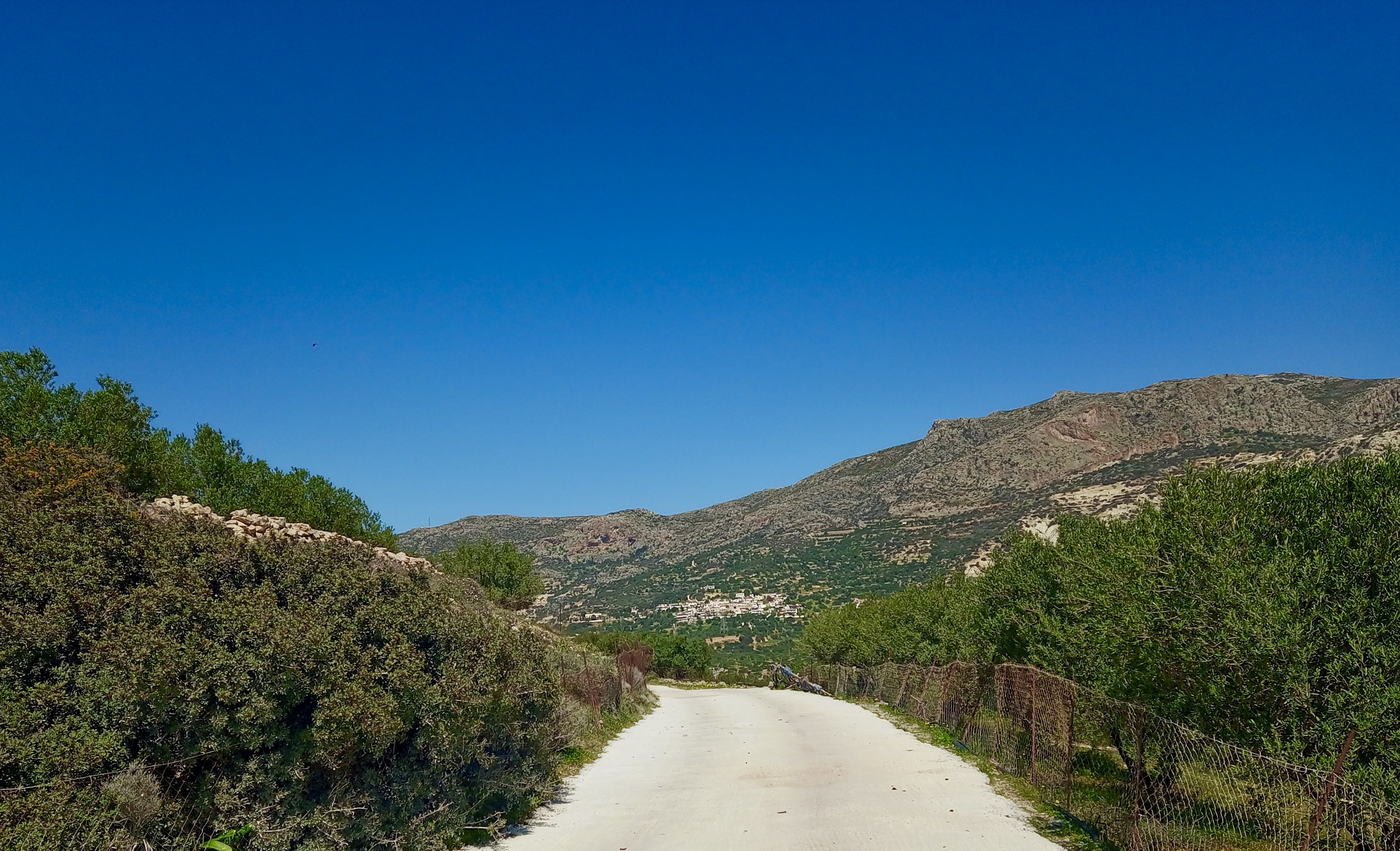
Friday November 8th, 5.07pm just below the village.

The first story below is from a couple of weeks ago, as I was musing about life here in the village:

It’s early evening, and only the softest of breezes is caressing our faces as our neighbour Maria sits across the way on her balcony, head bent towards her sewing. She’s evidently repairing some garment or other and her concentration on what she’s doing is complete. Her mother, Evangelia, is feeding the chickens in their pen just across the metre or so of pathway from her kitchen door. Just a few days ago we were passing the time of day with Maria and asking how Evangelia was doing, since we hadn’t seen her pottering about lately as much as she used to.

Maria is worried about her mother. Maria is about sixty, but still works every season, doing long hard days at a hotel up in Elounda, where she stays overnight for days on end sometimes, owing to the shifts that she works and the fact that it’s a 25 minute drive to get home. Evangelia is in her late eighties and convinced that she has something serious wrong with her. She’s beginning to face up to her mortality, truth be told, and it’s not a welcome thought to entertain. Maria tells us that they’ve taken her for some examinations and the doctors say that there’s nothing of concern to worry about, but Evangelia thinks otherwise. She thinks she may have brain cancer or something. Is this what happens to you when you get to that age? I don’t know, but Maria’s at a loss as to how to comfort her mother. The chickens clucked in the background as we talked, and Maria asked if their sounds bother us at all. 

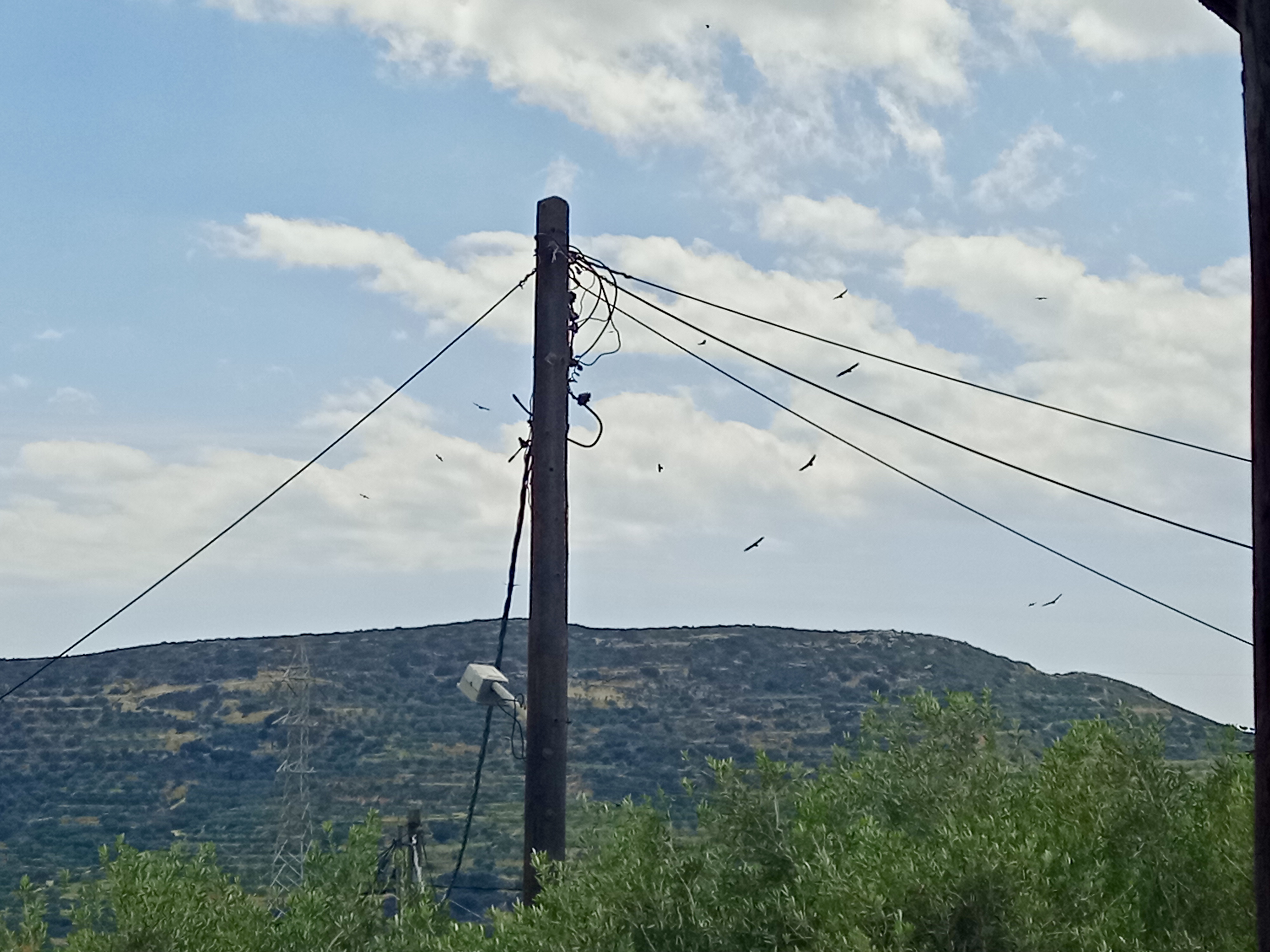
Bother us? A few chickens? We live in a village of only around 100 inhabitants, most of the time the only sounds we hear are of the Griffon Vultures circling the crag, or the buzzards in the valley below, the occasional squawk of a crow. We hear the goat and sheep bells from way across the valley, and the only appreciable noise pollution we experience here is when one or two of the youths who live close by come hairing up the valley on their 50cc mopeds, baffles having been removed from their exhausts in an attempt to make their rides sound more sporty than they really are. I can hardly criticise. Those boys are full of respect whenever they see us, and when I was sixteen, about their age, I had a Lambretta Li150 and I’d done exactly the same with my exhaust pipe too. I thought that the throaty roar would make it go faster and that other youths would look to me with more respect, but all I was probably doing was irritating people of slightly more mature years.

Actually, I assured Maria that I love hearing her mother’s chickens, because when I was growing up, between the ages of around 18 months and ten years of age, my family had lived in a small village around six miles outside of Bath, and our next-door neighbours, the Biggs’, used to keep chickens too. When I sit on our terrace here in our modest little house on Crete sipping coffee of a morning, if I close my eyes when those chickens cluck and scratch around, I can be transported back to the Tunley of the 1950’s with consummate ease.
We sympathised with Maria as she expressed her worries about her beloved mum, who, despite having spent her entire life without having gone more than 10 kilometres from the village, still wanted to live, still wanted to carry on her daily routine, even though it was becoming tougher of late to keep it up, what with sweeping the path outside her door, cooking every day, often for her daughter upstairs, plus for one of her other children, Adonis, one of two sons (both now in their sixties) whom she dotes on, and washing, preparing vegetables, and even slaughtering and plucking a chicken now and then when it’s deemed necessary.

The other Maria, she who lives below us along with her son Dimitri, has recently given up full-time work, and is now working full-time at home. Every time we pass her door and stop for a few words of neighbourly chat, she expresses a feeling of guilt over not having asked us down for a coffee, yet she’s always on the go. She, like our mutual neighbour Evangelia, cooks every day for Dimitri and often her other sons or nephews who all work together running their farm, flocks and herds. She’s always washing clothes or mopping down her veranda, while her laundry flaps in the breeze from the balcony above.  She has a daughter who works and has a toddler, so she is to be seen most days pulling up outside her mother’s house to leave the child with its delighted grandmother for a few hours. 
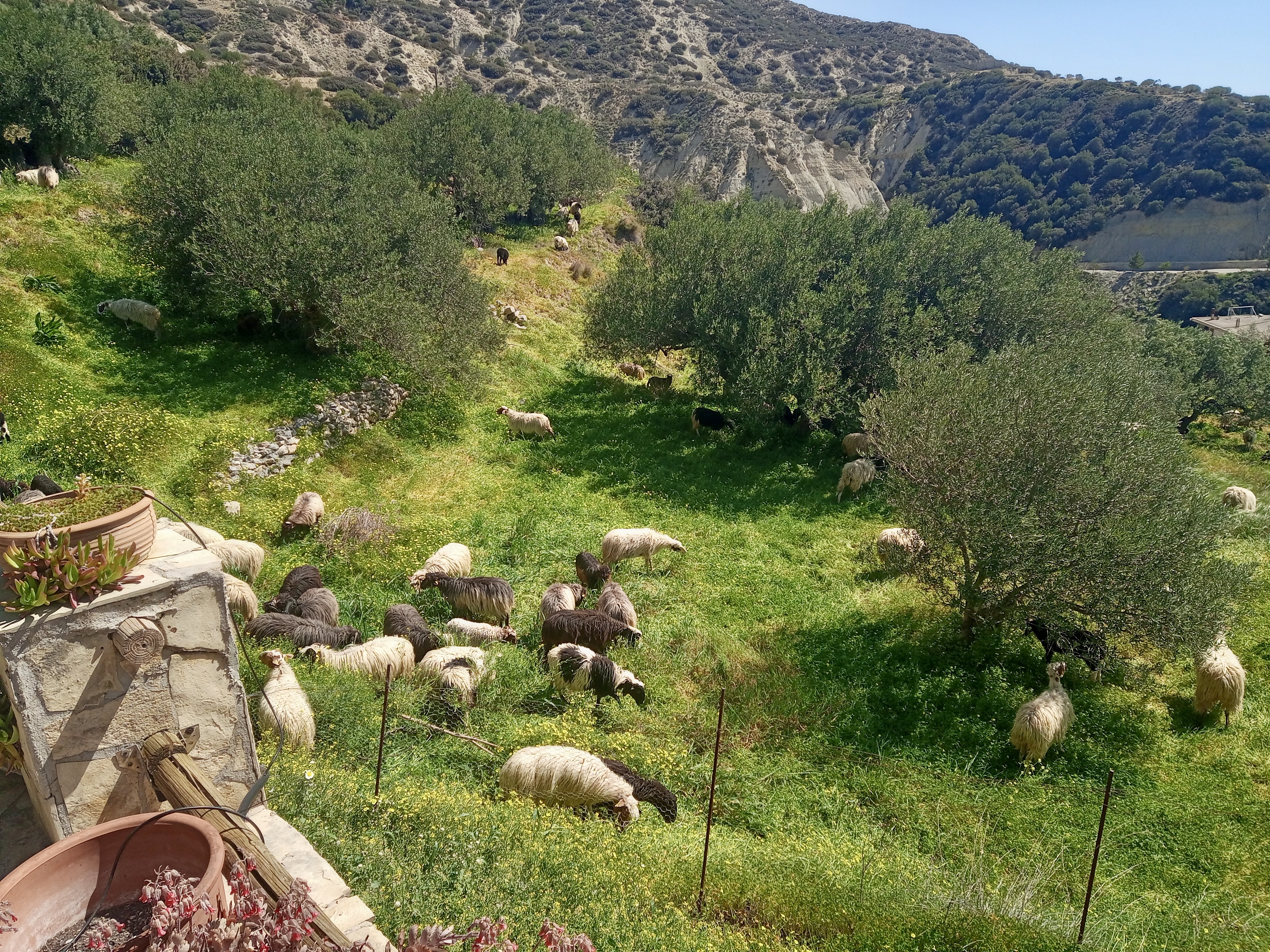
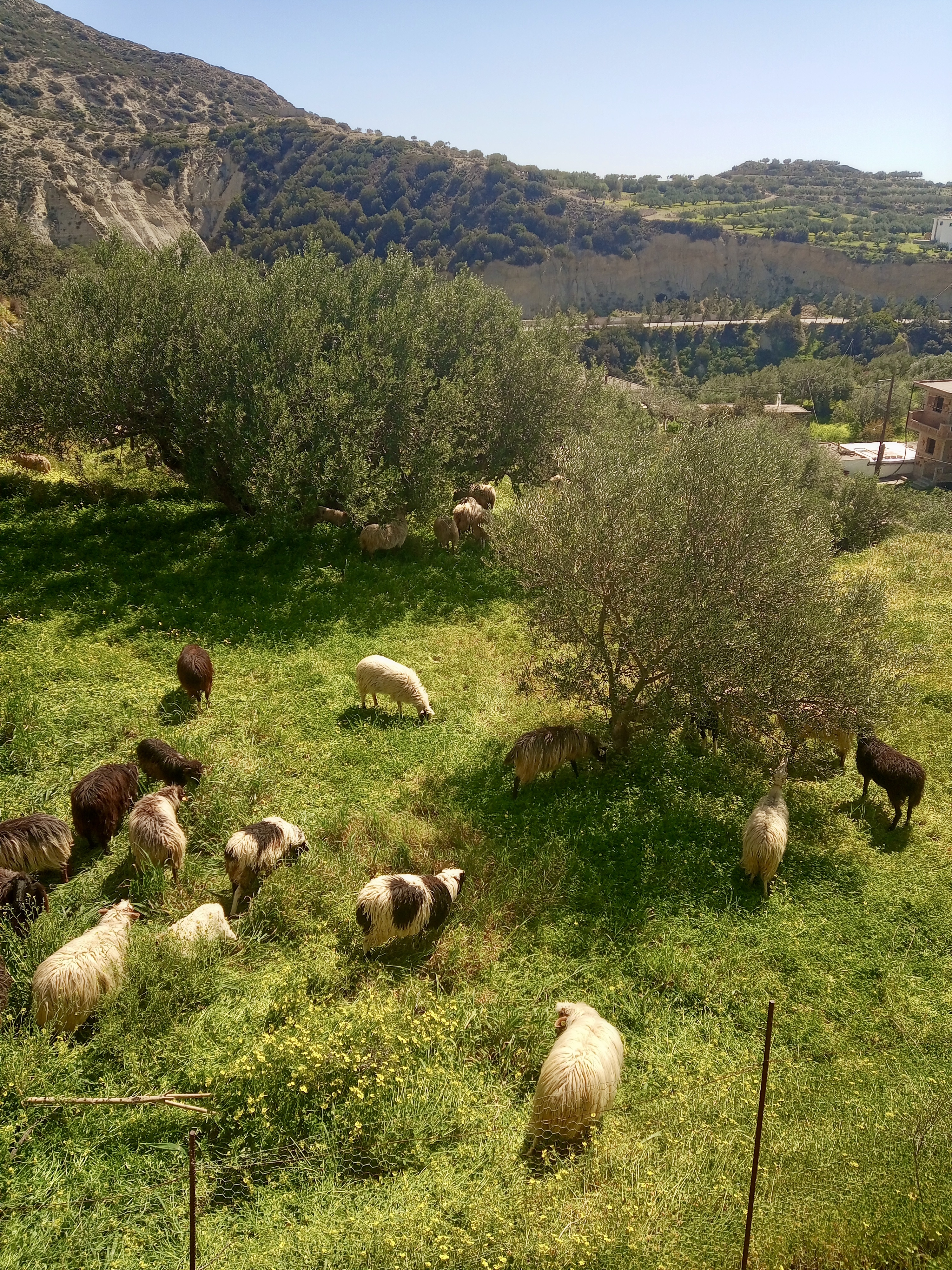
Sometimes Dimitri’s brother or cousin will leave their pickup outside Maria’s house and, although we can’t actually see it from our veranda, we can hear when maybe they have a tiny lamb in the back for some reason or other. The bleating prompts us to wander down and take a look, and usually we’re rewarded with that ‘aah bless’ moment when we see the tiny creature, slightly anxious and evidently wondering what’s going on. They seldom leave any animal there for long, but while there, we usually like to go down and take a peek if we’re at home.

There’s something deeply calming about living in a place like this. We never, ever let a day go by without expressing our appreciation for just how life has turned out for us. I’ve probably said this before, but if anyone had told me just a few decades ago that my life would turn out like this I’d have said they needed some serious therapy. Yet here we are, Next year marks our 20th anniversary of living on a Greek island, and we’ve lived on two in that time. 

The Greeks can be amazingly creative when it comes to transliterating English words into the Greek alphabet. Recently, on Trocho tis tychis (Wheel of Fortune) there have been two separate rounds when the clue was “in the same band.” Now, what amused me was the fact that both bands in question were British and hailed from 50 years ago, when the contestants were still a couple of decades away from even being born yet, so how they were supposed to know these names was a bit of a mystery to start with. Anyway, I thought I’d show you the two rounds in question and see if you can work out who the musicians are and consequently what bands we’re talking about here. If you can’t work it out, to put you out of your misery I’ll be placing the answer on my Facebook page once this post has gone live.

Have a look. The first shot shows three members of a rock band and the second shows four:

This bloke Minas has a lot to answer for. He’s apparently the patron saint of Heraklion. Now, we live around an hour and a quarter from Heraklion and tend to go there two or three times a year, when we need to buy stuff that it’s simply not possible to get in Ierapetra. Sometimes you can get stuff in Ierapetra that you’ll find in Heraklion, but there’s a much larger choice if you go to the city, plus they have a branch of Praktiker, which is a bit like B&Q Depot in the UK. Praktiker sells just about everything, like the Wallmart stores in the USA. The trip from our house to Heraklion takes about an hour and a quarter, so, since we were in the city on Sunday for something else, we decided this time to find a modest little AirBnB to stay in, so that we could hit the stores early on Monday morning.

So far, so good. Now, when we used to live in Rhodes we got caught out a couple of times in the early years when we’d driven all the way to town (which also took us a good hour) only to find that unbeknown to us, there was some kind of bank holiday or religious observance going on and all the flaming stores were closed. Talk about frustrating. Anyway, as a result of this I decided reluctantly to allow the calendar on my laptop to display all the Greek bank holidays (and there are plenty of ’em!), so that we could avoid making the journey, again for nothing. So, this past weekend, OK, it was Remembrance weekend and Monday was the actual day, November 11th. Yes we knew that, but here in Greece it’s not a holiday when all the businesses and stores are closed. So we were fairly confident that, when we got into the town on Monday morning, we’d be able to accomplish some serious retail therapy.

We spent a really cosy night in a lovely compact and bijou little studio about fifteen minutes walk out of the town centre, and it was a snip at €37 for the night. Parking was easy and we knew that we’d be able to leave the car there while going into the town in the morning. The apartment was one of three called the Cocomelo. On Monday morning we got up, checked out and the sun was shining brightly and only a light breeze was blowing as we began walking into the town. The first ten minutes was fine, until we passed a large supermarket that was, for some inexplicable reason, closed and its car park empty. We looked at each other perplexed. Why would a supermarket (one of a large chain in Crete) be closed on a normal Monday morning? After that we began noticing more and more premises that ought to be open and yet weren’t. The only businesses that were all open and doing a brisk trade were the coffee shops.

Of course the beloved’s first reaction was to suggest that I had in some way been mistaken about the date of some Greek festival or bank holiday or other. I had to stress in no uncertain terms that I’d double checked the calendar on my MacBook Pro several times (can one double check something several times?) and there was categorically no national holiday on Monday November 11th. The last one had been Ochi Day on October 28th and the next would be Polytechneio on the 17th. The Greek calendar is peppered with observances where everything closes and there’ll be marches in the streets, religious folk carrying icons this way and that, even soot being thrown around (at least it was in Arhangelos on Rhodes during Tsiknopempti in March) and so on. Most of these involve the stores being closed for the day and very often they’ll do what they do in the UK and attach the celebration to a Monday, so as to extend the weekend a little.

The odd thing was, as we finally got into town, it was to our immense dismay to find that all the stores were closed. Apart from the coffee shops, nothing was open for business. Talk about irritating. And it’s all down to this bloke Minas. It seems that this particular ‘holiday’ is unique to Heraklion. That’s why it didn’t figure on the calendar, since it doesn’t apply to anywhere else in Greece, not even to other towns on Crete. Grrrr. So, apart from a coffee and a bite, we couldn’t do anything else but drive home. I’ll tell you something, never again are we going to plan a visit to Heraklion on a flippin’ Monday.

I think I’ll cheer myself up with some recent photos…

Above: November 2nd, 11.00am, seafront Ierapetra.

Above: The town beach, 5th November. Quieting down for the winter.

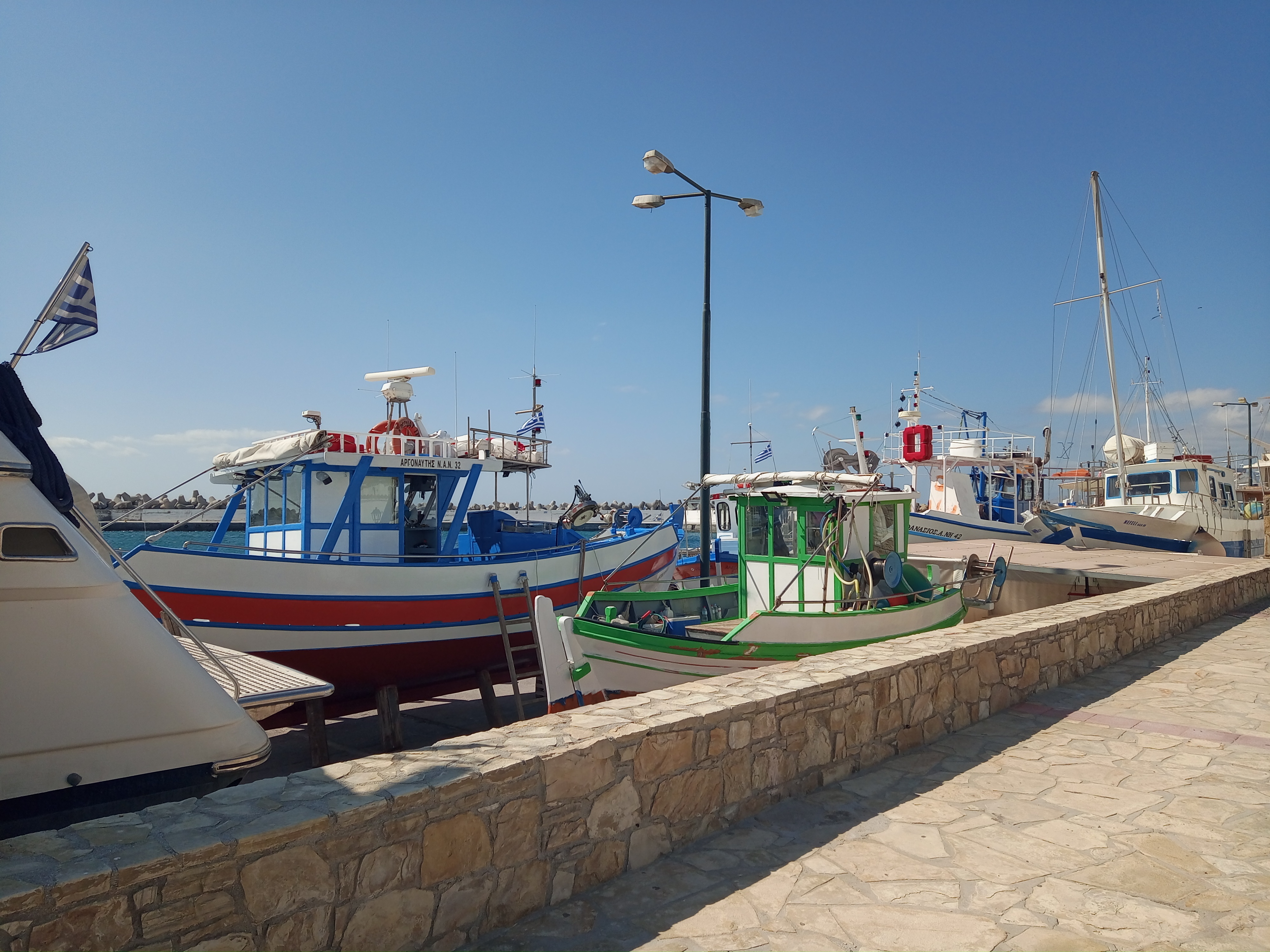
Above gallery of 3: Seafront and harbour area, 5th November, 12.11pm

Above: Commuters we met on the road home from Ierapetra, 5th November, 1.12pm. And finally…

Above: The veranda at our house. Wide angle view. Friday 8th November, 4.45pm.

Click HERE to go to my Amazon Author Page, where you can browse and purchase all of my written works.