When we went back to the UK last month it was the first time either of us had left Greece for seven years. So, the last time we’d travelled back to the UK was when Britain was still in the European Union. None of this was on my mind when we arrived at the passport control desk on our way into the departure lounge at Heraklion airport, of course. Joining the queue to approach the glassed-in desk, behind which sat a couple of young Greek officials in smart uniforms, I thought, ‘it won’t take long to get through this part, they seem to be moving the passengers through at a fairly brisk trot.’ Of course, since it was an EasyJet flight we were taking, the majority of the passengers were British, with just a small smattering of Greeks in the mix.
When I reached the desk it was a pretty young lady who took my passport from me to examine it. I fully expected her to glance at the relevant page, hand it back to me and wave me through, as she had done with the dozen or so people that had been in the queue in front of me. She opened the passport, then began to thumb through the pages, most of which, as we all know, are blank. She appeared to do this a couple of times, all the while the expression on her face was becoming more indicative of her being somewhat flummoxed. Her brow now firmly knotted with disbelief, she nudged the uniformed young man sitting next to her, whose queue had now temporarily disappeared, and bade him look through my passport too. What on earth was going on?
We all know that it doesn’t matter how innocent and law abiding we may be, having to wait while officials, especially the uniformed variety, peruse our papers, passport, or whatever, can unnerve us no end. By the time a couple of minutes had passed, and I was still standing there with one hand resting on the desk near the gap in the glass, in readiness to receive my passport back, and a tingly chill beginning to run down my spine, I started to get really worried. I knew that my passport still had enough time on it before it needed renewal, just. So what was going on here? The young lady, my passport in her left hand, began tapping at her keyboard with her right and staring at her computer screen, evidently looking for something, but what? It’s at times like these when your imagination starts to do you no favours at all, isn’t it. I had visions of being escorted to some private room somewhere, only to encounter someone in a white coat slapping on a pair of latex gloves. Had my passport been hacked and duplicated in some way by some major international crook, and did these two young officers maybe think that I was that person?
Just when I was starting to really freak out, the young lady looked at me, smiled and said, in Greek, “Do you have a biometric residency ID card by any chance?”
Of course, I did, and was only too quick to extract it from my purse and show it to her. She took it from me, took a very brief look at it, showed it to her comrade, and then she handed it back, along with my passport, smiled and said, “OK, thank you sir, have a good flight.”
So, as I shuffled through into the madness that is a departure lounge, with all its perfume shops and bookstores, its rucksack, clothing and electronic gadget retail outlets, its hordes of passengers all trying to grab one of the far too inadequately provided curvy metal seats, I was mystified to begin with about what had gone on back there. Yvonne was behind me in the queue and I was fortunately able to tell her to have her residency card ready when she reached the desk, hence probably avoiding that pregnant delay that had so put the wind up me, and she did indeed pass through with no delay as a result. But what had been the problem?
Now, if you live in the UK and you’ve travelled to Greece since Britain left the E.U., then maybe you’ll know, but the only conclusion that I could come to about what had gone on was this…
The officials had no idea that we were actually on our outbound flight. My presenting a UK passport to her had obviously led her to think that I was returning to Britain after a holiday in Greece, rather than going to the UK for a short visit, before at some later date taking our inbound flight back here to Greece. So, isn’t it true that, now the UK is out of the European Union, UK residents can only stay in a European country for a maximum of 90 days (not sure if that’s the right number, but the principle is what I’m getting at here)? That being the case, if you’re travelling from the UK to Greece for a holiday, I’m presuming that your passport gets stamped with the date on which you entered Greece on your arrival, yes? So, in that case, what I now assume that the young lady official was looking for was a rubber stamp in my passport showing my date of arrival in the country. Not finding it, she was thinking, ‘hold on, how long’s this bloke been in Greece then?’
Fortunately for me, she was bright enough to conclude that I must have been an ex-pat living here full time and, that being so, I’d obviously have a residency permit to show for it. She’d been right of course, and thus, problem solved. Phew.
•

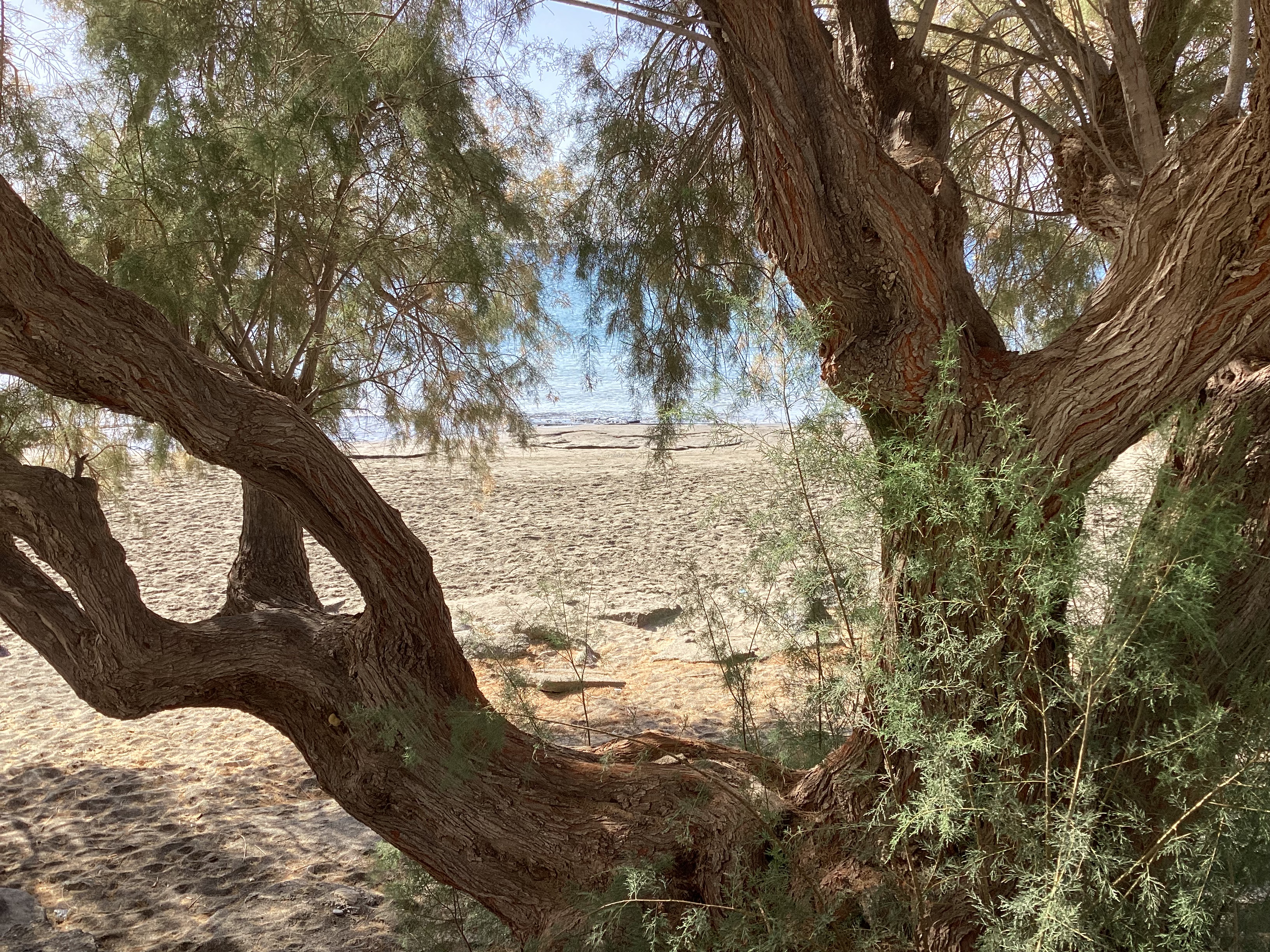
On the beach a week or so before we left for the UK, we got talking to a nice couple who we see regularly taking their coffees there and also having a dip, much as we do a couple or three times a week. In the course of a summer, you get to know a lot of local people when you frequent the same patch of beach every week. Here in Ierapetra, I’m thrilled to say, the beach is never overcrowded and still, even in high season, the majority of people around you are locals. Having now lived here for five years and counting, we actually have a nodding relationship with quite a lot of people, and it’s a nice feeling. It’s a community, if you like. The more regularly you see the same few people, even those who serve you your drinks, the more you tend to converse, and hence the more you find out about their lives, and they yours, of course. For instance, there’s this lovely young couple, in their thirties I’d guess, Effie and Gianni. They invariably grab an umbrella quite nearby and so, after having greeted them with a ‘kalimera’ a few times, it was only inevitable that the conversation would progress to “The sea’s really lovely today,” or “Didn’t see you yesterday, where were you?”
It soon progresses on to them wanting to find out where we’re from and what our background is, and vice versa. Quite a few of the regulars we talk to now had us wondering in the beginning about how they could afford to turn up at the beach at around 11.00am, then order their coffees and hang out for a couple of hours, taking the occasional dip along the way. Didn’t they have work to go to, for example? In Effie and Gianni’s case, they have a series of thermokipia (hothouses) where they grow vegetables not only for the local market, but also for exporting all over Greece. They’re actually up at the crack of dawn, get to work for around 6.00am and then knock off mid-morning for a few hours, before returning to work late afternoon for another few hours before knocking off for the day around 8.30pm.
Then there’s Giorgo, who actually drives a truck collecting and delivering from the farmers in our area and is based in Heraklion. He comes down to Ierapetra every day during the week, where he’ll collect produce to drive it back to the port town. But, while he’s here, he manages to steal an hour or two for a bit of R&R on the beach. He sets out from Heraklion before light most days and is back there by mid-afternoon, when he’ll knock off for the day. It was really fortuitous our getting to know Giorgo, because in the course of one conversation a while back he offered to bring us anything that we might want that we might need to go to Heraklion for, to save us making the trip ourselves. As it happened, we had been fretting about needing a fresh supply of Earl Grey tea. OK, so Lidl do their own brand (Lord Nelson) and they have a branch in Ierapetra, but, even though I rate a lot of their products highly, the Earl Grey is (IMHO) rubbish. If it has any Bergamot oil in it, then I’ve never been able to detect it. On the other hand, Marks and Spencer have a branch in Heraklion and we’ve found that our favourite Earl Grey tea ever (and we’ve been through Twinings, Liptons, Sainsbury’s own, not to mention a host of organic brands, over the years) is Marks and Spencer’s own.
So, when Giorgos told us that he’d be glad to bring us anything we may want from Heraklion, we put our order in. When we told him we’d love a few boxes of M&S Earl Grey tea-bags he was incredulous. “That store only does clothes, doesn’t it?” He asked us. We were only too delighted to inform him that he was quite wrong. Anyway, his wife was duly despatched into town and a couple of days later our order arrived, courtesy of the very helpful Giorgo.
As we handed him the cash for the tea, I told him that we’d now ordered a lounge suite from Praktiker. It took him a second or two before he exploded in a belly laugh at my joke.
•
Mavkos continues to show up most days. He’s become more affectionate with each visit and has now reached the stage where he doesn’t like to finish his meal without a frequent smooth of the head. Part way through eating he’ll stop, raise his head, and look around and won’t resume eating until he’s had a ‘smooth.’ I even got to pick him up yesterday, something which he used to demand to happen before he’d eat his breakfast back before he disappeared for all those months. The only problem we now seem to have is that Ginge is well unhappy about Mavkos being back on the scene and regularly looks for opportunities to have a go at him. Ah well, we’ll see what plays out with time.


•
Click HERE to go to my Amazon Author Page.
There you can browse and purchase all of my written works.


 Accretions