Variety pick ’n mix

When we went back to the UK last month it was the first time either of us had left Greece for seven years. So, the last time we’d travelled back to the UK was when Britain was still in the European Union. None of this was on my mind when we arrived at the passport control desk on our way into the departure lounge at Heraklion airport, of course. Joining the queue to approach the glassed-in desk, behind which sat a couple of young Greek officials in smart uniforms, I thought, ‘it won’t take long to get through this part, they seem to be moving the passengers through at a fairly brisk trot.’ Of course, since it was an EasyJet flight we were taking, the majority of the passengers were British, with just a small smattering of Greeks in the mix.

When I reached the desk it was a pretty young lady who took my passport from me to examine it. I fully expected her to glance at the relevant page, hand it back to me and wave me through, as she had done with the dozen or so people that had been in the queue in front of me. She opened the passport, then began to thumb through the pages, most of which, as we all know, are blank. She appeared to do this a couple of times, all the while the expression on her face was becoming more indicative of her being somewhat flummoxed. Her brow now firmly knotted with disbelief, she nudged the uniformed young man sitting next to her, whose queue had now temporarily disappeared, and bade him look through my passport too. What on earth was going on?

We all know that it doesn’t matter how innocent and law abiding we may be, having to wait while officials, especially the uniformed variety, peruse our papers, passport, or whatever, can unnerve us no end. By the time a couple of minutes had passed, and I was still standing there with one hand resting on the desk near the gap in the glass, in readiness to receive my passport back, and a tingly chill beginning to run down my spine, I started to get really worried. I knew that my passport still had enough time on it before it needed renewal, just. So what was going on here? The young lady, my passport in her left hand, began tapping at her keyboard with her right and staring at her computer screen, evidently looking for something, but what? It’s at times like these when your imagination starts to do you no favours at all, isn’t it. I had visions of being escorted to some private room somewhere, only to encounter someone in a white coat slapping on a pair of latex gloves. Had my passport been hacked and duplicated in some way by some major international crook, and did these two young officers maybe think that I was that person? 

Just when I was starting to really freak out, the young lady looked at me, smiled and said, in Greek, “Do you have a biometric residency ID card by any chance?”

Of course, I did, and was only too quick to extract it from my purse and show it to her. She took it from me, took a very brief look at it, showed it to her comrade, and then she handed it back, along with my passport, smiled and said, “OK, thank you sir, have a good flight.

So, as I shuffled through into the madness that is a departure lounge, with all its perfume shops and bookstores, its rucksack, clothing and electronic gadget retail outlets, its hordes of passengers all trying to grab one of the far too inadequately provided curvy metal seats, I was mystified to begin with about what had gone on back there. Yvonne was behind me in the queue and I was fortunately able to tell her to have her residency card ready when she reached the desk, hence probably avoiding that pregnant delay that had so put the wind up me, and she did indeed pass through with no delay as a result. But what had been the problem?

Now, if you live in the UK and you’ve travelled to Greece since Britain left the E.U., then maybe you’ll know, but the only conclusion that I could come to about what had gone on was this…

The officials had no idea that we were actually on our outbound flight. My presenting a UK passport to her had obviously led her to think that I was returning to Britain after a holiday in Greece, rather than going to the UK for a short visit, before at some later date taking our inbound flight back here to Greece. So, isn’t it true that, now the UK is out of the European Union, UK residents can only stay in a European country for a maximum of 90 days (not sure if that’s the right number, but the principle is what I’m getting at here)? That being the case, if you’re travelling from the UK to Greece for a holiday, I’m presuming that your passport gets stamped with the date on which you entered Greece on your arrival, yes? So, in that case, what I now assume that the young lady official was looking for was a rubber stamp in my passport showing my date of arrival in the country. Not finding it, she was thinking, ‘hold on, how long’s this bloke been in Greece then?’ 

Fortunately for me, she was bright enough to conclude that I must have been an ex-pat living here full time and, that being so, I’d obviously have a residency permit to show for it. She’d been right of course, and thus, problem solved. Phew.

On the beach a week or so before we left for the UK, we got talking to a nice couple who we see regularly taking their coffees there and also having a dip, much as we do a couple or three times a week. In the course of a summer, you get to know a lot of local people when you frequent the same patch of beach every week. Here in Ierapetra, I’m thrilled to say, the beach is never overcrowded and still, even in high season, the majority of people around you are locals. Having now lived here for five years and counting, we actually have a nodding relationship with quite a lot of people, and it’s a nice feeling. It’s a community, if you like. The more regularly you see the same few people, even those who serve you your drinks, the more you tend to converse, and hence the more you find out about their lives, and they yours, of course. For instance, there’s this lovely young couple, in their thirties I’d guess, Effie and Gianni. They invariably grab an umbrella quite nearby and so, after having greeted them with a ‘kalimera’ a few times, it was only inevitable that the conversation would progress to “The sea’s really lovely today,” or “Didn’t see you yesterday, where were you?”

It soon progresses on to them wanting to find out where we’re from and what our background is, and vice versa. Quite a few of the regulars we talk to now had us wondering in the beginning about how they could afford to turn up at the beach at around 11.00am, then order their coffees and hang out for a couple of hours, taking the occasional dip along the way. Didn’t they have work to go to, for example? In Effie and Gianni’s case, they have a series of thermokipia (hothouses) where they grow vegetables not only for the local market, but also for exporting all over Greece. They’re actually up at the crack of dawn, get to work for around 6.00am and then knock off mid-morning for a few hours, before returning to work late afternoon for another few hours before knocking off for the day around 8.30pm.

Then there’s Giorgo, who actually drives a truck collecting and delivering from the farmers in our area and is based in Heraklion. He comes down to Ierapetra every day during the week, where he’ll collect produce to drive it back to the port town. But, while he’s here, he manages to steal an hour or two for a bit of R&R on the beach. He sets out from Heraklion before light most days and is back there by mid-afternoon, when he’ll knock off for the day. It was really fortuitous our getting to know Giorgo, because in the course of one conversation a while back he offered to bring us anything that we might want that we might need to go to Heraklion for, to save us making the trip ourselves. As it happened, we had been fretting about needing a fresh supply of Earl Grey tea. OK, so Lidl do their own brand (Lord Nelson) and they have a branch in Ierapetra, but, even though I rate a lot of their products highly, the Earl Grey is (IMHO) rubbish. If it has any Bergamot oil in it, then I’ve never been able to detect it. On the other hand, Marks and Spencer have a branch in Heraklion and we’ve found that our favourite Earl Grey tea ever (and we’ve been through Twinings, Liptons, Sainsbury’s own, not to mention a host of organic brands, over the years) is Marks and Spencer’s own. 

So, when Giorgos told us that he’d be glad to bring us anything we may want from Heraklion, we put our order in. When we told him we’d love a few boxes of M&S Earl Grey tea-bags he was incredulous. “That store only does clothes, doesn’t it?” He asked us. We were only too delighted to inform him that he was quite wrong. Anyway, his wife was duly despatched into town and a couple of days later our order arrived, courtesy of the very helpful Giorgo.

As we handed him the cash for the tea, I told him that we’d now ordered a lounge suite from Praktiker. It took him a second or two before he exploded in a belly laugh at my joke. 

Mavkos continues to show up most days. He’s become more affectionate with each visit and has now reached the stage where he doesn’t like to finish his meal without a frequent smooth of the head. Part way through eating he’ll stop, raise his head, and look around and won’t resume eating until he’s had a ‘smooth.’ I even got to pick him up yesterday, something which he used to demand to happen before he’d eat his breakfast back before he disappeared for all those months. The only problem we now seem to have is that Ginge is well unhappy about Mavkos being back on the scene and regularly looks for opportunities to have a go at him. Ah well, we’ll see what plays out with time.

Click HERE to go to my Amazon Author Page.

There you can browse and purchase all of my written works.
Village People

This is indeed a huge island. I know I’ve probably mentioned this before, but Crete is as wide from West to East as Wales UK is from North to South. To get from where we live to Chania is about 220 kilometres, or about three and a half hours by road, and that’s nowhere near the full distance from coast to coast, as Chania is still another 47 kilometres from Platanos in the West, and from our village to Kato Zakros on the East coast is about 83 kilometres. Plus, the roads you’d need to travel in order to complete both journeys are anything but straight and wide.

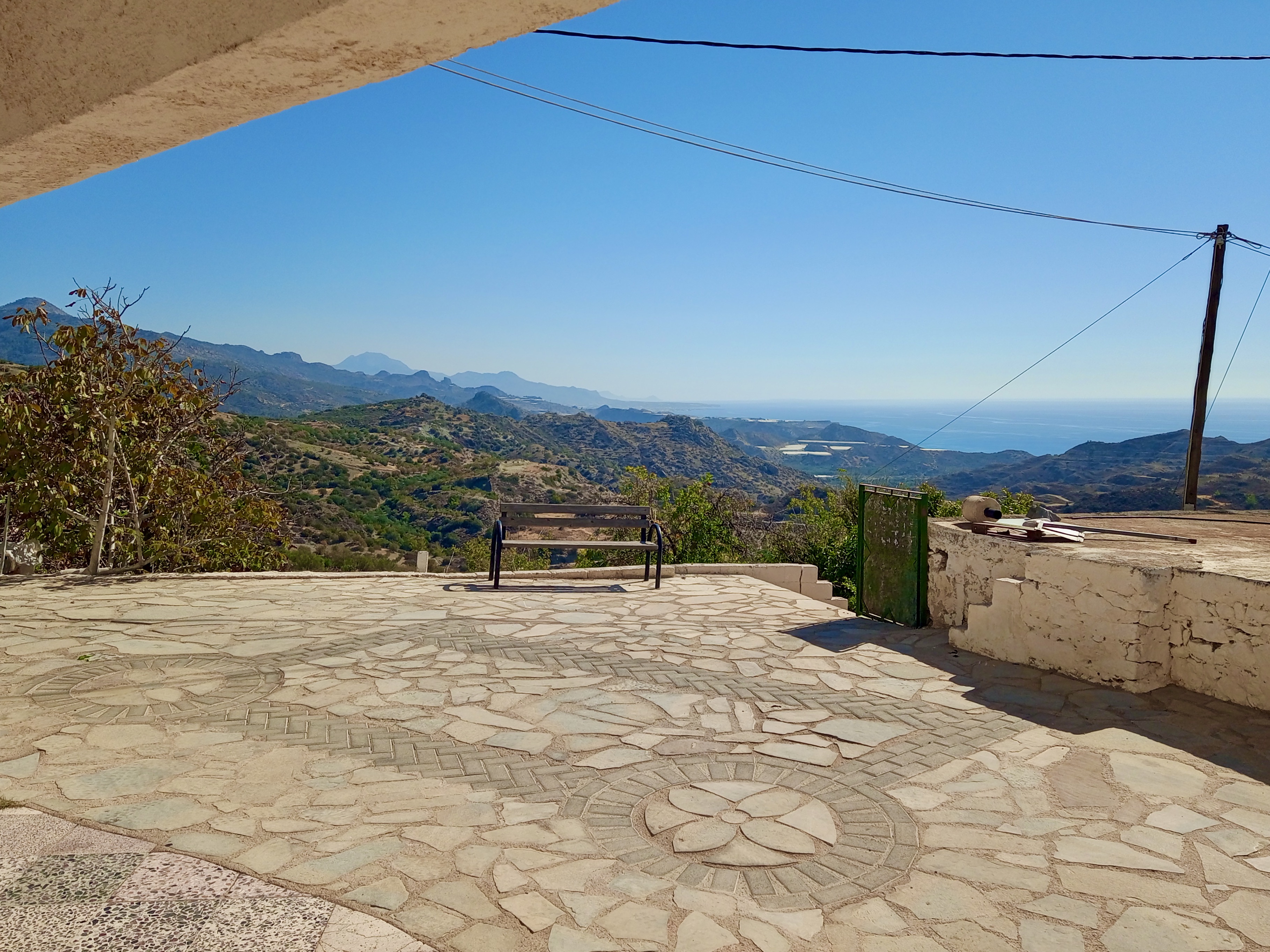
Peppered all across the steep mountainsides of the island are innumerable villages, ranging from small hamlets of a few houses, to those with a selection of shops, kafeneions and even the occasional branch of a bank. It never ceases to fascinate us to visit a small village from time to time, simply to absorb the ambience, take in the often breathtaking views, and marvel at the tenaciousness of those residents who still live in the less accessible ones. If you take what’s laughably called the ‘main road’ west from Ierapetra, you very soon start ascending steep mountainsides and negotiating hairpin bends, often without safety barriers, that would make even James Bond break into a sweat. You need your wits about you and to engage very low gears in order to get round some of those bends without plunging over the all-too-close-by edge and plummeting hundreds of feet down a wooded hillside to a certain death.

Once you get past Myrtos, where the road takes a sharp turn to the right away from the coast and up into the hills, you don’t drive without paying very rapt attention to what you’re about, and all the more so if you have a passenger or three, since their lives are in your hands, after all.

Thus it was that on the morning of Sunday September 29th we found ourselves taking a random left turn a thousand feet or so above the coast to the west of Myrtos, where the sign informed us that the only village at the end of the road we were taking was called Gdochia (pronounced, if you can manage it guhdO’hia, with a soft guttural ‘g’ and a ‘d’ that’s like the ‘th’ in ‘the’, got it?). As you descend the mainly single track lane (at least it is tarmac-ed), you catch amazing glimpses of steeply sloping mountains, clad primarily in olive groves, but also with maquis (look it up! Well, ‘cos I’m such a nice bloke, I’ve done it for you, just click that link to find out) through which you momentarily see the azure and glistening Libyan Sea far below.

When you enter the village the word ‘sleepy’ instantly comes to mind. Talk to a few residents and you find that the place is probably only populated by around fifty or so souls these days. In fact the Wikipedia entry says its populations is currently around 30, whereas around twenty years ago it was over a hundred, and thereby hangs a familiar tale, told by small villages all over not only Crete, but rural Greece in general.

Myrtos is the first half-decently populated village/town to the East, and that’s around 6km away down a tortuously twisty-turny road. Heading west you’d arrive at Viannos in around 25 minutes, and the distance is about 19km. Getting out of Gdochia to travel to Iepapetra, you expect to drive for at least half an hour, and it’s only 22km. How quickly would you cover 22km (less than 14 miles) in the UK, for example? I suppose it would depend on which roads you were taking, but I’d say you’d more often than not cover that distance in around half that time.

One dark episode in the village’s history, and it’s a sadly familiar tale all across this island, was in September 1943, when the Nazis executed over 40 of the residents. Best leave that subject for now, although, as, is the case with so many of these villages, the more senior residents still remember such horrific events as if they were yesterday. And the residents of villages like Gdochia are now primarily elderly ones. It’s the case everywhere, since such villages as this one subsisted for centuries on farming, and the residents by and large seldom went more than a few kilometres away from their home village throughout their whole lives. Ierapetra, to a 19th century Gdochia resident, may as well have been in Australia, for all the chances they were ever going to have of going there.

Thus it’s easily understandable why such villages are haemorrhaging residents. In the past half-century or more, with the advent of technology, has come the desire on the part of young ones growing up to experience the consumer society, street cafés, restaurants, dance clubs, office jobs where they don’t need to get their hands dirty and that free them from 12 hour days toiling with back bent under the sweltering sun. Designer clothes and smart phones, cars and flash motorbikes, beaches where the young and beautiful hang out, all this you don’t get to experience if you follow on from your forefathers tilling the hard soil to grow vegetables, or perhaps produce olive oil.

In Gdochia, I’d say maybe half of the residents are now ex-pats from Germany and France, who’ve bought into this whole ‘small village among the bougainvillea, vines and olive groves’ dream. I’m not knocking those who’ve chosen this village to fulfil their dream, but it wouldn’t be for Yvonne and I, no. Since the village has no general store, and not even a kafeneion any more, if you simply wanted a carton of milk, or a few provisions, you’re looking at an hour’s journey by car there and back, probably down the serpentine mountainside into the coastal village of Myrtos. If you wanted to simply go out for the evening, the journey is a trying one there and back. Where we live, we have the best of both worlds. Our village is less than ten minutes from town, still has a rudimentary kafeneion, and yet is nevertheless a world away from the hubbub of a busy urban area.

Of the Greeks who still live in Gdochia, where so many properties are now closed up and silently rotting away, I’d say no one’s under around fifty years old. Those that are from that age upwards are among the doughty tough Greeks who yet decide to stay on the land, run around in pickup trucks and exhibit faces that display premature wrinkles owing to long days out in the Greek sun.

So, there you have it, my synopsis of the village people of Greece, born of a visit to one tiny hamlet. What the solution is to so many once thriving villages silently and relentlessly falling into decay and desolation, I don’t pretend to know. All I do know is that, if you want to experience such places while they still cling on to some semblance of life, do it soon, as many of these villages will for sure be ghost-towns within a decade to two.

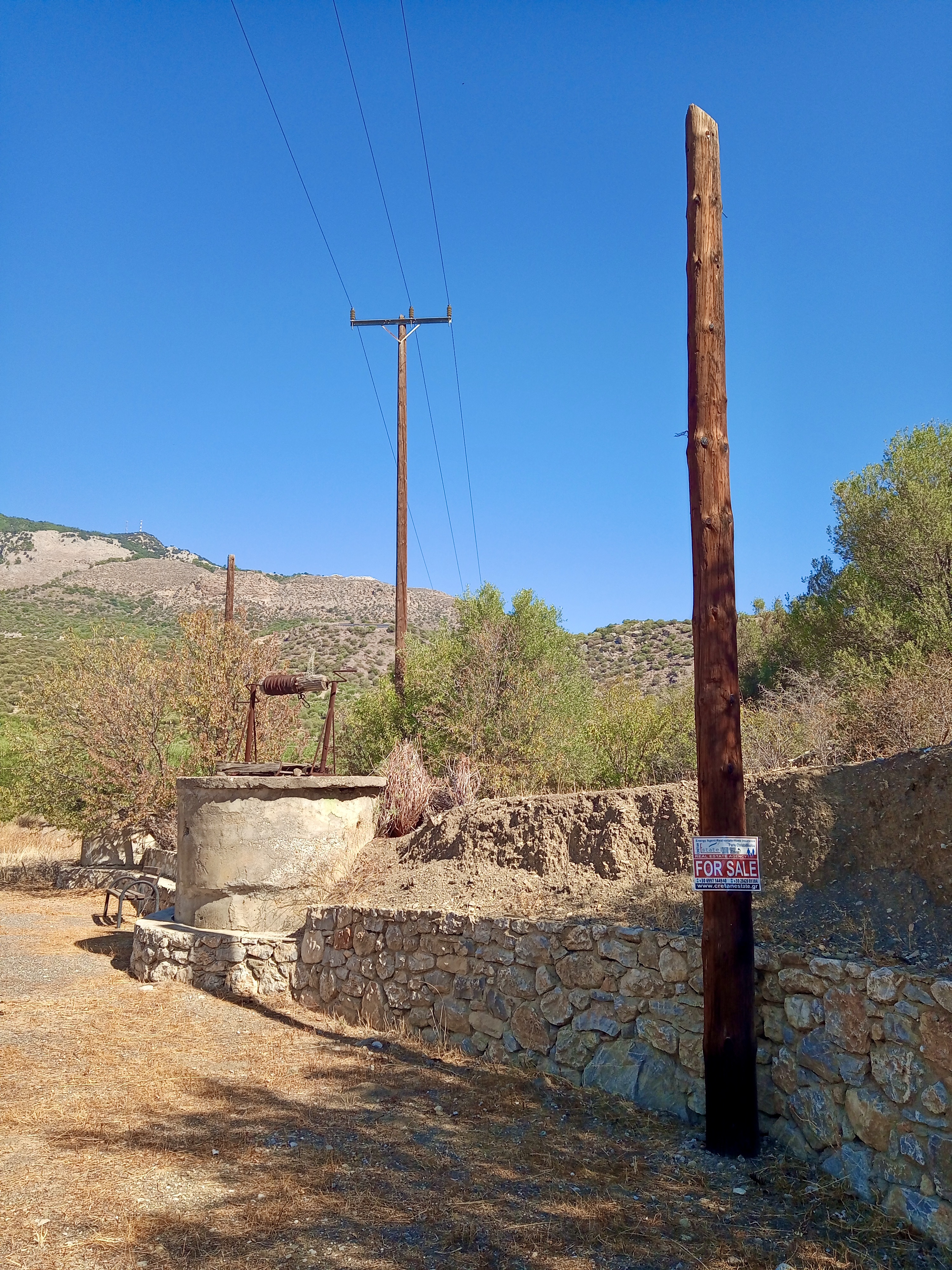
Below: Anyone want to buy a wooden post?

Click HERE to go to my Amazon Author Page. There you can browse and purchase all of my written works.

Appreciation, plus a rant about plastic inflatables

At this time of the evening, around 6.00pm in late September, the light of the sinking sun, viewed from our French windows or out on the veranda, for it’s only around an hour now until it sets behind the hills to our right, is quite magical as it throws into sharp contrast the shadows on the two hills that sit a few kilometres across the valley to the south of us. Even though they’re that far away, the bells of the local herd of goats are clearly audible, and the individual shadows of thousands of olive trees are pin-prick sharp. The sun, just for half an hour or so, sends its shafts across the northern slopes of those two hills owing to its prescribed arc in the daily sky during this season, and then it’s gone.

To the left of both hills, we watch the glistening last rays twinkling on the vast Lybian Sea, and further to the right between those two hills we can just make out another patch of sea, and, through that gap, as if positioned there deliberately, the island of Chrissi is clearly visible on days when the humidity is low enough to permit distant vision. It’s an island that has long drawn the interest of sun-seeking visitors and, when we first moved here in 2019, six or seven boatloads of lobster-red, shorts-wearing, sunglass-toting sun seekers would ply their way there from Ierapetra sea front throughout the summer season, their rucksacks perched between their knees as they sat aboard the vessels for the hour-long trip. These folk would be bussed here from other locations like Agios Nikolaos and Elounda, maybe even further away too, their coaches would park up a little way along the sea front from the harbour where the boats were tied up, and the reps would shepherd their flocks of human pleasure seekers as they walked in teams along the promenade to the area where they’d go aboard.

It always used to put me in mind of my ten years as an excursion escort on Rhodes when I saw this. How often had I stood at the door of a coach, waving my clipboard, or walked from the vehicle to some embarkation point, during those years? How often had I boarded an excursion boat with my guests and eagerly awaited for the onboard bar to open so as to pick up an iced coffee to sip while we made the crossing, or cruised to the first stop on a ‘bay to bay’ excursion? More often than I could count now, in retrospect.

These days, happily, there is only one of those six boats still making the crossing daily all throughout the summer season. Each of those vessels would carry two or three hundred passengers in the high season of July and August, which meant that Chrissi Island would be overrun by human bodies for several hours every day for months on end. 

The boats would tie up on the South side of the island, and the guests would traipse across the few hundred metres from the South to the North coast, where they’d experience paroxysms of delight as its pristine, white sandy beach came into view before them. On the paradisaic beach of Chrissi there was back then a plethora of umbrellas and sun loungers, along with a small bar, where a diesel generator would chug away all day long, keeping the drinks cool in the refrigerators that had been shipped over there to service the thirsty hedonists. Hundreds of bodies would roast all day before their owners would wend their weary ways back across the island for the trip back to Ierapetra and hence to their coaches for the journey back to their accommodation. Each guest would go back with their mind mulling over how beautiful had been the unspoilt and unbuilt-up environment within which they’d been privileged to spend the day.

Chrissi Island was a world away from anywhere they’d ever been, more often than not.

The problem was, the very fact that so many thousands would traipse across the island on an annual basis was threatening to destroy the very reason for making the visit. The tons of rubbish that insensitive tourists would leave behind continually would take a gargantuan effort to clear up at the end of each season. The delicate natural balance of the unique environment on that island was being thrown out of kilter ever more with the increase of tourism year on year. The flora and fauna there was under serious threat.

So it was that a couple of years ago the local powers that be, in an effort to stop any further desolation of the natural environment on Chrissi took the decision, rightly in my humble opinion, to stop this succession of daily human invasions. Starting last year, no boats were going to be allowed any more to tie up on the makeshift jetty on Chrissi Island, and no sun beds, umbrellas or beach bars at all would be set up on its tropical-looking beach. The only excursions that would be permitted, at least for a number of years in order to allow the natural environment to hopefully make a recovery, would be boats that would anchor a few hundred metres off from the beach, while their occupants could dive from the boat and those who were strong enough swimmers might make their way across to the beach for a while, but there would be no facilities there, no encouragement for people to linger for too long, else they would return with a serious case of sun stroke no doubt.

All these thoughts raced through my mind as I gazed appreciatively and in no small wonder upon the indescribable beauty of the Cretan countryside under that late evening sun, as its rays put on the best of all light shows in the final hour of a late September day.

Here’s just one single photo for you. Do you like it? (Warning: trick question):

I used to like it, I have to admit. I took it one baking hot morning as I stood with a bunch of day-trippers on the stone quay at the far end of St. Paul’s Bay in Lindos, Rhodes, back when I was still working as an excursion escort. There was a short overcrowded stretch of sandy beach right beside that quay; still is, of course, and, while we waited for our vessel to arrive at around 9.15am (the boat that would be our temporary home for the next seven hours while we chugged along the coast, stopping off at various bays for all the guests to enjoy a swim in the warm, clear waters of the Aegean Sea) this young woman drifted past, having settled herself into that inflatable flamingo, reading a book as she did so, not a care in the world, I imagined.

As the time has passed since I took that shot, my whole point of view about inflatable plastic ‘accessories’ has gone through something of a revolution, an awakening even. OK, so it was not so likely that in that particularly secluded bay that such a feather-light pleasure aid would fly away in the wind, but I have since seen rubber rings, inflatable beach balls and li-los taking off far too often as their neglectful owners have forgotten how light they were and left them unattended while a gust of wind grabbed them and whisked them out to sea. Once the breeze takes one of these inflatable plastic environmental disasters there’s precious little that can be done to catch it. How many times have I tried to swim after some kid’s bouncy blow-up ring or beach ball, only to give up several hundred metres off from the beach, having failed to make any impression on the distance between us? More than I care to remember. Many’s the time when I’ve only had just about enough puff to get back to the beach myself, feeling well depressed about yet more plastic pollution on its way out to sea to probably cause the death of some fish, turtle or other innocent, hapless sea creature.

I’m sorry if I upset anyone here, but to manufacture li-los, beach balls, inflatable armbands, or anything at all that people might want to blow up while on a breezy beach is the height of  irresponsibility in my book. I shudder when I see people arriving on the beach clutching all those awful feather-light plastic inflatable accessories, each one a disaster waiting to happen. A couple of years ago, one of the major UK tour operators ran a TV ad for their summer packages in which they actually used computer wizardry to spell out a whole sentence using various plastic inflatables, all apparently spread across the surface of the sea just off from a stupendously beautiful-looking beach, inviting people to take one of their wonderful summer breaks. That ad only ran for a short while and I like to think that the company that ran it withdrew it after too many complaints from people concerned about the environment. If that was the case, bravo to those who made the effort to complain.

In these environmentally aware days, when we’re being told again and again about the dangers of plastic in the natural world around us, doesn’t it seem rather odd that millions of tons of lethal plastic crap (for want of a better word) is littering the beaches of the world every single day? I have absolutely no doubt whatsoever that an alarming percentage of that stuff is getting taken by the wind and blown out to sea also on a daily basis. 

If you’re going to the beach, I’m sure you and your kids can do without a li-lo, a blow-up ring or inflatable flamingo, surely. If not for yourselves, think about what all that stuff is doing to the sea life on our delicate planet when it gets taken from your hands by the breeze. Remember Happy Feet and the plastic retainer for a six-pack of beer cans, or whatever they call those things? It’s all about educating both ourselves and our families, I suppose.

In the time it’s taken me to write this post, the sun’s set behind the hills in the West to our right, those hills that surround the magnificent Lasithi Plateau, so near to us and yet so far, owing to the precarious roads and tracks that lead up there from this side of that mountain range. Twilight, or as it’s called in Greek – liko’fos [λυκόφως] – is now upon us and little lights across the landscape are just beginning to twinkle as the natural light ebbs away into the darkness. There’s no moon at the moment, so the stars will be impossibly vivid tonight as we’ve no cloud cover at all and the humidity is low. I allow myself a nostalgic smile at the word likofos, because there was a taverna with that name just above our favourite beach when we used to take holidays on Skiathos. It’s on the path running down to Megali Ammos (Big Sand) beach, or used to be when we went there, which was some decades ago now. In fact, I notice that on Tripadvisor it is still there (just looked), but posted under the English name, Twilight, but when we used to go there it was only known by its Greek name.

Ah well, time to get up and do something. 

Click HERE to go to my Amazon Author Page. There you can browse and purchase all of my written works.