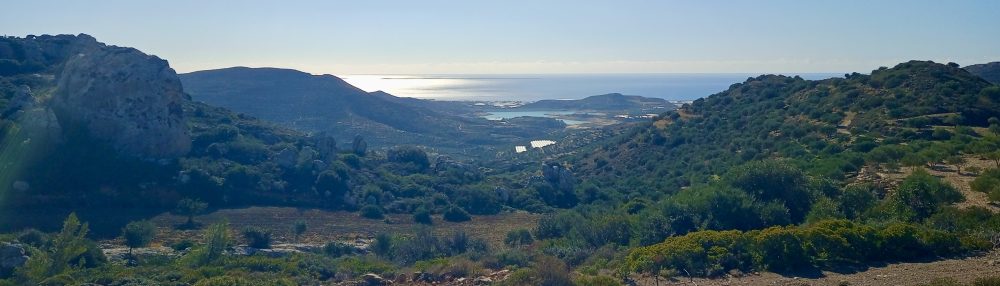
As the fires drew ever closer to our old home on Rhodes, here in Lasithi, Crete we became ever more glued to the Greek TV news. The announcement was made by the authorities that people in Kiotari had to evacuate as a safety precaution. Ron and Janet took what they could, and reluctantly fled down the track in their car, not knowing what they’d find when they returned. The TV pictures and video were bloodcurdling, and we could only imagine how we’d have felt if we’d still been living there ourselves. Back in August 2008 there had been a big fire in the South of the island and, at that time, two thirds of the sky above our house in Kiotari had turned the colour of a strong cup of tea. Ash and burnt pine needles rained down on us for several days and the Canadairs flew over so close to the ground that we could see the pilots through the windows. Drops of water sprinkled our faces as we gazed up at them.
This time though, Ron and Janet, not really having much of a clue as to what to do or where to go, chose to drive over to the other side of the island, where they assumed, rightly, that they’d be safe. They knew Kamiros Skala well, having often dined at one of the few waterside tavernas there, and that was where they spent the night, trying to bed down in the car, ever wondering what was happening back in their beautiful little valley in Kiotari. Next day they drove back, cautiously approaching their home in the hope that they’d be able to go back up the valley and inspect the site. The lane that leads most directly from the main road up the one kilometre or so distance to the three houses was impassable. The electricity posts had been burnt to the ground and the power cables were laying on the parched earth, making it far too dangerous to try and drive over them. Using the other, less direct lane, however, Ron and Janet made it to their house.
The scene that greeted them was like something out of a Francis Ford Coppola movie. Our old home, which was situated just fifty metres below theirs on the hillside, was still smouldering, flames still flickering on the ground in the garden around the building. It was completely devastated, nothing salvageable was left. The house immediately above theirs was also burnt out, as was all of the vegetation around all three houses. But, for some inexplicable reason, Ron and Janet’s house was still largely intact. The fires had swept right around the house, consuming virtually all of the vegetation in their garden, and yet, apart from a few singe marks and buckled panels on one wall, the house looked still habitable. Maybe there was some hope that their Greek idyll wasn’t to come to an end after all.
The house that we had lived in, where our landlords kept, among other things, two, and occasionally three boats (a jetRIB, a twin outboarded rigid-hulled inflatable and a speedboat) was indeed all gone up in smoke. Our landlords had a lot of personal belongings in that house since they used it many times each year for their summer holidays. In fact John (our landlord’s name is also John) even kept a 4×4 vehicle on the drive for much of the time but, when all is said and done, they would recover. They still had their permanent home in South Wales UK. Ron and Janet however, had burnt their bridges, this was their home for the duration, or such had been their plan. When they gingerly got out of the car to an overwhelming smell of burning and as a view nothing but charred countryside, they were in anguish over what was left of their garden, but heaved great sighs of relief and incredulity to see the house still standing proud. The roof was intact, the shutters still in place, the walls incredibly still white. Had Yvonne and I still been living in the house that had been our home for 14 years over there, we’d in all probability gone with Ron and Janet when evacuating. We would have returned to see everything apart from what we had with us in the car destroyed. Everything we owned would have been history.
They reached their terrace and subsequently their front door, still closed and looking unbelievably pristine. Inserting their key in the lock, they opened the door and went inside, and sure enough the inside looked as if nothing had happened. Their lovely home was still ‘in one piece’ as if by some weird miracle. The houses both sides of them, above and below, were smouldering, whilst theirs stood proud and intact. OK, so the outside environment was like something out of an apocalyptic movie, but at least their furniture, their appliances, their personal effects, everything was still usable, habitable. The only problem was, as they found out almost without at first having thought about it, there was no electricity and no water came out of the taps. There was also, of course, no internet. It took Ron a few hours to get his mind together, whilst Janet thought on her feet. Let’s get one thing clear here, although Ron was the wrong side of 75 years old, he was still, up until the previous day, a fit, strapping and largely healthy man who could walk for miles. When I spoke only a day later to their son Dale, who lives in Cheshire UK, he told me that the only concession Ron had made up until then to the fact that he was ‘getting on a bit’ was that he’d become somewhat forgetful of late, that was all.
Now, I need to explain something here about the water supply to those three houses. Without going into too much detail, the rising water main was located a couple of hundred metres down the valley below the altitude of the houses. This had meant that, when they were built, a purpose-designed system had to be installed that involved a couple of holding tanks, a couple of electrical relay switches, a powerful electric pump, float-switches in the tanks and several hundred metres of both pipework and cabling. This enabled the water from the ‘spitaki’ (as we used to call the little concrete-block hut that had been constructed around the lower holding tank, pump and rising water main) to be pumped up the valley to a massive holding tank some metres above the topmost of the three houses. That circular tank was as big as your front room and made of that heavy-duty black PVC/plastic that I believe is the same material that they make all the irrigation pipes out of too. Its sides were a quarter of an inch thick, extremely sun-resistant and durable. The water supply to all three houses came from that tank.
When Ron and Janet returned to their home, they were at first unaware of the fact that the holding tank at the top of the hill was no more. Where it had stood, submerged in the ground up to its flat-top in a specially dug pit, there was now a partially collapsed hole full of melted black plastic. This fact was only discovered by Dale (a qualified plumber) when he flew over on the first available plane to see what could be done for his mum and dad. In fact he was showing me a live video feed as he trekked up the hill to inspect the tank, following my instructions as to how to locate it.
The upshot of all of this was that, for the house to once again have a water supply was going to a be pretty major undertaking. At first they had no idea what their neighbour above might be planning to do, but they already knew that our landlords had their house on the market and so were more than likely to be applying for an insurance payout and walking away. At the very least they were looking at weeks and possibly months before they could actually live in the house again. The water company had strenuously resisted taking responsibility for the water supply beyond the ‘spitaki,’ even though it would send its representative up to the houses to read their meters, and thus it represented a massive problem for Ron and Janet. No doubt the electricity company would work as quickly as they could to restore power (but that too would involve sinking half a dozen new poles into the ground all the way up the valley), and there would be no expense involved in that, but the water problem was a serious one.
In short, in the space of 24 hours, Ron and Janet’s retirement idyll, their dream life on a Greek island, which had lasted for over a decade, was wrecked. Their son Dale was there in double-quick time to see what could be done to help his mum and dad, but to begin with they had no choice but to find a rented apartment and move out for a while, to give them thinking time. Ron was bewildered by it all, as it seemed this massive shock took its toll on his ability to cope mentally.
As if the foregoing wasn’t bad enough, there was more to come in the sequence of events that was to totally change Janet’s life forever, all in the space of a couple of days. And all as a result of an ‘alleged’ attempt to clear some ground for a wind farm. I’ll write a third ‘chapter’ next.
•
Click HERE to go to my Amazon Author Page. There you can browse all of my written works.
 Accretions
Another wonderful piece of writing John. Thank you. Roger
Sent from Yahoo Mail on Android
Thx again Roger, although I’d rather in some ways not have had needed to write this story. 😥
John Yes, I totally understand but I can tell the writing of it is cathartic. All good wishes to you. By the way, do you ever look at the Born and Bred in Bath Facebook page? Rog
Sent from Yahoo Mail on Android
Not seen that FB group, only “Bathonians past & present memories.” I’ll check it out, thx Rog.
John The Bath Born and Bred Facebook page recently had a photo of the Berni Inn which had the cellar bar. If I am not mistaken, I think this is where you first met your wife? I have been thinking more about your “Consequences” trilogy – I think there will be 3? I really think it is such a good piece of work that it deserves a wider audience. Have you thought about publishing it more widely, or even approaching the Rhodes authorities to see if they would like a copy to keep for their history purposes? I realise of course that all of this would require the permission of the family. I hope all is well with the 2 of you. My wife, Kath, had a hip replacement exactly a week ago, so I am wearing my nurses uniform at the moment. Unfortunately I couldn’t find the black stockings and suspenders…. Dreading the onset of winter. Rog