

The house next-door to ours is owned by a very nice English couple, and when they’re in residence we get along really well. Sadly, they don’t seem to get much time to spend over here at the moment, but that resulted this past week in their son and his wife, along with their two children staying there for a few days. The kids were about 5 and 9 years old, the youngest being a boy and the older of the two a girl. Two more inquisitive kids you’d be hard-put to meet. Some kids of that age are so rebellious and naughty that I could cheerfully have them caged, and in a soundproof room at that. These two, though, were outgoing, respectful and very inquisitive. The lad was constantly asking questions, wanting to know stuff, and he simply loved lorries and trucks. He wasn’t in any way cheeky, recalcitrant or aggressive, but he had an inexhaustible thirst for knowledge. In short, we got on with the whole family like a house on fire.
While chatting with Toby, the dad, he told me that when he mentioned to a friend that he was taking the family off to his parents’ house on a hillside in Crete, the first question was, “have they got a pool?” This led me to thinking about this whole ‘villas and pools’ thing, and that’s why I decided to throw caution to the wind and express my views on the subject in this post.
Where to start, that’s my dilemma. There are so many factors that you need to consider when forming an opinion about swimming pools that you need to make a list and work your way through it. Having lived in rural Greece for 19 years now, I can confidently say that (with very few exceptions) if you see a new-build villa around the coast of an island and it has a pool then it’s either owned by foreigners, or by Greeks who built it in order to either sell it to foreigners or to let to them during the holiday season. Greeks who have holiday homes don’t bother with pools. They make do with an outdoor shower somewhere in the garden. Why is this?
People who come here for holidays have no idea whatsoever of what constructing a pool and then maintaining it will cost. Firstly, the government here decides (rightly in most cases) that anyone who can afford to have a pool can well afford to pay for its licence. Firstly, at the outset a building licence for a pool costs several thousand Euros, and that’s just the permit to build the thing. In fact, a ‘tax on luxurious living‘ is levied on the owners or possessors of swimming pools – yes, that’s what the government calls it. Using a complicated system of calculation too, the cost of an annual licence for owning a pool is, on average, a couple of thousand Euros. On top of that you have the maintenance costs. Most people we’ve known over the years have paid for a private company to come in and maintain their pool on a regular basis. This again will add a few hundred a year to your budget, unless you want to do it yourself, in which case you’ll have to go and buy the chemicals required to keep the water from becoming discoloured, not to mention full of bacteria that can harm the health of anyone getting into the thing. Keeping the tiles from becoming caked in green deposits and other nasties isn’t easy either. You’ll also need a selection of tools too.
Most of the pools that pool bars and hotels use for tourists are emptied at the end of the season, which in itself is a minor disaster for the surrounding environment. When we lived near Pefkos, on Rhodes, any time that we went there during November (after all the tourists had gone and the place was becoming a near ghost town for the winter months) the roads would be awash for days with pool water being pumped out using bit fat pipes, which would syphon the water out and simply gush it on to the road, from where it would take the easiest downhill route to the nearest patch of soil. Could they not put that water to some practical use? Nope, owing to the amount of chemicals in it, of course.
Now, imagine all those chemicals simply being absorbed into the surrounding olive groves, vineyards and vegetable patches, eh? If you were to Google ‘what chemicals do I need to put in my pool?’ you would see something like this in the search results…

Not a particularly environmentally friendly image is it? And just one of those bottles or tubs usually sets you back around €100 too. One website alone shows the following as being essential to keep your pool ‘healthy‘ (some strange new use of that word that I wasn’t previously aware of) –
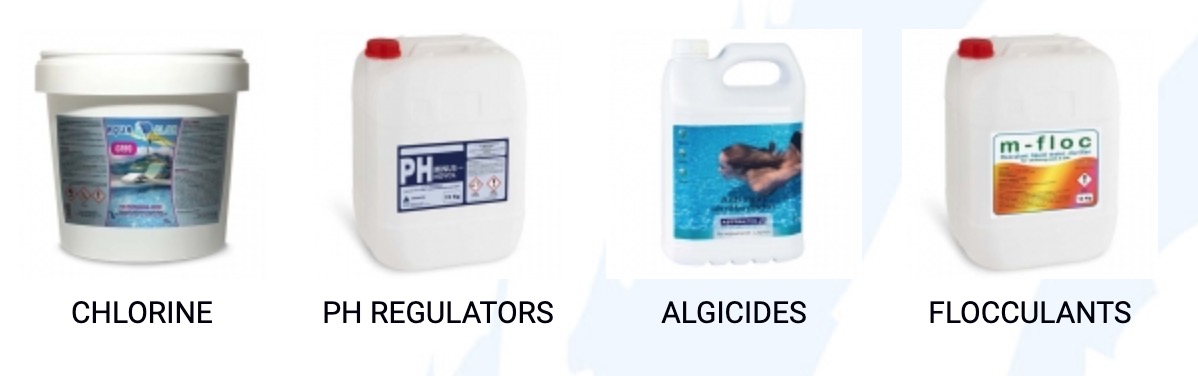
Lovely, eh? In fact click this link to see what one company recommends you consider putting into your lovely clear blue glistening pool. If you’ve gone and taken a look, remember, you’ll be swimming in that lot, plus it’ll all be absorbed into the local grapes and olives when the pool bars and hotels empty their pools come Autumn.
Now, by about this point you’re probably thinking that I’m a right old killjoy, I’m sure. OK, maybe I am, but anyone who truly cares about the natural environment must surely be alarmed by all of this, plus the fact that it never seems to get a mention in the media when they talk about preserving our planet. Can you imagine how many swimming pools have been constructed in tourist areas planet-wide this past few decades? I don’t want to depress you, but the facts do a pretty good job of that anyway.
About a decade ago, maybe slightly more now, Greece became virtually bankrupt, as anyone who has a relationship with or interest in the country will know only too well. One of the reasons for this was mass tax-dodging on a gargantuan scale. One of the ways that affluent people tried to avoid paying their pool licences was to declare on the paperwork that their pool wasn’t in fact for swimming in, but was actually a ‘water cistern’ for domestic consumption. In an earlier paragraph I stated that most Greeks don’t have pools, which holds true for the islands and rural areas. The only exception is the affluent suburbs of the cities, primarily Athens and Thessaloniki. In these areas the houses are a long way from the coast and thus a pool, much as it is in downtown Los Angeles I suppose, is a status symbol.
Most people are familiar with those pool covers that can be rolled up on a large drum at one end while the pool is in use, then extended to cover the entire pool when not so. I’m not kidding when I tell you that some of the richer pool owners in the Athens suburbs actually had their pool covers printed in a paving slab motiff, so that from above, when the pool cover was extended, it looked like a large patio area. It’s true I tell you. In fact back when the TV news was going on about the financial woes of the nation circa 2011-13, the news was that the government had started employing drones to fly over the affluent suburbs to spot pools that weren’t registered as such with the tax authorities. Heavy fines were imposed on any house owners who had pools that hadn’t been declared as such. Not a few celebrities got a mention during that time as having been caught out too.
One final thing on my list of things to consider when thinking about swimming pools is the water shortage. Most of the Greek Islands are currently facing massive and expensive decisions about how to procure enough water for domestic and agricultural use. Owing to the rapid increase of tourism this past four decades or so, water consumption has multiplied many times over, a problem exacerbated by the demand for swimming pools, of course, not to mention all those sweaty, sand-covered bodies coming back to their accommodation at the end of a long day’s lazing around, and then wanting to take a shower. Imagine the strain on the water infrastructure of a small island, when the population of that island increases a hundredfold during the months from May to October. I’ve mentioned before that, by the time we left Rhodes in September 2019, large swathes of the city (Rhodes Town) were having to go without water several times a week sometimes for up to 12 hours at a time, while the tourists splashed about in their water parks and pools with gay abandon. My good friends at the Top Three Bar would tell me that, after having been at work from the crack of dawn until way after midnight, they’d go home to their house in Analipsi several days in the week only to find that there was no water in their taps and they couldn’t even take a shower to remove the sweat from a day’s toil in temperatures in the mid-thirties.
What the solution to this is I don’t pretend to know. One thing I do know, however, is this: Looking after our planet begins with each individual taking their own responsibility for their ‘carbon footprint,’ their individual effect on the natural environment around them. That’s why, whenever anyone asks me, “do you have a pool?” My reply is, as I point my finger towards the glistening Mediterranean sea that’s always within sight, “Yup, there it is.”
The photo at the top, BTW, is taken from the Robinson Taverna, looking towards the Kalliotzina, at Koutsouras, just along the coast from here.
•
Click HERE to go to my Amazon Author Page. There you can browse and purchase all of my written works.
 Accretions
Thank you John, an illuminating read. I have often said that if I win the lottery then I would have a villa built with a pool. Now that idea doesn’t appeal at all.
I’ll just settle for the villa and use the sea as my pool, which I do now. x
How right you are!
100% agree with you John. Can I ask another question which has always puzzled me. When does a “house” become a “villa”? I go to Greece twice a year–and people are constanty asking me if I “have a villa!”–I dont, I believe in small scale tourism. Any ideas as to what a “villa” actually is?
That’s a very good question Dilys. The only answer I can come up with would be that in general, the word ‘villa’ refers to the more upmarket kind of building, more likely to have extensive grounds and a [dreaded] pool, for example. I’d describe our little ‘shangri-la’ here in our hillside village as not much more than a ‘chalet’ really, to put it in context, but it’s everything the two of us could ever need or ask for!