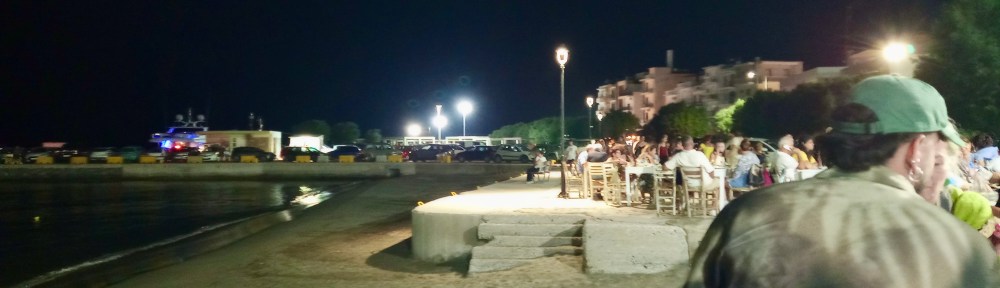

Above: Last Saturday evening, at around 10.00pm. The sea front at L’Angolo restaurant was buzzing. These heat-waves may be a bit difficult to deal with, but late in the evening, when the temperature’s hovering at around 30ºC, the best place to be is beside the sea. So that’s where we were, to enjoy our usual epic green salad with a large Pizza, not bad.
I’m a bit depressed though, to be honest. You know me, I’m sure. As a rule I like to keep positive, but occasionally I need to let off steam about something, and I’m feeling like doing so again now.
Let me explain. A couple of years ago we were on friendly terms with the lifeguards on the town beach, and they were a young couple, Mihalis and Spiridoula. They’re probably in Sydney now, because Mihalis told us that they couldn’t really make a living here in Greece, and that they’d worked out in Auz a few years before, and had come home because they wanted to be in their home country. However, the cost of accommodation here was becoming so out of proportion with their earnings, that they felt that the only way to get a half-decent living standard was to go back down under, so they said that they’d see that season out and then return to Australia.
Mihalis was the thinking type, and we had many a chat about world conditions and the state of the environment. Yeah, I know, nice light subjects for a hot day on a Greek beach, eh? I remember remarking that at least now there were recycling bins in evidence in Greece, a country that’s been very late coming to the ‘recycling & caring for the environment in general’ party, to put it charitably. When we’d first arrived in Greece on Rhodes back in 2005, there were no recycling facilities on that island at all, and the irony of it was that during the very summer of our arrival a big hotel in Rhodes Town was hosting an international conference on the importance of recycling. You couldn’t make it up, could you?
Nowadays, though, there are colour-coded dumpsters on most streets and – apart from a few wanton idiots who still chuck their general rubbish into whichever bin’s the nearest to their car window – people do seem to place their cardboard, glass, plastic and cans into the correct bin, which here on Crete is the blue one. I told Mihalis that I thought that this was an encouraging development, something to be positive about. His reply? “Sorry to disappoint you John, but they collect the contents of all bins, blue or green, makes no difference, in the same trash truck. Think about it, have you ever seen a recycling truck, painted in different livery, maybe with a recycling logo on the side, in Ierapetra? I happen to know that there are no recycling facilities here, it all goes into landfill, all of it.”
No doubt observing my reaction by my facial expression, he continued, “Look, I’m sorry to break it to you, but that’s the reason why most of the rubbish collections are done under cover of darkness. Whatever efforts you make to separate your recycling from household rubbish, it makes no difference. Ιt’s a bloody disgrace, but there it is.”
From that day to this, still fired with a basic need to live in hope, we continue to chuck everything that’s recyclable into the blue bins, and the normal rubbish in the green ones. I don’t want to blow our own trumpet here, but we actually have very little ‘normal rubbish’ to throw away anyway, because my wife always cooks with fresh vegetables, never packaged, and we steer well clear of packaged, processed foods as much as we can. Knowing, as I do, that there are European Union treaties and standards that have to be met by the member states, I’ve gone on believing that Mihalis may just have been wrong. Perhaps his opinion was coloured by a general disappointment in his home country, but either way, we’ve gone on trying to do the right thing. Yvonne and I find it impossible not to do whatever we can to help the environment, as should everyone with a brain IMHO.
So, to the reason why I’ve chosen to talk about this subject this time around. I’ve talked many times before about how, since I’m a bad sleeper, I often take a walk around the village during the night hours. All the local cats and dogs, probably even the local bat population, know me all too well by now, and they watch passively as I trudge by. Now and then I’ll pass a neighbour who’s also not sleeping, and they’ll be sitting quietly outside their front door, trying to keep slightly cooler when the temperature never drops below about 27-28ºC all night. We nod a quiet whispered greeting and I continue on my way.
Well, a few nights ago I took my walk at the crack of dawn. Well, it was actually around 4.30am, still before the blackness in the eastern sky had begun to develop its pre-dawn glow. As I walked back along the main road through the village, a loud noise reached my ears from a little way behind me. It was accompanied by nightmarish flashing lights that put me in mind of some hellish scene from a sci-fi movie or something, maybe the war of the worlds had actually begun. I soon realized that the sound was of machinery, including a diesel engined truck, and the clanking of dumpsters being heaved up by the rubbish truck’s lifting mechanism, which tips the dumpsters upside down and empties their contents into the truck’s gaping, hungry aperture at the rear end. I knew that a hundred metres in front of me were the two bins that serve our small lane, so I ducked behind a tree in the murkiness to see what happened when the truck reached our bins.
There are two bins beside the road at the bottom of our small, steep lane. One’s blue, placed there by the new village mayor Manoli after I’d suggested (when he’d asked us for suggestions) that there ought to be one, since our village, when he got elected, didn’t even have one blue (recycling) bin to its name, whereas Meseleri, five kilometres up the mountain, had about six. So now we do have one blue one and one green one (for regular waste) at several spots within the village, and, I’ve got to say, most villagers do put the right stuff in the right bin. The blue one’s often well full of cardboard packaging when someone’s had a new appliance delivered, for example. Good on them.
So, there I was, with a full and unimpeded view of our bins, watching from a dark recess behind a tree as the trash truck pulled up beside them. This was, of course, the regular dustbin-lorry (as we’d call them in the UK) and not one especially allocated to collect recycling, oh no. There are two men who stand on platforms either side at the back, and they cling on to metal grab-handles whilst the truck’s in motion. As the truck comes to a stop, the men leap off, grab the bins, wheel them to the truck, hook them up, then operate a control panel and the mechanism lifts the bins, then tips all the contents into the truck, where the hydraulic crushing mechanism takes over and compresses the waste before forcing it further back inside the truck’s ‘container.’
The men did exactly the same with both bins. In fact, when they emptied the recycling one, I heard the glass in it being smashed and shattered by the crushing mechanism too. To say I was crestfallen would be a huge understatement. Yes, I’d been warned a couple of years ago, but Greece is a member of the European Union, and as such has signed up to a whole raft of environmental measures. In fact, I’ve done some research and, at the risk of depressing you further, here are the facts as they stand, and it doesn’t make for pleasant reading:
There’s a European rule governing whether member countries need to recycle waste, and here are the facts. The main rule is part of the EU Waste Framework Directive (Directive 2008/98/EC, as amended by Directive 2018/851). This directive requires all EU member states to:
Take measures to promote recycling and reuse of waste and meet binding recycling targets:
By 2025: at least 55% of municipal waste must be recycled.
By 2030: at least 60%.
By 2035: at least 65%.
It also obliges countries to implement the following waste hierarchy: Prevention, reuse, recycling, recovery (e.g., energy recovery), disposal (landfill as a last resort).
Member states must report their recycling rates to the European Commission, which can take action (including infringement procedures) if targets aren’t met.
So, how is Greece doing on meeting these targets? The EU Waste Framework Directive (Directive 2008/98/EC, amended by Directive (EU) 2018/851) sets binding rules for recycling across member states, including:
Municipal waste recycling targets, to repeat the figures: 55 % by 2025, 60 % by 2030, 65 % by 2035. A landfill‑use limit: no more than 10 % of municipal waste may be landfilled by 2035
There is a requirement that member states measure and report recycling rates, with the Commission empowered to take enforcement or infringement actions if targets or reporting obligations are missed.
The current performance of Greece (as of latest data)?
In 2021, Greece recycled just 17 % of its municipal waste, far below the EU average of 49–50 %. Landfilling is still dominant, at around 77–80 % of waste. Waste generation per person is about 509–524 kg/year, slightly above EU average of 502–527 kg.
Is there a Risk involved when missing the EU targets? Oh yes… According to early‑warning assessments by the European Commission, Greece is at risk of failing to meet the 2025 recycling target and future landfill reduction objectives. Interestingly, In 2024, the Commission initiated an infringement procedure, issuing a letter of formal notice to Greece for failure to properly transpose the Directive and not reporting required data for 2020–2022. Plus, In December 2024, a reasoned opinion was sent concerning persistent non‑compliance with both the Waste Framework Directive and the Landfill Directive, focusing on deficiencies in waste facilities and untreated landfills.
OK, so Greece has implemented landfill taxes, increasing annually until 2027, with revenues redirected to fund recycling infrastructure and pay‑as‑you‑throw schemes. The Recovery and Resilience Plan (2021–2027) allocates €853 million to support recycling, separate collection, and waste treatment infrastructure. In early 2025, government reforms include redirecting 85 % of landfill tax revenue directly to municipalities, plus €70 million in bonuses to incentivise better performance*. Metrics reported for 2022 show recycling at just 17.3 %. Yes, seriously.
And, the consequences & penalties for non‑compliance?
Greece faces legal enforcement steps: formal notices and reasoned opinions, with risk of escalation to the Court of Justice of the EU if improvements aren’t made. Past examples of EU‑imposed fines: in 2000 Greece paid daily fines (over €17,000 per day) over failure to shut down an illegally operating toxic waste facility on – wait for it – Crete.
(*Which begs the question, if local councils are actually receiving this cash, what the blazes are they doing with it?)
There you go, then. One can only hope that things will get better, because it has to be wholly unacceptable for local councils to be duping the conscientious among their populace with the placing of recycling bins in the community, whilst not actually recycling anything, right?
•
Moving swiftly on, to lighter matters, here are a few photos…

Above: Well, I say ‘lighter matters,’ but look at the temperature as we drove home with the shopping the other day)
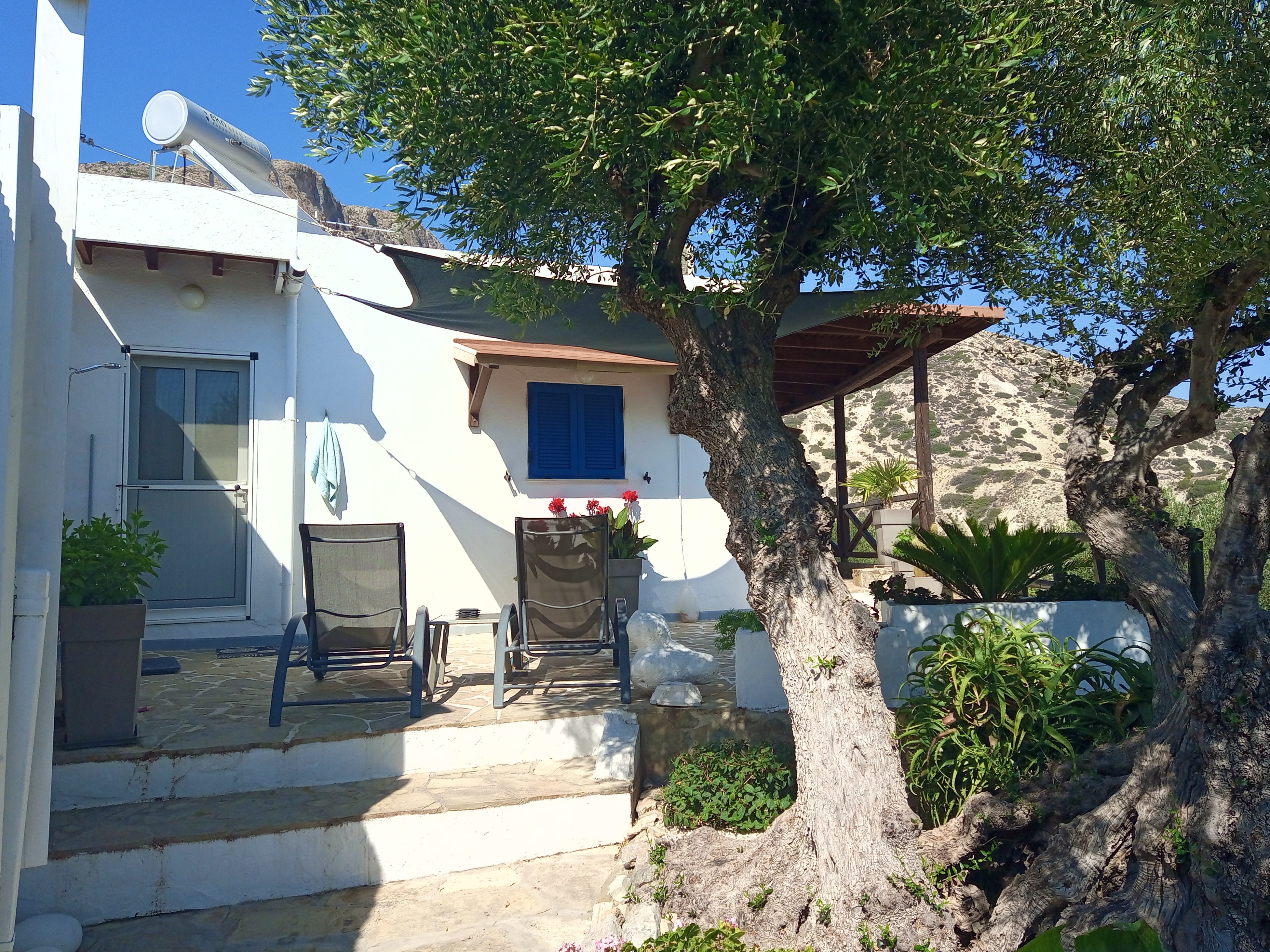
Above: Our ‘sun terrace’ yesterday. We rarely close the shutters on that bedroom window, but in these conditions it’s a must.

Above: The variety of different hibiscus flowers is amazing. We probably have about 6 different types in pots around the place and they’re all slightly different. This one’s truly ‘blousy’ when it’s in full bloom though, don’t you think?

Above: And, of course, the canas are a marvel to behold. Finally, the one below is of a dead wasp as the local ant population had just begun to arrive to do their ‘rubbish collection.’ Now, if you want to see a good example of natural recycling, look no further than the lowly ant.

•
Click HERE to go to my Amazon Author Page, where you can browse and purchase all of my seventeen written works.
 Accretions
We suspect they do the same thing here where we live, combining both the recyclables and regular trash. It’s sad. Our town used to have a recycling truck, which picked up our recyclables bins and dumped th
Bob, you didn’t finish your comments before posting, so can you do it in another comment pls? I’d like to read all of what you wanted to say.